The most common cause of unexplained syncope during childhood is neurocardiogenic syncope.Reference Johnsrude1–Reference McLeod3 Up to 15% of children and adolescents experience at least one episode of unexplained syncope.Reference Brignole, Alboni and Benditt4, Reference Lewis and Dhala5 Neurocardiogenic syncope is considered as a benign condition. However, sudden loss of conscience and muscle tone causes anxiety and stress among the patient and the family members due to the similarity to sudden death. Neurocardiogenic syncope is usually diagnosed by typical history and absence of other proven causes of syncope. Head-up tilt testing has been found useful to verify the diagnosis of neurocardiogenic syncope.
The pathophysiology of neurocardiogenic syncope is still unclear. The most widely accepted mechanism of its aetiology is vigorous contraction of the heart due to relative hypovolemia leading to stimulation of C-fibres and sympathetic withdrawal. Autonomic nervous system dysregulation is thought to be responsible in the pathophysiology. Different methods assessing the autonomic nervous system behaviour have been used to study the neurocardiogenic syncope. Analysis of heart rate variability is a useful non-invasive method that may be used to investigate the activity of autonomic nervous system. Recently several trials investigated heart rate variability in syncopal patients during head-up tilt test and/or 24-hour period, but conflicting results have been published.Reference Alehan, Ayabakan and Özer6–Reference Khalil, Hessling, Bauch, Maier, Dickhaus and Ulmer11
The aim of this study is to evaluate the autonomic nervous system activity in children with syncope and in healthy controls both during head-up tilt test and throughout the day and compare the functions of autonomic nervous system between these two groups.
Material and methods
Study population
A total of 24 consecutive patients between 6 and 18 years of age, who experienced at least one typical attack of neurocardiogenic syncope and referred to Marmara University Paediatric Cardiology department between October, 2005 and January, 2008 were included in the study group, group I. In total 10 healthy age and sex matched children were included to the study as the control group, group II. For all the patients and the control group written informed consents were obtained from the parents. Marmara University Ethical Committee approved the study. All the children were evaluated at Marmara University Paediatric Cardiology Department by using 24-hour Holter monitorisation and head-up tilt test in addition to routine cardiac and neurological examination, electrocardiography, transthoracic echocardiography, and blood chemistry. The children who had a cardiac or neurological disease, an electrolyte imbalance or anaemia that could explain the aetiology of syncope, a history of drug usage that affects the autonomic nervous system, and a family history of unexplained sudden death or arrhythmia were excluded from the study.
Evaluations
The work-up of the patients and controls included a detailed history of the syncopal episodes, physical examination, auscultation, blood pressure measurement in supine and upright positions, heart rate, complete neurological examination, blood chemistry, complete blood count, serum glucose, sodium, and potassium levels, transthoracic echocardiography, 12 lead standard electrocardiography, head-up tilt test and 24-hour Holter monitoring.
Head-up tilt test protocol
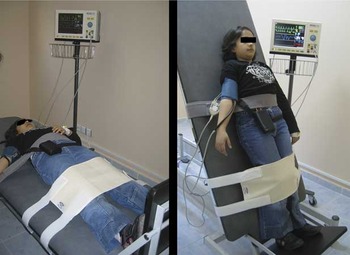
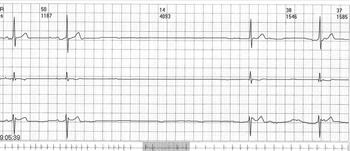
The tilt testing was carried out in a quiet room with low lightning after 2 hours of fasting and always between 9 and 12 ante meridiem. An intravenous catheter was placed 30 minutes before starting the test, as a precaution for possible emergency interventions. No intravenous fluid infusions or pharmacologic provocation was used during the test. Children were monitorised by using a standard three lead cardiac monitor and a sphygmomanometer of appropriate size on the right arm. Heart rate was monitored continuously and blood pressure was recorded every 3 minutes non-invasively. In addition, Cardioscan Dellmar–Reynolds three lead Holter Electrocardiogram records were obtained during the test. Only non-invasive methods were used to evaluate the autonomic nervous system. Catecholamine levels did not obtain to prevent the stress of another injection, which could affect the autonomic nervous system activity. The children remained in supine position for 15 minutes. Then the table was tilted to an angle of 60 degrees mechanically (Fig 1). Children were returned to supine position after 45 minutes or if they lost consciousness or experienced symptoms of presyncope including dizziness, lightheadedness, fatigue, sweating, visual disturbances, that is, blurring, tunnel vision; associated with a blood pressure or heart rate drop of at least 30% of baseline levels. A positive response was defined as the development of syncope or presyncope associated with hypotension, bradycardia, or both. Vasodepressor response was defined as at least a 30% decrease in systolic blood pressure with syncope or presyncope, and cardioinhibitory response was defined as at least 30% decrease in heart rate with syncope or presyncope (Fig 2). The mixed pattern was characterised by both blood pressure and heart rate decreases with syncope or presyncope. A negative test was defined as the absence of hypotension, bradycardia, syncope, or presyncope.
Head-up tilt test protocol.

Sinus arrest of a patient with cardioinhibitory response to the head-up tilt test for 4 seconds during the tilt test.

Patients with neurocardiogenic syncope, group I, were grouped into two subgroups according to the outcome of the head-up tilt test; group IA: syncopal children with positive outcome of head-up tilt test, group IB: syncopal children with negative outcome of head-up tilt test.
Heart rate variability analysis
Data acquisition and analysis were performed by using Cardioscan Dellmar–Reynolds three lead Holter Electrocardiogram and Cardioscan software. QRS complexes were automatically identified and labelled by software and reviewed manually to limit any potential artefacts. Intervals between ectopic beats, between normal and ectopic beats, and intervals inaccurately measured because of the artefacts were excluded from analysis. The mean heart rate, minimum heart rate, and maximum heart rate were recorded. Heart rate variability was assessed in two ways: time-domain analysis and frequency-domain analysis. Standard deviation of all RR intervals, mean standard deviation of NN intervals in 5-minutes recordings, the standard deviation of mean NN intervals in 5-minutes recordings, root mean square of successive differences, and NN50 count divided by the total number of all NN intervals were measured in the time-domain analysis of heart rate variability. The first three of these indices reflect the sympathetic and parasympathetic activity, whereas the others indicate the vagal tone. Spectral measures were obtained by the fast Fourier transform method. The values of low frequency (0.04–0.15 Hertz) and high-frequency (0.15–0.4 Hertz) spectral powers were evaluated. Low frequency mainly gives a measure of sympathetic activity with some influence from the parasympathetic nervous system. High frequency solely reflects the parasympathetic activity. To cancel out the influence of parasympathetic activity on low-frequency spectral power, the ratio of low frequency/high frequency was calculated, where an increase in the low-frequency/high-frequency ratio reflects a predominance of sympathetic activity.
All the heart rate variability parameters were obtained by using the Holter recordings of 24-hour period, during the daytime between 8 ante meridiem and 10 post meridiem, during the night between 10 post meridiem and 8 ante meridiem, and in the morning between 6 and 12 ante meridiem. In addition, the same parameters were measured by using the recordings obtained during the head-up tilt test both during the entire tilt position and during the initial 5 minutes of the tilt position.
Statistical analysis
SPSS 11.0 programme were used for the statistical analysis. Data were expressed as mean plus or minus standard deviation. Patients with neurocardiogenic syncope, group I, were divided into two subgroups according to the head-up tilt test responses; group IA: positive response to the head-up tilt test and group IB: negative response to the head-up tilt test. Variance analysis revealed the homogen distribution of the data. Demographic features, blood chemistry, transthoracic echocardiography, and electrocardiography findings, holter-electrocardiogram parameters were compared between the groups by using one-way ANOVA testing. Differences were considered statistically significant at values of p lower than or equal to 0.05. χ2 test was performed to compare the percents.
Results
The study group included 24 children, 11 males and 13 females, between the ages of 6 and 18 years, mean plus or minus standard deviation is 12.50 plus or minus 3.29 years. The control group included 10 healthy children, 5 males and 5 females, between the ages of 8 and 18 years (mean plus or minus standard deviation is 12.48 plus or minus 3.27 years). There were no significant differences in terms of age, sex, and demographical features between the groups (Table 1).
Demographic features of the syncope and the control groups.

SD, standard deviation; NS, non-significant (p > 0.05)
Group I: patients with neurocardiogenic syncope, Group IA: patients with neurocardiogenic syncope with positive response to the head-up tilt test, Group IB: patients with neurocardiogenic syncope with negative response to the head-up tilt test, Group II: control group
The mean number of total syncopal episodes experienced within the study group was 3.50 plus or minus 2.59. The number of syncopal episodes during the last 6 months was 2.17 plus or minus 1.49. A total of five patients (20%) reported minor traumatic injury related to syncope. A total of eight patients (33%) reported a family history of syncope or presyncope.
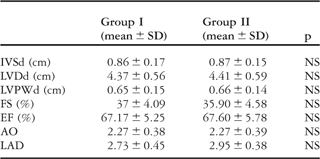
All the children included in the study had normal haemoglobin, blood glucose, and serum electrolyte levels, and all had normal standard 12-lead electrocardiogram. M-mode measurements obtained by transthoracic echocardiography were normal according to the body weight in both syncopal and healthy children. There were no significant differences in the M-mode measurements between the groups (Table 2). Transthoracic echocardiography revealed physiologic/minimal mitral valve regurgitation in 38% of children with neurocardiogenic syncope and 10% of healthy children, however there was no significant difference between the groups, p-value is greater than 0.05.
M-mode echocardiographic measurements of the study and control groups.
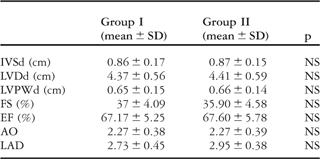
SD, standard deviation; IVSd, interventricular septum dimension; LVDd, left ventricle diastolic dimension; LVPWd, left ventricle posterior wall dimension; FS, fractional shortening; EF, ejection fraction; AO, aortic dimension; LAD, left atrium dimension; NS, non-significant (p > 0.05)
Group I: patients with neurocardiogenic syncope, Group II: control group
A total of 13 patients had positive head-up tilt test results within a mean period of 19.61 plus or minus 6.85 minutes from the beginning of the test. Out of them, five (38%) were cardioinhibitory responses, four (31%) were vasodepressor responses, and four (31%) were mixed responses. None of the 10 controls experienced syncope or presyncope during the head-up tilt test. The mean age was 12.71 plus or minus 3.08 years in the tilt positive group and 12.32 plus or minus 3.67 in the tilt negative group, p-value is greater than 0.05. The female to male ratio in the tilt positive group was 5–7, and it was 7–4 in the tilt negative group. There were no statistically significant differences in terms of age, sex, and demographical features between the groups with positive and negative outcomes of head-up tilt test (Table 1).
The number of syncopal episodes was 4.23 plus or minus 2.98 with a range between 1 and 10 in the tilt positive group and 2.64 plus or minus 1.80 with a range between 1 and 7 in the tilt negative group, p-value is greater than 0.05, and it was 2.77 plus or minus 1.64 with a range between 0 and 6 versus 1.45 plus or minus 0.93 with a range between 0 and 3 in the tilt positive and negative groups, respectively, during the last 6 months, p-value is 0.02. A total of 33% of the patients in the study group had a family history of syncope or presyncope. Family history of syncope or presyncope increased to 46% in the group with positive outcome of head-up tilt test.
Baseline heart rate variability
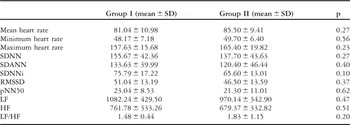
There was no significant difference between the study and the control groups in terms of the mean heart rate and standard deviation of all RR intervals, mean standard deviation of NN intervals in 5-minutes recordings, the standard deviation of mean NN intervals in 5-minutes recordings, root mean square of successive differences, and NN50 count divided by the total number of all NN intervals, low frequency, high frequency, low frequency/high frequency ratio parameters of heart rate variability during the 24-hour period (Table 3). In order to evaluate the diurnal rhythm of the autonomic nervous system, the heart rate variability measurements obtained during the morning hours, throughout the day and during the night were compared between the two groups. There was no significant difference in heart rate variability indices in the morning, daytime, and night between the syncope and control groups; p-value is greater than 0.05.
The 24-hour Holter electrocardiogram parameters of syncope and control groups.

SD, Standard deviation; SDNN, standard deviation of all RR intervals; SDNNi, mean standard deviation of NN intervals in 5-minutes recordings; SDANN, the standard deviation of mean NN intervals in 5-minutes recordings; RMSSD, root mean square of successive differences; pNN50, NN50 count divided by the total number of all NN intervals; LF, low frequency; HF, high frequency; LF/HF, low-frequency/high-frequency ratio
Group I: Patients with neurocardiogenic syncope, Group II: Control group
Heart rate variability during the head-up tilt test
We could not get the heart rate variability data during the head-up tilt test from one patient in the tilt positive group because of a technical problem, so we excluded him from the statistical analysis.
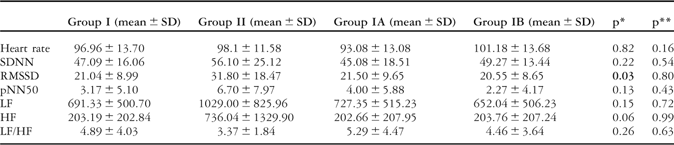
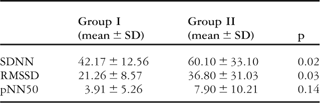
Time-domain parameters were reduced and low frequency/high frequency ratio was increased both in the syncope and tilt positive groups comparing to the tilt negative group. However, statistically significant difference was found only in root mean square of successive differences parameter between the groups (Table 4). On the other hand, during the first 5 minutes of the head-up tilt test, standard deviation of all RR intervals, and root mean square of successive differences were significantly lower in the syncope group compared with the control group. During the first 5 minutes of the head-up tilt test, standard deviation of all RR intervals was 42.17 plus or minus 12.56 milliseconds in the syncope group and 60.10 plus or minus 33.10 milliseconds in the control group; root mean square of successive differences was 21.26 plus or minus 8.87 milliseconds in the syncope group and 36.80 plus or minus 31.03 milliseconds in the control group (Table 5). The standard deviation of all RR intervals and root mean square of successive differences were found significantly lower in the syncope group than the control group, p-values, respectively; 0.02 and 0.03, which indicated sympathetic nervous system domination over the heart rate.
Heart rate variability indices of the groups during the head-up tilt test.
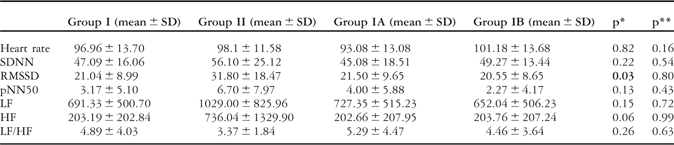
SD, Standard deviation; SDNN, standard deviation of all RR intervals; RMSSD, root mean square of successive differences; pNN50, NN50 count divided by the total number of all NN intervals; LF, low frequency; HF, high frequency; LF/HF, low-frequency/high-frequency ratio
Group I: Patients with neurocardiogenic syncope, Group II: Control group, Group IA: Patients with neurocardiogenic syncope with positive response to the head-up tilt test, Group IB: Patients with neurocardiogenic syncope with negative response to the head-up tilt test
*p: significance between group I and group II, **p: significance between group IA and group IB
Hear rate variability indices of the syncope and the control groups during the first 5 minutes of the head-up tilt test.
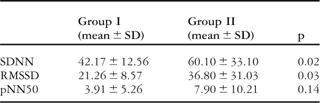
SD, Standard deviation; SDNN, standard deviation of all RR intervals; RMSSD, root mean square of successive differences; pNN50, NN50 count divided by the total number of all NN intervals
Group I: Patients with neurocardiogenic syncope, Group II: Control group
Discussion
Neurocardiogenic syncope, the most common form of syncope in children, can occur at any age; but the peak age groups are toddlers and older children between the ages of 9 and 14 years.Reference McLeod3 In our study, the mean age of children with neurocardiogenic syncope was 12.50 plus or minus 3.29 years, parallel to the literature.
In neurocardiogenic syncope, a familial tendency has been reported.Reference Márquez, Urias and Hermosillo12–Reference Lewis and O’Toole14 However, observations have not been in a large cohort. We documented a family history of syncope or presyncope in 33% of children with neurocardiogenic syncope. This ratio increased to 46% in children with neurocardiogenic syncope and a positive outcome of head-up tilt test. Both are greater than the frequency of syncope in community. This finding supported that pathophysiologic factors could be heritable. In laboratory studies, a significant genetic contribution to heart rate variability has been established by twin and family studies.Reference Kupper, Willemsen and van den Berg15 Kupper et alReference Kupper, Willemsen and van den Berg15 evaluated two time domain indices of heart rate variability in 772 healthy twins and singleton siblings by using 24-hour ambulatory electrocardiogram and found a strong confirmation that genes were important in the regulation of heart rate variability. In Framingham study, siblings and spouse pairs were evaluated to investigate the genetic and household effects to the heart rate variability; and documented both genetic and environmental factors were contributing to the autonomic nervous system activity.Reference Singh, Larson, O’Donnell, Tsuji, Evans and Levy16 Consequently we support that genetic, psychological, and environmental factors influence the autonomic nervous system altogether.
In earlier studies, it was documented that the frequency and duration of syncopal attacks were more in the children with positive head-up tilt test than the children with negative head-up tilt test.Reference Salim, Ware, Barnard, Alpert and DiSessa17, Reference Sheldon, Rose, Flanagan, Koshman and Killam18 However, other studies documented that the frequency of syncopal spells and duration of attacks did not influence the head-up tilt test outcome.Reference Qingyou, Junbao, Jianjun and Wanzhen19 In our study, we found a significant difference only in the frequency of syncopal attacks within the last 6 months. Autonomic nervous system maturates in favour of parasympathetic system while growing. Sympathetic activity withdrawals and parasympathetic domination takes over the sinus node. In this transition period, asynchronisation of the modifications can increase the frequency of the syncopal attacks. After the completion of the maturation, the frequency of syncopal attacks could reduce. Persistent dysregulation of the autonomic nervous system could be found in patients with recurrent syncopal attacks. Furthermore, some manoeuvres to prevent the syncopal attacks could be learned by patients with neurocardiogenic syncope; thus frequency of syncope attacks and positive outcomes of head-up tilt test could reduce in the course of time.
Neurocardiogenic syncope is a benign cause of syncope, which occurs when there is a disturbance in the autonomic control of the heart rate and blood pressure. In earlier studies, various investigators tried to assess the relation between heart rate variability indices and the head-up tilt test results to clarify the underlying mechanism of autonomic nervous system changes in neurocardiogenic syncope. The autonomic profile during the head-up tilt test was evaluated, but the results were conflicting. Some investigators documented increased sympathetic drive response to orthostatic stress,Reference Alehan, Ayabakan and Özer6, Reference Evrengul, Tavli, Evrengul, Tavli and Dursunoglu7, Reference Sehra, Hubbard, Straka, Fineberg, Engelstein and Zipes9, Reference Furlan, Piazza and Dell’Orto20, Reference Grimm, Wirths, Hoffmann, Menz and Maisch21 while others found inadequate enhancement of the sympathetic tone.Reference Kouakam, Lacroix and Zghal22 Some investigators found increased parasympathetic tone,Reference Suzuki, Hori, Nakamura, Nagata, Tomita and Aikawa23 and others found inadequate parasympathetic withdrawalReference Morillo, Klein, Jones and Yee8 during the head-up tilt test. Most of these studies included adult patients.
There are several studies in the paediatric population. In the majority of these studies increased sympathetic tone in response to the orthostatic stress established in patients with positive outcome of head-up tilt test.Reference Alehan, Ayabakan and Özer6, Reference Sehra, Hubbard, Straka, Fineberg, Engelstein and Zipes9, Reference Stewart, Erb and Sorbera24
Stewart et alReference Stewart, Erb and Sorbera24 investigated heart rate variability indices of 29 syncopal children during the head-up tilt test and found increased sympathetic tone both in the supine and the tilt positions in the patients with positive tilt test response. Sehra et alReference Sehra, Hubbard, Straka, Fineberg, Engelstein and Zipes9 and Alehan et alReference Alehan, Ayabakan and Özer6 both found increased sympathetic tone in response to the orthostatic stress in patients with positive outcome of head-up tilt test. Evrengül et alReference Evrengul, Tavli, Evrengul, Tavli and Dursunoglu7 evaluated heart rate variability indices of 27 children with neurocardiogenic syncope and found increased sympathetic tone in the first 5 minutes, early phase, of the head-up tilt test and increased parasympathetic tone in the last 5 minutes, late phase, of the test. The patients with positive outcome of head-up tilt test results demonstrated an exaggerated response and they suggest that this exaggerated response could be responsible for activating the pathological reflexes of neurocardiogenic syncope.
In our study, we evaluated heart rate variability indices of 24 children and 10 age and sex matched healthy controls during head-up tilt test and throughout the day. During the head-up tilt test, time-domain indices were reduced and low frequency/high frequency ratio was increased, supporting the symphatetic predominance in the syncope group compared with the control group; but significant difference was documented only in one parameter: root mean square of successive differences. On the other hand, during the first 5 minutes of the head-up tilt test, symphatetic overactivation was found in the syncope group, compared with the control group. Our results revealed no significant difference between the groups with positive or negative outcome of the head-up tilt test.
There are a few studies evaluating the asymptomatic periods of the children with neurocardiogenic syncope, and conflicting data are reviewed. Sehra et alReference Sehra, Hubbard, Straka, Fineberg, Engelstein and Zipes9 evaluated heart rate variability indices of 8 children with neurocardiogenic syncope and 10 healthy controls throughout the day, and found sympathetic predomination in syncopal children. Therefore, the small sample size and significant difference in only one parameter were reducing the value of this finding. Zygmunt et alReference Zygmunt and Stanczyk25 studied heart rate variability indices of 73 children with neurocardiogenic syncope and positive outcome of head-up tilt test; and the results were compared with the reference values calculated for Polish children. Their results revealed that, both time and frequency domain analysis of syncopal children were characterised by diminished values of indices, indicating that sympathovagal balance was shifted towards enhanced sympathetic modulation. But the normative values were obtained in a different laboratory and the control group did not have a head-up tilt test. These were reducing the value of this finding.
Evrengül et alReference Evrengul, Tavli, Evrengul, Tavli and Dursunoglu7 and Khalil et alReference Khalil, Hessling, Bauch, Maier, Dickhaus and Ulmer11 evaluated heart rate variability indices of syncopal and healthy children during the asymptomatic periods and found no significant difference between the groups throughout the day.
In our study, our results revealed no significant difference in both time domain and frequency domain indices of heart rate variability between syncopal and healthy children, during daytime, night, in the morning and throughout the day. This finding showed that the autonomic functions both in syncopal and healthy children during daytime are resembling each other; however response to orthostatic stress varies from children with neurocardiogenic syncope to healthy children.
Limitations of the study. Our sample size was small, since it was a preliminary study that was conducted in a limited time period and study groups were arranged to include sufficient number of subjects for statistical analysis. Patient-control group was not equal in number, because requirement of an intravenous catheter during the head-up tilt test and more than one visit to the hospital reduced the participation to the study especially in the control group. We could not evaluate the autonomic functions according to the type of head-up tilt test response because of the small sample size. In addition, the recordings of the blood pressure measurements were not beat to beat, which causes difficulty in assessment of the type of the head-up tilt test response, therefore comparing the cardioinhibitor and vasodepressor groups might be misleading. However, these parameters were not used for statistical analysis. In addition, it could be better if we could obtain the cathecolamine levels; however catecholamine levels were not obtained in the course of our study. We evaluated the global response of the autonomic nervous system to the orthostatic stress. This response is determined by both cathecolamine receptor numbers and functions as the cathecolamine levels. We evaluated the effect of the gravity as the orthostatic stress independent from the cathecolamine levels. Furthermore, longitudinal studies including greater groups and cathecolamine levels are needed to clarify the pathophisyology of neurocardiogenic syncope.
In conclusion, autonomic functions in children with neurocardiogenic syncope are similar to healthy children during the asymptomatic periods. However, sympathetic hyperactivation occurs during the early phase of orthostatic stress in children with neurocardiogenic syncope comparing to the healthy controls. Parasympathetic innervation is not sufficient in compensation of this sympathetic hyperactivation. Management strategy in neurocardiogenic syncope should be on the basis of these pathophysiologic mechanisms. Nevertheless, further studies are essential to clarify the pathophisyolgy of neurocardiogenic syncope and to evaluate the autonomic functions in syncopal children.