Introduction
Fetal alcohol spectrum disorders (FASD) encompass multiple diagnoses (Hoyme et al., Reference Hoyme, May, Kalberg, Kodituwakku, Gossage, Trujillo and Robinson2005), including fetal alcohol syndrome (FAS), alcohol-related neurodevelopmental disorder (ARND), and the recently adopted neurobehavioral disorder associated with prenatal alcohol exposure (ND-PAE) (American Psychiatric Association, 2013). In combination, FASDs affect 2–5% of young school children in the United States (May et al., Reference May, Gossage, Kalberg, Robinson, Buckley, Manning and Hoyme2009). A critical feature of these disorders is the neurobehavioral impairment that occurs across the spectrum (e.g., Mattson, Riley, Gramling, Delis, & Jones, Reference Mattson, Riley, Gramling, Delis and Jones1997). These impairments are lifelong (Mattson, Crocker, & Nguyen, Reference Mattson, Crocker and Nguyen2011; Streissguth, Barr, Kogan, & Bookstein, Reference Streissguth, Barr, Kogan and Bookstein1996), and include multiple cognitive deficits and increased incidence of disruptive disorders including attention-deficit/hyperactivity disorder (ADHD; Fryer, McGee, Matt, Riley, & Mattson, Reference Fryer, McGee, Matt, Riley and Mattson2007; Mattson et al., Reference Mattson, Crocker and Nguyen2011; Peadon & Elliott, Reference Peadon and Elliott2010).
The high rates of ADHD in children with FASD (Fryer et al., Reference Fryer, McGee, Matt, Riley and Mattson2007) and the overlap in behavioral presentation between FASD and idiopathic ADHD may hinder differential diagnosis between these two clinical groups. As a result, a growing body of research has focused on the comparison of the two groups and results indicate both similarities and differences in executive dysfunction (for a comprehensive review, see Mattson et al., Reference Mattson, Crocker and Nguyen2011). Of note, two recent attempts to develop a neurobehavioral profile of FASD demonstrated that measures of executive function (EF)—particularly, measures of planning, problem-solving, cognitive set-shifting, spatial working memory, verbal fluency—could distinguish alcohol-exposed children from typically developing children and children with ADHD using latent profile analyses (Mattson, Roesch, et al., Reference Mattson, Roesch, Fagerlund, Autti–Rämö, Jones and May2010; Mattson et al., Reference Mattson, Roesch, Glass, Deweese, Coles and Kable2013). Understanding the specificity of behavioral and cognitive deficits in FASD, via directed clinical comparisons, is key to improved clinical identification. With improved differential diagnosis, clinicians would be better able to develop and disseminate empirically supported interventions. Currently, studies suggest that alcohol-exposed children with ADHD do not respond to traditional pharmacologic treatment as children with ADHD without a history of prenatal alcohol exposure (Doig, McLennan, & Gibbard, Reference Doig, McLennan and Gibbard2008; Oesterheld et al., Reference Oesterheld, Kofoed, Tervo, Fogas, Wilson and Fiechtner1998; Snyder, Nanson, Snyder, & Block, Reference Snyder, Nanson, Snyder and Block1997), perhaps due to differences in the underlying neuroanatomical or biochemical bases of ADHD with and without FASD.
Traditionally, EF is assessed using standardized, objective, performance-based neuropsychological measures. However, executive dysfunction in children is often brought to clinical attention by parent report of commonly seen behaviors and parent-report questionnaires may be more ecologically valid than traditional neuropsychological measures. The Behavior Rating Inventory of Executive Function (BRIEF; Gioia, Isquith, Guy, & Kenworthy, Reference Gioia, Isquith, Guy and Kenworthy2000a) is a commonly used parent and teacher rating scale designed to assess behavioral problems associated with executive dysfunction in children and adolescents in real-world settings. The BRIEF can be used as part of multi-method assessment of dysfunction, ensuring a comprehensive and an integrated understanding of impairment. However, while the BRIEF has been used in studies of FASD (McGee, Fryer, Bjorkquist, Mattson, & Riley, Reference McGee, Fryer, Bjorkquist, Mattson and Riley2008; Rasmussen, McAuley, & Andrew, Reference Rasmussen, McAuley and Andrew2007), convergent validity of this measure with neuropsychological measures has not been tested in this population. Previous studies have investigated the relation between the BRIEF and neuropsychological measures of EF in other pediatric clinical populations—including ADHD, traumatic brain injury, epilepsy, and Tourette’s syndrome—with mixed findings. While some studies have found significant correlations between the BRIEF and neuropsychological measures of EF (Howarth et al., Reference Howarth, Ashford, Merchant, Ogg, Santana, Wu and Conklin2013; McCandless & O’Laughlin, Reference McCandless and O’Laughlin2007; Parrish et al., Reference Parrish, Geary, Jones, Seth, Hermann and Seidenberg2007; Toplak, Bucciarelli, Jain, & Tannock, Reference Toplak, Bucciarelli, Jain and Tannock2009), others have not (Anderson, Anderson, Northam, Jacobs, & Mikiewicz, Reference Anderson, Anderson, Northam, Jacobs and Mikiewicz2002; Bodnar, Prahme, Cutting, Denckla, & Mahone, Reference Bodnar, Prahme, Cutting, Denckla and Mahone2007; Mahone et al., Reference Mahone, Cirino, Cutting, Cerrone, Hagelthorn, Hiemenz and Denckla2002; Vriezen & Pigott, Reference Vriezen and Pigott2002), suggesting that cognitive and behavioral measures may tap into different constructs within the EF domain. Moreover, varied methodology used across analyses—including comparison of different scores (e.g., indexes vs. clinical scales), use of varied statistical tests and alpha corrections, inclusion of different clinical or non-clinical populations, and varied sample sizes—have contributed to mixed outcomes. Thus, it is not clear whether the BRIEF measures the same constructs and behaviors as objective performance-based assessments of EF. This study will assess whether the BRIEF can be used to accurately identify children with FASD. In addition, no study to date has focused on using behavioral ratings of EF to discriminate alcohol-exposed children from other clinical groups. To address this shortfall, the current study will include a comparison group of children with idiopathic ADHD.
The aims of this study were to: (1) characterize the EF deficits in children with FASD using a multi-method approach, (2) examine the relation between neuropsychological measures and parent-ratings of EF, and (3) determine if a unique score profile on the BRIEF can identify children with FASD with and without ADHD, compared to children with ADHD and controls. We hypothesized that children with prenatal alcohol exposure and ADHD, together, would display higher levels of executive dysfunction, as rated by caregivers on the BRIEF, compared to children with either prenatal alcohol exposure or ADHD, alone. Furthermore, we hypothesized that this elevation would not be detected on neuropsychological testing, which would be consistent with our previous study (Glass, Ware, et al., Reference Glass, Ware, Crocker, Deweese, Coles and Kable2013). Second, we predicted that the BRIEF would be correlated with performance-based measures of EF among the typically developing control group but not clinical groups. Finally, we hypothesized that, upon discriminant function analysis, the BRIEF would be able to discriminate groups with different profiles of clinical scale elevations.
METHOD
General Methods
Subjects were recruited as part of an ongoing research study through the Collaborative Initiative on Fetal Alcohol Spectrum Disorders (CIFASD). The CIFASD is a multisite, interdisciplinary project, one goal of which is to characterize the neurobehavioral phenotype for FASD. The clinical projects included in the CIFASD involve standardized neuropsychological and behavioral testing of children with FASD and comparison groups across multiple sites (for details about the methodology of the CIFASD clinical projects, see Mattson, Foroud et al., Reference Mattson, Foroud, Sowell, Jones, Coles and Fagerlund2010). Subjects were recruited and assessed at five different centers across the United States: (1) Center for Behavioral Teratology at San Diego State University, (2) Fetal Alcohol and Drug Exposure Clinic at Emory University, (3) 7 different communities throughout North Dakota, South Dakota, and Montana (Northern Plains), including 6 Indian reservations, (4) Center on Alcoholism, Substance Abuse and Addictions at University of New Mexico, and (5) Fetal Alcohol and Related Disorders Clinic at the University of California, Los Angeles. Recruitment was conducted as part of ongoing research initiatives or specifically for the CIFASD study through distribution of flyers, word of mouth, clinical recommendation, and in-school studies.
Subjects were administered a standardized neuropsychological test battery by a trained examiner blind to subject group. The CIFASD test battery measures a wide range of cognitive abilities, including general intellectual function as well as the domains of attention, memory, and EF. Full Scale IQ (FSIQ) scores were obtained using the Wechsler Intelligence Scale for Children-Fourth Edition (WISC-IV; Wechsler, Reference Wechsler2003). On the same day, primary caregivers completed interviews and questionnaires, including the clinician-assisted National Institute of Mental Health Computerized Diagnostic Interview Schedule for Children-IV (C-DISC-4.0; Shaffer, Fisher, Lucas, Dulcan, & Schwab-Stone, Reference Shaffer, Fisher, Lucas, Dulcan and Schwab-Stone2000) to determine ADHD diagnosis as well as other comorbid psychopathology based on the Diagnostic and Statistical Manual of Mental Disorders, Fourth Edition (DSM-IV; American Psychiatric Association, 2000). A positive ADHD diagnosis was indicated if a child exhibited at least 6 clinical symptoms within either the inattentive or hyperactive impulsive domains during the past six months. Five percent of our sample had a comorbid diagnosis of major depression/dysthymic disorder, 5% generalized anxiety disorder, 25% oppositional defiant disorder, and 7% conduct disorder; rates of comorbid psychopathology were highest in the AE+ and ADHD groups, followed by the AE− and CON groups, respectively. Similar data for the CIFASD sample were recently published (Ware et al., Reference Ware, O’Brien, Crocker, Deweese, Roesch and Coles2013). The majority of caregivers for alcohol-exposed subjects were adoptive parents, while caregivers of non-exposed subjects were predominantly biological parents. Before testing, informed consent and assent was obtained as approved by the Institutional Review Boards at San Diego State University and other CIFASD sites.
Subjects
The current study involved 373 children between the ages of 8 and 16 years (M=12.3, SD=2.6) and comprised four groups: (1) alcohol-exposed children with ADHD (AE+, n=79), (2) alcohol-exposed children without ADHD (AE−, n=36), (3) non-exposed children with idiopathic ADHD (ADHD, n=90), and (4) non-exposed typically developing control children without ADHD (CON, n=168).
Children in the alcohol-exposed groups had confirmed histories of heavy prenatal alcohol exposure, which was defined as at least 4 drinks per occasion at least once per week or at least 14 drinks per week during pregnancy. History of prenatal alcohol exposure was determined retrospectively through multi-source collateral report, including review of available medical history, birth, social service, or adoption agency records, and maternal report and questionnaires, when available. In many cases when the precise timing and amount of alcohol consumption were unavailable, mothers were reported to be “alcoholic,” alcohol abusing, or alcohol dependent during pregnancy. All children were evaluated using a standardized dysmorphological examination conducted by a member of the CIFASD Dysmorphology Core to determine FAS diagnosis based on physical, craniofacial, and growth anomalies; FAS was defined by the presence of two or more key facial features (short palpebral fissures, smooth philtrum, thin vermillion) and either microcephaly (head circumference ≤10th percentile) or growth deficiency (≤10th percentile for height or weight) (for more details see Jones et al., Reference Jones, Robinson, Bakhireva, Marintcheva, Storojev, Strahova and Chambers2006; Mattson, Foroud, et al., Reference Mattson, Foroud, Sowell, Jones, Coles and Fagerlund2010). While no published analyses exist, examination of the dysmorphology CIFASD database indicates that for subjects seen twice by the same examiner (n=152) or by two different examiners (n=277), inter-rater agreement for diagnosis (yes/no) was very high (κ=.93–.97).
Children in the comparison ADHD and CON groups had no prenatal alcohol exposure or minimal exposure (i.e., no more than one drink per week on average and never more than two drinks per occasion). Children were excluded from all groups if they met any of the following criteria: non-fluency in English, adoption from abroad after the age of 5 years or ≤2 years from the time of assessment, history of significant head injury with loss of consciousness greater than 30 min, evidence of any other known causes of mental deficiency, or history of significant physical, neurologic, or psychiatric disability that precluded involvement in the study, including history of a seizure disorder. Children were excluded from the AE− and CON groups if they met criteria for ADHD, as defined above. Children exhibiting subclinical ADHD symptoms (i.e., four or five symptoms on the C-DISC-4.0) were excluded from all groups.
Measures
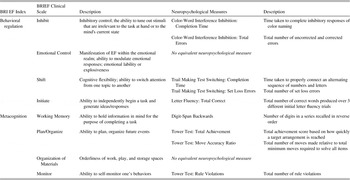
Behavior Rating Inventory of Executive Function-Parent Form (BRIEF). The BRIEF (Gioia, Isquith, Guy, & Kenworthy, Reference Gioia, Isquith, Guy and Kenworthy2000b) consists of 86 items and comprises 8 empirically derived scales (Inhibit, Shift, Emotional Control, Initiate, Working Memory, Plan/Organize, Organization of Materials, and Monitor scales) that are grouped into 2 global index scores (Behavioral Regulation, Metacognition) as well as an overall composite score (Global Executive Composite). The Behavioral Regulation Index (BRI) assesses the ability to use inhibitory control to shift cognitive set and regulate emotions and behavior, and the Metacognition Index (MI) assesses the ability to use working memory to initiate, plan, organize, and sustain future-oriented problem solving. Raw scores are transformed into age- and sex-adjusted T-scores for interpretation, with T≥65 considered clinically significant (mean of 50, SD of 10). The parent-report measure has high internal consistency across the scales (.80–.98) and test–retest reliability for normative (.81) and clinical (.79) samples (Gioia et al., Reference Gioia, Isquith, Guy and Kenworthy2000b). See Table 1 for a description of the BRIEF clinical scales.
Description of the BRIEF clinical scales and standardized neuropsychological variables included in analyses

All neuropsychological variables were age-corrected scaled scores except Trail Making Test Switching: Set Loss Errors and Tower Test: Rule Violations, which were raw scores.
BRIEF scales were matched to neuropsychological measures based on theoretical rationale using group consensus. Each neuropsychological variable measures an executive function subdomain equivalent to that expressed in the items of each BRIEF scale.
Delis-Kaplan Executive Function System (D-KEFS). The D-KEFS (Delis, Kaplan, & Kramer, Reference Delis, Kaplan and Kramer2001) is a neuropsychological test battery that is designed to measure multiple aspects of EF, including cognitive flexibility, fluency, response inhibition, planning, abstract reasoning, and concept formation. Color-Word Interference, Trail Making Test, Verbal Fluency, and Tower Test were selected for the current analyses because they were considered to be the theoretically and empirically related to the clinical scales of the BRIEF (see Table 1). All scores used in analyses were age-corrected scaled scores, with the exception of 2 process error variables, which were raw scores.
Wechsler Intelligence Scale for Children–Fourth Edition (WISC-IV). The WISC-IV (Wechsler, Reference Wechsler2003) was used to obtain a FSIQ score. Additionally, the Digit Span Test was selected for the current analyses as a measure of working memory.
Statistical Analysis
Statistical analyses were conducted using SPSS Statistics version 20.0 (IBM Corporation, 2011). An alpha level of p <.05 was used to determine statistical significance. Demographic data were analyzed using Chi-square statistics (sex, race, ethnicity, and handedness) and analysis of variance (ANOVA) statistics (age and FSIQ). With the exception of FSIQ, demographic variables were included as covariates if they were significantly correlated with the dependent variable and did not interact with either the dependent or independent variables. Preliminary analyses compared AE+ and AE− groups to determine whether or not alcohol-exposed groups should be combined. Consistent with previous reports in the same (Glass, Ware, et al., Reference Glass, Ware, Crocker, Deweese, Coles and Kable2013) and different (Rasmussen et al., Reference Rasmussen, Benz, Pei, Andrew, Schuller, Abele-Webster and Lord2010) samples, these groups did not differ significantly on neuropsychological variables (ps >.05), but differed on BRIEF scales (ps <.05); therefore, AE+ and AE− were included in analyses as separate groups.
To determine whether groups differed on BRIEF clinical scales and performance-based neuropsychological measures, separate 2 × 2 multivariate analyses of variance (MANOVA) were performed with alcohol exposure (exposed, non-exposed) and ADHD (ADHD, non-ADHD) as the between-subjects factors. Significant group differences were followed up with univariate 2 × 2 ANOVAs on each dependent variable, and pairwise comparisons were used to probe significant interactions using Tukey’s Honestly Significant Difference to protect against Type I error. The correspondence between BRIEF clinical scales and performance-based neuropsychological measures was analyzed using within-group Pearson’s correlations. Finally, to determine whether the BRIEF clinical scales could predict group membership, discriminant function analysis (DFA) was performed using the BRIEF clinical scales as predictors of group membership.
RESULTS
Demographic Data
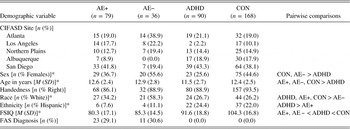
Groups differed on age, F(3,369)=4.21, p=.006, sex, χ2(df=3)=13.3, p=.004, race, χ 2(df=3)=15.5, p=.001, ethnicity, χ 2(df=6)=14.6, p=.024, and FSIQ, F(3,368)=40.1, p <.001, but not on handedness, χ 2(df=6)=9.53, p=.146. As expected, there were more boys in the ADHD group than CON group as boys are more likely to be diagnosed with ADHD than girls (Merikangas et al., Reference Merikangas, He, Brody, Fisher, Bourdon and Koretz2010). Demographic information and pairwise comparisons are presented in Table 2.
Demographic data for alcohol-exposed children with ADHD (AE+), alcohol-exposed children without ADHD (AE−), non-exposed children with ADHD (ADHD), and typically developing controls (CON)

*p<.05
ADHD, attention-deficit/hyperactivity disorder; CIFASD, Collaborative Initiative on Fetal Alcohol Spectrum Disorders; FSIQ, Full Scale IQ; FAS, fetal alcohol syndrome.
Group Differences: BRIEF
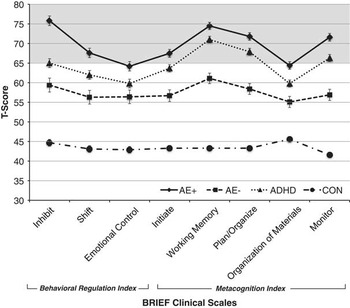
Mean BRIEF T-scores for each group are presented in Figure 1 and Supplemental Table 1. Scores on the validity scales were in the acceptable range for the overall sample (Inconsistency scale, M=2.61; Negativity scale, M =.98). However, there were significant differences among groups; caregivers were more inconsistent in their responding for the clinical groups than for the CON group, and caregivers responded with greater negativity for children in the AE+ group than in the ADHD group, followed by AE− and CON groups, which did not differ. The demographic variable of handedness was significantly related to BRIEF scores and was included in the MANOVA as a covariate. Using Wilk’s criterion as the omnibus test statistic, the combined dependent variables (all 8 BRIEF clinical scales) resulted in a significant main effect of Exposure, F(8,334)=21.1, p <.001, η 2 =.336, main effect of ADHD, F(8,334)=68.7, p <.001, η 2 =.622, and Exposure×ADHD interaction, F(8,334)=7.72, p<.001, η 2 =.156. Follow-up univariate 2 × 2 ANOVAs revealed statistically significant main effects of Exposure and ADHD for all clinical scales. Alcohol-exposed children had higher scores (i.e., reflecting greater dysfunction) than children without alcohol exposure, regardless of ADHD diagnosis; likewise, children with ADHD had higher scores than children without ADHD, regardless of alcohol exposure history. Additionally, the Exposure × ADHD interaction was statistically significant for all scales except for Inhibit. Pairwise comparisons revealed statistically significant differences between all groups on all scales except Emotional Control, for which AE− and ADHD groups had similar scores. The AE+ group had the highest T-scores on all scales (ps <.05), followed by the ADHD group, whose scores were significantly higher than the CON group and the AE− group (ps <.05), which was significantly higher than the CON group (p <.05).
Mean BRIEF scores by group for each clinical scale. Scores are presented as T-scores (mean of 50, SD of 10), with T≥65 considered clinically significant (shaded area). Groups differed (AE+>ADHD>AE−>CON) on all scales except Emotional Control, for which AE− and ADHD groups had similar scores (AE+>ADHD, AE−>CON). ADHD, attention-deficit/hyperactivity disorder; AE+, alcohol-exposed children with ADHD; AE−, alcohol-exposed children without ADHD; BRIEF, Behavioral Rating Inventory of Executive Function; CON, control.

Group Differences: Neuropsychological Measures
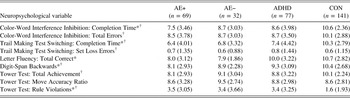
Mean scores on neuropsychological tasks for each group are presented in Table 3. The demographic variables of race and sex were significantly related to neuropsychological performance scores and were included in the MANOVA as covariates. Using Wilk’s criterion as the omnibus test statistic, the combined dependent variables (all neuropsychological test scores) resulted in a significant main effect of Exposure, F(9,305)=5.59, p <.001, η2 =.142, and main effect of ADHD, F(9,305)=3.51, p <.001, η2 =.094; no Exposure × ADHD interaction was observed. Follow-up univariate 2×2 ANOVAs conducted revealed statistically significant main effects of Exposure for Color-Word Interference Inhibition, Trail Making Test Switching, Letter Fluency, Digit-Span Backwards, and Tower Test Rule Violations; across these measures, alcohol-exposed individuals consistently performed worse than non-exposed individuals. Similarly, significant main effects of ADHD were seen on all neuropsychological scores except Letter Fluency and Tower Test Move Accuracy Ratio, with individuals with ADHD consistently performing worse than individuals without ADHD.
Mean scores by group for each performance-based neuropsychological measure

Data are presented as mean (standard deviation). All variables are age-corrected scaled scores except Trail Making Test Switching: Set Loss Errors and Tower Test: Rule Violations, which are raw scores.
*Significant main effect of Exposure (exposed < non-exposed)
†Significant main effect of ADHD (ADHD < non-ADHD)
ADHD, attention-deficit/hyperactivity disorder; AE+, alcohol-exposed children with ADHD; AE−, alcohol-exposed children without ADHD; CON, control.
Relationship of BRIEF to Performance-Based Neuropsychological Measures
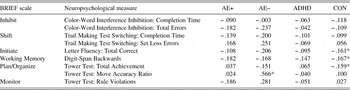
To examine the relationship between the BRIEF and performance-based measures of neuropsychological function, within-group Pearson’s correlations were calculated between each BRIEF scale and its corresponding neuropsychological variables (Table 1). Results of correlational analyses are presented in Table 4.
Within-group correlations (two-tailed) between BRIEF clinical scales and performance-based neuropsychological measures

Data presented in each correlational analysis represent nearly all subjects, with small differences within groups due to outliers removed or missing data.
*Significant correlation (p<.05) between BRIEF scale and neuropsychological measure
ADHD, attention-deficit/hyperactivity disorder; AE+, alcohol-exposed children with ADHD; AE−, alcohol-exposed children without ADHD; BRIEF, Behavioral Rating Inventory of Executive Function; CON, control.
The Plan/Organize scale was moderately correlated with Tower Test Move Accuracy Ratio (r =.566) for the AE− group. There were significant weak negative correlations (ps<.05) between Initiate scale and Letter Fluency (r=−.161), Working Memory scale and Digit-Span Backwards (r=−.167), and Plan/Organize scale and Tower Test Total Achievement (r=−.159) for the CON group. No significant correlations were found for any group between the Inhibit, Shift, and Monitor scales and neuropsychological performance.
Specificity of BRIEF Scales for Clinical Groups
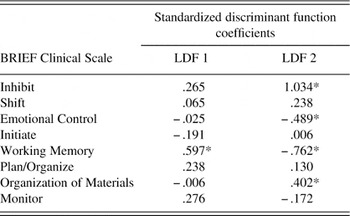
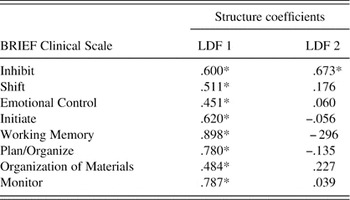
To determine whether BRIEF clinical scales could be used to distinguish clinical groups, a DFA was performed using the 8 clinical scales as predictors of group membership. Using an alpha level of.001 to evaluate the homogeneity of covariance matrices assumptions, Box’s M test was significant (p <.001). Three latent discriminant functions were tested at an alpha level of .05, and two were statistically significant (ps <.01). Standardized discriminant function coefficients and structure coefficients for each analysis are presented in Table 5 and Table 6, respectively. A practical significance cut off value of |.30| was used to determine the best predictors for distinguishing between groups (Duarte Silva & Stam, Reference Duarte Silva and Stam1995).
Standardized discriminant function coefficients representing each BRIEF scale’s unique contribution to each latent discriminant function.

*Item significantly distinguished group membership; practical significance cutoff value=|.30|.
ADHD, attention-deficit/hyperactivity disorder; AE+, alcohol-exposed children with ADHD; AE−, alcohol-exposed children without ADHD; BRIEF, Behavioral Rating Inventory of Executive Function; CON, Control; LDF, latent discriminant function.
Structure coefficients between BRIEF scales and standardized canonical discriminant function

*Item significantly distinguished group membership; practical significance cutoff value=|.30|.
ADHD, attention-deficit/hyperactivity disorder; AE+, alcohol-exposed children with ADHD; AE−, alcohol-exposed children without ADHD; BRIEF, Behavioral Rating Inventory of Executive Function; CON, Control; LDF, latent discriminant function.
The first discriminant function, χ 2(24)=567.7, p <.001, η2 =.813, maximally separated the CON group (M=−2.14) from the AE+ (M=2.37) and ADHD (M=1.61) groups but did not maximally separate the AE− group (M =.266). Standardized discriminant function coefficients suggested that best predictor for distinguishing between groups was the Working Memory scale. Children with ADHD, with or without prenatal alcohol exposure, were rated by caregivers as having significantly greater problems in this domain compared to control subjects. The second discriminant function, χ 2(14)=30.2, p =.007, η2 =.085, distinguished the AE+ group (M=.429) from the ADHD group (M=−.396), and standardized discriminant function coefficients suggested that four clinical scales best distinguished these groups: Inhibit, Emotional Control, Working Memory, and Organization of Materials. The AE+ group had higher scores than the ADHD group on Inhibit and Organization of Materials while ADHD subjects had higher scores on Emotional Control and Working Memory. Classification accuracy was 71.4% overall, with 92.1% of subjects from the CON group, 67.1% of subjects from the AE+ group, 50.6% of subjects from the ADHD group, and 42.9% of subjects from the AE− group classified correctly.
Post hoc Analyses on IQ
Analyses were repeated without subjects with IQ scores below 70 (n=36), and the results and interpretation remained the same, with a few exceptions. The Monitor scale was an additional predictor in the first discriminant function, and there was no longer a significant main effect of exposure on Tower Test Rule Violations and ADHD on Trail Making Test Set Loss Errors.
DISCUSSION
This study is one of the first to examine the clinical utility and validity of the BRIEF for detecting executive dysfunction in children with FASD, as well as to investigate the specificity of the BRIEF to distinguish children with FASD from idiopathic ADHD. We used a multi-method approach to characterize the EF deficits in children with prenatal alcohol exposure and test the specificity of these deficits in the presence of ADHD. Consistent with our hypothesis, both alcohol exposure and the presence of ADHD contributed to increased scores (indicating greater impairment) on the BRIEF. While alcohol-exposed children (AE+ and AE− groups) and children with ADHD (AE+ and ADHD groups) exhibited significantly elevated scores on the BRIEF compared to controls, a significant Exposure × ADHD interaction suggests an exacerbated effect of alcohol exposure and ADHD on nearly all BRIEF scales, with the AE+ group exhibiting the greatest problem behaviors, followed by the ADHD and AE− groups, respectively.
Findings from traditional neuropsychological measures, however, did not reflect this pattern. On these measures, alcohol-exposed children, regardless of ADHD status, demonstrated greater deficits than non-exposed children on measures of response inhibition, cognitive flexibility, verbal fluency, working memory, and planning while children with ADHD, regardless of prenatal alcohol exposure, were more impaired than children without ADHD in all neuropsychological domains except verbal fluency. Notably, there was no difference between AE+ and AE− groups on any neuropsychological variable.
These findings are consistent with prior studies showing an exacerbated effect of multiple risk factors in the AE+ group, resulting in more severe deficits in parent-reported behavior (Glass, Graham, et al., Reference Glass, Graham, Deweese, Jones, Riley and Mattson2013; Graham, Crocker, et al., Reference Graham, Crocker, Deweese, Roesch, Coles and Kable2013; Ware et al., Reference Ware, O’Brien, Crocker, Deweese, Roesch and Coles2013) but not in neuropsychological performance (Glass, Ware, et al., Reference Glass, Ware, Crocker, Deweese, Coles and Kable2013; Rasmussen et al., Reference Rasmussen, Benz, Pei, Andrew, Schuller, Abele-Webster and Lord2010). Our results support and extend these previous findings, as this is the first study to compare this pattern within the same domain. A possible explanation for this discrepancy is that parent-report measures do not capture the same constructs and behaviors as objective performance-based instruments. This suggestion was supported by the lack of within-group correlations between parent report and neuropsychological performance in the clinical groups, except for one significant association between the Plan/Organize scale and Tower Test Move Accuracy Ratio in the AE− group. Only three BRIEF scales were weakly correlated with neuropsychological performance in the control group. Thus, it appears that at least within FASD and ADHD populations, these two methods of measurement are tapping into different constructs or at least different aspects of EF. In contrast to previous studies demonstrating significant correlations between the BRIEF and traditional neuropsychological measures (McCandless & O’Laughlin, Reference McCandless and O’Laughlin2007; Parrish et al., Reference Parrish, Geary, Jones, Seth, Hermann and Seidenberg2007; Toplak et al., Reference Toplak, Bucciarelli, Jain and Tannock2009), we explored domain-specific correlations between the BRIEF clinical scales and specific neuropsychological tests of executive subdomains within different clinical groups. Our analyses provide a clearer understanding of whether elevations on particular BRIEF scales are associated with concomitant dysfunction in corresponding neuropsychological measures.
Several explanations might account for the lack of correlation between behavioral and cognitive variables. One interpretation is that the BRIEF does not measure the construct of EF in the same context as performance-based neuropsychological measures (that is, as inherent neurocognitive abilities related to frontal-subcortical circuits; Cummings, Reference Cummings1993). Rather, it captures how impairment in this underlying cognitive construct is behaviorally manifested in a real-world setting, which is not necessarily dependent on brain function alone. While cognition and behavior can influence each other, they are independent constructs. Poor cognitive self-monitoring may lead to problematic behaviors, but behavior may also vary depending on other factors, such as psychiatric comorbidities, mood, and social and environmental conditions, all of which may increase demands on children’s attentional system, thus exacerbating their behavioral presentation. This suggestion is illustrated by the lack of group differences on neuropsychological tasks between the AE+ and AE− groups, but a more severe presentation of problems on the BRIEF in the AE+ group than the AE− group. Thus, the presence of ADHD in the context of prenatal alcohol exposure appears to be a risk factor for greater impairment in the behavioral manifestation of executive dysfunction but not necessarily in underlying cognitive ability. Another possible explanation lies in the distinct cognitive and behavioral functions within the different regions of the prefrontal cortex (Anderson et al., Reference Anderson, Anderson, Northam, Jacobs and Mikiewicz2002). Whereas lesions in the dorsolateral prefrontal cortex give rise to impairment in cognitive aspects of EF (e.g., working memory; Bechara, Damasio, Tranel, & Anderson, Reference Bechara, Damasio, Tranel and Anderson1998; Fuster, Reference Fuster2000), the ventromedial prefrontal cortex plays an important role in personality and regulation of behavior (e.g., emotional decision-making; Bechara, Damasio, & Damasio, Reference Bechara, Damasio and Damasio2000; Bechara et al., Reference Bechara, Damasio, Tranel and Anderson1998). Thus, it is possible that the BRIEF and neuropsychological measures may be sensitive to different aspects of frontal lobe functioning.
The lack of association between the BRIEF and performance-based measures of EF highlights the difficulty of using neuropsychological measures to predict real-world function in children (and vice versa, parent reports do not always predict cognitive function), particularly in children with developmental disabilities. This clinically relevant issue is paralleled within the adult neuropsychological literature (Marcotte, Scott, Kamat, & Heaton, Reference Marcotte, Scott, Kamat and Heaton2010). Presently, there are very few available studies concerning the everyday functional impact of alcohol-related neuropsychological deficits in children with FASD. Our data suggest that cognitive impairment seen upon standardized neuropsychological testing may not map onto everyday functioning and behavioral presentation, at least as rated by parents. However, it is also important to consider that informant-reports, while they may give a reasonably accurate representation of real-world functioning, are also subject to reporter bias (Achenbach, McConaughy, & Howell, Reference Achenbach, McConaughy and Howell1987; Faraone, Monuteaux, Biederman, Cohan, & Mick, Reference Faraone, Monuteaux, Biederman, Cohan and Mick2003; Wadley, Harrell, & Marson, Reference Wadley, Harrell and Marson2003). Likewise, while performance-based measures are considered objective, an individual’s performance on these measures can fluctuate depending on motivation, cognition, and behavior (Myers, Holliday, Harvey, & Hutchinson, Reference Myers, Holliday, Harvey and Hutchinson1993; Rader & Hughes, Reference Rader and Hughes2005). Nevertheless, the behavior of children with prenatal alcohol exposure seems to be worsened in the presence of ADHD and possibly other common psychiatric diagnoses in this population, such as oppositional defiant disorder and conduct disorder (Fryer et al., Reference Fryer, McGee, Matt, Riley and Mattson2007). This may, in fact, contribute to the wide-range of variability in behavioral phenotypes seen across FASD (Graham, Deweese, et al., Reference Graham, Deweese, Roesch, Coles, Kable and May2013; Kodituwakku, Reference Kodituwakku2007; Mattson et al., Reference Mattson, Crocker and Nguyen2011).
The considerable heterogeneity of outcomes among children who have been prenatally exposed to alcohol in addition to the lack of a definitive physical or biological marker of alcohol exposure makes the identification of alcohol-affected children very challenging, especially in cases where maternal history of alcohol consumption is unknown (Mattson & Riley, Reference Mattson and Riley2011). Substantial overlap in cognitive and behavioral presentations with other clinical groups, such as children with ADHD, further hinders proper diagnosis and, subsequently, intervention and treatment opportunities, as alcohol-exposed children may respond differently to medication (Doig et al., Reference Doig, McLennan and Gibbard2008). To facilitate more accurate identification of alcohol-exposed individuals, research has focused on developing a profile based on the neurobehavioral effects of heavy prenatal alcohol exposure (Mattson & Riley, Reference Mattson and Riley2011). As part of this initiative, we used discriminant function analysis to investigate whether the BRIEF could be a helpful tool in the identification of alcohol-exposed children, particularly given that parent-report questionnaires are relatively easy and quick to administer but also provide large amounts of data about children’s behavior. In the first latent discriminant function, the Working Memory scale was found to significantly distinguish the CON group from the ADHD and AE+ groups, indicating that children with ADHD, regardless of alcohol-exposure status, have greater behavioral problems related to impairments in working memory. For the second latent discriminant function, four scales distinguished the AE+ and ADHD groups from each other. Alcohol-exposed children with ADHD showed greater behavioral problems related to poor inhibitory control and organization compared to non-exposed children with ADHD, who had greater problems with emotional control and working memory. The latter comparison suggests that the Inhibit and Organization of Material scales may be particularly clinically useful in identifying children with ADHD who are also alcohol-exposed, from children with idiopathic ADHD, who may present clinically with similar behavioral problems. Unfortunately, these data do not provide evidence that the BRIEF can distinguish children with heavy prenatal alcohol exposure from controls in the absence of ADHD, potentially hindering identification of the AE− group.
Altogether, our findings indicate that while the BRIEF may not measure EF in the traditional neuropsychological sense of the construct, it captures valuable information about children’s behavior and is sensitive to the effects of prenatal alcohol exposure and ADHD, further contributing to our understanding of the behavioral phenotype among alcohol-exposed children. The BRIEF may be a useful screening tool for prenatal alcohol exposure, particularly in settings where neuropsychological assessment may not be immediately available (e.g., school settings, doctor’s offices). However, our data suggest that it should be used to complement, rather than replace, traditional neuropsychological tests to assess cognitive function.
STRENGTHS AND LIMITATIONS
A few limitations to the present study should be acknowledged. Our sample of alcohol-exposed children who did not meet criteria for ADHD was relatively small in size due to the fact that a large percentage of children with prenatal alcohol exposure are diagnosed with ADHD (Fryer et al., Reference Fryer, McGee, Matt, Riley and Mattson2007). This may have limited our power to detect clinically relevant differences and affected the outcome of our discriminant function analyses, even though our overall sample size was large. Although we were still able to detect differences between the AE− and AE+ groups on several measures, the DFA did not distinguish these groups from each other, despite group differences on all scales of the BRIEF. Moreover, the effect sizes of our non-significant differences were small (e.g., η 2 =.010), indicating that nearly 1300 subjects would be required to result in statistically significant differences. As such, these likely reflect real non-differences rather than insufficient power. Additionally, we did not examine or correct for the relation between BRIEF ratings and neuropsychological performance and IQ scores. Given that low IQ is an intrinsic feature of prenatal alcohol exposure, covarying for IQ in analyses would substantially reduce variance and create statistically overcorrected results, as well as decrease the generalizability of our results (Dennis et al., Reference Dennis, Francis, Cirino, Schachar, Barnes and Fletcher2009). However, we performed sub-analyses excluding subjects with IQ scores < 70 (i.e., cutoff for intellectual disability) and our findings did not change. Furthermore, while the demographic variables of race and ethnicity were evaluated as covariates in the current analyses, socioeconomic status (SES) and home placement were not. Compared to typically developing children, a large proportion of alcohol-exposed children are from lower SES communities, raised in adopted or foster families, experience greater familial conflict, and/or have less stable home environments (Streissguth et al., Reference Streissguth, Bookstein, Barr, Sampson, O’Malley and Young2004; Werner, Reference Werner1986). As these risk factors have been shown to be associated with adverse mental health outcomes, including risk of psychiatric and behavioral problems and increased ADHD severity (Bastiaansen, Koot, & Ferdinand, Reference Bastiaansen, Koot and Ferdinand2005; Bradley & Corwyn, Reference Bradley and Corwyn2002; Newton, Litrownik, & Landsverk, Reference Newton, Litrownik and Landsverk2000; Pressman et al., Reference Pressman, Loo, Carpenter, Asarnow, Lynn, McCracken and Smalley2006), they may contribute to increased behavioral impairment in this group. However, this was not seen in alcohol-exposed children without a diagnosis of ADHD, suggesting that the effect, at least in this sample, was minimal. Similarly, our groups were not balanced on factors known to relate to EF, including sex and age, although they were evaluated as covariates in the current analyses. Finally, ADHD diagnosis was determined using only a single source, rather than multiple sources. While the C-DISC-4.0 diagnostic interview can effectively ascertain the presence of ADHD symptoms, it does not elicit contextual information about these symptoms or assess for specific rule-outs that would cast doubt on the diagnosis (Shaffer et al., Reference Shaffer, Fisher, Lucas, Dulcan and Schwab-Stone2000). Furthermore, this study only investigated the parent version of the BRIEF, which shares source variance with the C-DISC-4.0. Future studies would be well served to incorporate multi-modal methods for determining ADHD diagnosis (cf. Glass, Graham, et al., Reference Glass, Graham, Deweese, Jones, Riley and Mattson2013) and cross-informant reports of executive dysfunction (e.g., BRIEF teacher and self-reports).
Nevertheless, the current study has many notable strengths including its comparisons between alcohol-exposed children with and without ADHD on both measures of neuropsychological function and everyday behavioral presentation of the same functional domain. It also is one of the first to evaluate the convergent validity of the BRIEF in a large, representative sample of alcohol-exposed children and examine the relationship between cognitive function and real-life everyday functioning. Our sample of subjects, collected from various centers across the United States, is quite large and representative, allowing for greater generalizability of our results. More specifically, the sample included 34 (30%) children with FAS and had average IQ score of 82, further supporting the generalizability of the sample.
FUTURE DIRECTIONS
Our data demonstrate that within neurodevelopmental populations—specifically, children with FASD and ADHD—the BRIEF does not appear to measure the construct of EF in the same context as performance-based neuropsychological measures. Additional studies are needed to further elucidate the relationship between cognition and behavior, such as understanding moderators of neuropsychological function on behavioral presentation. Nevertheless, we illustrate that BRIEF clinical scales can distinguish alcohol-exposed children from children with idiopathic ADHD and believe that this measure could be included in a screening process to more efficiently and effectively identify children with heavy prenatal alcohol exposure. Future research should continue to seek to identify measures that can aid in the identification of alcohol-exposed individuals from typically developing children and children with other psychiatric disorders and developmental disabilities. We acknowledge that parent and objective measures of EF are capturing different yet important information. Understanding both the neuropsychological and behavioral problems can help inform future interventions. Future studies can extend these findings and investigate self-report as a way to better understand the personal distress that individuals with heavy prenatal alcohol exposure are facing in order to adequately target the areas that are most important and clinically significant.
ACKNOWLEDGMENTS
All or part of this work was done in conjunction with the Collaborative Initiative on Fetal Alcohol Spectrum Disorders (CIFASD), which is funded by grants from the National Institute on Alcohol Abuse and Alcoholism (NIAAA). Additional information about CIFASD can be found at www.cifasd.org. Research described in this manuscript was supported by NIAAA grant numbers U01 AA014834 (Mattson), U24 AA014811 (Riley), U24 AA014818 (Barnett), and U24 AA014815 (Jones). Additional support was provided by NIAAA grant numbers F31 AA021630 (Nguyen), F31 AA022261 (Glass), and T32 AA013525 (Riley). The authors have no financial or other conflicts of interest.
The authors thank the families and children who graciously participate in our studies and to the members of the Center for Behavioral Teratology for ongoing assistance and support. We also acknowledge the efforts in data collection of Kristina Hubbard, Delilah Bolo, and Heather Holden in San Diego; Suzanne Houston, Ariel Starr, and Genevieve Rodriguez in Los Angeles; Sharron Paige-Whitaker in Atlanta; Alfredo Aragón, Ethan White, and Stephanie Rueda in Albuquerque; and Rosemary Bozeman and Carol Keaster in the Northern Plains.
*The Collaborative Initiative on Fetal Alcohol Spectrum Disorders (CIFASD; E. Riley, San Diego State University, Principal Investigator) includes 16 different centers where data collection and analysis take place. The data collection sites and associated investigators described in this paper are: San Diego State University (S.N. Mattson), University of New Mexico and Northern Plains (P.A. May, W. Kalberg), University of California, Los Angeles (E.P. Sowell), Emory University, Atlanta, GA (C.D. Coles, J.A. Kable). Additional sites include the University of Cape Town, South Africa (C.M. Adnams).