INTRODUCTION
The population biology of any group of animals includes the quantitative aspects of their biology that allow understanding their changes in abundance and distribution (Begon et al., Reference Begon, Townsend and Harper2006). The description of the population characteristics is essential to fully understand the relationship between the species and other components of the ecosystem, and to be able to determine the effects of human activities over these populations. Several studies have characterized some of the local responses of marine communities to protection from fisheries (García-Rubies & Zabala, Reference García-Rubies and Zabala1990; Bennett & Attwood, Reference Bennett and Attwood1991; Rakitin & Kramer, Reference Rakitin and Kramer1996; Babcock et al., Reference Babcock, Kelly, Shears, Walker and Willis1999; Pinnegar et al., Reference Pinnegar, Polunin, Francour, Badalamenti, Chemello, Harmelin-Vivien, Hereu, Milazzo, Zabala, D'anna and Pipitone2000; Guidetti & Sala, Reference Guidetti and Sala2007; Stockwell et al., Reference Stockwell, Jadloc, Abesamis, Alcala and Russ2009). Despite the growing literature about the expected responses of populations and communities to protection within Marine Protected Areas (MPAs) or no-take areas, most of the mechanisms that are supposed to work in marine reserves have not yet been empirically demonstrated (García-Charton & Perez-Ruzafa, Reference García-Charton and Perez-Ruzafa1999).
Coastal marine ecosystems are highly variable, and the biotic and abiotic factors inherent to these environments can affect the bio-ecological characteristics of cephalopod populations living within them (Boyle & Rodhouse, Reference Boyle and Rodhouse2005). Density, spatial distribution, size–frequency and age structure can be influenced by specific factors of the habitat. In this respect, the natural variability of populations can confuse the effect of the protection of environments. Moreover, the natural forces that drive the spatial and temporal variation in the population structure can be both physical (habitat complexity, temperature and salinity) and biological (recruitment, predation, prey availability, etc.). Thus, the problem is in determining the relative importance of such processes in influencing the population structure characteristics (García-Charton & Perez-Ruzafa, Reference García-Charton and Perez-Ruzafa1999).
In San Matías Gulf (Patagonia), the presence and population features of the small octopus Octopus tehuelchus d'Orbigny (1934) seem to differ between several intertidal environments. Narvarte et al. (Reference Narvarte, González and Fernández2006) compared sex-ratio and recruitment in two sites of the west coast of San Matías Gulf, one of which was a MPA. These authors reported that abundance and recruitment within the MPA was three times higher and that these differences may be explained by the establishment of the reserve and the decrease in fishery activities, which significantly decreased the catch of brooding females, thus allowing a higher egg survival. On the other hand, our previous studies have shown that O. tehuelchus has a strong variability and plasticity (evidenced by variation in the progression of maturity, growth, life-span and reproductive traits) in response to the environment in which each individual is developed (Storero et al., Reference Storero, Ocampo-Reinaldo, González and Narvarte2010, Reference Storero, Narvarte and González2012).
The main objective of this study was to describe and compare some demographic characteristics of O. tehuelchus in different coastal environments of San Matías Gulf, in order to establish differences and similarities between these populations, and discuss them in relation to their natural variability, the effectiveness of marine reserves and the importance of differentiating between the reserve effect and natural variability.
MATERIALS AND METHODS
Background of Octopus tehuelchus
The Patagonian octopus inhabits the intertidal and subtidal environments from South Brazil (30°S) to North Patagonia (45°S). In Patagonia (San Matías Gulf), the high abundances favour the exploitation by artisanal fishers who collect octopuses by hand with an iron-gaff or by turning over rocks. Octopus tehuelchus is a small octopus (up to 150 g), which lays 40–80 large eggs (approximately 9–12 mm long × 3–5 mm wide) during the end of the summer and autumn. Eggs are laid in holes in the rocks or in empty shells. Embryonic development occurs in winter, with four months of parental care. Hatchlings emerge in spring/summer (dorsal mantle length: 4–6 mm; total length: 10–14 mm; and total weight: 0.052–0.139 g, approximately) and the benthic young have habits similar to those of adults. The lifespan is two/three years and growth is seasonal, with slow growth rates during winter. Size at maturity is approximately 40 mm of dorsal mantle length. Octopus tehuelchus is an opportunistic predator that feeds on molluscs and crustaceans (Pujals, Reference Pujals1986; Iribarne, Reference Iribarne1990, Reference Iribarne1991a, Reference Iribarneb; Ré & Gómez Simes, Reference Ré and Gómez Simes1992; Narvarte et al., Reference Narvarte, González and Fernández2006; Storero et al., Reference Storero, Ocampo-Reinaldo, González and Narvarte2010, Reference Storero, Narvarte and González2012).
Study sites
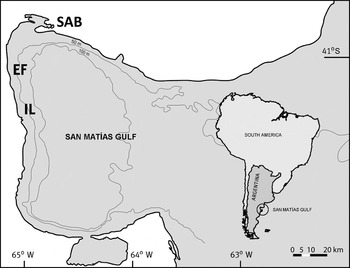
San Antonio Bay (SAB: Figure 1) is located in the north-west sector of San Matías Gulf (40°42′S–40°50′S/64°43′W–65°07′W). It is an estuarine shallow water system with semidiurnal tides between 6 and 9 m in range, channels, and sandy–pebbly bottoms. Because SAB is characterized by a high species richness and biological diversity, it was declared a MPA in 1993. Despite the conservation status of the area, there are a few conservation actions to protect migratory birds that feed, rest or reproduce in the bay, without considering the other components of the ecosystem. Low tides expose large muddy intertidal flats, where people from the surrounding urban areas collect octopuses from artificial shelters (usually bottles, pipes, pots, etc.). There is no management plan that considers this artisanal octopus fishery, and particular management measures only regulate the pot–longline fishery in the subtidal zone. Furthermore, the existence of strong oceanographic patterns in SAB originates particular adaptations of the O. tehuelchus population (i.e. extended maturation and sub-annual cohorts (Storero et al., Reference Storero, Ocampo-Reinaldo, González and Narvarte2010)).
Study area and sampling sites: SAB, San Antonio Bay; EF, El Fuerte; IL, Islote Lobos.

The north-west region of San Matías Gulf shows extended rocky intertidal shores. El Fuerte (EF: 41°14′S/65°08′W), located 55 km southward of SAB (Figure 1), has been a traditional fishing area for the last 60 years. This rocky intertidal zone is characterized by tidal pools with the small mussels Brachidontes rodriguezii and Perumytilus purpuratus as the dominant species, and the presence of various algae, crabs and gastropods (Narvarte et al., Reference Narvarte, González and Fernández2006). During spring/summer months, the area is regularly visited by fishermen who collect octopuses using a 40 cm-long iron gaff, or by turning over rocks (Iribarne, Reference Iribarne1991a).
Islote Lobos (IL: 41°26′S/65°03′W), located 45 km southward of EF, also used to be a traditional fishing ground until it was declared a MPA in 1977 (Figure 1). It is composed of six islands connected to land during low tide, is characterized by rocky shores, and inhabited by small mussels, crabs and snails. Although it became a protected area for the conservation of marine mammals and birds that inhabited the islands, and although there is no regulation of the fishery in this reserve, the fishing effort on octopuses has diminished (Narvarte et al., Reference Narvarte, González and Fernández2006). In this sense, the characteristics of the area (i.e. located away from urban areas, inaccessible to vehicles, etc.) favours the very low/null fishing intensity.
Biological sampling and data analysis
Octopuses were monthly collected by an expert fisherman in the intertidal zone of SAB, EF and IL from October 2005 to September 2007. Between 6 and 26 transects (300 m2, 100 m long × 3 m wide) were monthly carried out depending on the weather conditions and the tide height. Samples were taken to the laboratory and frozen, and then defrosted and processed. Dorsal mantle length (DML, in mm), total body weight (BW, in g) and sex were recorded for each individual. Due to the characteristics of artisanal fishery (i.e. seasonality and low incomes to fishers) after recording the data, the catch was returned to the fisherman for sale.
To characterize the demographic structure in each study site, size–frequency distributions (weight) and their progression were analysed along the study period. Weight–frequency distributions were compared between sites and sexes with the Kolmogorov–Smirnov test. Also, individual BW was compared between sexes and sites with analysis of variance (ANOVA), and Tukey's test was used for a posteriori comparisons.
Sex-ratios were compared between months and sites and the Chi-square test was used to test differences in the proportion of sexes. When differences in sex-ratios were detected, an additional test was performed to explore whether the different proportion was due to gender differential survival or birth. Three groups (with individuals seasonally grouped) were considered: juveniles (≤27 mm DML, immature), adults (>27 mm DML, maturing or mature gonads with large volume: Pujals, Reference Pujals1986) and post-spawning adults (>27 mm DML, flaccid gonads with grey-violet coloration: Pujals, Reference Pujals1986).
Recruitment was monthly analysed in each study site using the number of juveniles (immature octopuses) fished by transect in relation to the number of mature females. The number of octopuses (juveniles or mature) by transect was seasonally averaged with the aim to identify the main recruitment season in each site. The number of juveniles by transect was compared for the main recruitment season, between years and sites with ANOVA. Also, the juvenile per mature female ratio was calculated for the seasons of maximum recruitment. To calculate these ratios, mature females from the same year were used because the study period did not allow us to use the mature females that originated each cohort (Storero et al., Reference Storero, Ocampo-Reinaldo, González and Narvarte2010). Taking into account the cohorts previously detected in Storero et al. (Reference Storero, Ocampo-Reinaldo, González and Narvarte2010), different individuals were used to calculate the ratios. For summer recruits (in SAB): summer juveniles/spring mature females; for spring recruits (in the three study sites): spring juveniles/autumn mature females.
RESULTS
Weight–frequency distributions
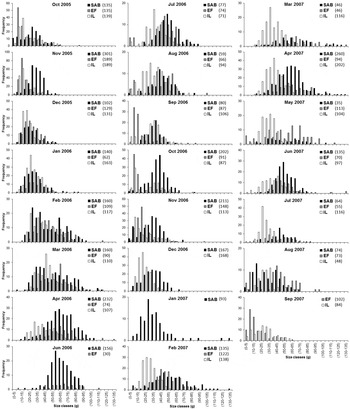
Monthly weight–frequency distributions showed significant differences between sites along the study period (Kolmogorov–Smirnov test, P < 0.05) with heavier octopuses in EF, except for October and November, when the heavier octopuses were observed in SAB (Figure 2). Weight–frequency distributions were similar between sexes for every month in SAB and EF (Kolmogorov–Smirnov test, P > 0.05). In contrast, the distributions in IL were significantly different between sexes, with females showing higher weights than males (Kolmogorov–Smirnov test, P < 0.05).
Monthly weight–frequency distributions in the three study sites: SAB, San Antonio Bay; EF, El Fuerte; IL, Islote Lobos. Total number of octopuses is shown in parentheses.

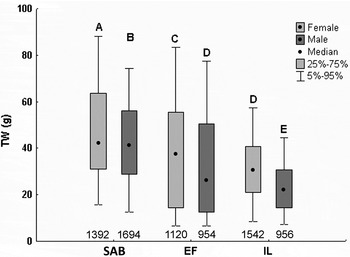
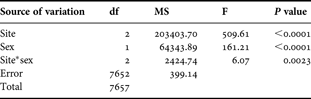
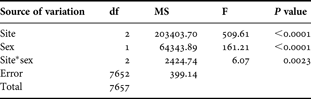
Comparisons of individual total BW between sexes and sites, showed a significant interaction because males from EF and females from IL showed similar body weights. Females were heavier than males in the three study sites. Also, octopuses from SAB were heavier than those from EF, which, in turn, were heavier than those from IL (ANOVA: Table 1; Figure 3).
Box-plot for male and female total weight (g): SAB, San Antonio Bay; EF, El Fuerte; IL, Islote Lobos. Different letters indicate significant differences (analysis of variance, Tukey's test P <0.05). Values below each box indicate total number of octopuses analysed by sex and site.

Result of the two-way analysis of variance to test for differences in total weight between sampling sites and sexes.
Sex-ratios
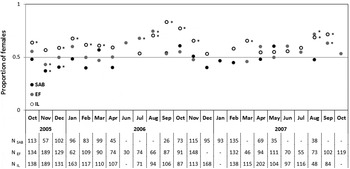
A different pattern was observed in the sex-ratios between sites. In general, SAB and EF showed a similar proportion 1:1 (female to male), with a few months where the ratio favoured either sex. In contrast, IL showed a higher proportion of females along the entire study period (Chi-square test, P < 0.05: Figure 4).
Monthly proportion of females: SAB, San Antonio Bay; EF, El Fuerte; IL, Islote Lobos. *, significant differences (Chi-square test, P < 0.05); N, total number of octopuses (males and females) analysed by month and site. When N was lower than 30, the Chi-square test was not performed.

The analysis of sex-ratio by sizes in IL showed that adult and post-spawning females outnumbered males in most of the seasons (Chi-square test, P < 0.05). The sex-ratio for juveniles was 1:1 along the year (there was only one exception in spring 2005).
Recruitment
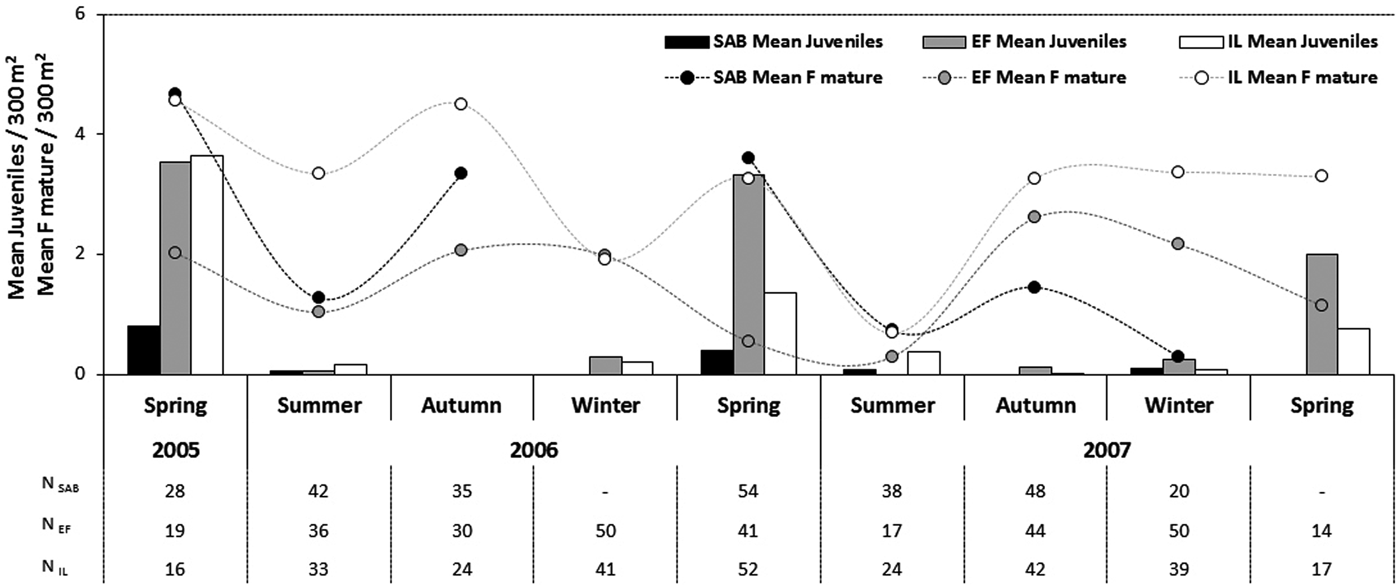
The mean number of juveniles caught along transects varied between seasons, being spring (September–November) the main recruitment season for the three study sites (Figure 5).
Mean number of juveniles and mature females caught by transect (300 m2). Standard deviations are not displayed to facilitate graph interpretation. SAB, San Antonio Bay; EF, El Fuerte; IL, Islote Lobos; N, number of transects (300 m2) carried out by site and season.
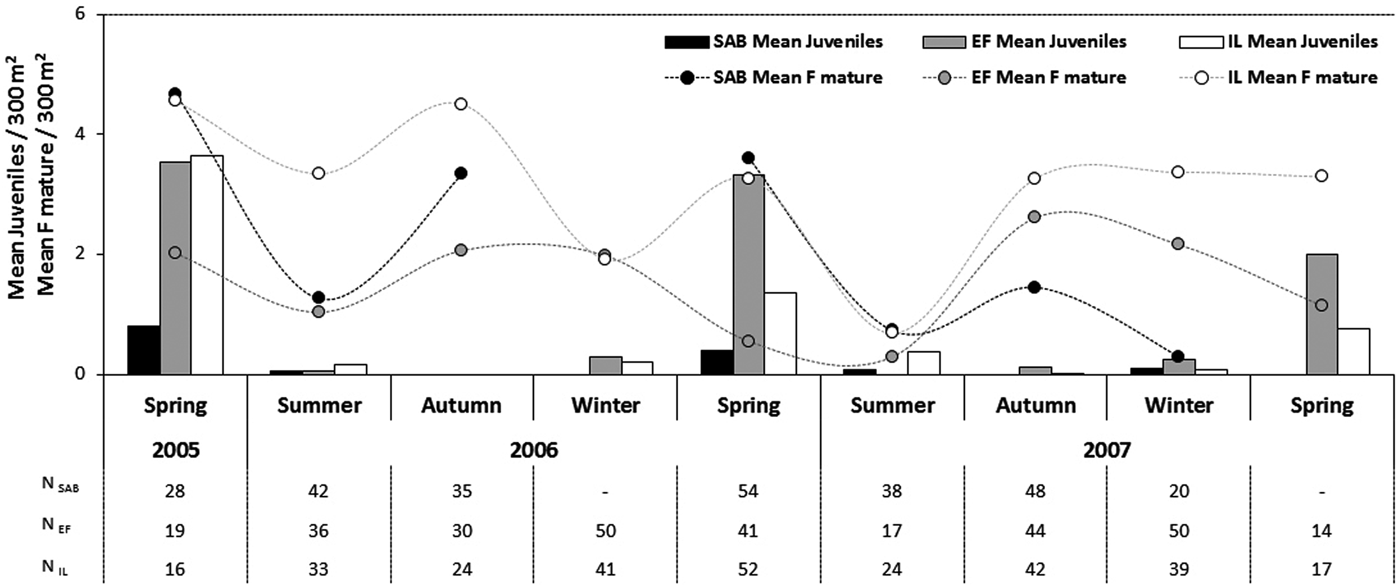
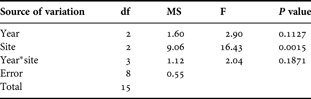
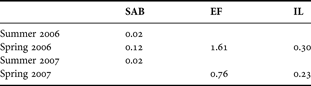
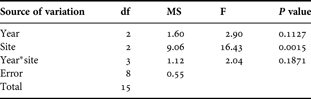
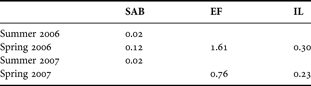
In general, the highest number of mature females was observed in IL during autumn. Although the abundance of mature females in SAB was also high, the number of juveniles caught by transect for the entire period was on average five times higher in EF (in average SAB 0.16 juveniles transect−1; EF 0.92 juveniles transect−1). IL also had a high abundance of juveniles (in average 0.66 juveniles transect−1) but variable between the springs analysed. EF showed the most successful recruitment in the three springs analysed, whereas SAB showed the least successful (ANOVA: Table 2; Figure 5). SAB and IL showed the presence of juveniles in the population (in lower proportion) during the summer months (December–February). The highest juvenile per mature female ratio was observed in EF followed by IL and SAB (Table 3).
Result of the two-way analysis of variance to test for differences in the number of juveniles caught by transect for the main recruitment season (spring), between years and sites.
Juvenile per mature female ratio in the main recruitment season (spring). SAB, San Antonio Bay; EF, El Fuerte; IL, Islote Lobos.
DISCUSSION
This study showed differences in the population characteristics of the Patagonian octopus in three coastal environments of San Matías Gulf. Although the weight–frequency distributions during some months were similar among sites, it is not possible to establish a unique and general pattern of size–frequencies for the populations of O. tehuelchus in the three sites studied. Boyle & Boletzky (Reference Boyle and Boletzky1996) mentioned that life history characteristics inherent to cephalopods (short lifespan, fast growth and early reproduction) exaggerate the difficulties to establish useful generalizations on cephalopod populations. In our study in contrast to that observed in EF and SAB, IL showed significant differences in the weight distributions of males and females. The comparison of the mean weight showed that females were heavier than males, and that octopuses from SAB were heavier than those from EF and IL. Several studies carried out in cephalopods have shown that these organisms are able to show a wide variation in size depending on the environments in which they develop their ontogeny (Belcari et al., Reference Belcari, Tserpes, Gonzalez, Lefkaditou, Marceta, Piccinetti Manfrin and Souplet2002; Boyle & Rodhouse, Reference Boyle and Rodhouse2005; Lefkaditou et al., Reference Lefkaditou, Politou, Palialexis, Dokos, Cosmopoulos and Valavanis2008). Moreover, our previous studies have shown that the growth pattern, lifespan and the reproductive traits of O. tehuelchus also varies in different environments, probably influenced by the oceanographic characteristics in each site (Storero et al., Reference Storero, Ocampo-Reinaldo, González and Narvarte2010, Reference Storero, Narvarte and González2012). This means that phenotypic plasticity may be one of the main features of octopus populations and this should be taken into account when evaluating the effects of MPAs.
The sex-ratio in the intertidal of SAB and EF was 1:1 throughout the year. The slight tendency favouring females in EF during some winter months (July–August) may be related to increased vulnerability to fishing of brooding females, which never leave the shelter while brooding. In contrast, females of IL outnumbered males throughout the year. The analysis of sex-ratios by sizes showed that the different proportions could be due to differential survival between males and females, since the sex-ratio of juveniles (≤ 27 mm DML) was 1:1. Also, post-spawning females outnumbered males, which may be related to the fact that they remain in the shelter during brooding months and are therefore more vulnerable to the sampling method or fishing. Additionally, differences in sex-ratios of adult and post-spawning octopuses in IL may be due to the higher mobility of males, which forces them to be more exposed to predation. Voight (Reference Voight1992) mentioned that males become more mobile at senescence to search sexually receptive females. So, as octopuses reach senescence, the cost of predation is less than the cost of not reproducing and therefore mature males are the most mobile individuals of the population and mature females the least mobile ones. In IL, predation pressure may be higher due to the presence of marine mammals and birds that are not present in the other study sites. Moreover, the populations of some marine birds (e.g. Magellanic penguin Spheniscus magellanicus and cormorants Phalacrocorax spp.) and mammals (e.g. southern sea lion Otaria flavescens), which are commonly cited as active predators of O. tehuelchus (Malacalza et al., Reference Malacalza, Poretti and Sertellotti1994; Koen Alonso et al., Reference Koen Alonso, Crespo, Pedraza, García and Coscarella2000), have increased in recent decades due to protection (Dans et al., Reference Dans, Crespo, Pedraza and Koen Alonso2004). Thus, the increased exposure to predators of adult and post-spawning males and the high predation pressure may originate a differential survival of females, causing an imbalance of the sex-ratio in IL.
Although the main recruitment season was spring (September–November), there was also some recruitment of juveniles (in a lower proportion) during the summer and winter months. Two authors of this paper have previously reported that recruitment during the 1990s was three times higher in IL (the MPA) than in EF, and that this may be due to a higher survival of embryos, which is a consequence of the decrease in fishing and low removal of brooding females during the brooding season (Narvarte et al., Reference Narvarte, González and Fernández2006). Our new data collected over two years showed rather different results, and demonstrate that the idea that MPAs have positive effects for O. tehuelchus populations can no longer be supported.
Although a higher proportion of mature females was observed in IL (some months twice higher than in EF), the highest recruitment was observed in the fishing ground of EF. Indeed, taking into account the annual catches of O. tehuelchus in EF (30 t approximately: Millán, Reference Millán2007), fishing does not seem to be the main factor affecting the pattern and intensity of recruitment. Our results highlight the importance of understanding and quantifying the magnitude and range of natural variability in each environment at the moment of assessing the effect of MPAs, as it seems to occur in IL or SAB. García-Charton et al. (Reference García-Charton, Williams, Pérez-Ruzafa, Milazzo, Chemello, Marcos, Kitsos, Koukouros and Riggio2000) mentioned that the ability to detect and predict the responses of marine populations and communities to the establishment of MPAs depends on the ability to distinguish between the influences due to management and the natural variability due to natural factors (such as natural mortality, migration, survival and recruitment). Most studies on the effect of MPAs point out that size, density and/or recruitment are higher within the reserves than within fishing areas; however, our results show an opposite tendency. Octopus tehuelchus was smaller in the marine reserve of IL (where the fishing intensity is low or null) and reached larger sizes in the main fishing area of EF and within the MPA of SAB (where there is no regulation and there is a mid–high fishing intensity). The highest recruitment was observed in the traditional fishing area, and since O. tehuelchus has no larval stage (i.e. the early-born individuals have habits similar to those of the adults) density should be strongly related to recruitment success.
Halpern (Reference Halpern2003) analysed the impact of MPAs on different organisms and remarked that density, biomass, size and diversity are significantly higher inside reserves than outside them (or after reserve establishment versus before). However, he also found that invertebrates did not follow this pattern, probably due to their exploitation level and its position in the food chain or to the main goals of reserves, which usually are not designed to protect invertebrates. In our study, the MPA of SAB was established to protect migratory birds that feed, rest or reproduce in the bay, not taking any particular conservation action on other components of the ecosystem. With this respect, there is no management plan that considers the octopus fishery, and particular management measures only regulate the artisanal pot–longline fishery in the subtidal zone. Also, the existence of strong oceanographic patterns in SAB originates particular adaptations of the O. tehuelchus population (i.e. higher weights, extended maturation, sub-annual cohorts and sex-specific size at maturity: Storero et al., Reference Storero, Ocampo-Reinaldo, González and Narvarte2010, Reference Storero, Narvarte and González2012).
Finally, most studies on MPAs compare size, abundance, biomass and species richness inside and outside reserves without considering the complexity of each site. Leite et al. (Reference Leite, Haimovici, Mather and Lins Oliveira2009) observed higher abundance of Octopus insularis within a fishery area than inside a national park, mentioning that open areas should be related to the availability of suitable habitats (particularly with dens). Also, Guidetti & Sala (Reference Guidetti and Sala2007) remarked that the non-linearity in the community-wide effect of reserves suggests that caution is needed in treating reserves and unprotected areas as two experimental treatments in ecological studies.
As shown for other octopuses, several factors like refuge and prey availability (Iribarne, Reference Iribarne1990; Katsanevakis & Verriopoulus, Reference Katsanevakis and Verriopoulus2004a; Leite et al., Reference Leite, Haimovici, Mather and Lins Oliveira2009), seasonality (Pierce et al., Reference Pierce, Valavanis, Guerra, Jereb, Orsi-Relini, Bellido, Katara, Piatkowski, Pereira, Balguerias, Sobrino, Lefkaditou, Wang, Santurtun, Boyle, Hastie, MacLeod, Smith, Viana, González and Zuur2008) and/or temperature (Sobrino et al., Reference Sobrino, Silva, Bellido and Ramos2002; Katsanevakis & Verriopoulus, Reference Katsanevakis and Verriopoulus2004b) may be interacting and regulating the population dynamics of O. tehuelchus. Future studies should focus on elucidating which are the main factors that could be playing an important role, influencing the populations of the Patagonian coast.
ACKNOWLEDGEMENTS
We thank ‘Suncho’ Fidel and ‘Cacho' Montenegro for fishing most of the octopuses, and Sandro Acosta, Nestor Dieu and Pablo Sacco for their technical assistance. The constructive comments and suggestions from the refereees are much appreciated. This work was funded by PID 371 (ANPCyT). L.S. acknowledges financial support from CONICET (doctoral fellowship). This work is part of a doctoral thesis developed by L.S. in the Universidad Nacional de Córdoba.