INTRODUCTION
Angel sharks (Squatinidae) are benthic, bottom-dwelling, non-batoid elasmobranchs that occur circumglobally in tropical and temperate waters and have been found at depths ranging from near shore to more than 1000 m (Compagno, Reference Compagno1984). They are historically common over large areas of the coastal, continental and insular shelf of the North-East Atlantic, from Norway, Sweden and the Shetland Islands to Morocco, West Sahara, the eastern Canary Islands and the Mediterranean and Black Seas (Fricke et al., Reference Fricke, Bilecenoglu, Sari and Kaya2007; Wirtz et al., Reference Wirtz, Fricke and Biscoito2008).
In the Mediterranean Sea, three species of angel shark are present: Squatina aculeata, Cuvier, 1829, Squatina oculata, Bonaparte, 1840 and Squatina squatina (Linnaeus, 1758). Squatina squatina has been commonly reported in the historical faunistic list concerning the coasts of Sicily (Arena & Li Greci, Reference Arena and Li Greci1973; Ragonese et al., Reference Ragonese, Vitale, Dimech and Mazzola2013; Giusto & Ragonese, Reference Giusto and Ragonese2014). Nowadays, Squatina squatina has almost disappeared and in 1985 only one specimen was sampled for the whole Strait of Sicily, close to Malta Island (Ragonese et al., Reference Ragonese, Vitale, Dimech and Mazzola2013). Intensive demersal fishing pressure throughout its range has resulted in significant declines, local extirpations and the contraction of its original range over the past 50–100 years. It is classified as globally ‘Critically Endangered’ on the IUCN Red List of Threatened Species (Morey et al., Reference Morey, Serena, Mancusi, Fowler, Dipper and Ellis2006).
However, except for rare information on the general biology, reproduction and distribution of this species (Capapé et al., Reference Capapé, Quignard and Mellinger1990; Scacco et al., Reference Scacco, Andaloro, Campagnuolo, Castriota and Vacchi2002; Bradai et al., Reference Bradai, Saidi and Enajjar2012), no other data was available with particular regard to its morphological or biological characteristics.
The aim of this paper is to present a record of Squatina squatina (Linnaeus, 1758) for the Strait of Messina, including its capture and maintenance in an aquarium.
MATERIALS AND METHODS
On 27 July 2008, a female specimen of angel shark, Squatina squatina, was caught using a nylon monofilament trammel net at a depth of 18 m, one nautical mile north-east off the coast of Rometta Marea (38°14′03.3″N 15°24′21.0″E), north Sicily, Central Mediterranean Sea (Figure 1). After the fish had been caught, it was transported to the aquarium and isolated in a seawater closed-circuit quarantine tank with a capacity of 200 l (at a constant temperature of 18°C, constant pH = 8, nitrites and nitrates absent). It measured 38 cm and weighed 1.9 kg. After an acclimation period of about 30 days, the animal was transferred to an open-circuit tank with a capacity of 350 l (at a constant temperature of 15.5°C, constant pH = 8, nitrites and nitrates absent) for 90 days and subsequently, to an open-circuit exhibition tank with a capacity of about 3000 l (at a constant temperature of 15.5°C, constant pH = 8, nitrites and nitrates absent) (Figure 2A). The fish became gradually accustomed to a diet of shellfish (squid) and fish (sardines and anchovies). The fish died on 30 August 2014 due to a malfunction of the ventilation system of the exhibition tank.
Capture location of the specimen of Squatina squatina in the Strait of Messina (38°14′03.3″N 15°24′21.0″E, North Sicily, Central Mediterranean Sea).

The individual of Squatina squatina: (A) in aquarium; (B) after death. Scale bar: B, 100 mm.
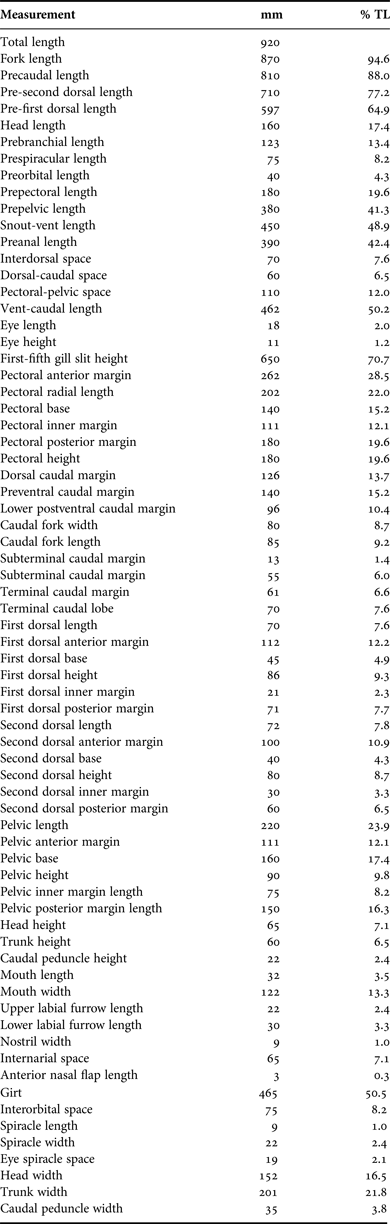
On examination after its death (Figure 2B), the main morphometric parameters were measured according to the systematic keys of Compagno (Reference Compagno1984) and Serena (Reference Serena2005) and recorded to the nearest mm (Table 1).
Morphometric measurements of Squatina squatina specimen (Compagno, Reference Compagno1984; Serena, Reference Serena2005).
The total weight (TW), eviscerated weight (EW), liver weight (LW) and gonad weight (GW) was recorded to the nearest gram. Upon dissection, the liver and gonads were removed and weighed. The eggs were counted and measured in each ovary. Both ovaries were weighed together. The hepatosomatic index (HSI) and gonadosomatic index (GSI) were calculated using the respective formulas: HSI = 100 LW/EW and GSI = 100 GW/EW.
RESULTS
The specimen was identified following the identification key by Compagno (Reference Compagno1984). Table 1 presents all of the morphometric measurements carried out on the Squatina squatina female caught in the Tyrrhenian Sea in mm and as a percentage of total length (TL). The morphology, morphometrics and colour of the specimen are in agreement with descriptions given by Tortonese (Reference Tortonese1956) and Compagno (Reference Compagno1984).
Throughout the period of its stay in the aquarium, the fish had become well-acclimatized and accustomed to captivity and its confined environment, and it had succeeded in living in perfect health for six years. In fact, on its arrival the specimen measured just 380 mm and weighed about 1900 g, and after its death it weighed 8406 g and contained no internal or external parasites as a result of an optimal state of captivity. The external examination of its body revealed an abnormal development of the pectoral fins, probably due to the limited freedom of movement induced by captivity (Figure 3).
Particular shape of the pectoral fins (arrow).
Dissection showed that the liver (W = 1906 g) occupied a large area of the body cavity and a visible asymmetry between the two liver lobes was observed. The calculated HSI was 24.12. In the right ovary there were 17 yellow yolk oocytes, but only five in the left ovary. We noted that the oocytes were not equally distributed in both ovaries. The diameter of the oocytes ranged from 2 to 9 mm (mean 5.01 ± 1.9). Both ovaries were functional and together weighed 64.8 g. This contrasts with the marked asymmetry described in other species of angel sharks; in fact, in Squatina argentina, Cousseau (Reference Cousseau1973) described the right ovary as atretic, while Natanson & Cailliet (Reference Natanson and Cailliet1986) reported a non-functional ovary in Squatina dumeril and Squatina californica.
The correct ovary functionality suggests that, even in captivity, the animal was carrying on a regular reproductive cycle, in accord with Capapé et al. (Reference Capapé, Quignard and Mellinger1990). Despite the state of captivity, dissection showed a considerable thickness of the abdominal muscle bundles.
DISCUSSION
In the Italian survey, captures of Squatina squatina were rarely reported (Relini et al., Reference Relini, Biagi, Serena, Belluscio, Spedicato, Rinelli, Follesa, Piccinetti, Ungaro, Sion and Levi2000). Squatina squatina was reported from trawl surveys carried out in the Adriatic Sea in 1948, but some authors have indicated that this species may now be absent from this area (Jukic-Peladic et al., Reference Jukic-Peladic, Vrgoc, Krstulovic-Sifner, Piccinetti, Piccinetti-Manfrin, Marano and Ungaro2001). Indeed, evidence points to angel sharks being absent nowadays from most of the Mediterranean coastline.
Even though angel sharks have represented a low value by-catch for Mediterranean commercial fisheries (Piccinetti et al., Reference Piccinetti, Ungaro, Sion and Levi2000), their low resilience to exploitation has determined their near-disappearance from the bottoms and their inclusion among the endangered and even critically endangered species on the IUCN Red List (Froese & Pauly, Reference Froese and Pauly2013).
There is still a lack of data on the status of this species in the southern Mediterranean and active conservation measures must be made appropriate for the protection of this species. In fact, the OSPAR Commission, in its report entitled ‘Background document for angel shark Squatina squatina’ (Fowler, Reference Fowler2010), suggests the adoption of conservation and monitoring tools so that all stakeholders (legislative bodies, fishing operators and research bodies) are encouraged to acquire: historic records (location, dates and abundance); current location, dates and number of bycatch (returned to the sea) and sea angling records (including tag and release); and individuals in captivity (with a view to facilitating life history and genetic studies).
The present finding is the first documented occurrence of S. squatina off the north coast of Sicily in the last 25 years, in spite of the continuous surveying and monitoring of the fishing capacity in this Sicilian zone, and is proposed as a useful tool for raising attention to the state of this delicate species.