Introduction
The cotton bollworm, Helicoverpa armigera (Hübner) (Lepidoptera: Noctuidae), exhibits a facultative pupal diapause that is regulated by temperature and photoperiod (Reed, Reference Reed1965; Cullen & Browning, Reference Cullen and Browning1978; Browning, Reference Browning1979; Roome, Reference Roome1979; Nibouche, Reference Nibouche1998; Qureshi et al., Reference Qureshi, Murai, Yoshida and Tsumuki1999, Reference Qureshi, Murai, Yoshida and Tsumuki2000). When larvae of the Okayama population of this species are reared at 20°C, pupal diapause is induced by a short photoperiod (10L:14D), but not by a long photoperiod (14L:10D) (Qureshi et al., Reference Qureshi, Murai, Yoshida and Tsumuki1999, Reference Qureshi, Murai, Yoshida and Tsumuki2000). Furthermore, we have recently identified, by transferring larvae of various instars and pupae between long and short photoperiods, that the early fifth larval instar is the main photosensitive stage for pupal diapause determination in the Okayama population (Kurban et al., Reference Kurban, Yoshida, Izumi, Sonoda and Tsumuki2005).
Photoperiod is the major environmental stimulus for diapause induction in most insect species (Danilevsky, Reference Danilevsky1961; Tauber et al., Reference Tauber, Tauber and Masaki1986; Danks, Reference Danks1987). However, temperature also plays a very important role in diapause induction of H. armigera (Hackett & Gatehouse, Reference Hackett and Gatehouse1982; Qureshi et al., Reference Qureshi, Murai, Yoshida and Tsumuki1999). Many individuals in the Okayama population collected from fields enter diapause at 20°C under a short photoperiod, but some individuals do not (Qureshi et al., Reference Qureshi, Murai, Yoshida and Tsumuki2000). Furthermore, photoperiod insensitive non-diapausing individuals have been commonly present in field populations from Okayama Prefecture for several years (H. Yoshida et al., unpublished observation).
However, it is not known whether or not pupal diapause of these photoperiod-insensitive non-diapausing individuals is induced by moderately low temperature such as 15°C. Furthermore, their thermal sensitive stages for diapause induction are unknown. In the present experiment, we evaluated temperature as a stimulus for diapause induction and identified the thermal sensitive stages for diapause induction using non-diapausing strain selected at 20°C under 10L:14D from the Okayama population of H. armigera.
Materials and methods
Insects
Larvae were collected initially from cabbage fields in Ushimado (34.6°N; 134.1°E), Okayama Prefecture, Japan in September 2001. Insects were reared in the laboratory for several generations. In order to obtain non-diapausing strains, non-diapausing individuals which did not exhibit diapause at 20°C under a short photoperiod (10L:14D) were selected during three generations. The non-diapausing strain was maintained by rotation crossing among four strains. The resultant non-diapausing strain was used in the present experiment. Pupae shown in figs 1–4 are from the populations of the third generation, whereas the eighth generation was used in the experiments of figs 5 and 6. Eggs were collected daily and the larvae reared on an artificial diet according to the methods of Kurban et al. (Reference Kurban, Yoshida, Izumi, Sonoda and Tsumuki2005) with some modifications. About 150 first or second instar larvae were reared in a plastic Petri dish (diameter: 95 mm, height: 23 mm); and they were reared, in 30 ml plastic rearing vials without vermiculite on the bottom of the bottles, separately from third instar until the determination of pupal diapause.
Treatments
Larvae and pupae were transferred between 20°C and 15°C at different larval instars and pupal stages to determine the diapause incidence in different treatments. Newly oviposited eggs were held at 20°C or 15°C to which the first instar was exposed. However, pupae used in fig. 6 were obtained from larvae which were reared at 20°C from eggs and then at 15°C from third instar to pupal stage, because of the short rearing days. Larvae in individual instars and newly ecdysed pupae were transferred between the two temperatures within 24 h after moulting or pupation. Furthermore, fifth instar larvae were transferred between the two temperatures at the early (within one day after moulting) and middle (end of feeding, about 5 days after moulting) fifth instar. Forty eggs or larvae and 30 pupae were used in the individual treatments.
Diapause determination
Diapause was determined by a lack of eye spot movement. Pupae that retained eye spots in the post genal region for more than 15 days at 20°C and for 30 days at 15°C were considered to be in diapause.
Statistical analysis
Fisher's exact test for count data with Holm's multiple test procedure was used to determine the significance of differences in diapause induction rates. Data for each group were compared to data for the initial group (‘3rd’ in figs 1–4 and ‘1’ in figs 5 and 6) in each experimental series.
Results
Effect of temperature on diapause induction
When larvae were reared from eggs until pupation at 20°C, 4.4% of male and 0% of female pupae entered diapause under a short photoperiod and neither male nor female pupae entered diapause at 20°C under a long photoperiod. However, 100% of both male and female pupae entered diapause at 15°C without respect to photoperiod.
Transfers between temperatures in individual instars under a short photoperiod
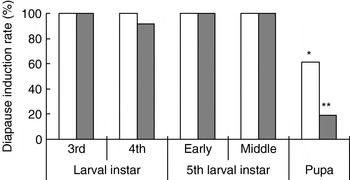
When larvae reared from eggs through to middle fifth instar at 20°C were transferred to 15°C, almost all male and female pupae entered diapause (fig. 1). The diapause incidence was comparable to that obtained by rearing at 15°C from eggs through pupae. However, when the newly ecdysed pupae were transferred to 15°C, the diapause induction rate was reduced in both males (61.1%) and females (19.0%).
Effect of transfer from 20°C to 15°C on pupal diapause incidence in Helicoverpa armigera under a short photoperiod (10L:14D). Larvae reared at 20°C were transferred to 15°C within one day in individual instars after ecdysis or pupation and at middle fifth larval instar. Significant differences were analysed between third instar larvae and the others. Significant differences were observed between middle fifth larval instar and pupa (*P<0.05, **P<0.01). □, Male;  , Female.

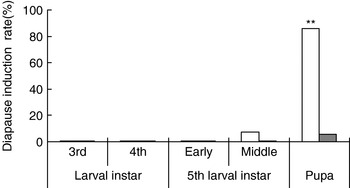
When larvae reared from eggs through to middle fifth instar at 15°C were transferred to 20°C, almost no pupae entered diapause in both males and females (fig. 2). The diapause incidence was comparable to that obtained by rearing at 20°C from eggs to pupae. However, when newly ecdysed pupae were transferred to 20°C, diapause induction rate was increased in males (85.7%), but not in females (5.9%).
Effect of transfer from 15°C to 20°C on pupal incidence in Helicoverpa armigera under a short photoperiod. Larvae reared at 15°C were transferred to 20°C within one day in individual instars after ecdysis or pupation and at middle fifth larval instar. Significant differences were analysed between third instar larvae and the others. Significant differences were observed between middle fifth larval instar and pupa (**P<0.01). □, Male;
, Female.

Transfers between temperatures in individual instars under a long photoperiod
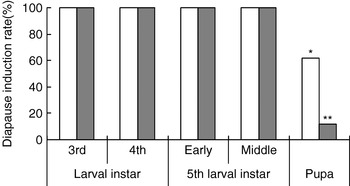
When larvae reared from eggs through to middle fifth instar at 20°C were transferred to 15°C, 100% of both male and female pupae entered diapause (fig. 3). However, the diapause induction rate of newly ecdysed pupae transferred from 20°C to 15°C was reduced in both males (61.9%) and females (11.7%).
Effect of transfer from 20°C to 15°C on pupal incidence in Helicoverpa armigera under a long photoperiod (14L:10D). Larvae reared at 20°C were transferred to 15°C within one day in individual instars after ecdysis or pupation and at middle fifth larval instar. Significant differences were analysed between third instar larvae and the others. Significant differences were observed between middle fifth larval instar and pupa (*P<0.05, **P<0.01). □, Male;
, Female.

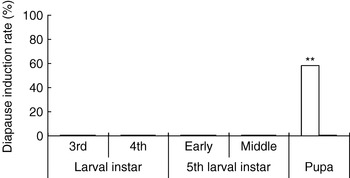
When larvae reared from eggs through to middle fifth instar at 15°C were transferred to 20°C, diapause of both males and females was not induced (fig. 4). However, diapause of ecdysed pupae transferred to 20°C was induced in males (57.9%), but not in females (0%).
Effect of transfer from 15°C to 20°C on pupal incidence in Helicoverpa armigera under a long photoperiod. Larvae reared at 15°C were transferred to 20°C within one day in individual instars after ecdysis or pupation and at middle fifth larval instar. Significant differences were analysed between third instar larvae and the others. Significant differences were observed between middle fifth larval instar and pupa (**P<0.01). □, Male;
, Female.

Transfers between temperatures during the pupal stage
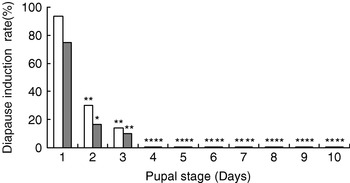
Pupae obtained from larvae reared at 20°C and 15°C were transferred to 15°C and 20°C, respectively, at different pupal stages. When newly ecdysed pupae were transferred from 20°C to 15°C, 93.3% of males and 75.0% of females entered diapause (fig. 5). However, diapause induction rate of pupae which were transferred on the third day to 15°C was reduced in males to 14.2% and in females to 10.0%.
Effect of transfer from 20°C to 15°C on pupal incidence in Helicoverpa armigera under a short photoperiod. Pupae reared at 20°C from eggs were transferred to 15°C at different intervals after pupation (‘1 day after pupation’ means that pupae were transferred within 24 h after pupation and, so on). Significant differences were analysed between the first day of pupation and the others. Significant levels are indicated with asterisks (*P<0.05, **P<0.01). □, Male;
, Female.

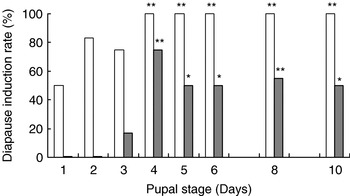
When newly ecdysed pupae were transferred from 15°C to 20°C, about 50% of males entered diapause (fig. 6). All male pupae transferred to 20°C during the fourth day to the tenth day in the pupal stage entered diapause. When female pupae were transferred to 20°C within the first three days of pupation, almost no pupae entered diapause. However, about half of the female pupae transferred during the fourth day to the tenth day to 20°C entered diapause.
Effect of transfer from 15°C to 20°C on pupal incidence in Helicoverpa armigera under a short photoperiod. Larvae were reared at 20°C from eggs and then at 15°C from third larval instar to pupal stage. Pupae were transferred to 20°C on different days after pupation (‘1 day after pupation’ means that pupae were transferred within 24 h after pupation, and so on). Significant differences were analysed between 1 day of pupation and the others. Significant levels are indicated with asterisks (*P<0.05, **P<0.01). □, Male;
, Female.

Discussion
Photoperiod has an especially important influence on the seasonal cycles of insect species in the temperate region. Therefore, diapause induction in numerous insect species in temperate regions is regulated by photoperiod (Danilevsky, Reference Danilevsky1961; Tauber et al., Reference Tauber, Tauber and Masaki1986; Danks, Reference Danks1987). Helicoverpa armigera has a facultative pupal diapause regulated by photoperiod during the larval stage (Reed, Reference Reed1965; Roome, Reference Roome1979; Nibouche, Reference Nibouche1998; Qureshi et al., Reference Qureshi, Murai, Yoshida and Tsumuki1999, Reference Qureshi, Murai, Yoshida and Tsumuki2000; Shimizu & Fujisaki, Reference Shimizu and Fujisaki2002). However, the non-selected Okayama population entered diapause at 15°C, but not at 25°C without respect to photoperiod (Qureshi et al., Reference Qureshi, Murai, Yoshida and Tsumuki1999). Furthermore, in the present study, diapause of a non-diapausing strain selected at 20°C by a short photoperiod was induced at 15°C without respect to photoperiod, showing that photoperiod acts only within a narrow temperature range of around 20°C. In original populations, which were used for artificial selection of photoperiod-insensitive non-diapausing individuals in the present study, initial average diapause incidence rate of males was 65% (n=about 600) and that of females 43% (n=about 600) at 20°C under 10L:14D (H. Yoshida & A. Kurban, unpublished observation). Furthermore, a considerable number of photoperiod-insensitive non-diapausing individuals were also present with some fluctuations in different parts of Japan (Shimizu & Fujisaki, Reference Shimizu and Fujisaki2002; Shimizu et al., Reference Shimizu, Shimizu and Fujisaki2006). These indicate that photoperiod-insensitive non-diapausing individuals are commonly present in relative abundant proportions in fields in Japan.
The main stage sensitive to photoperiodic induction of diapause determination is the early fifth larval instar, but not the pupal stage, in H. armigera (Kurban et al., Reference Kurban, Yoshida, Izumi, Sonoda and Tsumuki2005). In the present study, when third to early fifth instar larvae were transferred from 20°C to 15°C or from 15°C to 20°C, diapause incidence rate was almost 100% and 0% in both males and females without respect to photoperiod, respectively (figs 1–4). These results show that third to early fifth larval instars are not thermal sensitive stages for diapause induction in both sexes. However, when newly ecdysed pupae, within 24 h after pupation, were transferred from 20°C to 15°C, the diapause induction rate was significantly reduced in both males (P<0.05) and females (P<0.01) (figs 1 and 3). Furthermore, when newly ecdysed pupae reared at 15°C were transferred to 20°C, the diapause induction rate increased in males (P<0.01) but not in females (figs 2 and 4). In the experiment transferring from 20°C to 15°C at different pupal stages, diapause induction rates were significantly reduced in males and females during three or four days after pupation. Significant differences in diapause induction rate in both males and females was observed between the first three days and after the fourth day transfers from 15°C to 20°C (fig. 6). From the results obtained in the transfer experiments between 20°C and 15°C, the periods of middle larval instar to the second or third days in the pupal stage are thermal sensitive stages for diapause determination in males and females with some exceptions in females. The discrepancy in diapause induction rates of newly ecdysed female pupae between figs 1 and 5 may be due to the insect generations used.
Hackett & Gatehouse (Reference Hackett and Gatehouse1982), Cullen & Browning (Reference Cullen and Browning1978) and Browning (Reference Browning1979) have also reported that final larval instar to pupal stage is the thermal sensitive stage for diapause induction in H. armigera and H. punctigera (wallengren), respectively. However, they conducted the experiments without separating males and females. In the present study, the difference in response to temperatures for diapause induction was compared between sexes. Diapause induction in males needed an exposure to 15°C during either late fifth larval instar or first to third day in the pupal stage, whereas in females, late fifth larval instar to third day in the pupal stage. When female larvae or pupae were exposed to 20°C in either of these periods, diapause was not induced. Furthermore, diapause induction was cancelled in half of the females when they were exposed to 20°C from the fifth to the tenth day in the pupal stage, which is the period of the thermal insensitive stage (fig. 6). Another possibility is that half of the females of the photoperiod-insensitive strain cannot maintain diapausing states until diapause determination when they are exposed at 20°C. These results show that female pupae have more tendencies towards non-diapause than male pupae in the Japanese populations (Shimizu & Fujisaki, Reference Shimizu and Fujisaki2002). However, no significant difference in pupal diapause induction rates has been observed between males and females in Botswana populations, when temperatures are changed between 27°C and 18°C in larval and pupal stages (Roome, Reference Roome1979). The difference of response to temperatures in males and females between the Japanese and Botswana populations may be due to the different populations distributed in temperate and tropical regions, respectively. Another possibility is that fluctuating environmental factors such as temperature and photoperiod mask the sexual difference under outdoor conditions (Shimizu et al., Reference Shimizu, Shimizu and Fujisaki2006).
The present experiment suggests that sensitive stages for thermal induction of diapause in photoperiod-sensitive strains may be late fifth instar of larval and early pupal stages, which are the same stages as in photoperiod-insensitive strains, because diapause is induced both under short and long photoperiodic conditions when insects are reared at 15°C. Temperature can modify the effect of photoperiod after the photoperiodic stimulus has been received by the sensitive stage. Larvae or pupae burrowed into soil receive no photoperiodic signal. Thus, the stage sensitive to thermal induction may be developed after the middle fifth larval instar, probably during the late fifth larval instar (burrowing into soil, about the eighth day after moulting), to the early pupal stage. Consequently, temperature is the primary diapause cue in H. armigera. The present results were obtained at constant temperatures. However, environmental conditions, such as temperature and photoperiod, are changeable in the field. Even though the diapause induction rate in some insect species is affected by fluctuating temperatures (Beck, Reference Beck1983; Eizaguirre et al., Reference Eizaguirre, Lopez, Asin and Albajes1994), it has not been reported whether the thermal sensitive stage is affected by fluctuating temperatures. Therefore, the effect of fluctuating temperatures and photoperiods on thermal sensitivity remains to be proved.
Diapause of some individuals in the Okayama populations collected from fields is not induced by short photoperiods (Qureshi et al., Reference Qureshi, Murai, Yoshida and Tsumuki1999, Reference Qureshi, Murai, Yoshida and Tsumuki2000; Shimizu & Fujisaki, Reference Shimizu and Fujisaki2002). The insect is an alien insect pest, which immigrated quite recently from southern regions to Japan (Yoshimatsu, Reference Yoshimatsu1995). The effect of photoperiod on diapause induction is different for equatorial and tropical insect species (Tauber et al., Reference Tauber, Tauber and Masaki1986; Danks, Reference Danks1987). In fact, the Uganda populations of H. armigera develop with no diapause state (Coaker, Reference Coaker1959). Some individuals or strains which cannot adapt enough to the seasonal photoperiod of the invaded region are present in the Okayama population.
Because the cold hardiness level of non-diapausing pupae of H. armigera is very low, they cannot overwinter in the non-diapause state in fields (Izumi et al., Reference Izumi, Anniwaer, Yoshida, Sonoda, Fujisaki and Tsumuki2005; Shimizu et al., Reference Shimizu, Shimizu and Fujisaki2006). Even though diapause of non-diapausing strains is not induced by a short photoperiod, the diapause is induced by cold temperatures in autumn fields. In individuals of the photoperiod-insensitive strain, where diapause was induced by low temperatures and thus also acclimation occurred, their cold hardiness increased to a similar level of that of the diapausing strain (A. Kurban et al., unpublished observation). Therefore, photoperiod-insensitive non-diapausing individuals or strains may overwinter in diapause states in fields as well as photoperiod-sensitive diapausing ones. Actually, some non-diapausing strains can be collected from fields in Okayama Prefecture every year (H. Yoshida, unpublished observation).
Acknowledgements
The authors express their thanks to Dr M. Ashfaq, Research Institute for Bioresources, Okayama University for critical reading of the manuscript and useful suggestions. This study was supported in part by a Grant-in-Aid for Scientific Research (B) (14360028) from Japan Society for the Promotion of Science and Technology and by a grant from Ohara Foundation for Agricultural Research.