Used as life-saving therapy in the 1940s, the widespread misuse of antimicrobials has diminished their effectiveness, representing a rapidly growing threat to public health.1 Each year, as many as 2 million Americans will acquire serious infections caused by bacteria resistant to 1 or more antibiotics, resulting in 23,000 deaths, $20 billion in direct healthcare costs, and $35 billion in overall societal costs.2
Antibiotic prescribing and utilization practices are major modifiable drivers of antimicrobial resistance (AMR).Reference Dar, Hasan and Schlundt3 Up to 50% of US antibiotic prescriptions are neither necessary nor appropriate in outpatient and inpatient settings.2,Reference Hadler, Yousey-hindes, Kudish, Kennedy and Sacco4 AMR is a multifactorial issue that must be addressed on multiple fronts.Reference Overt and Scale5 Some suggest a 2-pronged approach: developing new antimicrobials to fight resistant strains while limiting use of current drugs to reduce rising resistance rates.Reference Kesselheim and Outterson6 Our study focuses on the stewardship of current antimicrobials in hospitals.
Several organizations, including the Centers for Disease Control and Prevention (CDC) and the Society for Healthcare Epidemiology of America (SHEA), have led national efforts to improve infection control and prescribing practices in healthcare settings.Reference Srinivasan and Fishman7 One such approach is antimicrobial stewardship programs (ASPs), a set of strategies designed to improve the appropriate use of antibiotics through optimal drug selection, dosage, duration of treatment, and administration. ASPs seek to provide effective treatment to patients while minimizing unintended consequences of antibiotic use.Reference Srinivasan and Fishman7
In 2014, the CDC started recommending the adoption of ASPs by hospitals, and they have published a checklist to assist with implementing the 7 Core Components of ASPs,8 considered a minimum standard for hospitals. Those 7 elements are related to the hospital’s infrastructure and implementation of antimicrobial stewardship activities.9 Veterans’ Affairs (VA) medical centers have required ASPs since 2014. Through the CDC National Healthcare Safety Network (NHSN), acute-care hospitals are currently required by the Centers for Medicare and Medicaid Services (CMS) to report 5 types of healthcare-associated infections (HAIs): central-line–associated bloodstream infections (CLABSIs), catheter-associated urinary tract infections (CAUTIs), select surgical-site infections (SSIs), Clostridioides difficile infections (CDIs), and methicillin-resistant Staphylococcus aureus (MRSA) infections.10
MRSA results from the development of resistant strains, but C. difficile is a bacteria with innate resistance to many antibiotics. It causes diarrheal disease after exposure to antibiotics that deplete the native microbiome and allow for its overpopulation. For that reason, CDI is considered an antibiotic adverse event and indicator of antimicrobial use, which is also why it is used as an outcome in several studies addressing antimicrobial stewardshipReference Mijović, Dubravac-Tanasković, Račić, Bojanić, Stanić and Lazarević11,Reference O’Leary, Van Santen, Webb, Pollock, Edwards and Srinivasan12 and prescribing practices.Reference Ge, Fevrier and Conell13,Reference Dantes, Mu and Hicks14 ASPs are universally recognized as essential tools in healthcare infection control efforts.Reference Balsells, Filipescu, Kyaw and Wiuff15 In hospitals, ASPs are associated with shorter hospitalizations and decreased antimicrobial consumption.Reference Karanika, Paudel, Grigoras, Kalbasi and Mylonakis16
At the state level, California has pioneered efforts to address AMR. In 2008, it started requiring hospitals to implement processes for the judicious use of antimicrobials (Senate Bill [SB] 739)Reference Trivedi and Rosenberg17 and to report rates of HAIsReference Halpin, Milstein, Shortell, Vanneman and Rosenberg18, and it has been the only state to mandate ASPs in US hospitals since 2015.19 In 2014, California SB 1311, required that, by July 1 2015, all California acute-care hospitals do the following: (1) adopt and implement an ASP in accordance with federal and professional guidelines (eg, monitoring and evaluation of the judicious use of antimicrobials); (2) form a physician-led multidisciplinary antimicrobial stewardship committee; (3) appoint to that committee a physician or pharmacist with expertise in antimicrobial stewardship through prior training; and (4) report ASP activities to appropriate hospital committees leading quality improvement activities.20
After the passage of the SB 1311, the percentage of hospitals in California that met the CDC 7 Core Elements for ASPs9 increased from 59.3% in 2014 to 69.2% in 2015Reference Rizzo, Kealey and Epson21 and to 81% in 201622; however, the effect of the California law on AMR-related outcomes remains unknown. Although many studies have examined ASPs at the hospital level, most have analyzed its impact on prescribing practices and antibiotics useReference Shah, Joshi and Ganguly23–Reference Taggart, Leung, Muller, Matukas and Daneman27 rather than directly on AMR rates. One of the major reasons for the lack of more assertive investigation is that it is difficult to analyze ASP and AMR rates across many hospitals using publicly available datasets alone.
In the present study, we estimated the impact of passing an ASP mandate in California (SB 1311) on MRSA and CDI rates in acute-care hospitals. Our hypothesis is that after 2015, MRSA and CDI rates in acute-care hospitals dropped significantly in California compared to other states.
Methods
Data sources
We merged 2013–2017 hospital-level data from the Centers for Medicare and Medicaid Services’ (CMS) Hospital Compare, Provider of Service File, and Medicare Cost Reports files. Hospital Compare compiles information about quality of care from >4,000 Medicare-certified hospitals. Provider of Service Files contain data on hospital characteristics and type of services provided, and Medicare Cost Reports include utilization and cost data as well as facility characteristics for all Medicare-certified providers.
Subjects
We identified all CMS-certified acute-care hospitals in the United States for which MRSA and CDI standardized infection ratio (SIR) data were available from 2013 through 2017. We excluded VA hospitals (different data collection period), children’s hospitals (different case mix and/or hospital epidemiology), and critical-access hospitals. The latter are required to report infection data only in some states, and most do not have the minimum number of infections required to calculate the SIR.
Measures
We considered 2 primary outcomes: MRSA SIR and CDI SIR. The Hospital Compare system uses infection data from the CDC NHSN, which calculates each hospital’s MRSA SIR (ratio of MRSA bacteremia laboratory-identified events to the predicted number of MRSA bacteremia events) and CDI SIR (ratio of CDI laboratory-identified events to the predicted number of CDI events).
MRSA predicted events are calculated by the NHSN based on admission prevalence rate of MRSA infections, average length of stay, medical school affiliation, type of hospital, number of ICU beds, and amount of MRSA infections identified in the emergency department and/or observation units. CDI predicted events are calculated using the type of laboratory test used to identify CDI, whether the hospital has emergency departments and/or observation units that collect stool specimens for C. difficile testing, facility bed size, number of ICU beds, medical school affiliation, admission prevalence rate of CDI, and type of hospital. The MRSA and CDI SIRs are calculated only for hospitals with at least 1 predicted event.10
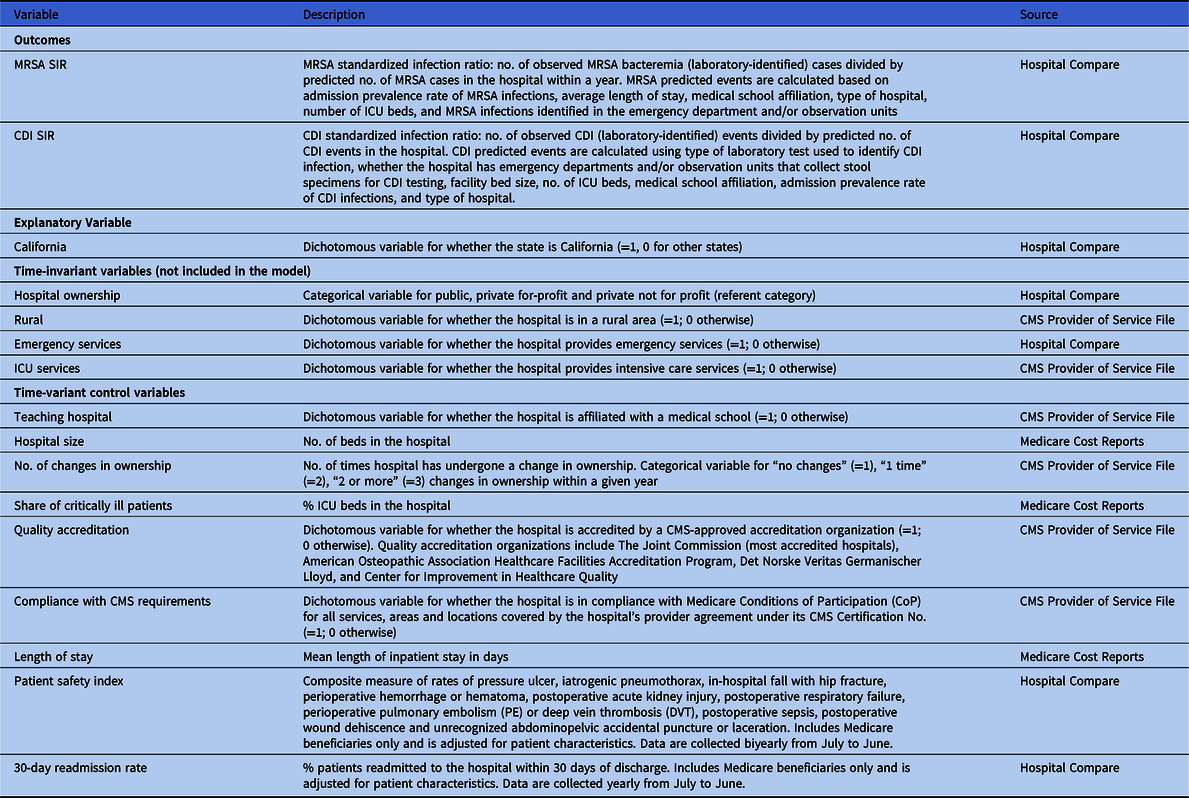
Our main explanatory variable was whether a hospital is located in California. Time-varying control variables in the models included medical school affiliation, bed count, quality accreditation, number of changes in ownership, compliance with CMS requirements, % intensive care unit beds, average length of stay, patient safety index, and 30-day readmissions rate. Operational definitions for each variable are provided in Table 1.
Data Source and Variables Description, 2013–2017
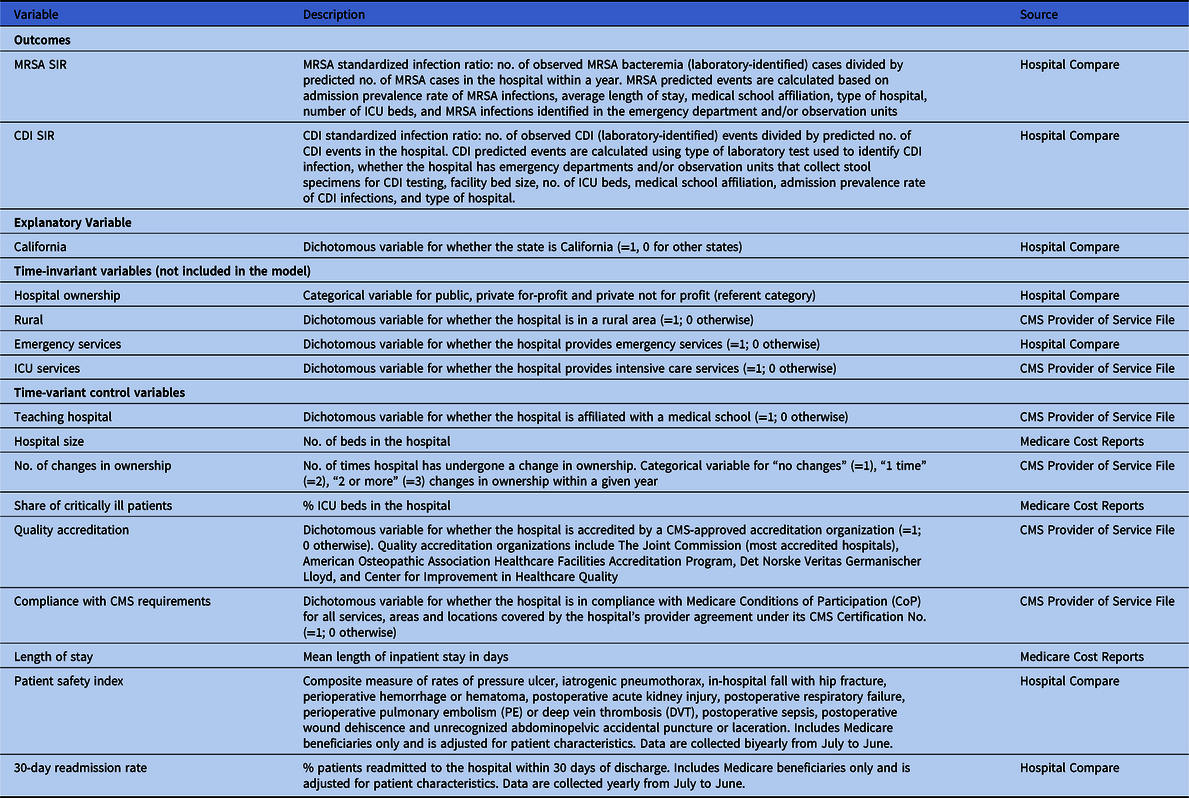
Note. MRSA, methicillin-resistant Staphylococcus aureus; SIR, standardized infection ratio; CDI, Clostridioides difficile; CMS, Centers for Medicare and Medicaid Services; ICU, intensive care unit.
Analysis
Using panel data, we estimated a difference-in-difference (DID) model with hospital fixed effects for each outcome (MRSA SIR and CDI SIR). We chose a hospital fixed-effects model because it controls for both unobserved as well as observed time-invariant hospital-specific characteristics such as location (state, rural, vs urban), hospital ownership, teaching status, specialty hospital, patient case mix, and structural factors (eg, infection control team, number/distance of sinks around hospital rooms, ability to track lab results electronically, safe surgery check lists, etc). Those characteristics are likely related to both our key variable of interest (being in California) and our outcomes (MRSA and CDI SIRs) and could confound the relationship estimated. Because several of these variables are not observed and are mostly time invariant, the hospital fixed-effects model was chosen over other estimation methods.
We confirmed our model specification using Hausman tests between a fixed-effects versus ordinary least-squares model, and a fixed-effects versus random effects model. In both cases, coefficients in the fixed-effects model were significantly different from the other estimation methods; therefore, we selected the fixed-effects estimation to obtain consistent parameter estimates.
For the DID approach to provide unbiased estimates, 2 assumptions should hold. First, California is the only state being impacted by the policy change and there is no other shock happening at the same time. This assumption is reasonable because California was the only state to pass such legislation during the study period (2013–2017).19 Second, California and the other states should have parallel trends for MRSA and CDI SIRs in the pretreatment period. This assumption was tested by including the interaction between each year and our key explanatory variable. Robust standard errors were used to address heteroscedasticity among hospitals of varying sizes.
For sensitivity analyses, we estimated the models again including healthcare-associated infection (HAI) variables (ie, CLABSI, CAUTI, and SSI) as controls because HAIs may be confounders in the estimated relationship. We also estimated the models again excluding states with <30% and <40% hospital adoption of the CDC’s 7 Core Components for ASPs from the control group. Because California had an initial high compliance with the 7 Core Elements, hospitals in states with higher compliance could provide a better counterfactual comparison for California hospitals in this analysis.
Results
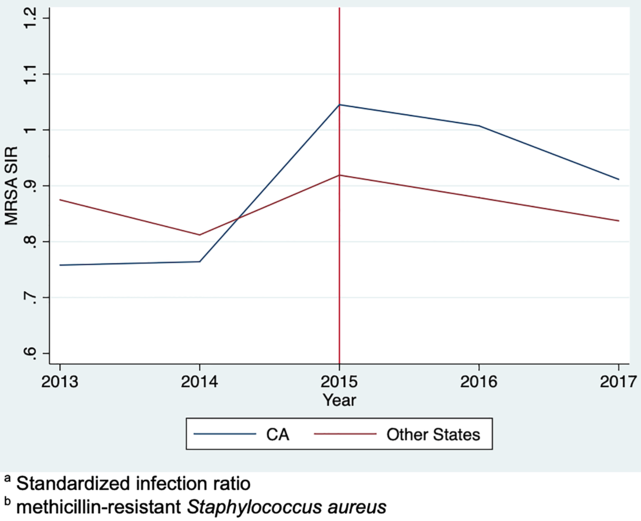
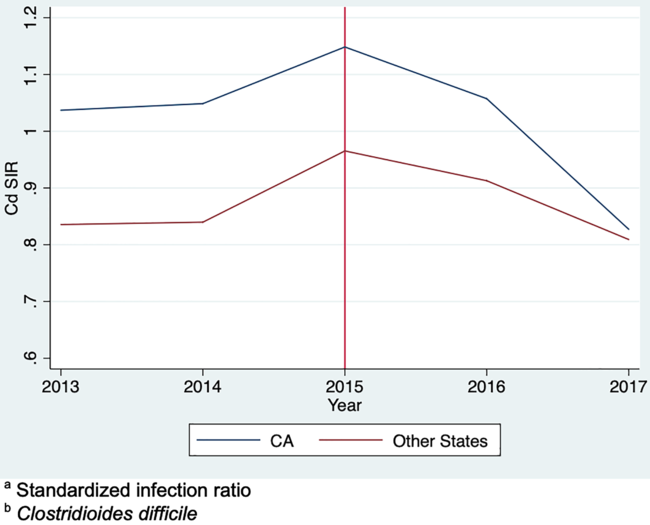
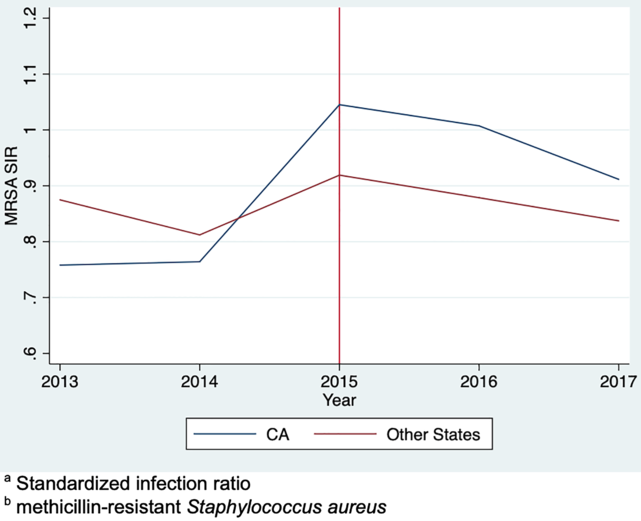
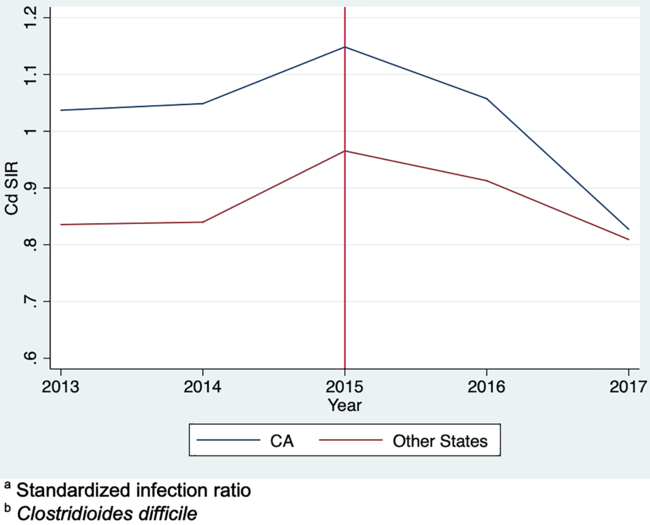
We included data for 2,016 and 3,163 acute-care hospitals in the United States in the MRSA and CDI models, respectively, which corresponds to 51.9% and 81.5% of the total acute-care hospitals in the country. For MRSA, the SIR peaked in 2015 then started to decrease in California hospitals; other states had a less steep upward trend for MRSA in 2015 (Fig. 1). For CDI, trends were very similar between California and other states before the mandate, with a steeper decrease in California after the mandate (Fig. 2).
Standardized infection ratio (SIR) for methicillin-resistant Staphylococcus aureus (MRSA) in California versus other states, 2013–2017.
Note. Starting in 2015, a new baseline is used for SIRs.
Standardized infection ratio (SIR) for Clostridioides difficile infection (CDI) in California versus other states, 2013–2017.
Note. Starting in 2015, a new baseline is used for SIRs.
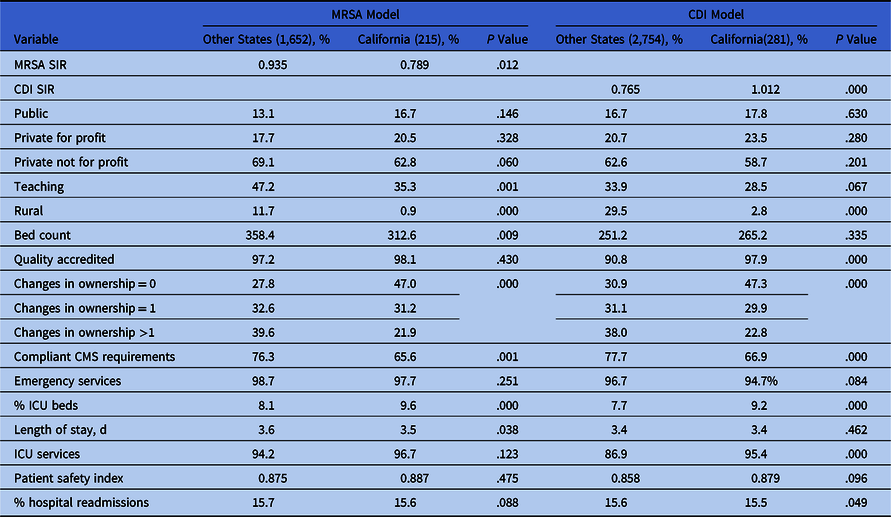
In 2013, the average SIR in California hospitals was 0.79 for MRSA (vs 0.94 in other states) and 1.01 for CDI (vs 0.77 in other states). Compared to other states, in terms of hospital characteristics, California hospitals were larger; had a higher percentage of ICU beds and quality-accredited hospitals; and had a lower percentage of hospitals that were teaching, rural, had changed ownership, and were compliant with CMS requirements (Table 2). The sample sizes in both Tables 2 and 3 are larger for the CDI model because there were more hospitals for which the CDI SIR was available because it is a more common infection.
Descriptive statistics for MRSA and CDI model by California Versus Other States in 2013
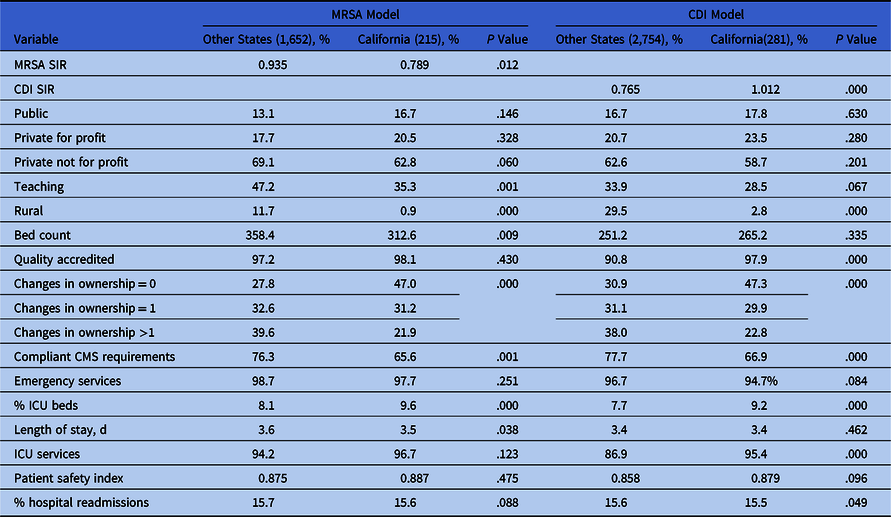
Note. MRSA, methicillin-resistant Staphylococcus aureus; SIR, standardized infection ratio; CDI, Clostridioides difficile infection; CMS, Centers for Medicare and Medicaid Services; ICU, intensive care unit.
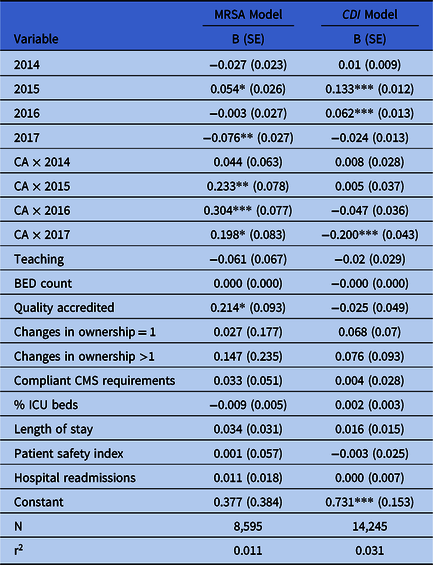
Regression-Adjusted Estimates for the Effect of the ASP Mandate in California on MRSA and CDI SIRs, 2013–2017
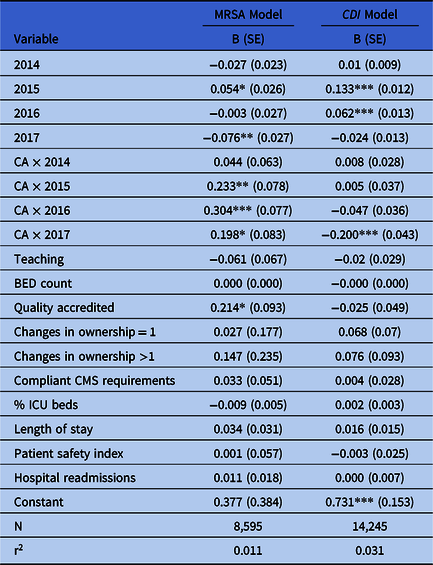
Note. ASP, antimicrobial stewardship program; MRSA, methicillin-resistant Staphylococcus aureus; CDI, Clostridioides difficile infection; SIR, standardized infection ratios; CMS, Centers for Medicare and Medicaid Services; ICU, intensive care unit.
* P < .05.
** P < .01.
*** P < .001.
Compared to hospitals in other states, California hospitals had increases (P < .05) of 23%, 30%, and 20% in their MRSA SIR in 2015, 2016 and 2017, respectively, though there was a downward trend after 2016 relative to other states. California hospitals were associated with a 20% (P < .001) decrease in their CDI SIR only in 2017 (Table 3). Time trends were significant in 2015 and 2017 in the MRSA model and in 2015 and 2016 in the CDI model. Quality accreditation was associated with an increased MRSA SIR.
In sensitivity analyses, results were robust to the inclusion of other healthcare-associated infection variables (CLABSI, CAUTI, and SSI) and the exclusion of states with <30% and <40% hospital adoption of the CDC 7 Core Components for an ASP.
Discussion
We analyzed whether California SB 1311 supporting ASPs reduced MRSA and CDI in acute-care hospitals. Our results show that the California mandate had a significant association with MRSA and CDI SIRs, and surprisingly, that association was in the opposite direction for MRSA.
CDI SIR decreased after the mandate
Our findings support our hypothesis that the mandate in California would be associated with a reduction in the SIR for CDI. The mandate introduced in SB 1311 was associated with a significant decrease in CDI SIR in 2017, but a sharper downward trend occurred in 2015 compared with other states (Fig. 2). Other studies have also shown a decrease in CDI rates after restricting antimicrobial use.Reference Talpaert, Rao, Cooper and Wade28,Reference Vernaz, Sax, Pittet, Bonnabry, Schrenzel and Harbarth29 One study showed a 19% decrease in CDI SIR after implementing antibiotic preauthorization combined with clinician education.Reference Christensen, Barr and Martin30 Another study detected a decrease as large as 66% in incidence of CDI (incidence rate ratio, 0.34) after implementing revised antibiotic guidelines.8
Moreover, hospital antibiotic prescribing could be improved in 37% of the cases, and a 30% reduction in broad-spectrum antibiotic use could result in a 26% decrease in CDI infections.Reference Fridkin, Baggs and Fagan31 In the outpatient setting, a 10% reduction in antibiotic prescribing was associated with a 17% decrease in CDI rates.Reference Dantes, Mu and Hicks14
In a systematic literature review, ASP interventions in several different countries were associated with a decrease in CDI incidence in 62.5% of the studies analyzed, especially in those implementing antimicrobial use restrictions, despite heterogeneity of interventions and ways in which outcomes were reported.Reference Mijović, Dubravac-Tanasković, Račić, Bojanić, Stanić and Lazarević11 These findings are consistent with the fact that antibiotic use is the main driver for CDI; therefore, CDI rates should respond more quickly to changes in ASPs than MRSA.Reference Tamma, Avdic, Li, Dzintars and Cosgrove32
MRSA SIR increased after the mandate
One plausible explanation for the increase in the MRSA SIR in California is that hospitals may have introduced processes and structures to proactively identify AMR cases (including MRSA), which peaked in 2015 and then started decreasing (Fig. 1). Notably, California had a lower MRSA SIR before the enactment of SB 1311, which may also have contributed to our findings. Furthermore, the impact of ASPs is likely stronger for gram-negative microorganisms because most of the restricted antibiotics are primarily for gram-negative bacteria, which is not the case for MRSA.
Another explanation is that resistant strains are not likely to respond immediately to improved stewardship efforts, in part, because MRSA control is also dependent on improving infection prevention (ie, increased hand hygiene, improved environmental disinfection, and reducing risk of CLABSI) and because MRSA is very prevalent in the community (not only in healthcare settings). A 3-year ASP intervention, for example, was associated with increased MRSA incidence.Reference Conlon-Bingham, Aldeyab and Scott33 However, a study that analyzed data from 6 postintervention years found a large and significant reductions in MRSA incidence in the last 2 years of the study.Reference Zhang, Cui and Wang34
MRSA and CDI SIRs increased in 2015
One explanation for the 2015 increase in both MRSA and CDI SIR in California and other states was the new baseline and improved method the NHSN used to calculate predicted events starting in 2015. In prior years, the baseline years used to calculate predicted infections were 2010 and 2011. According to the CDC, with the new baseline, MRSA and CDI SIRs should shift closer to 1 nationwide,35 probably because of the improvements in predicting number of infections in each hospital. Because the re-baseline was implemented for all hospitals and, therefore, states nationwide, and because our analysis included time-variant fixed effects, this change should not have biased our estimates.
Other ASP initiatives
In 2008, California had already passed SB 739 requiring hospitals to implement processes for evaluating the judicious use of antimicrobialsReference Trivedi and Rosenberg17; as of 2017, California was the only state to have passed legislation requiring hospitals to implement specific ASP measures (SB 1311).19 However, several other factors may have increased ASP adoption in hospitals. These included increases in state-mandated CDI reporting,Reference Reagan, Herzig, Pogorzelska-Maziarz, Dick, Stone and Srinath36 voluntary adoption of hospital ASPs nationwide after the CDC launched the 7 Core Components for ASP,Reference O’Leary, Van Santen, Webb, Pollock, Edwards and Srinivasan12,Reference Pollack, Santen, Weiner, Dudeck, Edwards and Srinivasan37 and the Joint Commission’s new antimicrobial stewardship requirements that went into effect in 201738 (with a draft document circulating already in 2016). Both programs affect all CMS-certified hospitals nationwide, so our estimates should not have been affected.
Regional and local initiatives may have also increased ASPs. For example, Missouri SB 579, passed in 2016, required strict reporting of HAIs and implementation of ASPs statewide by the end of 2017, although it did not provide specific ASP standards to be implemented.39 In addition, the largest healthcare system in Utah has been actively promoting ASP implementation in small community hospitals in the past few years.Reference Stenehjem, Hersh and Buckel40 Despite those scattered initiatives, a significant association between the California mandate and CDI and MRSA rates still exists in acute-care hospitals.
Our study has several limitations. First, we could only assess 2 years of postintervention data; to the extent that MRSA and CDI rates would continue to fall, we would underestimate the impact of the legislation. Second, although adoption of the CDC 7 Core Components for ASPs by California hospitals increased from 58% in 2014 to 81% in 2016,22 we were not able to estimate the differential impact of specific antimicrobial policies or ASP components, only the overall impact of the mandate. Third, because fixed-effect models are an inefficient estimation method, we may have failed to detect smaller, statistically significant differences. The external generalizability of the results is also limited; they can only be extrapolated for adult acute-care hospitals not part of the VA system that have reported at least 1 MRSA/CDI case to the NHSN. Finally, although our data support the parallel trends assumption, we only had 2 years of pretreatment data, and we were not able to verify time trends before that period.
In conclusion, our analysis provides evidence that the 2015 California mandate was associated with a decrease in CDI rates in 2017. A sharper decrease in CDI after 2015 is consistent with the fact that CDI rates are driven largely by antibiotic use. Contrary to our hypothesis, the California ASP mandate was not associated with an immediate decrease in the MRSA SIR. More data on postintervention years are needed to assess the long-term impact of the mandate.
This study has several policy implications. It is the first to shed light on a major and persistent healthcare problem by measuring the impact of a statewide ASP mandate. Results from this study can be used by healthcare administrators to understand the impact of antibiotic prescribing practices on patient and financial outcomes in their institution, to promote action toward adopting or improving their ASP according to federal guidelines, and to bring awareness of a possible underidentification of AMR cases. Furthermore, healthcare advocates and policy makers can use evidence from this study to assist hospitals implement ASPs and advocate for legislation at the regional and state levels. Because most US states do not have ASP legislation in place, this study can also serve as evidence for implementing regulation that requires a minimum standard ASP in acute-care hospitals. Future research should evaluate the effect of other ASP mandates as additional states pass this type of regulation.
Acknowledgments
We thank Jason Rotter for his valuable contributions to the data analysis.
Financial support
No financial support was provided relevant to this article.
Conflicts of interest
All authors report no conflicts of interest relevant to this article.