

In 1891, Charme dangereux, the latest release from the prolific novelist André Theuriet, hit the shelves. It told the story of a staid Parisian, Jacques, who succumbs to the charms of a mysterious Russian princess, the unforgettably named Mania Liebling, while vacationing in Nice. She first catches his eye at the Théâtre Municipal during a performance of Don Giovanni:
After the conclusion of the trio des masques, the singers were recalled and an ovation was given to Ludkof. All of a sudden, from amid the upstanding crowd, voices called for ‘the Russian anthem!’ The curtain, already half dropped, rose, the soloists and choir reappeared on the stage and the orchestra struck up the first bars of the Russian national air. In the blink of an eye, the whole room was on its feet, and it made a striking effect: the sight of these three tiers of boxes, decorated with bare-shouldered young ladies, applauding with excitement. With each word of the hymn, the demonstration heightened, the audience in the orchestra stalls letting out loud cheers and stamping their feet. An electric thrill shook all these souls. Mouths opened wide to hurl out acclamations, ladies tore the flowers from their corsages and threw them onto the stage, men frantically waved their hats. Jacques looked to the box on the first level; the unknown woman in white, eyes lit up, breast heaving, had torn off her gloves and was striking the palms of her little bare hands together, as if to bruise them.Footnote 1
Beyond its function as a rather unsubtle plot device, this outpouring of enthusiasm for Russia might seem incongruous. Yet Theuriet’s description is made up of near-direct quotes from newspaper reports of a real-life event: on 30 January 1890,Footnote 2 midway through the French-language premiere of A Life for the Tsar at the Théâtre Municipal in Nice, the audience had risen for the Russian national anthem with excited cries of ‘Vive la Russie! Vive la France!’Footnote 3 Afterwards, the Marseillaise was sung, before both anthems were repeated. The reaction was so heated, so unprecedented – and so many critics from Paris were there to witness it – that it was vividly related in all the local and many of the national papers in the following days. Never before had an opera performance in Nice provoked such widespread interest. Reviewers on all sides declared that the premiere had ‘achieved a double success: the first, from an artistic point of view, and the second, from a political one’.Footnote 4
The reason, in part, was that France and Russia were on the verge of a critical alliance. After the Franco-Prussian War (1870–1), France had been left diplomatically isolated. Then, in 1882, Russia also became vulnerable following Bismarck’s consolidation of the Triple Alliance (Triplice) between Germany, Austro-Hungary and Italy, and negotiations began for a Franco-Russian entente, the terms of which would be drafted in 1892 and finalised in 1894. The period has frequently been described as one of mounting chauvinism, in which French music critics became increasingly hostile towards the importation of foreign repertoire.Footnote 5 After all, the humiliating losses suffered during the Franco-Prussian War, combined with the threat of the new central European alliance, left many anxious over the country’s waning political and cultural prestige in comparison with the growing strength of the new Italian and German nation states. None of this, however, would stop audiences flocking to foreign operas, leaving critics in a double bind: while internationalism in the opera house could not be explicitly encouraged, to ignore foreign repertoire would be to risk sacrificing Paris’s position as a leading cultural centre.
In this context, the approaching alliance led some to frame Russian music as an ideal foreign import – something that would maintain international connections, without compromising nationalistic agendas. And although the early French reception of Russian music has been explored to an extent, the story typically focuses around moments in which this repertoire was treated as an exotic import, such as the special Russian nights held during the Parisian Universal Expositions of 1878 and 1889.Footnote 6 The next major event to receive attention is then the arrival of Sergei Diaghilev in 1907, which famously led to years of sensational seasons of Russian ballet and opera. Revisiting these incidents is undoubtedly important for understanding the roots of one of the most frequently discussed problems in the reception of Russian composers: that their popularity in the West has often been dependent on their supposed ‘Russianness’.Footnote 7 At the same time, however, this focus paints a picture of Russian musical culture as structurally isolated, and with little in it of interest to its westerly neighbours beyond novelty. Such narratives, as I seek to demonstrate here, require nuancing through investigation into a broader range of moments of cultural contact, and by uncovering more complex processes of musical migration.Footnote 8
In what follows, I explore how it was that in this period of new alliances, A Life for the Tsar (and not a French opera) became so important for the Théâtre Municipal in Nice, an institution thoroughly on the periphery of the French opera network. Building on recent investigations of operatic decentralisation in France by Katharine Ellis and Clair Rowden, I explore both the desire in Nice for Parisian recognition, and also why Nice, rather than Paris, was first to stage Russia’s cornerstone opera.Footnote 9 But there was more to this premiere and its raucous reception than concerns about the state of the French nation, or of Niçois musical life. After all, many in the audience were foreign tourists rather than local patriots. Such a reaction, therefore, would not have been possible were it not for the right publicity, the right guests and a carefully choreographed first night.
The Arrival of Gunsbourg
The driving force behind the French premiere of A Life for the Tsar was the new director at the Théâtre Municipal, Raoul Gunsbourg (1860–1955). Though born in Romania, Gunsbourg spent his career lucratively marketing France to Russia and, later, Russia to France; he was, it could be said, the model of a transnational intermediary. Having lived in Paris as a medical auditor, he moved to Moscow in 1880 to work as an actor at a French Salon des Variétés. After the assassination of Tsar Alexander II the following year, all the state theatres were temporarily closed for public mourning, but foreign institutions were permitted to remain open. Gunsbourg seized the opportunity and took over as manager of the Salon, transformed it into a Théâtre des Variétés, and began staging plays and operettas in French.Footnote 10 With the revocation of the Imperial theatre monopoly in 1882, full-length French-language operas were permitted for the first time in Russia in almost seventy years.Footnote 11 Gunsbourg gradually worked his way up, directing open-air theatres and private performances for Alexander III, until, in 1888, he was appointed to the Arcadia Theatre, where he staged full-scale French-language operas for the paying public.Footnote 12
Once well established in Russia, Gunsbourg began to spend his winters directing in France, first in Lille (1888–9) and then Nice (1889–92).Footnote 13 His tenure at the Théâtre Municipal, however, had an uncertain start. The opera season was no small matter for the people of Nice, and when municipal council meetings were held to select the director in April 1889, large crowds turned out to have their say.Footnote 14 ‘This question, as we know’, a report read in the leading local paper, Le Petit Niçois, ‘is one of utmost importance and can have a serious influence on the success of our winter season, in which the performances given at the magnificent hall on the rue St-François-de-Paule constitute one of the main attractions.’Footnote 15 The ‘winter season’, which ran from November to April, saw thousands of wealthy visitors flock to Nice for the mild climate and the chance to mingle with aristocrats from across the globe. Their expenditure determined the economic wellbeing of the city, making it vital that the opera house, the centrepiece of the season, was a success.
Despite being shaped by the habits and tastes of outsiders, the Théâtre Municipal had become a hotly contested space for expressing local identity. Gunsbourg’s election took place just as the city’s first ever French-language municipal opera season, under its first ever French director, was drawing to a close. Although Nice had been ceded to France from the Kingdom of Sardinia in 1860, the language, directors and much of the repertoire of the Municipal Theatre had remained Italian until 1888, when a four-year campaign to switch the language of the theatre from Italian to French finally came to fruition.Footnote 16 Since 1871, pro-Italian separatists, under the banner of their newspaper, Il pensiero di Nizza, had campaigned to retain Italian opera in Nice.Footnote 17 They eventually lost out to the French nationalists, led by Henry Hardy-Polday through the local journal, Le Rabelais, which described the Francification of the theatre as the top priority in the fight against ‘Italianisms’ (italienneries) in the city, ahead of guarding the French-Italian border and eliminating separatist newspapers and societies.Footnote 18 In 1888, Italian impresario Edoardo Sonzongo was replaced with the French Auguste Taillefer, and, as a show of support for the theatre’s national rebranding, the council made a considerable increase to the opera subsidy, raising it from 72,000 to 100,000 francs.Footnote 19 Some members of the municipal council even proposed adding a clause to the cahier des charges dictating that the director of the theatre must be of French nationality.Footnote 20 Though the motion was not passed, there was public outcry and rioting at the Théâtre Municipal when it was announced that Taillefer was being replaced, after just one season, by someone called ‘Gunsbourg’.Footnote 21 The local papers released various assurances that, despite his name, he was definitely not German. Gunsbourg nevertheless had much to prove if he wanted to secure a second term.
One obvious method of ensuring that the season was at least financially stable would be to stage an opera that piqued local interest. A Life for the Tsar, still one of the most frequently performed operas in Russia, was sure to appeal to the city’s sizeable Russian community. Though Nice had attracted Russian visitors since the eighteenth century, it had become a particularly fashionable winter destination after 1856, when Nicholas I’s widow, Alexandra Feodorovna, and her entourage began to make extended visits, setting up home at the villa Avigdor annually until her death in 1860.Footnote 22 She also had an Orthodox chapel, the first in France outside of Paris, erected on the Rue Longchamp, creating a focal point for an emerging Russian quarter.Footnote 23 By 1880, the Russians were the third most numerous visitors to Nice (after the French and British), and had established a substantial permanent presence there.Footnote 24
In recognition of this influential demographic, Gunsbourg’s whole first season had an unusually Russian bent. As well as producing A Life, he used his Russian connections to book the ballerina Virginia Zucchi, a firm favourite on the Russian stage. By the time subscriptions went on sale in October 1889, both A Life and Zucchi had been announced for the coming season,Footnote 25 and one notice reported that ‘the Russian colony, [which is] so well represented in our city, has proven extremely quick to fill the boxes and orchestra stalls, and the number now registered far surpasses that of previous years’.Footnote 26 But, it was not simply by pandering to the Russian community that Gunsbourg could hope to secure his re-election; he would also use his season showpiece to help put Nice on the map, thus proving not only his local but also his national loyalties.
Nice through Parisian eyes
The journey is short, but the route delicious, along this silk-fringed ribbon of coast … Come! We’ll bid adieu to the mists of the Seine. We’ll forget, for a time, the failings of men, the sadness of things.Footnote 27
After the deregulation of the theatres in 1864 under Napoléon III, and even more so after the Franco-Prussian War, theatres in the provinces had struggled to hold grand opera seasons due to a lack of funds.Footnote 28 By 1890, however, things were looking up. When the Théâtre-Lyrique in Paris closed in 1877, just two state-funded opera theatres were left in the capital—the Opéra and Opéra-Comique—meaning that spare funds and the position of the nation’s third opera house were up for grabs.Footnote 29 Moreover, with the cahiers des charges of the Opéra and Opéra-Comique restricting their repertoire to just two novelties per season, there was insufficient space for the vast supply of new operas being written. Composers began to look to theatres further afield, thus lending further incentive, and further opportunities, for regional stages to make their mark.Footnote 30 Back in 1877 and 1879, Lyon had established itself as a potential contender for France’s third opera house, with premieres of Gounod’s Cinq mars and Saint-Saëns’s Etienne Marcel; but it was only around a decade later that theatres in the provinces were really beginning to rival Paris. Following a Parisian-led campaign in 1888, Rouen’s Théâtre des Arts, for instance, presented itself as a viable extension to the capital’s opera scene through premieres of Saint-Saëns’s Samson et Dalila and Albert Cahen’s Le Vénitien on 3 March and 14 April 1890 respectively, as well as the first successful French performance of Wagner’s Lohengrin in 1891.Footnote 31
Yet while Nice was on its way to becoming France’s fifth most populous city, and despite its opera house receiving a considerable municipal subsidy, attracting eminent soloists and giving packed six-month seasons every year, it remained far from being counted among the leading regional centres for opera.Footnote 32 For a start, having been Italian until 1888, the Théâtre Municipal had only recently become an eligible extension of the French opera network. What is more, the physical distance of Nice from Paris, combined with its predominantly Niçard-speaking local population (an Italianate French dialect), rendered the city separate in practical terms. And things were further complicated, first by questions over the city’s conceptual connections to France and second, by the feeling that its cosmopolitan, elitist opera scene belonged in a past age.
For readers of Theuriet’s Charme dangereux, the symbolism of the foreign, carefree ‘woman in white’, Mania, who seduces the restrained Frenchman, Jacques, would not have been difficult to decipher. Nice, at the time, was typically depicted by writers in the capital as a destination for the French to escape to, rather than to inhabit. Even in appearance, the Comté de Nice seemed something of an alien place. Its landscape, with its stretches of unindustrialised land, azure seas, bright sun, orangeries and palm trees, little resembled the densely populated, damp north. The exotic plants imported to the region from across the Mediterranean even meant that Parisian observers were more likely to compare the area to Africa or the Orient than to the rest of France.Footnote 33 When critics came to Nice from Paris to report on A Life for the Tsar in 1890, many started their accounts with wide-eyed descriptions of the scenery. Henri Bauer of L’Echo de Paris, for instance, began his review:
Here, we have the sun, the pleasure of life in the sweet fresh air and by the blue water. It is a contrast to the fog and mud in which you are currently paddling, dear Parisians, my brothers, who are accustomed to hellish winter. Ah, how soothing the sojourn in this blossoming corner of the world, blessed with the sun’s caresses.Footnote 34
Fresh air and fog, blue water and muddy puddles, pleasure and struggle, paradise and hell; in each pairing, the former belongs to the unfamiliar world Bauer is in the midst of discovering, the latter, to his French ‘brothers’ in Paris.
Mania Liebling’s cosmopolitanism (she is a Russian princess of Galician heritage with an Austrian husband) embodied another of the city’s most characteristic traits. Since the late eighteenth century, Nice had attracted visitors from far afield as a destination for the sick to take the sea air. From the 1860s, however, the influx of foreign visitors increased dramatically, as a result of both the annexation to France and the railway, which reached the south in 1864.Footnote 35 In the 1870s and 1880s, tourism boomed and it became fashionable for wealthy families from Britain, Russia, Germany, Austria and the United States to migrate for the winter simply for leisure.Footnote 36 Even the people in Nice could therefore lead Parisians to forget they were in France.
Nice was also deemed morally distant, as suggested by Mania’s ‘charme dangereux’ and the plot of Theuriet’s novel, which reflected the city’s reputation as a place of luxury and hedonism. The winter residents (‘hivernants’) brought such an influx of wealth to the city that, for ‘the season’, all efforts were directed towards their leisure. Nice became alive with music, carnivals, flower shows, balls and theatrical entertainments; so much so that many of the Parisian critics who came in 1890 for the premiere of A Life described the city as a ‘ville de fête’. As Francisque Sarcey, influential feuilleton writer for Le Temps, marvelled in a lengthy account of his visit: ‘Ah, millionaires are fortunate people! It must be a never-ending party to be able to spend the three months of winter in those blessed climes!’Footnote 37 At first, the hivernants had purchased villas for their visits, and moved their entire households for the winter. Some of these residences became home to cercles and salons at which private musical and theatrical performances were given.Footnote 38 In the 1870s and 1880s, however, with tourism expanding and the new rail connection generating the possibility of short-term stays, hotels replaced villas as the accommodation of choice. With the decline of villa-based soirées as a result, entertainment shifted more and more to the public sphere.Footnote 39 Casinos arrived alongside the hotel boom, generating more Parisian disdain for – and equal fascination with – the debauched south.Footnote 40 By 1890, Nice was thus known as a place of extravagance and pleasure-seeking: the ideal setting for novels about illicit love affairs, though not, perhaps, for serious operatic enterprises.Footnote 41
That said, Nice was by no means a cultureless place. Indeed, the city had already been host to two significant opera premieres. Long before the French-language premiere of A Life, the Russian Baron Pavel von Derwies had given the first performances of the opera in France at his villa Valrose (1879 and 1881) and, in 1881, the mezzo-soprano Sophie Cruvelli sang in France’s first Lohengrin at her Cercle de la Mediterranée.Footnote 42 Both, however, had been in Italian, and both had taken place at private villas, rather than municipal institutions. Such performances, therefore, would not be counted as part of the decentralisation effort, or even as national premieres, but as evidence of the persistence of a dated Italianate operatic tradition, governed by closed social circles.
Even as the focus of the winter season moved towards the public Théâtre Municipal, evenings at the opera in Nice continued to resemble elite social gatherings. Most of the seating in the theatre was taken up by boxes in the old Italian style (rather than more democratic galleries) to satisfy the foreign colony and to cater for the high demand for subscriptions.Footnote 43 Indeed, four different lists were in place to grant access to as many hivernants as possible.Footnote 44 Rather like Jacques in Theuriet’s novel, the Parisian critics who came to Nice in 1890 were duly struck by the wealth on display (even if the scene cannot have been so different from an evening at the Opéra). Sarcey, for instance, continued his gushing commentary by observing that ‘the theatre was truly beautiful … all decorated with pretty ladies in full evening dress, sparkling with diamonds! Heavens, one could never tire of Nice!’Footnote 45 Attractive as this might have been in the context of a temporary escape from the capital, it sat uneasily next to the contemporary Parisian arguments for the popularisation of the opera houses, and even for an end to the heavy subsidisation of an institution that catered for the privileged few.Footnote 46 In Nice, not only were municipal funds being lavished on the few, but also on foreigners, rather than those whose taxes funded the theatre. Local critics, therefore, had both to counter the usual Parisian prejudices about provincial opera-going, and to overcome the preconception that their city was out of touch – an immobile sunny paradise, full of pleasure-seekers, who left serious art and matters of national importance to the capital.Footnote 47
Making the music of the past the music of the future
Glinka’s A Life for the Tsar might seem an unusual choice of opera to help dispel this image: it was, by then, fifty-four years old, it was not French and its musical language was notably Italianate. On a local level, the opera certainly ensured that the season had a positive financial impact. With the local papers having built anticipation for the premiere by printing lengthy preview articles and releasing warnings that tickets were selling fast,Footnote 48 the first night took 12,828 francs in receipts, almost eight times the season average of 1,668.Footnote 49 Even though ticket prices had been raised to higher rates than usual, this was a huge amount, on par with the ‘extraordinaire’ nights which the theatre held in honour of celebrity singers: Adelina Patti, for instance, brought in 13,200 and 12,621 francs for two of her performances in 1895. And it was not just the premiere that did well. Seven of A Life for the Tsar’s eleven performances were among the ten highest grossing nights of the season (see Table 1).
Highest grossing performances for the 1889–90 season
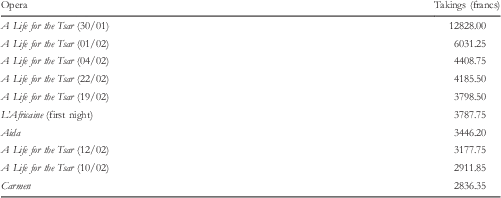
Note: Table generated using list of nightly takings for the 1889–90 season in ‘Grand Théâtre de l’Opéra de Nice [Document d’archives]: tableaux de la troupe et journal des recettes’ at the BNMus [VM DOS-5 (1)].
The premiere was also a critical triumph. Gunsbourg sealed local approval by achieving the ‘miracle’, as Émile Blavet of Le Figaro put it, ‘of tearing around fifteen of the most prominent Parisian journalists away from their posts at the peak of the winter season and persuading them that the “action” was not in Paris, but in Nice’.Footnote 50 In order to encourage the warmest possible responses from his guests, Gunsbourg greeted them personally on their arrival at the train station on 29 January 1890, and treated them to extravagant banquets during their stay. This all seems to have paid off. The Parisian response was uncharacteristically unanimous for a new opera, and unusually substantial for a regional premiere. Newspapers in the capital were filled with glowing reports from self-proclaimed Wagnerians, such as Victor Wilder, and conservatives such as Sarcey alike.Footnote 51 Highlights from these reviews were proudly reprinted in Nice in the coming days as evidence that the premiere of A Life for the Tsar constituted a decentralist achievement. Even before the performance, Jean Labeille of Le Petit Niçois declared that the opera had already ‘had the initial result of bringing some of the most eminent of our Parisian brethren to Nice and reminding them that the borders of France do not stop at the fortifications of Paris’.Footnote 52
But the Parisians’ enthusiasm was not just a result of Gunsbourg’s good hospitality. For over twelve years, there had been attempts to have A Life performed in the capital, provoking many of the Parisian critics to express their regret that the first French performance had taken place in Nice, and not Paris. Wilder, for instance, remarked in his review:
How is it that a work, so popular in Russia that one cannot begin to count the number of performances [given there], has remained obstinately ignored here? It will never be clear. Twenty times over there has been a chance of translating it and putting it on at one lyric theatre or another; the project has always been abandoned as soon as it was conceived.Footnote 53
One reason for such efforts was that A Life had already appeared in numerous cities across Europe (listed in the Appendix), putting pressure on Paris to follow suit. The 1874 Italian premiere in Milan may well have triggered the first attempt to give the opera its French début. In 1876, rumours surfaced of plans to have the opera sung in Russian at the forthcoming Universal Exposition of 1878, but in the end, only extracts were given.Footnote 54 Performances of the opera in London in 1887, which were widely reported in Paris,Footnote 55 were also quickly followed by announcements that plans were under way for the French premiere.Footnote 56 Soon afterwards, the publisher Durdilly commissioned a French vocal score, thus addressing the ‘question of translation’ noted by Wilder.Footnote 57 Then, in 1888, a Parisian staging of A Life for the Tsar seemed to be on the cards once again when a troupe from St Petersburg embarked on a tour of Europe with the opera in their repertoire.Footnote 58 All the Parisian theatres appear to have turned them away, however, and they performed in Germany, Denmark and Britain instead.Footnote 59 Not that this was the work’s premiere in Germany where, as the Russian translator and critic Michel Delines observed, ‘this masterpiece’ had been known since its premiere in Hanover in 1878.Footnote 60 Meanwhile, in addition to keeping up with other cities, the prospect of performing the opera was attractive for the chance it offered to shake up the tired repertoires of the Opéra and Opéra-Comique. Many Parisian critics at the Nice premiere in 1890 used their reviews to voice their frustrations at the state of opera on the capital’s main stages, one remarking, for instance, that he hoped Gunsbourg would come to Paris soon, since he would be sure to offer them ‘something other than a hundredth reprise of La Juive or a thousandth reprise of Guillaume Tell’.Footnote 61
But this was not just about finding something outside the usual repertoire, or securing an opera that had been performed elsewhere. Russian critics had been arguing since 1836 that this opera heralded ‘the dawn of a new age’ for Europe: that Glinka had combined the best of ‘Italian singing and German harmony’ with a fresh Russian sound to create ‘a new element in art’.Footnote 62 Indeed, it was Glinka’s perceived potential to beat the ‘two “wests”’ at their own game that had helped A Life come to be considered Russia’s figurehead opera.Footnote 63 While some of the first French visitors to attend performances of the opera in St Petersburg were sceptical (in 1840, Adolphe Adam declared A Life ‘a failure’ that ‘would have next to no chance of success in any country besides Russia’Footnote 64), these Russian accolades soon began to spread. François-Joseph Fétis, for instance, praised A Life in 1857 for being unfettered by tired operatic conventions.Footnote 65 Russian assertions that Glinka marked out a third way became increasingly relevant in the 1860s as French critics railed against Wagner’s ‘music of the future’. In a lengthy article for the Revue nationale in 1862, Théophile Gautier fils depicted Glinka as a healthy antidote:
Glinka enjoys an advantage which will perhaps shield him from the curse launched by the public against the so-called school of the future; he has discovered a gold mine in the music of his country, an inexhaustible vein of completely fresh melodies, whose procedures, if they have them, differ essentially from ours … If one needs a special musical education to appreciate the works of Wagner, the least initiated will always discover with Glinka a charm that will enchant them.Footnote 66
By the end of the following decade, Glinka was not being portrayed as an appealing addition to European repertoires, but as a rival force. After the humiliations of the Franco-Prussian War and Wagner’s subsequent diatribes against France, debate raged over whether Wagner should be accepted on the French stage as a progressive artist or rejected as a national enemy.Footnote 67 Glinka, and Russian music in general, signalled a less fraught alternative. In 1879, Octave Fouque wrote a ten-part biographical article on Glinka for Le Ménestrel, which concluded:
If it is true … that we are on the eve of a complete musical revolution; if the antique modes are to reappear on the scene and dethrone modern tonality, which was established on their ruins; and if the scales of the Orientals are to invade European music, we shall probably be preceded in this course by the Russians.Footnote 68
In this passage, Russian composers are revolutionaries, dethroners, invaders; but this is a welcome form of anarchy, one in which the French would share. As such, Russian achievements in the field of national opera were even portrayed as an example to French composers.Footnote 69 Fouque concluded his biographical series by announcing that Glinka was at the head of this new movement:
[Glinka] is the founder and creator; he is the patriarch and father of this numerous generation of musicians. He was the first who conceived the idea of delving into the mines of popular melody, all the wealth of which is not yet known.Footnote 70
Again, the image of the ‘mine’ of folksong treasures is used, this time suggesting that Russia was in possession of an ancient, powerful natural resource that could be tapped to reinvigorate Europe.
Throughout the 1870s, Glinka had been increasingly aligned with new music, not just in print, but also in the concert hall.Footnote 71 In 1873, Jules Pasdeloup began to programme works by the composer in his Concerts populaires at the Cirque d’hiver. Taking pride in providing the masses with the ‘classics’ (Beethoven, Haydn, Mozart, Mendelssohn and Weber) alongside new, adventurous repertoire, the series was considered the most prestigious in the capital.Footnote 72 It was here that Parisians were first able to hear extracts from Wagner’s operas, such as the preludes to Lohengrin (1870), Tristan und Isolde (1874) and Die Walküre (1881),Footnote 73 but also some of the first French performances of Glinka’s Kamarinskaya, Jota aragonesa and the Overture to A Life for the Tsar.Footnote 74 This mirrored similar events elsewhere, such as the promotion of Glinka by prominent figures of the New German School: Liszt in his Weimar concerts of 1873 and Bülow in his concert tours and productions of A Life for the Tsar in Hanover in 1878.Footnote 75 Bülow’s high opinion of Glinka was also publicised widely in 1874 thanks to his infamous article for the Allgemeine Zeitung, written during a visit to Milan for the Italian premiere of A Life. His outrage at the Milanese public’s disinterest in Glinka and adoration of Verdi, whose Requiem (which he famously described as an ‘opera in ecclesiastical robes’) premiered in the same week, prompted a veritable scandal, leading the review to be translated and reprinted worldwide.Footnote 76 All these links – to the New German School, to the Concerts Populaires, to Wagner – reinforced the idea that Glinka, and Russian music more generally, shared the artistic ideals and serious aesthetics of the ‘music of the future’, without sharing the problematic Germanic associations that usually came with it.
In Nice, meanwhile, Pasdeloup’s programming techniques were being mirrored at Valrose. Derwies likewise included Wagner and Glinka alongside the ‘classics’ to local and – by the late 1870s – Parisian acclaim.Footnote 77 During the years in which the concert series at Valrose was active (1870–81), many of Glinka’s works were performed ahead of Paris, such as the Jota aragonesa, which appeared in 1874, before the first performances in Paris at the Trocadéro in 1878.Footnote 78 One Niçois reviewer, ‘Ch-M. Domergue’, praised Derwies’s concerts as ‘art for art’s sake’ (l’art pour l’art), and wrote that one forthcoming concert programme, which included Kamarinskaya, constituted ‘the epitome of an appreciation of the music of the future’.Footnote 79 Glinka had thus come to be associated, both in Paris and in Nice, with audiences interested in serious, pioneering artistic ventures, making A Life for the Tsar a shrewd choice for a city such as Nice – deemed stuck in the past – to reinvent itself.
When it came to promoting A Life in Nice in 1890, preview and review articles were consequently filled with declarations that this was a thoroughly modern opera, despite it having been written in the 1830s and bearing the strong imprint of the bel canto tradition.Footnote 80 Some attempted to style this music of the past as the music of the future by stressing that the opera, as Labeille of Le Petit Niçois put it, was ‘overflowing with originality’.Footnote 81 For those who found it less easy to refute the opera’s Italianisms, assurances were made that Glinka’s Russianness shone through. ‘Scratch away at the Neapolitan’, Wilder assured his readers, ‘and you find the Cossack. If the form of his melody is Italian, the sentiment which animates it remains Slav.’Footnote 82 The local tourist journal La Colonie étrangère provided particularly positive and comprehensive coverage of the opera, publishing three front-page preview articles in the weeks leading up to the premiere. In the first of these, it stated: ‘Russia is the country of the future. Who can dare to deny it, when looking at its literature, its music, its painting, its industry?’Footnote 83 The critic had bolstered the statement in an earlier article, in which he remarked that those listening to A Life might be forgiven for thinking that Glinka had lifted whole passages from the scores of Gounod, Delibes, Massenet and Saint-Saëns.Footnote 84 Not only did this declaration suggest affinities between Russia and France, but it also aligned Glinka with composers who were, quite literally in this case, of the future. Framed in this way, A Life became an asset to the Théâtre Municipal – proof of its artistic merits and of its ability to avoid the repertorial stagnation plaguing Paris.
The Nation on stage
The performances of A Life for the Tsar in Nice also seemed to demonstrate the city’s political relevance. All the suggestions that Russian music might be the future, that the New Russian School might provide an equal and opposite force to the New German School, even that Glinka might be an alternative to Wagner, were highly politically charged – reflections of mounting hostility towards Germany and new attempts to draw closer to Russia in light of the impending alliance. In the years before the treaty was signed, there were increasingly frequent public displays of Franco-Russian affection on both sides in the form of formal visits and cultural exchanges.Footnote 85 A production of A Life for the Tsar had the potential to form an ideal diplomatic gesture, and thus to place Nice at the forefront of a critical national issue.
Since the very first article on Glinka to appear in France, A Life had been presented as the cornerstone of the Russian operatic tradition.Footnote 86 Not only was it patriotic in subject – it depicts the legend of the rescue of the first Romanov tsar through the self-sacrifice of the peasant Ivan Susanin – but it was also the first full-scale, all-sung Russian opera, and the first to gain permanent repertory status. In consequence, A Life had already been discussed in France as a potential tool for solidifying the alliance. After the first Russian translation was made of Victor Hugo’s Hernani in 1887, a staging of the opera was proposed by the pseudonymous ‘Saint-Jean’ as a suitable return gesture, as recorded in Le Figaro:
If it is true that one act of civility merits another, then, since Russia has translated Hernani and is going to produce it in St Petersburg and Moscow, would it not be in good taste to stage A Life for the Tsar at the Paris Opéra?Footnote 87
The next year, French composers actively promoted a French premiere of A Life on similar grounds. In February, Ambroise Thomas, Charles Gounod, Ernest Reyer, Camille Saint-Saëns, Jules Massenet and Léo Delibes all signed the charter of the newly formed ‘Association artistique et littéraire franco-russe’. At its head was Juliette Adam (1836–1936), a Republican and Russophile who used her influence as an editor and in her literary salons to promote the Franco-Russian cause.Footnote 88 Having secured these composers’ endorsements, Adam encouraged them to write music on Russian themes and to disseminate Russian music in France in the coming years.Footnote 89 It is also likely that she was behind the following appeal, signed by the six composers, to the minister of the Académie des Beaux-Arts in July 1888:
We the undersigned, members of the musical composition section of the Académie des Beaux-Arts, eager to give a welcome of international and artistic sympathy to Russia in the person of Glinka, the illustrious founder of Russian opera, would be glad to see his principal and popular work, A Life for the Tsar, performed on a French stage.Footnote 90
But if the premiere of A Life represented such a significant political and artistic moment, how did it end up in Nice, and not Paris? There was, of course, the issue of the overcrowding of the theatres to keep it from the capital, and the arrival of Gunsbourg to propel it to Nice; but the answer is also, once again, political. While Paris was home to a large Russian community, many of its members were political émigrés who opposed the Tsar.Footnote 91 In Nice, however, which filled up each winter with Russian aristocrats, an opera depicting the rescue and coronation of the first Romanov through the martyrdom of a peasant was more likely to be well received.Footnote 92
At the same time, Gunsbourg was well aware that, by producing an opera that spoke to a central issue in Republican international policy, he could soothe local anxieties about the city’s disconnectedness from the rest of France (and about his own national allegiances). And indeed, the Republican Petit Niçois, for whom enforcing French local identity was a central concern, offered by far the most extensive and positive coverage of Gunsbourg’s project, publishing articles on the opera in every issue from 28 January to 5 February, often on the front page. With public feeling towards Russia at a new high, not only could A Life be used to attract the attention of Paris, but also to demonstrate the city’s Frenchness, in a venue where this very issue had long been under dispute.
The reviews in 1890, in Nice and Paris alike, helped enforce the feeling that staging A Life was an unofficial demonstration of Franco-Russian friendship.Footnote 93 The librettist, Louis Gallet, writing in the pro-Russian Nouvelle Revue, even called the opera a ‘sort of dramatised Marseillaise’,Footnote 94 suggesting the performance was akin to an extended rendition of Russia’s national anthem. A prominent tendency of the reviews was to treat the opera as the embodiment of Russia itself. The critic for Nice artistique informed his readers, for example, that Glinka’s music ‘was animated by a distinctive spirit as vague and poetic as the land in which the action takes place’.Footnote 95 Such affirmations were also used to convey positive popular opinion towards the Russians. The opera was described by Labeille of Le Petit Niçois as reflecting ‘the characteristics of a strong and youthful people’,Footnote 96 and by Wilder of Gil Blas as ‘the manifestation of an elevated spirit and a sincere soul’.Footnote 97 Both echoed familiar tropes that Russia was a powerful up-and-coming nation, untarnished by Western failings; in short, the ideal ally.
In this context, French critics also proved sympathetic towards the depiction of a peasant dying to save the ancestor of a soon-to-be allied monarch. Susanin’s self-sacrifice had become a point of contention among Russian critics in previous years. Vladimir Stasov, for instance, had complained about what he called Susanin’s ‘hen-like’ submission to a tsar he had never met.Footnote 98 The plot had similarly raised eyebrows when the opera was performed in London in 1887, with one critic describing Susanin’s actions as a display of ‘dog-like fidelity’.Footnote 99 For Louis Dumas of the fashionable journal La Saison de Nice, however, ‘the devotion of this poor peasant who places his affection for his country before his children and gives his life to save his prince’ was ‘quite simply sublime’.Footnote 100 This French-language performance of Russia’s cornerstone opera, at the newly French Théâtre Municipal and before a cosmopolitan audience, thus became a reaffirmation of the city’s national allegiances: not to Italy, but to France and Russia. It was through fostering a transnational relationship, rather than simply premiering a new French opera, that Gunsbourg could offer Nice an opportunity to draw the nation’s gaze away from the capital.
Staging the auditorium
Perhaps in recognition of the difficulties in convincingly framing A Life for the Tsar as a modern opera, without a plot that contradicted Republican politics and without Italian trappings, the overwhelming focus of the critical response was ultimately not on the opera itself. Nor did critics dwell long on the lavish production, replete with new sets and live horses for the coronation finale.Footnote 101 Instead, it was the performance in the auditorium that induced most widespread and enduring media attention. Once again, Gunsbourg was key in ensuring that the political significations of the premiere were highlighted on the night. Though the anthem singing was portrayed as spontaneous in the press, the conditions had been carefully set in place. True, there had been an appreciative atmosphere throughout the evening: the Act I finale was followed by three curtain calls to the tune of enthusiastic cries of ‘Vive la Russie!’; Zucchi’s solo in the Mazurka of Act II was encored, as was Vanya and Susanin’s duet in Act III; the public, reportedly, cheered every mention of the ‘Tsar’ or ‘Russie’.Footnote 102 But it was only after Act III that the demonstrations broke out. One reviewer disclosed that the Russian anthem did not start up because the audience requested it, but because Gunsbourg ‘gestured to the orchestra’.Footnote 103 The music was already on the stands, and the chorus had already learnt the words. The timing was perfect. Such an outburst could not have come after Act I, in case the auditorium had not filled up yet. Act II ends with a chorus of Poles vowing to overthrow the Tsar, Act IV with the hero’s death, and leaving it to Act V would run the risk of playing to a half-empty house. Act III, however, concludes with a militant peasant chorus swearing death to a foreign foe: just the thing to follow up with a patriotic demonstration.Footnote 104 And in case the public had forgotten that Gunsbourg was responsible for the evening’s success, he clambered out of his box and took centre stage to sing along.Footnote 105
Though this was most probably the first time that the two anthems had been sung in tandem at an opera house, or that the Russian anthem had interrupted a French opera performance, such patriotic vocal outbursts were not unprecedented in France. Gunsbourg even had first-hand experience of the positive impact ostensibly spontaneous singing could have. As the director in Lille in the previous season, he had introduced Étienne Méhul’s famous revolutionary war song, ‘Chant du départ’ (1794), at the end of Act III of Offenbach’s La Fille du Tambour-Major: the point when the Austrian troops attempt to prevent the French from breaking free from a beleaguered position.Footnote 106 Well aware of the political connotations, the audience rose to sing along.
Gunsbourg could be confident of an even more heated reaction to his choice of interpolation in Nice. The sound of Alexey L’vov’s Russian anthem (1833) had become familiar in France since the 1830s as a popular melody for arrangements and fantasias.Footnote 107 But in the years leading up to the alliance, this tune afforded new resonances. Playing the Russian anthem with the Marseillaise became a common occurrence in public manifestations of pro-Russian feeling.Footnote 108 Both had been sung, for instance, in Nouart in 1886 at the erection of a monument to Antoine Chanzy, a general who had served during the Franco-Prussian War and had been ambassador to Russia from 1879 to 1882. A report in L’Avenir de la Dordogne in 1889 told of the warm welcome given to the Russian general and chief of the Main Staff, Nikolai Obruchev, and his French wife when they came to stay in the region, with crowds gathering to call out ‘Vive la France! Vive la Russie!’ as the two national songs were played, while similar demonstrations were made at a barracks in Paris that same year for the visit of the captain of the Russian imperial guard.Footnote 109 As the first notes of the Russian anthem sounded at the Théâtre Municipal on 30 January 1890, therefore, both French and Russian audience members would have realised the implications; the follow-up calls for the Marseillaise were not so much a spontaneous request as part of a well-rehearsed pattern of patriotic performance.
That evening, moreover, the auditorium was particularly primed for a public outpouring of Franco-Russian enthusiasm. Gunsbourg scheduled A Life’s premiere at the highpoint in the season, when all the finest of high society had made their way to Nice for the carnival, meaning that the turnout was sufficiently impressive to merit extensive lists of notable persons present in the reviews.Footnote 110 These included various distant members of the Russian royal family (such as the Duke and Duchess of LeuchtenbergFootnote 111) and other members of the Tsar’s entourage (including an ex-mistress of Nicholas I, Varvara Nelidov Bux). There was also an array of French and Russian celebrities, such as the spiritualist Maria de Mariategui, Baron de Rothschild (of the famous banking family) and Henckel von Donnersmarck, one of the richest industrialists of the age, with his glamorous wife Katharina Slepzow, a fashion icon from St Petersburg. Alongside such figures, the political leaders of the Alpes-Maritimes, including Arsène Henry, the Prefect, and Alfred Borriglione, the Deputy, turned out to show their support. Two well-known lobbyists for the Franco-Russian alliance had also come down to Nice from Paris expressly to attend the premiere: Paul Déroulède (1846–1914), a nationalist author and politician who founded the Ligue des patriotes to promote French retaliation against Germany after 1870; and Juliette Adam who, as well as being an influential campaigner for the Franco-Russian alliance, was the editor of La Nouvelle Revue.Footnote 112 Then, of course, there were all those Parisian critics to ensure that the demonstration was reported back in the capital.
The spectacle of the theatre – packed out with politicians, aristocrats and critics, and united in cheering both France and Russia – caused quite a stir. The combined performance of the anthems was widely treated as symbolic of the harmony between the two nations, and no one seemed concerned by the contradictory pairing of a revolutionary anthem with one declaring fealty to an autocrat. A reporter for Le Mentonnais, for instance, declared: ‘the Marseillaise and Bogè Tzara formed a single national and patriotic song’.Footnote 113 This sense of unity, at once of art and politics, of the two nations and of the cosmopolitan spectators, was emphasised by numerous references to the way the audience were dressed. Review after review noted the striking impression created by the uniformity of the bejewelled ladies all with bare shoulders alongside men all in black.Footnote 114 By providing such details and listing the attendees, local critics stressed that this, as Dumas of La Saison described it, was ‘not some hoi polloi or short-sighted ignorant mob’.Footnote 115 In other words, the demonstration was not the work of some extremist, or paid French claque, but of a like-minded and well-informed audience.
Having carefully staged the auditorium and, of course, the opera itself, Gunsbourg followed up with another well-orchestrated performance. The lavish banquet he threw at the Grand-Hôtel for his Parisian guests was replete with an exemplary cast, scenery and set pieces, all of which were, once again, widely reviewed in the local press. Reports informed the Nice public that after the Franco-Russian themed menu (including ‘Canapés Moscovites’ and ‘Salade Parisienne’), Gunsbourg rose to give the first of many toasts.Footnote 116 He began by recalling his childhood memories of the Franco-Prussian War, asserting that even then (aged ten) he had felt French, despite his Romanian birth.Footnote 117 He went on to recount the warm welcome he had received in Russia as an impresario, thus strengthening his self-made image as an ambassador of Franco-Russian goodwill. ‘By giving you the first performance of A Life for the Tsar’, he concluded, full of emotion, ‘I have provided you with the opportunity to further the great sympathetic movement in favour of Russia which has been born in France, to cultivate it, to give it life.’Footnote 118 For all these claims, however, there was not a single Russian representative among the fifty guests. Neither were any of the correspondents from the Moscow, Vienna, New York, London or Rome newspapers who attended the premiere invited.Footnote 119 Instead, the guest list comprised Parisian and local journalists, the opera soloists and leading members of the municipal council. This assembly was not so much a Franco-Russian gesture as it was a chance to nurture connections between Côte and capital: to celebrate French unity, and for Gunsbourg to emphasise his decentralist success in front of those who would decide his fate the following year.
Rather than providing a platform for A Life for the Tsar, Gunsbourg had succeeded in making A Life for the Tsar a showcase for Nice; one observer remarked that ‘one could not dream’ of ‘a more grandiose and powerful advertisement in favour of our town’.Footnote 120 If the implications of placing Russia’s cornerstone opera in the French language, in front of an international audience, were not obvious enough, the demonstrations after Act III pronounced that there was a place for Nice in French politics. Even without this, the performance had been declared a triumph and the opera itself an adventurous step, thus affirming the city’s artistic merits. Gunsbourg had chosen an opera that exploited the very features that typically caused Parisians to be dismissive of the Comté de Nice – the luxurious lifestyle of its visitors, its large foreign contingent – by turning them to the national cause of the Franco-Russian alliance. He had even allowed Nice temporarily to show Paris up by successfully putting on an opera they had failed to and, in so doing, legitimised his position. So it was that a Russian opera first came to a public stage in France, not for the chance to marvel at its Russianness, but for the chance it provided for one regional town to prove itself to the capital.
Epilogue
Unsurprisingly, Gunsbourg secured his second season. But writers on the chauvinistic Rabelais still grumbled that the Théâtre Municipal was being managed by a ‘Romanian, born to German Jews’, and that his magnificent first season had been nothing more than ‘vainglory’,Footnote 121 rather than, as Blavet put it, a selfless ‘mission to cement the Franco-Russian alliance in the field of art’.Footnote 122 In 1891, Gunsbourg quit Nice and moved along the coast to Monte Carlo, where, once again, he drew Parisian attention through exploiting his Russian connections. It was here that he would eventually found his own ‘Ballet Russe’.Footnote 123 The theatre commission, meanwhile, appointed a new (Italian) director: Santino Costa.
As for A Life, the reviews in Nice and Paris alike insisted that the opera would surely now make its ‘tour de France’.Footnote 124 Rumours appeared even before the season was up that Gunsbourg was in negotiations with the Eden-Théâtre in Paris to stage the opera there the following year. However, A Life was never repeated in Nice, let alone at any other regional opera house. It did reach Paris in 1896, but at the small-scale, privately managed Nouveau Théâtre, where it was given in the hope of cashing in on the excitement of the state visit of the newly crowned Nicholas II. The rendition was so poor that it was dropped within a week.Footnote 125
But in truth this had not been an attempt to establish Glinka’s first opera in the French repertoire. The extraordinary nature of the event made it unrepeatable and the performance itself forgettable. The opera had receded in the press coverage, through unrealistic attempts to style it as modern, its representation as an emblem of an idealised Russian nation, and its disappearance in reviews in favour of recounting the patriotic demonstrations after Act III. And sure enough, the one thing missing from the scene at the theatre in Theuriet’s Charme dangereux is the opera itself: A Life for the Tsar disappears in favour of Don Giovanni.
Instead, it was the demonstration that persisted in public memory. Just a few months later in Vichy, during a performance of Offenbach’s operetta Madame Favart, a curiously familiar sounding report appeared:
It was known that M. Wannovski [the Russian minister for war] would be attending the performance … All of a sudden, when the second act began, the orchestra started up the Russian national anthem. … It was like an electric shock. In the blink of an eye, the whole audience was on its feet.
Hats were waved. Cheers were interspersed with cries of ‘Vive la Russie!’ Everyone, turned towards the box where M. Wannovski was seated, applauded him as the representative of a powerful friend of France.Footnote 126
The singing of the Russian and French anthems in this way became a staple part of gala concerts held to celebrate official state visits. The anthems were included in concerts for the visit of the French fleet to the Russian port of Cronstadt in 1891, for the Russian fleet’s visits to Toulon and Paris in 1893 and when Nicholas II came to the capital in 1896. Similar demonstrations also began to take place in Russian theatres. In the 1896–7 Moscow season, renditions of the two anthems were reportedly demanded before every French opera performance.Footnote 127 This aspect of the 1890 premiere became part of the diplomatic repertoire, even if A Life for the Tsar itself failed to make it into the operatic canon.
Neatly aligning national sympathies with aesthetic value had thus proved unrealistic. After the excitement had died down, some, even in Nice, began to question the motivations behind the performance. ‘Zut Majeur’ of La Saison argued a few weeks later:
Patriotism has nothing to do with the arts, particularly music. Though born in countries which are now enemies, Beethoven, Wagner, Mendelssohn and Verdi, should not be any less admired by even the most chauvinistic Frenchman, and it would be difficult for us to take Glinka and Rubinstein as our musical diet under the pretext that their country is allied to France and that, in listening to this bland music, we are doing a service to our dear country.Footnote 128
Indeed, despite the early 1890s seeing the consolidation of the Franco-Russian alliance against the Triplice, it was in these very years that Lohengrin spread all over France and became fixed in the French repertoire, while A Life was remembered as little more than a glorified national anthem ‘en action’.Footnote 129
So political sympathies were not enough to keep A Life on the French stage; but these, combined with the idea that Russian music heralded an alternative ‘music of the future’ helped pave the way for a new (and more familiar) turn in French musical life. Debussy and Ravel would look to Russian music in the belief that it possessed the keys to liberating Western harmony and form;Footnote 130 Diaghilev would pose his ballets russes as an alternative Gesamtkunstwerk that would draw the public to modern art;Footnote 131 and Stravinsky’s Parisian ballets would rebrand Glinka’s ‘mine’ of Russian melodies as a source of primitivist modernism.Footnote 132 The clichés in which Theuriet dealt in Charme dangereux might well show that, despite the Franco-Russian alliance, and despite burgeoning interest in Russian music, stereotypes prevailed in the popular imagination. Mania Liebling’s exotic allure, after all, stems not only from her embodiment of Nice’s characteristics, but also from her Russian nationality. And yet, by placing the original scenario – on which Jacques and Mania’s is based – under the magnifying glass, a far more intricate cultural web comes into view: one which suggests that it might be time to start plotting a musical map of nineteenth-century Europe in which Russia has both a more important and a more complicated part to play than its familiar role as the novel Eastern neighbour.
Appendix
timeline of A Life for the Tsar in Europe, 1860–96



