Introduction
Drug use (DU) is a global public health issue, defined by the United Nations Office on Drugs and Crime (UNODC) as the non-medical use of substances controlled under international drug control conventions. This risky behavior ranges from occasional use to addiction, increasing the risk of associated complications and mortality. The World Drug Report (2023) reveals that in the past year, approximately one in 13 individuals aged 15–64 globally reported using at least one controlled psychoactive drug in the last 12 months and more than one in 100 have a drug use disorder. Internationally, the number of people who use drugs reached 296 million in 2021, constituting 5.8% of the global population aged 15–64. The World Health Organization (WHO) (2020) reported that nearly 11 million people inject drugs. Among them, 1.4 million individuals are infected with the HIV virus, and 5.6 million are infected with hepatitis C. The annual health loss measured in Disability-Adjusted Life Years due to drug use exceeds 42 million, constituting approximately 1.3% of the global disease burden. Gaining insights into the influence factors of DU, particularly mutable factors that may contribute to it, may help mitigate the risk of DU.
Childhood maltreatment (CM) is recognized as a prominent risk factor for DU (American Psychiatric Association, 2013). According to the WHO (2016), CM is defined as “all forms of physical and/or emotional ill-treatment, sexual abuse, neglect or negligent treatment, or commercial or other exploitation, resulting in actual or potential harm to the child’s health, survival, development, or dignity in the context of a relationship of responsibility, trust, or power.” The WHO categorizes CM into five main types: childhood physical abuse (CPA), childhood sexual abuse (CSA), childhood emotional abuse (CEA), childhood physical neglect (CPN), and childhood emotional neglect (CEN). Although the specificity model of early adverse experience recognizes that these types of CM are not identical (Garber & Hollon, Reference Garber and Hollon1991), there is evidence to suggest that different types of CM often co-occur (Rogosch & Cicchetti, Reference Rogosch and Cicchetti2004) and the risks of DU provoked by different types of CM coexist with both heterogeneity and commonality (Keyes et al., Reference Keyes, Eaton, Krueger, McLaughlin, Wall, Grant and Hasin2012), resulting in different types of CM can be further integrated when exploring their relationship with DU. The relationship between CPA and DU was noted early on, with studies indicating a close association between them (Kerr et al., Reference Kerr, Stoltz, Marshall, Lai, Strathdee and Wood2009). Nevertheless, with the advance of this field of study, a growing body of research has also shown a close association between CEA and DU (Myers et al., Reference Myers, Bantjes, Lochner, Mortier, Kessler and Stein2021). Although the relationship between CSA and DU has also garnered early and widespread attention from researchers, research results concerning the association between the two are mixed (Brown et al., Reference Brown, Fite and Bortolato2022; Hankins, Reference Hankins2022), contributing to the challenge researchers face in conclusively determining the degree of association between CSA and DU. Furthermore, although researchers have investigated the relationship between CEN, CPN, and DU (Grummitt et al., Reference Grummitt, Kelly, Barrett, Lawler, Prior, Stapinski and Newton2022), limited exploration of their correlations with DU, influenced by the phenomenon of “neglect of neglect” (Stoltenborgh et al., Reference Stoltenborgh, Bakermans-Kranenburg and Van Ijzendoorn2013) has made it difficult to arrive at clear-cut conclusions regarding their associations. So far, there is no definitive conclusion regarding the differences in the association between different types of CM and DU. While exploring the relationship between different types of CM and DU, researchers have gradually discovered that internalizing and externalizing pathways serve as important mechanisms linking CM to DU, thus forming the CM-DU dual pathway model (Cicchetti & Handley, Reference Cicchetti and Handley2019; Lupien, Reference Lupien2014), due to variations in risk characteristics of different types of CM, they are associated with DU through distinct pathways. Specifically, childhood physical maltreatment (CPM including CPA and CPN) and childhood emotional maltreatment (CEM including CEA and CEN) are primarily associated with DU through externalizing and internalizing pathways, respectively (Cicchetti & Handley, Reference Cicchetti and Handley2019). However, the pathway between CSA and DU remains uncertain. These findings provide a framework for integration of different types of CM to explore their associations with DU.
Currently, although researchers have employed meta-analytic methods to investigate the relationship between specific subtypes of CM and DU, and the prevalence of various forms of CM in individuals with a specific type of drug addiction, there remains a lack of consensus within the academic community regarding the strength and difference of the correlations between CM and its subtypes (hereafter CM + ST) and DU. Exploring the correlation between CM + ST and DU may not only enhance our understanding of the relationship between these two variables but it can also serve as a prerequisite for further investigations into the underlying mechanisms between them. Accordingly, drawing on the CM-DU dual pathway model, this study classifies CM into three subtypes: CPM, CEM, and CSA, aims to comprehensively explore the strength and variability of the association between CM + ST and DU through a multilevel meta-analysis and moderation effect testing.
The association between childhood maltreatment and drug use
The externalizing pathway consists of personality traits of impulsivity and a series of externalizing symptoms (Chassin et al., Reference Chassin, Colder, Hussong, Sher and Cicchetti2016). The Life History Theory in Psychology posits that CM, particularly CPM determines the development of an individual’s fast life history strategy (Nettle & Framkenhuis, Reference Nettle and Frankenhuis2020), which acts as a predictor for externalizing symptoms (Yang et al., Reference Yang, Shields, Zhang, Wu, Chen and Romer2022) and is associated with the decline in executive function (Figueredo et al., Reference Figueredo, Jacobs, Gladden, Bianchi, Patch, Kavanagh, Beck, Sotomayor-Peterson, Jiang and Li2018). Given the close relationship between CPM and executive functions (Moreno-Manso et al., Reference Moreno-Manso, García-Baamonde, de la Rosa Murillo, Blázquez-Alonso, Guerrero-Barona and García-Gómez2022), CPM is more likely to be associated with DU through the externalizing pathway. Galler et al. (Reference Galler, Bryce, Zichlin, Fitzmaurice, Eaglesfield and Waber2012) and Liu et al. (Reference Liu, Raine, Venables and Mednick2004) demonstrated an association between malnutrition resulting from physical neglect and reduced impulse control. Research has indicated that sleep deprivation (Meldrum et al., Reference Meldrum, Barnes and Hay2015) and food neglect (Vaughn et al., Reference Vaughn, Ward, Fisher, Faith, Hughes, Kremers, Musher-Eizenman, O’Connor, Patrick and Power2016), can also have detrimental effects on impulse control and impair individual executive function, which may lead to the development of DU. Additionally, a nine-year prospective study showed that parental punishment contributes to neurobehavioral disinhibition in children, consequently elevating their susceptibility to DU disorder (Mezzich et al., Reference Mezzich, Tarter, Kirisci, Feske, Day and Gao2007). Further, Kobulsky (Reference Kobulsky2017) confirmed the presence of significant indirect effects of the severity of physical abuse on early DU through externalizing problems.
Another pathway forming a non-mutually exclusive relationship with externalizing pathways is the internalizing pathway, which is characterized by temperamental styles of inhibition and enduring internalizing symptoms (Hussong et al., Reference Hussong, Jones, Stein, Baucom and Boeding2011). The emotional socialization theory (Morris et al., Reference Morris, Silk, Steinberg, Myers and Robinson2007) posits that the negative emotional environment resulting from the emotional problems of abusive parents leads to internalizing symptoms in children who experienced maltreatment, CEM exacerbates the aforementioned symptoms (Lin et al., Reference Lin, Kehoe, Pozzi, Liontos and Whittle2024). The self-medication hypothesis posits that drugs serve as significant means to alleviate or avoid internalizing symptoms (Torres & Papini, Reference Torres and Papini2016), which suggests that CEM may primarily be associated with DU through an internalizing pathway. A systematic review found CEN to be associated with mood disorders and substance use disorders (Carr et al., Reference Carr, Martins, Stingel, Lemgruber and Juruena2013). Goeders (Reference Goeders2004) demonstrated that alleviating negative emotions is an important component of drug use motivation among individuals with a history of early emotional abuse. A study investigating the impact of different types of CM on drug-use motivation revealed through internalizing symptoms that CEM tends to exert a facilitating effect on expansion and enhancement motives for DU (Barahmand et al., Reference Barahmand, Khazaee and Hashjin2016).
Regarding CSA, numerous studies have observed specific negative consequences or symptom clusters associated with CSA which revealed the characteristics and strength of the CSA-DU relationship. However, understanding of the pathway between CSA and DU remains exploratory. In the initial stages, researchers frequently included both CPA and CSA in the same study, examining their associations with DU through the externalizing pathway (Anne et al., Reference Anne Lown, Nayak, Korcha and Greenfield2011). As attention in this research field has shifted towards the internalizing pathway, researchers have progressively acknowledged the close link between the negative consequences of CSA and the internalizing pathway (Quas et al., Reference Quas, Goodman and Jones2003). Concurrently, research has shown that various demographic variables, such as gender, influence the relationship between CSA and DU (Lewis et al., Reference Lewis, McElroy, Harlaar and Runyan2016). This has sparked a new wave of research on the CSA-DU relationship.
In sum, despite extensive investigations on the relationship between CM + ST and DU, there is still no consensus regarding the strength and difference of the relationships between CM + ST and DU. Given the pervasive uncertainty and the value of addressing this issue, rigorously estimating and comparing the correlations between CM + ST and DU appears timely.
Factors that may influence the childhood maltreatment-drug use link
Several factors may affect the associations between CM or its subtypes and DU, including gender, drug type, region and measurement method. Gender may act as a moderator in the relationship between CSA and DU. Epidemiological data consistently indicate a higher prevalence of CSA among females, while the prevalence of other types of CM do not exhibit clear gender differences (WHO, 2020). Trickett and colleagues (Reference Trickett, Kim and Prindle2011), in their review of adolescent adverse developmental outcomes resulting from CM, observed that various subtypes of CM other than CSA exhibited similar prevalence rates among both boys and girls. Santo et al. (Reference Santo, Campbell, Gisev, Tran, Colledge, Di Tanna and Degenhardt2021) also reported nearly equal rates of CEM and CPM across genders. Apart from the prevalence rates, studies have revealed the presence of gender differences regarding the repercussions of CM. A study found that although male victims of CSA exhibited more problems compared to female victims, internalizing problems became increasingly severe over time in female victims, while this trend was not observed in males (Lewis et al., Reference Lewis, McElroy, Harlaar and Runyan2016). Regarding DU, although research indicates that males use drugs more than females, the females who do use drugs progress from initial drug use to dependency more rapidly than males (McCance-Katz et al., Reference McCance-Katz, Carroll and Rounsaville1999), and the prognosis for rehabilitation of DU is worse for females than males (Green et al., Reference Green, Polen, Dickinson, Lynch and Bennett2002). Additionally, females who use drugs exhibit more severe psychological problems than males, which lead to more severe relapses among them (Neale, Reference Neale2004). Based on a synthesis of research findings, we posit that gender may moderate the association between CSA and DU.
The drug type may also influence the association between CM + ST and DU (Baron, Reference Baron2010). The literature on DU suggests that contemporary drugs can be divided into two categories: “hard drugs” and “soft drugs.” “Soft drugs” mainly encompass cannabis (marijuana) and certain prescription medications. “Hard drugs” mainly include opioids and stimulants etc (Janik et al., Reference Janik, Kosticova, Pecenak and Turcek2017). Compared to soft drugs, hard drugs exhibit stronger addictive properties and higher potential risks. In the present study, we employ the term “hard drug” to encompass opioids, amphetamines, cocaine, and the like, while the term “soft drug” primarily refers to cannabis (marijuana) and certain prescription medications. Research indicates differences in the motivational factors for the use of soft drugs and hard drugs (Drazdowski, Reference Drazdowski2016). The use of soft drugs tends to be influenced by social factors like recreational motives (McCabe et al., Reference McCabe, Boyd and Teter2009), peer influence (Moon et al., Reference Moon, Blakey, Boyas, Horton and Kim2014) or environmental factors (Mason et al., Reference Mason, Mennis, Way, Light, Rusby, Westling, Crewe, Flay, Campbell, Zaharakis and McHenry2015). However, the use of hard drugs may more closely associated with severe psychological distress (Ashrafioun et al., Reference Ashrafioun, Zerbo, Bishop and Britton2020). Consequently, it can be inferred that any form of CM may increase the likelihood of using hard drugs. Simultaneously, the tendency to sensation-seeking and impulsivity are significant contributing factors to the use of hard drugs. Research has shown that CPM is closely associated with sensation-seeking and impulsivity (Shin et al., Reference Shin, Cook, Morris, McDougle and Groves2016). These characteristics may contribute to a closer relationship between CPM and the use of hard drugs. These findings reveal that drug type may act as a moderating variable in the relationship between CM + ST and DU. Based on the consequences of CPM, we believe that significant moderation effects of drug type are most likely to occur in samples with a history of CPM.
Regional factors may also act as a moderator in the relationship between CM + ST with DU. Regional disparities create variations in developmental levels and drug policies, which, in turn, influence the relationships between CM + ST and DU. In this study, the regions refer to four continents – Europe, the Americas, Africa, and Asia (due to the limited sample size, our study did not further differentiate “the Americas” into North and South America). Regional development disparities (United Nations Development Programme (UNDP), 2019) to a certain extent influence the educational beliefs of local families, which, in turn, affect the incidence of CM. A survey conducted by Akmatov (Reference Akmatov2011) across 28 developing countries revealed significant variations in the prevalence of CM across regions, with the highest rates observed in African countries. The study also found that children living in poor households are at a higher risk of experiencing various forms of CM. Research on CM prevalence and its consequences in high-income countries has shown that in Middle Eastern countries undergoing economic transition, CEA is higher than in high-income Western countries (Gilbert et al., Reference Gilbert, Widom, Browne, Fergusson, Webb and Janson2009). Andrews et al. (Reference Andrews, Corry, Slade, Issakidis, Swanston, Ezzati, Lopez, Rodgers and Murray2004) revealed that the burden of CSA is estimated to be highest in the East Asian region compared to other global regions. These research findings indicate that individuals in Africa and Asia have a higher risk of CM than those in Europe and North America. However, research focused on the Human Development Index (HDI) in Latin American countries, which measures regional development based on education, health, and living standards, has shown that higher HDI countries tend to have a higher prevalence of drug consumption than those with a moderate HDI (Silva et al, Reference Silva, Velázquez, Robles, Hynes and De Marco2014). On the other hand, regional disparities in drug policies may also influence the relationship between CM + ST and DU. Specifically, harm reduction drug policies are primarily employed in Europe and America, while “Zero-tolerance” is more commonly used in Africa and Asia. Typically, lenient drug policies tend to lead to higher drug accessibility (MacCoun, Reference MacCoun1993). However, Benfer et al. (Reference Benfer, Zahnow, Barratt, Maier, Winstock and Ferris2018) noted that lenient drug policies may increase the willingness of individuals who use drugs to seek treatment. While it is challenging to discern how regional factors directly influence the relationship between CM and DU, research findings underscore the impact of regional factors on the CM-DU relationship. Therefore, we posit that regional factors may moderate the relationships between CM + ST and DU.
Mmeasurement method may also act as a moderator in the relationship between CM + ST with DU. All the studies included in this meta-analysis used survey methods, which can be further classified into self-report, other-report (other-report is based on others’ judgments of an individual’s subjective self-evaluation of their own characteristics), and mixed-method (combination of self-report and other-report). Research has shown that in cross-sectional studies, using the same measurement method, particularly self-report, to collect data at a single point in time may result in consistency of responses across different items, thereby introducing common method bias (Conway & Lance, Reference Conway and Lance2010). This response consistency may artificially increase the correlations between variables, thereby inflating the relationships observed in the study’s results. At the same time, we recognize that both CM and DU are sensitive topics of investigation, making them susceptible to social desirability bias (Grimm, Reference Grimm2010). This may result in discrepancies between self-reported and other-reported outcomes for these two variables. As all of the effect sizes in our review are represented by correlation coefficients from cross-sectional studies, we incorporated measurement method as a moderating variable to examine its moderating effect on the relationship between CM + ST with DU. In addition to the previously mentioned moderator variables, we also explore the moderating impact on the effect sizes between CM + ST and DU stemming from other variables associated with the characteristics of participants, the study, and the variables.
The present study
Theoretical and empirical research has revealed the association between CM and DU. However, there is currently a lack of consensus in the academic community regarding the degree of correlation between CM and DU, as well as how correlations vary between different subtypes of CM and DU. Previous meta-analytical studies in this field have investigated: 1) the relationship between specific subtypes of CM and DU (De la et al., Reference De la Peña-Arteaga, Nogueira, Lynskey and Hines2021); 2) the prevalence of various forms of CM among individuals addicted to a particular type of drug (Santo et al., Reference Santo, Campbell, Gisev, Tran, Colledge, Di Tanna and Degenhardt2021); and 3) the longitudinal relationship between CM and DU disorders (Halpern et al., Reference Halpern, Schuch, Scherer, Sordi, Pachado, Dalbosco, Fara, Pechansky, Kessler and Von Diemen2018). Building upon previous meta-analyses, first, we separated drugs from substances and focused solely on drug use while broadening the scope of drug use disorders to drug use (encompassing both drug use disorders and the drug use behavior that does not meet the diagnostic criteria for drug use disorders), to investigate the association between CM + ST and DU. Next, we investigated the relationship between different subtypes of CM and DU examining the difference in the strength of associations among these subtypes. We then examined the moderating effects of variables associated with the study, the participants, CM and DU on the relationship between CM + ST and DU. To complete this procedure, we conducted a multilevel meta-analysis, which is a robust method for addressing the dependence of effect sizes.
Method
Literature search strategy
The current meta-analysis was performed according to the Preferred Reporting Items for Systematic reviews and Meta Analyses guidelines. A protocol for this work was registered on the Open Science Framework (OSF: https://osf.io/k9dea/). To identify relevant research, a three-step method was employed to identify studies published between 1980 and 2023. The initial literature retrieval was conducted between October 2022 and March 2023, and an updated search was conducted in October 2023. This comprehensive approach aimed to obtain a representative sample of studies investigating the associations between CM and DU. First, key electronic databases, including PsycINFO, Web of Science, Google Scholar, MEDLINE, ScienceDirect, and ProQuest Dissertations, were systematically searched for relevant studies using the following keywords and Boolean operators: (childhood abuse OR childhood maltreatment OR child abuse OR child maltreatment OR childhood adverse experience OR child adverse experience OR early victimization OR childhood adversity AND drug addiction OR drug abuse OR drug use disorder OR drug misuse OR drug use). Then, to ensure the comprehensiveness of the search, the same search terms were applied to examine key journals in the field, including Addictive Behaviors, Addiction, Child Abuse & Neglect, Drug and Alcohol Dependence and Substance Use & Misuse. Finally, a search alert was established using the terms “drug use” and “childhood maltreatment” on platforms like Stork. This strategy aimed to capture the latest research developments in the field, providing up-to-date information for the final data analysis.
Inclusion and exclusion criteria
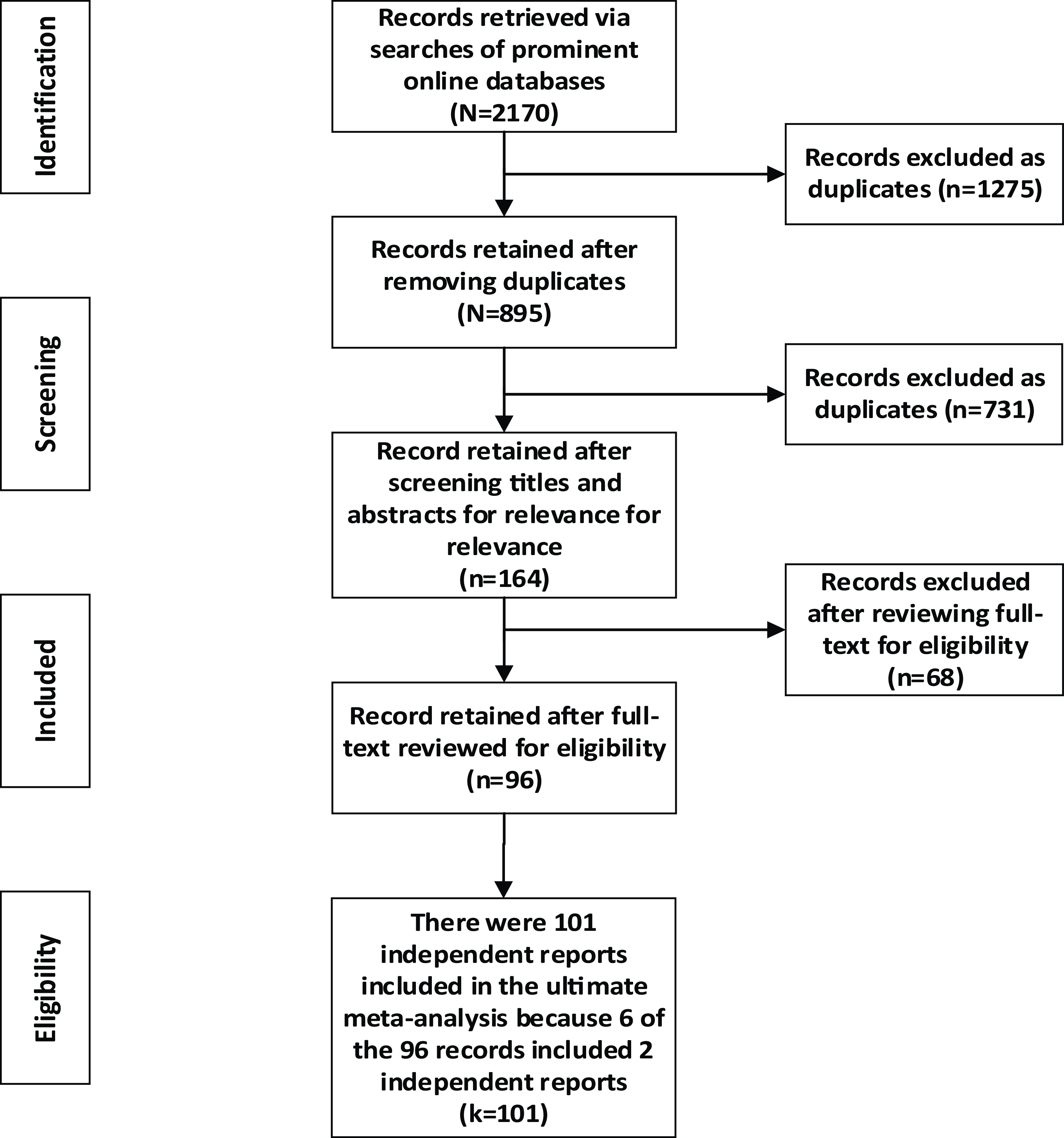
The initial search yielded 2,170 citations. After reviewing the titles and abstracts of all articles and excluding studies that were irrelevant, 895 studies were deemed suitable for further assessment. The inclusion criteria were as follows: (a) studies had to employ quantitative research methods; (b) studies had to provide statistical information such as sample size and Pearson’s correlation coefficients; and (c) studies had to be published in English. Studies were excluded if they: (a) were review articles; (b) discussed substances or addiction unrelated to drugs; or (c) examined the two constructs longitudinally over a specific time span.
Ultimately, 101 independent study samples, contributing to a combined dataset of 333 effect sizes, met the established screening criteria (see Figure 1).
The Preferred Reporting Items for Systematic Review and Meta-Analyses (PRISMA) flow diagram for the literature search and report selection.

Funnel plots assessing publication bias for the associations between (a) overall childhood maltreatment, (b) childhood emotional maltreatment, (c) childhood physical maltreatment, and (d) childhood sexual maltreatment with drug use.

Coding the studies
We categorized the attributes of the eligible studies and coded them into the following domains: participant characteristics include percentage of male participants, mean age, detection rate of CM and annual income (the proportion of annual income exceeding 12,746 USD. This value is derived from the World Bank’s Global Development Data, which defined the threshold for personal high-income per year in 2013. The year, 2013, represents the median year for the studies included in this meta-analysis) (Mishra et al., Reference Mishra, Pandey, Singh, Gupta, Sahu and Keshri2019); study characteristics include publication year, sample size, region, measurement method, and publication status; and variable characteristics which involved the drug type, whether alcohol was present within the substances, the retrospective DU period and the subtype of CM. The first author and a graduate student independently coded all information based on a coding manual developed for the study that outlined the coding categories and potential codes to be applied for each article. The two raters achieved 97% agreement; discrepancies were resolved via discussion. The criteria employed to derive the effect size were as follows: (a) the analysis encompassed effect sizes from cross-sectional studies that investigated the relationship between CM or its subtypes and DU; (b) in cases where a study presented multiple independent samples, each sample was individually included in the analysis. For instance, if a study reported two distinct Pearson correlation coefficients for males and females, it would contribute two independent data points to the analysis; (c) for longitudinal studies, we incorporated effect sizes computed at the baseline assessment.
Procedure and data analysis
Primary analyses
The multilevel meta-analysis was conducted using R statistical software (version 4.2.2) using the restricted maximum likelihood method for estimating model parameters. The “metafor” package was employed for computing the overall effect size and moderator analysis. The correlations (r) were converted to Fisher’s z-values using the “escalc” function. In the reports concerning the relationship between overall CM and each subtype of CM and DU, as well as in the intercepts of the moderator analyses, Fisher’s z-values were subsequently reconverted into correlations (r) for ease of interpretation.
Following the guidelines outlined by Assink and Wibbelink (Reference Assink and Wibbelink2016), three distinct sources of variance were incorporated into the model encompassing the sampling variance corresponding to the observed effect sizes (Level 1), the variance among effect sizes arising within the same study (Level 2, or intra-study level), and the variance across different studies (Level 3). A significant variance within or between studies implies a heterogeneous effect size distribution. In such cases, moderation analyses were conducted to assess the moderating effects of relevant variables. When we performed the moderator analyses, all category variables were encoded as dummy variables, while continuous variables were centralized.
Afterwards, funnel plots were created to visually search for evidence of bias, which would be apparent in an asymmetrical plot. Next, asymmetry was assessed using Egger’ s weighted regression test to check for publication bias (Egger et al., Reference Egger, Smith, Schneider and Minder1997). P-uniform* analysis was employed to evaluate publication bias (Van Aert & van Assen, Reference Van Aert and van Assen2018).
Finally, considering the large number of studies and samples retrieved, a few outliers were expected. Thus, to assess the impact of outliers and the robustness of the multilevel meta-analytic outcomes, we employed a “leave-one-out” method for conducting two sensitivity analyses (Dodell-Feder & Tamir, Reference Dodell-Feder and Tamir2018).
Results
Sample
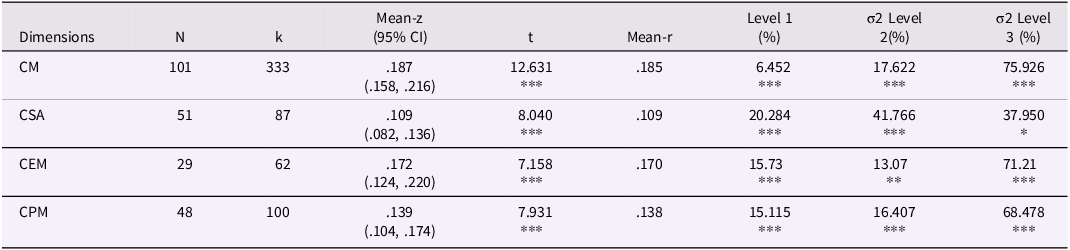
The multilevel meta-analysis encompassed 95 eligible studies, contributing a total of 101 independent study samples (N) and 333 effect sizes (k) involving 132,341 participants. Table 1 presents the collective effects from the multilevel meta-analysis concerning the associations between CM + ST and DU and the outcomes of the moderator analyses.
The effect sizes across childhood maltreatment and its subtypes with drug use
A significant positive overall effect size between CM and DU was found, r = .185, p < .001 based on 333 interdependent effect sizes extracted from 101 independent studies. The relationships between the three subtypes of CM and DU were significant. Specifically, the overall effect size between CEM and DU was significant, r = 0.170, p < .001; the overall effect size between CPM and DU was significant, r = 0.138, p < .001; and the overall effect size between CSA and DU was significant, r = 0.109, p < .001. These findings indicate that both CM + ST positively correlated with DU (see Table 1).
Moderation analysis
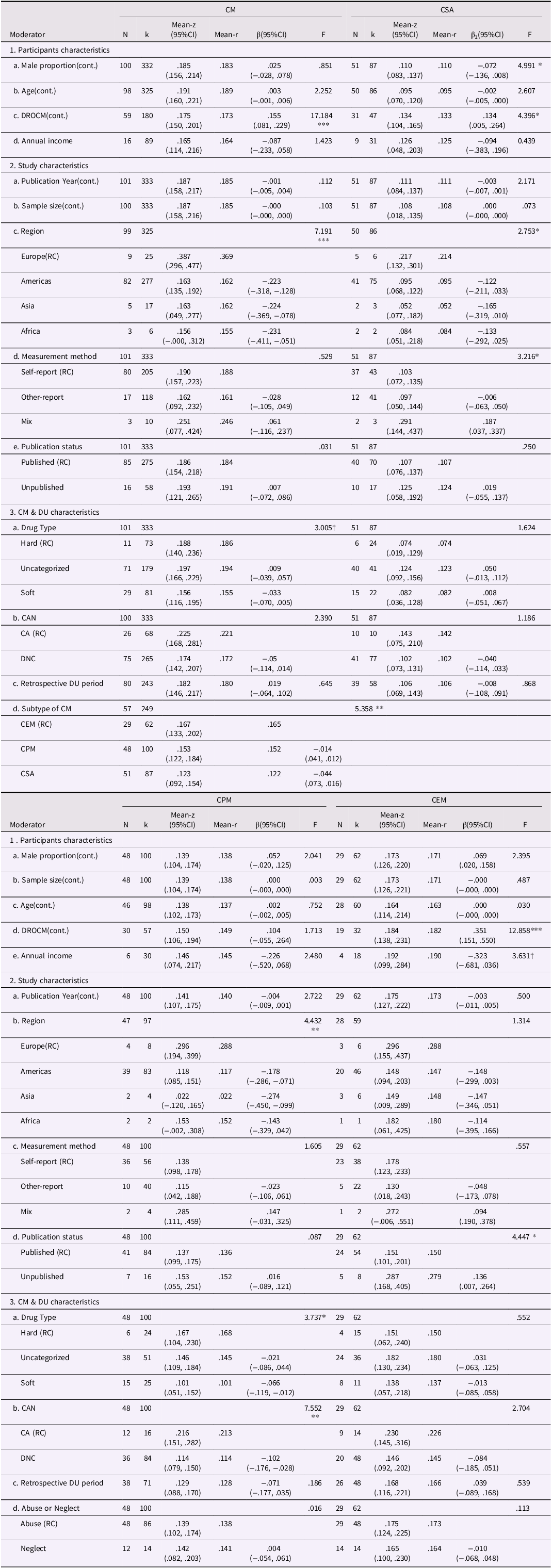
The distributions of components in both Levels 2 and 3 between CM + ST and DU were significant. This indicates the presence of potential moderator variables influencing the relationship between CM + ST and DU. The moderation analysis showed that CM subtypes, region and detection rate of CM moderated the relationship between CM and DU. As shown in Table 2, compared to the CSA group, the CEM and CPM groups exhibited larger effect sizes, and were significantly greater than that of CSA, F (2, 246) = 5.358, p < .01. Additionally, significantly larger effect sizes were observed in samples from Europe compared to samples from the Americas, Asia, and Africa, F (3, 321) = 7.197, p < .001, and as the detection rate of CM increased, the association between CM and DU increased, F (1, 178) = 17.184, p < .001. The moderating effect of drug type showed marginally significant results, F (2, 330) = 3.005, p = .051.
Overall effects of CM+ST on DU

Notes: N = the number of independent studies, k = the number of effect sizes; σ2 Level 1: variance samples, σ2 Level 2: variance within studies, σ2 Level 3: variance between studies. Mean-z = mean effect size (Fisher’s z), 95% CI = confidence interval of each mean-z, Mean-r = mean effect size (correlations coefficients r).
The moderation analysis indicated that drug type, region, and the presence or absence of alcohol in substances moderated the CPM-DU relationship. Table 2 shows that the hard drug group had significantly larger effect sizes than the Uncategorized and soft drug groups, F (2, 97) = 3.737, p < .05. European samples showed larger effect sizes compared to the Americas, Africa, and Asia, with significant differences from the Americas and Asia, F (3, 93) = 4.432, p < .01. Samples using both alcohol and drugs had significantly greater effect sizes than those using drugs alone, F (1, 98) = 7.552, p < .01.
The moderator effects of the relations between CM+ST with DU

Notes: N = number of independent studies, k = number of effect sizes, cont = continuous variable, RC = reference category, Mean-z = mean effect size (Fisher’s z), 95% CI = confidence interval of each mean-z. Mean-r = mean effect size (correlations coefficients r). DROCM = detection rate of CM, CAN = Contains Alcohol or Not, CA = Contains alcohol, DNC = Does not contain, Annual income = The proportion of income greater than 12746 per year. β(95% CI) = estimated regression coefficient (confidence interval of each β). *p <. 05; **p <. 01; ***p <. 001; †p <. 10
The moderation analysis indicated that the publication status and detection rate of CM moderated the relationship between CEM and DU. As shown in Table 2, significantly larger effect sizes were observed in unpublished studies than published ones, F (1, 60) = 4.447, p < .05. As the detection rate of CM increased, the association between CEA and DU increased, F (1, 30) = 12.858, p = .001.
The moderation analysis showed that gender, region, detection rate of CM, and measurement methods moderated the CSA-DU relationship. Table 2 shows that as the proportion of males increased, the CSA-DU association weakened, F (1, 85) = 4.991, p < .05. Larger effect sizes were found in European samples compared to the Americas, Asia, and Africa, F (2, 82) = 2.753, p < .05. As the detection rate of CM increased, so did the CSA-DU association, F (1, 45) = 4.394, p < .05. Mix measurement methods had significantly larger effect sizes compared to self-report and other-report, F (2, 84) = 3.216, p < .05.
Publication bias and sensitivity analysis
Figure 2, from A-D respectively, shows the distributions of effect sizes of CM + ST and DU. As shown in A and B, some studies were distant from the funnel plot’s center, indicating possible publication bias. Egger’s test on the effect sizes of CM and DU (Z = 2.71, p = .007) and CEM and DU (Z = 2.42, p = .015) also revealed asymmetry in the funnel plot. However, after correcting for publication bias using p-uniform*, the effect size results of CM and DU (r = .143, 95% CI[.118, .167], p < .001) and CEM and DU (r = .190, 95% CI[.140, .239], p < .001) remained statistically significant. Based on these results, the effect sizes of CM and DU, and CEM and DU were not influenced by publication bias.
Although the distributions of the effect sizes between CPM and DU, and CSA and DU were visually symmetrical (Figures C and D), we also conducted Egger’s test to evaluate the funnel plot’s symmetry. This test indicated that the distribution of the effect sizes between CPM and DU (Z = .709, p = .48) and CSA and DU (Z = 1.34, p = .18) was not significant. Egger’s test results were consistent with the funnel plot and revealed no publication bias.
When we sequentially excluded the included effect sizes and re-performed a multilevel meta-analysis, the results revealed that the association between CM and DU fell within the range of [.173, .188]. The association between CEM and DU fell within the range of [.166, .177]; the association between CPM and DU fell within the range of [.133, .143]; and the association between CSA and DU fell within the range of [.104, .113]. Similarly, when we sequentially excluded the included primary studies and re-conducted a multilevel meta-analysis, the results indicated that the association between CM and DU fell within the range of [.173, .189]; the association between CEM and DU fell within the range of [.165, .180]; the association between CPM and DU fell within the range of [.134, .145]; and the association between CSA and DU fell within the range of [.104, .113]. When we performed sensitivity analysis by iteratively excluding effect sizes, or by iteratively excluding primary studies, we found that the recalculated main effects showed minimal changes before and after exclusion, and significance level remained unaltered. These outcomes collectively suggest that the results of the current meta-analysis are robust and reliable.
Discussion
In this multilevel meta-analysis, we investigated the relationship between CM + ST and DU, and whether these associations were moderated by variables associated with the study, the participants, CM, and DU. The findings indicate that CM and all its subtypes were positive and significantly correlated with DU, but there are differences in the correlation between different subtypes of CM and DU. We also observed that the detection rate of CM, drug type, region, gender, measurement method and whether the substances used included alcohol had moderating effects on the relationships between CM + ST and DU.
Overall associations between childhood maltreatment and drug use
The meta-analysis results indicate that the CEM sample had the largest effect size, followed by CPM, and that CSA had the lowest effect size. Moderation analysis indicated that there were no significant differences in effect size between CEM and CPM samples. However, both CEM and CPM exhibited significantly higher effect sizes than that of CSA. The lowest correlation between all the subtypes of CM and DU was CSA, which is a unique form of maltreatment; therefore, its relationship with DU may be influenced by the characteristics of CSA itself and other factors. For example, CSA can be categorized into different types, including penetrative sexual abuse, sexual contact, and non-contact sexual abuse (Arias et al., Reference Arias, Leeb, Melanson, Paulozzi and Simon2008). Different types of CSA may result in varying traumatic consequences and activate distinct coping mechanisms, which in turn may influence the relationship between CSA and DU. Meanwhile, some researchers have suggested that CSA victims exhibit “sleeper effects” showing little distress initially, followed by increased psychopathology over time (Lewis et al., Reference Lewis, McElroy, Harlaar and Runyan2016). This effect reflects the impact of time on the consequences of CSA, which may further influence the relationship between CSA and DU. At the same time, gender is also an important factor influencing the relationship between CSA and DU (Kobulsky, Reference Kobulsky2017). The above factors not only directly influence the relationship between CSA and DU, they may also interact, thereby exerting a more complex impact on the relationship between CSA and DU. However, researchers have limited control over these variables during investigations, which may impact the exploration of the relationship between CSA and DU. Further, research suggests that individuals who experience CSA may experience severe psychological and physical distress (Nigussie, Reference Nigussie2014). Van der Kolk (Reference Van der Kolk, Perry and Herman1991) asserted that CSA significantly contributes to the initiation of self-destructive behavior. Wright et al. (Reference Wright, Friedrich, Cinq-Mars, Cyr and McDuff2004) found that adult CSA survivors are more prone to self-destructive tendencies than individuals who have not experienced CSA. Self-destruction has been characterized as behavior committed (and omitted) that tends to shorten or diminish life (Lee, Reference Lee1985). These tendencies can be categorized into several subtypes, including: (1) suicidal behavior such as suicide ideation and attempts; (2) deliberate self-harm such as self-mutilation, substance abuse, and termination of vital treatment; and (3) chronic self-destructiveness including failures in self-care, risk-taking, accident proneness, and habitual self-defeating behaviors (Figueroa, Reference Figueroa1988). According to Joiner et al.’s (Reference Joiner, Brown and Wingate2005) theory of suicidal behavior, DU is considered a form of chronic self-destructive behavior; thus, we speculate that CSA may be more closely associated with suicide. As Van der Kolk (Reference Van der Kolk, Perry and Herman1991) observed, sexual abuse largely initiates self-destructive behavior, apart from substance use disorder, suicide attempts are closely associated with CSA (McCabe et al., Reference McCabe, Hughes, Beal, Evans-Polce, Kcomt, Engstrom, West, Veliz, Leary, McCabe and Boyd2022). The research findings by Brown et al. (Reference Brown, Cohen, Johnson and Smailes1999) on community participants revealed that CSA exhibits the strongest independent association with suicidal behaviors compared to other forms of childhood maltreatment. Recent meta-analyses have indicated that childhood sexual abuse is an important risk factor for suicide attempts (Ng et al., Reference Ng, Yong, Ho, Lim and Yeo2018). On these grounds, individuals who have experienced CSA may choose more extreme self-destructive behaviors as a means of coping or relieving pain, which may also be why CSA is less associated with DU than that of the other subtypes of CM.
Moderators of the association between childhood maltreatment and drug use
As hypothesized, region moderated the correlations between CM and the two subtypes – CPM and CSA – and DU. The moderating effect of region on the relationship between CM and the two subtypes, and DU revealed that the European region exhibited the largest effect size, significantly higher than the effect sizes from other regions. The main factors contributing to this outcome may include differences in drug policies and variations in the likelihood of CM occurrence due to regional development status. The “harm reduction drug policies” in Europe and North America may allow greater accessibility to drugs than the “zero-tolerance drug policies” in Asia and Africa (Mosher & Akins, Reference Mosher and Akins2007), and this difference can impact the likelihood of engaging in DU which in turn influences the relationship between CM + ST with DU. Researchers have found that regional disparities exist in the incidence of CM, specifically, CM is more prevalent in Africa and Asia due to higher levels of authoritarian parenting styles. Meanwhile, it is least frequent in Europe and North America (Moody et al., Reference Moody, Cannings-John, Hood, Kemp and Robling2018). According to the “healthy context paradox” (Lucas-Molina et al., Reference Lucas-Molina, Pérez-Albéniz and Fonseca-Pedrero2022), abused individuals exhibit more adjustment problems in settings with lower overall levels of maltreatment. This has resulted in Europe exhibiting a lower tolerance for CM along with more severe negative perceptions of CM, which leads to more severe negative consequences associated with CM. The relatively higher incidence of CM in Asia and Africa has to some extent increased the tolerance of individuals living in these regions towards CM, mitigating its negative perceptions and adverse consequences. Additionally, in Asia and Africa, strict penalties are imposed on DU under zero-tolerance drug policies, which may have contributed to the smaller effect sizes observed.
The analysis of moderation effects revealed a significant moderating role of drug type on the relationship between CPM and DU, with a marginally significant moderating effect on the relationship between CM and DU. Specifically, compared to samples with uncategorized drugs and individuals who use soft drugs, a stronger association between CPM and DU was observed in individuals who use hard drugs, and this association was significantly higher than that observed in those who use soft drugs. Studies have shown that the use of hard drugs is more closely associated with severe psychological distress (Ashrafioun et al, Reference Ashrafioun, Zerbo, Bishop and Britton2020). CPM not only leads to severe psychological distress (Tottenham, Reference Tottenham2012), but also affects individuals’ executive functioning (Crouch et al., Reference Crouch, McKay, Lelakowska, Hiraoka, Rutledge, Bridgett and Milner2018), which may increase the likelihood of hard drug use. The moderating effect of drug type on the relationship between CM and DU revealed the following order in effect sizes: the uncategorized drug type group yielded the highest effect size, followed by the hard drug group, with the soft drug group exhibiting the lowest effect size. Meanwhile, we observed that while the moderating effect of drug type on the relationship between the CEM and CSA groups did not reach statistical significance, the effect sizes also followed the above sequence. The differences in effect size rankings across different groups may be attributed to the increased likelihood of hard drug use due to the association between CPM and declines in executive functioning.
As hypothesized, gender significantly moderated the effect size between CSA and DU. Specifically, as the proportion of males increased, the effect size of CSA and DU decreased significantly. The higher detection rate of CSA among females may one of the key factors contributing to the results above. Although males and females are both at risk of CSA, research suggests that the detection rate of CSA is higher among females than males. Estimates based on national samples from the US and the UK indicate that between 4.9 and 21% of females experience sexual abuse prior to age 18, compared to between 2.5 and 11% of males (Gault-Sherman et al., Reference Gault-Sherman, Silver and Sigfúsdóttir2009). A nationwide study conducted on Icelandic youth revealed that female children have approximately three times higher odds of experiencing childhood sexual abuse than their male counterparts (Gault-Sherman et al., Reference Gault-Sherman, Silver and Sigfúsdóttir2009). Meanwhile, according to Cermak and Molidor (Reference Cermak and Molidor1996), differences in socialization between males and females affect their responses to victimization of CSA. After experiences of sexual abuse, females tend to exhibit more passivity and emotional dependence, while males are more comfortable exhibiting emotions and behaviors that may displease others, including anger and aggression (Hooper and Warwick, Reference Hooper and Warwick2006). Thus, due to gender differences in coping strategies, females who have experienced CSA may bear greater psychological distress and trauma-related symptoms (Chandy et al., Reference Chandy, Blum and Resnick1996). As indicated by the findings of a prospective study, the internalizing problems of female victim of CSA are becoming increasingly severe, while this pattern is not observed in males (Lewis et al., Reference Lewis, McElroy, Harlaar and Runyan2016). Widom (Reference Widom1989) identified differences in the types of delinquency exhibited by sexually abused males and females. Males tended to be more involved in violent offenses, while females tended to be more involved in drug- property-, and disorderly related offenses. All these differences may explain the significant moderating effect of gender on the relationship between CSA and DU.
We also found that the measurement methods had a significant moderating effect on the relationship between CSA and DU. Specifically, the effect sizes when using mixed measurement methods were significantly greater than those observed in the self-report and observer-report. The reasons may lie in the high sensitivity associated with measuring CSA, as respondents may have been unwilling to accurately report their experiences due to feelings of shame, fear, or cultural taboos, particularly in face-to-face interviews (Rosenbaum et al., Reference Rosenbaum, Rabenhorst, Reddy, Fleming and Howells2006). This aligns with the findings of the present study, which revealed that the effect size for the observer-report group was the lowest, while the self-report group was slightly higher, but there was no significant difference between the two. This result reveals that employing mixed methods may not only reduce the sensitivity of CSA victims but it can also effectively mitigate measurement biases associated with a single method, enhancing the reliability of the research findings.
The substances used (including alcohol or not) significantly moderated the effect size between CPM and DU. The effect size between CPM and DU was significantly stronger when both alcohol and drugs were included among the substances compared to when drugs without alcohol were present. Hoffmann et al. (Reference Hoffmann, Benzano, Ornell, Kessler, von Diemen and Schuch2022) showed that CPM is more strongly associated with alcohol use than other subtypes of CM, and numerous other studies have supported this conclusion (Freisthler et al., Reference Freisthler, Midanik and Gruenewald2004). In addition to the close association between CPM and alcohol use, there is a higher likelihood of parent physical maltreatment of their children as alcohol addiction may also offer some explanatory insight into this moderation effect. Kelleher et al. (Reference Kelleher, Chaffin, Hollenberg and Fischer1994) found that parents who were identified as alcohol dependent or alcohol abusers were 4.7 times more likely to physically abuse their children than matched controls. Alcohol use disorder not only serves as a significant factor for parent’s physical abuse of their children but it also exerts an intergenerational influence on their children’s perceptions of alcohol (Handley & Chassin, Reference Handley and Chassin2009). The cognitive model for the intergenerational transference of alcohol use behavior proposes that the observation of parental drinking habits contributes to a child’s beliefs and expectations of alcohol’s effects, which in turn reinforces their future alcohol use (Campbell & Oei, Reference Campbell and Oei2010). Accordingly, individuals who have experienced CPM are more likely to have parents with alcohol use disorder, and further, parents’ alcohol abuse is not only positively correlated with CPM, but it may also affect their children’s functional cognition of alcohol, which may strengthen the association between CPM and alcohol use.
We also found a significant moderating effect of the detection rate of CM on the relationships of all CM + ST and DU, except for CPM. DU is considered a potential consequence of CM (American Psychiatric Association, 2013). Thus, as the detection rate of CM in the study sample increased, the relationship between CM + ST and DU was likely to strengthen. However, this result was not observed in the CPM group. One potential explanation for this finding is the distribution of the CPM detection rate, which may have led to reduced statistical sensitivity due to an uneven distribution across the levels of the moderating variable. Our analysis revealed that the distribution of CPM detection rates significantly deviates from a normal distribution, most studies(32%) reporting detection rates at relatively low levels ranging between 20 and 30% in this study. This imbalanced distribution may have led to an analysis that is biased towards the level with the largest sample size, thereby attenuating the moderating effect (Morris, Reference Morris2023).
The publication status also significantly moderated the relationship between CEM and DU. The effect size in the unpublished group was significantly higher than that of the published group. However, this result does not align with the traditional understanding of publication bias, which typically refers to there being a greater likelihood of significant results in published papers while non-significant results are less likely to be published. We believe that the main reason for our finding may be that researchers’ attention regarding the relationship between CEM and DU arrived relatively late compared to other subtypes of CM. Thus, many studies in this field have remained unpublished. However, the close association between CEM and DU is well-supported theoretically (Cicchetti & Handley, Reference Cicchetti and Handley2019). Among these unpublished research results, many were statistically significant, with the effect sizes in the unpublished group significantly larger than those of the published group.
Implications
This meta-analysis provides insights into the relationship between CM and DU. The findings indicate that CM and each of its subtypes are weakly positively correlated with DU. This suggests that CM may as a distal influencing factor for DU. Therefore, controlling and intervening in CM can mitigate the occurrence of DU to some extent. However, the lower correlation may result from both the substantial temporal span between CM and DU and the potential mechanisms between CM and DU.
Our findings also found the difference in the associations between various subtypes of CM and DU. Specifically, CEM displayed the closest correlation with DU, followed by CPM, while CSA exhibited the lowest correlation, subgroup analyses indicate no significant differences in the relationship between CEM and CPM with DU, but the correlations in both groups are significantly higher than that between CSA and DU. This finding supports the principle of equivalence in the development of psychopathology, and implies that despite CEM gaining attention relatively late, it is a research topic of value for investigating the relationship and mechanisms between CEM and DU. At the same time, the relatively low association between CSA and DU also suggests to researchers the necessity to delve into the similarities and differences in clinical responses to CSA compared to other subtypes of maltreatment. In conclusion, focusing on the relationship between various subtypes of CM and DU is a key to deepening the understanding of the association between CM and DU, with implications for targeted interventions on DU.
Limitations and future research directions
Some limitations of this study merit exploration in future research. First, the co-occurrence characteristics of different types of CM may lead researchers to underestimate the overall extent of CM experienced by individuals when focusing on a specific subtype of CM. This focus can also result in a false emphasis on the targeted subtype, exaggerating its impact on the individual. As our study explores the relationship between different types of CM and DU from a variable-centered perspective, the findings may be influenced by the above factors. Hence, it is advisable for readers to interpret the study results regarding the relationship between a singular subtype of CM and DU with caution. In future studies, researchers are advised to employ person-centered methodologies to investigate the co-occurrence patterns of CM within drug-using populations and their effects on drug use behavior, which is critical for designing targeted intervention and prevention strategies.
Second, a disparity in sample sizes is evident across various groups regarding certain moderating variables, notably the regional variable. Smaller sample sizes are more prone to sampling errors, which may introduce potential inaccuracies. During effect pooling, larger sample size groups can wield greater impact on effect estimations, potentially leading to a bias in the results of larger sample size groups in meta-analytic outcomes. Hence, careful consideration is warranted when interpreting the results of moderation effect tests for these variables. In future research, different regions should be explored separately to better understand regional characteristics.
Third, although meta-analyses have been widely used to synthesize research findings, when conducting a meta-analysis, researchers must make theoretical and methodological choices. For example, in the present study, we classified CM into three subtypes based on the similarities and differences in the primary negative outcomes associated with various types of CM. However, such a categorization may also obscure certain information, for instance, the relationships between CEA and CEN, and DU or between CPA and CPN, and DU cannot be separately presented. Although we conducted supplementary subgroup analyses to address these issues, further investigation of these matters is warranted.
Fourth, the studies included in this research have limitations regarding language variety and research design. First, our study only searched English-language databases, neglecting potentially valuable research in other languages. While English is the primary language of scientific publication, important contributions can also be found in Chinese, Spanish, and French. Excluding non-English literature may limit the generalizability of findings and overlook cultural perspectives on the relationship between CM and DU. Second, all included studies were cross-sectional, preventing the establishment of causal relationships between CM and DU. The dominant theory suggests that CM is a risk factor for DU. Therefore, future research should expand the linguistic scope to include studies from diverse cultural backgrounds and incorporate longitudinal designs to better clarify the causal relationship between CM and DU.
Fifth, our study follows previous research by categorizing drugs into hard and soft categories. We highlight the distinctions in use effects and how motivations differ between hard and soft drugs in the analysis of drug type. While research has revealed differences in motivations and use effects across drug types, these may not fully explain variations in effect sizes. Factors such as drug characteristics (Cumming et al., Reference Cumming, Kinner, McKetin, Li and Preen2023; Haight et al., Reference Haight, Jacobsen, Black, Kingery, Sheridan and Mulder2005; Watanabe et al., Reference Watanabe, Tarumi, Oneschuk, Lawlor, Portenoy and Indelicato2002), environment (Mason et al., Reference Mason, Mennis, Way, Light, Rusby, Westling, Crewe, Flay, Campbell, Zaharakis and McHenry2015), cultural and policies (Mosher & Akins, Reference Mosher and Akins2007) also influence the choice of drug type. Readers are advised to interpret moderation effects cautiously, and future studies should consider alternative classifications to better explore the impact of drug type on the CM + ST and DU relationship.
Sixth, DU occurs on a spectrum ranging from initial use to drug use disorder. The variations in severity of addiction may affect the relationship between CM and DU. However, our study has not yet conducted an in-depth exploration of this issue (We attempted to use the “retrospective DU period” as an indicator of addiction severity. However, it as an artificial time variable appears that this indicator may not accurately reflect the issues we intended to address). In future studies, researchers are advised to use the level of addiction as a moderating variable to examine its moderating effects on the relationship between CM and DU.
Seventh, the results of this meta-analysis indicate that CM and its various subtypes are weakly positively associated with DU. This suggests the presence of potential intermediate mechanisms between CM and DU; exploring these mechanisms can offer additional insights for clinical interventions targeting DU.
Conclusion
In this multi-level meta-analysis, we examined the relationships between CM + ST and DU, compared the differences in correlations between different CM subtypes and DU, and explored the moderating effects of study characteristics, participant features, and CM and DU characteristics on the aforementioned relationships. The results of this study indicate a significant positive association between CM + ST and DU. However, the strength of these associations was relatively weak, which could be due to the substantial temporal span between CM + ST and DU, as well as the potential mechanisms between CM + ST and DU. Different subtypes of CM showed varying associations with DU. CEM displayed the closest correlation with DU (r = 0.170), followed by CPM (r = 0.138), while CSA exhibited the lowest correlation (r = 0.109). Importantly, subgroup analyses indicate no significant differences in the relationship between CEM and CPM, and DU, but the correlations in both groups are significantly higher than those between CSA and DU. The significant, yet differing correlations between different subtypes of CM and DU to some extent support the principle of equality in psychopathology. At the same time, the relationships between CM + ST and DU are different across regions, types of drugs, genders, and the presence of alcohol. In sum, these findings clarify the relationships between CM + ST and DU and lay the foundation for investigating the intricate relationship between CM and DU.
Acknowledgements
No acknowledgements to declare.
Funding statement
This research received no specific grant from any funding agency, commercial, or not-for-profit sectors.
Competing interests
The author(s) declared no potential conflicts of interest with respect to the research, authorship, and/ or publication of this article.