Rapid rates of poverty reduction and middle-income growth have led to dramatic changes in the income distribution of developing countries. The global “extreme” poverty headcount (measured by the international “extreme” poverty line of US $1.25 and more recently US $1.90 in Purchasing Power Parity [PPP] terms) Footnote 1 has more than halved over the past two and a half decades. In the meantime, populations on lower-middle and middle incomes have doubled in size and now account for well over two-thirds of the inhabitants of developing regions. Footnote 2 While these trends were dominated by China and India, important progress has also been registered in poorer regions of the world like sub-Saharan Africa. Footnote 3
It is no surprise that the developing world’s “new middle classes” now play a prominent role in public and policy debates. Popular media outlets and the “grey” literature of business consultancies, think tanks, and international aid agencies have variably described expanding middle-income groups as heralds of economic growth, Footnote 4 democratization, Footnote 5 and social and cultural change. Footnote 6 However, several observers also note limitations, such as the large number of households who still live on relatively low incomes, Footnote 7 and the persistence of more conservative values among recently upwardly mobile populations. Footnote 8
The new middle classes have received comparatively less attention in the political science literature on democratization and welfare-state development. Recent studies of democratic transitions often take a longer-term view and do not yet take into account latest estimates of falling poverty rates and expanding lower-middle income populations in developing regions. Footnote 9 Evidence about growth and policy preferences in lower- and middle-income groups also does not typically play a direct role in the academic literature on changing welfare-state systems in developing regions. Footnote 10 While more recent contributions have begun to rectify this shortcoming, Footnote 11 these attempts are still few and far between and do not yet provide a coherent framework to theorise about potential new conflict lines and actors that may emerge in the context of rapid lower-middle income growth.
We start to fill this gap by identifying emerging evidence and new directions for research about the social and political consequences of lower- and middle-income growth. While we do not seek to contribute to region-specific debates, we concentrate on the situation in the “average” low or lower middle-income country, where much of recent economic growth has taken place in incomes that are too low to be considered middle class by advanced-economies’ standards. We concur with literature on previous regime transitions that the weakness of occupational class structures and the persistence of wide-spread absolute poverty and vulnerability in many developing countries undermine the validity of more traditional theoretical frameworks that focus on class-based mobilization and changes in relative inequality as the primary drivers of democratization and political reform. Footnote 12 At the same time, we note that even modest improvements in lower-middle incomes may bring about transformations through alternative channels, such as new pressures for political reform and stronger protection of private-property rights that result from the increased accumulation of assets and education among upwardly mobile lower income groups. After an overview of alternative approaches to defining the new middle classes, we develop these arguments by reviewing implications of recent lower-middle income growth for descriptions of middle-class development derived from modernization theory, redistributivist theories of democratization and welfare-state reform, and by reviewing evidence about changing consumer behaviors and political preferences among lower-middle income households.
Defining the New Middle Classes
Researchers have traditionally struggled to agree on a common definition of class. The literature on the new middle classes is no exception.
Recent ethnographic and sociological accounts of the new middle classes have often eschewed a hard definition. Drawing on the work of cultural sociologists like Bourdieu, Footnote 13 this literature typically defines middle classes around shared life styles and behaviors that resemble those of middle classes in advanced economies (for example consumer behaviors and choices of housing styles). Footnote 14 However, while this literature produces increasingly rich evidence about new processes of social differentiation during times of rapid economic change, its primary drawback is the lack of anchoring in an interpersonally comparable standard of wellbeing that would be required for statements about the size and scope of the middle-class phenomena being analyzed. For example, according to evidence we will discuss later, many groups in emerging economies that begin to resemble the middle classes in developed countries are still relatively small and would be better described as economic elites, once the relative income distributions of their respective societies are taken into account.
Other researchers have started from more objective indicators, typically grounded in Marxist Footnote 15 and Weberian concepts of class. Footnote 16 In particular, survey-based studies of middle-class behaviors and attitudes have often relied on proxy-indicators of socio-economic status, like respondents’ education, economic assets, or employment and occupational status. Footnote 17 However, the primary problem with these approaches again arises from the particular social and economic context within which recent poverty reduction occurred in the developing world. Although lower-middle income growth over the past decades was often accompanied by a structural shift into self-employment or service-related jobs, many developing countries did not see the emergence of large entrepreneurial or manufacturing classes that are usually at the heart of sociological debates about class relations. Footnote 18 Other often-used indicators of middle-class status, like formal employment, higher education, or ownership of costlier middle class assets like cars also often fail to capture much variation at the lower tail of the income distribution, where much of the recent growth in developing countries was concentrated. Footnote 19
Economists, whose work dominates the literature reviewed here, have typically circumvented the complexity of the class concept and have relied on people’s income as the sole indicator. This research can be further divided into relative and absolute approaches. Relative approaches have been influential in earlier work about the middle classes and include indicators like the income share held by the middle quantiles of the population, relative income ranks, Footnote 20 or self-reported income status. Footnote 21 These measures have a foundation in sociological and social-psychological perspectives on social inequality, and are meant to capture experiences like relative deprivation, polarization, and status inequality that are often identified as drivers of distributional and political conflict. Footnote 22 For instance, an early example of the literature reviewed here by William Easterly focuses on the income accruing to households between the twentieth and eightieth percentile of the population, arguing that this measure describes the extent of polarization and cohesion in society, which in turn is used to predict the likelihood of political conflict, democratic performance, and stable economic growth. Footnote 23
The primary problem with these relative measures for the purpose of our discussion arises again from the comparatively modest living standards among populations in the middle of national income distributions of many developing countries. Banerjee and Duflo Footnote 24 show for a sample of low- and middle-income economies that households in the twentieth to eightieth percentile range that is used to define middle classes in Easterly’s study still live on average incomes that are close to the extreme PPP $2 poverty line. This is consistent with previous work by Milanovic and Yitzhaki Footnote 25 and subsequently Ravallion, Footnote 26 who find that only small shares of the population in the developing world qualify as middle class, if absolute living standards of developed countries are taken as a reference.
In this article we follow an emerging consensus to define middle classes around (PPP-adjusted) absolute income thresholds. This approach typically uses a lower bound set variably between the international PPP $2 extreme (food) poverty line and the PPP $4 poverty threshold of more affluent developing regions (e.g., Latin America) Footnote 27 and further includes a cutoff around PPP $10 per capita per day, to distinguish households who are still vulnerable to poverty from economically more secure groups. The underlying motivation behind this definition is the Weberian notion that households should enjoy a certain minimum of economic security to be considered middle class. Footnote 28 Additional income thresholds have been set variably at PPP $20, $50 or $100, to identify higher income groups whose living standards begin to approach those of middle classes in developed countries. Footnote 29
Although these definitions lack an explicit grounding in relativist conceptions of class, there are some signs that they capture relevant social experiences. For example, perception surveys from Latin America suggest that absolute definitions of economic vulnerability and middle-class status often predict subjective status differences better than relative approaches that use national median incomes as a reference. Footnote 30 Yuan, Wan, and Khor document for urban China that, while respondents on incomes between PPP $2-$10 often report higher levels of life satisfaction than the extreme poor, they still tend to express much stronger feelings of economic insecurity and concerns about the future than other groups. Footnote 31
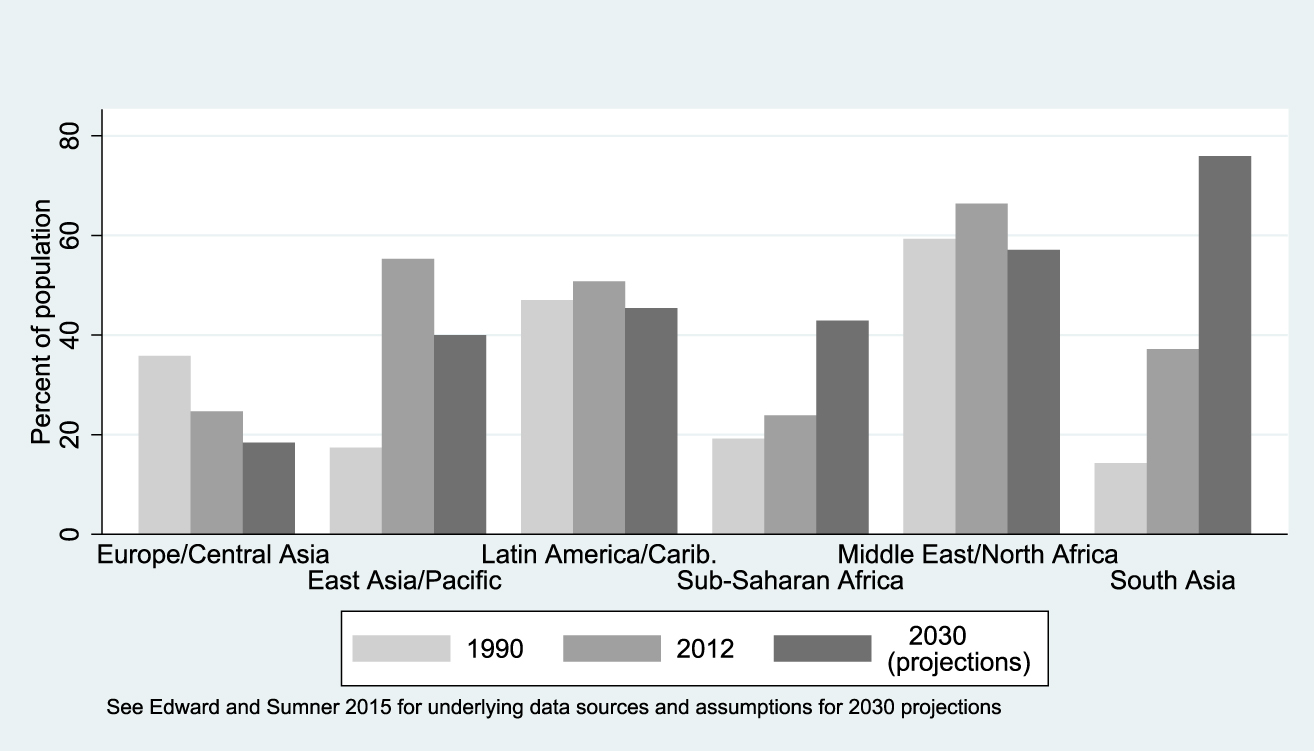
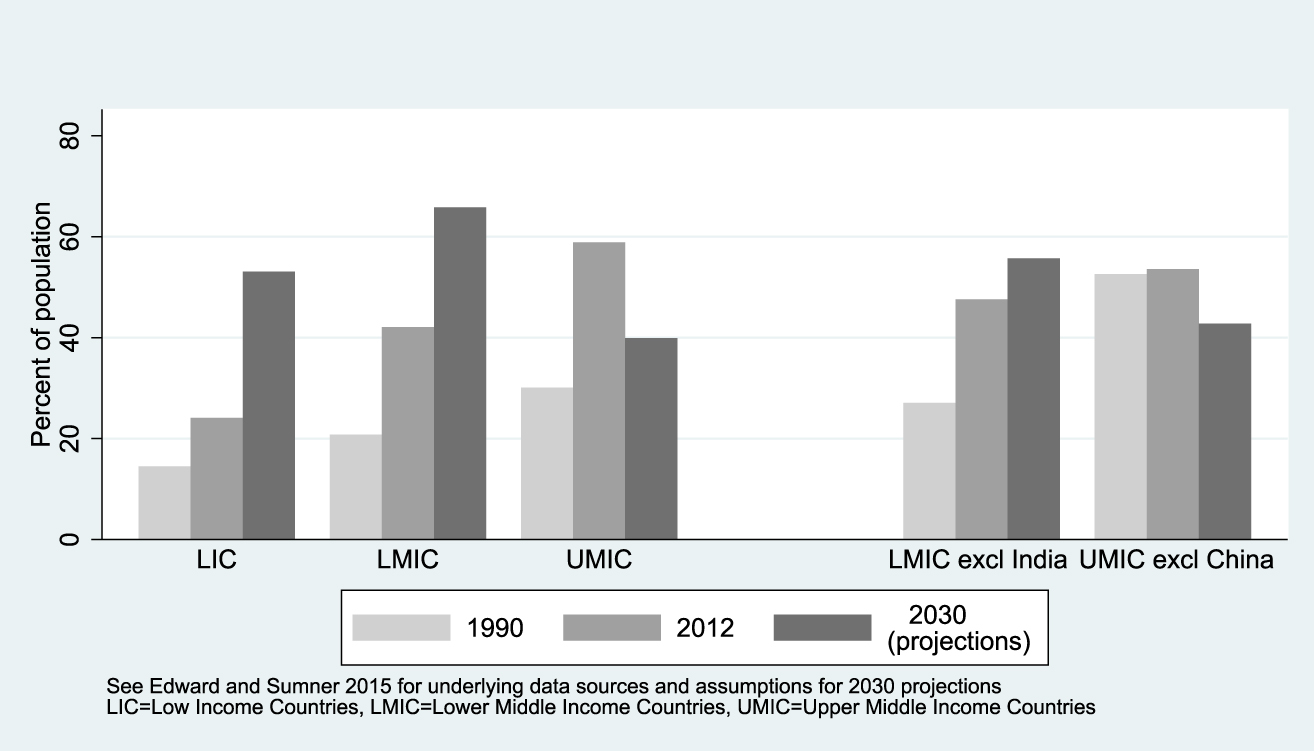
According to recent estimates that use these thresholds, large population shares in low, lower-middle, and even some upper-middle income countries still live, and will continue to live for some time, in the vulnerable income range below PPP $10 (figures 1 and 2, we use PPP $2.50 as the lower bound). Footnote 32 Sizeable population shares on more secure and affluent incomes typically only emerge in some upper-middle, and non-OECD high-income countries, as well as in economically more-advanced regions like Eastern Europe and Latin America. Footnote 33 However, especially in populous middle income countries, like China and India, the absolute numbers of households on incomes above PPP $10 begin to approach or even exceed those in developed regions by some estimates. Footnote 34
Population share living on incomes between $2.50 and $10 per capita (By region, in 2005 PPPs)

Population share living on incomes between $2.50 and $10 per capita (By country income group, in 2005 PPPs)

Pathways from Lower-Middle Income Growth to Wider Social and Political Development Outcomes
The relatively small size of Western-type middle classes and the weakness of clear occupational class divides in many developing countries pose obvious problems for analysis that seeks to understand political transformations through the terminology of social class. This problem was already noted in studies of previous regime transitions in developing countries, Footnote 35 which consequently focused on alternative actors and sources of political mobilization, such as social movements, Footnote 36 popular or middle sectors, Footnote 37 moderate elements in incumbent authoritarian regimes, Footnote 38 or local cultural elites and intellectuals. Footnote 39 We adhere to this tradition in arguing that the socio-economic context of many developing countries requires a move away from conventional concepts of middle-class development and associated assumptions about the link between inequality and regime outcomes. In the next sections we develop this argument around three topics: (1) deviations between observed political behaviors and attitudes among lower-middle income groups in developing countries and modernization theoretical accounts of middle-class development; (2) the impact of lower-middle income growth on distributional conflict and welfare reform, and (3) possible changes in political behaviors due to the increased accumulation of physical and human capital assets by lower-middle income households. Throughout, we also stress the importance of socio-economic and political regime contexts, which we believe are crucial for predicting when and how lower-middle income groups are able to organize around their shared political interests.
Analytical Challenges
Before we continue with our discussion it is important to be clear about limitations in the data and evidence that support the literature reviewed here. With few exceptions, information on the size and political behaviors of lower- and middle-income groups in developing countries is based on cross-sectional studies and on one-off survey snapshots. Footnote 40 This limits researchers’ ability to track people’s behaviors and preferences as they move in and out of poverty, which would be required to support claims that poverty reduction causes new forms of political engagement or conflict. In the following we highlight studies that overcome these shortcomings whenever possible. However, we also conclude by calling for investments in more and better longitudinal data and case studies, to improve the understanding of the consequences of lower-middle income growth and allow for better policy responses in the future.
At the same time, we note considerable new opportunities for research that arise from the improved availability of detailed data on poverty and lower-middle income growth trends. Whereas previous studies of the link between poverty reduction and political and social regime change often had to rely on relatively broad indicators, such as GDP per capita, the Gini index, or average caloric consumption and child mortality, Footnote 41 recent improvements in survey and micro-economic data permit much more detailed estimates of the size and economic circumstances of specific segments of the income distribution. We argue that these improvements represent significant progress over earlier data sources because they are better suited for capturing emerging new distributional divides and group-specific experiences of wellbeing and economic security. A primary objective of our review is to promote the use of this new information, while also advocating for continued investments in improved data quality.
Modernization Theory and Observed Political Preferences of Lower-Middle Income Households
A natural starting point for our discussion includes accounts of middle-class development from modernization theory. Footnote 42 Moore’s famous dictum “No bourgeoisie, no democracy” Footnote 43 has provided a highly influential point of reference for previous debates about middle-class led political transitions. It has also shaped recent commentary on the new middle classes, which has often postulated a preference of the developing world’s growing middle income groups for market-friendly economic reforms, good governance, and progressive cultural policies. Footnote 44
Despite these claims, the distance between modernization theoretical accounts of middle-class development and the reality in many developing countries today clearly remains quite large. In particular the circumstances of populous vulnerable groups on incomes between PPP $2-$10 are still far removed from those of bourgeois middle classes in the historical development of today’s advanced economies, who usually enjoyed considerable control over means of production, commerce, and finance. Gaps between theory and local reality also emerge from recent analysis of political outcomes and attitudes in countries undergoing rapid lower middle income growth. Cross-country analysis by Loayza, Rigolini, and Llorente. Footnote 45 —to our knowledge the only study that makes direct use of newly available data on poverty trends and lower-middle income growth to test for signs of an emerging “progressive middle-class consensus”—only find significant improvements in outcomes like health and education spending, trade and economic policy, and governance quality, when growth was concentrated on incomes above PPP $10. By contrast, expansion of populations with incomes between PPP $2.5 and $10 was not associated with positive effects when compared to countries where growth was concentrated among poor populations with incomes below PPP $2.5. Footnote 46 Signs of meaningful transformations in political attitudes at lower income levels similarly do not emerge in earlier cross-country analysis of value and perception surveys. While this literature does not reject the possibility that poor and economically vulnerable groups can be fervent defenders of democracy, Footnote 47 systematic shifts towards more progressive value systems are typically only observed at average income levels above those of countries that saw particularly fast rates of recent lower middle income growth over the past decades. Footnote 48
Within-country analysis of political attitudes by income group illustrates how economic insecurity may undermine the emergence of politically progressive preferences among lower-middle income groups. Lopez-Calva, Rigolini, and Torche Footnote 49 find for several Latin American countries that respondents with estimated incomes between PPP $4-$10 were more likely than both the poor and affluent groups to express a preference for populist and authoritarian forms of government that often dominate politics in the region. Footnote 50 Another worrying result of this study is that, although respondents in the vulnerable income range report more positive perceptions of economic opportunity than the poor, they did not express more trust in the political institutions of their countries (higher levels of trust only emerged among more affluent households). A recent study of middle-class attitudes in Kenya also documents that support for democratic institutions was generally lower among households who still frequently faced challenges to satisfy their basic needs. Footnote 51 Resnick Footnote 52 finds for Zambia that lower levels of trust even persisted among households on comparatively secure incomes of up to PPP $20.
Despite this emerging evidence a legitimate question remains whether the income-based definitions that dominate in the literature are sufficiently grounded in social contexts and interactions to capture the emergence of “class-like” identities and preferences. Amoranto, Chen, and Deolaliker and the aforementioned study by Lopez-Calva, Rigolini, and Torche find that, while responses to questions on composite indices relating to trust, perceptions of opportunity, legitimization of political violence, left-right partisanship, and economic policy preferences generally change monotonically with self-reported status and income, there are typically no distinct jumps in the data that would point to the emergence of discrete class-specific identities. Both contributions also find that self-reported political attitudes generally differ more between countries than across income groups within the same society. Footnote 53 Studies of perception surveys that focus on alternative dimensions of social identification such as respondents' education, job characteristics, ethnicity, religion, and urban-rural status also often find larger differences in political attitudes between these categories than along income ranks. Footnote 54 This is consistent with parallel research, which has often struggled to find robust links between personal incomes and political preferences in countries with lower levels of economic development and high inequality—in other words the universe of countries that account for most of the world’s recent lower-middle income growth. Footnote 55
In our reading a fruitful direction for future research is a more thorough integration of income-based measures with other locally salient markers of social identity. For instance, case studies of recent conflicts in Thailand suggest that violent clashes between the conservative upper-middle class “Yellow Shirts” and the pro-Taksin government “Red Shirts” movements were reinforced by the successful blending of urban lower-middle income groups and rural-poor identities in the case of the “Red Shirts” movement. Footnote 56 Comparable claims have been made in media and blog commentary on violent clashes in Turkey and Egypt, which are often presented as conflicts between upwardly mobile but culturally more conservative rural-middle income groups and more progressive urban middle classes. Footnote 57 The rich literature on public action and ethnic patronage in Africa similarly suggests that, although class-based interests at times crowd out ethnic affiliations, ethnic identity remains a factor in the background that can easily shape political organization along class lines. Footnote 58 Like our recommendation, this literature increasingly starts to marry economic and ethnic categories in the analysis of ethnic conflict and public goods provision. Footnote 59
Lower-Middle Income Growth and Distributional Conflict
Despite their obvious limitations, income-based measures of class provide a potentially more useful link to literature on distributional conflicts and political outcomes in developing countries. Easterly, in his aforementioned study of middle-class development, has suggested that a higher share of income accruing to populations in the middle of the income distribution can contribute to improved economic and political outcomes by reducing levels of inequality and polarization. Footnote 60 Easterly‘s argument does not presume the emergence of discrete class identities or progressive middle-class behaviors, but focuses instead on increased social cohesion and reduced polarization as middle incomes grow. Class-specific identities and behaviors are also not needed in recently influential political-economy models that relate democratic transitions to declining levels of inequality and demands for redistribution. Footnote 61 Drawing on the individualistic calculus of the Median Voter Model, Footnote 62 these theories predict that falling poverty numbers and middle-income growth would result in a shift in the distribution of individual political preferences to the right, away from calls for radical redistribution. This in turn would increase the likelihood of democratization, by reducing elites’ fear that political power-sharing will be followed by an expropriation of their assets in favor of the poor.
The primary problem with these models for the social and economic transformations discussed here again arises from the relatively low living standards of many middle-income groups in developing countries. Earlier research on the link between poverty reduction and regime change in developing regions suggests that demands for redistribution in countries that experience rapid growth in the presence of persistent extreme deprivations will often increase if populations demand more social spending to eradicate remaining pockets of poverty. Footnote 63 Calls for redistribution may also increase if upwardly mobile, but economically vulnerable, groups demand higher social spending to protect them from the uncertainties of rapid economic and social change. Signs of this effect are documented by Wietzke, Footnote 64 who finds that support for government redistribution grew more rapidly in societies that experienced faster rates of growth among groups on incomes closer to the PPP $2 poverty line. The same study documents much lower levels of redistribution support in countries that experienced growth in the secure income range above PPP $10, hinting at potentially deep differences in social policy preferences between vulnerable groups and more affluent middle classes (which we address shortly). Previous research by Cramer and Kaufman, Footnote 65 who rank respondents on the basis of household assets, finds that even though redistribution preferences of poorer and middle-income groups are not well-explained by relative wellbeing or inequality, these groups’ satisfaction with distributional outcomes was significantly reduced in times of rapid economic growth. While they speculate that feelings of relative deprivation explain this result, experiences of social risk and volatility during periods of rapid economic transformation may also clearly play a role.
Going forward, we believe considerable progress can be made by assessing the potential for distributional conflict within wider regime and social policy contexts, similar to analytical approaches adopted by earlier comparative welfare-state and regime transition literature. Footnote 66 Recent analysis suggests that major emerging powers with large lower-middle income groups like China, India, and Indonesia have already surpassed the income levels of today’s advanced economies when the latter introduced social assistance and health programs for their lower-income populations. However, today’s emerging economies spend much less on average on social protection programs than today’s developed countries did at the time. Footnote 67 Tensions involving lower- and middle-income groups are also likely to be exacerbated by the truncated and fragmented fiscal and social-policy systems of many developing countries. Multiple case studies indicate that social-policy systems in regions like Latin America or Asia are divided between social-insurance systems that disproportionally benefit more affluent formal sector workers, and social assistance and cash transfers whose targeting criteria exclude households above national poverty lines. Footnote 68
The extent of future distributional conflict is likely to depend crucially on how existing political regime and social policy contexts shape the ability of upwardly mobile groups to organize and build political coalitions. For instance, recent comparative analysis of welfare-state reform processes suggests that vulnerable groups were often more vocal and better able to form political alliances in support of social-protection and poverty-alleviation programs in regions like Eastern Europe and Latin America, where the combination of prior democratic reforms and the legacy of historically more developed welfare states and manufacturing sectors have created favorable political conditions for more expansive and inclusive social policies. Footnote 69 Lower-middle income growth is also likely to have important implications for other closely related fields of research, such as on the use of social programs for government patronage and clientelism. In particular, it is probable that continued middle-income growth will affect the incidence and manifestation of government patronage, if improving living standards raise the economic and political costs of payouts and pork-barrel politics. Footnote 70
Another closely related area for future research concerns possible coalitions between upwardly mobile lower-income groups and more established affluent middle classes. Coalitions involving affluent middle classes are often seen as an important precondition for successful political mobilization processes. This claim has been made, for example, for the recent political uprisings in the Middle East, Footnote 71 as well as for recent protests over social inequality and corruption in Latin America, which have been variably described as joint movements by vulnerable and affluent middle classes. Footnote 72
However, the literature is generally divided whether middle classes will always support demands of lower-income groups. Footnote 73 For instance, Birdsall Footnote 74 notes that in most low and lower-middle income countries, where people on higher-middle incomes still account for small shares of the population, affluent middle classes are often more easily co-opted by political authorities, such as through employment in the public sector or in state-owned companies. The failure to arrive at more coherent social-policy reforms and increased tax-based social spending in many developing countries similarly has been attributed to the difficulty of achieving political buy-in from more-affluent middle classes, who often opt for higher quality private services and do not directly benefit from newly established means-tested social assistance programs targeted at poorer income groups. Footnote 75
Assessments of the likelihood of coalitions involving affluent middle classes can be enriched by taking into account lessons from the literature on relative inequality and social mobility. Footnote 76 For instance, Hirschman’s Footnote 77 well-known “tunnel effect” hypothesis suggests that rapid economic growth can reduce distributional class conflicts by creating shared prospects for upward mobility. But these mitigating effects can wear off if some groups begin to experience real or perceived threats of falling behind. This is particularly probable for more-established affluent middle classes, for whom the possibility of relative status decline is more realistic in times of widespread upward economic mobility.
Evidence from value and perception surveys again provides support for such divides. Research by Graham and Pettinato Footnote 78 for Latin America finds that, even at the comparatively modest average incomes in the region in the 1990s, attitudes of affluent middle classes were often driven by fears of status decline and relative deprivation. While absolute income levels matter more for the subjective wellbeing of lower-income groups, relative differences became much more important for those in more comfortable economic circumstances. The authors also identify a large group of “frustrated achievers” in Peru, who—despite experiencing significant improvements in their incomes—remained unsatisfied with their relative status in society. They speculate that this has to do with comparisons with groups higher on the income ladder, similar to sentiments often documented among “squeezed middle classes” in advanced economies. Footnote 79 In a similar vein, Ravallion and Lokshin Footnote 80 report for Russia that non-poor households who feared a fall in their incomes supported stronger redistribution. Both of these studies use panel data and are therefore able to account for individual mobility trajectories. These results are consistent with the often-documented finding for developed economies that money increasingly loses ground to relative welfare comparisons and other more qualitative aspects of people’s circumstances in the subjective wellbeing evaluations of more affluent groups. Footnote 81
Changing Consumer Behaviors
A third channel that we believe deserves more attention involves the effect of income growth and increased asset accumulation on the political behaviors of lower-middle income groups.
Microeconomic theory suggest that even modest improvements in lower-middle incomes observed in large parts of the developing world can have significant impacts on household discretionary spending and consumption. Footnote 82 Support for this is available for a range of geographic regions. Birdsall et al. Footnote 83 show for Latin America that, whereas poor households allocate an estimated 70–90% of their expenditure to food and other basic necessities, those in the PPP $4-$10 range spend only 24–36% of their income on basic needs, the rest going to middle-class consumer goods like electronic appliances. Tschirley et al. Footnote 84 find gradually increasing shares of consumption of processed food among African households on incomes between PPP $2-$20. Banerjee and Duflo and Thurlow, Resnick, and Ubogu Footnote 85 identify larger dwelling structures and better access to water, sanitation, and electricity in the vulnerable income range, especially on incomes closer to the PPP $10 threshold. Increased use of electricity also goes along with a higher likelihood of television ownership and other media use, attributes that have been linked to recent changes in behaviors and political aspirations among lower-middle income groups citizens. Footnote 86
Middle-income growth, in interaction with wider demographic transformations, also often leads to changes in household investments in education and other non-material assets in ways that resemble the “delayed gratification” behaviors typically attributed to more-affluent middle classes. Micro-level studies have found that, relative to poorer households, adult women in the vulnerable and secure income range tend to have fewer children. Footnote 87 The combination of rising absolute incomes and fewer children often implies a net improvement in per capita education spending, even when the relative share of household expenditures devoted to education remains stable. Households’ access to health services and insurance, also typically increases in the vulnerable and secure income ranges. Many of these services, however, are contracted from private providers, suggesting that also lower-income households are willing to opt out of public services when the latter are perceived to be of insufficient quality. Footnote 88
While previous literature has often focused on the effects of increased household consumption on economic growth and private sector development, Footnote 89 it is entirely conceivable that the emerging accumulation of physical and human assets will also influence social and political outcomes through other channels. It can be expected, for example, that growing educational investments among lower-middle income individuals should turn into a major driver of reform, once today’s lower-middle income children become workers and voters. Moreover, even in the short term, widespread increases in household spending on basic utilities and social services should have cumulative effects on aggregate social development outcomes. Support for this argument is provided by Cobham and Sumner, Footnote 90 who show that rising incomes of the poorest income groups—defined in relative terms—are associated with improvements in non-monetary indicators like clean water supply and lower child mortality. Footnote 91
In our view, another important potential consequence of increased asset accumulation is a change in public attitudes about the importance of personal economic and property rights. An insightful model by Ansell and Samuels Footnote 92 suggests that accumulation of income and wealth by upwardly mobile, yet politically disenfranchised, groups can result in demands for political reforms, if these groups fear expropriation of their assets by ruling elites. The model is presented explicitly as an alternative to redistributivist theories of regime change mentioned earlier, with stronger roots in contractarian thought and reduced emphasis on people’s concerns about income inequality. As a consequence, its premises can hold, even when lower-middle income growth does not translate into the predicted reduction in distributional conflicts.
Although the model was not written for today’s developing countries, we see some support for its premises in the recent rise in anti-corruption protests in emerging economies. Many case studies have pinpointed grievances about government corruption—real or perceived—as major causes of political mobilization among lower-income groups in regions as diverse as Latin America, Asia, or Africa. Footnote 93 Concerns about government and public sector accountability have also been identified as drivers of recent upheavals in the Arab world. For example, Birdsall Footnote 94 suggests that Mohamed Bouazizi, the street vendor whose self-immolation triggered the uprising in Tunisia, was a member of the upwardly mobile but vulnerable lower-middle income group. According to eyewitness accounts, Bouazizi’s protest was directly motivated by anger about what he perceived to be routine harassment and obstruction of his modest business interests by local authorities. Concerns about limited economic opportunity and rarely accountable political elites also dominate in other accounts of lower and middle-class behavior during the uprisings in the Arab world. Footnote 95
It is important to note, however, that none of these developments necessarily offset more fundamental obstacles to democratic and social policy reforms that we discussed earlier in this article. The previously cited evidence from perception surveys and the long history of authoritarian “strong men” in lower-middle income countries amply illustrate that economically vulnerable populations are often willing to forgo more fundamental political liberties to support regimes that promise to root out petty corruption through a more-authoritarian style of government. Footnote 96 Anti-corruption demonstrations of lower-income groups in other contexts also often stopped short of demands for more fundamental democratic change. For example, in China, many recent anti-corruption protests were primarily directed against local government officials, but they have not been linked to questions about the legitimacy of communist one-party rule. Footnote 97
This points to future research on possible analytical frameworks that compare consequences of lower-middle income growth across multiple dependent variables, ranging from measures of democratic transition and regime breakdown, to lower-level outcomes such as government control of corruption or procedural measures of democracy and law enforcement. Footnote 98 In most cases, we would expect much more immediate effects of lower-middle income growth on measures of government quality and corruption than on more fundamental indicators of regime type and transition.
Conclusion
There can be little doubt that recent changes in the income distribution of low- and middle-income countries will continue to shape social and political realities in the developing world for years to come. We have argued for a stronger integration of emerging evidence about these transformations into the comparative analysis of democratization and social-policy reform processes. Based on our review, we expect that improved cross-fertilization across currently distinct literatures on middle-income growth and political transitions would result in a much more nuanced understanding of social and political transformations currently under way in developing countries. We also concur with others before us that important progress can be made by combining economic analysis of changing poverty trends and distributional outcomes with comparative perspectives on pre-existing social conflict lines and relevant regime and institutional contexts.
Despite these potentials, we stress again the need for continued investments in data quality about the new middle classes. As noted earlier in this article, an important shortcoming of much of the available literature is the limitation to relatively aggregated cross-sectional information, which constrains researchers’ ability to make causal inferences about the social and political consequences of lower-middle income growth. Although a response to this problem may require non-trivial up-front investments (such as by augmenting household expenditure panel surveys with modules on political attitudes and behaviors or by conducting new longitudinal case studies and surveys), such efforts would be highly worthwhile. A more robust understanding of the behaviors and motivations of upwardly mobile populations has potentially vast benefits for the design of economic and social policies in today’s emerging economies. It should not be undermined by data limitations and analytical blind spots that have relatively simple technical fixes.