

INTRODUCTION
Disturbances of thought, reasoning and affect modulation, common to the acute phases of such psychiatric disorders as schizophrenia and mania, result in behavioural disturbance being unfortunately common in acute psychiatry (Duxbury, Reference Duxbury2002). Behavioural and pharmacological management are first line responses to aggression. However, seclusion, which involves placing service users into a secure locked room, is used to contain potentially harmful behaviour when other interventions have been unsuccessful in stabilising or reducing risk of imminent harm (Colaizzi, Reference Colaizzi2005).
The need for seclusion in acute psychiatry has, however, been vehemently debated (Sailas & Wahlbeck, Reference Sailas and Wahlbeck2005). Advocates propose that for highly agitated and disturbed service users, the reduction of stimulation in seclusion can calm arousal and help to maintain safety for the service user, staff, and others (Lendemeijer & Shortridge-Baggett, Reference Lendemeijer and Shortridge-Baggett1997). Opponents of seclusion use argue that service users describe seclusion as degrading and traumatising (Frueh et al., Reference Frueh, Knapp, Cusack, Grubaugh, Sauvageot, Cousins, Yim, Robins, Monnier and Hiers2005), and as a punishment used by staff to control service user behaviour (Meehan et al., Reference Meehan, Bergen and Fjeldsoe2004). Placing someone in seclusion can also result in physical injury for service users and staff, and increase the risk of death as a result of injury or medication complications being missed due to the isolation of being in seclusion (Busch & Shore, Reference Busch and Shore2000).
In response to adverse outcomes and a strong service user sentiment, psychiatric services in North America have led the development of seclusion reduction initiatives (Sailas & Wahlbeck, Reference Sailas and Wahlbeck2005). Sensory modulation and a focus on early identification of escalating agitation and intervention have proven to be effective in reducing the need for seclusion (D'Orio et al., Reference D'Orio, Purselle, Stevens and Garlow2004; Huckshorn, Reference Huckshorn2004). Sensory modulation approaches involve providing sensory-based therapy tools or creating appropriate environments that engage service user’s senses to reduce the build up of agitation and prevent the escalation of aggression (Champagne & Stromberg, Reference Champagne and Stromberg2004). A number of items or approaches have proven to reduce service user agitation including weighted blankets, multisensory treatment rooms (that may contain paintings, personalised music, reading material), portable music players and optical lamps (Baillon et al., Reference Baillon, Van Diepen and Prettyman2002; Sullivan et al., Reference Sullivan, Bezmen, Barron, Rivera, Curley-Casey and Marino2005; Whitecross, Reference Whitecross2006).
Related to the use of sensory modulation approaches has been recognition that different service users respond to different sensory interventions, and that early assessment that highlights a service user’s triggers and preferred management approaches can reduce seclusion use (D'Orio et al., Reference D'Orio, Purselle, Stevens and Garlow2004). A program in which staff were educated to interview service users to document stress triggers and preferred management approaches, resulted in significantly reduced use of physical restraint (Jonikas et al., Reference Jonikas, Cook, Rosen, Laris and Kim2004). Also highlighted was the importance of using service user feedback when developing tailored intervention plans, which can also enhance the therapeutic alliance between service user and staff (Ryan & Happell, Reference Ryan and Happell2009).
With international programs showing seclusion reduction is achievable, trialing an intervention that draws on sensory assessment and therapy in Australian acute psychiatry services is important, where seclusion use is still relatively common. A survey in 2004 found that 16% of service users admitted to psychiatric inpatient services in the State of Victoria were secluded (Department of Human Services Mental Health Branch Victoria, 2004). The current report therefore details a pilot implementation of the use of sensory assessment and modulation to reduce the use of seclusion.
METHODS
Setting and pilot implementation
Implementation occurred as a six-month pilot (July–December 2008) on a 30-bed acute psychiatry inpatient unit at The Alfred Hospital. The unit operates a low dependency open ward area (LDU) and an adjacent locked psychiatric intensive care unit (PICU) for service users with different levels of acuity or observational needs from within the local geographical area. Two seclusion rooms are contained within the PICU. The unit also provides a statewide psychiatric intensive care assessment and intervention service for people with a history of aggression or assaults referred by inpatient units throughout the state of Victoria, with statewide service users cared for within LDU or PICU alongside local service users. Also impacting on care provision, from July 2008 service users and staff were no longer permitted to smoke on the unit. During the pilot, 263 service users were admitted to the unit with an average hospital length of stay (LOS) of 19.0 days (SD = 21.3). A total of 100 service users spent at least one day in PICU (mean days = 4.2; SD = 4.1) and 40 (15%) were secluded at least once. Most service users were admitted with psychotic disorders, bipolar disorder and, to a lesser extent, major depression.
Implementation involved: 1) purchase and dissemination of sensory resources; 2) development of the ‘Alfred Psychiatry Safety Tool’; 3) education for inpatient staff on the use of the Safety Tool and sensory resources.
Dissemination of sensory resources
Following a literature review a range of sensory resources were purchased. These included optic lamps, digital music players, musical instruments, herbal teas, glider chairs, exercise bike, weighted blankets, stress balls and exercise putty, to supplement existing art and music therapy resources on the unit. To facilitate access, some of the resources were stored on a ‘sensory cart’ that could be mobilised around the unit and others were available in the low dependency area.
Development of the Alfred Psychiatry Safety Tool
Adapted from The Massachusetts Department of Mental Health – Safety Tool (LeBel et al., Reference LeBel, Stromberg, Duckworth, Kerzner, Goldstein, Weeks, Harper, LaFlair and Sudders2004), a two-page questionnaire was developed to guide clinicians in interviewing service users about stress triggers and warning signs, calming strategies and seclusion history, details which could be included in safety plans. Common examples of stress triggers, warning signs and calming strategies were also displayed to prompt clinicians during the interview. A copy is available on request. A small number of service users completed the Safety Tool before the project commenced to ensure that it could be understood by psychiatric service users.
Staff education
Education was offered to unit staff in workshops led by the unit manager and senior occupational therapist. Workshops emphasised familiarisation with and use of sensory resources as well as the Safety Tool. In addition to project specific training, before working in PICU, staff completed a mandatory two-day training program providing practical training in de-escalating and managing aggressive behaviour.
Evaluating the service user impact
Approximately 1–2 mornings each week during the six-month pilot, medical histories for PICU service users (more at risk of aggressive behaviour) were audited to identify completed Safety Tools. While it is possible that some completed Safety Tools may have been missed, it was expected that this audit schedule would capture the majority of those completed. For service users with a completed Safety Tool, past seclusion experience was documented along with seclusion episodes occurring during the admission after the Safety Tool interview date. Total hospital LOS for that admission was also documented. Admission Health of the Nations Outcome Scale (HONOS) ratings were collected to provide a measure of illness severity. The HONOS is a clinician-rated 12-item measure of psychiatric symptoms, behaviour and social functioning (Bebbington et al., Reference Bebbington, Brugha, Hill, Marsden and Window1999), and used by Australian psychiatric services to monitor treatment outcome.
Evaluating the staff impact
Staff feedback was collected via an anonymous questionnaire, developed to explore the experience of using sensory resources and the Safety Tool. As well as demographics, staff were asked about their experience of working with aggressive service users, the frequency, type and benefit of sensory resources used with service users, frequency and benefit of using the safety tool, and whether it should be incorporated into ongoing practice on the ward. In general, questions were scored on a Likert scale (1=not at all, 2=somewhat, 3=moderately, 4=very). A copy is available on request.
RESULTS
Use of the Safety Tool with acute psychiatry service users
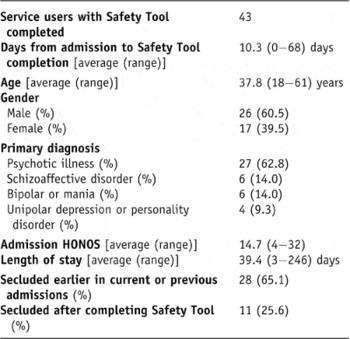
Safety Tools were completed with 43 service users who had spent time in PICU, with most completed within the first few days of admission (see Table 1). One refused to complete the interview so was excluded from thematic analysis. Three completed the Safety Tool on the unit in the months before the project commenced and were included in all analysis. Most were male and experiencing a psychotic illness, with an average hospital LOS of 39.4 days (SD = 42.0). When compared with those for whom a Safety Tool was not completed (Mean LOS = 17.0 days; SD = 20.6), a Mann-Whitney U-test (to adjust for a non-normal distribution) found a significantly longer LOS for those administered a Safety Tool (Mann-Whitney U-test, z = −5.92, p < 0.0005). While 65% had been secluded in a previous admission or in the current admission before completing the Safety Tool, only 26% were secluded after completing the Safety Tool.
Demographics and clinical presentation for service users with completed Safety Tools

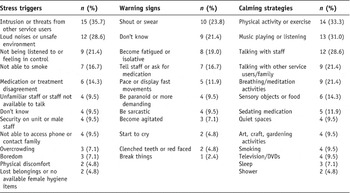
The stress triggers, warning signs and preferred calming strategies on the 42 validly completed Safety Tools are displayed in Table 2. Loud noises (e.g. slamming doors, yelling) or perceived or actual threats from other service users on the unit were the most common. Not being involved in or having preferences regarding treatment decisions ignored were also prominent stressors, as was not being able to smoke. Highlighting a gender effect, being managed by male staff distressed some service users.
Stress triggers, warning signs and preferred calming strategies documented on the 42 validly completed Safety Tools

Overt behavioural signs such as shouting, pacing, or agitation were the most common warning signs for escalating distress. Withdrawal behaviours such as becoming isolative were also common. Highlighting a clear avenue for education by staff, 21% of service users were not aware of their warning signs for distress.
Engaging in physical activities (e.g. walking, basketball, exercise) or music playing and listening were the most common preferred calming strategies. Conversation with staff and other service users or family/friends to address escalating distress were also important, as was use of a range of sensory experiences (e.g. creating artwork, tactile resources, food, shower). Self-soothing strategies (e.g. quiet time in room, breathing exercises) were also helpful.
Staff feedback on the use of sensory resources and the Safety Tool
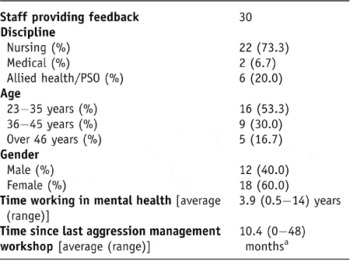
Approximately 70% of unit staff completed the questionnaire, with staff mostly nurses, female and less than 35 years of age (see Table 3). Time since participation in aggression management training varied, with most having completed this within the past 12 months. Exposure to behavioural disturbance was high, with most staff ‘a number of times a week’ managing aggressive service users and ‘moderately’ confident in identifying and managing someone with the potential to become aggressive.
Staff demographics and clinical experience

a Four staff had not previously participated in an aggression management workshop
Safety Tools had been completed with a service user by 50% of staff, and 81% had read a completed Safety Tool. Most staff said that information gathered using the Safety Tool was ‘somewhat-moderately’ helpful for them in managing potentially aggressive service users, and 76% said the Safety Tool should become a part of routine practice on the unit. Qualitative feedback on the timing of completion was that the Safety Tool was most effectively completed on admission unless the service user was too unwell or agitated. For secluded service users it was thought that reviewing the Safety Tool during post-seclusion debriefing facilitated discussion with the service user about how to prevent recurrences. Suggestions to improve the Safety Tool were to allow for inclusion of staff and family/carer observations.
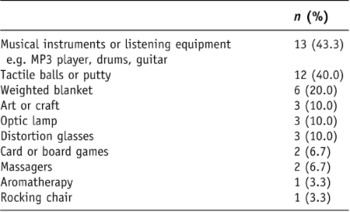
Some form of sensory resources had been used by 81% of staff with service users on the unit. Music playing or listening items, tactile or visual items and art activity were most common (see Table 4). Staff mostly found the sensory resources ‘somewhat-moderately’ helpful in managing service users’ escalating behavioural disturbance. Qualitative feedback about barriers to the use of sensory resources was also provided. Time constraints that limited the capacity for staff to engage therapeutically with service users using sensory resources were the primary barrier. A lack of confidence or understanding of how to best use the sensory resources was also reported, as was difficulty accessing the resources at times due to being stored in the allied health office or having no clear protocols governing their access and use.
Percentage of staff (n=30) having used sensory resources with service users to calm disturbed behaviour

Regarding education in the use of the Safety Tool and sensory resources, 71% of staff had attended at least one training session. This level of education was not sufficient, however, as most staff reported only having been provided with ‘somewhat sufficient’ education on their use.
DISCUSSION
This project involved a 6-month pilot of the use of sensory assessment and therapy resources to assist staff in engaging with service users to reduce seclusion use in an acute psychiatric inpatient unit. Implementation involved the development and use of a Safety Tool, a brief questionnaire that was completed in interview with service users to determine stress triggers and warning signs, preferred calming strategies and seclusion history. A variety of sensory modulation resources (e.g. musical instruments and listening devices, tactile putty or stress balls, optic trees to provide visual stimulation) were also made available to staff on the basis of previous research (Baillon et al., Reference Baillon, Van Diepen and Prettyman2002; Champagne & Stromberg, Reference Champagne and Stromberg2004; Whitecross, Reference Whitecross2006), with implementation supported by staff education.
The Safety Tool was completed with high acuity service users who required, in many cases, very lengthy inpatient admissions. In most cases the Safety Tool was completed within days of admission, or following a marked escalation of disturbed behaviour for service users initially settled on admission. Considering their very high level of previous seclusion (65%), a relatively small proportion (26%) required seclusion after completing a Safety Tool with staff. Information gathered was also thought by staff to assist in managing potentially aggressive service users, and most (76%) said it should be incorporated into routine unit practice.
The relatively small proportion of service users with completed Safety Tools during the project was related to a clinical decision by senior nursing staff to align completion of the Safety Tool to the level of aggression on a clinical risk screen. With the Safety Tool intended to assist management of service users potentially requiring seclusion level care, clinical nursing staff determined that a Safety Tool would be completed with each service user identified as being at ‘high risk’ for behavioural aggression. Following the completion of this project, further training and practice development has been conducted to broaden the use of the Safety Tool as an information gathering tool.
Sensory modulation resources were also used to varying extents by most staff and were said to be ‘somewhat-moderately’ helpful in assisting to manage escalating behavioural disturbance. Ongoing barriers to the effective use of the sensory resources on the unit were also identified. One related to the level of education provided to staff, with many saying they wanted more information about how to determine the preferred choice of resource, and effectively use them with individual service users. A number of systemic barriers were also identified. The first related to time constraints that were thought to limit the capacity for staff to therapeutically engage individual service users. The level of documentation required to be completed for each service user was in particular thought to restrict time for therapeutic engagement. A second identified barrier related to a lack of clarity around accessing the sensory resources. They were often locked in the office of allied health staff, making access more difficult, and there was no clear tracking mechanism to ensure allocated sensory resources were returned.
The importance of sensory resources as a component of aggression management interventions was highlighted by the number of service users reporting sensory approaches among their preferred calming strategies. While a small proportion said that sedating medication was helpful, music playing and listening was a very common preferred calming strategy for service users. Other visual (art making), tactile (shower, weighted blanket), smell (aromatherapy) and taste (chocolate and coffee) strategies were also helpful calming strategies. Consistent with the need for an interdisciplinary and multi-faceted approach to managing aggression, exercise (walking, basketball) and self-soothing strategies (meditation, breathing) were also important, as was spending time talking to and being verbally calmed by staff (Hancock et al., Reference Hancock, Buster, Oliver, Fox, Morrison and Burger2001). The capacity for staff to spend time engaging therapeutically with service users is therefore critical to assist in identifying and intervening early with potentially aggressive service users (D'Orio et al., Reference D'Orio, Purselle, Stevens and Garlow2004), to break the cycle of escalating aggression in a way that is consistent with service users’ preferences (Jonikas et al., Reference Jonikas, Cook, Rosen, Laris and Kim2004).
A limitation for the current project was the observational nature. A more robust evaluation of the potential impact of the Safety Tool on seclusion use, could instead have involved a randomised-controlled design where service users were assigned to either the Safety Tool condition or treatment as usual. However, as this pilot was a feasibility study to determine its capacity to be incorporated into routine care, the decision was made to instead observe the selection of who the Safety Tool was completed with, the nature of responses and any potential impact.
CONCLUSION
Part of a multi-faceted approach to preventing aggression and seclusion use, a structured clinical tool that gathered feedback from service users about what distressed and calmed them, assisted acute psychiatry staff to better engage with service users and prevent and manage behavioural disturbance. The improved availability of sensory modulation resources that could be tailored to the calming preferences of individual service users, also provided staff with additional ways of therapeutically engaging service users to improve care delivery which led to a reduced seclusion use for the study participants. As this is the first completed research paper in Australia examining the benefits of incorporating sensory approaches into a multifaceted program to reduce seclusion use, it has the potential to inform practice within Alfred Psychiatry and more broadly, as well as providing direction for further research into the efficacy of such treatment modalities.
Acknowledgements
This project was made possible by a quality improvement project grant from The Alfred hospital. The authors would also like to thank staff and service users involved in the implementation of this pilot for providing feedback about their experience.