Introduction
The Visceae is one of seven tribes within the Sanatalaceae in the most recent Angiosperm Phylogeny Group classification (Angiosperm Phylogeny Group, 2016), having been previously recognised as the family Viscaceae. Nonetheless, in treatments based on both molecular phylogenetic and evolutionary studies in which members of the Santalales are placed in 18 different families (Nickrent et al., Reference Nickrent, Duff, Cowell, Wolfe, Young, Steiner, dePamphilis, Soltis, Soltis and Doyle1998, Reference Nickrent, Malécot, Vidal-Russell and Der2010), it has been proposed that the Viscaceae should be retained. In these treatments, the family is characterised by the absence of an embryo suspensor (Ross & Sumner, Reference Ross and Sumner2005a, Reference Ross and Sumner2005b; Ross Friedman & Sumner, Reference Ross Friedman and Sumner2009), the presence of which is characteristic of the Santalaceae. Whether recognised at the tribe or family level, molecular analyses strongly indicate that the group is monophyletic (Der & Nickrent, Reference Der and Nickrent2008; Su et al., Reference Su, Hu, Anderson, Der and Nickrent2015; Maul et al., Reference Maul, Krug, Nickrent, Müller, Quandt and Wicke2019). Subsequent authors (Sanjai & Balakrishnan, Reference Sanjai and Balakrishnan2006; Mathiasen & Daugherty, Reference Mathiasen and Daugherty2009; Mehrvarz et al., Reference Mehrvarz, Shavvon and Golmohammadi2012; Sanjai & Balakrishnan, Reference Sanjai, Balakrishnan, Balakrishnan, Chakrabarty, Sanjappa, Lakshminarasimhan and Singh2012; Kołodziejek et al., Reference Kołodziejek, Patykowski and Kołodziejek2013; Mathiasen & Daugherty, Reference Mathiasen and Daugherty2013; Kuijt & Hansen, Reference Kuijt, Hansen and Kubitzki2015; Mathiasen & Kenaley, Reference Mathiasen and Kenaley2015a, Reference Mathiasen and Kenaley2015b; Petersen et al., Reference Petersen, Cuenca, Møller and Seberg2015; Su et al., Reference Su, Hu, Anderson, Der and Nickrent2015; Kuijt, Reference Kuijt2016; Mathiasen & Kenaley, Reference Mathiasen and Kenaley2016; Sadowski et al., Reference Sadowski, Seyfullah, Wilson, Calvin and Schmidt2017) have followed the treatment of Nickrent et al. (Reference Nickrent, Duff, Cowell, Wolfe, Young, Steiner, dePamphilis, Soltis, Soltis and Doyle1998, Reference Nickrent, Malécot, Vidal-Russell and Der2010), and we do so here.
The genus Viscum L. is variously estimated to comprise about 120 species (Nickrent, Reference Nickrent1997–), 150 species (Mabberley, Reference Mabberley2017) or 113 species (POWO, 2019), distributed in tropical to temperate regions of the Old World. Hooker (Reference Hooker1886) reported 11 species and two varieties of Viscum for the Indian subcontinent. Danser (Reference Danser1941) reported 24 species of Viscum for erstwhile British India, 14 of which also occur in Southeast Asia, including Malaysia, and Australia. Later, Rao (Reference Rao1957), Sanjai & Balakrishnan (Reference Sanjai and Balakrishnan2006, Reference Sanjai, Balakrishnan, Balakrishnan, Chakrabarty, Sanjappa, Lakshminarasimhan and Singh2012) and Thriveni et al. (Reference Thriveni, Shivamurthy, Amrutesh, Vijay and Sadanand2013) reported the occurrence of 16 species in India.
In the leafless species that occur in India, owing to the polymorphism of Viscum articulatum Burm.f., many species and infraspecific taxa have been described and nomenclatural combinations made by various authors. Danser (Reference Danser1941) considered Viscum articulatum,V. liquidambaricola Hayata and V. nepalense Spreng. as separate taxa based on their internodal length and breadth. He also provided additional information on the distribution and host specificity of these taxa, particularly Viscum articulatum and V. nepalense. Moreover, he described the variety Viscum nepalense var. thelocarpum Danser based on the presence of warty young fruits. However, in the same publication he clearly pointed out difficulties in differentiation, citing instability in the size of the internodes and the size and shape of the fruit when used as taxonomic characters. Although he noted that Viscum articulatum is usually parasitic on members of Loranthaceae, many authors (Fischer, Reference Fischer1926; Rao, Reference Rao1957; Sanjai & Balakrishnan, Reference Sanjai and Balakrishnan2006, Reference Sanjai, Balakrishnan, Balakrishnan, Chakrabarty, Sanjappa, Lakshminarasimhan and Singh2012) have pointed out various other host associations.
Rao (Reference Rao1957) showed that there are no significant taxonomic differences between Viscum nepalense and V. articulatum except the degree of variation in the size of internodes and fruits after maturity. Therefore, he merged Viscum nepalense into V. articulatum but retained the varietal status of variety thelocarpum and considered V. liquidambaricola as a variety of V. articulatum. In contrast, Sanjai & Balakrishnan (Reference Sanjai and Balakrishnan2006) stated that internodal length and breadth and shape of fruits vary continuously, and that distinctions based on these characters cannot be supported, recognising all these taxa under Viscum articulatum.
During field expeditions, specimens from certain populations of a squamate Viscum were collected from two localities in the Western Ghats of India. On critical analysis, they were found to be similar to the squamate Viscum mysorense Gamble group (Kirkup et al., Reference Kirkup, Polhill, Wiens and Bussing2000), although the presence of a central male flower in the triad is identical to the morphology found in the V. capitellatum Sm. group. For these reasons, these plants cannot be attributed to any known species of Viscum. Therefore, a new species is described here and notes on its phenology and ecology are provided, together with a comparison with allied species.
Taxonomic Treatment
Viscum sahyadricum Sardesai, S.P.Gaikwad & S.R.Yadav, sp. nov.
In overall morphology very similar to Viscum articulatum Burm.f. but differing in having a central male flower without its own bracteal cup, the presence of a peduncle, and male and female flowers with three petals (or corolla lobes). It is also similar to Viscum capitellatum Sm. and V. trilobatum Talbot in inflorescence architecture with characteristic central male flowers; however, it differs from both in having flattened upper internodes, very inconspicuous, scale-like leaves, and male and female flowers with three corolla lobes. – Type: India, Maharashtra, Kolhapur District, near Suleran Village, on the way to Amboli, 16°3′29.27′′N 74°4′43.69′′E; c.690 m, 20 vi 2006, Sardesai 3540 (holo CAL; iso BAMU, BSI, MH, SUK). Figs. 1 , 2 .
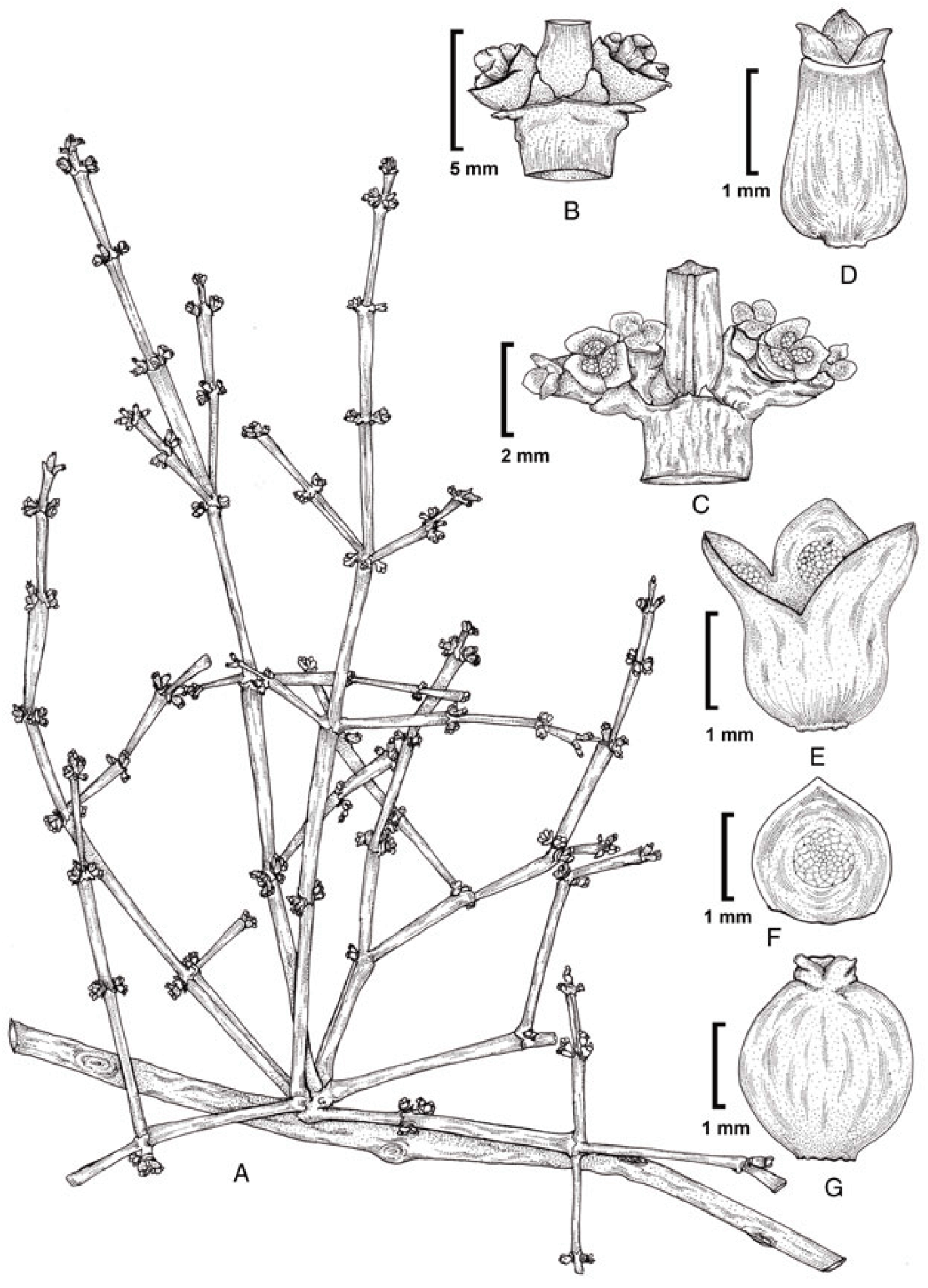
Viscum sahyadricum Sardesai, S.P.Gaikwad & S.R.Yadav. A, Habit; B and C, part of branch, showing a pair of scale leaves and young inflorescences; D, female flower; E, male flower; F, corolla lobe with anther; G, fruit. Drawn by Ramchandra Gore.

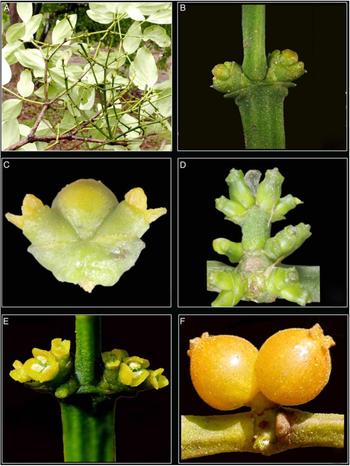
Viscum sahyadricum Sardesai, S.P.Gaikwad & S.R.Yadav. A, Habit with host; B, branch showing a pair of scale leaves and young inflorescences; C and D, 3- and 5-flowered cymules, respectively, showing central male and lateral female flowers; E, cymules showing central male and lateral female flowers; F, fruits. Figure prepared by Ramchandra Gore. (Photographs: A, E and F, M. M. Sardesai; B–D, S. R. Yadav.)
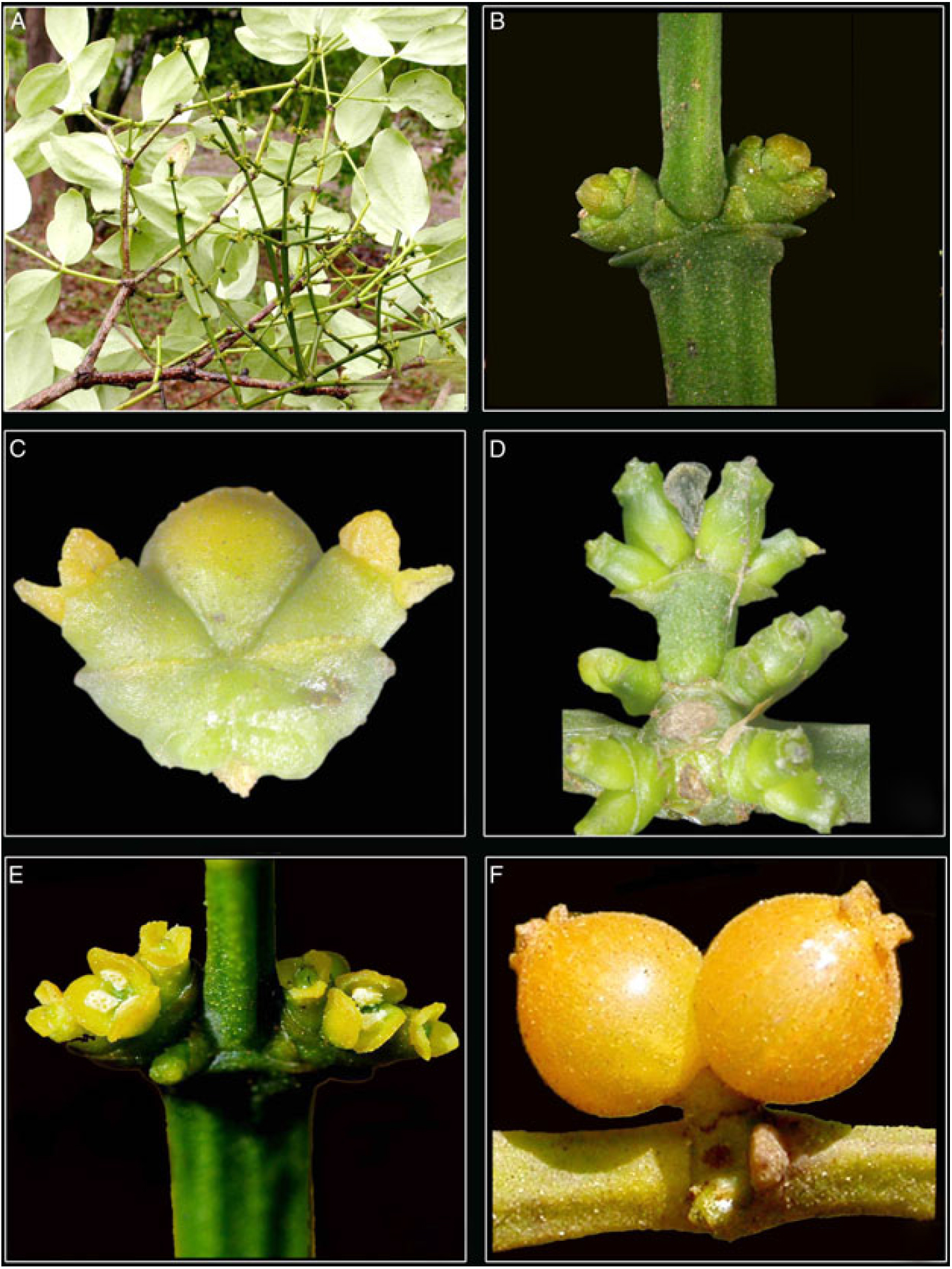
Monoecious evergreen, herbaceous partial stem-epiparasite. Branches dark green; stems branched, stiff, basal branches percurrent, upper ones dichotomously or trichotomously branched; nodes swollen; lower internodes stout, terete, 3–5 × 0.2–0.4 cm; upper internodes 5–7 × 0.1–0.2 cm, slender and longitudinally grooved, gradually flattened towards apex. Leaves all inconspicuous, scale-like, at the base of the branches very small, triangular, often absent and those at the apices acute, conduplicate, triangular or claw shaped, connected at their bases forming a boat-like sheath at the apex of every internode, 0.8–2.5 mm long. Inflorescences cymose, arising from the nodes, sessile or subsessile, peduncle up to 13 mm long. Flowers unisexual, sessile, regular, 3-merous, usually in triads, rarely 5, with female lateral flowers and a central male flower or all flowers female; enclosed in a cupule of 2 connate acute bracts, bracts c.1 × 1 mm, broadly ovate with acute apex, with some hairs and deposits. Male flowers sessile, globose, c.1.5 × 1 mm; corolla lobes 3, free, valvate, concave, ovate, c.1 × 0.75 mm, acute at apex, each bearing an anther on the inner surface; stamens 3, c.0.5 × 0.5 mm, anthers sessile, opposite and attached to the inner surface of the corolla lobes, opening by many pores; pistillodes absent. Female flowers sessile, oblong, c.2 × 1 mm; perianth lobes 3, free, valvate, triangular, c.1 × 0.5 mm, acute at apex; ovary inferior; styles short, thick; stigma dome-shaped. Fruits globose, smooth, c.5 mm in diameter, apiculate with persistent corolla lobes, orange at maturity. Seeds compressed, subcordate, c.2.5 mm across.
Flowering and fruiting. April to November.
Distribution. Western Ghats mountains, Gavase and Suleran in Kolhapur District of Maharashtra State and Kudremukha in Chikkamagaluru District of Karnataka State.
Ecological note. The populations observed near Gavase and Suleran villages in Kolhapur District of Maharashtra State occur as epiparasites only on Helicanthes elastica (Desr.) Danser, whereas individuals in the population at Kudremukha, on the way to Kalasa, Chikkamagaluru District, Karnataka State, grow as an epiparasite only on Macrosolen capitellatus (Wight & Arn.) Danser. The species is so far known to occur in only these two localities, which lie approximately 300 km apart in the Western Ghats. It is quite possible that the species may occur elsewhere in the region, and therefore attempts were made to locate it in accessible parts of the Western Ghats in Maharashtra State, but without success. It may, however, occur in parts of the Western Ghats in Goa and Karnataka States, where the forests are more dense, humid and inaccessible.
Etymology. The specific epithet ‘sahyadricum’ is derived from the Sahyadri mountains (northern Western Ghats), which include the type locality.
Additional specimens examined. India. Maharashtra: Kolhapur District, Near Gavase Village, 16°6′19.98′′N, 74°8′3.39′′E, 705 m, 04 iv 2004, Sardesai 3127 (BAMU!). Karnataka: Chikkamagaluru District, Kudremukha, on the way to Kalasa, 13°12′38.79′′N, 75°15′29.28′′E, 802 m, 9 vii 2007, SR Yadav 102 (SUK!).
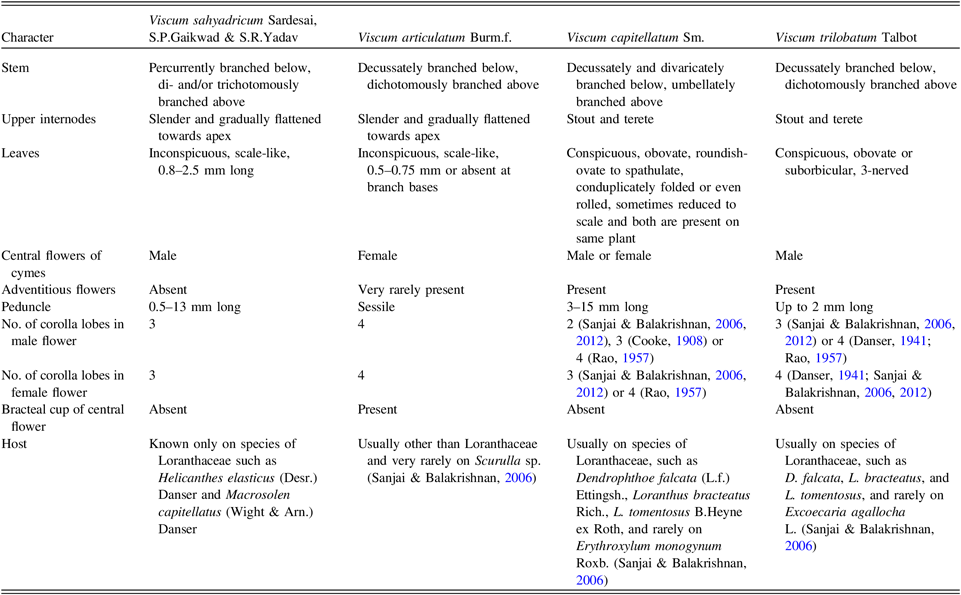
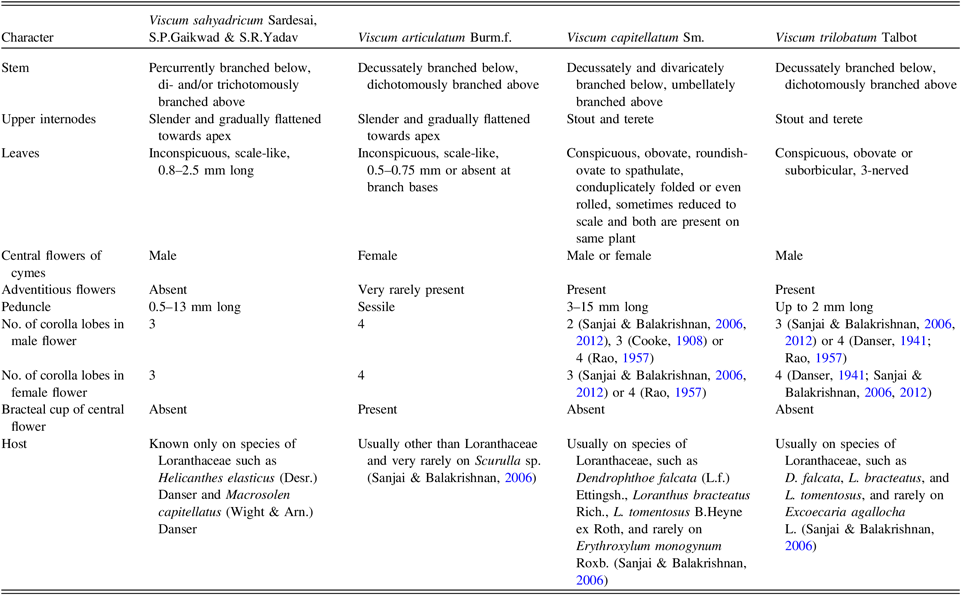
As mentioned above, the new species is very similar to Viscum articulatum and in inflorescence architecture to V. capitellatum and V. trilobatum, but it differs from all in having percurrent branching and an absence of adventitious flowers. Leaves are conspicuous in both Viscum capitellatum and V. trilobatum; however, in the former they are sometimes reduced to scales, although both morphologies are present on the same plant. Interestingly, in these two species different numbers of corolla lobes have been reported in male and female flowers by different authors. In Viscum capitellatum, male flowers are reported as having two (Sanjai & Balakrishnan, Reference Sanjai and Balakrishnan2006, Reference Sanjai, Balakrishnan, Balakrishnan, Chakrabarty, Sanjappa, Lakshminarasimhan and Singh2012), three (Cooke, Reference Cooke1908) or four (Rao, Reference Rao1957) corolla lobes and female flowers three (Sanjai & Balakrishnan, Reference Sanjai and Balakrishnan2006, Reference Sanjai, Balakrishnan, Balakrishnan, Chakrabarty, Sanjappa, Lakshminarasimhan and Singh2012) or four (Rao, Reference Rao1957) corolla lobes. In Viscum trilobatum, male flowers are reported as having three (Sanjai & Balakrishnan, Reference Sanjai and Balakrishnan2006, Reference Sanjai, Balakrishnan, Balakrishnan, Chakrabarty, Sanjappa, Lakshminarasimhan and Singh2012) or four (Danser, Reference Danser1941; Rao, Reference Rao1957) corolla lobes, and female flowers four corolla lobes (Danser, Reference Danser1941; Rao, Reference Rao1957; Sanjai & Balakrishnan, Reference Sanjai and Balakrishnan2006, Reference Sanjai, Balakrishnan, Balakrishnan, Chakrabarty, Sanjappa, Lakshminarasimhan and Singh2012). However, during our studies we observed that male as well as female flowers have three corolla lobes each in both these species. Comparative morphological characters are shown in the Table.
Comparative account of the species
Acknowledgements
The authors thank Radhey Shyam Sharma and Vandana Mishra, Centre for Environmental Management of Degraded Ecosystems, Delhi University for essential help. Thanks are also due to Snehal Page and Ramchandra Gore for the illustrations. The authors are grateful to Daniel L. Nickrent for comments, suggestions and valuable insights on the manuscript, and to an anonymous reviewer for constructive comments.