Bio-adhesive hydrogel has been explored for medical devices such as a bio-adhesion barrier, hemostatic device, wound dressing or drug release system. A dry film or sponge which forms an adhesive hydrogel absorbing body fluid on wet bio-tissues can be used as a bio-adhesion barrier or a hemostatic device, of which some are already clinically applied. Currently, most of these devices are made from animal proteins such as collagen (gelatin) or fibrinogen, which runs the risk of infection of viruses, bovine spongiform encephalopathy, or inflammation.[Reference Hardean, Bantayehu, Ryan, David, Mark and Jeffrey1, Reference Tomizawa2] Bio-adhesive materials comprising only synthetic or non-mammalian sourced materials are to be expected as safe medical materials. Films or fibers based on polysaccharides such as oxidized cellulose, carboxymethylcellulose, and hyaluronic acid have been developed for use as an adhesion barrier and a hemostasis device.[Reference Liakakos, Thomakos, Fine, Dervenis and Young3, Reference Seyednejad, Imani, Jamieson and Seifalian4] However, their adhesion strength is not high enough, and the efficacy is limited because of their inflammatory and wound-healing retardation properties.[Reference Hardean, Bantayehu, Ryan, David, Mark and Jeffrey1, Reference Tomizawa2, Reference Reijnen, Meis, Postma and van Goor5–Reference Klingler, Floch, Seelig, Branton, Wolfe and Metzger7] Low flexibility in the dry state of the polysaccharide-derived materials also makes it difficult to be applied on a tissue of a complicated shape.[Reference Kuo8]
Poly(acrylic acid) (PAA) is commonly known as a bio-adhesive polymer,[Reference Park and Robinson9, Reference Ch'Ng, Park, Kelly and Robinson10] and has been used in many drug formulations. Water-swellable cross-linked PAA gel is a safe and useful adhesive gel. However, the chemically cross-linked polymer barely degrades into a water-soluble material, and often difficult to be molded into a desired shape. We therefore focused on a hydrogen-bonding complex of PAA with poly(vinylpyrrolidone) (PVP).[Reference Lau and Mi11, Reference Tan, Peh and Al-Hanbali12] They are both highly safe synthetic polymers approved and have been used as pharmaceutical excipients. However, when aqueous solutions of PAA and PVP are directly mixed, hydrogen-bonding gel is immediately formed, and soon precipitated into an insoluble solid. The resulting rigid gel does not swell, nor redissolve in water. PAA and PVP are known to bind to each other not only through hydrogen bonding, but also by hydrophobic interactions.[Reference Vasheghani, Rajabi, Ahmadi and Gholehzadeh13, Reference Vasheghani, Rajabi, Ahmadi and Zenooz14] These hydrophobically assembled polymer complexes would neither be rehydrated nor will they dissociate in water. Recently, we found that the PAA film which had been produced by drying up the solution of PAA, could be hydrated in aqueous PVP solution to become a soft hydrogel. Restriction of the movement of PAA segment would have prevented the formation of highly ordered polymer chain complex. The swelled gel could be kept for hours without any precipitation or clouding. The hydrogel was dried by gently heating until it became a transparent film, which could be rehydrated in water again to become a soft hydrogel. When the film was put on a wet bio-tissue, it formed a sticky hydrogel absorbing body fluid, and firmly adhered to the tissue.
One of the promising application of such bio-adhesive hydrogel would be a local hemostat. Local hemostasis is sometimes difficult especially in patients taking anticoagulant. When the patients taking anticoagulant underwent tooth extraction, dental surgery operation, or gastrointestinal endoscopic surgery, they were directed to stop taking the drug for several days prior to the treatment. However, serious adverse side effects, such as formation of thrombosis were observed in some cases.[Reference Wahl15, Reference Maulaz, Bezerra, Michel and Bogousslavsky16] They are, thus, now instructed to continue to take the anticoagulant drugs. This type of patients is required to take periodic blood coagulation test, but blood sampling often caused prolonged and continuous bleeding. For such difficult-to-control bleeding, safe and efficient hemostatic device is desirable. PAA/PVP bio-adhesive hydrogel is expected to cover the bleeding site, and effectively arrest hemorrhage. Moreover, the PAA/PVP complex would slowly dissociate into the original safe water-soluble polymers under physiological conditions. Such bio-adhesive and bioabsorbable hydrogel would, thus, be useful as not only a hemostatic device, but also as a bio-adhesion barrier. In this study, a water-swellable PAA/PVP film was prepared, and the effect as a hemostatic device and as a bio-adhesion barrier was examined.
Preparation of water-swellable PAA/PVP complex films and their properties
When aqueous or ethanol solutions of PAA and PVP are directly mixed, they soon precipitate as a white non-swellable hard solid [Fig. 1(a)]. On the other hand, water-swellable PAA/PVP complexes could be prepared as follows: PAA solution has dried up to be a clear film. PVP solution was then added onto the PAA film. PAA film swelled in the PVP solution [Fig. 1(b)], and was dried up to produce a transparent PAA/PVP complex film [Fig. 1(c)]. It formed a soft hydrogel absorbing water immediately upon touching the water [Fig. 1(d)]. In this preparation procedure, movement of PAA segments was strictly limited, and only partial cross-linking between PAA and PVP polymer chains could be formed. Non-bound free segment of those water-soluble polymers would bring about high swellability of the complex. And as expected, the PAA/PVP film put on the wet bio-tissue soon formed a hydrogel absorbing the fluid, and strongly adhered to the tissue in seconds [Fig. 1(e)].
Images of (a) non-swellable PAA/PVP complex, (b) PAA/PVP soft swollen hydrogel, (c) PAA/PVP transparent film, (d) reswollen PAA/PVP gel, and (e) adhesion behavior of the water-swollen PAA/PVP gel to a tissue.

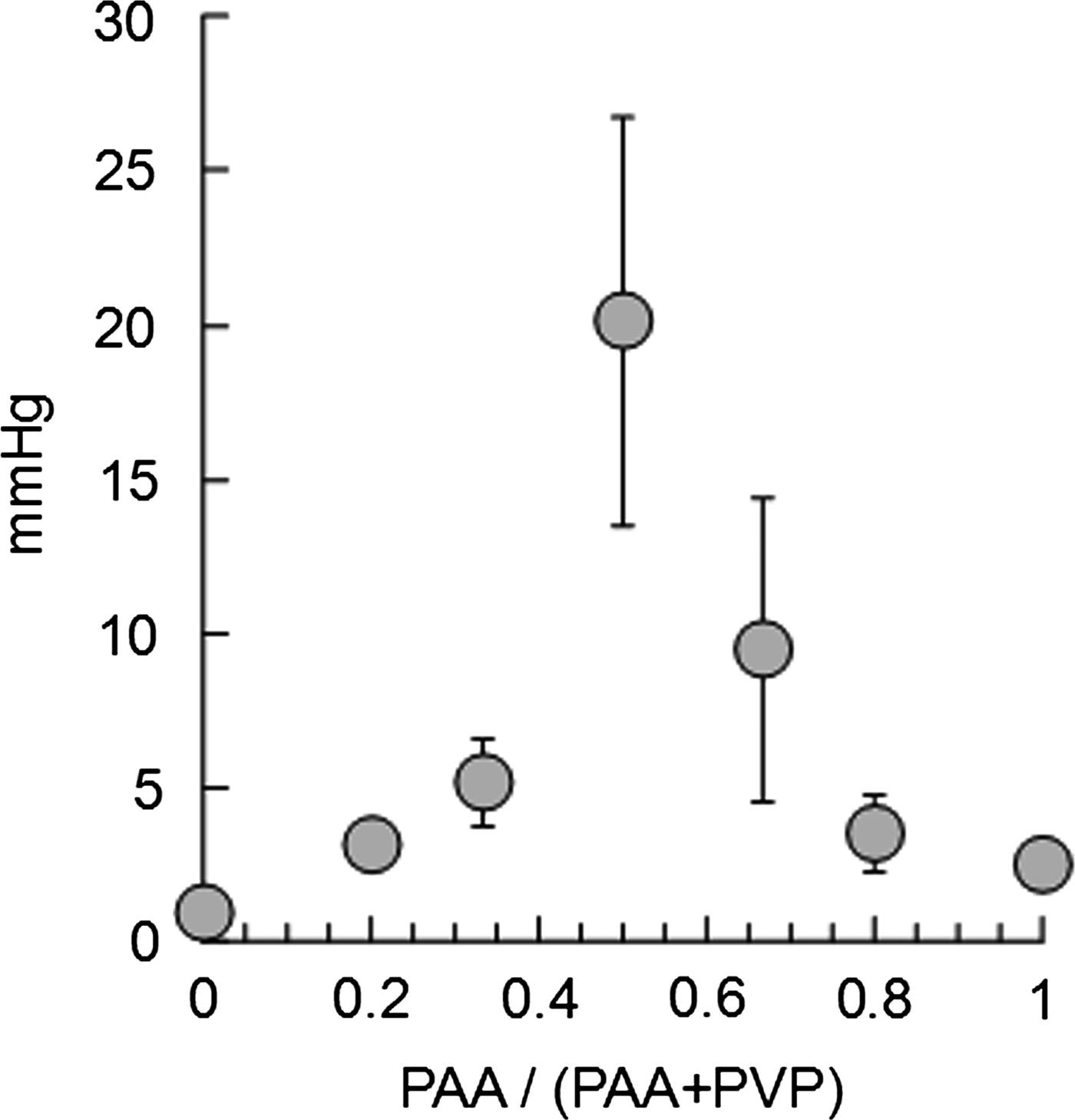
Sufficient water pressure resistance is required to be used as a hemostatic device. PAA/PVP films were prepared at various PAA/PVP ratios, and the effect of the polymer composition on the pressure resistance was examined. The films were put on the wet plastic plate (a piece of cell culture plate) with a hole of 0.8 mm diameter. Water pressure was then applied, and punctual pressure was measured.
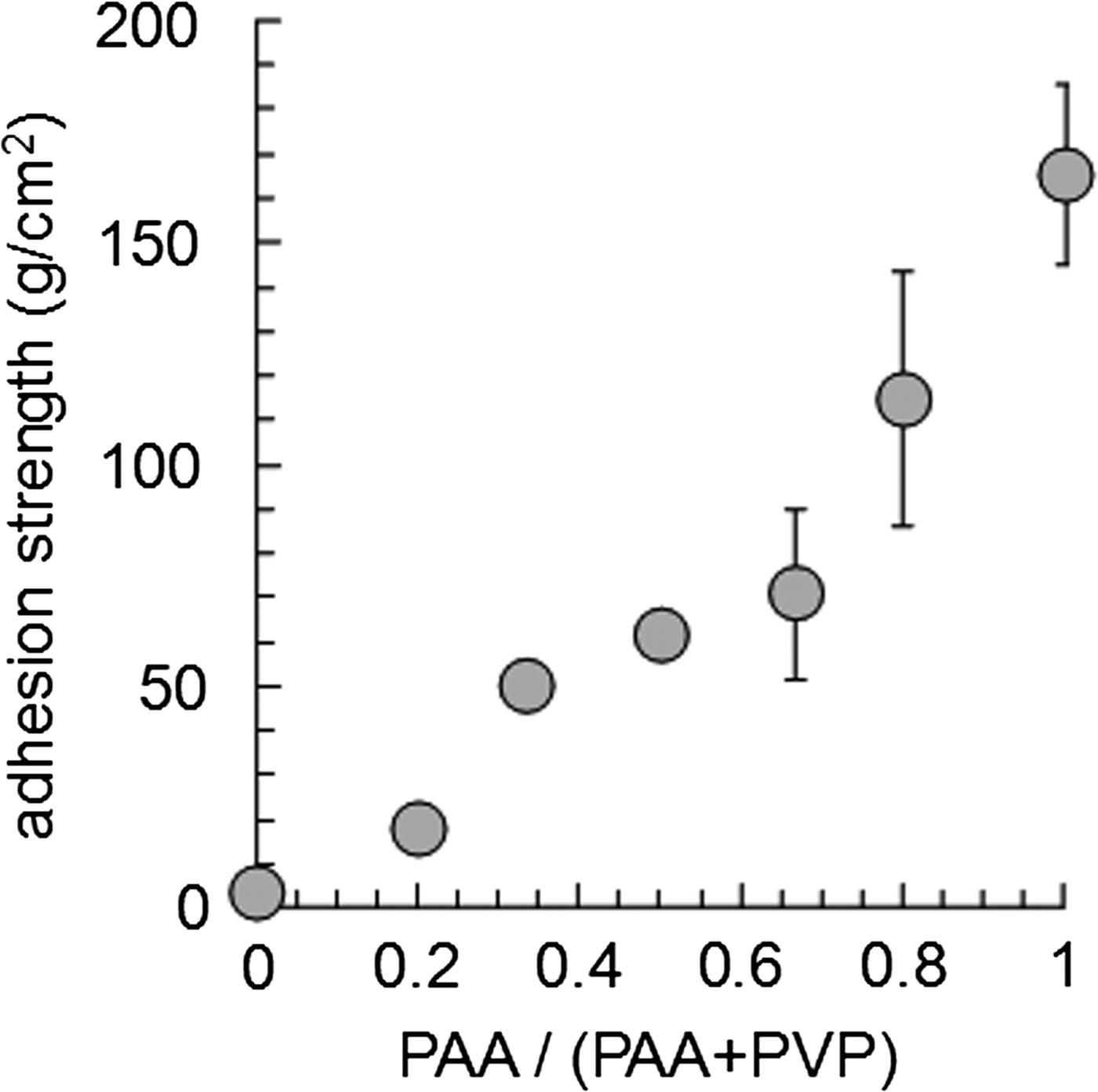
The composition of PAA and PVP affected the water pressure resistance, and the film made of an equal unit mol of PAA and PVP exhibited the highest resistance (Fig. 2). The excess water soluble polymer without cross-linking might lead to the dissolution of the film causing a leak hole formation. The bio-adhesion strength of the PAA/PVP films was then evaluated. The films with various PAA/PVP contents were put on a wet fish sausage, and the force required to peel off was measured. As shown in Fig. 3 the film with higher content of PAA showed higher adhesion strength. PAA is known as a bioadhesive polymer,[Reference Park and Robinson9, Reference Ch'Ng, Park, Kelly and Robinson10] and therefore a high PAA content would lead to an enhanced binding strength between the tissue and the gel.
Water pressure resistance of the PAA/PVP films prepared at various PAA/PVP compositions.
Adhesion strength of the PAA/PVP films prepared at various PAA/PVP compositions.
Adhesion barrier effect of the PAA/PVP film
A complex of PAA and PVP is formed through the hydrogen bonding in which the carboxyl groups in PAA plays a role as a hydrogen donor. When an aqueous PAA solution is mixed with an aqueous PVP solution, micro-environment around the PAA molecule is slightly acidic because of the acidic atmosphere made by PAA itself. So, the hydrogen bonding is formed stably. However, if it is put in the body, the complex is surrounded by the fluid pH 7.4, and the carboxyl groups is gradually neutralized into carboxyl anion, which is not able to form the hydrogen bonding any more. PAA and PVP are then slowly dissociated into original water soluble polymers, and dissolved into a body fluid. The PAA/PVP hydrogen-bonding gel can be, thus, left in the body, such as in the peritoneal cavity or under the skin.
Such bioabsorbable bioadhesive hydrogel is expected as an adhesion barrier for peritoneal and abdominal surgery. Effect of the PAA/PVP film to prevent intestinal adhesion was examined. When the cecum of mouse was burned by a heated spatula [Fig. 4(a-1)], and set back into the peritoneal cavity, the cecum formed strong adhesion to a peritoneum or other intestines in 7 days after the operation [Fig. 4(a-2)]. The adhesion could be effectively prevented by the PAA/PVP film when put on the heated site, and the cecum treated with the film did not adhere to any of other tissues [Fig. 4(b)]. Water-swollen PAA/PVP hydrogel fixed on the injured site would have prevented the attachment and proliferation of fibroblast between the wounded surface of the cecum and other tissues.
Adhesion barrier effect of the PAA/PVP film: (a-1) the cecum burned by a heated spatula, (a-2) the cecum 7 days after the operation (non-treated), (b-1) the PAA/PVP film (size: ca. 1.2 cm × 1.2 cm, thickness: ca. 75 μm) attached to a burned site, and (b-2) the cecum treated by the film 7 days after the operation.
Hemostatic effect of the PAA/PVP film
Bio-adhesive hydrogel is expected to cover the hemorrhaging site and arrest bleeding. Hemostatic effect of the film was examined on the mouse treated with heparin. Mice were injected with 50 IU of Fragmin, a low molecular weight heparin, and the femoral vein was exposed and cut. When the water-swellable PAA/PVP film being backed with a gauze was placed on the bleeding site, it absorbed the blood, and immediately formed an adhesive hydrogel. The gel bonded tightly to the blood hemorrhaging site, and bleeding was stopped within minutes [Fig. 5(a)], whereas the other site treated with only gauze kept bleeding over 30 min [Fig. 5(b)].
Hemostatic effect of (a) PAA/PVP film (backed with a gauze, size: ca. 1.2 cm × 1.2 cm, thickness: ca. 75 μm) and (b) gauze only.
PAA and PVP are both highly safe synthetic polymers. In preliminary histological investigation, after implantation of the PAA/PVP complex film in the femoral muscle of mice for 5 days, no adverse effect was observed in the tissue adjacent to the implanted film. Bioadhesive PAA/PVP complex hydrogel would, thus, hold promising potential as a medical device for hemostatics and as an adhesion barrier.
Acknowledgments
This work was partly supported by Izumi Science and Technology Foundation. Authors also thank CBC Co. Ltd., and BASF Japan Ltd. (Tokyo, Japan) for kindly giving PAA and PVP, respectively.