

In Switzerland, as in many other European countries, the workplace integration of people with disabilities has been a public policy goal for many years (European Agency for Development in Special Needs Education, 2012, p. 5f). Generally, the focus is on integration into the general labour market, and on economic aspects such as productivity and profitability. For people with disabilities, work and employment have several meanings: engaging in meaningful activity, experiencing self-affirmation and competence, establishing social contacts, having a structured daily routine, and strengthening social status (Kradorff & Ohlbrecht, Reference Kardorff, Ohlbrecht, Mecklenburg and Storck2010). While there are numerous factors involved, including physical and mental health components, this article focuses on the ways in which work can create feelings of belonging and participation. The need for affiliation is essential to all human beings and is not specific to people with disability. That being so, neither the kind of disability nor the time at which it was incurred is at the centre of attention in this study. The article rather addresses an expanded understanding of disability management.
The aim of the study was to explore the work biographies of graduates of basic vocational training programs (Parker Harris, Heller, Schindler & van Heumen, Reference Parker Harris, Heller, Schindler, van Heumen, Heller and Harris2012), and in particular, to analyse their workplace integration in order to know what factors favour and hinder the transitions from school to vocational training and then to employment (Parpan-Blaser et al., Reference Parpan-Blaser, Häfeli, Studer, Calabrese, Wyder and Lichtenauer2014). Thus, this article focuses on the following two questions:
-
• What allows for and facilitates successful workplace integration of people with cognitive or learning disabilities?
-
• Which jobs and activities provide the participants with basic vocational training?
In order to obtain a rich and detailed view of the work biographies, our investigation uses the International Classification of Functioning, Disability and Health (known as ICF) as a sensitising concept (Hammersley, Reference Hammersley and Jupp2006) that also bears our definition of disability: ‘A person's functioning and disability are considered to be the product of the dynamic interaction between health conditions and contextual factors’ (World Health Organization [WHO], 2013). This allows us to consider not only the social conditions but also personal attributes and circumstances that people bring to their participation (in work life). A second theoretical anchor is the findings from transition research (e.g., Heinz, Reference Heinz2009; Walther & Plug, Reference Walther and Plug2006): Support and impediment are particularly salient in transitions, which are passages wherein someone leaves a well-known social context for another setting. As they imply considerable changes demanding re-orientation and new coping strategies, transitions are always both risky and promising. They are stages of particular vulnerability, and unaccompanied by appropriate support can become a predictable breaking point on the way to workplace integration and greater self-determination. Moreover, there is a tendency to ascribe transition problems to the person rather than to situations and structures.
Focusing on participation has methodological implications: the people concerned — graduates of practical training (PrT) — were interviewed directly. Until now, interviewing people with disabilities rather than simply collecting data via their carers has only been done in a few cases (Lichtenauer, Reference Lichtenauer, Gredig and Schnurr2012) and has been mostly limited to consideration of aspects of successful job integration (Doose, Reference Doose2006; Roulstone, Gradwell, Price & Child, Reference Roulstone, Gradwell, Price and Child2003; Tomblin & Haring, Reference Tomblin and Haring1999), to interviewing people in a specific institution (Müller & Van Gilder, Reference Müller and Van Gilder2014; Niemi & Kurki, Reference Niemi and Kurki2014), or who have certain types of disabilities (Östlie, Johansson & Möller, Reference Östlie, Johansson and Möller2009). Although our project included forms of participative research, it is neither ‘inclusive’ (Walmsley & Johnson, Reference Walmsley and Johnson2003) nor ‘participatory’ (Aldridge, Reference Aldridge2015) research in a narrow sense. Nevertheless, during the research project, we held an inclusive conference in 2014, and the final report was issued in an easy-to-read version (Studer & Parpan-Blaser, Reference Studer and Parpan-Blaser2014).
The Swiss Education System and Basic Vocational Training
After compulsory schooling, around two thirds of young people in Switzerland take up vocational education and training. Vocational Education and Training (VET) programs are thus an important part of the Swiss education system. One of the main characteristics of this system is its permeability and the possibilities of pursuing advanced education and training. VET programs enable trainees to enter the labour market early in their work life, and pay serious attention to required skills and future job offers. One of the VET program features is a double-track approach to learning: part-time apprenticeship in a company alongside part-time theoretical training at a VET school. The two-year VET leads to a Basic Federal Certificate, the three- or four-year VET to a Federal Diploma (State Secretariat for Education, Research and Innovation [SERI], 2016).
For most young adults with cognitive or learning disabilities, a VET leading to a Federal Diploma is too demanding, but some may be able to obtain a Basic Federal Certificate (Hofmann & Häfeli, Reference Hofmann and Häfeli2013; Hofmann & Kammermann, Reference Hofmann and Kammermann2009). For people with disabilities who are not (yet) able to attain a VET Certificate, a two-year basic vocational training program (PrT) was developed by the Swiss Organization of Social Institutions (INSOS). This training program is not part of the public education system, but it is funded through social insurance. Today, about 160 institutes in Switzerland offer places for this basic vocational training for about 1,100 young people with disabilities. The PrT can currently be completed in 54 different job areas. Up to one third of the PrT students find jobs on the general labour market after completing their training (http://www.insos.ch/praktische-ausbildung/portraet/). For those who do not find jobs, there are several different types of workplace integration options in Switzerland, all of them supported by the national social insurance system. They include:
-
• Sheltered employment: This usually means workplaces in which the work situation is highly matched to the changeable performance of the individual person (e.g., characterised by specially set-up workplaces, personal care and flexible working hours; Bundesamt für Statistik [BFS], 2016).
-
• Supported employment: Assists people with disabilities to access or to keep paid employment in companies. The main goal is to train and support persons who are already integrated into companies in the general labour market (Rüst & Debrunner, Reference Rüst and Debrunner2005).
-
• Social enterprises: These firms pursue economic as well as social entrepreneurial goals. Since a large part of their employees is disabled, they often depend on public funding. Profits generated are mostly reinvested in the firm. Different forms of social enterprises exist in Switzerland. The main goal is social integration rather than profit maximisation (Crivelli, Bracci & Aviles, Reference Crivelli, Bracci and Avilés2012).
-
• First labour market: Also called the general job market. Usually, the salaries paid are in line with normal wages in the industry or sector, and employees receive no additional support.
In Switzerland there are no systematic statistics of how many persons work in sheltered employment. This is basically because the number of places in independent sheltered workplaces and private enterprises is not known. The existing data are limited to the number of sheltered-employment places within institutions with residential homes. In 2013, 13,673 persons were working in such institutions. Another 947 places existed in other types of institutions with residential home areas. There are no statistics for supported employment and social enterprises workplaces (BFS, 2016).
Current State of Research
Most empirical investigations show that for men and women with cognitive disabilities the realms of training and work are pre-structured through a system of specialised support mechanisms (Gillan & Coughlan, Reference Gillan and Coughlan2010; Winn & Hay, Reference Winn and Hay2009). For example, in Germany, young disabled adults who have a Certificate of Secondary Education are more likely to take up advanced training after a vocational preparatory year, whereas young adults who attended a special school are more likely to transfer to a state-funded training program (Gebhardt, Tretter, Schwab, & Gesteiger-Klicpera, Reference Gebhardt, Tretter, Schwab and Gasteiger-Klicpera2011). Quantitative findings from Austria show that young adults from special schools are less likely to gain job qualifications or training support than students with integrative schooling backgrounds. Young adults from special schools are also more likely to be working in sheltered employment (Fasching, Reference Fasching2014). Even career counselling is discriminatory in this respect. For instance, one study shows that career counselling recommendations differ depending on the type of school attended; special education students are advised to use employment schemes, whereas vocational qualifications are recommended for integrated students (Fasching, Reference Fasching2012). Aside from the type of school, also important in the transition from school to vocational training is the capacity to form career aspirations. A Swiss study has found that the experiences of special education or supplementary remedial lessons interfere with the development of career aspirations (Sahli Lozano, Eckart, & Blanc, Reference Sahli Lozano, Eckart and Blanc2009). It also shows that young adults with cognitive disabilities have fewer self-reflective skills and go from overestimating to underestimating themselves, which makes a clear statement about realistic career aspirations difficult (Schellenberg & Hofmann, Reference Schellenberg and Hofmann2012). The separate support models for people with special needs that have been used for a long time can thus also turn into factors of social exclusion, even while demanding normalisation, inclusion and participation (Fasching Reference Fasching2014). They can also create additional barriers to the transition into general labour market activity — a transition often requested by the paying social insurance institutions.
Possible ways to leave behind the divided support system are demonstrated by countries such as Austria (where supported occupation approaches are integrated into the dual training system); Norway (offering continuing qualification, even after career entry); Sweden and Denmark (which provide counsellors for continual and occasional support, even after vocational training); and the United States (US; where there are college options for people with intellectual disabilities; Gebhardt et al., Reference Gebhardt, Tretter, Schwab and Gasteiger-Klicpera2011; www.ThinkCollege.net). Another approach is supported employment. Pilot studies in the US demonstrate that direct instructions and guided training at the workplace by a job coach lead to increased professional skills and self-competence (Müller & Van Gilder, Reference Müller and Van Gilder2014). The large-scale, case-control design study by Wehman, Chan, Ditchman and Kang (Reference Wehman, Chan, Ditchman and Kang2014) shows that supported employment is a promising intervention on the path to employment even for people with cognitive disabilities. Experience of ‘real work’ training (e.g., in social enterprises) can also be significant and helpful (McConkey & Haddock, Reference McConkey and Haddock2012). Butcher and Wilton (Reference Butcher and Wilton2008) raise questions about the practical outcomes of support measures during the transition from school to work life. They suggest viewing the outcome as a transition to a subjectively meaningful activity and to becoming an adult, rather than a transition to a paid job. In a study by Estrada-Hernandez, Wadsworth, Nietupski, Warth, and Winslow (Reference Estrada-Hernández, Wadsworth, Nietupski, Warth and Winslow2008), more than half of the participants in the transitional programs have jobs that match their interests. However, the monthly salary depends on the degree of their disability. This fact is assumed to indicate a career-choosing process with limited perspectives: Only jobs in low salary segments tend to be known and accessible.
In the context of supported employment, the employer's perspective in the first labour market is also interesting. The study by Waterhouse, Kimberley, Jonas, and Glover (Reference Waterhouse, Kimberley, Jonas and Glover2010) indicates a lack of understanding among employers about disability and related questions of employment. Disability and integration policies should therefore also address the employer: awareness raising, external mediation and counselling services are required to offer prompt support.
The significance of family support for people with disabilities in the area of training, work and occupation is undisputed (Parker Harris et al., Reference Parker Harris, Heller, Schindler, van Heumen, Heller and Harris2012). The study by Gillan and Coughlan (Reference Gillan and Coughlan2010) is exemplary in its adoption of the parents’ perspective, showing that they play different roles in the transitional processes of their children (different from those that teachers, case managers and legal representatives play). The parents view the competitive work market, negative attitudes among employers, the loss of insurance benefits, insufficient information about possible options, scarcity of individual-centred approaches in training programmes, and low involvement in decision making and planning (at the professional level) as obstacles to their children's employment integration.
Research Setting/Method
Currently, some 160 special institutions in Switzerland provide basic vocational training for people with cognitive disabilities. For our data collection, we selected 36 of these special institutions, according to their regional distribution and their readiness to collaborate in the study.
Quantitative Data Collection and Analysis
On behalf of the study team, these 36 institutions sent an easy-to-read questionnaire to all their graduates of the years 1995 to 2010 — a total of 1,600 persons. The short paper-and-pencil questionnaire primarily aimed to establish a database for the sampling of interviewees, but it also collected general information on the whereabouts of graduates after vocational training (highest educational degree obtained, work experience, current place of work, current type of living). The questionnaire — available in the three national languages — contained a brief description of the project and questions about sociodemographic data (age, gender, year of graduation) and other criteria for later sample selection (e.g., subjective view of the handicap). The items were based on theoretical considerations, and their comprehensibility and clarity was evaluated in a pre-test. The return rate of 26% (N = 412) indicates that those with cognitive disabilities can be directly addressed with a specific survey tool tailored to their capacities for understanding and expression. Questionnaire data was entered into Statistical Package for the Social Sciences (SPSS) software and analysed by descriptive statistics.
Qualitative Data Collection
Out of 412 persons who responded to the questionnaire, 194 expressed their willingness to participate in an interview. Through a process of theoretical sampling aimed at a sample of maximal variance (Patton, Reference Patton2002), 27 participants were selected for an exploratory in-depth interview. In a first step, we considered mainly training and work-related sampling criteria (domain of vocational qualification, number of workplaces since graduation, current work context, unemployment, type of impairment), and in a second step, we also took into account gender, language region and age. The interviews were designed to provide insight into the course of a participant's work biography, shed light on transitional phases (from school to training, after graduation, when changing job or work context) and to examine individual job satisfaction. In addition, each interviewee selected one person at his or her work site (e.g., supervisor, social worker, professional team leader, job coach) to be interviewed about the institutional and structural aspects of their work situation (What relevance has the basic vocational training for X and her current occupation? How do you perceive X's need for assistance and support at work?).
The interview guidelines were developed according to the central issues of the study and the chronology of a work biography. For every topic, an open question was asked as a narrative stimulus (e.g., When you think about your last workplace, what can you say about it?) followed by flexible questions about specific matters (e.g., What was your daily routine like? What were your tasks? What did you like/dislike there?). All questions for the participants with cognitive disabilities were pre-tested with two persons out of the target group. Participant interviews were conducted at their workplace. To facilitate the entry into an unfamiliar situation, the introduction was anchored in the current work context and each interview began with an open question about current occupation. The conversation proceeded from there to the vocational choice, as the beginning of the work biography. Once all the questions related to stages and milestones of training and work were covered, the interview proceeded to other aspects of life and more personal matters.
During the contact process and the interviews with the participants with cognitive disabilities, we paid careful attention to the wording, pace and design, adjusting them to the person being interviewed (e.g., providing the possibility to inquire or interrupt, facilitating the narration with graphical visualisation of timelines in order to assist recollection). Hagen (Reference Hagen2007) has pointed out that people with cognitive disabilities frequently adapt their responses to social expectations and tend, for example, to avoid critical statements. Therefore it was explicitly pointed out at the outset of our interviews that participants always had the possibility of opting out of the survey, asking for a break, or refusing to answer. The interviewees were asked to choose a pseudonym for anonymity reasons, and all conversations were recorded and transcribed with the respondent's permission.
Qualitative Data Analysis
The qualitative analysis of the verbal data was carried out in four steps: First, data was coded in open form and then gradually condensed using a structural content analysis according to Mayring (Reference Mayring2008). Dimensions and categories — derived from the issues at stake and using the ICF as a sensitising concept (Hammersley, Reference Hammersley and Jupp2006) — were gradually refined and expanded (e.g., from ‘current conditions of employment’ to ‘current conditions of employment: good matching/poor matching’), in order to obtain an adequate degree of abstraction and distinction. In a third step, all cases were described chronologically and a brief summary was established for every interviewee. Fourth, through comparative analysis (Kelle & Kluge, Reference Kelle and Kluge2010) according to some key categories (course of the work biography, professional aspiration, significance of vocational training, subjective satisfaction), patterns of work biographies were assembled. Findings about aids and impediments on the way to occupation and workplace integration respective to the single cases were summarised according to ICF categories.
Results: Quantitative Analysis
The quantitative results from the information provided by the 36 training institutes that sent out the questionnaires, and from the 412 returned questionnaires, provided details about the structures and processes that support or impede employment integration.
Specialisations of the Training Institutes
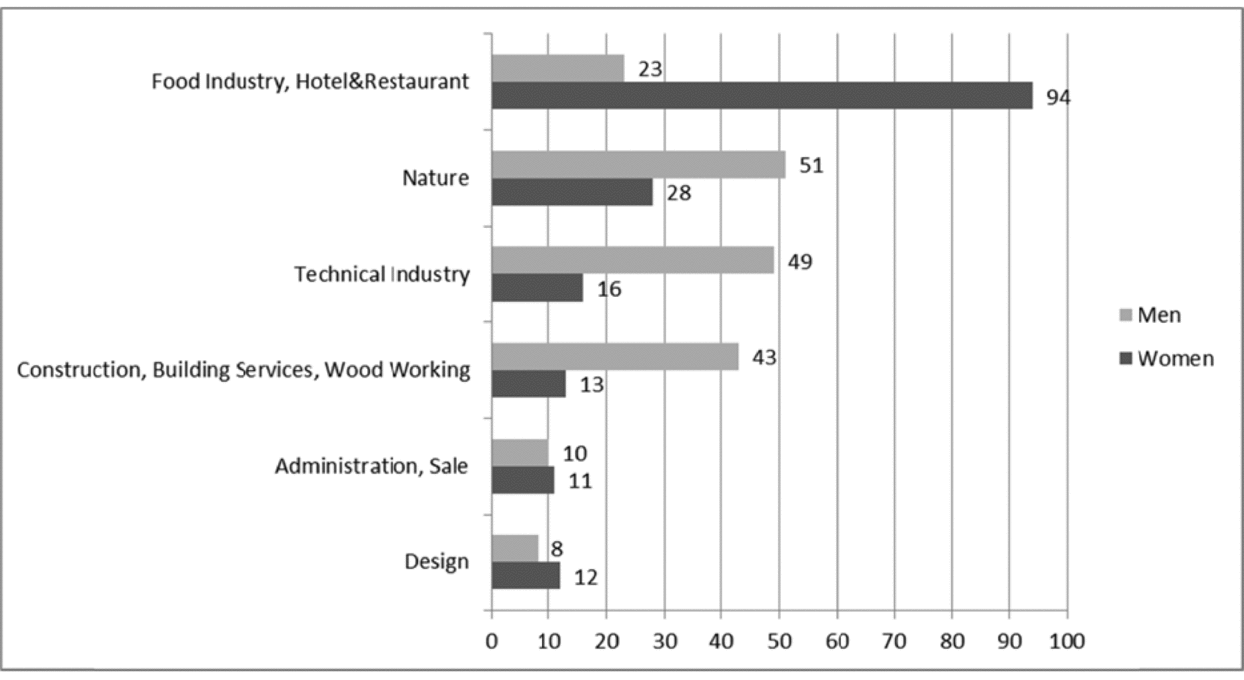
We assigned the various practical training schemes to fields of interest following Egloff and Jungo's (Reference Egloff and Jungo2011) classification system. This system is widespread in career counselling in the German-speaking part of Switzerland and is designed to support young adults in their decision-making. There are nine fields of interest with corresponding job references: Nature; Food, Hotel & Restaurant; Design; Construction/Building Services/Wood Working; Technical Industry, and Trade; Planning/Calculating; Trade/Administration/Sales; Language/Literature/Theatre/Music; Health/Care/Counselling. Our questionnaire sample used only six fields of interest (see Figure 1).
Gender-based job allocations (based on Egloff & Jungo, Reference Egloff and Jungo2011).

Every fourth institute specialises in one or two vocational training fields, one in three offers up to five different practical training programs. Because of this specialisation, compared with nondisabled students, disabled students can less often take into account individual, nonjob-specific criteria such as the distance between training location and home, in their choice of vocational training program. Therefore, either the trainee must attend boarding school during their vocational training, or they are limited to the jobs that are offered by a training institute.
Permeability
The Swiss vocational training system aims to be permeable between educational levels. About 10% of our respondents benefit from the vertical permeability of practical vocational training to go on to gain a federal certificate. The idea of pursuing education and training at higher levels, and acquiring more advanced federal certificates in addition to basic training appears in our sample. Our results correspond with existing data about the situation in Switzerland (Häfeli, Reference Häfeli2012).
Gender and Career Choice
The questionnaire sample consisted of slightly more men (53%) than women (47%). As Figure 1 shows, the quantitative results reveal notable gender-specific career choices: Almost four times as many women as men choose a training program in the hotel and restaurant/food industry (including kitchen work and housekeeping), while men dominate in the training programs for outdoor or nature-related industries (such as gardening and farming), the building industry, and technical industries (χ2 = 84.6, df = 7, p < .001).
Work mobility
Statistical analysis further shows that half of the respondents completed their vocational training between three and ten years ago. Although some people have changed work place since then, job mobility among them tends to be low: 75% of respondents have worked at a maximum of two different jobs since completing their training. This is mirrored in the net rotation rate (rate of job change per annum) of around 5% according to the Swiss federal statistics office (BFS, 2012). In comparison, the average net rotation rate of all employees in Switzerland is 12.4%. Does staying at the same place of work over several years mean good integration? The qualitative results, discussed below, provide more information on this subject. They indicate that staying at the same place of work can mean different things.
Results: Supporting and Hindering Factors to Different Forms of Workplace Integration
The qualitative results of this study trace the work biographies of people with cognitive disabilities who have completed basic vocational training (PrT), and reveal the supporting and impeding factors they encounter(ed). These factors in workplace integration can be highlighted and summarised using the sensitising ICF concept. The 27 interviewees had work experience of 1 to 10 years, had to date worked at between one and six workplaces, and were aged between 20 and 36 years. They worked in the domains of Nature, Food, Hotel & Restaurant, Design, Construction/Building Services/Wood Working, Technical Industry or Trade/Administration/Sales. They came from 13 different cantons (out of 26 in Switzerland) and from all three language regions. Their impairments as described by themselves were learning disability, trisomy 21, visual impairment, Asperger's syndrome, Williams Beuren syndrome, mental disability, epilepsy, and cerebral palsy.
Because of the high degree of heterogeneity in the work biographies and for the specific overview of the present article, we chose five cases representative of different work contexts on the grounds of where the interviewees were then working (sheltered employment, supported employment, social enterprise with customer contacts, first labour market, and between first labour market and sheltered employment). Unemployment is broached as an issue in several of the case studies.
Sheltered Employment
‘Drums’ is 22 years old and works in sheltered employment, in the staff canteen of an institution for people with disabilities. His young professional career has been linear and so far without major crisis. At the end of his time at a special school, he was accompanied by his occupational counsellor and the teacher, on whose recommendation he first tried working not only in the kitchen, which was his choice, but also in the garden centre. He chose the PrT placement in the kitchen, where he has been working since completing school. Drums is happy about his vocational training and the job that followed.
The institution where Drums works offers three daily career-planning and advanced vocational training sequences: five minutes every day on different job subjects (kitchen hygiene, types of cooking, etc.), staff coaching with supervisors, and annual assessment interviews. Staff members from the work area, people from the living areas and the parents/legal representatives attend these interviews. Drums feels ambivalent about the annual assessment interviews because on the one hand, he receives feedback and can voice his own concerns, but on the other hand, he has difficulties communicating in this environment, which is why he asks his father to participate.
And this assessment interview, well, maybe it is important, because we can really present our concerns, which are not always that simple; it is also very useful . . . I am usually a bit reserved . . . Therefore, I am relieved when I can leave. I give short answers because I feel embarrassed with so many people around. (D177)
The meetings are a continuing site of discussion, allowing long-term and thorough career planning. Drums's objections and insecurities (e.g., about levels of stress, his preference for ‘more boring’ work) are taken into consideration and worked through. His supervisor sees the current place of work as a ‘transit station’: People should gain their experiences here in order to feel safe to make their first step into the job market. She is also convinced that Drums can make progress in a suitable work environment with understanding supervisors. She sees his future career in a social enterprise with customer contact (such a job would be within the same institution). Drums rather sees himself working in the creative workshop in the future. While he does not feel confident enough to work in the social enterprise, his supervisor expresses concern about a job in the creative workshop, ‘because, he says, she [feels that] I would be bored there’.
Drums's case (representing people in sheltered employment) shows that institutional and personal support is important for active career planning and its possibilities. Individual-centred career planning is formed through exchange, support, and enough time to deal with new challenges. For Drums, the participation of parents or others whom he trusts is crucial.
Supported Employment
‘Notter’ was 28 years old at the time of the interview. He told us that he has a learning disability. After school, he went for a placement in an organisation, after which his career aspirations changed and he started PrT as a small instrumentation attendant. After completion of his vocational training, he looked for a job on the general job market, which was difficult, as his profession is unknown outside sheltered employment. ‘Well, I managed to get sort of a vocational pre-training, however the problem is that nobody has ever heard of the job of a small instrumentation attendant. It is only known in the sheltered workshop’. Notter became unemployed and registered with the regional employment agency. The agency enrolled him in an employment scheme with placements in the domestic servicing and maintenance of retirement homes, which increased his desire for work in the ordinary job market. Being unemployed was unbearable for him, so he started looking for sheltered employment after a year.
Because I really couldn't take it any more . . . the unemployment situation, I could not bear it any longer . . . it was my own wish to go back to a sheltered workshop then, so that I would have a job, rather than being unemployed for much longer because this really got to me. (N258)
The disability information centre quite quickly found a job for Notter as an operations attendant in an outpost of a sheltered workshop. With the support of job coaching that, just like his work contract, is organised through the workshop, Notter currently works in the general labour market, in the technical service department of a retirement home.
The aim now is to replace his current work contract in sheltered employment by a direct contract in the first labour market. Notter makes great efforts to achieve this. For example, he writes down important work routines in order to remember them, and uses the counselling interviews in job coaching. As a key focus in Notter's workplace integration, his job coach stresses the matching of person and workplace. For her, Notter's employment is successful chiefly because he is pleasant-natured and has many key qualifications. His personality and way of dealing with problems help him to manage his tasks.
Looking back, Notter does not believe that his vocational training was very helpful. He is pleased with his job and thinks he has reached his goal (to transfer to the first labour market), but all of this happened with only little support for his workplace integration. It is not very important to him that the contract and salary are processed through a sheltered employment scheme.
Notter's work biography shows how difficult it can be, without support, to enter the general labour market after vocational training, and indicates that this goal can only be achieved with a series of detours and the perseverance of the person concerned. It also reveals that training for a job that is generally unknown can pose a problem. By contrast, entry into sheltered employment is often easy. After vocational training, placement in the first labour market can help a person to reach his personal goals. But professional support (e.g., job coaching) is required; personal goals and social networking are not sufficient. Needs-based support in technical work problems and social issues is very important. Moreover, long-term and continuing support by a job coach can help people to reach their chosen goals. Matching the job coach and the person to be supported on the one hand, and the job and the person on the other hand, are both helpful. Notter's case shows that combining different forms of workplace integration can lead to subjective satisfaction and a sense of participation. Looking for unconventional solutions has also been fruitful in workplace integration. The openness of the professional support system to solutions beyond the ‘official’ paths is helpful.
Working in a Social Enterprise (with Customer Contacts)
‘Luzia’ is 26 years old and attended a special school. She told us that she received support in her career choice from teachers, disability insurance career counsellors and her parents. She did placements in zookeeping and housekeeping. Because of the better job prospects in the latter field, she chose vocational training as a housekeeper. The regional allocation of training institutes in sheltered employment meant that Luzia had to do her vocational training in a boarding school.
The training period was strenuous for her; the training itself involved learning many new things and it was challenging because she could not find much peace and quiet or spare time to relax in the boarding school. Luzia also felt homesick; however, she did not need additional help back then, as she found nice colleagues at the training place.
Luzia received support to find a job through the training institute; she had several options, differing in support and work organisation. She chose a job in the kitchen of a hotel, run as a social enterprise. She is able to do her work by making checklists, taking notes and following them. Her workload is only 80%, so her intensive work days are shortened. The supervisor reports on further adjustments to the workplace, such as the purchase of useful kitchen material (e.g., a clearly labelled litre measure) and playful practise of measuring quantities. The supervisor says this of Luzia's progress:
At the beginning, she needed support for everything, but now she knows the routines and what she has to do, and can actually do it herself most of the time. And also, at those times when she struggles and thinks she hasn't gotten anywhere, we look back with her to how it was at the start and to realise how much she has already achieved, which is totally incredible. (L46)
Luzia likes working and is highly interested in her personal and professional further development. It shows in the interview, where she emphasised that she is interested in more responsibility at work and more independence in her life. In the quarterly appraisal interviews, she can discuss job-related continuing training and adjustments in the workplace.
Luzia's case is representative of people with disabilities in social enterprises and shows that continuing support based on what is learned, on good relationships, and adjustments of workplace/workload lead to a satisfying work situation for all concerned. A matching workplace such as this one in a social enterprise, can be found more easily when the training institution is well connected to the working world, so that it provides matching job solutions and support for former trainees. Luzia's case also shows how staying at a boarding school during vocational training, which is the logical consequence of disproportionate regional allocations of training institutes, creates additional burdens for the trainees, although it can also facilitate their becoming independent of parents.
Employment in the First Labour Market
‘Mickey’ was 26 years old at the time of the interview and lived with his then-pregnant girlfriend. He told of problems at the end of his time in regular school, and of being referred to the possibility of an invalidity vocational training program. Mickey's choice of training institute depended on his friends, and the institutional procedure was crucial in his career choice. He completed a probation period in the available training areas, for which he received marks: ‘And they graded me. I received the best grades as landscape gardener. That is why I had to start working there’. Mickey attended the subsequent vocational training without much motivation. His grades dropped. He was under the impression that practical competences were supported, whereas academic performances were secondary. He started drinking and smoking marijuana during the vocational training.
Placements in the first labour market formed part of the third training year, designed to provide access to potential jobs. The second placement in a landscaping company, where he would be hired for nine years, was found for him by his uncle. Without private networking, Mickey would not have gained this job. He likes his work as a landscape gardener as well as the atmosphere in the company. The employer and supervisor stated that his training level was insufficient when he started and that he would therefore be trained further ‘on the job’. His performance overall is satisfying. He does maintenance and cutting work, repetitive work with corresponding instructions, knows many customers because he has been there for a long time, and is well integrated into the team. On the other hand, there have been difficulties with the terms of employment and salary. At first, the employer paid low wages, believing that the employee received additional social insurance benefits. Mickey's parents intervened and the salary was raised. After this salary raise, however, Mickey's economic worth to the employer was no longer assured over the winter months, as the types of jobs he was doing (garden maintenance) do not exist in the winter season and also, he is not sufficiently qualified to cut trees and shrubs. Therefore, Mickey has been registered as unemployed during winter for four years now. The resulting income fluctuations — only partly compensated for by his parents — create difficulties.
Just now I have to find an apartment, as my girlfriend is pregnant. And finding an apartment with my loss of income in the winter will be difficult. Sometimes I have three thousand, sometimes two thousand, sometimes four thousand [Swiss francs]. When the management of the places for rent see this, they say: ‘No, you do not have a regular income’. (M81)
Mickey appreciates his vocational training and having an acknowledged diploma. They helped him to find a job: ‘This was good in the end: the paper is acknowledged. I can see that what I have done makes sense’ (M305). The graduation has a positive effect on Mickey's sense of achievement; his experience was that with the right support, he can improve his performance, and he hopes that even now, being unemployed due to illness, he can make it through. The preconditions are rather unfavourable, however: his precarious situation may deteriorate further because of accumulated stress: Personal difficulties (straitened financial situation, debt payments, increased alcohol consumption) and living together with his pregnant girlfriend in a small apartment, all affect his ability to work in different ways. He receives no professional support at the moment in shaping his job future.
Mickey's job choice process shows that there are limited training possibilities for young adults in difficult social conditions, and that the mix of social and disability-specific indications impedes access to training institutes. As a smooth transition from school to vocational training is prioritised for them, the interviewees experience this process as an assignment rather than a choice. Decentralised training institutes also jeopardise the social integration of these young people, as social contacts during the training period at boarding school are reduced to other trainees of the same age and in the same situation during the week. Integrated placements in the last year of training simplify the start in the general job market, and private networks are important. For companies willing to hire those who pass the PrT, so far, adequate and continuing support is lacking. This is significant, as workplace integration is more successful if the workplace offers a thorough introduction, if the social integration of a team works, and if there is a realistic evaluation of the compatibility between the PrT graduate's skills and the job requirements. However, difficulties can arise if the employer is not informed about the training and life situation of the PrT graduate.
Between the First Labour Market and Sheltered Employment
‘Elektrofreak’ is 24 years old, foreign-born, visually impaired and lives with his fiancée. He attended regular school in Switzerland from sixth grade, had little knowledge of the Swiss job market and therefore began vocational training in a sheltered workshop without any particular career aspirations. The transition from school to vocational training was confusing: From Elektrofreak's point of view, the teachers and his parents had organised sheltered vocational training for him, without discussing the possibility of a normal VET. During the PrT, Elektrofreak found that the conditions were not adjusted to his impaired vision, either in school or at work. The subsequent difficulties in school and practical limits reduced his motivation. The training institute reacted to his lack of interest first with a change to practical training and then by laying him off.
After he lost his job, Elektrofreak moved to another canton and wanted to become independent of the disability insurance, by finding a job in the general labour market. For several years, he moved between temporary jobs and being unemployed. As he kept losing his jobs weeks or months after starting them, because of his impaired vision, Elektrofreak eventually had to request financial support from the social security office.
I tried to find work in a normal firm which does not belong to sheltered employment . . . Then it took a long time for me to understand that this is impossible. But I kept trying to do something where I am not limited. Because I always had the feeling that just because I don't see properly doesn't mean that I have to hold back . . . I have always tried to do everything. But after three years of trying to work I realised that it does not make sense. (E79)
An information centre then helped Elektrofreak to find a workplace and to reconnect with the disability insurance centre. Next, he completed a sheltered vocational training program with placements in the general labour market. However, due to a lack of workplace adjustments on the one hand, and job requirements such as a demanding work pace on the other hand, he could not manage this transition.
After PrT, Elektrofreak therefore stayed in the training firm, where he liked the pleasant work atmosphere and his boss. He now works mainly in his favourite department, where he is challenged neither too much nor too little, and where his impaired vision does not impede his using of the fine measuring instruments, thanks to workplace adjustments. He is valued as a competent, independent and sociable employee, who can also teach others. Planning his future career is made difficult at present by the ongoing assessment procedure of the disability insurance, which became more complicated because of a move to a different canton. His boss believes that Elektrofreak's future is in the first labour market, but with a job coach.
Elektrofreak's work biography shows what a rocky road the career path can be. Lack of both career aspirations and information on the career choice process created a confusing transition to vocational training, where he was demoted for insufficient motivation and eventually lost his job. Workplace adjustments were required but not taken into account. His ‘failures’ led to a longing for independence. Missing insurance benefits and private support (e.g., from his family, a legal representative) meant that Elektrofreak ended up with financial difficulties. At his current workplace, however, the good match between requirements and competences, the workplace set-up, and the good work atmosphere all add up to job satisfaction.
Discussion
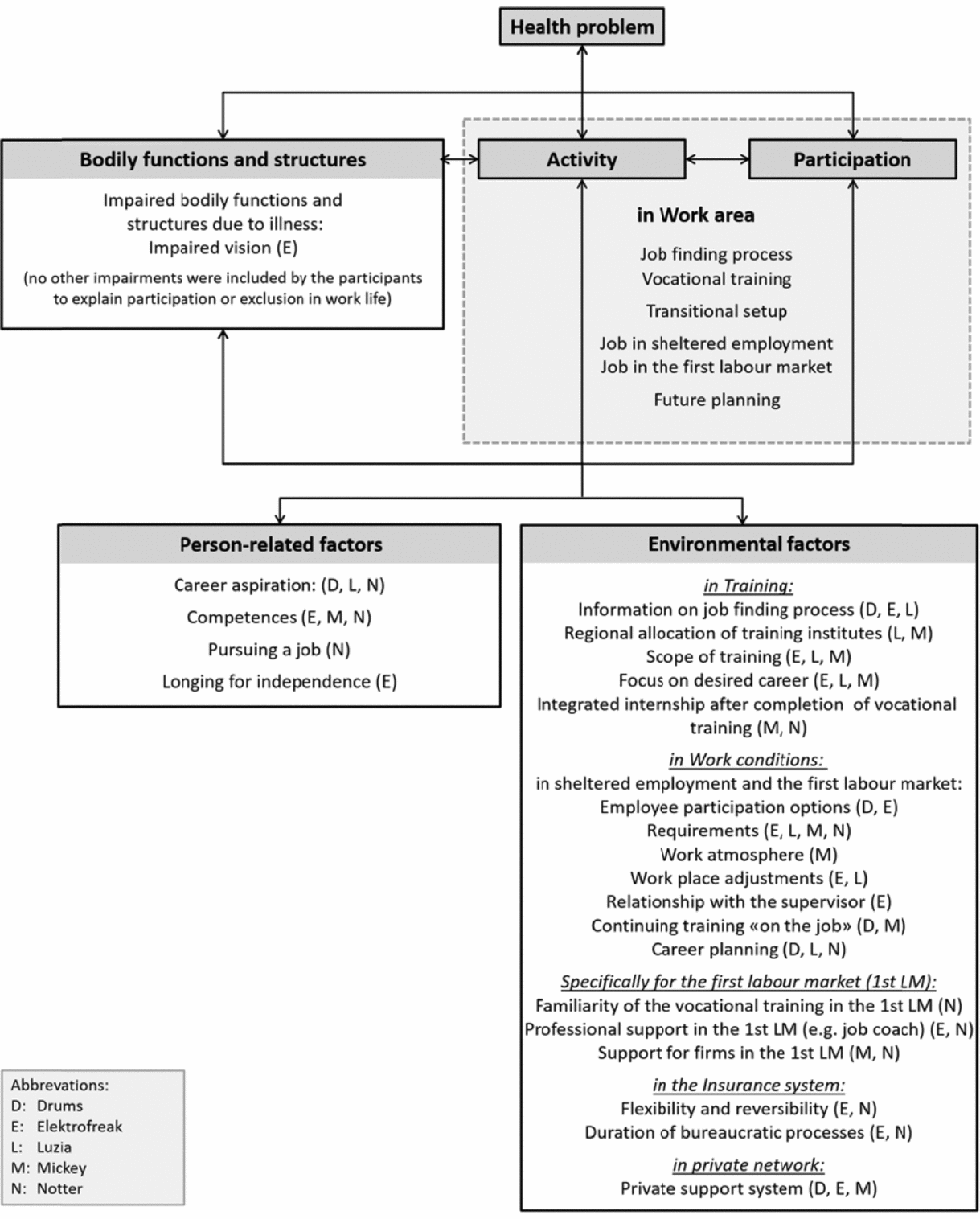
The cases presented above reveal important supporting and hindering factors in successful job integration. Figure 2 summarises these results on the ICF slide, as we used it as a sensitising concept. Integration and participation, and the obstacles to them, are defined in the ICF as the interaction of a person (individual factors) with their environment. The interaction of individual and environmental factors determines whether and to what extent someone can participate in working life. Participation in work life stretches over the entire work biography of a person, from vocational training to the job-seeking process, to a carefully constructed transitional set-up, matching jobs in either the general labour market or in sheltered employment, and planning for the future. Only a few of our interviewees view their personal limitations as an explanation for their degree of integration, whereas they refer frequently to environmental factors. As indicated in Figure 2, only people with a visual impairment referred to this as an explanation for their participation or exclusion in work life; other impairments were not mentioned in this setting. Environmental factors are crucial because they are considered modifiable. The environmental factors box in Figure 2 summarise the results from the five case studies. For better confirmability, the different findings are marked with the first letter of the person's chosen pseudonym (D = Drums; N = Notter, L = Luzia; M = Mickey; E = Elektrofreak). However, we cannot make definitive statements about which supporting and hindering factors operate in which particular work contexts, as the qualitative method does not suggest any such clear connection.
Interactions of workplace integration factors according to ICF.

Important Factors for Workplace Integration
In this final section, we describe the important factors for a successful workplace integration, a lack of which can be regarded as impeding integration. Prior to this, the limitations of the study shall briefly be discussed. Like all empirical studies, the one presented here has its limitations, the main limitation being inherent to the manner in which the research was conducted. As we undertook the enquiry of a widely unexplored topic, we set our focal point in researching and capturing the perspectives of the mainly concerned persons. To interview the graduates themselves led to the fact that objective information and facts remain intermittent in some places, so that the cases cannot be compared in all respects. In particular, only few statements can be made about connections between supporting and hindering factors and specific work areas, the integration in the first labour market or different types of disability. To tackle questions on correlations of this kind or to take a longitudinal approach could be the purpose of further research, since the discovered factors hindering or supporting integration processes refer in a more general way to training and work conditions, transition management or working principles of professional support.
A second point that entailed limitations is the fact that we collected quantitative data with the main objective to establish the readiness for an interview among the graduates of a basic vocational training and to thus create the database for the subsequent sampling process. To not jeopardise responses, we decided to keep the easy-to-read questionnaire as short as possible, constraining at the same time the achievement of more significant quantitative evidence. However, the satisfactory return rate indicates that easy-to-read questionnaires are manageable for persons with disabilities, provided that a certain length or a certain range of topics are not exceeded.
The results of the study show that successful workplace integration for people with disabilities occurs through the combination of different factors. We cannot simply assume that PrT is a guarantee of workplace integration. The arrangements and individual experiences following PrT mainly affect the perceived importance of vocational training. The heterogeneity of work biographies, for example, shows that the form of the subsequent transitions (into and out of jobs, and their context) is extremely important. A carefully set up transition prevents the jeopardising or questioning of goals attained. On an individual level, it is also noteworthy that the participants in this study consider self-competences (motivation, willingness to change, resistance to stress) more useful to integration than technical skills. However, self-competences can only be used where the basic conditions are favourable. Thus, the desired further education cannot be achieved if suitable training programmes are missing.
The heterogeneity of the individual job histories also illustrates that the significance of workplace integration differs from person to person. Vocational training can be experienced subjectively as significant, even though it may be followed by very different forms of employment. Considering this matter, one important finding from our study is that the distinction between the general labour market and sheltered forms of employment is blurred; there are in fact a number of different employment types to be considered when discussing successful workplace integration. Many of the people we interviewed have had experience of the first labour market. Regardless of whether they stayed in their first job or are now differently employed, they all speak of difficulties encountered, such as stress and strain. Among other things, this shows that matching individual skills with job requirements is crucial for successful integration. It also underlines the importance of promoting permeable modes of working, so that people with disabilities can gain positive experience of workplace integration in different types of activities.
If investment in training people with disabilities is to be successful and useful, it is essential to take a long-term perspective on the set-up and support of transitions. That means creating a life plan together with the person concerned, taking into consideration their needs and desires, and then regularly checking the plan, and modifying it if required. This is hardly possible when, for example, in the transition from school to vocational training, the goal of immediate placement takes priority over the professional desires of the disabled person, especially where a crucial choice is at stake. Hence, from the beginning, the chief characteristic of the job-seeking process is important. Is the goal an immediate placement after the obligatory school period, or the development of long-term, aspirational career path? The second is scarcely possible when poor transition management gives priority to immediate continuity and does not allow enough leeway when a crucial choice is at stake. Later, different work arrangements should be handled flexibly in order to enable smooth and ‘mistake-tolerant’ transitions from sheltered employment to the general labour market, and vice versa. In addition, long-term professional support (e.g., by a job coach) is extremely important. Our interviewees believe that successful workplace integration occurs when they have the possibility of developing and enhancing their own professional aspirations, and institutional and personal networks give them options to choose from. Since social security in Switzerland provides funding for vocational training only once — this is an important issue. Indeed, this current practice is opposed to the principle of lifelong learning and development, which should be available for people with disabilities, as it is for others.
People with disabilities are often caught between their longing for self-determination and their dependence on structural conditions and support at work. In this context, the attitudes of the supporting persons are crucial. Thus, professional support should be offered with the aim of helping the supported person to achieve self-determination. Only a systematic and exhaustive deployment of a permeable education system, seeing support as dialogue, and services as rendered to an equal, can do justice to the desires and needs of disabled persons, and best ensure that the process results in their successful workplace integration.
Conclusion
Successful integration is not necessarily related to professional success and employment in the general labour market, but can be acquired in a variety of different work contexts, as our study reveals. Moreover, the subjective perception of integration arises from the interplay of various personal and environmental factors, where acknowledgement and appreciation experienced in other areas of life are just as important. Job integration, after all, is about equal access to work and the development of a self-determined life with equal rights, as Göhring-Lange (Reference Göhring-Lange2011) insists in her definition of self-determined participation. Job integration does not mean the same thing to everyone, and in order to develop a feeling of participation in the world of work, the self-determination and life quality of those concerned must be taken into account. A subjective feeling of participating in the working world does not have the same implications for all people with disabilities. Differing degrees of autonomy and differing notions of quality of life lead to different forms of workplace integration. A very important factor in successful integration therefore is that people have options, and this is particularly true for people with disabilities.
Acknowledgements
The study was mainly funded by the Swiss Bureau for Equality of People with Disabilities (EBGB). Financial support was also provided by INSOS (Swiss Association of Institutions for Persons with Disabilities), the Swiss National Association of and for the Blind, the Ernst Göhner Foundation and the Alfred and Gertrud Bernays-Richard Foundation.