1. Introduction
Many have argued that routines are ‘the central unit of [organizational] analysis’ (Becker, Reference Becker2004: 643; Nelson and Winter, Reference Nelson and Winter1982). The routines construct has also become the explicit foundation for capabilities-based work in strategic management: definitions of organizational capabilities are frequently anchored on routines. For example, Zollo and Winter define organizational capability as a ‘learned and stable pattern of collective activity through which the organization systematically generates and modifies its operating routines in pursuit of improved effectiveness’ (Reference Zollo and Winter2002: 340, emphasis added; cf. Eisenhardt and Martin, Reference Eisenhardt and Martin2000: 1107). More generally, routines are argued to be the most fundamental unit and building block of organizational capabilities (cf. Winter, Reference Winter2003).
However, despite several decades of work on organizational routines, fundamental questions persist, suggesting an opportunity to carefully revisit the underlying analytics and theoretical foundations of the routines and capabilities-based literature. While others have focused on definitional issues and associated ambiguities and research opportunities related to routines (e.g., Becker, Reference Becker2004, Reference Becker2005a; Foss, Reference Foss2003; Felin and Foss, Reference Felin and Foss2005), the purpose of this paper is to address and explicate the behaviorist and empiricist foundations of the organizational routines and capabilities literature.
We focus directly on the most general and common antecedents and mechanisms of organizational routines and capabilities, namely experience and repetition. We revisit foundational literature in psychology and philosophy and highlight how repetition and experience have endogenous origins and can only provide a partial, and thus incomplete, understanding of organizational capability and behavior. The purpose of this paper, then, is both critical and developmental. We first discuss five endogeneity-related problems associated with specifying repetition and experience as the key antecedent and mechanism of organizational routines and capabilities, namely (1) the problem of origins and causation (2) the problem of new knowledge, (3) the problem of extremes, (4) the problem of intentionality, and (5) the problem of the environment. We argue that the traditional input (experience)–output (behavior or capability) relationship in extant research on routines and capabilities is ‘underdetermined’, and the associated empiricist mechanisms (such as repetition) need to be revised and revisited. Second, in response to the above problems, we discuss how the ‘poverty of stimulus’ argument from rationalist philosophy (e.g., Chomsky, Reference Chomsky1986; Popper, Reference Popper1972) might theoretically provide a more fruitful way to understand and overcome the endogeneity problems associated with the behaviorist and empiricist foundations of the extant routines and capabilities literatures.
2. Behaviorist foundations and organizational routines
Historical origins and review
Much of the literature on organizational routines and capabilities is founded on a behaviorist and empiricist epistemology, or theory of knowledge.Footnote 1 The behaviorist tradition builds on a longer, Lockean tradition of empiricism (Schwartz, Reference Schwartz1978; Watson, Reference Watson1934), which succinctly can be defined as the doctrine that knowledge and learning derives from experience (Chomsky, Reference Chomsky1959; Popper, Reference Popper1972). Empiricism, then, suggests that behavior and capability is determined by external stimuli perceived by the senses, thus placing heavy emphasis on perception, observation, experience, and the environment as key independent variables: what individuals and organizations believe and know is a function of their past, heterogeneous experiences, repeated exposures, stimuli, sense perceptions, and observable environmental contingencies.
The argument in this tradition – also foundational to March and Simon's (Reference March and Simon1958) classic work – is that experience and environmental stimuli are critical in determining the beliefs and expectations that drive individuals’ and organizations’ behavior.Footnote 2 Theoretically, there is a strong link between psychological behaviorism (as pioneered by the likes of Thorndike, Reference Thorndike1932; Watson, Reference Watson1934; and Skinner, Reference Skinner1989) and subsequent models of organizations (specifically see, e.g., March and Simon, Reference March and Simon1958: 9–10, 139–142). As a brief example, Simon and March note that ‘activity (individual or organization) can usually be traced back to an environmental stimulus of some sort, e.g., a customer order or a fire gong’ (1958: 139; Skinner, Reference Skinner1989). The influence of behaviorist theory is also evident in Cyert and March's classic A Behavioral Theory of the Firm, which, among other things, discusses the role of simple rules and standard operating procedures – clear forerunners of organizational routines – and focuses on environmental stimuli and experience as key antecedents (Reference Cyert and March1963: 114–127).Footnote 3 It is argued that, for the most part, ‘the firm learns from its experience’ and environment (Cyert and March, Reference Cyert and March1963: 118; see also Greve, Reference Greve2003).
Central currents and assumptions of the empiricist tradition also carry into Nelson and Winter's (Reference Nelson and Winter1982: 14) classic work, and more generally into extant conceptions of organizational routines. While the routines literature has faced strong criticism due to definitional proliferation (Becker, Reference Becker2005a), nonetheless there seems to be a strong consensus that repetition, experience, and the environment – which of course are pillars of empiricism and behaviorism – are central.Footnote 4 So, Winter's early definition of a routine – a ‘pattern of behavior that is followed repeatedly, but is subject to change if conditions change’ (Reference Winter1964: 263) – reflects the behaviorist emphasis on repetition, as well as the environment's role in determining learning, change, and behavior. More generally, in a review of the routines construct, Becker highlights how ‘amongst the dimensions [of routines] identified in the literature, the frequency of repetition seems to be a particularly important one’ (Reference Becker2004: 650). Furthermore, Cohen et al., for example, define a routine as an ‘executable capability for repeated performance in some context that has been learned by an organization in response to selective [environmental] pressures’ (Reference Cohen, Burkhart, Dosi, Edigi, Marengo, Warglien and Winter1996: 683, emphasis added). Routines, then, ‘reflect experiential wisdom in that they are the outcome of trial and error learning and the selection and retention of past behaviors’ (Gavetti and Levinthal, Reference Gavetti and Levinthal2000: 113, emphasis added). Hodgson and Knudsen emphasize the role of stimuli and the environment in relating ‘habits’ with routines, habit that ‘depend crucially upon stimuli from the social environment’ (Reference Hodgson and Knudsen2004: 289). Overall, repetition and experience, by definition, go hand in hand and provide the overall foundation for both organizational routines and capabilities and thus strongly link routines-based work to an empiricist epistemology.Footnote 5
The literature on organizational capabilities builds on the above empiricist foundations and has a similar experiential and behaviorist focus. For example, Zollo and Winter (Reference Zollo and Winter2002) give primacy to the role of ‘accumulated experience’ as the origin of organizational capabilities (cf. Mazur and Hastie, Reference Mazur and Hastie1978). Gavetti and Levinthal (Reference Gavetti and Levinthal2000) focus on ‘experiential wisdom’, Eisenhardt and Martin (Reference Eisenhardt and Martin2000) emphasize various ‘simple experiential routines’, Levinthal and March (Reference Levinthal and March1993, also see Lounamaa and March, Reference Lounamaa and March1986) focus on ‘experiential learning’, Levitt and March (Reference Levitt and March1988) focus on routines as the ‘experiential lessons of history’, and, finally, Nonaka (Reference Nonaka1994) focuses on ‘hands-on experience’ and ‘shared experience’ (see also Reagans et al., Reference Reagans, Argote and Brooks2005). There is also a very closely related literature both in economics and organization theory on experience curves, which has often been tied to organizational learning and performance outcomes (Spence, Reference Spence1981; Yelle, Reference Yelle1979).Footnote 6
Experience and repetition as inputs and mechanisms
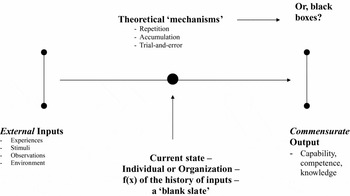
The behaviorist and empiricist approach, whether in psychology or the organizational routines and capabilities literatures, can be summarized as a simple input–output model (see Figure 1).
A simplified, input–output model of organizational routines and capabilities

In short, empiricist and behaviorist approaches postulate a strong, deterministic relationship between various inputs and associated outputs. Various external factors (whether stimulus, experience, environment, exposure, situation) essentially determine not only outcomes but also the internal make-up of the organism in question. As noted by Popper (Reference Popper1972: 60–64), behaviorist and empiricist theories effectively represent a ‘bucket theory’ of the mind that presumes an empty bucket, a tabula rasa, that then is filled with experiential, observational, and sensory inputs. Building on this behaviorist tradition, organizational scholars have also argued that the decision-rules, routines, behaviors, capabilities, etc. of the organization are a function of experience and the history of environmental inputs, and thus the initial state of the organization (and individuals within the organization) essentially is a ‘blank slate’ (cf. Popper, Reference Popper1972; Pinker, Reference Pinker2002). Importantly, behaviorist and empiricist theories assume that the relationship between input and output is commensurate as the organism's behavior and capabilities are the result of the number of times an activity is pursued, done, or ‘experienced’ via the environment, assumptions that are also strongly reflected in how routines and capabilities are also measured in the organizational literature (e.g., Haleblian and Finkelstein, Reference Haleblian and Finkelstein1999). More generally, the empiricist tradition focuses on history, environment, and ‘accumulating bits of sensory information’ (Schwartz, Reference Schwartz1978: 16–17), and is often empirically operationalized in the form of counts (repetitions and patterns of experiences, observation or events) as the key parts of the explanans (for an overview, see Becker, Reference Becker2005b). Not surprisingly, in the context of organization studies, this tradition is a close ally of evolutionary modes of explanation (Simon, Reference Simon1969; Nelson and Winter, Reference Nelson and Winter1982).
The emphasis in empiricist approaches on various external and environmental factors is clear (Figure 1). For example, Skinner notes: ‘A scientific analysis of behavior dispossesses autonomous man and turns the control he has been said to exert over to the environment. . . He is henceforth to be controlled by the world around him, and in large part by other men . . . environmental contingencies now take over functions once attributed to autonomous man’ (Reference Skinner1971: 196, emphasis added). This same emphasis is also evident in the organizational literature. Haleblian and Finkelstein aptly summarize this environmental focus as follows: ‘Behavioral learning theory predicts an individual's behavioral outcomes by analyzing environmental influences. According to the theory, there are both present and past environmental influences on behavior’ (Reference Haleblian and Finkelstein1999: 31).
Overall, what is quite striking about the routines and capabilities-based literature is that it utilizes the exact same inputs, mechanisms, and theoretical arguments as the psychological literature that it builds on. For example, Schwartz's (Reference Schwartz1978) book on psychological learning illustrates that the same exact input–output relationships and theoretical mechanisms are featured both in behaviorist psychology and much of the organizational literature on routines and capabilities (see Figure 1). And importantly, both literatures also make the same underlying assumptions as to the initial state of the organism and the critical role placed on experiential and external sources for behavior, learning, and change.
However, understanding the link between behaviorist approaches in psychology and those in organization theory and strategy is important as arguments in the former field have been significantly challenged (see, e.g., Chomsky, Reference Chomsky1959; Fodor, Reference Fodor1991; Popper, Reference Popper1972) and there are promising alternative ways to think about behavior, learning, and capabilities in organizations as well. In short, as we will highlight, the behaviorist and empiricist emphasis on experience and repetition has rather persuasively been refuted in the very disciplines from which the concepts (and more general epistemology) originate.
3. Problems with behaviorist and empiricist foundations
A fundamental, underlying question, which essentially provides the impetus for our central thesis for challenging experience, observation, and repetition as the causal antecedent of behavior and learning, is: What are the origins of heterogeneous experience or the repetition of an activity? Implicit in much of our subsequent discussion is that this question has not and cannot be adequately answered with the present behaviorist and empiricist foundations. Put differently, we argue that experience, and thus routines and capability, have endogenous origins.
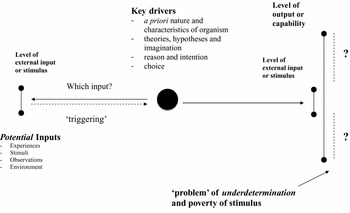
We argue that experience and repetition are only an epiphenomenon of more ultimate theoretical causes of behavior; experience and capability have endogenous origins. Citing experience and repetition as causes of behavior and capability only restates rather than resolves the theoretical problem of understanding and explaining organizational behavior or heterogeneity. Or, put differently, experiences proximally co-vary with capability outcomes but cannot logically be ascribed as the causal antecedents. By an epiphenomenon, we refer to the question of whether the theoretical explanation given provides causal finality, or whether the explanation induces immediate questions about the nested, actual antecedents (cf. Boudon, Reference Boudon, Hedstrom and Swedberg1998: 172–173). We argue that experience remains quite proximate to outcomes, as the immediate question becomes the underlying origins of heterogeneous experiences, and the reasons for its repetition. We will next identify and more systematically explicate the key theoretical problems associated with specifying experience and repetition as the antecedents of organizational routines and capabilities (our discussion is essentially summarized in Figures 1 and 2).
Capability input–output relationship and poverty of stimulus

The problem of origins and causation
The general question of where different types of experiences originate from in the first place and to what we impute heterogeneous experience (and its repetition) remains unanswered in extant, empiricist theories of routines and capabilities. Behaviorist learning theories impute causality to various experience and external factors (Chomsky, Reference Chomsky1959; Schwartz, Reference Schwartz1978), but how one (an individual or organization, any organism) sets out to have a ‘better’ or ‘quality’ (heterogeneous) experience(s) remains unanswered. We can of course look to the theoretical mechanisms highlighted in Figure 1, that is the need to experience, do, repeat, and accumulate experience, etc., but what does that mean where perhaps there is no past? This point is particularly poignant as there is a general emphasis on the past as the source for organizational learning (specifically see Levitt and March, Reference Levitt and March1988), but the emphasis on the past inherently leads to an infinite regress that deserves to be more carefully unpacked. In other words, the perpetual look to the past immediately begs further questions of the initial conditions of experience accumulation, especially since behaviorist theory gives subsequent emphasis on the localness and path dependence of continued organizational operations (Cyert and March, Reference Cyert and March1963). Thus, where does the first experience (which would seem quite critical given subsequent path dependence) come from? Or put differently, how does an organization begin to ‘accumulate’ experiences in the first place? How are the better and the right experiences accumulated? Where does a routine come from?
More importantly, if experience and repetition is the origin of learning and behavior, then logically the experiences themselves, and input and environmental stimuli more generally, should in essence carry the contents of experience or ‘lessons learned’ within them.Footnote 7 There indeed are frequent mentions of the notion of ‘lessons learned’ from past experience and repetition in the organizational learning and capabilities literatures (e.g., Argote and Epple, Reference Argote and Epple1990; Levitt and March, Reference Levitt and March1988: 336; Zollo and Winter, Reference Zollo and Winter2002: 348). But, in theoretically and empirically emphasizing the number or types of experiences (e.g., failures: Haunschild and Sullivan, Reference Haunschild and Sullivan2002) that an organization has had, there is, in effect, an implicit theoretical assumption that the lessons learned are contained in the experiences (or environmental stimuli) themselves. This seems quite tenuous. From a methodological and experimental perspective, the initial conditions and characteristics, choices, nature, and abilities of the individual or organization itself should be studied (or at least controlled for) rather than the experiences themselves, which may be epiphenomena and endogeneous. While we realize that experiences (and their repetition) are used as empirical proxies, these empirical proxies are not tightly coupled with final theoretical and causal factors. Thus a theory-data disconnect is created, with the theory being driven by the data: that is, theory being developed based on what is empirically observed post hoc in the environment (e.g., ‘counts’ of experiences). It is not clear what in the experiences themselves, especially their number or repetition, has meaningful content, and presumably the characteristics and nature of the organism itself needs to be taken into account. Overall, this theory–data disconnect provides one rationale for the many mixed findings in experiential models of learning (cf. Hayward, Reference Hayward2002; Zollo and Singh, Reference Zollo and Singh2004).
There is also a serious problem of survivor bias in specifying experiences themselves as the cause or origin of learning and behavior. That is, organizations which began particular activities early on and continue to repeat and accumulate the right activities inherently took initial, important steps which have nothing to do with the number of experiences, but rather the underlying factors which allowed them to have the experience in the first place. Again, this is particularly important in light of path-dependence. To put this in the context of the mechanisms highlighted in Figure 1, it is not the amount of doing or repetition that is the key causal factor, but rather the ability to do and capability to repeat in the first place (which a blank slate conception does not allow). The distinction is subtle, though it has wide theoretical ramifications for the very notion of learning and capability development. Specifically, in analyzing behavior, learning scholars may simply see a trailing track record of success (again, as proxied by experience and history), where the organizations that were not able to experience some activity, or those that simply pursued the wrong activities, fall out of the equation. However, imputing the experience or activity itself and its repetition leads theories to be mis-specified (Rock, Reference Rock1957). To best crystallize this point, think, for example, of the practical or managerial implications of the literature on experience curves. The practical advice for a young organization would be to have ‘lots of good experiences’. But, what those activities are, which activities are ‘good’, and how and why organizations are able to pursue these experiences in the first place should become a more important causal factor than the experiences themselves.
The problem of extremes
Another problem in experience or repetition-based models of organizational routines and capabilities is that they do not readily account for extremes. In part, the problem of extremes can be attributed to underlying statistical and empirical matters recently noted by McKelvey and Andriani (Reference McKelvey and Andriani2005) (e.g., the Gaussian denial of extremes and unstable means), though there are important theoretical considerations as well, which we explicate in relation to experiential models of organizational learning and capabilities.
Specifically, given the commensurate input–output relationship of experiential and behaviorist models (Figure 1), there are numerous anomalies related to the problem of extremes which cannot be accounted for, though they should theoretically fall within explanatory bounds. To take one glaring example from the literature, how do experiential models account for organizational ‘diseconomies’ (Zenger, Reference Zenger1994), that is the oft-noted discrepancy between the radically skewed innovation outcomes in small and young versus large and old organizations (the former being much more productive and innovative in relation to their size)? That is, experience and repetition-based learning models would of course predict the primacy of older, larger (thus more experienced) organizations, given that the theoretical mechanisms (e.g., repetition, accumulation; cf. Figure 1) have ‘operated’ both longer and more frequently, thus leading to increased organizational capability (cf. Felin and Zenger, Reference Felin and Zenger2009). By way of attempting to solve this problem, the organizational capabilities literature of course does point to issues of ‘too much’ experience and associated redundancy, learning myopia or rigidity (e.g., Leonard-Barton, Reference Leonard-Barton1992; Levinthal and March, Reference Levinthal and March1993). However, beyond simply citing curvilinear experiential effects (cf. Haleblian and Finkelstein, Reference Haleblian and Finkelstein1999; Hayward, Reference Hayward2002) or offering somewhat ad-hoc language to solve the problem, theoretical models should be able to better account for and explain the extremes, that is answer the question: why do less-experienced companies disproportionately outperform more-experienced companies? Overall, explaining extremes is a critical issue for strategic management given the field's raison d'etre of explaining competitive advantage, as much of what is exciting about organizational analysis happens at these extremes, presently outside the scope of experiential and behaviorist models.
To more carefully delve into the underlying experiential learning theory (again, recognizing that organizational theoretical models focus on the same inputs and mechanisms as behaviorist learning theories, Schwartz, Reference Schwartz1978), how would we account for differential outcomes in individuals within the same setting (given the same experience, stimulus, and instruction)? The behaviorist psychologist and social learning theorist Lev Vygotsky (whose work is built upon in several knowledge-based papers, e.g., Spender, Reference Spender1996; Brown and Duguid, Reference Brown and Duguid2001) indeed briefly recognized the problem of extremes in a short chapter titled, ‘The Problem of Giftedness’ (1926). Vygotsky rightly argues and admits that theories should be able to account for the full range of data, and both at the high end (e.g., gifted individuals) and the low end (e.g., learning-challenged individuals) there is a vast discrepancy and theoretical vacuum in experiential and behaviorist models as to the underlying sources and antecedents of capability (also see Estes, Reference Estes1970). In fact, the discrepancy of the theory at both ends of the data is such that it questions whether models anchored on experience are appropriately specified, even for the ‘average’ individual or organization. Similarly, the problems in capabilities-based work associated with averages and extremes also loom large. Why, despite similar environments, do we nonetheless observe differential overall outcomes? That is, why do individuals and organizations in the same environments have different ‘experiences’? Why are younger companies proportionally more innovative? How do some have ‘better’ experiences?
The problem of intentionality
A closely related problem is the issue of intentionality in routines and capabilities-based work. Experientially based models argue that what happens in organizations simply reflects input–output relationships (stimulus–response), leaving little room for discretion. This of course remains quite implicit, but nonetheless important to highlight. Environmental feedback and various stimuli determine behavior, which is a strong legacy from behaviorist psychology and empiricist epistemology. However, organizational analysis should not only be interested in describing the determinacy of outcomes (experiential and behaviorist models have a certain built-in inevitability, cf. Langlois and Csontos, Reference Langlois, Csontos, Mäki, Gustafsson and Knudsen1993; De Rond and Thietart, Reference De Rond and Thietart2007), but should also be interested in the intentional (also see Hodgson, Reference Hodgson2002). That is, the reason for being of organizational analysis is not just to explain random heterogeneity or the inevitable, but, more importantly, to also explain the intentional and choice-related actions of individuals and organizations (cf. Felin and Foss, Reference Felin and Foss2005).
The notion of intentionality suggests that we take seriously the matter of ‘free will’ and choice (cf. Chisholm, Reference Chisholm1967; Lucas, Reference Lucas1970), and other closely related notions such as volition (Zhu, Reference Zhu2004) and consciousness (Nagel, Reference Nagel1974). While intention and free will perhaps are hard-to-define concepts, nonetheless they deserve careful consideration in social science. It may indeed be that ‘proving’ free will or intention is problematic as an artifact of the fact that scientifically (from an empiricist perspective) proving anything in experiential models is specifically defined as pointing to the external, observable causes of behavior (Fodor, Reference Fodor1991; Popper, Reference Popper1972). However, though this admittedly is simplistic, to refute behaviorist theories, which only allow external and observable causes, I can simply raise my right hand, or not, while typing this sentence, with no apparent external, observable cause. In fact, the very act of writing this article is a manifestation of intention and creativity (we hope) – as for example none of the sentences constructed in this paper has appeared elsewhere and also has not been externally ‘put in’, but rather is genuinely a new and novel creation (Chomsky, Reference Chomsky2003). The behaviorist approach indeed argues that to explain any behavior, we need to simply look for external stimuli (see Schwartz, Reference Schwartz1978: 6), though it seems that the simple illustration above refutes the point. Underlying internal factors provide better and more final theoretical grounds than the more proximate external or experiential factors.Footnote 8 While a form of intentionality does emerge via second-order functions into the routines and capabilities-based literatures, nonetheless their operation is also tied to stimuli (related to lower-order routines not functioning or environmental queues), while we think that more active conceptualizations are also warranted, as our ‘internalist’ discussion will later illustrate.
The problem of creativity and new knowledge creation
Central to work in organizational routines and capabilities is understanding the emergence of new alternatives. That is, where does new knowledge and creativity come from, what are its underlying sources and antecedents? As we have outlined, experiential and behaviorist models focus on various external factors as antecedents to organizational learning, though this leaves the central question of new knowledge and creativity unanswered; the input–output relationship is commensurate (cf. Figures 1 and 2). Put differently, experiential and behaviorist models logically must presuppose that all knowledge is externally determined and thus, in effect, that all knowledge already exists (nothing emerging internally), and there is no wiggle-room for an individual or organizational contribution (beyond past, accumulated external and experiential inputs). However, we clearly observe creativity and new knowledge above and beyond, or even sans, apparent external inputs. In short, the experiential input–output relationship in organization theory is underdetermined.
Various theoretical mechanisms, as we have discussed (Figure 1), have of course been highlighted as a potential source of new knowledge and innovation, such as recombination (Fleming and Sorenson, Reference Fleming and Sorenson2004) or repeated interaction (Ethiraj et al., Reference Ethiraj, Kale, Krishnan and Singh2005) or socialization (Nonaka, Reference Nonaka1994), but these mechanisms do not resolve the problem of the sources of newness as they fundamentally depend on piecing together, for example via association (see Popper, Reference Popper1972: 3–7), existing, external knowledge elements (or cite ‘emergence’) (cf. Felin and Zenger, Reference Felin and Zenger2009). Thus, important, unanswered, theoretical questions remain, including: How specifically do new knowledge elements arise and more specifically, from where? How and why are certain ‘recombinations’ made – simply through iterations of random trial and error or some sort of intelligence (cf. Felin and Zenger, Reference Felin and Zenger2009)? Where did the previously pieced-together knowledge arise from in the first place? Which external knowledge elements are combined, why, and by whom? The intervening theoretical mechanisms cited seem to serve at best as temporary conceptual placeholders requiring further theory development.
A quite helpful way to recast the problem of new knowledge and creativity in experiential and behaviorist models of behavior is through very closely related arguments in artificial intelligence. Specifically, much of the intuition in organization and management theory indeed relies on concepts which are central to artificial intelligence as well, namely: input–output relations, programs and routines, trial and error learning, hill-climbing, and if–then statements (Simon and Newell, Reference Simon and Newell1958; Minsky, Reference Minsky1961; Russell and Norvig, Reference Russell and Norvig1994; also see Cyert and March, Reference Cyert and March1963; Gavetti and Levinthal, Reference Gavetti and Levinthal2000; Levinthal, Reference Levinthal1997).Footnote 9 Simon explicitly makes some links between behaviorist theories and artificial intelligence in his book Sciences of the Artificial (Reference Simon1969). In short, behaviorist theories and associated arguments in artificial intelligence in essence argue that individuals and organizations can be cast as experience (input–output) machines or automata or ‘information processing systems’ (March and Simon, Reference March and Simon1958: 9; Minsky, Reference Minsky1961). In conjunction with this, Simon suggests the following behaviorist conceptualization of individuals: ‘A man, viewed as a behaving system, is quite simple. The apparent complexity of his behavior over time is largely a reflection of the complexity of the environment in which he finds himself’ (1969: 65). The equivalent relationship between machines/computers and individuals and organizations has indeed been useful in helping us understand correlations between environmental stimuli (e.g., actions of peers and imitation) and knowledge outcomes, but these models inherently remain closed and un-open to original contributions on the part of the organism itself (outside of the history of external inputs) and thus do not account for new knowledge (only its replication or recombination) and creativity, which is readily observed. If behavior and learning depend on mechanisms such as imitation or recombination, where does novelty originate from?
The problem of creativity and new knowledge as it relates to computers and machines has long been recognized, and also has implications for understanding human creativity. Specifically, despite optimistic projections on the possibilities of creativity and learning on the part of computers (see e.g., Simon and Newell, Reference Simon and Newell1958: 7; also see Minsky, Reference Minsky1961; Russell and Norvig, Reference Russell and Norvig1994 for a more general discussion), computers and artificial agents can only produce what they are programmed to do, originating no new knowledge and showing no creativity (e.g., Block, Reference Block1981; Bringsjord, Reference Bringsjord1993). In general, mechanistic and computational approaches to the mind and behavior have persuasively been refuted on grounds of their determinism, lack of intention and creativity (e.g., Dreyfus, Reference Dreyfus1992; Lucas, Reference Lucas1961). Creativity and new knowledge are outside the realm of possibility for computers (and empiricist theories as well, given that the input–output relations that are similarly specified) as they are inherently dependent on what the programmers or designers of the machine ‘put in’ in the first place.
Overall, we argue that neither the automaton or agent of artificial intelligence (Minsky, Reference Minsky1961), nor the maze-running rat of behaviorist psychology (Tolman and Brunswick, Reference Tolman and Brunswick1935), is the appropriate model for understanding human behavior, organizational capabilities, or learning, given that the input–output relations simply cannot account for ‘the new’. The input–output under-determination was also recognized by Descartes (Reference Descartes1637) who noted the creativity, appropriateness, and newness (all three being unattainable by machines) of everyday activities, such as children speaking, where unique and novel outputs are constantly being generated without external stimulus and experience. For example, we can answer any question in infinite varieties, or more generally speak without any external inducement, or even think an infinite variety of creative ‘un-thought’ thoughts without any external inputs or stimuli (Block, Reference Block1981; Chomsky, Reference Chomsky2003; Popper, Reference Popper1972).
The problem of the environment
The final problem, the problem of the environment, is closely related to the above problems, and indirectly provides an apt summary of sort for the other four central problems associated with behavioral and empiricist models of organizational routines and capabilities.
Nothing, of late, seems to be more real to strategy and organizational scholars than the notion of the environment. The environment is said to mold (Simon, Reference Simon1969) and determine much of organizational behavior and learning (Cyert and March, Reference Cyert and March1963). Behaviorist learning theory in fact suggests that ‘if you want to know why someone did something, do not ask. Analyze the person's immediate environment until you find the reward’ (Schwartz, Reference Schwartz1978: 6). However, what the relevant environment is, how it is defined, where the environment originates from and so forth generally only becomes clear in behaviorist and empiricist models after the behaviors of the individual or organization are observed (see Popper, Reference Popper1972; cf. Chomsky, Reference Chomsky1959). The post hoc hunt for observable experience and external stimuli, however, leads behaviorist and empiricist theories to be mis-specified (showing potential correlations between experiences and behavior, though not causation) as logically what ‘stimulates’ does not depend on the stimulus (e.g., its repetition or intensity; Yerkes and Dodson, Reference Yerkes and Dodson1908) but rather the underlying a priori characteristics, nature, and choices of the organism itself (as we will discuss in the next section). In short, there is no environment as such (given the multitude of possible stimuli and inputs) without individuals and organizations and their respective intentions, nature, perceptions, and characteristics, which begs the question of what the environment is in the first place and how it might have emerged endogenously. In other words, empiricist theories do not allow us to account for the fact that organisms might self-select into and create environments; the environment might have endogenous origins.
The problem of the environment is also highlighted by Simon: ‘The world we live in today is much more a man-made, or artificial, world than it is a natural world. Almost every element in our environment shows evidence of man's artifice’ (Reference Simon1969: 4–5). Unfortunately, behaviorist and empiricist models in organization theory have been closely linked to natural sciences with the emphasis placed on such things as incremental and experiential evolution, randomness, and environmental selection (e.g., Nelson and Winter, Reference Nelson and Winter1982; also see Holland, Reference Holland1995), and thus the evidence of ‘man's artifice’ essentially gets lost in ascribing causal roles to the artifice rather than the man. The question that our arguments then begs for is whether the borrowing of these environmental models – inputs, mechanisms, assumptions, and all – serves strategic management and organization theory well, given the clearly intentional efforts of individuals to create organizations, artifacts, and products. Recently, in quite related fashion, the physicist George Ellis pointed out that physics, natural science, or evolutionary models, simply cannot meaningfully explain intentional, man-made artifacts: ‘Our environment is dominated by objects that embody the outcomes of intentional design (buildings, books, computers, teaspoons). Today's physics has nothing to say about the intentionality that has resulted in the existence of such objects, even though this intentionality is clearly causally effective’ (Ellis, Reference Ellis2005: 743). We argue that questions of capabilities, behavior, and learning are also best kept separate from approaches that emphasize the strongly causal role of external stimuli and the environment, particularly when it comes to understanding matters of new knowledge creation, creativity, and innovation, but also behavior and capability more generally.
4. The poverty of stimulus argument: an internalist and rationalist approach for understanding capabilities
In this section, we provide some preliminary outlines toward an internal or rationalist approach to understanding capabilities and behavior; we also make important links to the economics and strategic management literature.Footnote 10 Our sketch here is of necessity brief, though given the criticism that we have levied toward the behaviorist and empiricist foundations of the routines and capabilities-based work, it is important for us to also offer some constructive directions and at least the beginnings of an alternative approach. Specifically, we advance an internal or rationalist approach to capability and knowledge by giving specific emphasis to the ‘poverty of stimulus’ argument and we also begin to partially reconcile internal and external epistemologies of capability by focusing on the triggering role of the experiential environment. Our efforts here most certainly do not amount to a full theory, but rather we introduce the notion of ‘poverty of stimulus’ and a focus on the ‘internal’ in the same spirit as Simon introduces bounded rationality (see Augier, Reference Augier2001: 272), namely not as a theory but as a theoretical and methodological tool, in hope of re-directing extant work on organizational routines and capabilities.
Internal factors and human nature
We begin with the assertion that to understand behavior we must focus on internal factors related to the organism itself that is under study, rather than the external factors surrounding the organism in question (whether individual or organization). To recap and contrast, behaviorist and empiricist models presume that the emphasis should primarily be on various external factors, the history of external inputs, and the environment (Figure 1), while we argue that what in the first place gets ‘put in’ (and is created) is more a function of the organism than the environment or stimulus (and its repetition) (Figure 2). Behaviorist and empiricist approaches essentially engage in an ‘epistemology without a knowing subject’ (Popper, Reference Popper1972: 102), without consideration of the potential contribution of the nature of the organism itself to behavior. Our goal is to re-introduce the knowing subject, human nature, and choice into the analysis – a shift to an internal focus.
To more concretely illustrate what we mean by an internal focus, consider a hypothetical, ever-present ‘pet bee’ that a child might have (see Chomsky, Reference Chomsky2002). Say both organisms, the child and the bee, were exposed to the same exact environment and stimuli, what would be the differences in capabilities? Quite obviously, radically different behavioral and capability outcomes would readily be evident (cf. Brewer, Reference Brewer, Weiner and Palermo1974). The child would not develop the navigational ability of the bee and the bee would not develop language capabilities, despite uniform environmental stimuli. Capabilities, in other words, are endogenous. In short, to understand behavior and what is learned, there is a need to understand the contribution and nature of the organism itself (internal rather than external factors) (see Figure 2). In fact, no amount of external reinforcement, experience, stimulus repetition, or doing (see theoretical mechanisms in Figure 1) is likely to help a bee to learn how to talk. And vice versa, the navigational abilities of the child are unlikely to match the bee. Now, the problem of course is that it appears as if external stimuli cause capability, specifically as the environment in behaviorist and experiential models is determined post hoc (i.e. after behavior is observed – the environmental stimuli are sought after, cf. Schwartz, Reference Schwartz1978; cf. Fodor, Reference Fodor1991), thus not controlling for underlying capabilities and mental activities which may already pre-exist and be latent. The big confound, then, is that we only find bees in what appear to be rich environments with stimuli commensurate to outputs. It misleadingly looks like, for example, that the experiences or interaction of the bees somehow causes the navigational capability (cf. Figure 1). And similarly, it may mistakenly look like the experiences of the firm result in capability, but disentangling external and internal effects becomes confounded and problematic.Footnote 11 Our argument, then, is that the nature and choices of the organism – and, self-selection into and creation of environments – need to be carefully understood to explain behavior and capability, whether at the individual or organizational level.
The poverty of stimulus
A central notion from an internal or rationalist perspective is the ‘poverty of stimulus’ argument (Figure 2). While experiential approaches focus on the causal role of environmental stimuli in learning, the poverty of stimulus highlights creative and new output, despite impoverished and degenerate inputs (cf. Chomsky, Reference Chomsky2003; Cudworth, Reference Cudworth1731). Or put differently, experiences may trigger, but cannot meaningfully cause, outcomes (see Felin and Zenger, Reference Felin and Zenger2009). The poverty of stimulus argument, then, allows us to answer the question: How specifically do we account not only for the acquisition of a particular piece of knowledge or a capability, but also for the quite apparent competence and even creativity given impoverished environmental inputs, or even without any environmental stimuli? And, the poverty of stimulus also directs us to understand the endogenous, latent origins of novelty, emerging from the organism itself (rather than its environment). Again, while we certainly can look to the environment for observable causes of behavior or capability, the post hoc search for rich stimuli mis-specifies and biases theories. What gets ‘put in’, in the first place, depends more on (and is endogenous to) the organism itself and its characteristics and choices (see Figure 2) rather than the attributes of the environment or stimulus.
The notion of poverty of stimulus has been introduced in the context of language acquisition (e.g., Chomsky, Reference Chomsky1986; see Laurence and Margolis, Reference Laurence and Margolis2001 for an overview), though earlier antecedents can readily be found in Greek philosophy (e.g., Plato's Meno). More generally, the poverty of stimulus argument is an underlying assumption in all of internal or rationalist epistemology. In short, from the context of language acquisition, the poverty of stimulus is perhaps best summarized as follows:
One can describe the child's acquisition of knowledge of language as a kind of theory construction. Presented with highly restricted data, he constructs a theory of language of which this data is a sample (and, in fact, a highly degenerate sample, in the sense that much of it must be excluded as irrelevant and incorrect – thus the child learns rules of grammar that identify much of what he has heard as ill-formed, inaccurate, and inappropriate). The child's ultimate knowledge of language obviously extends far beyond the data presented to him. In other words, the theory he has in some way developed has a predictive scope of which the data on which it is based constitute a negligible part. The normal use of language characteristically involves new sentences, sentences that bear no point-by-point resemblance or analogy to those in the child's experience. (Chomsky, Reference Chomsky1975: 179, italics added)Footnote 12
The poverty of stimulus argument points out that the explanatory burden in explaining learning, behavior and capability needs to shift from external inputs to the organism itself; specifically, as there are latent, ex ante and internal capabilities, which deserve to be explicated and understood given the remarkable and creative output despite impoverished inputs (Figure 2). The context here of course is linguistics and psychology, though the intuition is also central for understanding organizational behavior, particularly since, as we have discussed, empiricist theories and assumptions have been directly imported from psychology into organizational analysis. Given the poverty of stimulus argument, the key differentiating factor in explaining learning or behavior becomes not the stimuli nor experiences per se, but rather the respective individual-level characteristics and processes related to the nature of the organism that is being studied. In short, the poverty of stimulus argument suggests that the external environment does not in any meaningful way contain the ‘lessons learned’ within it, but rather what is learned and ‘put in’ is a function of the organism itself (Figure 2). That said, the stimulus of course may provide an important triggering role in eventual competence and capability. But, the nature, characteristics, and choices of the organism itself become a more final causal explanation of heterogeneous experiences, with the experiences themselves only being epiphenomena of these a priori factors. In other words, for all learning there must logically be an ex ante ability to ‘handle’ the experience and furthermore the capability to discern and recognize stimuli, which has less to do with the characteristics of the stimulus itself and more to do with the underlying characteristics, capabilities, and choices of the organism.
Human nature, rationality, and economic action
As the reader might note, the emphasis we place on human nature seemingly moves us from one form of determinism (behaviorist approaches and their environmental determinism) to another form of determinism (the role of human nature in determining behavior). We might unwittingly have replaced one deterministic and physical theory with another form. However, the rationalist approach that we build on is an intriguing epistemology in that it not only insists that human nature be appropriately accounted for, but it also allows for choice, intention, and creativity to play a central role in explaining behavior and capability (Chomsky, Reference Chomsky2003). Popper (Reference Popper1972) also succinctly makes this point in his classic ‘clouds and clocks’ essay, significantly sub-titled ‘An Approach to the Problem of Rationality and the Freedom of Man’. In this essay Popper argues that ‘what [social science] wants to understand [is] how such non-physical things as purposes, deliberations, plans, decisions, theories, intentions, and values, can play a part in bringing about physical changes in the physical world’ (1972: 229; emphasis in original; cf. Ellis, Reference Ellis2005). In other words, there is ‘Spielraum’, an extended possibility space that should be accounted for in the decision-making and choices and behavior of individuals and organizations (Felin and Zenger, Reference Felin and Zenger2009).
Versions of heterodox economics have of course dealt with the issue of free will and choice (e.g., Schackle, Reference Schackle1979), for example via discussions of bounded rationality and ‘situationism’ (Latsis, Reference Latsis1972, Reference Latsis, Cohen and Wartofsky1982; Langlois and Csontos, Reference Langlois, Csontos, Mäki, Gustafsson and Knudsen1993; Simon, Reference Simon1955). However, the extant focus on bounded rationality in the routines-based literature places far too much emphasis on boundedness rather than rationality (Bianchi, Reference Bianchi1990). The rationalist approach that we are arguing for specifically is interested in the generative mechanisms that might play a role in choices and situationally rational action. As illustrated in Figure 2, there are a host of central variables and generative mechanisms that behaviorist approaches dismiss implicitly or logically cannot address given the commensurate input–output relationship (cf. Figure 1).
Our focus on the nature of the organism itself, rather than imputing its nature from the environment, also requires us to study and understand the role of subjective plans, purposes, and hypotheses that economic agents bring to situations. As noted by Popper (Reference Popper1972: 247), human beings, unlike animals or physical objects, have the capacity for purposeful deliberation which itself is causal and generative in nature.Footnote 13 In other words, rather than strongly anchor on external factors such as experience as sources of behavior and capability (Figure 1), the internalist and rationalist approach focuses on the anticipations, calculations, preferences, interests, and even creative conjectures of economic actors. Popper articulates this poignantly by pointing out that ‘observations are secondary to hypotheses’ (Reference Popper1972: 346); in other words, internal deliberations have much to do with what is perceived and created. By comparison, a behaviorist approach gives causal precedence to observations as the central inputs in explaining thoughts, plans, and behavioral outcomes (Figure 1). In other words, the hypotheses and theories of the human agents play a central, effectively causal, role in shaping and determining what is experienced and repeated (Felin and Zenger, Reference Felin and Zenger2009). This intuition is aptly encapsulated in philosopher Ned Block's so-called productivity argument: ‘people are capable of thinking vast numbers of thoughts that they have not thought before – and indeed that no one may have ever thought before’ (Reference Block, Osherson, Gleitman, Kosslyn, Smith and Sternberg1995: 3). Thoughts and deliberations, then, are not epiphenomenal to observations and experiences, rather the former endogenously create and influence the latter.
In economic settings, where does capability (and for that matter, novelty) then emerge from? We place heavy emphasis on individuals and organisms themselves, and their generative capacity to imagine novel possibilities and to take actions. As powerfully noted by Charles Peirce: ‘Man's mind has a natural adaptation to imagining correct theories of some kinds . . . If man had not the gift of mind adapted to his requirements, he could not have acquired any knowledge’ (Reference Peirce and Tomas1957: 71). Entrepreneurs and managers, then, can in part be seen as ‘scientists’, of a sort, who make conjectures and have theories about effective courses of actions, novel possibilities, and so forth.
Routines, dispositions and possibility
There is a relatively recent interpretation of routines and capabilities that has some links to the rationalist and internalist approach that we are advocating, namely the literature on routines as ‘dispositions’ (Becker, Reference Becker2005a: 818; see Hodgson, Reference Hodgson2003, Reference Hodgson2004; Hodgson and Knudsen, Reference Hodgson and Knudsen2004). Indeed, dispositions suggest an internal propensity and capability for given courses of action. Dispositions are defined as ‘stored behavioral capacities or capabilities [that] involve knowledge and memory’ (Hodgson and Knudsen, Reference Hodgson and Knudsen2004: 9). There is also an emphasis on ‘potential behavior that can be triggered’ (Becker and Zirpoli, Reference Becker and Zirpoli2008: 130, emphasis added; see Hodgson, Reference Hodgson2004: 652). The emphasis on possibility and the indeterminacy (or choice) of behavior indeed resonates with our notion of the poverty of stimulus. Our concern, however, is that even the dispositions notion of routines remains anchored on the set of stimuli that an individual or organization has faced in the past, rather than allowing for endogenous, generative mechanisms to operate fully. The dispositions intuition explicitly builds on the notion of habits; habits which in turn ‘depend crucially upon stimuli from the social environment’ (Hodgson and Knudsen, Reference Hodgson and Knudsen2004: 289). Our point, on the other hand, is that stimuli and the environment necessarily cannot – given the poverty and degeneracy of the stimuli – be ascribed as the causal factors of behavior and capability, rather behavior and capability naturally must also have latent, endogenous origins. That said, we think there is much potential at the intersection of the ‘dispositions’ and ‘poverty of stimulus’ notions to understand the nature of economic actors, their dispositions, the set of triggering stimuli, etc., to more fully develop an understanding of organizational behavior and capabilities.
5. Implications and future directions
Our call for rationalist foundations for the organizational routines and capabilities literature suggests several opportunities for future research. First, the endogenous drivers and mechanisms (between the inputs and outputs – as pointed out in Figure 2), provide a fruitful area for future investigation. Rather than search for external factors (such as experience or stimuli) as antecedents of organizational behavior or capability, we suggest that the underlying characteristics and nature of the organization itself provide an opportunity for future work. For example, there is an opportunity to study the underlying ‘microfoundations’ of organization, that is to study the individuals that compose the organization, their underlying characteristics, nature, abilities, preferences, choices, and so forth (see Felin and Foss, Reference Felin and Foss2005). Furthermore, the organization itself, as an actor, might be studied to understand its underlying nature, such as the identity-related choices of organizations (King et al., Reference King, Felin and Whetten2010). Second, there is an opportunity to understand how choice sets emerge for individuals and organizations, specifically how the set of ‘possible’ actions is conceptualized or created. The rationalist approach specifically presumes that the hypotheses and theories of agents drive observations and experience rather than the other way around (Chomsky, Reference Chomsky2003; Popper, Reference Popper1972). Thus, there is an opportunity to understand how the imagination, hypotheses, and theories impact economic actors and organizational behavior and performance. Furthermore, rather than treat given action sets or patterns as givens, there is an opportunity to understand how these actions sets and possibilities originate. Third, the extant literature on routines places undue emphasis on behavioral regularities and repetition, while managerial work might precisely be about dealing with exceptions, departures from the routine. As noted by Alfred Sloan: ‘we do not do much routine work with details. They never get up to us. I work fairly hard, but it is on exceptions or constructions, not on routine or petty details’ (Reference Sloan1924: 194; quoted in Garicano, Reference Garicano2000: 898). Thus, routines naturally play an important role in organizational behavior – for example, they lessen the cognitive workload of employees within the firm – but these very behaviors also have origins in cognitive work that has occurred in the past. In short, the nexus of routines versus non-routine work provides an intriguing opportunity for future work. Fourth and finally, our goal has not been to completely dismiss the role of experience, repetition and the environment in understanding organizational behavior and capability, and thus there is an opportunity to more carefully explicate how experience and the environment ‘triggers’ the emergence of particular actions or capabilities, as suggested by the ‘poverty of stimulus’ argument. Naturally there are important links between the external (Figure 1) and internal factors (Figure 2) that affect organizational behavior and performance. We hope that this paper triggers additional work along these lines.