Introduction
Mites within the family Trombiculidae have a distinct life cycle whereby the larval stage (referred to as chiggers) is parasitic, while the subsequent active life stages (nymph and adult) are free-living predators (Shatrov and Kudryashova, Reference Shatrov, Kudryashova, Morand, Krasnov and Poulin2006). Chiggers commonly attach to vertebrate hosts such as rodents, birds and reptiles for a variable length of time (days to months) (Traub and Wisseman, Reference Traub and Wisseman1968). Small mammals and particularly rodents are important hosts for chiggers. For example, more than half of the species in the largest chigger genus Leptotrombidium are associated with rodents (Shatrov and Kudryashova, Reference Shatrov, Kudryashova, Morand, Krasnov and Poulin2006; Mullen and OConnor, Reference Mullen, OConnor, Mullen and Durden2019). Multi-species infestations are common for chigger species (Moniuszko et al., Reference Moniuszko, Felska and Mąkol2018) and species-specific parasitope preference is often recorded (Traub and Wisseman, Reference Traub and Wisseman1974; Cunha-Barros et al., Reference Cunha-Barros, Van Sluys, Vrcibradic, Galdino, Hatano and Rocha2003; Zhan et al., Reference Zhan, Guo, Speakman, Zuo, Wu, Wang and Yang2013). For example, chiggers preferred the anterior axillae of the Amazon lava lizard (Tropidurus torquatus) and two other lizard species in south-eastern Brazil (Cunha-Barros et al., Reference Cunha-Barros, Van Sluys, Vrcibradic, Galdino, Hatano and Rocha2003), while the inside of the external ear was the preferred attachment site for several chigger species on the Yunnan red-backed vole (Eothenomys miletus) in China (Zhan et al., Reference Zhan, Guo, Speakman, Zuo, Wu, Wang and Yang2013). As mentioned before, chiggers only temporarily attach to the host and the exact time of the year that they attach varies seasonally with some species more abundant on the host during spring and summer (Clopton and Gold, Reference Clopton and Gold1993; Klukowski, Reference Klukowski2004) while other taxa attach to the host during winter where they overwinter (Williams, Reference Williams1946; Moniuszko and Mąkol, Reference Moniuszko and Mąkol2016).
Much of what we know about the diversity and distribution of trombiculid mites is based on the larval stages. This is due to the fact that they are more easily observed while being attached to their host. The family is highly speciose and has a cosmopolitan distribution (Shatrov and Kudryashova, Reference Shatrov, Kudryashova, Morand, Krasnov and Poulin2006). Within the group, there has been diversification in habitat preference and they are regarded as habitat-specific (Shatrov and Kudryashova, Reference Shatrov, Kudryashova, Morand, Krasnov and Poulin2006). However, the extent of habitat specificity varies between species with some species adapted to multiple habitat types, while other species are more restricted (Mohr, Reference Mohr1947; Traub and Wisseman, Reference Traub and Wisseman1974). For example, at a local scale, Leptotrombidium deliense was recorded across various habitat types from dense jungle vegetation to cleared agricultural areas in the Philippine Islands and New Guinea (Mohr, Reference Mohr1947), while Eutrombicula alfreddugesi was associated with short to tall grass found along forest edges (transition zones) compared to the undergrowth of the forest core in Nebraska, USA (Clopton and Gold, Reference Clopton and Gold1993). The latter authors related this to more suitable microclimatic conditions (low temperature, high relative humidity, low solar radiation) and a higher occurrence of small mammal species in transition zones (Clopton and Gold, Reference Clopton and Gold1993). Interestingly, species within the scrub typhus-associated genus Leptotrombidium seem to adapt to transformed habitats such as cleared forests and cultivated dry-lands, which would explain the higher incidence of scrub typhus in humans in agricultural areas in Taiwan (Kuo et al., Reference Kuo, Huang, Ko, Lee and Wang2011).
Research on chiggers in South and southern Africa is scant and largely limited to parasite-host species lists for the region (Lawrence, Reference Lawrence1949; Zumpt, Reference Zumpt1961; Stekolnikov, Reference Stekolnikov2018). Current records of chigger species for the country stand at 86 species (Stekolnikov and Matthee, Reference Stekolnikov and Matthee2019). South Africa is diverse in topography, plant (Mucina and Rutherford, Reference Mucina and Rutherford2006) and small mammal species (Skinner and Chimimba, Reference Skinner and Chimimba2005) and it is thus expected that the country as a whole should host a high diversity of chiggers and that each of the nine biomes (albany thicket, desert, forest, fynbos, grassland, indian ocean coastal belt, savanna, succulent- and nama karoo; Mucina and Rutherford, Reference Mucina and Rutherford2006) should have a set of unique chigger species. To date, few ecological studies, based on large sample sizes, have been conducted on chiggers of South Africa and specifically on chigger species associated with small mammals. Recent studies on the Namaqua rock mouse (Micaelamys namaquensis) and the eastern rock sengi (Elephantulus myurus) at a single natural locality in the grassland biome (summer rainfall region) only recorded chiggers as a group (Fagir et al., Reference Fagir, Ueckermann, Horak, Bennett and Lutermann2014, Reference Fagir, Horak, Ueckermann, Bennett and Lutermann2015). Although no taxonomic distinction was made, the authors recorded significantly higher infestations on both host species during the wet and warm summer compared to dry and cold winter months (Fagir et al., Reference Fagir, Ueckermann, Horak, Bennett and Lutermann2014, Reference Fagir, Horak, Ueckermann, Bennett and Lutermann2015). Around the same time, the chigger species associated with the four-striped mouse (Rhabdomys pumilio) were studied in fragmented remnant vegetation in the southern fynbos biome (winter rainfall region) of the country (Barnard et al., Reference Barnard, Krasnov, Goff and Matthee2015). In this study, seven chigger species representing six genera (Ascoschoengastia, Leptotrombidium, Neoschoengastia, Schoengastia, Schoutedenichia and Shunsennia) were recorded on R. pumilio. In addition, the study showed that the three most common species (Leptotrombidium sp., Neoschoengastia sp. and Schoutedenichia sp.) co-occurred on certain parasitopes with a preference for the tail base region (Barnard et al., Reference Barnard, Krasnov, Goff and Matthee2015). As yet, data on the chigger diversity associated with rodents in various biomes and the distribution of chigger species across habitat types are lacking for the country and region. To address this paucity of information, a study was conducted on rodents in different habitat types in the savanna biome (summer rainfall region) of South Africa. The region is home to some of the largest nature reserves that are often bordered by human settlements. Subsistence farming (crop and cattle) is commonly practised in these rural communities. The study aims were to (1) record the chigger species associated with rodents in the savanna biome, (2) assess if the chigger species display parasitope preference on the host body and (3) compare the distribution of chigger species on rodents in natural, agricultural and urban habitat types across a wildlife–human/domestic animal interface. Given the dearth of empirical data on chiggers, it was predicted that several new chigger species or locality records would be reported. Further, we predicted that chigger species would display significant parasitope associations and that, given their habitat preference, chigger communities would differ between habitat types.
Materials and methods
Study area
The study was conducted at a wildlife–human/domestic animal interface in the Mnisi rural community located in the Bushbuckridge Municipality in the north-eastern part of South Africa (Fig. S1). The community consists of approximately 40 000 people living in 8500 households within several small villages (referred to as urban habitat type). Some properties have small vegetable patches and goats, chickens and dogs often roam the yards. The community shares 75% of its boundary with wildlife reserves. The fenced reserves comprise pristine natural savanna vegetation. Farming areas consist of seasonal crop fields that are enclosed with wire fences that are covered with shrubs or stacked dead branches and these areas are commonly grazed by cattle following the harvest. These agricultural areas were located on the outskirts of the villages and formed an interface between urban and natural areas.
The vegetation structure of each habitat type was recorded during two of the field seasons (August 2014 and January 2015) using the descending point method (Roux, Reference Roux1963). The three habitat types varied in the percentage of ground cover and the proportion of plant life forms. In particular, the relative proportion vegetation cover was the highest in the natural (87%) and lowest in the urban habitat types (35%). The highest proportion of grass was recorded in the natural compared to the urban habitat (Fig. S2). This pattern was recorded during spring (August 2014) and summer (January 2015). The only difference between the two seasons was a higher proportion of shrubs in the agricultural habitat during summer (47%) compared to spring (7%).
Study design
Rodents (Muridae) were trapped in three habitat types (natural, agricultural and urban) in July/August 2014 (29/07–07/08), January 2015 (05–15/01) and September 2015 (07–17/09). Rodent trapping was conducted at three independent sites (>1 km apart) in the neighbouring Manyeleti Nature Reserve (24°38′52″S, 31°31′35″E) and in three villages and their respective crop fields (Gottenburg 24°38′01″S, 31°25′19″E; Thlavekisa 24°37′51″S, 31°22′42″E; and Hlalakahle 24°48′59"S, 31°20′13″E). Each of the villages and crop fields was >2 km apart. The project was approved by Mpumalanga Tourism and Parks Agency (permit number ES 5/14), Department of Agriculture, Forestry and Fisheries (Reference number 12/11/1/7/5) and the Animal Ethics Committees of Stellenbosch University (Reference number SU-ACM11-00004) and Pretoria University (Reference number V046-14).
A standardized rodent trap design was followed in each habitat type and trap session. Sherman-type live traps were set at 10 m intervals along 100 m trap lines. The trap lines were replicated (3–5 replicates) and left out for 3–4 days per habitat type. In the urban habitat, traps were set in and around houses along streets. Traps were continuously baited with a mixture of peanut butter and oats and checked in the morning. Traps were closed in the heat of the day (10:00–15:00) to prevent trap-related deaths. Rodents were targeted and once trapped, placed in labelled plastic bags, euthanized with halothane and frozen at −80 °C. For each rodent, sex, reproductive state (separated into adult and juvenile) and body measurements (weight and body length) were recorded. Rodents were preliminarily identified morphologically (Stuart and Stuart, Reference Stuart and Stuart2001; Skinner and Chimimba, Reference Skinner and Chimimba2005) and thereafter confirmed molecularly (cytochrome b gene) (Bastos et al., Reference Bastos, Nair, Taylor, Brettschneider, Kirsten, Mostert, von Maltitz, Lamb, van Hooft, Belmain, Contrafatto, Downs and Chimimba2011). Rodents that belong to the genus Mastomys (M. coucha and M. natalensis) are presented at genus level as not all individuals could be identified molecularly. Prior to parasite removal, animals were thawed and systematically examined under a stereomicroscope. A subsample of chiggers was collected by removing the skin where they were attached with fine-point forceps and stored in plastic tubes containing 70% ethanol until slide-mounting commenced. Chiggers that were found on more than one body region were stored in separate vials. The specific body region was recorded for each sample. Chiggers were mounted on microscope slides using Faure–Berlese medium (de Faure's medium), according to standard methodologies (Walter and Krantz, Reference Walter, Krantz, Krantz and Walter2009). Further, in general, 1–29 individuals per sample tube were mounted for identification, pending the number of individuals within the tube.
Mounted specimens were examined under a Leica DM5000B microscope (Leica Microsystems GmbH, Wetzlar, Germany) using differential interference contrast; morphometric data were recorded using an MBI-3 microscope (LOMO plc, Saint Petersburg, Russia) using phase contrast optics. Identification to species level was performed using revisions of the genera Gahrliepia Oudemans, 1912 (Traub and Morrow, Reference Traub and Morrow1955), Herpetacarus Vercammen-Grandjean, Reference Vercammen-Grandjean1960 (Vercammen-Grandjean, Reference Vercammen-Grandjean1966), Microtrombicula Ewing, 1950 (Vercammen-Grandjean, Reference Vercammen-Grandjean1965a), Schoutedenichia Jadin and Vercammen-Grandjean, 1954 (Vercammen-Grandjean, Reference Vercammen-Grandjean1958), Leptotrombidium generic complex (Vercammen-Grandjean and Langston, Reference Vercammen-Grandjean and Langston1976), and using original descriptions of species.
Environment and host-associated variables
We included environment (i.e. trap season, habitat type and locality) and host (i.e. host species, reproductive state, weight and body length) associated variables to characterize each host individual and its environment (i.e. infracommunity). We explored the association among qualitative factors by calculating Goodman and Kruskal's τ implemented through the ‘GoodmanKruskal’ package (Pearson, Reference Pearson2016) in R version 3.5.2 (R Development Team, 2019). Goodman and Kruskal's τ measure is asymmetric; meaning that the association between two variables, x and y, is generally not the same as that between y and x. Thus, this association measure allows the detection of asymmetric relations between categorical variables (e.g. one variable obtained by re-grouping another). In general, we found low correlations among factors, except for the correlation between locality and habitat that was collinear. Locality was somewhat predictive of habitat (τ = 0.48), but the reverse association was much weaker (τ = 0.37). As we were interested in the effects of habitat on the community structure of the chigger mites, locality was not considered in further analyses.
Data on chigger mite infracommunity structure and parasitope
We constructed a presence/absence matrix with (1) chigger species as columns and rodent host individuals as rows to investigate chigger presence/absence (i.e. community structure), and (2) parasitope as columns and rodent individuals as rows to investigate to what extent the chigger mite community structure is explained by the distribution of species on the body of each rodent individual. Only rodents with at least one chigger species were included in the final matrices. A principal component analysis (PCA) was then performed on each matrix using the ‘princomp’ function implemented through the ‘stats’ package in R to reduce the dimensionality of the data. As PC1 explained most of the variance in both matrices, we extracted the scores of this component to represent chigger community structure and parasitope, respectively, in further analyses.
Data analysis
Pielou's measure of species evenness (J) was used to assess the evenness of chigger species between habitat types. It was computed as J = H/ ln(S), where H is Shannon Wiener diversity and S is the total number of species in a given habitat type. We used the ‘vegan’ package (Oksanen et al., Reference Oksanen, Blanchet, Friendly, Kindt, Legendre, McGlinn, Minchin, O'Hara, Simpson, Solymos, Stevens, Szoecs and Wagner2018) to compute S, H and J.
Canonical correspondence analysis was conducted to explore the relationship between the presence/absence of chigger species (i.e. community structure) and their distribution on the body of each individual rodent (i.e. parasitope). First, we prepared a data matrix of the presence/absence of chigger species. Only rodents with at least one chigger species were included. Second, we prepared a data matrix of the presence/absence of chigger mites on the different body regions of individual rodents. Thereafter, we computed the likely association between the two matrices, i.e. the community structure and the parasitope, using the Wilks L test.
PCA was conducted on the presence/absence of chigger species (i.e. community structure). The co-ordinates on the first axis were extracted and used to explore the likely factors that explained the presence/absence of chigger species. We then used Generalized Linear Mixed Models (GLMM) to explain the importance of several independent variables such as rodent sex, weight, body length and condition, reproduction, season, habitat and locality on the values of the first dimension of the PCA explaining the structure of the chigger community. Rodent species identity was used as a random factor. We used likelihood-based methods (Burnham and Anderson, Reference Burnham and Anderson2002) to quantify the alternative models and estimate their parameters. AIC adjusted for sample size (AICc) was used to assess the relative information content of the models. We quantified the uncertainty that the ‘best’ model would emerge as superior if different data were used with Akaike weights wr (Burnham and Anderson, Reference Burnham and Anderson2002). Selection of the best competing models was made using package ‘gmulti’ (Calcagno and de Mazancourt, Reference Calcagno and de Mazancourt2010) in R.
Results
Rodent species, density and abundance
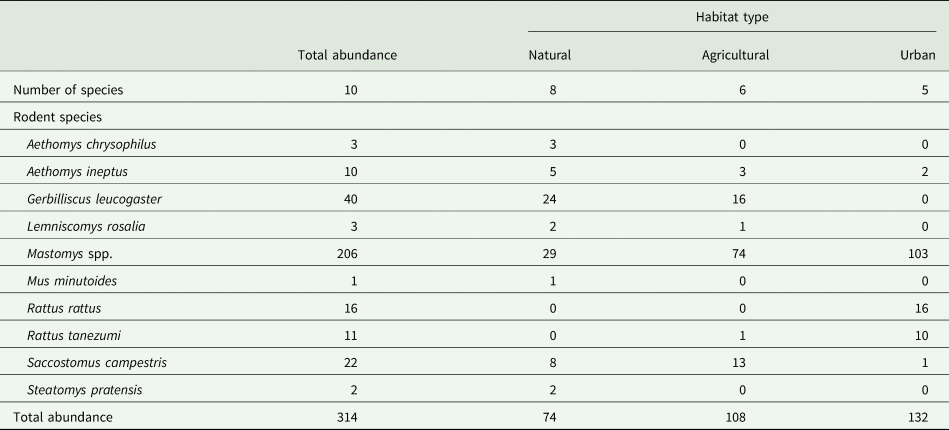
Rodents (n = 314), representing at least 10 species, were trapped across the three habitat types. Mastomys sp. was the most common host (Table 1). Although rodent species richness was the highest in the natural habitat (n = 8), the total abundance was the lowest (n = 74). In contrast, the urban habitat had the lowest number of rodent species (n = 5), but the highest rodent abundance (n = 132). Several rodent species were shared between the different habitat types (e.g. Aethomys ineptus and Mastomys sp.), while Rattus species were mainly associated with the urban habitat (Table 1). There was a slight variation in rodent abundances seasonally with higher abundances recorded in July/August 2014 and September 2015 (135 and 98 individuals, respectively) compared to January 2015 (81 individuals). The core species remained the same throughout the sampling period, with two satellite species (Mus minutoides and Steatomys pratensis) recorded in September 2015.
Rodent species and overall abundances in different habitat types across a wildlife–domestic animal/human interface in savanna biome, South Africa

Chigger mite diversity and parasitope preference
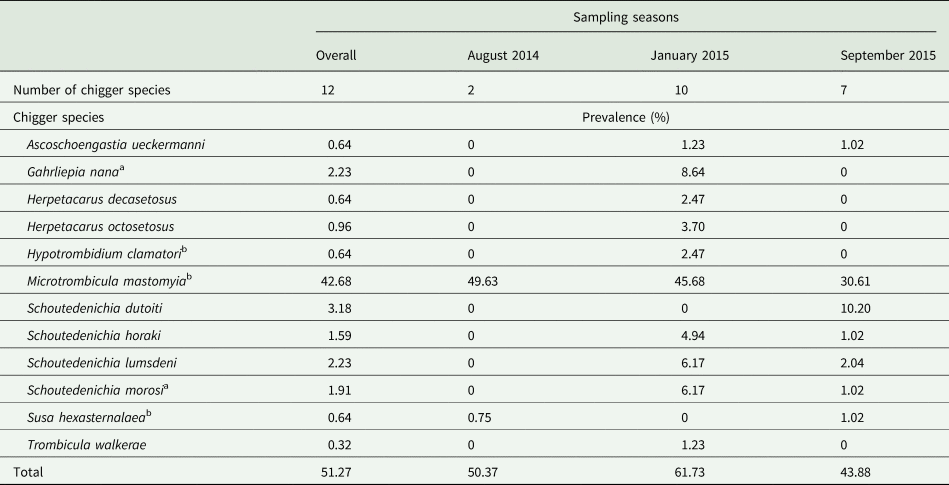
Twelve chigger species were recorded from 161 rodents (overall prevalence 51.27%) (Table 2). Seven species were known species of which four species have been recorded in South Africa before – Gahrliepia nana (Oudemans, 1910), Schoutedenichia dutoiti (Radford, 1948), Schoutedenichia lumsdeni Vercammen-Grandjean, Reference Vercammen-Grandjean1958 and Schoutedenichia morosi Vercammen-Grandjean, Reference Vercammen-Grandjean1958. Five species were recently described as new – Ascoschoengastia ueckermanni Stekolnikov and Matthee, Reference Stekolnikov and Matthee2019, Herpetacarus decasetosus Stekolnikov and Matthee, Reference Stekolnikov and Matthee2019, Herpetacarus octosetosus Stekolnikov and Matthee, Reference Stekolnikov and Matthee2019, Schoutedenichia horaki Stekolnikov and Matthee, Reference Stekolnikov and Matthee2019 and Trombicula walkerae Stekolnikov and Matthee, Reference Stekolnikov and Matthee2019 – and three were recorded in South Africa for the first time – Hypotrombidium clamatori (Vercammen-Grandjean and Langston, Reference Vercammen-Grandjean and Langston1976), Microtrombicula mastomyia (Radford, 1942) and Susa hexasternalaea (Vercammen-Grandjean, Reference Vercammen-Grandjean1960). Overall M. mastomyia was the most prevalent species (42.68%) followed by S. dutoiti (3.18%) (Table 2).
Chigger species richness and prevalence in different seasons across a wildlife–domestic animal/human interface in the savanna biome, South Africa

a New locality record.
b New country record.
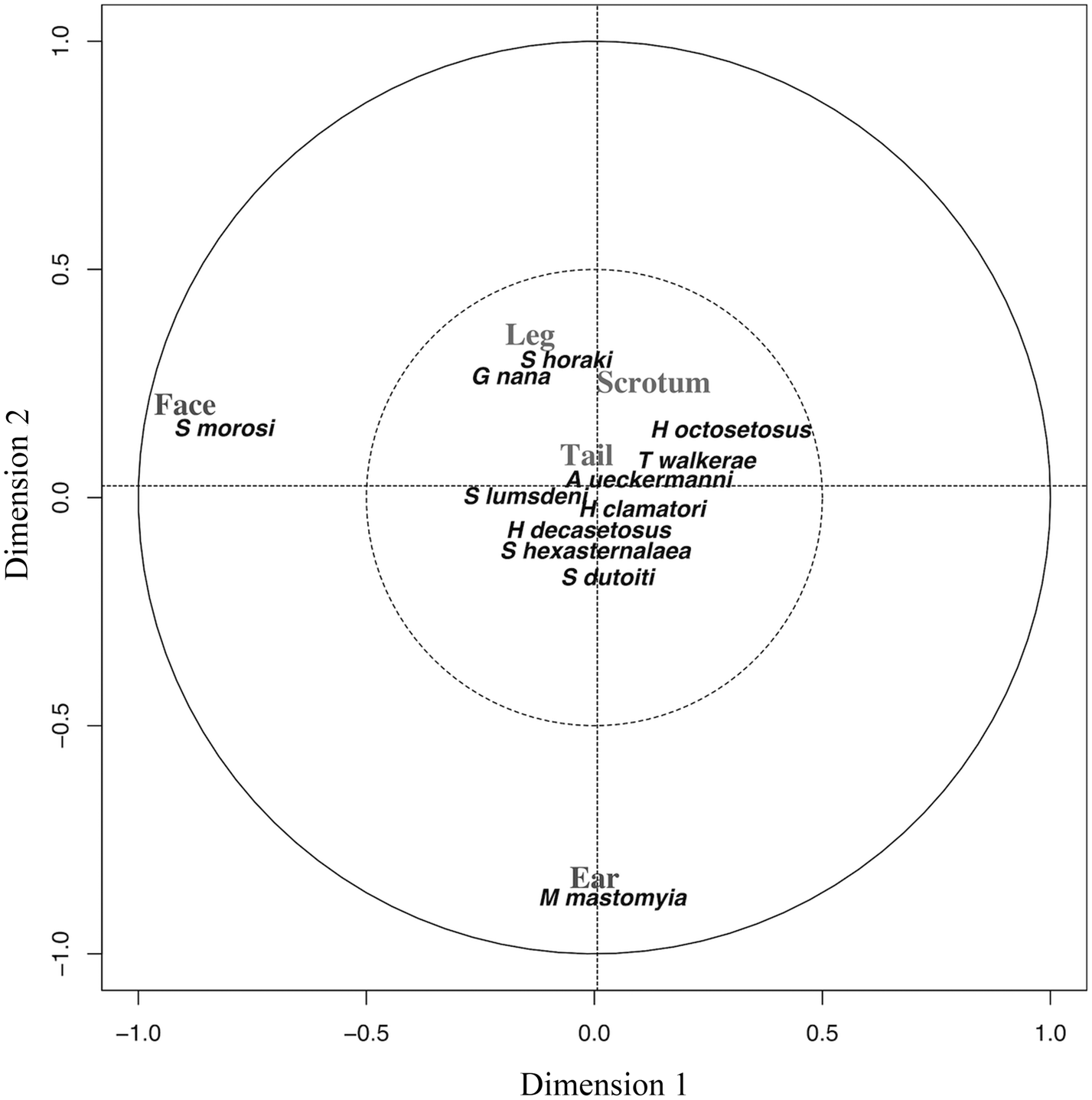
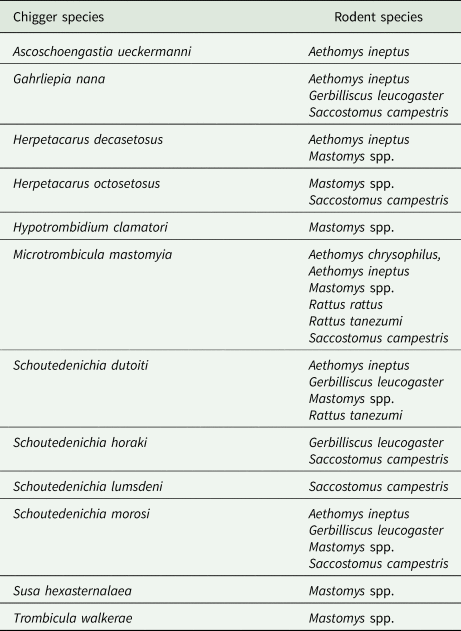
Multiple host species infestations were common with four of the chigger species (G. nana, M. mastomyia, S. dutoiti and S. morosi) recorded on three or more rodent species (Table 3). Chiggers were mainly associated with the ears of rodents (94.08%) of which the majority was found on the concha and helix of the external ear and to a lesser extent on the face, tail base and legs (each <4%). There was a significant association between the chigger community structure and the parasitope (Wilks L = 4.2 × 10⁻⁵, F = 71.40, d.f. = 91, P < 0.0001) (Fig. 1). The ear was the preferred attachment site for the dominant chigger species (M. mastomyia), while the face was preferred by one species (S. morosi). The tail base and front and hind legs were preferred by two species (G. nana and S. horaki, respectively), but without strong statistical support. The remainder of the chigger species did not show particular parasitope preference.
Representation of chigger species (in italic) and their parasitopes (in bold) on the plane defined by the first two canonical variates, with inside correlation circle of radius 0.5 (dot line) and outside correlation circle of radius 1.0 (continuous line). Canonical variables between the two circles showed high correlations (between 0.5 and 1.0).

Chigger species and the respective rodent species that they were recorded on in the savanna biome, South Africa

Chigger mite infracommunity structure
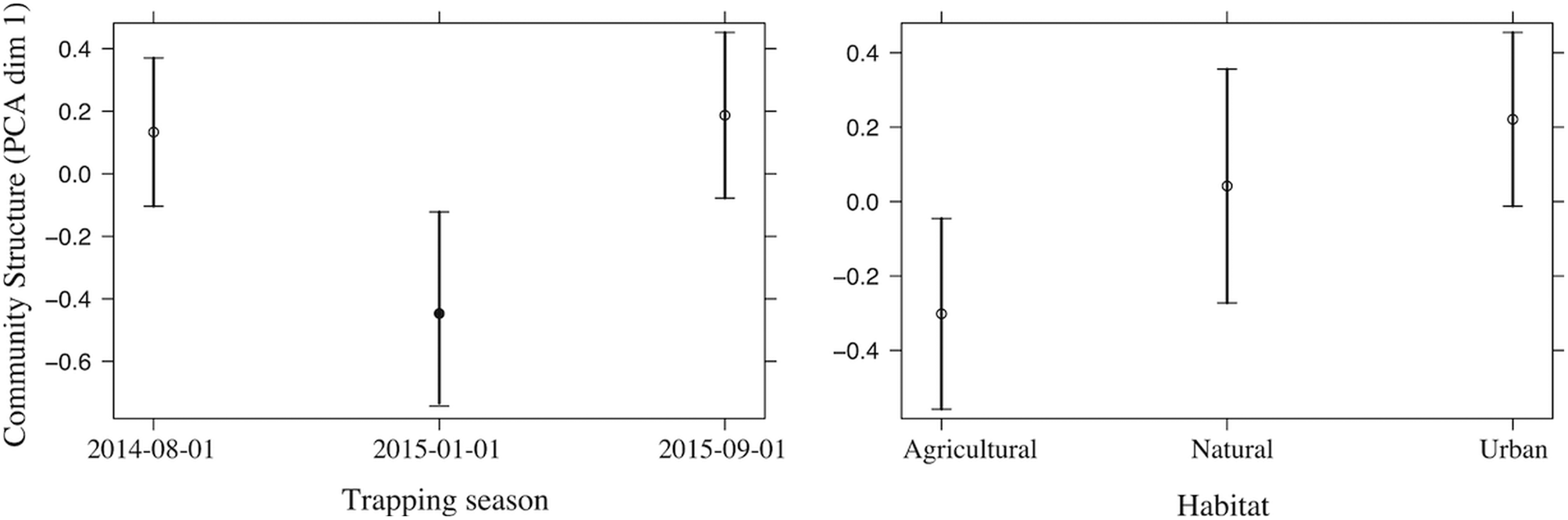
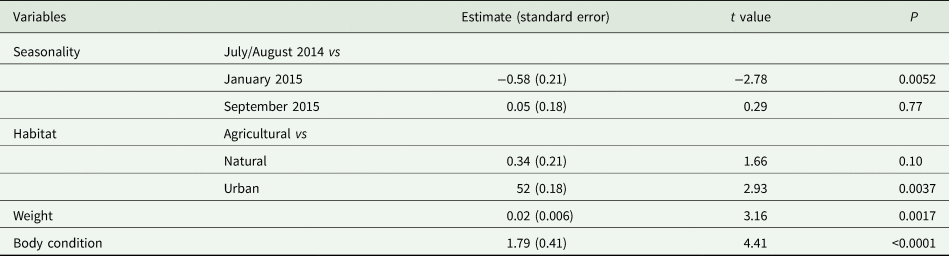
The best GLMM included seasonality, habitat, body weight and body condition as likely factors explaining the structure of chigger mite infracommunity (Table 4, Fig. 2). Chigger community structure was positively related to rodent weight and body condition (the latter, weight/body length) (Table 4). Microtrombicula mastomyia was the most prevalent species in each of the three sampling seasons (Table 2). The number of chigger species and overall prevalence were higher in January 2015 (10 species and 61.73%, respectively) compared to August 2014 (two species and 50.37%, respectively) and September 2015 (seven species and 43.88%, respectively) (Table 2).
Effects of seasonality (trapping season) and habitat on the structure of chigger mite infracommunity (using the first dimension of a PCA on the presence/absence of each chigger mite species on individual rodent) based on the first best GLMM with rodent species identity as a random factor (see Table 4).

Results of the first best GLMM with rodent species identity as a random factor, explaining the structure of chigger mite infracommunity (using the first dimension of a PCA on the presence/absence of each chigger mite species on individual rodent)

Explanatory variables Estimate (standard error), P Log likelihood, Residual deviance (degree of freedom) (null deviance = 631.87, d.f. = 312, AIC = 1071, Akaike weights = 0.808).
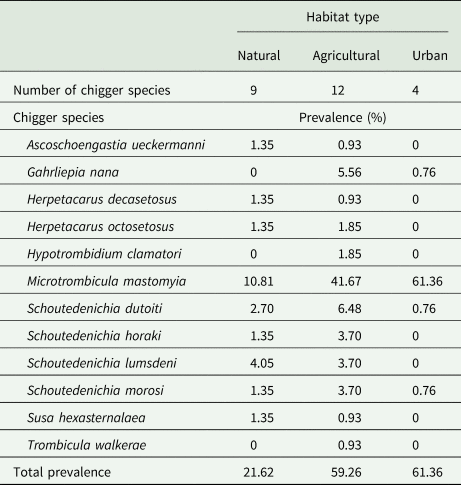
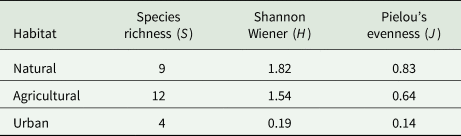
Three chigger species were shared between the three habitat types of which M. mastomyia was the most prevalent species in each habitat (Table 5). The largest number of chigger species (12) was recorded in the agricultural habitat type followed by the natural (nine) and urban habitats (four) (Table 5). This pattern was not supported by the prevalence data as the overall chigger prevalence was almost equally high in the urban and agricultural habitats (61.36 and 59.26%, respectively) and the lowest in the natural habitat (21.62%). Although the overall prevalence was comparable between the agricultural and urban habitats, the individual species prevalence values varied distinctly. Specifically, the urban habitat was dominated by M. mastomyia (61.36%), while the remaining three species occurred on <1% of the rodents. In contrast, although M. mastomyia was again the dominant species (41.67%) in the agricultural areas, five of the remaining 11 species occurred on ⩾3% of the rodents (Table 5). The patterns recorded above were supported by the diversity indices with Shannon Wiener (H) and Pielou's evenness (J) being higher in the agricultural habitat compared to urban. However, both indices were the highest in the natural habitat type (Table 6).
Chigger species richness and prevalence in different habitat types across a wildlife–domestic animal/human interface in the savanna biome, South Africa

Diversity indices of chigger species in different habitat types (natural, agricultural, urban) across a wildlife–domestic animal/human interface in the savanna biome, South Africa

Overall, co-occurrence of chigger species was only recorded on 11 rodent individuals (<4%) of which seven rodents harboured three chigger species and four rodents harboured two chigger species. Chigger co-occurrence varied over time and habitat type with nine of the rodents recorded in January 2015 and two in September 2015, while eight of the rodents were recorded in agricultural habitats compared to two in urban and one in natural habitats.
Discussion
The study recorded a diverse assemblage of chigger species that were represented by 12 species and eight genera. Five of the chigger species are new to science and were recently described (Stekolnikov and Matthee, Reference Stekolnikov and Matthee2019), while three other species are new records for South Africa. In Africa, the genus Ascoschoengastia was previously known from four species recorded in Zimbabwe, Tanzania and Djibouti (the latter in north-east Africa). The recently described A. ueckermanni represent the first record for this genus in South Africa (Stekolnikov, Reference Stekolnikov2018; Stekolnikov and Matthee, Reference Stekolnikov and Matthee2019). The genus Herpetacarus is well represented in South and southern Africa with 16 species recorded in the subregion (Vercammen-Grandjean, Reference Vercammen-Grandjean1966; Stekolnikov, Reference Stekolnikov2018). Several of these species were recorded on rodents, such as M. namaquensis and Otomys species in South Africa (Stekolnikov, Reference Stekolnikov2018). According to Zumpt (Reference Zumpt1961), the genus Schoutedenichia is well represented in Africa with much fewer species occurring outside the continent. This is supported by the fact that the genus currently comprises 62 African species of which most are reported from small mammals from Central Africa [Democratic Republic of the Congo (DR Congo), Rwanda and Central African Republic]. At present, six Schoutedenichia species are known from South Africa (Stekolnikov, Reference Stekolnikov2018). Outside Africa, three species are known from Australia (Domrow and Lester, Reference Domrow and Lester1985), 11 species from the Palaearctic (Kudryashova, Reference Kudryashova1998), seven from India (Fernandes and Kulkarni, Reference Fernandes and Kulkarni2003), four from South-East Asia, one from Polynesia and one from North America (Vercammen-Grandjean, Reference Vercammen-Grandjean1965b). The species T. walkerae represented the first record of the genus Trombicula sensu stricto in Africa. This genus was previously known only from South-East and South Asia, and in Australia (Stekolnikov and Matthee, Reference Stekolnikov and Matthee2019). Three of the remaining seven species present new country locality records: H. clamatori was previously recorded on a bird, the Jacobin Cuckoo (Clamator jacobinus) from Zimbabwe (Vercammen-Grandjean and Langston, Reference Vercammen-Grandjean and Langston1976). Microtrombicula mastomyia was previously known from Central and West Africa (Sierra Leone, Ivory Coast, DR Congo, Central African Republic, Cameroon and Ghana) where it has been recorded on 11 murid rodent species including the brown rat (Rattus norvegicus), black rat (R. rattus) and one soricomorph (Crocidura sp.) (Stekolnikov, Reference Stekolnikov2018). This species' broad host range is supported in the present study where M. mastomyia was recorded on six rodent species. Lastly, S. hexasternalaea was previously known only from its type locality in the DR Congo, where it was collected from the short-snouted elephant shrew (Elephantulus brachyrhynchus) (Vercammen-Grandjean, Reference Vercammen-Grandjean1960). The remaining four chigger species were previously recorded from South Africa, but mostly outside the savanna biome (Zumpt, Reference Zumpt1961; Stekolnikov, Reference Stekolnikov2018). Gahrliepia nana is known from the grassland biome in the central-eastern and eastern side of South Africa (Gauteng and Kwa-Zulu Natal) and was previously recorded on the common mole rat (Cryptomys hottentotus), lesser leaf-nose bat (Hipposideros caffer) and M. namaquensis (Zumpt, Reference Zumpt1961; Stekolnikov, Reference Stekolnikov2018). Schoutedenichia dutoiti was described from a single specimen found on S. campestris in the Albany thicket biome, close to Grahamstown, in the south-eastern part of the country (Zumpt, Reference Zumpt1961). Recently it was re-described using the holotype and our new material from Mpumalanga Province (the present study) (Stekolnikov et al., Reference Stekolnikov, Kessler, Matthee, Hasiniaina, Radespiel, Zimmermann and Durden2019). Schoutedenichia lumsdeni is known from the savanna biome at a locality close to the present study, where it was recorded on Paraxerus spp., most probably Paraxerus cepapi (tree squirrel) (Zumpt, Reference Zumpt1961; Skinner and Chimimba, Reference Skinner and Chimimba2005; Stekolnikov, Reference Stekolnikov2018). Lastly, S. morosi was previously recorded on the Cape gerbil (Gerbilliscus afra) and vlei rat (Otomys sp.) in the south-eastern grassland biome of Lesotho (Zumpt, Reference Zumpt1961; Stekolnikov, Reference Stekolnikov2018). Although Lesotho is an independent country, it is in its entirety imbedded within South Africa.
Chiggers often display parasitope preferences that can include the ears, face, nasal cavity and anus of rodents (Mohr, Reference Mohr1947; Nadchatram, Reference Nadchatram1970; Shatrov and Kudryashova, Reference Shatrov, Kudryashova, Morand, Krasnov and Poulin2006). In the present study, two chigger species (M. mastomyia and S. morosi) displayed a significant parasitope preference. The dominant species (M. mastomyia) was recorded on the concha and helix of the external ear of the rodents. This parasitope was also recorded for chiggers on Norway rats (R. norvegicus) from Southwest China (Guo et al., Reference Guo, Dong, Men, Qian, Wu, Ren, Qin, Song, Yang and Fletcher2016). In addition, Reeves et al. (Reference Reeves, Durden and Wrenn2004) recorded two Euschoengastia species (E. jamesoni and E. peromysci) from the ears of small mammal hosts in South Carolina, USA. In South Africa, this parasitope was recorded previously for chiggers on the Namaqua rock mouse (M. namaquensis) in the savanna biome (Fagir et al., Reference Fagir, Ueckermann, Horak, Bennett and Lutermann2014; D. Fagir, personal communication). Although several of the other chigger species (A. ueckermanni, H. decasetosus, H. octosetosus, H. clamatori, M. mastomyia, S. dutoiti, S. lumsdeni, S. hexasternalaea and T. walkerae) were also recorded on the external ear, there was no strong statistical support for this pattern, which may be attributed to small sample sizes or multiple attachment sites. Chiggers are morphologically small with minute cheliceral blades (movable digits of the cheliceral) that they use to attach to the skin of the host (e.g. cheliceral blade lengths range from 24 μm in S. horaki to 35 μm in A. ueckermanni in the present study). In addition, the length of the stylostomes (a feeding tube that naturally develops in the host skin during feeding) is also microscopic with records of 300–350 μm for Kepkatrombicula desaleri from chamois (Rupicapra rupicapra) in the European Alps (Shatrov and Stekolnikov, Reference Shatrov and Stekolnikov2011) and 926 μm for Trombicula sensu lato from Ord's kangaroo rats (Dipodomys ordii) in Utah, USA (Allred, Reference Allred1954). Given their small attachment appendages, it would be reasonable to suggest that chiggers prefer to attach to body regions with a thin horny layer (the stratum corneum layer of the epidermis) (Weedon, Reference Weedon2010). Avoiding removal through grooming activities is another important factor that may influence chigger parasitopes preference (Goff, Reference Goff1979). For example, biting lice tend to attach their eggs to inaccessible body regions, such as the head, back and tail, on pigeons (Nelson and Murray, Reference Nelson and Murray1971). In the present study S. morosi was associated with the rodent face, while G. nana was recorded on the tail base of rodents. Both these parasitopes have been recorded for chiggers in previous studies (Reeves et al., Reference Reeves, Durden and Wrenn2004; Fagir et al., Reference Fagir, Ueckermann, Horak, Bennett and Lutermann2014; Barnard et al., Reference Barnard, Krasnov, Goff and Matthee2015). Compared to fleas, chiggers are less mobile on the host and they readily attach to the skin of the host after they access its body (Nadchatram, Reference Nadchatram1970). It is possible that the rodent ear, face and tail base are less accessible for grooming (Goff, Reference Goff1979; Barnard et al., Reference Barnard, Krasnov, Goff and Matthee2015), which facilitates chigger survival (Waage, Reference Waage1979; Murray, Reference Murray1987).
The prevalence of individual chigger species varied on rodents with M. mastomyia being the most prevalent species (42.68%) and that of the remaining 11 chigger species ranging between 3.18 and 0.32%. A high dominance of a few species appears to be a common pattern for chiggers (Zhan et al., Reference Zhan, Guo, Speakman, Zuo, Wu, Wang and Yang2013). This pattern is supported by individual chigger species prevalence that ranged from 90.4 to 3.9% on small mammals in Thailand (Chaisiri et al., Reference Chaisiri, Stekolnikov, Makepeace and Morand2016) and 67.8 to 0.1% on rodents in South Korea (Choi et al., Reference Choi, Lee, Kang, Yang, Song, Shin and Kwon2017). The high dominance of M. mastomyia in the present study may be due to its adaptability to different conditions as it was recorded in all three seasons and habitat types and had the largest host range (recorded on six rodent species) of all the chigger species. This pattern is supported by the fact that M. mastomyia is widely distributed in Central and West Africa where it occurs on numerous rodent species (Stekolnikov, Reference Stekolnikov2018). It is also interesting to note that, in the present study, single species infestations were present on more than 95% of the rodents, with a maximum of three chigger species co-occurring. Species co-occurrences were mainly restricted to the species-rich trap session (January 2015) and habitat type (agriculture). This pattern may be explained by the high dominance of M. mastomyia (relative prevalence of 82.20%) and the low relative prevalence of the remaining chigger species (range from 0.61% for T. walkerae to 6.13% for S. dutoiti).
Although not the focus of the study, a significant positive relationship was recorded between chigger community structure and rodent weight and body condition. This is not unexpected as adult animals are generally heavier and tend to move around more to find food. Mobile animals will more readily come into contact with parasites, such as chiggers, in the environment (Sasal et al., Reference Sasal, Morand and Guégan1997; Stekolnikov, Reference Stekolnikov2002; Teitelbaum et al., Reference Teitelbaum, Huang, Hall and Altizer2018).
Although a restricted short-term sampling approach is inappropriate for studying seasonal variation in chigger communities, it is apparent from the study that chigger communities varied between the sampling sessions with a significantly larger number of chigger species in summer (January 2015) compared to late winter (July/August 2014) and spring (September 2015). South Africa generally has a distinct seasonal variation in climatic conditions with wet and warm summers and dry and mild winters typical for the north-eastern part of the country (Rutherford et al., Reference Rutherford, Mucina, Powrie, Mucina and Rutherford2006). An increased occurrence of chiggers in summer has previously been recorded in South Africa and elsewhere (e.g. Clopton and Gold, Reference Clopton and Gold1993; Klukowski, Reference Klukowski2004). In particular, Malan (Reference Malan2015) recorded significantly higher chigger prevalence on R. pumilio in summer (warm and dry conditions) in the fynbos biome, while Fagir et al. (Reference Fagir, Ueckermann, Horak, Bennett and Lutermann2014) recorded higher abundance and prevalence of chiggers on M. namaquensis in the grassland biome (warm and wet conditions). In addition, chigger abundances were also higher in summer on the insectivore E. myurus in the grassland biome (Fagir et al., Reference Fagir, Horak, Ueckermann, Bennett and Lutermann2015). This pattern may be due to a combination of more favourable temperatures and the availability of food resources for predatory life stages (nymph and adult) and parasitic larvae. Trombiculid mites spend a short part of their life cycle (days to weeks) as parasitic larvae on hosts. The rest of the life stages are free-living with nymphs and adults feeding on soft-bodied arthropods (e.g. Collembola) or eggs of small arthropods (e.g. mosquitoes, Drosophila spp. and beetles) (Wharton, Reference Wharton1946; Sasa, Reference Sasa1961; Nadchatram, Reference Nadchatram1970). The duration of their life cycle is species-specific, but it is normally around 2–3 months in warmer climates (e.g. tropics and sub-tropics) (Traub and Wisseman, Reference Traub and Wisseman1968; Nadchatram, Reference Nadchatram1970). The abundance and diversity of adult mosquitoes generally increase in spring with peak abundance in summer (November to December) (Maharaj et al., Reference Maharaj, Raman, Morris, Moonasar, Durrheim, Seocharan, Kruger, Shandukani and Kleinschmidt2013). This is specifically so for the Anopheles gambiae species complex, the most widespread and abundant species complex in the north-eastern savanna of South Africa (Munhenga et al., Reference Munhenga, Brooke, Spillings, Essop, Hunt, Midzi, Govender, Braack and Koekemoer2014). In addition, the wet season is the main time for the decomposition of litter and when soil fauna such as Collembola are active (Reddy and Venkataiah, Reference Reddy and Venkataiah1990). Summer is also the main breeding season of most rodent species in southern Africa (Skinner and Chimimba, Reference Skinner and Chimimba2005) and particularly the dominant rodent genus (Mastomys) in the present study (Massawe et al., Reference Massawe, Mulungu, Makundi, Dlamini, Eiseb, Kirsten, Mahlaba, Malebane, Von Maltitz, Monadjem, Taylor, Tutjavi and Belmain2011).
Chigger communities were significantly affected by habitat type. In particular, chigger species richness, diversity and evenness were lower in urban habitats compared to agricultural or natural habitats. In the urban habitat, only four chigger species were recorded and the dominance of M. mastomyia was more pronounced (lowest evenness value). As mentioned above, M. mastomyia is a highly adaptable species and opportunistic species are often able to take advantage of conditions associated with anthropogenic transformed habitats (Pardini et al., Reference Pardini, Nichols, Püttker, Dellasala and Goldstein2018). There are several factors that may facilitate this pattern. Most of the properties, in the villages, had outdoor kitchens, grain stores, woodpiles and uncontained refuge. These living conditions may have facilitated the higher rodent abundance (n = 132) and the presence of Rattus species (n = 26). It is also interesting to note that the Rattus species were only infested with the two most abundant chigger species (M. mastomyia and S. dutoiti). The presence of dogs and chickens on these properties may have also contributed to the incidence of chiggers as dogs are known hosts for chiggers (Apesteguía et al., Reference Apesteguía, Portell, Kassab and Salinas2019) and chiggers have been recorded previously on chickens (Kitaoka et al., Reference Kitaoka, Asanuma and Otsuji1976). Further, the storage of water in open containers next to houses and the presence of grain stores, small vegetable patches and ‘kraal’ (small fenced area where goats and cattle are kept at night) may provide ideal microhabitats for small arthropods such as mosquitoes, beetles and flies, which can serve as food for free-living trombiculid mites. For example, the mosquito species A. gambiae sensu stricto is commonly associated with human dwellings (Kweka et al., Reference Kweka, Zhou, Munga, Lee, Atieli, Nyindo, Githeko and Yan2012). As a result, adult females readily use micro-habitats close to houses and especially prefer temporary, small and shallow water bodies such as hoof prints and water puddles to lay eggs (Mutuku et al., Reference Mutuku, Bayoh and Gimnig2006; Kweka et al., Reference Kweka, Zhou, Munga, Lee, Atieli, Nyindo, Githeko and Yan2012). In addition, grain stores provide food for various small arthropods such as weevils and beetles (see Singh and van Emden, Reference Singh and van Emden1979). In the present study, the largest number of chigger species (12 species) were recorded in the agricultural habitat, while the highest chigger diversity (H = 1.82) and evenness value (J = 0.83) were recorded in the natural habitat. Heterogeneous habitats are often characterized with high diversity (Cramer and Willig, Reference Cramer and Willig2005), which supports the pattern that we found for the natural habitat type. Although the agricultural habitat, in the present study, was transformed, the extent of the transformation and the composition of the surrounding matrix will influence the impact on animal communities (Pardini et al., Reference Pardini, Nichols, Püttker, Dellasala and Goldstein2018). In the present study, agricultural habitats were characterized by small (<0.25 hectare) seasonal crop fields (planted with maize and peanut plants) that were enclosed with shrubs or dead branches (for protection). Further, crop fields were located on the outskirts of the individual villages and often in close proximity to seasonal rivers and natural vegetation. In fact, as stated above, the agricultural habitat type acted as the interface between the natural and urban habitat type. Based on this, it is possible that the landscape in the agricultural habitat was relatively heterogeneous. The availability of alternative food resources and shelter benefited rodent hosts (total rodent abundance of 108 compared to 74 for natural habitat). This pattern is supported in a study by Froeschke et al. (Reference Froeschke, van der Mescht, McGeoch and Matthee2013) that recorded a higher relative abundance and greater body length for R. pumilio individuals in remnant fragments of an agricultural mosaic in South Africa (also see Froeschke and Matthee, Reference Froeschke and Matthee2014). In addition, birds and specifically ground-living birds in South Africa (e.g. francolin and guineafowl) are able to adapt to agricultural areas that have heterogeneous habitats (Goijman et al., Reference Goijman, Conroy, Bernardos and Zaccagnini2015; van Niekerk, Reference Van Niekerk2017). Ground-living birds are also common hosts for chiggers (Kitaoka et al., Reference Kitaoka, Okubo, Asanuma and Otsuji1972; Kaluz et al., Reference Kalúz, Hung, Čapek and Literák2016) and can therefore facilitate the occurrence of chigger species within the agricultural habitat type. Further, the agricultural habitat may also provide food resources to predatory nymph and adult trombiculid mites through the presence of Collembola (Janion, Reference Janion2013; Leinaas et al., Reference Leinaas, Bengtsson, Janion-Scheepers and Chown2015) and mosquito species (Kweka et al., Reference Kweka, Zhou, Munga, Lee, Atieli, Nyindo, Githeko and Yan2012) that are associated with agricultural habitats.
The study highlights the chigger diversity associated with rodents in South Africa and provides a basis for future studies in this neglected field. In support of previous studies, the distribution of chigger species was structured with a significant preference for the ear and face. It is evident that local-scale environmental factors play an important role in shaping chigger communities.
Supplementary material
The supplementary material for this article can be found at https://doi.org/10.1017/S0031182020000748
Acknowledgements
The authors wish to thank the staff at Manyeleti Reserve and community leaders for permitting us to conduct fieldwork in the reserve and community. The project would not have been possible without the support from the Environmental Monitors, working within the villages, several postgraduate students and fellow researchers; in particular, Jeanette Wentzel, Marinda Oosthuizen, Luis Neves and Armanda Bastos (Pretoria University, South Africa), Carolina Vicario (University of California, Davis, USA), Darryn Knobble (Ross University, St Kitts) and Conrad Matthee (Stellenbosch University, South Africa) are thanked for technical support.
Financial support
This work was funded by the Russian Foundation for Basic Research (grant number 16-04-00145-a, to A. A. Stekolnikov) and the Ministry of Science and Higher Education of the Russian Federation, project ‘Development of the modern basis for the taxonomy and phylogenetics of parasitic and bloodsucking arthropods’ (State Registration number АААА-А19-119020790133-6, to A. A. Stekolnikov). Further, funding was also provided by Stellenbosch University and the South African National Research Foundation (NRF), GUN 85718 (to S. Matthee). Any opinion, finding and conclusion or recommendation expressed in this material is that of the authors and the NRF does not accept any liability in this regard.
Conflict of interest
None.
Ethical standards
The project was approved by Mpumalanga Tourism and Parks Agency (permit number ES 5/14), Department of Agriculture, Forestry and Fisheries (Reference number 12/11/1/7/5) and the Animal Ethics Committees of Stellenbosch University (Reference number SU-ACM11-00004) and Pretoria University (Reference number V046-14).