INTRODUCTION
Stroke is a focal neurological disorder of abrupt development due to a pathological process in blood vessels and is the most common cerebrovascular disease that causes brain damage (Donaghy, Reference Donaghy2009). The two main types are ischemic and hemorrhagic strokes (Lezak, Reference Lezak2012). A stroke caused by lack of blood reaching part of the brain due to the obstruction of blood vessels is called an ischemic stroke. Hemorrhagic stroke is either a brain aneurysm burst or a weakened blood vessel leak, where blood spills into or around the brain and creates swelling and pressure, damaging cells and tissue in the brain (Sacco et al., Reference Sacco, Kasner, Broderick, Caplan, Connors, Culebras and Vinters2013).
Stroke stages of evolution are classified following different criteria (e.g. duration of illness or rehabilitation process). The duration of illness criterion establishes (i) acute phase in the first week after stroke, (ii) sub-acute phase in the second to the fourth weeks after stroke, (iii) post-acute phase from the first to the sixth month after stroke, and (iv) chronic phase more than six months after stroke onset (Bouffioulx, Thonnard, Arnould & Vandervelde, Reference Bouffioulx, Thonnard, Arnould and Vandervelde2010; Elsner, Kugler, Pohl & Mehrholz, Reference Elsner, Kugler, Pohl and Mehrholz2013). The rehabilitation process criterion proposes (i) acute stage, which comprises the initial period of hospitalization in specialized units to manage cerebrovascular disease under the direction of neurologists, (ii) post-acute stage, where patients who survive the acute phase of stroke achieve neurological stabilization of their condition, and (iii) chronic stage where the objectives are the optimal reinsertion at family, social and work levels (Moyano, Reference Moyano2010). In the present study, post-acute stage was defined as 2–6 months post-stroke (including in-patient and out-patient rehabilitation phases), while chronic stage was defined as >12 months post-stroke (during in-home phase).
Stroke patients may suffer cognitive impairment with alteration of behavioral regulation (Teasell & Hussein, Reference Teasell and Hussein2016), including decreases in attention, memory, and executive function (Ma, Chan & Carruthers, Reference Ma, Chan and Carruthers2014). The severity of lesion and the location of brain injuries caused by the stroke may play prominent roles in the recovery process. However, it is not possible to make prognoses based just on these factors since clinical practice shows high inter-individual variability in post-stroke recovery. This inter-individual disparity could be explained through the reserve construct (Stern, Reference Stern2009; Umarova, Reference Umarova2017).
The construct of reserve is generally explained through two theoretical models: brain reserve and cognitive reserve (CR). The brain reserve or passive model proposes that people can assume a certain level of brain damage, past which symptoms would be manifest (Satz, Reference Satz1993). In this model, the brain’s potential to cope with brain damage is based on anatomical measurements (e.g. cerebral volume, cranial circumference, or brain-ventricle ratio). CR or active model refers to the influence of exposure to daily life events and environmental factors which shape network efficiency, processing capacity, and flexibility (Barulli & Stern, Reference Barulli and Stern2013; Stern, Reference Stern2002). This active model is subdivided in two components: neural reserve and neural compensation (Stern, Reference Stern2016). Neural reserve comprises pre-existing processes, networks more likely to withstand harm without altering function because they are more effective or have greater capacity. Neural compensation comprises alternative circuits that help to maintain dexterity in the execution of daily actions in the presence of brain damage.
CR is a hypothetical construct and many CR proxies have been proposed. These measures include different types of data that may be considered static or dynamic. Static proxy measures are objectively verifiable data with the potential to remain stable over a period of time. In contrast, dynamic proxy measures are more subjectively gauged, with greater potential for variability over the same time frame, including various forms of participation in cognitively stimulating hobbies and leisure activities (Malek-Ahmadi et al., Reference Malek-Ahmadi, Lu, Chan, Perez, Chen and Mufson2017). Dynamic proxies are usually measured through frequency questionnaires of participation in such activities.
There are many studies of CR in Alzheimer’s disease (AD), where education and occupation are the main CR proxies (Valenzuela & Sachdev, Reference Valenzuela and Sachdev2006). It has been considered that these proxies foster new cognitive strategies (Jones et al., Reference Jones, Manly, Glymour, Rentz, Jefferson and Stern2011). Sánchez, Rodríguez and Carro (Reference Sánchez, Rodríguez and Carro2002) found that these proxies had a protective role in patients with AD. Similar results have been observed in other AD studies (Garibotto et al., Reference Garibotto, Borroni, Kalbe, Herholz, Salmon, Holtoff and Perani2008; Stern, Reference Stern1994; Stern, Albert, Tang & Tsai, Reference Stern, Albert, Tang and Tsai1999) and also in Parkinson’s disease (Hindle, Martyr & Clare, 2010). CR has been explored in traumatic brain injury too, finding positive effects of years of education on recovery of cognitive functions (Kesler, Adams, Blasey, & Bigler, Reference Kesler, Adams, Blasey and Bigler2003; Schneider et al., Reference Schneider, Sur, Raymont, Duckworth, Kowalski, Efron and Stevens2014; Sumowski, Chiaravalloti, Krch, Paxton, DeLuca, Reference Sumowski, Chiaravalloti, Krch, Paxton and DeLuca2013). Alosco et al. (Reference Alosco, Mez, Kowall, Stein, Goldstein, Cantu and McKee2017) studied patients with chronic traumatic encephalopathy and found that occupational attainment complexity predicted later age at cognitive deficit onset. Literature shows positive effects of education in stroke recovery (Elkins et al., Reference Elkins, Longstreth, Manolio, Newman, Bhadelia and Johnston2006), cognitive change after stroke and transitory ischemic attack (Sachdev et al., Reference Sachdev, Brodaty, Valenzuela, Lorentz and Koschera2004) and favorable post-stroke survival in mild to moderate ischemic stroke (Ojala-Oksala et al., Reference Ojala-Oksala, Jokinen, Kopsi, Lehtonen, Luukkonen, Paukkunen and Oksala2012). Zieren et al. (Reference Zieren, Dueringa, Peters, Reyes, Jouvent, Hervéc and Dichgansd2013) focused on the importance of lesion severity, pointing to education as a predictor of better cognitive performance but only in those cases with low or moderate severity.
There are also many studies of dynamic proxies of CR in different pathologies. Participation in leisure activities is positively related to better cognitive functioning in patients with multiple sclerosis (Sumowski et al., Reference Sumowski, Chiaravalloti, Krch, Paxton and DeLuca2013) and AD (Bennett, Schneinder, Tang, Arnold & Wilson, Reference Bennett, Schneider, Tang, Arnold and Wilson2006), and is associated with reduced risk of developing dementia (Scarmeas, Levy, Tang, Many & Stern, Reference Scarmeas, Levy, Tang, Manly and Stern2001). One study focused on CR dynamic proxies and stroke (Verghese et al., Reference Verghese, Wang, Katz, Sanders and Lipton2009) found that participation in cognitive leisure activities was associated with reduced risk of vascular cognitive impairment in older adults.
In summary, prior studies support the notion that higher scores on CR proxy measures (whether static or dynamic) are generally associated with better cognitive performance. However, while CR has been widely explored in dementia, just a few studies have explored CR in acquired brain injury (Nunnari, Bramanti & Marino, Reference Nunnari, Bramanti and Marino2014).
The main objective of the present study was to investigate the relationship between CR and cognitive change over different stages of stroke. We have recruited 34 chronic stroke patients that were transferred to the neurorehabilitation hospital, Institut Guttmann, after the acute phase of stroke. They have been studied retrospectively when they were in post-acute stage (2–6 months, post-stroke) and after recruitment, in chronic stage (>12 months post-stroke). CR has been estimated through proxy measures previously published in the literature (static proxies: years of formal education and occupation attainment; dynamic proxies: engagement in cognitively stimulating activities). Because it is thought that different proxy measures of CR may have independent impacts on rehabilitation (Stern, Reference Stern2006), we chose to study them separately. In addition, we will separate dynamic proxy measurements referring to the time before the stroke (“pre-stroke cognitive reserve” or Pre-CR) from those referring to chronic stage of stroke (“post-stroke cognitive reserve” or Post-CR).
Cognitive function has been evaluated through information from medical records (neuropsychological assessments done at hospital admission and discharge) and through a neuropsychological assessment following recruitment to the study. The main goal was to study dynamic proxy measures before and after stroke onset and compare relationships if any between Pre- and Post-CR graded scales and static proxy measures with cognitive change in post-acute and chronic stages. We tested the following hypotheses: (1) the frequency of activities assessed by dynamic proxies of CR decreases as a result of stroke; (2) higher pre-CR and static proxy measures correlate with rate of cognitive change after stroke in post-acute and chronic stages; (3) higher post-CR and static proxy measures correlate with better cognitive performance in patients with chronic stage stroke.
To the best of our knowledge, this is the first study that separates pre-stroke CR from post-stroke CR, and the first to include both static and dynamic proxies of CR to explore the relationship between them and cognitive change after stroke.
METHOD
Participants
At Institut Guttmann, a neurorehabilitation hospital, a review was carried of clinical records of patients who had an ischemic or hemorrhagic stroke between August 2014 and August 2016. Those who met the inclusion criteria were selected as candidates for recruitment.
Inclusion criteria were (1) age over 18 years old, (2) to have a diagnosis of first-ever stroke, (3) to be in chronic stage of evolution at the moment of recruitment (>12 months after stroke), and (4) cognitive impairment was diagnosed by neuropsychological assessment upon hospital admission. Exclusion criteria were (1) diagnosis of aphasia, (2) to be suffering any psychiatric condition, or (3) history of substance abuse.
Thirty-four former patients from Institut Guttmann (15 women) between the ages of 28 and 64 years (
 ${{{x}}} = 49.7$
; σ = 8.16) diagnosed with stroke (hemorrhage = 17; ischemic = 17) were recruited. At the time of stroke, patients were between 26 and 62 years old (
 ${\acute{\acute{x}}} = 47.5$
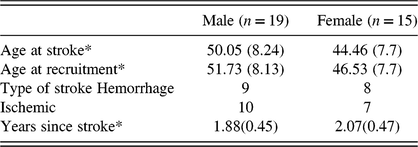
; σ = 8.37; <50 = 20, >50 = 14). See Table 1 for distribution of sample demographics. All participants gave informant consent and were able to understand the implications of the study.
Distribution of the sample

* Data expressed as mean years and deviation.
All recruited patients were initially assessed with a neuropsychological battery upon admission to the rehabilitation hospital (
 ${\acute{\acute{x}}} = 1.5$
months of evolution; σ = 0.83), at the time of hospital discharge (
 ${\acute{\acute{x}}} = 5.9$
months of evolution; σ = 2.1) and they were assessed again at the time of participating in the study (
 ${\acute{\acute{x}}} = 23.9$
months of evolution; σ = 5.7).
The study was approved by the Institute Guttmann’s Research and Innovation Committee and the Ethics Committee. The study was conducted in accordance with the Declaration of Helsinki (World Medical Association Declaration of Helsinki, 2013).
Procedure
Recruitment included postal, email, and telephone contact of participants. Out of the 91 people contacted, 45 declined to participate, 41 accepted but 7 had to be excluded. Data were obtained from patients’ medical records and collected in person during interview, using questionnaires and neuropsychological tests (see Figure 1).
Study flow. NPS assessment: Neuropsychological assessment.

Measures
Cognitive reserve static proxies
Education was operationally defined as self-reported years of education (< 8 years – primary education n = 11, 8–12 years – compulsory secondary education and Bachillerato n = 17, >12 years – University education n = 6), according to the structure of the education system in Spain (eacea.ec.europa.eu, 2013). Occupation complexity was operationally defined as level of occupation according to the National Catalogue of Professional Qualifications of Spain (Incual.mecd.es, 2018) (low n = 6, medium n = 17 and high n = 11).
Cognitive reserve dynamic proxies
Cognitive Reserve Scale (CRS) (León, García-García & Roldán-Tapia, Reference León, García-García and Roldán-Tapia2014) has been used to compile information of the frequency with which patients do or used to do reserve related activities identified in literature as dynamic proxies. To focus on frequency of participation in lifetime activities, we applied CRS, a measurement scheme previously validated in the Spanish population (León, García-García & Roldán- Tapia, Reference León, García-García and Roldán-Tapia2011). CRS measures testimonial and remembered accounts of participation across 24 items grouped into four domains: activities of daily living (ADLs), training/formation, hobbies, and social life. In its original version, CRS aims to obtain a measure of reserve focused on healthy adults throughout different stages of life. In the present study, the same items were applied but participants were asked to indicate how often they used to engage in these activities before stroke onset (CRS pre-stroke) and how often they engage nowadays at the chronic stage of the stroke (CRS post-stroke). Therefore, “Pre-CR” represents CRS pre-stroke and “Post-CR” represents CRS post-stroke. The answers were scored in a range from 0 (“never”) to 4 (“whenever it is possible”) and the total score was based on the sum of all the answers for each patient.
Neuropsychological Assessment
Performance-based measures
All participants were evaluated at the time of admission in the neurorehabilitation hospital (pre-treatment assessment) and at discharge (post-treatment assessment), with a neuropsychological battery. The same battery was applied to conduct the chronic stage assessment. We ran confirmatory factorial analysis using cfa() function of “R” (Rosseel, Reference Rosseel2018) and we identified three cognitive factors from the battery tests (the methods to do this are further explained below in “Confirmatory Factorial Analysis”):
Attention factor (AT factor): Trail Making Test A (Tombaugh, Reference Tombaugh2004), reported as the number of seconds required to complete the task; therefore, higher scores mean worse performance. Digit Span forward subtest from WAIS-III (scored from 0 to 9) (Wechsler, Reference Wechsler1997) which assesses attention span and where higher scores mean better performance.
Memory factor (M factor): Sub-scores from RAVLT (Schmidt, Reference Schmidt1996), which assesses rate of learning (scored from 0 to 75 words), long-term verbal memory and verbal recognition (both scored from 0 to 15), where higher scores mean better performance.
Executive functions (EF) factor: PMR test (a Spanish version of FAS test) (Fortuny, Reference Fortuny1999) which assesses phonological verbal fluency (scored as amount of words generated) and Digit Span backward (scored from 0 to 8) and Letter Number Sequencing (scored from 0 to 21) from WAIS-III, which assess verbal working memory.
Since three temporal moments have been studied (admission, discharge, and chronic stage) three cognitive factors were created for each moment in order to study cognitive change. Change in cognitive factors was obtained calculating the difference of grades in cognitive factors between discharge and admission and between chronic stage and discharge.
Self-rating scales applied in chronic stage of stroke
In addition to the neuropsychological assessment, we assessed self-rating measures to recover information about how participants perceived their performance in daily life in chronic stage of stroke.
Functional disability was measured using the Patient Competency Rating Scale (PCRS) (Prigatano & Fordyce, Reference Prigatano and Fordyce1986) which comprises 30 items, spanning a range of everyday situations and behaviors, and for each item, the patient must make judgments about their own level of competency. The scores range from 1 (“I cannot do it”) to 5 (“I can do it easily”). Additionally, the Community Integration Questionnaire (CIQ) (Willer, Rosenthal, Kreutzer, Gordon & Rempel, Reference Willer, Rosenthal, Kreutzer, Gordon and Rempel1993) was used, a self-rating scale developed to measure community integration that comprises three subscales (home integration, social integration, and productive activities) The scores range from 0 to 29; a high score indicates greater integration, and a low score reflects less integration.
Also, the following self-rating questionnaires were applied to measure frequency of subjective cognitive complaints: Rating Scale for Attentional Behavior (Ponsford & Kinsella, Reference Ponsford and Kinsella1991) measures frequency of attentional difficulties in daily routines and the scores ranges from 0 (“never”) to 4 (“always”); Prospective and Retrospective Memory Questionnaire (Crawford, Smith, Maylor, Della Sala & Logie, Reference Crawford, Smith, Maylor, Della Sala and Logie2003) evaluates prospective and retrospective memory in the short and long term, with a score range from 1 (“never”) to 5 (“always”); and Behavior Rating Inventory of Executive Function – Adult Version (Roth, Isquith & Goia, Reference Roth, Isquith and Goia2005) assesses frequency of difficulties related to executive functions in day-to-day activities. This questionnaire uses a three-point Likert scale (1 = behavior is never observed to 3 = behavior is often observed).
Analysis
Mean differences in performance-based and self-rating scores, and between CRS-Pre stroke and CRS-Post stroke were examined using Wilcox test. To study the relationship between CR variables (dynamic and static) and neuropsychological assessments we used Pearson correlation coefficient r and Kruskal–Wallis test. CRS domains in Pre-stroke and Post-stroke forms have been studied separately. Cohen’s d has been used to measure effect size when comparing mean differences with Wilcox test (d = 0.2 is considered a small effect size, d = 0.5 moderate effect size and d = 0.8 strong effect size) (“Effect sizes”, 2018). Epsilon squared (ε 2) estimate has been used to calculate effect size in Kruskal–Wallis tests (ε 2 = 0.04 weak, ε 2 = 0.25 moderate, ε 2 = 0.36 −0.64 strong) (Ferguson, Reference Ferguson2009). Since our analysis implied multiple comparisons, we used FDR (“False Discovery Rate”) correction. Hence, p < 0.05 defined statistical significance. We used “R” (R Core Team, 2018) for statistical analyses.
Confirmatory factorial analysis was carried out using lavaan cfa() version 0.6–2 function of “R” (Rosseel, Reference Rosseel2018). We used full-information maximum likelihood (FIML) for the missing data. We standardized the latent factors, allowing free estimation of all factor loadings. The model fit was acceptable but not excellent (χ2 (17) = 67.33; p < 0.001), with a comparative fit index of 0.863 (Iacobucci, Reference Iacobucci2010) (see Figure A for a diagram of the model tested).
Cognitive factors were created following CFA. We used raw scores from all neuropsychological tests from each evaluation (admission, discharge and chronic) except from TMT-A since its grades required transformation due to deviations from normality in its native distribution. Descriptive statistics for each test are included in Table A.
RESULTS
Study 1. Dynamic proxies of cognitive reserve before and after stroke
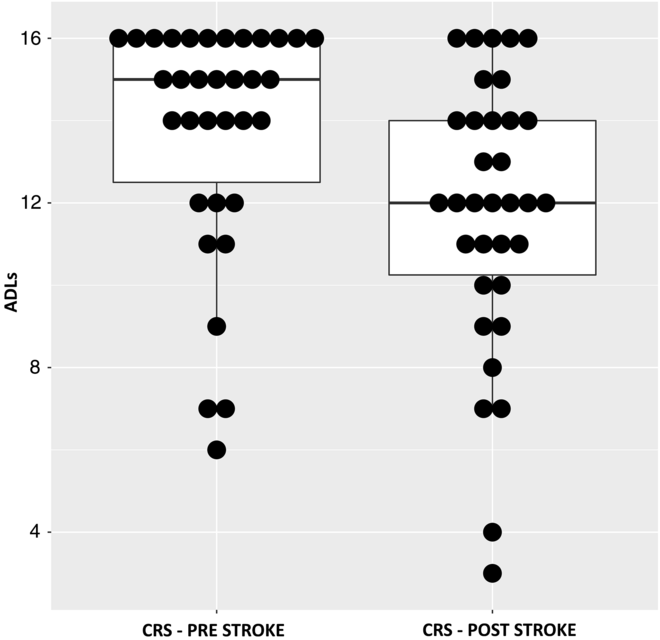
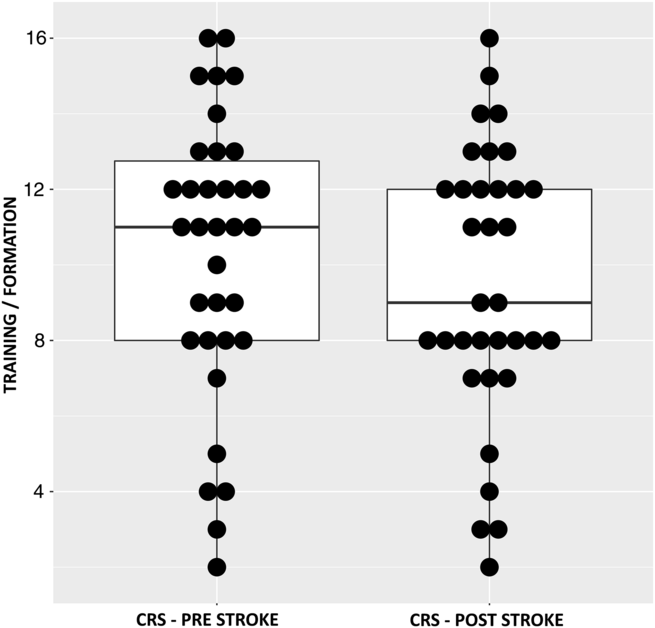
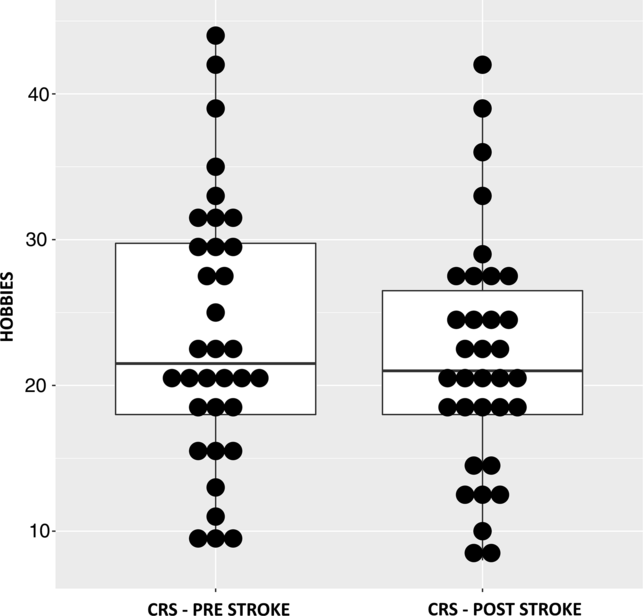
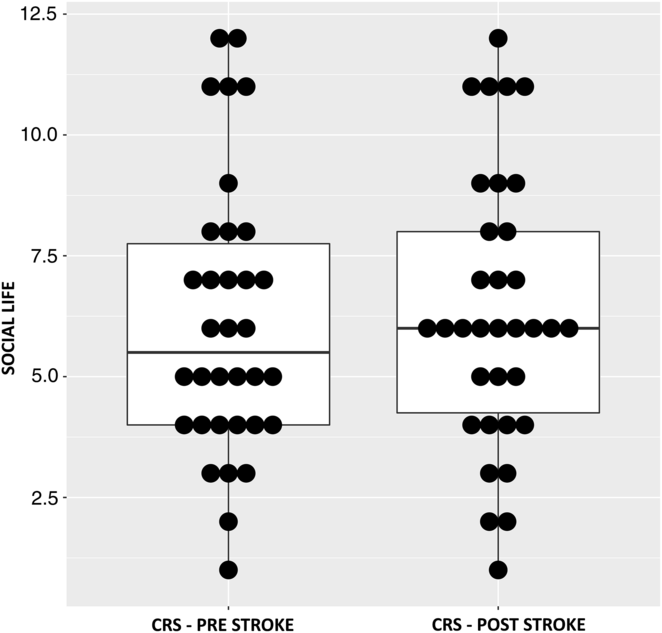
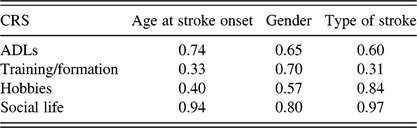
Scores obtained in the four domains of CRS pre-stroke were compared with scores in CRS post-stroke. Wilcoxon test was used to compare mean differences. Influence of gender, age at stroke onset (<50, >50), and type of stroke (ischemic or hemorrhage) was studied too. We found significant mean differences when comparing scores of CRS pre-stroke and CRS post-stroke in the ADLs domain (p = 0.006, d = 0.64) and in the training / formation domain (p = 0.02, d = 0.22). There were no significant differences between CRS pre-stroke and CRS post-stroke in Hobbies (p = 0.17; d = 0.19) nor in Social Life (p = 0.70; d = 0.07) (see Figures 2–5). We did not find mean differences based on demographics (see Table 2).
Mean differences between scores in CRS Pre-stroke and scores in CRS Post-stroke in ADLs domain.

Mean differences between scores in CRS Pre-stroke and scores in CRS Post-stroke in Training/formation domain.

Mean differences between scores in CRS Pre-stroke and scores in CRS Post-stroke in Hobbies domain.

Mean differences between scores in CRS Pre-stroke and scores in CRS Post-stroke in Social Life domain.

Mean differences between CRS and demographics (Wilcoxon p-values)

Study 2. CR (Pre-CR and static proxies) and change in cognitive factors between admission-discharge stage and discharge-chronic stage of stroke
Scores in the four domains of CRS pre-stroke did not show significant correlations with the difference between the three cognitive factors at discharge-admission and chronic-discharge (see Table B).
We did not find mean differences in the change between cognitive factors based on demographics (gender, age at stroke onset and type of stroke) (see Table C) nor based on static proxies of CR (occupation and years of education) (see Table D).
Study 3. Post-CR and cognitive functions and performance in daily life in chronic stage
We studied the relationship between CRS-post stroke and cognitive factors in chronic stage. Self-rating measures were studied too. Scores in each of the four domains of CRS-post stroke did not show significant correlations with cognitive factors of chronic stage (see Table E)
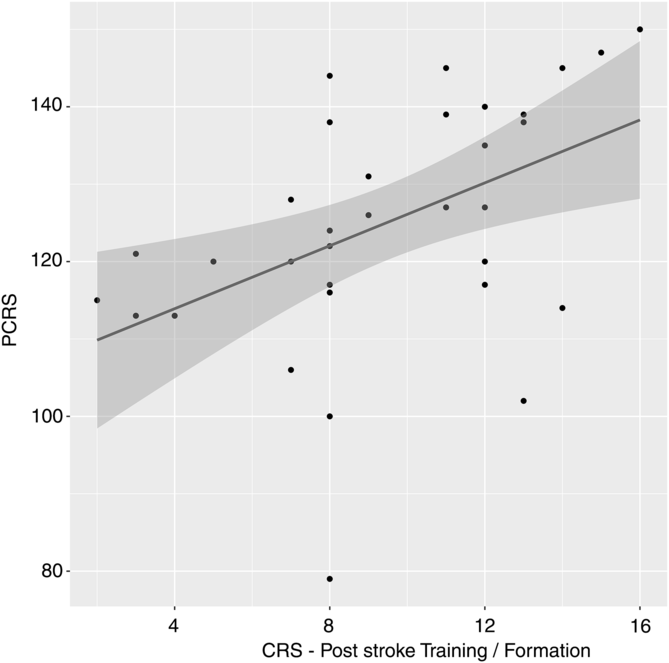
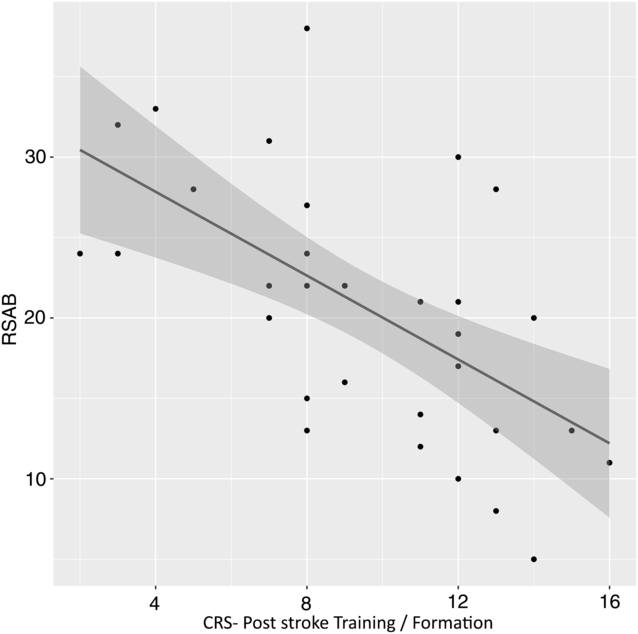
Scores in training/formation of CRS-post stroke showed significant correlation with PCRS (r = 0.469; p = 0.029), RSAB (r = − 0.6; p = 0.004), BRIEF-Metacognition (r = − 0.468; p = 0.029). Sub-scores in Hobbies CRS-post stroke showed significant correlations with RSAB (r = − 0.471; p = 0.029) (see Figures 6–9).
Correlation between scores in Behavior Rating Inventory of Executive Function – Adult version Metacognition index and scores in CRS-Post stroke Training/Formation domain.

Correlation between scores in Patient Competency Rating Scale and scores in CRS-Post stroke Training/Formation domain.

Correlation between scores in Rating Scale for Attentional Behavior and scores in CRS-Post stroke Training/Formation domain.

Correlation between scores in Rating Scale for Attentional Behavior and scores in CRS-Post stroke Hobbies domain.

CIQ showed significant correlations with CRS-Post stroke in the four domains: ADLs (r = 0.531; p = 0.018), Training/formation (r = 0.475; p = 0.029), Hobbies (r = 0.474; p = 0.029) and Social Life (r = 0.611; p = 0.004) (see Figures 10–13).
Correlation between Community Integration Questionnaire total score and scores in CRS-Post stroke ADLs domain.

Correlation between Community Integration Questionnaire total score and scores in CRS-Post stroke Training/Formation domain.

Correlation between Community Integration Questionnaire total score and scores in CRS-Post stroke Hobbies domain.

Correlation between Community Integration Questionnaire total score and scores in CRS-Post stroke Social Life domain.

No other significant correlations were found between the four domains of CRS-post stroke and self-rating measures (see Table F).
We also studied mean differences in cognitive factors according to occupation complexity and years of education. The results showed no significant differences in AT Chronic (“Occupation” p = 0,256; ε2 = 0,180; “Years of education” p = 0,648; ε2 = 0,076), M Chronic (“Occupation” p = 0,836; ε2 = 0,015; “Years of education” p = 0,836; ε2 = 0,039) and neither in EF Chronic (“Occupation” p = 0,253; ε2 = 0,209; “Years of education” p = 0,253; ε2 = 0,205).
Discussion
We retrospectively studied the relationship between different types of CR proxies and cognitive functions in different stages of post-stroke evolution. The results showed relationships between CR and cognitive functioning in chronic stage of stroke. Specifically, we found a positive association between self-rating questionnaires of neuropsychological assessment in chronic stage and Post-CR. On the other hand, we did not find significant relationships between any type of CR proxy included in the study and change on any of 3 categories of cognitive factors we identified from our neuropsychological battery data, at any stage of stroke.
While static CR proxies are resistant to change once a certain stage of life has passed (education during youth and occupation during adult life), the nature of the dynamic proxies makes it possible to start them and to quit at any stage of life. Stroke causes many changes in routine and frequent activities that used to be performed by patients before the stroke (Cott, Wiles & Devitt, Reference Cott, Wiles and Devitt2007). Thus, it makes sense that stroke also affects the frequency of CR dynamic proxies, and because of this possibility we studied the differences between Pre-CR and Post-CR. We found that study participants had reduced their participation in some reserve-related activities, but they tended to maintain the same frequency in others. Our findings indicate that they lower their participation in ADLs, the management of personal, economic and domestic matters, and in training/formation, the expansion of knowledge and new skills. In contrast, they tend to resume previously chosen hobbies, considered as leisure activities and physical activities, and social life. Other studies have explored the reengagement in daily life activities in chronic stage of stroke. Verberne et al. (Reference Verberne, Post, Köhler, Carey, Visser-Meily and van Heugten2018) studied social participation of stroke patients and found that those more dependent on ADLs were more likely to have less participation in general 2 years after stroke. Singam, Ytterberg, Tham and von Koch (Reference Singam, Ytterberg, Tham and von Koch2015) found that participation in ADLs after stroke was linked to mobility, and participation in leisure activities was associated with both age at stroke onset and mobility. Jellema et al. (Reference Jellema, van Hees, Zajec, van der Sande, Nijhuis-van der Sanden and Steultjens2017) carried out a systematic review of environmental factors that influence stroke patients’ reengagement to “personally valued activities” and found that social support (availability of family and friends) was highly related. These studies highlight the need to design long-term rehabilitation programs to increase participation in life situations, and based on our results, CR activities such as ADLs and training and formation should be especially addressed.
We have found relationships between Post-CR and self-reported cognitive functioning. Concretely, engagement in training and formation showed inverse relationship with self-rating scores in attentional complaints, but direct association with level of metacognition, the ability of planning and monitoring one’s thinking and actions and functional abilities in daily life. Also, frequency in Post-CR hobbies is inversely related to attentional complaints. However, it is still not clear the nature of this relationship. Scarmeas and Stern (Reference Scarmeas and Stern2003) and Stern et al. (Reference Stern, Arenaza-Urquijo, Bartrés-Faz, Belleville, Cantilon, Chetelat and Vuoksimaa2018) have discussed before if the relationship between proxies of CR and cognitive functioning is causal or reflective of reverse causation. Following their conclusions, those who initially have a good performance in attention and executive functions are more motivated towards participating in cognitively stimulating activities, since they are more effective and obtain a greater sense of achievement than those who have more cognitive difficulties. On the other hand, it is possible that participating in this type of activity helps to stimulate or maintain cognitive functioning. Future research should be focused on exploring this question.
We have also explored static proxies, concretely, education and occupation. Our results showed that years of formal education was not significantly related to rate of change in attention, memory, and executive function as factors in our 3-factor model. Education has shown to be a predictor of cognitive performance and it is considered as having a protective role against brain damage (Steward et al., Reference Steward, Kennedy, Novack, Crowe, Marson and Triebel2018). Kessels et al. (Reference Kessels, Eikelboom, Schaapsmeerders, Maaijwee, Arntz, van Dijk and de Leeuw2017) found evidence of the relationship between education and grade performance on tests in stroke patients, but this relationship was mediated by the age, so the role of education by itself was not clear. On the other hand, Berggren, Nilsson and Lövdén (Reference Berggren, Nilsson and Lövdén2018) pointed out that education has no relationship with the rate of cognitive decline in heathy elders. Lenehan, Summers, Saunders, Summers and Vickers (Reference Lenehan, Summers, Saunders, Summers and Vickers2014) concluded that education is directly related to level of performance on tests but there isn’t a relationship between education and age-related cognitive decline. Our results suggest that the same phenomenon happens in stroke-related cognitive change over time. The moment when the education is received (childhood and adolescence) “modulates” the way we learn to respond to test and exam situations, and therefore the way we respond to cognitive tests, but the rate of change in performance over time is independent. Education may protect against brain damage but does not influence the rate of cognitive recovery after stroke.
We also did not find significant relationships between complexity of occupation and any measure of neuropsychological assessments. In a review, Baldivia, Andrade and Bueno (Reference Baldivia, Andrade and Bueno2008) pointed out that the evidence of the relationship between occupation and cognition is limited. Perhaps occupation can be considered as informal education. Helmer et al. (Reference Helmer, Letenneur, Rouch, Richard-Harston, Barberger-Gateau, Fabrigoule and Dartigues2001) indicated that occupation is related to levels of education and literacy and hence is difficult to study as a separate variable. On the other hand, studies with the elderly population found that occupation is related to better cognitive functioning (Adam, Bonsang, Grotz & Perelman, Reference Adam, Bonsang, Grotz and Perelman2013; Schooler, Mulatu & Oates, Reference Schooler, Mulatu and Oates1999). We are inclined to think that every variable in lifestyle has some potential to influence cognitive functioning after stroke, and this might include occupation. In our study we used the classification of the National Institute of Qualifications of Spain to differentiate levels of work complexity. This classification is organized in levels of qualification, defined as professional skills that can be acquired through training or through work experience. There are other ways to assess complexity and involvement of cognitive functions of a profession as discussed by other authors (Finkel, Andel, Gatz & Pedersen, Reference Finkel, Andel, Gatz and Pedersen2009; Schooler, Mulatu & Oates, Reference Schooler, Mulatu and Oates2004). In conclusion, most CR studies are focused on aging and dementia, while there is no evidence of the role of occupation in stroke recovery. Our study has been the first to address this issue, with results suggesting there is no relationship. Future research is necessary to further explore the possible role of occupation in stroke.
Lastly, we also analyzed social integration in our study. Other researchers have used CIQ to study populations with stroke (Dalemans, De Witte, Beurskens, Van Den Heuvel & Wade, Reference Dalemans, De Witte, Beurskens, Van Den Heuvel and Wade2010; Lee, Lee, Choi & Pyun, Reference Lee, Lee, Choi and Pyun2015). In our study, we found that total score of CIQ showed significant correlations with all domains of CRS. CIQ assesses community integration using three domains: competence in instrumental ADLs, social integration, and productive activities. The relationship with CRS could indicate that community integration could be another dimension of CR or, on the other hand, that CIQ is assessing the same as CRS and hence, it could be used as a tool to assess dynamic proxies of CR in people who have suffered stroke. Given the importance of assessing CR, and that CIQ is a measurement tool designed specifically for people with brain injury (Dijkers, Reference Dijkers2000), we may propose that it is a good candidate proxy worthy of further study for its utility in assessing CR in this type of patients.
We see strengths but also important limitations in our research. First, we focused on a subpopulation of young to middle-age adults with moderate to severe stroke who are living at home (these might not be representative of an elderly population or those living in nursing homes and health centers). We did not include visuospatial modality of learning and working memory, and neither speed of processing, being this last one an important variable since it is related to functional outcome after stroke (Barker-Collo, Feigin, Parag, Lawes & Senior, Reference Barker-Collo, Feigin, Parag, Lawes and Senior2010) and many neuropsychological measures of attention and executive functioning involve time-sensitive tasks. Another limitation of the study is that part of our results is based on self-rating scales, which cannot exclude the possibility of response bias. Moreover, we did not study or account for the effect of “self-awareness” or the capacity of the person to inform accurately regarding their own performance, which may tend to be altered after stroke. Another limitation was sample size, which could impact the sensitivity and/or resolving power of CFA analysis, mean differences, and correlations. Finally, we did not include neuroimaging, so we could not control brain lesion characteristics besides the type of stroke.
Conclusions
Activities related to ADLs and learning tend to be more abandoned after a stroke, while there is a reengagement in previously practiced hobbies and social life. On the other hand, none of the static CR proxies included in the study were related to cognitive performance in either post-acute or chronic stages of stroke. However, dynamic proxies of CR such as training activities and hobbies are related to the perception that patients had about their functional abilities, attention performance, and metacognition in daily life.
Our results suggest that dynamic proxies are related to cognitive performance in daily life in chronic stroke. We propose that dynamic proxies of CR should be included in neuropsychological assessments in stroke patients and also in the design of programs for long-term rehabilitation. Also, more research of CR in stroke is needed to better understand the implications of static proxies in cognitive recovery.
ACKNOWLEDGEMENTS
The authors are grateful to Admissions Department and Documentation Area (O. Araujo) of Institut Guttmann, and to Dr. Schrum and C. Molina-Mendiola for providing writing assistance and general support.
CONFLICTS OF INTEREST
The authors have nothing to disclose.
FUNDING
This work was supported by BIOCAT La Fundació BioRegió de Catalunya – Registry Number: COM15–1-0004 and Fundació Bancària “la Caixa” – Obra Social “la Caixa” Project number: LCF/PR/PR16/11110004.
SUPPLEMENTARY MATERIAL
To view supplementary material for this article, please visit https://doi.org/10.1017/S1355617719000638