

The Coinage of CrotonFootnote 1
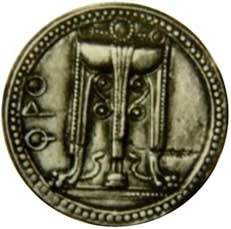
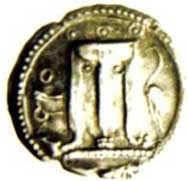
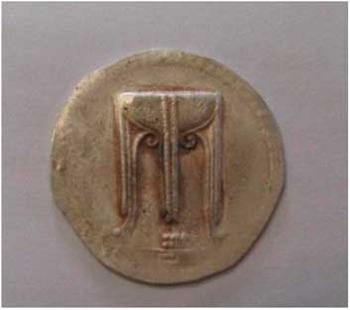
The incuseFootnote 2 coinage of Croton consists of different coin types that were produced during a century of minting in which the first coins were of exquisite workmanship and artistic quality. These were the early ‘Tripod’
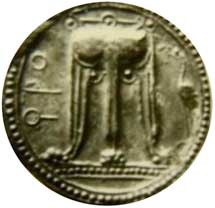
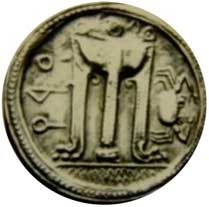
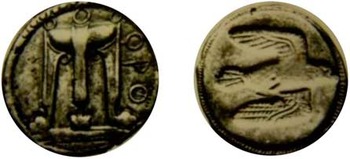
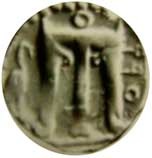
series of 30mm diameter (Fig. 1) that were later reduced to 28mm diameter and then divided into two series – termed ‘Heron’ and ‘Crab’Footnote 3 incuses – ranging from an initial 28mm diameter (Figs 2 and 3) to 18mm. Somewhere in the same period another series, the ‘Eagle’ incuses, was introduced (Fig. 4). As coin diameters reduced, the quality of the workmanship and of the artwork diminished (Fig. 5).
30mm ‘Tripod’ coin

28mm ‘Heron’ coin

28mm ‘Crab’ coin

26mm ‘Eagle’ coin

18mm stylized ‘Heron’ coin

The 981 extant genuine Croton incuses (which I examined in 1983)Footnote 4 have an average weight of 7.81gm and standard deviation of 0.41.Footnote 5 It can be assumed, therefore, that a consistent method of producing each blank close to a constant weight during a century of minting at Croton must have been employed.Footnote 6
Furthermore, since all the coins have a similar weight (and therefore similar quantity of metal), a 30mm diameter coin blank is thinner than a 22mm diameter coin blank. 8gm of silver alloy, when minted as a 30mm coin, is about 1.1mm thick, while 8gm of the alloy minted into a 22mm coin is about 2.1mm thick. Thus the desired diameter of the coin determines its thickness. The results of the experiments carried out at Monash University Metallurgy Department showed that it is the thickness of the coin blank that determines the processes required to make it ready for striking into coin.Footnote 7
The Alloy
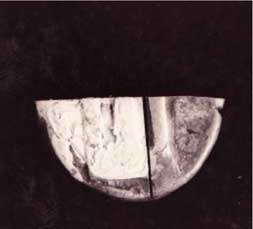
The genuine Croton incuse coin fragment from the Ashmolean Museum Oxford (Fig. 6) was examined and found to be made of 96% silver (Ag) and c. 4% copper (Cu), which is referred to as Ag4Cu.Footnote 8 The alloy may have been naturally derived in antiquity from the mined silver ore. All ‘Monash coins’ were made from our own manufactured Ag4Cu alloy.
19mm Croton incuse fragment after slivers removed and mounted in resin for etching.

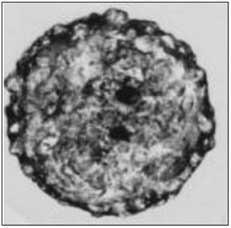
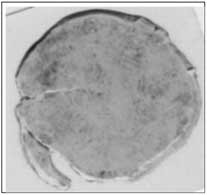
Preliminary tests showed that, when Ag4Cu is melted in normal atmosphere, it absorbs a large quantity of oxygen and expels the same amount explosively when it solidifies, leaving the surface of the alloy covered in small craters (Fig. 7). Melting the alloy in a carbon environment (on a carbon block) provides a reducing atmosphere that prevents oxygen absorption.Footnote 9
17mm cast Ag4Cu pellet (X 2) which has solidified in a non-reducing atmosphere.

Creating the Blank
In antiquity a coin was made when a metal blank was placed between an obverse die (cut into an anvil) and a reverse die (cut into one end of a punch), and the opposite end of the punch then struck with a force. The blank was manufactured into an acceptable size and shape for producing the coin, and the dies were cut by hand by a die-engraver. The dies had to be cut to the right size to fit the desired coin blank; conversely, there is no point producing a pair of dies if you cannot produce blanks of sufficient diameter that will fit them.
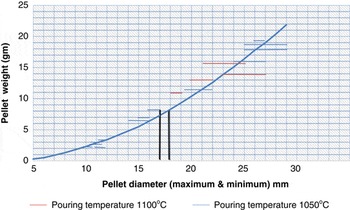
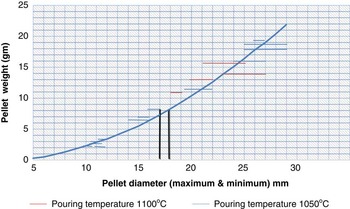
To test if 8gm of molten Ag4Cu spreads to an acceptable 30mm blank for the production of the earliest incuse coinage,Footnote 10 8gm of our pre-weighed alloy was melted and poured onto a flat carbon surface.Footnote 11 It solidified into a 17mm (maximum) pellet – a flattened spheroid (see Graph 1,
Spreadability Graph (with line of best fit) shows that 8gm of molten Ag4Cu alloy at melting point 1050°C spreads to c.18mm when poured onto a flat carbon plate.

p. 31).Footnote 12 There is a rapid loss of heat energy resulting in rapid solidification when the 8gm of molten alloy at 1050°C is poured out onto the flat surface and exposed to ambient temperature.
This 8gm 17mm diameter spheroid has to be enlarged in some way to enable the production of larger coins.Footnote 13
Attaining Consistent Weight of 8gm of Ag4Cu
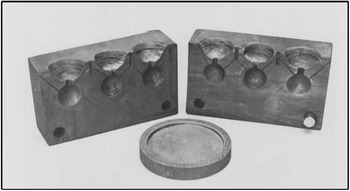
We tested another plausible method of creating the pellet and, at the same time, achieving consistent weights. We prepared ‘split-moulds’ (Fig. 8, next page) by carving spheroidal cavities into two separate carbon blocks, which were then joined together with the cavities aligned. The molten metal alloy was then poured into this split-mould, which was then separated after the metal had solidified to allow removal of the cast blank. Each cavity in the joined mould was capable of holding 8gm of the molten Ag4Cu alloy. These cavities were each fed from a reservoir above through a narrow conduit. In practice, the reservoir above had to hold at least 16gm of molten metal to ensure that it flowed through the conduit to fully fill the 8gm mould below before the metal solidified.
Carbon split- moulds for making three pellets, and flat plate. Each reservoir in the mould above holds at least twice the amount of molten alloy than the pellet cavity below. The flat plate was used for the “spreadability” tests, which proved that 8gm of molten Ag4Cu poured onto it will not spread to more than c. 17mm.

We opted to melt 24gm of Ag4Cu alloy (8gm for the mould, plus c. 16gm for the reservoir above) for the experiment of pouring into these split-moulds, carrying out one melting operation at a time for each mould.Footnote 14
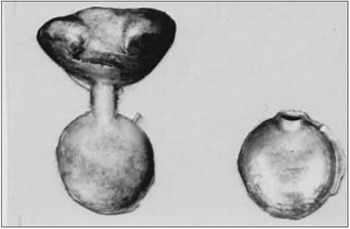
This method, however, uses a large amount of heat energy. The solidified 16gm reservoir has to be cut from the pellet (Fig. 9) and returned to the forge later to be re-melted. In effect this means that each 8gm of Ag4Cu has to go through three melting processes before becoming a pellet. In addition, the forge has to melt c. 24gm of the Ag4Cu alloy in a container capable of pouring the liquid into the split-mould cavity and, furthermore, the split-moulds (having a limited useful life) would have to have been regularly produced with great accuracy and consistency to produce pellets within the weight standard deviation of the Croton coinage.
16mm pellet with reservoir attached, and pellet with reservoir clipped, leaving remnant ‘sprue’ at the edge.

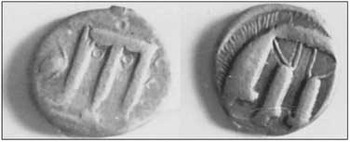
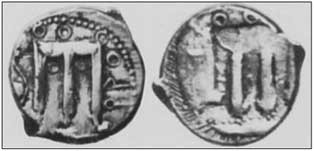
Despite these difficulties, however, it is possible that, in the production of a small series of late incuse coins, ancient minters used split-mould casting to make coin pellets. The existence of two incuse coins of Croton of 22mm diameter indicates the practice of split-mould casting. On the first coin (Fig. 10) there appears to be a remnant ‘sprue’ left when the reservoir metal was clipped from the pellet. On the second coin (Fig. 11) there is an ‘equatorial ridge’ that was cast into the pellet because of an ill-fitting split-mould.Footnote 15
Late 20mm Croton incuse with remnant ‘sprue’ at edge, indicative of the coin pellet being made in a mould.

Late Croton incuse with remnant ‘equatorial ridge’, possibly struck from a pellet made from an ill-fitting split-mould.

Pre-weighing alloy chips or filings before melting them proved to be, in practice, the best way to produce pellets of consistent weight with minimal heat loss, and would be a reliable method over long periods of coin production.
Producing the Best Shaped Pellet for Making the Blank Disc
An optimal shaped pellet (a ‘flattened spheroid’) was obtained by tipping 8gm of pre-weighed silver alloy filings into a small depression in a small carbon blockFootnote 16 and placing it in the furnace, set at 1050 degrees Celsius, until molten. Almost immediately after the block was removed from the furnace the silver alloy solidified, since the small carbon block rapidly loses its heat and the small amount (8gm) of molten silver contains only a small amount of heat energy, which also rapidly dissipates.
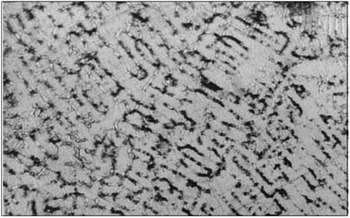
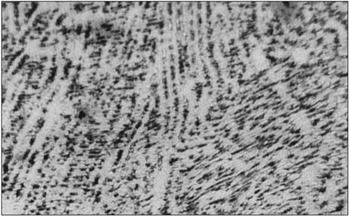
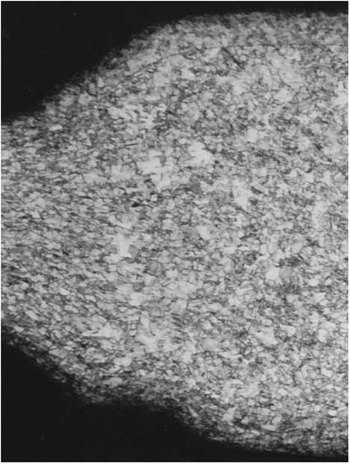
The 8gm, 18mm, as-cast, Monash ‘flattened spheroid’ was sectioned, mounted in resin, etched, and photographed through a microscope. Fig. 12 shows the resultant as-cast microstructure (X 60) which is typical of this alloy. Crystals align in evenly spaced rows or layers.
Cross-section of as-cast microstructure (X 60) of Ag4Cu alloy, in which crystals are evenly spaced and streamlined in layers.

Hammering the Pellet into a Disc
The spheroid pellet, with the flat upper surface, is a convenient shape to begin the light hammering process to produce a disc for minting.Footnote 17 As the alloy pellet is hammered and flattened, it begins to work-harden at the surface and, as it becomes thinner, it work-hardens right through its cross-section. When the disc has been work-hardened right through, it will crack at the edges if hammered further (Fig. 13). The spheroid shaped pellet allows maximum deformation to take place in the middle of the disc before the outer areas become work-hardened and crack. A genuine incuse coin of Croton with a diameter of 24mm (Fig. 14) show cracks at the edges that were made during the manufacture of the blank.Footnote 18
An 8gm pellet hammered past 24mm and cracked. The tongue of metal has resulted from hammering out a flaw in the cast pellet.

24mm ‘Heron’ coin (obverse) struck on a blank with cracks at the edge.

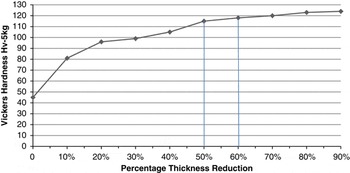
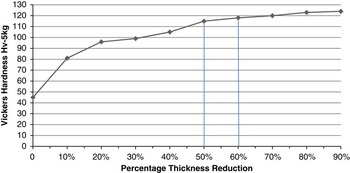
Graph 2 (p. 32) shows the relative hardness at the centre of the blank’s cross-section after various percentage deformations. At 50% reduction in thickness, the 8gm disc is 2.1mm thick and the hardness has reached 115 HV.
Hardness Graph shows that an 8gm 15mm Ag4Cu cast alloy pellet reaches c. 118HV after reducing its thickness by 60% through hammering. Cracking occurs when the thickness of an 8gm pellet is reduced to below 2.0mm and hardness increase to above c. 118HV.

Footnote 19 The blank diameter is now approximately 22mm. At 60% reduction in thickness, the disc is 1.7mm thick, 24mm in diameter, and has a critical 118HV.
These figures are of crucial importance: it is at a diameter of 24mm, a hardness of 118HV, and a thickness less than 2.0mm that the 8gm disc can no longer be hammered without cracking. For an acceptable impression to be imparted by the dies onto a 24mm blank to make a coin, or to continue on and hammer the disc out to 30mm, the blank has to be softened by an annealing process.Footnote 20
Fig. 15 shows the microstructure (X 60) of a disc that has been hammered, in this case, from an as-cast, 15mm blank to 17mm (20% deformation), with HV of 95 at the centre of the section. The disc has been reduced in thickness by almost 1mm – from 4.3mm to 3.4mm. The as-cast crystal streamlines have been flattened and distorted – they have been strained.
Cross-section of the as-cast pellet (left half of image) and 20% reduced microstructure (right half) (X 60). Here the alloy crystals have been distorted under compression.

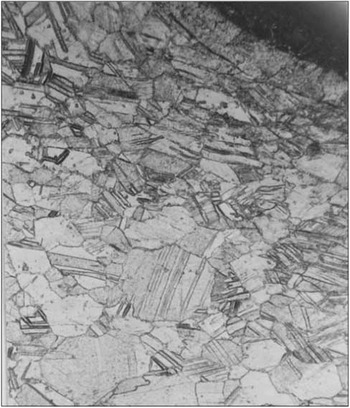
Fig. 16 shows the microstructure (X 220) of a disc that has been hardened by hammering the spheroidal pellet flat to 22mm diameter, annealed by holding the temperature at 500 degrees Celsius for 30 minutes, then struck between dies. The flattened (strained) crystals have grown randomly by the annealing process into large crystals across the entire section, releasing the strain. This crystal growth, after the metal has been work-hardened and then annealed, is normal for this alloy. The large crystals near the surface have been distorted by the dies when the blank was struck into a coin.
Cross-section microstructure (X 220) of a 22mm Ag4Cu alloy Monash coin that has been work-hardened by flattening from a 17mm pellet, annealed and struck between dies. Large crystals in the centre show random growth when annealed. The growth crystals near the surface (top right) have been distorted by the die strike.

Comparison of Monash ‘Coin’ Microstructures with Genuine Incuse MicrostructuresFootnote 21
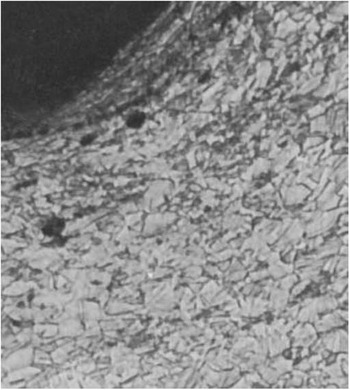
Fig. 17 shows the crystal structure (X 120) of a genuine 19mm diameter Croton incuse. The microstructure is similar to that of the 22mm ‘Monash’ coin (Fig. 16). Large random crystal growth caused by annealing is evident across the section, and these large crystals were distorted near the surface when the blank was struck between dies.Footnote 22
Cross-section microstructure (X 120) of a 19mm incuse coin from Croton. The coin shows similar structures to Fig. 16. It was struck on a blank that had been annealed after being work-hardened (flattened). The large regrowth crystals are present in the structure; those near the surface (top left) have been distorted by the die strike.

This comparison means that the ancient coin makers were softening their 8gm, Ag4Cu, flattened discs even to make the 19mm coinage. They must also have softened their flattened disc to make their 22-24mm incuses.
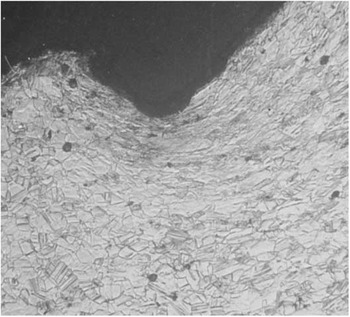
The experiment continued by striking a softened 22mm diameter blank between dies, removing the coin from the dies, re-softening it and then re-striking the coin between the relocated dies.Footnote 23 This was done to examine further changes which occur to the crystal structure when a coin is worked after annealing – in this case worked by the second die-strike. Fig. 18 shows the changes in the microstructure (X 60) in the area where the die made the imprint in the first strike. When large, regrown crystals have been distorted and annealed again, they re-grow into smaller crystals. The image shows these small, re-growth crystals near the surface (where the first strike had distorted them) which were then distorted by the second die strike.
Cross-section microstructure (X 60) of a 22mm Ag4Cu alloy Monash coin after the 17mm pellet had been flattened to 22mm, softened, struck between dies once, softened and struck again between relocated dies. Large growth crystals from the first annealing were compressed (distorted) near the surface by the dies, then regrew during the second softening into smaller (secondary) regrowth crystals. These smaller crystals near the surface have been compressed by the second die strike.

Producing the 30mm Incuses
Another softened 24mm diameter blank was hammered out to 30mm. At this diameter the section had been reduced in thickness by more than 70% from the as-cast condition, and was now 1.1mm thick.
This 30mm blank had to be annealed to allow the dies to impart the image successfully onto the coin. Softening at 500°C for 30 minutes and then striking between the dies usually produced a good quality image. However, when striking a particular 31mm blank between our Monash dies, it was too hard to receive successfully the imprint of the dies, even with two separate strikes (Fig. 19). This half-struck ‘coin’ had to be softened again (500°C for 30 minutes) for the dies to impart their image successfully onto the blank with a third die strike. Further experiments at this point showed that a thin, 30mm diameter, incuse, softened blank cannot be minted successfully without defects if the dies are not aligned; the reverse image interferes with the obverse image where they intersect.Footnote 24
31mm Monash coin after first die strike. The border and the tripod feet have not been completed. Another softening process was required to allow a second aligned strike between the dies to produce a satisfactory coin.

Fig. 20 (next page) shows the crystal structure (X 60) of the Monash ‘coin’ after the cast pellet had been enlarged by hammering to 24mm (strained), softened, hammered again to 31mm (strained again), softened again and struck between dies. The annealing processes are evidenced by the growth of the crystals after each straining phase, and the final distortion of these regrown crystals upon striking between dies. Note that the initial, as-cast crystals, distorted when strained (first hammering to 24mm), grew into large, variable sized grains with the first softening process, and then were streamlined with the second hammering, only to grow again randomly as smaller crystals during the second annealing process, and then to be distorted near the surface upon striking between the dies.
Cross-section micro-structure (X 60) of a 31mm Monash coin made from a 17mm cast pellet which was hammered to 24mm, softened, hammered to 31mm, softened again, then struck between dies. The smaller, secondary regrowth crystals (appearing through the entire section after the second softening process), have been distorted by the dies near the surface.

The annealing process itself is heat-energy intensive. As well as having to melt the alloy in the furnace at the outset at 1050 degrees Celsius to create a 17mm pellet, an 8gm, 30mm diameter coin being minted on the production line at the mint at Croton would have spent at least two half-hour periods in the forge at 500°C to soften the blank, and may well have spent another half hour in the forge after the first die-strike – in a semi-completed state – to soften the coin in preparation for the second die-strike to complete the coin. On the other hand, 8gm of silver alloy melted at 1050°C, solidified into a pellet and hammered out to a 24mm diameter blank, would have only spent 30 minutes in the forge at 500°C – one softening process – to become soft enough to be successfully struck into a coin with a single die-strike.
Conclusion
In light of the Monash experiments, it is possible to conclude that the Croton minters deliberately reduced the size of their coin blanks to take advantage of the shorter manufacturing process, allowing them to increase the rate of production of these smaller coins.
The incuse coinage minted in the late 6th century by the four cities of southern Italy – Croton, Metapontum, Caulonia, and Sybaris – are closely related, right up to the destruction of Sybaris,Footnote 25 and the capture of its wealth by Croton in 511/10. After this victory it is plausible to assume that Croton’s increase in wealth would call for an increase in coin production.Footnote 26 Reducing the blank size would allow the minters to meet this demand.
Spreadability Graph (with line of best fit) shows that 8gm of molten Ag4Cu alloy at melting point 1050oC spreads to c.18mm when poured onto a flat carbon plate.

Hardness Graph shows that an 8gm 15mm Ag4Cu cast alloy pellet reaches c. 118HV after reducing its thickness by 60% through hammering. Cracking occurs when the thickness of an 8gm pellet is reduced to below 2.0mm and hardness increase to above c. 118HV.

End-note
C.F. Elam in 1931 (n. 10) made some interesting observations when examining the crystal structures of 15 silver Greek coins minted between 500 and 300 BC. Of great interest to us is her microstructure images of an 8.08gm, 28mm Sybaris incuse. From this evidence she concludes that the coin had been ‘stamped direct from the casting. The shape of the original blank must have been round, thin, and approximately of the size of the finished coin’ (p. 62). In the light of the Monash experiments, which show that 8gm, Ag4Cu alloy cannot be cast into a 28mm disc, Elam’s conclusion requires some explanation. Fortunately this comes by way of discussion immediately following Elam’s analyses. Dr S.W. Smith of the Royal Mint London explains that the Sybaris incuse microstructures (Elam’s figures 10, 11, and 12) are very familiar ‘because they represent fairly closely the microstructures of almost any modern coin over a wide range of silver composition. They indicate that the blanks had been cold-worked and annealed sufficiently to enable the coin to be struck, but not sufficiently to cause complete re-crystallisation. This procedure is characteristic of modern coining’(p. 68).
Without the image of the coin in Elam’s report it is not possible to speculate further. But if, for example, the coin has a poorly struck image, it might indicate that the blank was not softened sufficiently – as evidenced by the microstructure’s incomplete re-crystallisation – for the die to properly impart the image to the coin. Furthermore, Elam mentions that the rough edges of the coin are evidence that the coin had not been cold-worked.Footnote 27 On the contrary, however, it is the unworked, cast alloy that solidifies into a smooth-edged spheroid. The irregular edges on this coin are most probably the result of cold-working the blank. As noted above (pp. 24-5 and n. 18), edge cracks will occur when hammering the cast blank into a broader disc.