Introduction
Aerobic anoxygenic phototrophic (AAP) bacteria are common in oceanic planktonic communities, as well as in limnic habitats (Mašín et al. Reference Mašín, Nedoma, Pechar and Koblížek2008, Medová et al. Reference Medová, Boldareva, Hrouzek, Borzenko, Namsaraev, Gorlenko, Namsaraev and Koblížek2011, Čuperová et al. Reference Čuperová, Holzer, Salka, Sommaruga and Koblížek2013). They require organic substrates for respiration and growth, but are able to obtain cellular energy from light using bacteriochlorophyll a-containing reaction centres (Yurkov & Csotonyi Reference Yurkov and Csotonyi2009). The presence of AAP bacteria in polar lakes was first documented by Labrenz et al. (Reference Labrenz, Lawson, Tindall and Hirsch2009) who isolated four aerobic bacteriochlorophyll a-producing strains (Roseisalinus antarcticus, Roseibaca ekhonensis, Roseovarius tolerans, Staleya guttiformis) from the meromictic hypersaline heliothermal Ekho Lake. These isolates represent psychrotolerant organisms with growth temperatures of 3–35°C. Most studies of aerobic phototrophs have been conducted in tropical and temperate regions. Here, we provide the first enumeration of AAP bacteria in Antarctic polar lakes.
Methods
Sampling
The study was conducted on James Ross Island, north-east Antarctic Peninsula during the summer of 2009 (January/February). The lakes were classified as ‘young’ with a maximum expected age of decades to a century and ‘old’ that originated several thousand years ago. Most of the sample sites were ‘old’ stable shallow lakes. Blue-green, Ginger and Omega 1 are classified as ‘young’ kettle lakes and Federico as a young moraine lake (Nedbalová et al. Reference Nedbalová, Nývlt, Kopáček, Šobr and Elster2013; a detailed description can be found at http://dx.doi.org/10.1017/S0954102015000590). The surface layer was sampled from the shore. Infrared epifluorescence microscopy was used to analyse the planktonic community (Medová et al. Reference Medová, Boldareva, Hrouzek, Borzenko, Namsaraev, Gorlenko, Namsaraev and Koblížek2011). Heterotrophic, phototrophic and cyanobacterial cells were distinguished by comparing the images recorded in the blue (all DNA-containing cells), red (cyanobacteria and algae) and infrared (AAPs and cyanobacteria) channels. Water temperature was 0.3–9.2°C, oxygen saturation 86–180%, pH 7.1–9.5, conductivity 33–4,000 μS cm-1, dissolved organic carbon (DOC) 0.68–9.10 mg l-1 (mean: old lakes 4.2 mg l-1, young lakes 1.0 mg l-1), dissolved inorganic nitrogen as NO3-N 0–95 μg l-1 and NH4-N 0–107 μg l-1, and soluble reactive phosphorus (SRP) 3.6–113.4 μgl-1 (mean: old lakes 13.5 μg l-1, young lakes 73.8 μg l-1)
Data analysis
Statistical analyses used CANOCO 5. Data were log-transformed, centred and standardized by species.
Results
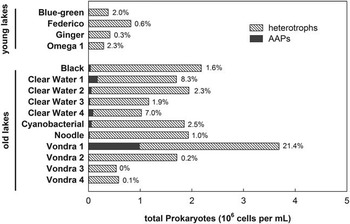
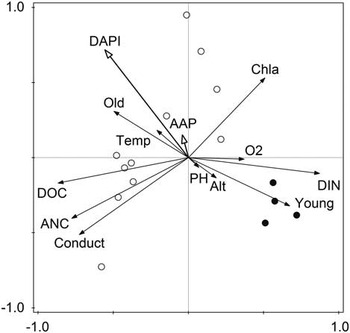
Epifluorescence microscopy revealed AAP bacteria in 14 of 15 lakes (Fig. 1). The bacterial morphotypes were rods of varying length (typically 1–3 μm). Abundance varied from 0 to 7.9×10⁵ cells ml-1 (mean: 8.0×10⁴, median: 2.0×10⁴) with the highest at Lake Vondra 1. The AAP bacteria represented up to 21.4% (median: 1.6%) of the total prokaryotic community (Fig. 1). Heterotrophic counts were approximately one order of magnitude higher (3.69×10⁶ cells ml-1; mean: 1.2×10⁶, median: 1.3×10⁶). Principal component analysis (PCA) suggests that AAP bacteria abundance in the lakes was mainly influenced by water temperature and lake age (Fig. 2).
Abundance of heterotrophic and aerobic anoxygenic phototrophic (AAP) bacteria in freshwater lakes, James Ross Island. Percentage expresses the fraction of the planktonic prokaryotic community.

Principal component analysis on correlation matrix. The relationship among measured environmental variables taken as ‘species’. The first axis explained 40.9% of total variance. The abundance of aerobic anoxygenic phototrophic (AAP) and heterotrophic (DAPI) bacteria are passively projected as covariates onto the diagram. White circles=scores of ‘old’ lakes, black circles=scores of ‘young’ lakes. Alt=altitude, ANC=acid neutralizing capacity, Chla=chlorophyll a concentration, Conduct=conductivity, DOC=dissolved organic carbon, DIN=dissolved inorganic nitrogen, Old=‘old’ type of lakes as a factor, SRP=soluble reactive phosphorus, Temp=temperature, Young=‘young’ type of lakes as a factor.

Discussion
The observed AAP abundance was one order of magnitude lower than cell counts reported from oligotrophic lakes in temperate regions, but their relative proportion was comparable to freshwater and peat bog lakes in Central Europe (Mašín et al. Reference Mašín, Nedoma, Pechar and Koblížek2008, Čuperová et al. Reference Čuperová, Holzer, Salka, Sommaruga and Koblížek2013, Lew et al. Reference Lew, Koblížek, Lew, Medová, Glińska-Lewczuk and Owsianny2015).
The positive correlation between AAP abundance and temperature corresponds to observations from freshwater oligotrophic limnic systems (Mašín et al. Reference Mašín, Nedoma, Pechar and Koblížek2008, Lew et al. Reference Lew, Koblížek, Lew, Medová, Glińska-Lewczuk and Owsianny2015). A higher proportion of AAP bacteria was predominantly observed in old stable shallow lakes with higher DOC and lower SRP concentrations and well-developed cyanobacterial mats. A positive correlation between AAP abundance and DOC has also been documented in oligotrophic alpine lakes in Central Europe (Čuperová et al. Reference Čuperová, Holzer, Salka, Sommaruga and Koblížek2013). In summary, temperature, lake age and DOC content were the most important environmental factors controlling AAP growth.
In conclusion, AAP bacteria appear to have adapted to Antarctic conditions and may play a significant role in the microbial food web in polar freshwater ecosystems.
Acknowledgements
The sampling was supported by the project CzechPolar LM2010009. The authors are grateful to the J.G. Mendel Czech Antarctic Station and its crew. MK is supported by the GAČR project 15-00703S and project Algatech Plus CZ.1.05/2.1.00/03.0110. Many thanks to Jan Šmilauer for providing the statistical software for the canonical analysis. We also thank the reviewers for their comments.
Author contribution
LN and JE arranged the lake sampling and provided the water samples. HM analysed the samples and enumerated the AAP bacteria. All authors contributed to the preparation, improvement and editing of the manuscript.
Supplementary Material
Supplemental material will be found at http://dx.doi.org/10.1017/S0954102015000590.