In the introduction to his thought-provoking, highly original and enjoyable book, Caspar Hare makes the following confession:
I find that the little tact, experience, and sensitivity to the delicate nuance of moral life that I have gained since my pimply adolescence leave me ill-equipped to settle any interesting questions in normative ethics by balancing my intuitions about principles against my intuitions about cases. (14)
Instead, Hare adopts a different approach. He starts with some relatively uncontroversial assumptions about moral decency and rationality and explores their implications. Hare is well aware of the price of adopting such a foundational strategy: the less controversial your axioms are, the harder it is to draw interesting conclusions from them. Thus, along the way, Hare has to add some more controversial postulates. However, compared with previous attempts to follow a foundational strategy, Hare's attempt is remarkably successful in drawing strong conclusions from fairly weak assumptions.
A natural reference point in this respect is John Harsanyi's moral theory (see, for example, Harsanyi Reference Harsanyi1977). Like Hare, Harsanyi adopted a foundational strategy, and he too based his theory on some fairly uncontroversial assumptions about moral decency and rationality. Harsanyi adopted Adam Smith's rule, ‘Act in the way the impartial and sympathetic observer would act’. Here is, roughly, how he interpreted this rule. First, he demanded that the sympathetic observer act rationally in the sense of obeying all of the Von Neumann-Morgenstern (VNM) axioms. Second, he demanded that a ‘sympathetic’ observer always respect the Pareto condition. Third, he demanded that an ‘impartial’ observer should respect anonymity (which for Harsanyi meant that two different people who have the same utility functions should always be treated in exactly the same way).
Hare's assumptions are weaker than Harsanyi’s. With regard to rationality, Hare demands much less than compliance with the VNM axioms. First, he allows that a morally decent and rational agent's preferences may be incomplete. Second, he does not assume any of the VNM axioms regarding choices under conditions of uncertainty (he does assume a much less restrictive condition which I will discuss soon).
With regard to sympathy (or ‘adopting an attitude of good will toward other people’, in Hare's terms), while Harsanyi assumes ex-ante Pareto (Pareto in terms of uncertain prospects), Hare only assumes ex-post Pareto (Pareto only in terms of certain outcomes).
With regard to impartiality, while Harsanyi's demands treating people anonymously, Hare relies on no such assumption and derives it as a result from a fairly weak metaphysical assumption about personal essence.
Since Hare's assumptions are weaker than Harsanyi’s, his aims are, accordingly, less ambitious. While Harsanyi took his assumptions to imply a relatively strong version of Utilitarianism, Hare does not try to derive a complete moral theory from his own assumptions. He aims only at shedding new light on some major questions and argumentative moves in normative ethics.
I do not take Hare's less ambitious aims to be a drawback. On the contrary, I believe the aims Hare sets himself are ambitious to the right degree. His conclusions – which, I believe, can be fairly described as generally utilitarian – are pretty strong, but they are not implausibly strong. While reading the book I asked myself many times, ‘Is this the right conclusion?’ but I hardly ever thought, ‘This is obviously the wrong conclusion. What went wrong?’
There is, however, a downside to Hare's strategy. Although Hare's assumptions are rather weak, weaker assumptions do not always lead to more convincing arguments. Some of Hare's arguments strike me as being flawed exactly because they are based on assumptions which are too weak. I will briefly discuss two of these cases, one for each of the first two parts of Hare's book. Space limitations do not allow me to do the same for the third part of the book, in which Hare extends the conclusions of the first two parts to cases which involve a sacrifice by the decision-maker.
In the first part of the book, Hare explores the implications of his minimal assumptions about moral decency and rationality for what he calls ‘opaque cases’, in which the decision-maker does not know the identity of those who will be affected by his choices, but knows the anonymized payoff structure of the decision situation. Although Hare discusses several different problems, it will be instructive to concentrate on one involving what is usually called ‘the problem of irrelevant utilities’: by going left you can save one person in 3 hours; by going right you can save another person in 2½ hours. Assume that avoiding half an hour of waiting is of some importance for both persons. What should you do?
First consider a non-opaque case. Suppose, that is, that you know that it is Ann who is on the left and Barbara who is on the right and suppose you know them both well. In such cases, Hare (unlike Harsanyi) allows a morally motivated rational agent to have no preferences (in the sense – I take it – of having an incomplete set of preferences) between saving Ann and saving Barbara. Still, Hare demands that in a choice between saving Ann in 3 hours or 2½ hours, the agent will strictly prefer the latter (and the same goes, of course, for Barbara). So Hare allows the agent to prefer saving Ann in 2½ hours to doing so in 3 hours, and likewise for Barbara, but still to have no preference between saving Ann in 2½ hours and saving Barbara in 3 hours.
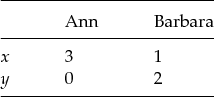
What happens, though, when the agent does not know whether it is Ann on the left and Barbara on the right or vice versa? Hare understands this case as one in which the agent assigns equal credence to each of the two possibilities. Thus, the decision situation can be described as in Table 1.
Anonymized problem of irrelevant utilities.

The dilemma is clear: on the one hand, whatever the way world is, the agent has no preferences between the outcomes of the two possible acts (and knows that). Thus, it seems that the agent should have no preferences between the two acts. On the other hand, while choosing ‘right’ gives both Ann and Barbara a probability of 0.5 of being saved in 2½ hours, choosing ‘left’ gives each one of them a probability of 0.5 of being saved in 3 hours. Thus, it is clear that both Ann's and Barbara's expected welfare is greater if the agent chooses ‘right’.
Hare's position is that in such a case the agent is not morally permitted to choose ‘left’. I agree. Hare also believes that this is the case because choosing ‘left’ is an irrational act. I agree with that too. However, I take Hare's explication of rationality to be extremely implausible.
Here it is. In case my preferences are incomplete, it is a condition of rationality, according to Hare, that ‘it is permissible for me to choose an option if and only if, for some utility function that represents a coherent completion of my preferences, U, no alternative has greater expected U-utility’ (53). What Hare means by ‘coherent completion of my preferences’ is any possible rational (in the VNM sense) preference order that can be derived from my previous incomplete preference order by making it complete.
This is a very weak rationality demand. In fact, it is so weak that in the absence of any further restrictions on the set of rational preference orders that constitute ‘coherent completions’ of the agent's incomplete preferences, it only restricts an agent's choices (in our example) in one possible case: when the agent assigns equal credence to both states of the world. Since, in such a case, every utility function that represents a coherent completion of the agent's set of preferences assigns a higher expected utility to ‘right’, choosing left is irrational according to this theory. Since the case Hare considers is of this kind, he manages to derive a non-permissive conclusion from his very weak assumptions, but that is exactly what makes his reasoning unconvincing. According to Hare's theory, it is only when the decision-maker assigns equal credence to both states that it is impermissible for him to choose ‘left’. As soon as the decision-maker becomes ever so slightly more confident that it is Ann or Barbara who is on the left, it is permissible for him to choose either ‘left’ or ‘right’.
This is an unwelcome result. Intuitively, if it is indeed impermissible to choose ‘left’, it is not only because the decision-maker assigns equal credence to both states. Suppose, for example, the decision-maker raises his degree of belief that it is Ann who is on the right from 0.5 to 0.8. According to Hare's account, it is now permissible for him to choose ‘left’. This is so since there exists a utility function, u(.), such that: (a) u(.) ranks ‘Ann saved in 2½ hours’ above ‘Ann saved in 3 hours’ and ‘Barbara saved in 2½ hours’ above ‘Barbara saved in 3 hours’; and (b) The maximization of the expectation of u(.) (relative to the decision-maker's new degrees of belief) leads to choosing ‘left’. Here is one such a utility function:
u(Barbara saved in 2½ in hours) = 1000
u(Barbara saved in 3 hours) = 900
u(Ann saved in 2½ hours) = 2
u(Ann saved in 3 hours) = 1
The change in morality's prescriptions is due, that is, to the fact that utility functions such as the one above constitute, in our example, possible coherent completions of the decision-maker's incomplete preferences. However, such utility functions constitute coherent completions of the decision-maker's incomplete preferences also in the case in which the decision-maker is certain that it is Ann (or Barbara) who is on the right. Why, then, is a reference to such utility functions permitted in cases of uncertainty and not permitted in cases of certainty? In other words, Hare's argument lacks ‘explanatory plausibility’. It is not always enough to start with plausible assumptions and reach plausible conclusions. You also have to show that your assumptions support your conclusion in the right way.
A comparison with Harsanyi illustrates this point. How would Harsanyi treat the decision situation described in Table 1? It is irrational for Harsanyi ‘to have no preferences’ between saving Ann in 2½ hours and saving Barbara in 3 hours. The agent must either strictly prefer one to the other or be indifferent between them. If the agent is indifferent, then he must be indifferent between choosing ‘left’ and choosing ‘right’. If the agent strictly prefers saving Ann in 2½ hours to saving Barbara in 3 hours, then he must prefer ‘right’.
Thus, from the standpoint of Harsanyi's theory, it is clear why choosing ‘left’ is impermissible: the agent prefers the outcome of choosing ‘right’ to the outcome of choosing ‘left’ in every state of the world. This seems to be the correct explanation in the sense that according to it the agent's credence distribution has nothing to do with what is permissible for him to do in this case. Whatever the agent's degrees of belief are, the conclusion holds. Harsanyi's assumptions are indeed stronger than Hare’s, but their strength is exactly what makes Harsanyi's use of them convincing.
Now, while I agree with Hare that the completeness axiom must be relaxed (and for exactly the reasons Hare mentions), and while I also agree that this raises the need to generalize expected utility theory for cases in which an agent's preferences are incomplete, I reject Hare's generalization.
I find a similar problem in the main argumentative move Hare employs in Part 2 of the book, where he moves from ‘opaque’ to ‘non-opaque’ cases. I consider the main achievement of this section to be a convincing argument for a strong principle that Hare calls ‘Anonymous Benevolence’ (AB), which has some far-reaching implications that he skilfully explores.
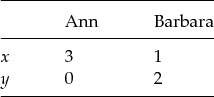
Roughly, AB demands that a morally motivated rational agent choose between states of affairs based on their distributional structure, without taking into consideration the identity of the people occupying each position. For example, in Table 2, AB demands that the agent choose act x, because the positions of both the worse-off and the better-off improve by moving from y to x, even though no Pareto-dominance principle alone implies this.
Well-being under two acts
Hare uses several new assumptions to derive AB. The most important one is a metaphysical assumption he calls ‘Personal Essence is Not Perfectly Fragile’ (PENPF). What it demands is: ‘All people could have been ever-so-slightly different along any natural dimension of qualitative sameness and difference’ (101). This seems to be a fairly weak assumption, and Hare is convincing in disarming some possible objections to it.
Given this assumption, argues Hare, it is possible to construct what he calls a ‘morphing sequence’ from any ordered pair of a person and a state of affairs to any other such ordered pair. A morphing sequence is a chain of ordered pairs of persons and states of affairs such that it is true of any link in the chain that the person in that link is the same person as the person in the link preceding it and the one it precedes.
In some cases, it is possible to construct what Hare calls an ‘upslope morphing sequence’, such that each person in the chain is better off than the persons in the link preceding it. It is not difficult to see the general form of a strategy that uses this idea to get AB. In the example described in Table 2 for instance, since it is possible to construct an upslope morphing sequence from (Ann, act y is chosen) to (Barbara, x is chosen) and from (Barbara, y is chosen) to (Ann, x is chosen), it is also possible to construct a sequence that starts with the state of affairs that x leads to and ends with the state of affairs that y leads to, such that each state in the sequence Pareto-dominates the subsequent state.
Hare's argument for AB is novel and his treatment of this idea is extremely skilful. As before, I consider his other assumptions to be fairly weak and his conclusions to have just the right amount of boldness. However, as before, I think it is exactly the weakness of the assumptions which makes the argument less convincing: if AB is right, it seems to me, it is not because people's essence is not perfectly fragile.
It is not clear from Hare's discussion whether he takes PENPF to be a necessary truth, and I am not sure what my own position is regarding this question. Thus, it is not clear whether I can meaningfully ask you to consider a world in which PENPF does not hold and judge whether the AB condition should or should not hold in such a world.Footnote 1 However, I can meaningfully ask you to consider a world in which you become uncertain about whether PENPF is false. Do you find the claim ‘If I were convinced that PENPF is false, I would reject the AB condition’ plausible? For me the answer is clearly negative.
What is wrong about violating the AB condition is, I think, that by doing so the decision-maker weights some people's interests more than those of others, on the basis of irrelevant considerations. Harsanyi's argument for (something similar to) the AB condition captures exactly this intuition: impartiality consists of putting yourself behind a veil of ignorance that prevents you from treating people differently based on their morally irrelevant features. I do not see how Hare's morphing argument captures this intuition. Thus, although I agree that PENPF is weaker than some of the implicit assumptions Harsanyi uses in his veil-of-ignorance argument, it is exactly the weakness of this assumption that makes Hare's argument less convincing as an explanation of the principles he aims to defend.
I do not claim that Hare's argument is invalid, nor do I claim that PENPF is false. It is just that its truth and the soundness of Hare's argument – as with the argument discussed above for opaque cases – do not provide the right explanation for why AB holds.
This leaves us with the question of what is explanatory, or grounding, relation is between the metaphysical fact that people's essence is not perfectly fragile and the moral judgment that one must sometimes treat other people impartially. I do not have an answer, but Hare's discussion has convinced me that it is a question very much worth exploring. Since I take this to be the highest compliment a philosophy book can get, I end my review here.
ACKNOWLEDGEMENTS
I thank Caspar Hare and Alex Voorhoeve for comments.