


1. Introduction
From 1887, several Latin American municipalities turned to international markets in search of funding for their most desired public projects. The rapid demographic and urban growth experienced by many of the main Latin American cities required increased investment in urban infrastructure: new streets and roads, elegant promenades and theaters, hygienic slaughterhouses, clean water, and reliable tramway lines. The demands of the region’s new urban population confronted limited domestic capital markets and, in some cases, neglect from national governments. The solution was to send municipal secretaries or hire seasoned financiers to negotiate loans with European and North American banking houses. This article presents a first effort to map the phenomenon of Latin American municipal external borrowing between its inception in 1887 and 1929, a period of profound institutional and economic change in the region.
The article establishes the scale and scope of this issue through a new dataset containing all verified records of Latin American foreign municipal borrowing between 1887 and 1929. Historians (Morse, Reference Morse1962, Reference Morse1971; Hardoy, Reference Hardoy1987) have argued that urbanization in Latin America was primarily a nationally driven project, with a specific interest in developing the export apparatus, and that port cities such as Rio de Janeiro, Buenos Aires, and Montevideo came to dominate representations of tropical and subtropical belle époque cities. Modern life was, therefore, largely conceived as a big-city project. Although national capitals and large cities were the major borrowers, this article finds that external borrowing for the purposes of urban modernization was a much wider phenomenon. Accordingly, this research seeks to decentralize the narrative of urban modernization in Latin America by showing that medium-sized cities not closely connected to the main national export markets—such as Concepción in Chile, Tucumán in Argentina, and Pelotas in Brazil—also participated in foreign municipal borrowing. Map 1 illustrates the wide geographical spread of foreign municipal borrowing across the region between 1887 and 1929.
Spatial distribution of Latin American bond issues 1887–1929.

With external funding came a much closer relationship between the most local and peripheral instance of the world economy—Latin American municipalities—and global capital markets. As this article shows, the range of European and U.S. banks involved with these municipalities was considerable. This phenomenon was also complex in its institutional design. Both highly federalist countries, such as the Brazilian Republic, and centralized states, such as Chile, participated in municipal external borrowing alike. It was equally complex in terms of internal political rearrangements. In some cases, especially in capital cities, municipalities and national governments worked together; in others, they did not. Some issues benefited from provincial, state, and national guarantees, while others were left to deal alone with bankers and investors.
The research is based on a unique database compiled by the author, with detailed analysis of flows of foreign capital directly to municipal authorities, the banks involved, and the wide range of loan purposes and collateral offered to investors. The data were drawn from a wide range of primary sources, some of them neglected, including municipal loan prospectuses, investor memoirs, reports from investment associations, press coverage, banking documents, as well as laws and parliamentary debates on municipal foreign debt. The sources and a full list of bonds are provided in the Appendix.
The article is structured as follows. Section 2 reviews the literature on municipal borrowing in a global context, highlighting the lack of studies on Latin America. Section 3 analyzes the emergence of Latin American municipal bonds in foreign markets and examines the institutional reforms that enabled this funding mechanism in Mexico, Brazil, Argentina, and Chile. Section 4 offers a periodization of bond issues between 1887 and 1929, providing insights from the supply-side perspective through a breakdown of the data. Section 5 explores how cities sought modernity through the specific purposes of these bonds. Section 6 concludes the study.
2. Cities: The birthplace of public debt
The origins of public debt are inextricably linked to cities. The first modern instruments of public debt were municipal bonds, issued by Italian city-states in the twelfth century. These served mixed purposes—some state-like, such as paying condottieri and creating armed fleets to protect commercial sea lanes; others more local, such as funding urban infrastructure and municipal bureaucracies.
Between the thirteenth and fifteenth centuries, the Dutch adopted and refined the Italian model of public financing, extracting substantial benefits from municipal bonds. In their perpetual struggle against the sea, the Dutch continually issued municipal bonds to construct dikes, canals, and windmills, thereby expanding and safeguarding their precious land. In fact, the longest-lasting bond still being paid today is a municipal bond issued by the Dutch city of Utrecht in 1345 to finance its barrage systems (Goetzmann, Reference Goetzmann2016, pp. 250–252).
The rise of sovereign debt for centralized states from the sixteenth century also depended on cities Stasavage (Reference Stasavage, Monson and Scheidel2015) argued that territorial states in Europe relied on their wealthy, merchant-controlled cities to access public credit. French public debt, known as rente, was first issued and managed by the municipality of Paris in 1522. In sixteenth-century Spain, eighteen cities were responsible for issuing and paying annuities, which were ultimately controlled by the Crown in Madrid.
While warfare is often cited as the primary driver of public debt during the Ancien Régime, as Tilly (Reference Tilly2002) argued, by the nineteenth century, public spending and public debt increasingly funded infrastructure and social programs. The rise of the liberal state and the development of representative institutions throughout the century brought changes to fiscal regimes across European countries. The expansion of voting rights and constitutional frameworks made public spending more politically responsive. As Cardoso and Lains (Reference Cardoso and Lains2010) demonstrated, this new political equation promoted institutional reforms in fiscal apparatuses and public debt. One major consequence was the increased decentralization of fiscal systems. While central governments focused on defense and foreign policy, subnational entities—states, provinces, and municipalities—took responsibility for providing economic and social services (Cardoso and Lains, Reference Cardoso and Lains2010, p. 23).
By the late nineteenth century, the United Kingdom had a well-developed municipal debt market, both domestic and foreign. Domestically, the expansion of the voting franchise in the 1880s increased public spending demands, which investors met by financing infrastructure projects (Daunton, Reference Daunton, Cardoso and Lains2010). Webster (Reference Webster2022) provided one of the first in-depth analyses of their size, origins, and impact, while also noting the lack of prior research. Broader views came from Wormell (Reference Wormell2002), and more infrastructure-related studies, such as McTominey (Reference McTominey2023), addressed the topic indirectly. Meanwhile, London became a key hub for colonial and foreign municipal securities, attracting issuers from the U.S., Latin America, and continental Europe. British investors showed strong interest: in 1907, municipal bonds made up 2.2% of British foreign investments, rising to 4% by 1913, surpassing commercial and industrial assets (Kennedy, Reference Kennedy1974, p. 432). The number of foreign cities listed on the London Stock Exchange grew from four in 1880 to forty-three by 1913, including Nagoya, New York, and Moscow.Footnote 1
Continental Europe also developed a consolidated municipal debt market in the nineteenth century. The rise of regional stock exchanges from the 1870s helped popularize municipal bonds used to fund urban development, often seen as more attractive than sovereign debt (Michie, Reference Michie2006, p. 95). Recent studies by Maggor and Sawyer (Reference Maggor, Sawyer, Barreyre and Delalande2020) and Todd and Yates (Reference Todd, Yates, Barreyre and Delalande2020) highlight the depth of this market in France, especially in Paris, where Haussmann’s major urban reforms under the Second Empire were largely financed by municipal debt. Alongside strong domestic markets, European capital markets also hosted foreign municipal securities. These ranged from nearby issues, like Lille issuing bonds in Brussels (Michie, Reference Michie2006, p. 95), to Paris’s more global reach. Between 1880 and 1914, Paris issued debt for at least 25 foreign cities, including Constantinople, Kyoto, and Zaragoza,Footnote 2 with an important presence for Latin American municipal and state/provincial debt (Maia & Saraiva, Reference Maia and Saraiva2012).
The historiography on municipal debt in the United States is notably robust. Hillhouse highlighted the rapid growth of the domestic municipal bond market—from an average of $400 million in 1917 to $1.14 billion in the 1920s, and noted that 60%–70% of cities with populations up to 30,000 financed their public infrastructure through debt (Hillhouse, Reference Hillhouse1936, p. 3). Building on this foundation, more recent historians have shown how municipal bonds were central to urban governance and expansion, particularly in the late nineteenth century, as the works of Boehm and Corey (Reference Boehm and Corey2015), Teaford (Reference Teaford1984), and Monkkonen (Reference Monkkonen1988, Reference Monkkonen1995) argue. Although numerous studies have addressed the domestic municipal debt market in the United States, relatively little has been written about foreign municipalities in U.S. capital markets. Michie (Reference Michie2006) and Cassis (Reference Cassis2010) have briefly touched upon the role of the New York City market for foreign municipal bonds. While New York was already a global financial center on the eve of World War I, its prominence rose dramatically during the 1920s, when 14 foreign cities were listed on the New York Stock Exchange during that period, including Bordeaux, Montevideo, and Prague.Footnote 3 From that point forward, New York became the primary global hub for Latin American municipal bonds, surpassing London in both the number of listed cities and the volume of issued debt.
In Latin America, the last quarter of the nineteenth century marked a period of rapid export expansion and increased mass migration to the region’s major economies (Kuntz-Ficker, Reference Kuntz-Ficker2017). Following years of state consolidation and internal conflict, Latin American countries were positioned for deeper integration into international capital markets. Sovereign debt became a common tool for external financing, but the promise of expanding exports and rising immigration attracted not only national governments but also subnational entities, such as states, provinces, and municipalities.
Processes of fiscal decentralization emerged relatively late in the region. Independent Latin American states inherited a colonial fiscal structure characterized by strong centralization of taxation and public expenditure. Only in the mid-nineteenth century did meaningful steps toward decentralizing fiscal authority begin. Examples include the federal Constitution of 1863 in Colombia, the constitutional reform of 1866 in Argentina, the federal Constitution of 1891 in Brazil, and the municipal legislation enacted in Chile in 1897. Although local taxation gradually increased during the century, weak domestic financial markets constrained the development of subnational borrowing. At the same time, rapid urban modernization generated growing fiscal demands. Unlike in the United States, Canada, and Britain, where strong local tax bases supported domestic municipal debt markets, Latin American cities lacked comparable fiscal capacity. In the United States and Canada, roughly 55% and 40% of revenues were raised locally, while in Latin America, the share ranged between 10% and 12%. As a result, many municipalities turned to international capital markets (Sokollof and Zolt, Reference Sokollof, Zolt, Edwards, Esquivel and Márquez2007; Webster, Reference Webster2022).
Cities faced the most urgent challenges, as they struggled to accommodate the influx of both internal and external migrants and meet growing demands for housing, public transportation, sanitation, and commercial and administrative infrastructure.
Beginning in the 1880s, Latin American cities aspired to emulate European models, especially those of London, Brussels, and, above all, Paris. These new bourgeois cities, as Romero (Reference Romero1999) termed them, developed long and complex lists of demands. New theaters, administrative buildings, avenues, and sewage systems were not just infrastructural necessities; they were powerful symbols of modernity. The central question was how to finance these transformations. For many cities, the solution mirrored that of their national governments half a century earlier: external debt.
Despite the abundance of research on Latin American sovereign debt,Footnote 4 the literature on subnational indebtedness during the period from 1880 to 1929 remains underdeveloped. The seminal work of Marichal (Reference Marichal1989) provides an important starting point for the region as a whole. In the case of Brazil, studies by Abreu (Reference Abreu2006), Hanley (Reference Hanley2018), and Maia and Saraiva (Reference Maia and Saraiva2012) offer insights into the broader landscape of subnational borrowing, though they focus primarily on states and provinces. For Chile, research by Nazer (Reference Nazer1999) and Salazar (Reference Salazar2019) explores municipal finance but includes limited analysis of external borrowing. In Argentina, several works have addressed the external debt of Buenos Aires—most notably Regalsky (Reference Regalsky2010), Regalsky and Salerno (Reference Regalsky and Salerno2009), and Saiegh (Reference Saiegh2013)—as well as the broader issue of municipal finance (Conti and Boto Reference Conti and Boto1997). However, no studies have been identified that focus on other cities or that analyze municipal foreign borrowing as a national phenomenon. In Mexico, research on Mexico City’s finances by Rabell (Reference Rabell2017), alongside broader examinations of municipal finance by Gamboa (Reference Gamboa1992), has clarified the administrative and legal frameworks governing subnational external debt issuance.
Building on and moving beyond this fragmented body of literature, the following sections present a comprehensive overview of Latin American foreign municipal debt, accompanied by a systematic breakdown of the dataset introduced earlier.
3. The rise of Latin American foreign municipal debt
The first Latin American cities to issue external debt were Córdoba and Rosario in Argentina in 1887. One year later, the port city of Santos issued the first Brazilian municipal foreign bond, the same year as Mexico City. Other cities followed, including Montevideo, the capital of Uruguay, in 1889, and Valparaiso in Chile in 1894. In the twentieth century, Lima, the capital of Peru, issued its first external bond in 1912, and Bogotá inaugurated the era of Colombian cities in the American market in 1924. From 1887 to 1929, 35 Latin American cities issued 78 municipal bonds in nine different capital markets (Table 1).
Latin American municipal bonds issued in international markets 1887–1929

Table 1 Long description
Counts of Latin American municipal bond issues in international markets from 1887 to 1929 are listed by country and by market: London, New York, Paris, and other European markets. London is the main venue for every country shown, led by Brazil with 21 issues and Argentina with 14, followed by Chile with 7. New York is generally second, with Brazil at 11, Argentina at 7, and Colombia at 6. Paris activity is limited, with Argentina at 6 and Brazil at 2, and no Paris issues recorded for Chile, Colombia, Mexico, Peru, or Uruguay. Other markets are small: Argentina and Brazil each have 2, Chile has 1, and the remaining countries have none listed there. Brackets indicate issues placed simultaneously in more than one market, so some entries represent shared placements rather than exclusive issuance in a single city.
(Sources: Appendix. Loans issued simultaneously in two or more markets were placed inside [ ]. Others: Berlin, Frankfurt, Hamburg, Amsterdam, Brussels, Zurich, and an unspecified city in Switzerland).
Although the market for Latin American sovereign debt had been known to the international investors since the 1820s (Dawson, Reference Dawson1990), the subnational debt—in this case municipal—would still need half a century to emerge and establish itself. Between 1880 and 1930, many Latin American countries underwent significant political transformations that enabled the expansion of external funding for municipalities. After a period of intense political turmoil in the mid-nineteenth century, most countries entered a phase of relative political stabilization and accelerated economic growth fueled by primary exports. However, the extent to which this new institutional framework supported external municipal borrowing varied across the region.
Mexico offers a particularly illustrative example. Following Porfirio Díaz’s rise to power in 1876, federal autonomies were curtailed, and authority became increasingly centralized. As Mexico re-entered international capital markets during the 1880s, subnational entities found their borrowing power significantly limited (Banzat, Reference Banzat1968, pp. 116–117). The only Mexican municipality to issue external bonds directly was the federal capital, which secured a £2,400,000 loan in 1888 through the London-based Trustees Corporation. This debt was later absorbed by the federal government in 1903 following the administrative reorganization of the Federal District. Afterward, Mexican municipalities could only access international capital through intermediaries—typically banks or corporations based in Mexico—which would then issue bonds abroad, with repayment stipulated in paper currency. This arrangement was used by the cities of Veracruz, Guadalajara, Tampico, Oaxaca, Chihuahua, Durango, Aguascalientes, and Puebla between 1898 and 1910 (Gamboa, Reference Gamboa1992).
Other countries, such as Argentina, Brazil, and Chile, developed more flexible institutional frameworks that allowed—and at times even encouraged—subnational entities to issue external debt. In Argentina, the late 1800s were marked by profound institutional transformation. After four decades of internal conflict, the federalists enacted a new constitution in 1853, fully implemented by 1860. Inspired by the U.S. model, it granted considerable autonomy to the provinces (Saiegh, Reference Saiegh2013). Although this period saw moments of political compromise, tensions escalated during Nicolás Avellaneda’s presidency (1874–1880), culminating in a conflict between Julio Roca’s national-liberal movement and Governor Carlos Tejedor’s defense of Buenos Aires’ provincial autonomy. After the defeat of the porteños in 1880, Roca reasserted central authority by designating Buenos Aires as the federal capital, initiating the years of “peace and administration,” as his government agenda proclaimed (Sabato, Reference Sabato2008, pp. 269–304). If these years were not ones of absolute peace, as the political upheavals of the Revolución del Parque and the Baring Crisis of 1890 show, the political foundations for economic progress were nevertheless laid (Gerchunoff et al., Reference Gerchunoff, Rocchi and Rossi2008).
One of the key achievements of the 1880s was the unification and stabilization of Argentina’s monetary system. Until 1881, the country lacked a unified currency. That year, Congress passed Law No. 1130, establishing a paper currency fully convertible to gold at a fixed rate. This reform enabled Argentina to adopt the gold standard between 1883 and 1884 and again from 1900 to 1914. It was during this era that Argentine provinces and municipalities first accessed international capital markets. Between 1887 and 1929, six Argentine municipalities issued bonds in London and Paris, with values ranging from £200,000 to £2,000,000. By the time of the Baring crisis in 1890, 22.8% of Argentina’s external debt was municipal. This share dropped to 8% in 1912 and 10% in 1922, but rose again to 34% by 1932.Footnote 5
In early twentieth-century Brazil, institutional changes were also underway. With the proclamation of the Republic, the 1891 constitution established a federal system that granted significant powers to both states and municipalities. After a turbulent period of military rule under Deodoro da Fonseca and Floriano Peixoto (1889–1894), the election of Manoel de Campos Sales in 1898 marked the beginning of greater political consolidation, a political arrangement initiated in the final year of Prudente de Morais’ term, when Sales was his Minister of Justice. Sales was instrumental in establishing the Política dos Governadores, a political arrangement that traded expanded fiscal and political autonomy for regional elites in exchange for federal dominance over legislative affairs (Lessa, Reference Lessa2015, pp. 165–192). Following years of instability and erratic economic policy, the Republic entered a phase of greater stability.
The 1891 constitution provided states and municipalities with considerable fiscal independence. Excise, some export taxes, and land taxes were allocated to these subnational entities, while the federal government relied primarily on import taxes. Under the Empire, municipalities received roughly 8% of national tax revenues; under the Republic, this rose to 18% (Hanley, Reference Hanley2018, p. 17). Crucially, the constitution allowed municipalities to issue external debt. Before 1891, only two Brazilian municipalities had issued external debt. However, from 1902 to 1929, seventeen municipalities entered international capital markets, issuing debt in London, Paris, Berlin, New York, Brussels, Amsterdam, and Switzerland.Footnote 6 These new opportunities resulted from the broader fiscal autonomy negotiated by Brazil’s municipal and state elites. Over time, municipal debt came to represent a growing share of Brazil’s total foreign public debt, rising from 1.5% in 1890 to 8.7% in 1912, and reaching 18% in both 1922 and 1932.Footnote 7
Chile also underwent significant reforms in the 1880s concerning its municipalities and local governance. After independence, the Santiago elites succeeded in establishing a highly centralized republic. The Chilean Republic concentrated substantial political power in the presidency, while local administrative bodies remained weak and poorly equipped to represent municipal interests. Chilean municipalities had a very narrow fiscal base, which further heightened their dependence on the presidency through subsidies.
Despite these subsidies, which accounted for up to 20% of municipal budgets in 1871, many municipalities fell deeply into debt. Their typical lenders were commercial and export houses or Chilean banks, offering loans at interest rates between 7% and 12%. As the financial burden became unsustainable, the central government initiated a reorganization of its administrative structure through two laws passed in 1887 and 1891. These laws restructured municipal governance, granted broader administrative autonomy, and expanded the range of taxes and contributions available to municipalities, thereby strengthening their fiscal base. To address mounting debt, President Manuel Baquedano converted all outstanding municipal domestic debt into national internal debt in 1891. At the time, the debts of Santiago and Valparaíso alone accounted for 70% of all municipal debt in the country, and their conversion effectively eliminated most of this burden (Nazer, Reference Nazer1999).
Following these reforms, Chilean municipalities gained access to international capital markets on terms far more favorable than those previously offered by domestic creditors in terms of interest rates and depth and liquidity of financial markets. This transformation coincided with a new era of prosperity, following Chile’s annexation of the nitrate-rich provinces after the War of the Pacific (1879–1883). Cities closely tied to this new source of wealth—especially those benefiting from the nitrate boom—capitalized on both the new institutional reforms and the municipal liberties introduced by the 1887 law of municipalities. This new legal framework separated local and general attributions and transferred several responsibilities that had previously belonged to the provincial governor to the mayor, including education, health, public works, and public order (Arias, Reference Arias2010).
The growing range of municipal responsibilities, however, also created greater opportunities for negotiation, enabling municipalities to explore new mechanisms for financing their activities, including the use of foreign debt. Valparaíso, the financial and commercial hub of the Chilean economy, issued its first external debt in 1894. It was soon followed by Concepción, Antofagasta, Viña del Mar, and Santiago, which issued bonds in capital markets such as London, New York, Amsterdam, Geneva, and Zurich. Foreign municipal debt in Chile only became significant in the late 1920s. In 1912, it represented just 1.4% of the total foreign public debt, rising modestly to 2% in 1922. However, it increased sharply to 19% by 1932, largely due to major loans taken by Santiago in 1928–1929 and a consolidated loan of US$15 million issued in New York in 1929 on behalf of sixty-five municipalities.Footnote 8
In several instances, national and municipal governments collaborated closely. Capital cities often shared political interests with national authorities and belonged to the same political elite. This was the case in Buenos Aires, where the city’s legislative body effectively doubled as the Federal Senate (Miranda, Reference Miranda2023). In more centralized countries, such as Chile, conflicts over municipal foreign indebtedness were less frequent. For example, the two loans issued by the Chilean port city of Valparaíso in 1894 and 1912 were assumed by the national government in 1917, recognizing the importance of the port’s public health and fire services for the broader Chilean economy (Simón and Sánchez, Reference Simón and Sánchez2018).
Brazil also offers illustrative cases of coordination between municipal and national authorities. In Rio de Janeiro, the mayor—appointed directly by the President—enjoyed sweeping powers to oversee urban reforms, expropriate private property, levy taxes, and issue foreign debt (Benchimol, Reference Benchimol1992, pp. 151–156). The political and social alignment between the city and federal authorities enabled the smooth execution of these initiatives. This was illustrated by the guarantees of the Federal Government to all but one bond issued by the city during the period.
National or state guarantees for municipal foreign debt often reflected a willingness to cooperate across levels of government. This was particularly evident in national capitals like Rio de Janeiro, Buenos Aires, and Montevideo. In some instances, municipal debt even served as a workaround for national governments seeking to access foreign capital markets during periods when sovereign borrowing was restricted—an approach documented in some Argentine cases (James, Reference James, Neal and Williamson2014, p. 275).
However, many municipalities lacked such backing, and this often led to conflict with national authorities. The Argentine port city of Rosario exemplifies the challenges faced by municipalities acting independently. Between 1887 and 1908, Rosario issued four foreign loans for public works and refinancing. Following defaults and the need to renegotiate with creditors, the national government frequently intervened to defend the country’s financial reputation. These interventions sparked intense legal and political disputes between Rosario and provincial and national authorities in both federal and provincial courts over the consequences of the municipality’s default for Argentina’s national credit reputation.Footnote 9
Brazil also witnessed strained relations between municipal and national governments. The repeated defaults of the Amazonian cities of Belém and Manaus—two of the most heavily indebted Brazilian municipalities during this period—were seen as jeopardizing the federal government’s creditworthiness. In response, federal politicians, including senators and even the president, occasionally called for restrictions on the ability of states and municipalities to contract foreign debt (Miranda, Reference Miranda and Passetti2025). When the Brazilian government was forced to renegotiate its entire foreign debt in the wake of the 1929 crash under the Aranha Plan, municipal debts were given the lowest priority in settlement negotiations with foreign creditors (Abreu, Reference Abreu2006).
4. Latin American cities in global capital markets
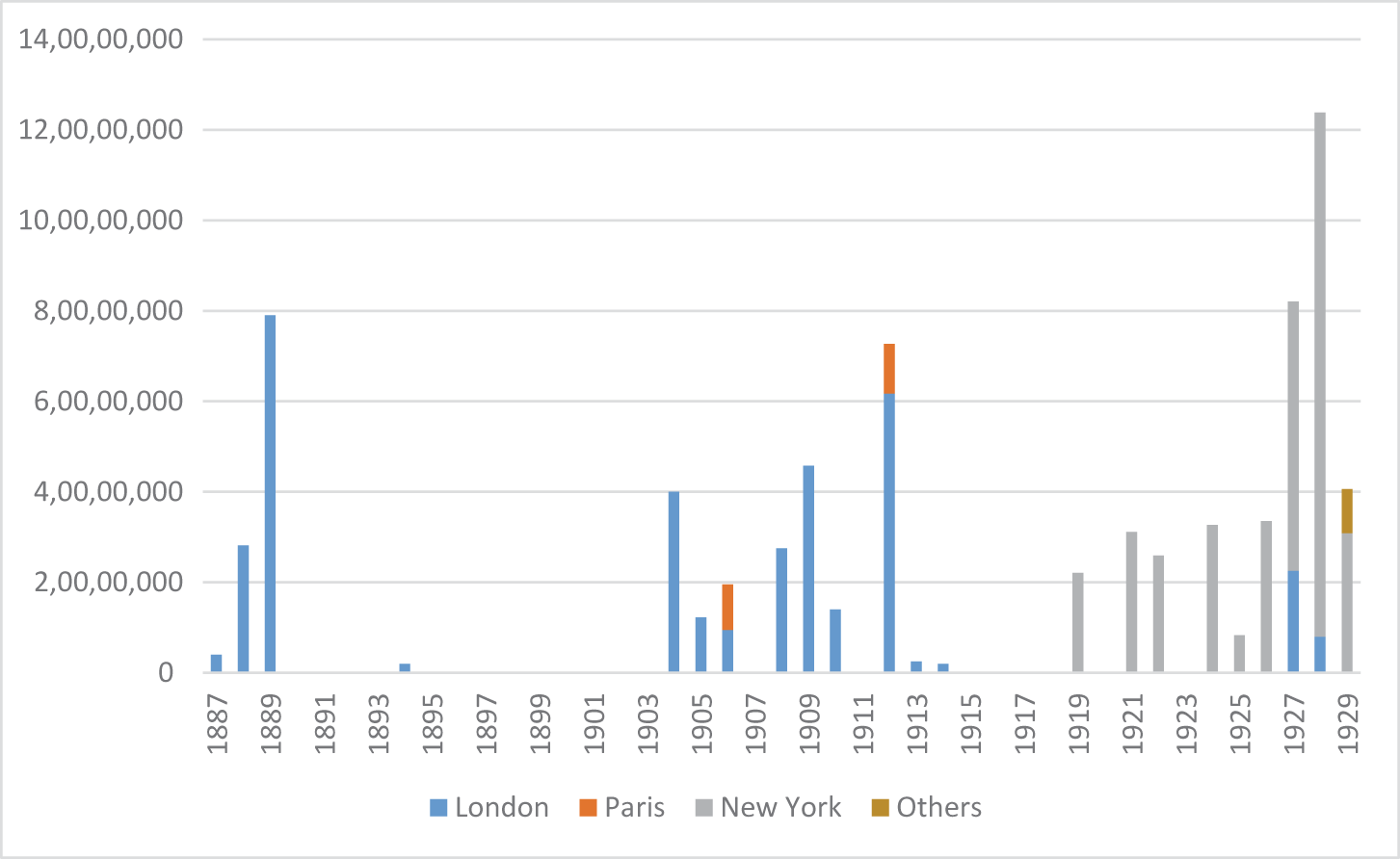
The issuance of Latin American municipal bonds in global capital markets can be analyzed in two distinct phases. The first phase, from 1887 to 1918, was dominated by the London capital market, followed at a distant second by Paris. This period also included a “dry decade” following the Baring Crisis of 1890, as well as the years of World War I (1914–1918), which significantly disrupted international financial flows. The second phase, from 1919 to 1929, saw the United States' emergence as the dominant exporter of capital to Latin American municipalities. During this period, a larger number of cities and countries accessed the New York market, leading to a marked increase in the annual volume of municipal debt issuance. Graph 1 shows the yearly issuance volume per primary capital market. Bonds issued in France were denominated in francs, those in New York in U.S. dollars, and others in Swiss francs, typically issued in Geneva, Zurich, and Amsterdam. All values have been converted into pounds sterling using contemporary exchange rates.
Volume of municipal foreign debt 1887–1929 (in £ pound sterling).

The first phase (1887–1918) was clearly led by London. Of the forty-five municipal bonds issued during this period, thirty were issued exclusively in London, two in Paris, two in New York, and eleven jointly in London and secondary markets such as Paris, Brussels, Berlin, Amsterdam, and Switzerland. The issuance of the first municipal bond in London in 1887 coincided with a period of extraordinary growth and integration in global financial markets and of optimism for Latin American sovereign debt (Flandreau and Zumer, Reference Flandreau and Zumer2004; Flandreau and Flores, Reference Flandreau and Flores2012). Industrialized European economies were actively exporting capital due to relatively low returns on domestic investments. In the United Kingdom, for example, the Bank of England’s discount rate averaged 4.18% from 1880 to 1914, reaching a historic low of 2% in 1894–1895. Yields on consols—British sovereign debt—were even lower, averaging 2.18% during the period and dipping to 1.96% in 1897 (Mitchell, Reference Mitchell1988). Even within European municipal markets, yields were notably low. By the 1910s, returns on municipal bonds in countries such as France, Belgium, and Austria ranged from 2% to 2.5% annually. Moreover, these securities suffered from relatively low liquidity. Municipal bonds typically involved lower nominal values than sovereign debt and were less attractive to institutional investors. Compounding this issue, many municipal bonds in France, Belgium, and Austria were issued as lottery bonds. These were regular interest-bearing bonds with quarterly coupon payments and principal repayment, but they also included semi-annual drawings offering large cash prizes. This structure appealed to small and inexperienced investors, who were willing to accept lower yields in exchange for the chance to win a prize, a practice that hindered liquidity, as noted by contemporary observers (Oosterlinck et al., Reference Oosterlinck, Blocher and Gulati2020; Todd and Yates, Reference Todd, Yates, Barreyre and Delalande2020, pp. 89–91).Footnote 10
In addition to the low returns on British and continental public debt, the first wave of financial globalization saw intense competition within the finance industry. Since the major clients for external sovereign debt were already secured by the large private houses in Europe, newer and less reputable banks sought to carve out new investments in an increasingly crowded market. This led them to target subnational Latin American bonds. The majority of banks involved with Latin American Municipal debt were second-tier and/or joint stock corporations, often operating as syndicates (Flandreau and Flores, Reference Flandreau and Flores2009).Footnote 11 According to Cairncross (Reference Cairncross1953), the costs of issuing bonds for inexperienced and smaller entities were significantly higher compared to national governments, where mid-sized banks were also willing to issue smaller amounts and operate in the riskier “contracting system.”Footnote 12
The 1880s witnessed a surge in these municipal bond issues, particularly in London and five other European markets. The first wave of issuances was led overwhelmingly by Argentine municipalities, which accounted for ten of the fourteen municipal bonds issued in that decade. This mirrored broader trends in British investment: by the late 1880s, Argentina was the destination for approximately 37% of all British portfolio investment in Latin America, and municipal governments benefited from this influx of capital. Many municipalities participated in the broader credit boom of the 1880s, borrowing to fund urban infrastructure projects and leveraging access to the recently founded Provincial Banks, which themselves were often capitalized with foreign loans.Footnote 13
However, this period of overindebtedness culminated in the Baring Crisis of 1890, which had devastating effects on the reputation of Latin American securities in international capital markets. The 1890s saw the virtual disappearance of Latin American municipal bonds from international markets. A notable exception was the city of Valparaíso, which successfully issued a bond in 1894 to finance the construction of its water supply system. Nevertheless, the sharp decline in municipal issues during this period suggests that Argentine subnational entities were perceived as having played a role in triggering the Baring Crisis, damaging investor confidence in similar securities across the region. Contemporary reports from the Council of Foreign Bondholders and other financial publications indicated that the troubled performance of Argentine municipalities had a spillover effect on the credibility of other Latin American subnational borrowers.Footnote 14
The period from 1904 to 1918 marked the return of Latin American municipalities to international capital markets. Although the outbreak of the First World War in 1914 caused a temporary strain on European capital markets, municipal borrowing continued. During the war years (1914–1918), six Latin American municipal bonds were issued—four in London and two in New York—underscoring the resilience of the market, even under adverse global conditions.
This broader period was characterized by the leadership of Brazilian municipalities, which accounted for twenty of the issues, followed by seven from Chile. Brazil’s favorable position in international capital markets was largely the result of the successful renegotiation of its national debt during the 1890s through the “funding loans” (Fritsch, Reference Fritsch and Abreu2014). This positioned its cities to seek foreign investment for urban infrastructure. Notably, the Brazilian municipal borrowing boom was not confined to cities linked to the dominant coffee economy. In fact, twelve out of the twenty issues came from cities not directly associated with coffee production. The expansion of the rubber boom in the Amazon (e.g., Belém and Manaus), the influx of European immigrants into the south (e.g., Porto Alegre and Pelotas), and the revitalization of sugar exports in the northeast (e.g., Salvador and Recife) provided a broad economic foundation for these borrowings.Footnote 15
In Chile, municipal borrowing was likewise shaped by economic expansion. The growth of the nitrate economy in the Atacama desert and the integration of southern provinces following military campaigns in the 1890s created fertile ground for cities like Antofagasta and Concepción to seek funding through international bond markets.
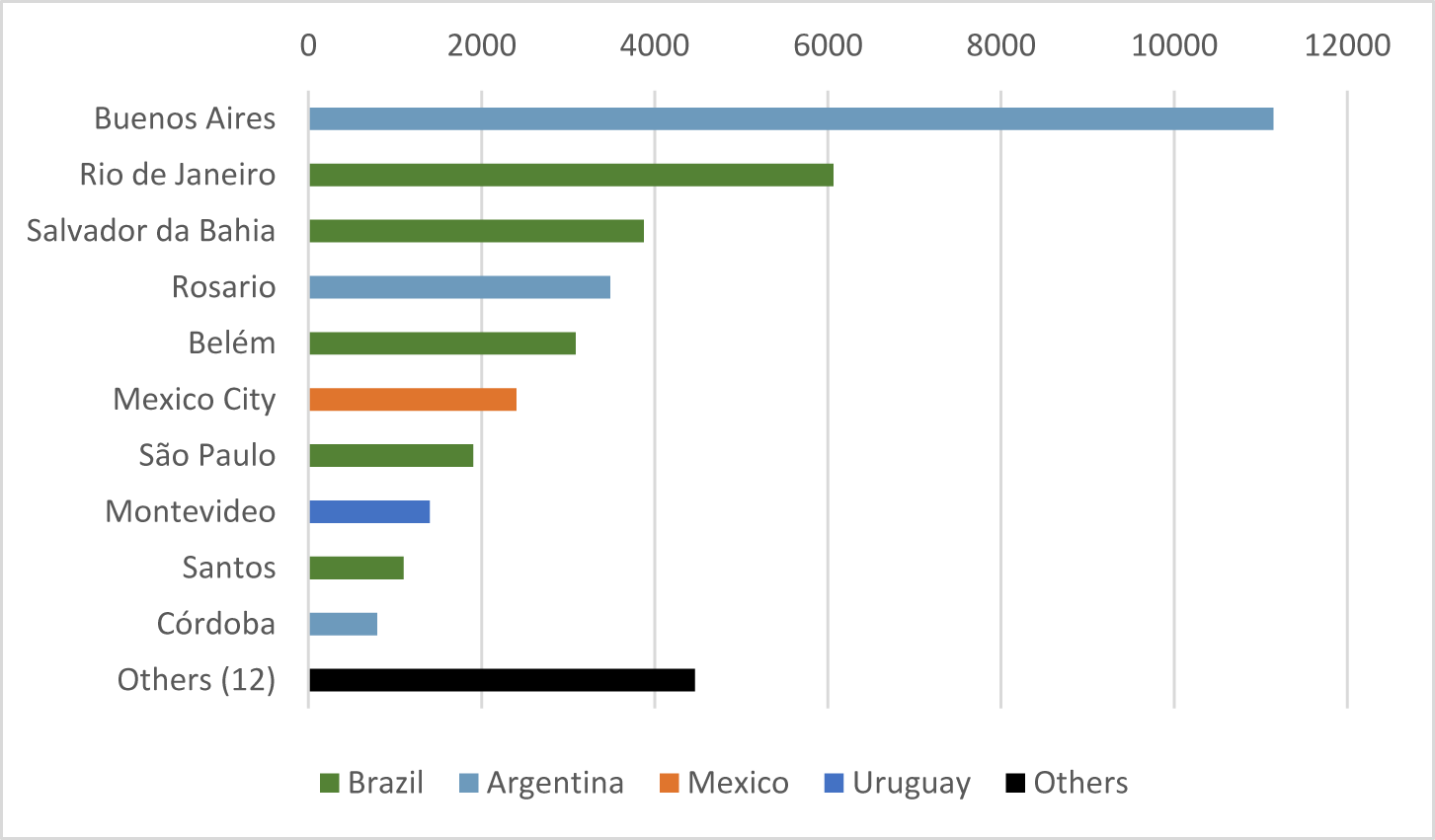
Graph 2 shows the aggregate volume issued by the top ten cities between 1887 and 1918. All amounts were converted to British pounds. This first period evidences the protagonism of Argentine and Brazilian cities, especially the unchallenged leadership of Buenos Aires. It also highlights the more pronounced position of capital cities, while noting the considerable number of other issuing cities during the period (12).
Top ten Latin American issuing cities 1887–1918 (aggregate volume in £ thousands).

Many of the financial institutions facilitating these transactions were British banks either established in Latin America or specializing in the region. These included the Anglo South American Bank, London Bank of Mexico & South America, London & Brazilian Bank, River Plate Trust, Bank of Tarapacá & Argentina, and the Bank of London & South America. In total, 23 different British banks were involved in underwriting Latin American municipal bonds during this phase.
A second phase, spanning from 1919 to 1929, was shaped by structural transformations in global finance that led to the rise of the United States, specifically New York City, as the preeminent hub for Latin American bond issuance. This shift reflected both the postwar weakening of European capital markets and the growing appetite of U.S. investors for foreign debt (Michie, Reference Michie2006, p. 151). Of the thirty-two municipal bonds issued in this decade, twenty-six were placed in New York, one was issued jointly in New York and London, four were issued in London alone, and one was issued in Amsterdam and Zurich. Notably, none were issued in Paris, Brussels, or Germany, highlighting the sharp postwar contraction of continental European markets.
Table 2 provides data on the average cost of capital for Latin American municipal bonds in London for the whole period and in New York in the 1920s. The table shows the average coupon rateFootnote 16 for Latin American issues in each decade and the average yield on British consols (and for U.S. Treasury bonds in the 1920s). The table shows that the dry decade of 1890 was met with higher credit costs for the decade. Conversely, the 1910s witnessed the lowest average borrowing costs, coinciding with the period when most Brazilian and Chilean cities entered European bond markets. In the 1920s, although credit costs were higher in New York compared to London, the table suggests that a combination of structural and geopolitical factors increasingly drew Latin American borrowers toward the U.S. market. While London turned its attention inward, increasingly focused on managing its imperial commitments, the U.S. banking system was undergoing rapid internationalization. U.S. banks expanded their operations abroad, and New York developed from a domestic financial center into a global one, particularly attractive to Latin American borrowers (Cassis, Reference Cassis1992, pp. 152–180). Reflecting this shift, U.S. portfolio investment in Latin America tripled between 1914 and 1919, and quadrupled between 1920 and 1924 (Lewis, Reference Lewis1938). Among these rising flows was a growing interest in Latin American municipal securities.
Cost of capital for Latin American municipal bonds in foreign markets

Table 2 Long description
Latin American municipal bonds issued in foreign markets are summarized by decade, listing number of issues, average current yield, a government benchmark yield, and the yield spread between them. Issue counts rise from 14 in the 1880s to 30 in the 1920s, with a low of 1 in the 1890s. Average current yields stay near 5.6 to 6.2 percent from the 1880s through the 1910s, then increase to 7.1 percent in the 1920s. Benchmark government yields increase over time, from about 2.6 percent in the 1880s and 1890s to 3.5 percent in the 1910s and 4.5 percent in the 1920s; the 1920s also report an alternative benchmark value of 4.1 percent. Spreads are widest in the 1880s at about 3.5 percent and generally narrow to about 2.0 percent in the 1910s, then widen slightly in the 1920s to about 2.6 percent, or 3.0 percent using the alternative benchmark. Because the 1920s include two benchmark figures, the spread for that decade depends on which benchmark is used.
(Sources: Appendix. For consols yields, Mitchell (Reference Mitchell1988). For U.S. Treasury Bonds, Homer and Sylla (Reference Homer and Sylla2005).
The final years of the 1920s witnessed the highest levels of Latin American municipal debt issuance during the entire period under study. By this time, the United States’ financial influence in Latin America had expanded well beyond its earlier focus on Central America and the Caribbean. U.S. trade and financial activities now extended deeply into South America, driven by both growing economic ties and increasing investor familiarity with Latin American securities. This familiarity was, in part, the result of years of active financial promotion and education campaigns conducted by U.S. banks (Stallings, Reference Stallings1987, p. 73). Subnational foreign loans, which had accounted for 12% of the U.S. foreign portfolio in the 1910s, rose to 28% in the 1920s (Stallings, Reference Stallings1987, p. 128).
This second phase of borrowing also introduced a new set of countries and cities to international capital markets. The first Latin American municipal bond issued in the U.S. market came from the city of São Paulo in 1919. In the ensuing years, several of the region’s fast-growing capital cities turned to New York to secure foreign credit, reflecting the increasing dominance of the U.S. economy in the hemisphere. The 1920s thus became a defining moment for what could be termed the “age of capital cities,” as major urban centers such as Rio de Janeiro, Buenos Aires, Montevideo, Santiago, Lima, and Bogotá issued bonds in New York. Additionally, several Colombian cities—including Barranquilla, Medellín, and Cali—entered international capital markets for the first time, issuing their initial bonds between 1925 and 1928.
Graph 3 shows the aggregate volume issued by the top ten cities from 1919 to 1929. Although most of the loans were issued in U.S. dollars in the New York market, the figures were converted to British pounds for the purposes of comparison with the previous period. The rise of Colombian cities into the top ten marks the growing strength of U.S. financial markets within their traditional sphere of influence. In Brazil, the rise of São Paulo as the country’s industrial hub is reflected in its second position. The unchallenged leadership of Rio de Janeiro reflects subsequent borrowing for the constant remodeling of the city center during the 1920s, including the costly removal of two urban hills, contracted with U.S. companies (Rippy, Reference Rippy1950). It is also notable that the number of issuing cities outside the top ten increased to sixteen. This figure, however, would be considerably higher if one considers the Brazilian syndicated loan for southern cities in 1927, issued on behalf of seven cities, and the Chilean municipal consolidated loan of 1929, issued on behalf of sixty-five cities.
Top ten Latin American issuing cities 1919–1929 (aggregate volume in £ thousands).

Unlike their British counterparts, U.S. banks were more inclined to form syndicates to manage municipal bond issues. Of the 30 Latin American municipal bonds issued in New York during this decade, 17 were underwritten through syndicates—some involving up to six banks.Footnote 17 Prominent among these were Chase National Bank, Dillon, Read & Co., Bancamerica-Blair Corporation, and Brown Brothers. In total, 33 different American banks from all over the country participated in the underwriting of Latin American municipal securities, reflecting both the breadth and depth of U.S. engagement in the region’s subnational finance.
5. Modernity and efficiency with external borrowing
The primary purpose of municipal foreign loans in Latin America between 1887 and 1929 was to finance public works. These cities sought to develop both productive and administrative infrastructure—particularly in contexts where national governments were either unable or unwilling to invest in urban modernization. Out of the 78 municipal loans issued during this period, only eight were not associated with any form of public works.
The range of projects financed through external borrowing was broad, reflecting the diverse needs and ambitions of the issuing cities. Loan proceeds supported the construction of infrastructure such as water and sewage systems, street paving, electric lighting, slaughterhouses, and even luxurious cultural institutions like theaters (see Table 3). These initiatives were often framed as symbols of urban modernity and efficiency, aligning with broader discourses of progress and state-building prevalent in the early twentieth century.
Purposes of Latin American External Municipal Bonds, 1887–1929

Table 3 Long description
Municipal external bond issues in Latin America from 1887 to 1929 are grouped by stated purpose and counted by number of issues. Public works is the most common purpose with 35 issues, followed by combined public works and refinance with 22. Standalone refinance accounts for 8 issues, while waterworks accounts for 6; mixed categories are smaller, with public works and waterworks at 4 and waterworks and refinance at 3. Overall, purposes tied to public works appear far more frequently than those focused mainly on waterworks or refinancing. The table also defines what each category includes: public works spans civic buildings and urban infrastructure such as roads, bridges, paving, lighting, tramways, power plants, markets, and related improvements; waterworks covers water collection and distribution, drainage, sewage, and firefighting; refinance covers deficit financing and debt restructuring actions such as consolidation, conversions, redemptions, and acquisitions. Counts reflect stated purposes and do not indicate bond size, spending levels, or project completion.
(Sources: Appendix).
Despite this general emphasis on public infrastructure, many of the bond prospectuses published in financial newspapers, investor bulletins, and stock exchange filings were vague. A common phrase used in these documents was that the funds were intended for “general improvements,” without elaborating on specific projects. In many cases, the details of how loan proceeds were used had to be reconstructed through supplementary sources, including municipal legislation, national press reports, parliamentary debates, and historical studies.
Latin American cities were undergoing significant transformations due to economic and demographic growth, fueled by both internal and external migration. Capitals and port cities were most affected by these changes. As economic centers of their countries, cities like Rio de Janeiro, Buenos Aires, and Santiago experienced a surge in population and infrastructure projects.
In mid-nineteenth-century Brazil, there were 296 cities with populations over 10,000. That number rose to 580 by 1900 and to 958 by 1920, at which point Brazil had twelve cities exceeding 100,000 residents, with the federal capital of Rio de Janeiro reaching 1,157,853 in 1920.Footnote 18 Argentina had forty-two cities with over 10,000 people in the mid-nineteenth century, while Chile had only eleven. By 1914, Argentina had 227 such cities, with Buenos Aires emerging as the largest metropolis in South America, home to 1.5 million people. In Chile, the number of cities with more than 10,000 residents rose to 113 by 1920, with the capital, Santiago, reaching a population of 500,000.Footnote 19
The improved economic situation demanded modern ports and better roads connecting hinterlands to railway systems. Given their central importance to national economies, ports and docks were typically the responsibility of national or state/provincial governments, as in the cases of Buenos Aires in the 1880s (Puerto Madero), and Rio de Janeiro and Salvador in the 1900s. The complementary apparatus, such as street broadening and lighting, was usually financed by the cities. Additionally, many of Latin America’s semi-manufactured goods were processed in these cities, leading to the construction of public slaughterhouses and warehouses. The emergence of basic industries producing consumer goods—such as garments, beer, and cigarettes—attracted large numbers of rural workers to urban areas, creating a need for more effective public transportation systems, such as tramways, and for public housing (Romero, Reference Romero1999; Almandoz, Reference Almandoz2018).
These practical needs were accompanied by new aspirations among both traditional and emerging elites. A new set of aesthetic standards, heavily inspired by European metropolises, became a guiding vision for these elites, many of whom were directly involved in issuing municipal external debt. They demanded public spaces that adhered to the urban principles promoted by the urban reforms of Paris between 1852 and 1870. The Paris Exposition of 1900 further reinforced the aesthetic ideals of Latin American elites, serving as a symbolic gateway to the vision of a modern and prosperous city (Almandoz, Reference Almandoz2018, pp. 150–158).
The Belle Époque era cemented theaters, jockey clubs, and promenades as the preferred social spaces for both national and expatriate elites. Many of these theaters were under municipal administration, such as the Theatro Municipal do Rio de Janeiro and the impressive Theatro Amazonas in Manaus. Perhaps the most prestigious of these was the Teatro Colón in Buenos Aires, inaugurated in 1908 and financed through municipal external debt (Miranda, Reference Miranda2023). This new spirit of municipal modernity also materialized in the construction of new City Halls designed by foreign architects, as seen in the cases of Rosario and Concepción, both financed with municipal external debt. It was also reflected in the development of large and modern promenades, such as the southern extension of Montevideo’s wide rambla along the Río de la Plata, funded through a foreign loan in 1926.Footnote 20
Theaters, railway stations, and administrative palaces required large open spaces, which were difficult to find in the old, cluttered colonial city centers. Inspired by the Haussmann reforms in Paris, the mayor of Rio de Janeiro, Francisco Pereira Passos, led a massive project to redesign the city center of the Brazilian capital. This project included the construction of a wide avenue and the invitation of Belgian, Italian, and French architects to design eclectic and Art Nouveau façades for nearby commercial and administrative buildings (Needell, Reference Needell2012, pp. 79–91). These structural reforms, initiated in 1903, took nearly two decades to complete and were financed through five municipal loans (1904, 1909, 1912, 1921, 1928) issued in London, New York, Berlin, and Amsterdam. Buenos Aires followed a similar path when, in 1907, Mayor Carlos Alvear commissioned plans for the redesign of Plaza de Mayo as part of a broader urban modernization effort that included wider and diagonal avenues styled after Haussmann’s reforms (Almandoz, Reference Almandoz2018, pp. 150–158). These reforms prompted the issuance of £2.9 million in foreign municipal debt in 1909, raised in the London and Berlin markets.Footnote 21
Capitals and middle-size cities alike tapped into international capital markets by issuing municipal debt. Even smaller cities like Tucumán in Argentina and Viña del Mar in Chile managed to issue bonds in London. In Brazil, the newly built capital of the State of Minas Gerais, the city of Belo Horizonte, also turned to international capital markets to build its electric and water systems.Footnote 22 In the Amazon region, the rubber towns of Manaus and Belém issued multiple municipal bonds in London, Paris, Brussels, and Switzerland between 1906 and 1919. However, the decline in rubber prices following the rise of British and Dutch production in Southeast Asia led to economic challenges for these cities (Musacchio and Zephyr, Reference Musacchio, Zephyr, Topik, Marichal and Frank2006).
The rapid urbanization in Latin America brought significant challenges, particularly in sanitation and public health. As cities grew, the need for improved infrastructure became apparent, leading to a second category of municipal loans specifically for waterworks. These projects—including water collection and distribution, drainage, sewage systems, and firefighting—were separated from the general public works category due to their critical role in maintaining public health and their considerable financial and political impact. Waterworks usually had strong state involvement, given their essential role in urban development. By 1900, 82% of waterworks in England were state-owned, as were 75% in France and 53% in the United States (Millward, Reference Millward2005, p. 18). In Latin America, it was no different.
Loans for waterworks often had higher nominal values per project and were in great demand, reflecting the certainty that investors had in the centrality of these projects for municipalities.Footnote 23 These loans ranged from direct municipal borrowing to finance waterworks to loans issued on behalf of specific public companies. Epidemics, such as those in Valparaíso during the 1880s and Rio de Janeiro in the 1900s, often resulted in the temporary shutdown of ports, severely affecting national and international commerce. The sanitary conditions of a city were often advertised in bonds prospectuses as good credentials for borrowing cities, creating a direct link between sanitation and productivity in investors’ minds.Footnote 24
Urban reforms aimed not only to modernize and beautify cities but also to improve sanitation by creating wider avenues and open spaces that facilitated better air circulation, which was believed to help control the spread of disease. Rapid economic growth in port cities, industrial towns, and political capitals attracted large numbers of rural migrants and foreign immigrants, leading to crowded living conditions in urban centers, known as conventillos in Buenos Aires, casas chorizo in Mexico City, and cortiços in Rio de Janeiro. Over time, these populations moved to the peripheries or settled on urban hills as city centers were redeveloped.
Overcrowded living conditions and the high movement of people in port cities facilitated the spread of contagious diseases, including typhus, cholera, and yellow fever, which could have devastating effects. Valparaíso’s severe cholera epidemic in 1886 prompted both local and national action. Water distribution was a persistent problem for the port city, given its peculiar hilly geography. The cholera epidemic, a disease mainly spread through contaminated water, prompted the expansion and improvement of the precarious water collection and distribution systems, especially in the neighborhoods located on the city’s hills (Madrid, Reference Madrid2017). The city’s first external municipal debt, £200,000 issued in London in 1894, was directed to fund the Empresa de Aguas Potables, a public company dedicated to managing waterworks. A subsequent £250,000 loan was issued in 1912 to finance additional sewage, water distribution, and firefighting infrastructure.Footnote 25
In Brazil, the city center of Rio de Janeiro had not seen significant changes since colonial times, and the rapid growth in coffee exports exacerbated the frequency of epidemics in the early 20th century. Urban reforms aimed at enlarging public spaces and displacing the residents of crowded slums (cortiços) to improve hygiene met with resistance, most notably during the 1904 Vaccination Riot, which opposed mandatory yellow fever vaccination amid heavy construction in the city center. The foreign municipal loans of 1921 and 1928 were specifically issued to complete the demolition of Morro do Castelo, a densely populated hill in the old city center, to improve air circulation, which was then considered crucial for disease prevention (Bouças, Reference Bouças1955, p. 471). The southern city of Porto Alegre was also constantly affected by floods from the Guaíba River since 1873 (Oliveira, Reference Oliveira1993, pp. 244–246). The disastrous flood of 1905 and subsequent smallpox epidemics led the municipality to turn to the London and Amsterdam markets to issue a £600,000 loan in 1909 to build a water system to help protect the city.Footnote 26
A third category of loans was for refinancing purposes. This included controlling budgetary deficits, consolidating debt, converting internal debt into external debt, redeeming bonds, and acquiring private companies—such as the tramways in Salvador da Bahia in 1918.Footnote 27 Cities typically had a wide range of income sources to offer as collateral for their debts.
While sovereign debt was primarily anchored in indirect and external taxes (such as foreign trade customs duties), cities relied more on direct and internal taxes. Table 4 shows all taxes offered as collateral, as identified in the sources for the Latin American municipal bonds studied. The most frequently offered taxes were direct taxes, especially house and profession taxes. Second came indirect taxes (excise) and taxes on services, usually those provided by the public works financed with the loan proceeds—such as waterworks in Valparaíso in 1894 or slaughterhouses in Rosario in 1887.Footnote 28 Many municipalities also adopted varied payment strategies to attract underwriting banks and investors. The city of Concepción, for instance, explicitly offered an increase in its committed municipal taxes in 1913. Salvador da Bahia offered to create a gold-denominated import tax to pay for the bond issued in London and Paris in 1912.Footnote 29
Taxes and revenues offered as collaterals

Table 4 Long description
Collateral options are organized into three categories: direct taxes, indirect taxes, and incomes or revenues. Direct taxes include house tax, licensing tax, taxes on trades and professions, industries, public security, automobiles, public markets, light and telephones, slaughterhouses, paving, and cleaning. Indirect taxes include customs duties, excise duties on alcohol and tobacco, taxes on sewage and water services, and taxes on tramways. Incomes or revenues include national and state or provincial guarantees, mortgages on city property such as roads, buildings, and land, and revenues from city-owned public services such as waterworks, turnpikes, tramways, and houses. The table is a categorical inventory rather than a quantitative comparison, so it does not indicate amounts, rankings, or changes over time.
(Sources: Appendix).
Direct taxes had a more immediate and visible impact on the mood of taxpayers, particularly in localized municipal settings. In the U.S. and British domestic municipal bond markets, financial decisions often tied taxpayers of all classes closely to local politics, directly influencing municipal governance (Monkkonen, Reference Monkkonen1988, p. 152). In Latin America, however, local governments generally remained fiscally weaker relative to central governments, limiting their capacity to rely on domestic capital markets and reinforcing the turn toward foreign borrowing. In the case of Rio de Janeiro, the urban reforms of the 1900s led Mayor Pereira Passos to implement strict measures to raise revenue for the reforms and associated debts. Passos was even dubbed a “Municipal Dictator” by the press and his political adversaries due to his relentless pursuit of budget surpluses (Benchimol, Reference Benchimol1992, pp. 235–267).
Another important form of collateral offered by municipalities was state and national guarantees. These guarantees varied according to countries’ political arrangements and local interests (Table 5).
Guarantees

Table 5 Long description
Guarantee status by country is summarized by counting issues with no guarantees and with central government, state or provincial, or other guarantees. Brazil reports 34 issues, including 20 with no guarantees, 5 with central government guarantees, and 9 with state or provincial guarantees. Argentina has 21 issues, with 17 having no guarantees, 4 with central government guarantees, 2 with state or provincial guarantees, and 1 with other guarantees. Chile lists 11 issues, all covered by central government guarantees, with no issues shown in the other categories. Colombia has 6 issues, all with no guarantees. Mexico has 1 issue with a central government guarantee and none without guarantees. Peru has 2 issues, both with no guarantees, and Uruguay has 3 issues, all with central government guarantees. Some counts include notes tied to specific entries, so totals should be read with those annotations in mind.
(Source: Appendix. * 3 Controlled, **Banco Nacional de la República; *** 2 Controlled).
There were three types of guarantees identified in all 78 Latin American municipal bonds issued in the period: Central Government Guarantees, State/Provincial Guarantees, and Special Guarantees, such as one for the City of Buenos Aires in 1888, guaranteed by the Banco Nacional de la República. Guarantees were explicated in bond prospectuses as an effective way of luring investors, as commonly noted by contemporary observers.Footnote 30
Central governments' guarantees were usually offered for the nation's capitals, such as the case for Mexico City, Montevideo, all but one Rio de Janeiro loan, and five Buenos Aires loans. The case of Chile is also notable, where all loans had to be previously approved by the presidency and offered guarantees. Among central government guarantees, the case of three Buenos Aires loans (1889, 1913, and 1914) and two Chilean issues (Santiago 1928 and a Consolidated 1929, for 65 municipalities) had a modality of controlled issue. In these cases, the Central Government was responsible for collecting the taxes and other collateral offered, and for making the payments to the underwriting banks.
State/provincial guarantees were also present in countries with federative institutional arrangements, as in the cases of Brazil and Argentina. Many Brazilian states were issuing debt for themselves while also offering full guarantees for their capital cities. The case of Rio Grande do Sul is notable, where the state offered full guarantees for a joint issue of seven cities in 1927, besides three other loans for its state capital, Porto Alegre. Despite these secured bonds, most of the loans had no guarantees offered by central or provincial/state governments, pointing to a high level of autonomy of Latin American cities in capital markets.
6. Conclusions
The rise of Latin American municipal bonds resulted from significant structural changes on both the demand and supply sides. Evolving economic, political, and social conditions in the region created a pressing need for new sources of financing, particularly given the weakness of domestic capital markets. Moreover, the relatively late fiscal decentralization of many countries, together with limited local tax revenues, constrained the development of robust domestic credit markets for subnational entities. As a result, municipalities increasingly turned to external borrowing, taking advantage of the growing availability of international capital and institutional reforms that facilitated access to foreign markets. Given the historically centralized nature of Latin American tax systems, the relatively broad scale of municipal foreign indebtedness further underscores the significance of this phenomenon.
This demand was met by an expanding global financial system, which had become increasingly competitive with the emergence of new joint-stock banks eager to secure deals—even if they involved higher risk and smaller amounts. This research also highlights important shifts within global capital markets, particularly the transition of financial leadership from London to New York during the 1920s. This shift affected not only sovereign debt but also municipal borrowing, marking a new phase in Latin America’s integration into international finance.
Economic and demographic growth necessitated new public spaces, urban infrastructure, and productive facilities. Loans were issued to finance public works, sanitation projects, and to refinance existing debt, reflecting the cities’ critical role in the global economy. Cities were the final and most sensitive link in the long chain of Latin American export economies. Political strife among regional and national elites, aspirations for modernization, and the threat of popular uprisings drove city elites to seek much-needed funding. The solution was found in international markets, adding a new layer of complexity to the interaction between the most local and peripheral points in the global economy—Latin American cities—and global capital markets.
The analysis of Latin American foreign municipal debt presented in this article opens several promising avenues for further research. The use of municipal bonds as a financial instrument highlights how modernization and economic expansion in Latin America were not exclusively national projects, but were also deeply shaped by local initiatives. While the article confirms that large cities and national capitals were the principal borrowers—helping to explain why places such as Rio de Janeiro, Buenos Aires, and Montevideo advanced so far ahead of many mid-sized cities within their respective countries—it also shows that foreign borrowing was by no means confined to big cities. Although they enjoyed a clear head start and easier access to funding for costly infrastructure projects, national capitals did not monopolize international credit markets.
Indeed, the high number of medium-sized cities accessing foreign capital, often repeatedly, is one of the most revealing findings of the study. Cities such as Paraná, Concepción, and Porto Alegre turned two, three, and even four times to financial centers such as London, New York, and Paris in search of funding. This repeated engagement suggests a much higher level of integration of local entities into global capital markets than is usually assumed. Municipal emissaries did not merely secure financial resources; they also circulated institutional practices, technical knowledge, and ideas about how to connect their cities more effectively to the global economy.
A further important finding concerns the institutional conditions of subnational borrowing. Contrary to what might be expected, federal political arrangements were not a necessary precondition for municipal access to international markets. While cities in the federal republics of Brazil and Argentina were indeed the largest issuers, municipalities in highly centralized states such as Chile and Colombia also borrowed abroad on multiple occasions. This evidence suggests that international capital markets exerted a powerful influence across Latin America regardless of domestic political organization, reinforcing high levels of integration between distant localities in the region and global financial markets.
Urban governments became key actors in shaping international financial flows, often operating with a high degree of autonomy and, at times, in opposition to national authorities. This tension—evident in cases such as Rosario and the Amazonian cities of Brazil—reveals the importance of local legislation in approving foreign loans and illustrates what could be termed a triangular globalization, where the interplay between local, national, and international forces was far from linear or uniform.
Furthermore, the depiction of Latin American cities’ insertion into global financial circuits challenges dominant historiographical narratives by showing a more heterogeneous and contested process of integration. Local authorities, through their capacity to contract debt—and at times default—could significantly influence not only their cities’ financial futures but also the broader national credit landscape. These disputes underscore the porous boundaries between local and national sovereignty in fiscal matters and highlight the role of foreign investment as a key driver in the reshaping of local political economies.
In this sense, municipal indebtedness offers a valuable lens for understanding the dynamics of local-national politics in Latin America. It shows how global capital markets were shaped not only by economic indicators but also by the legal, political, and institutional frameworks within individual Latin American cities. This intersection of the global and the local—of international finance and municipal governance—opens new perspectives on Latin America’s integration into the world economy and suggests that globalization, in practice, was a much more complex and negotiated process than often assumed.
Acknowledgements
I would like to thank the editor of the Revista de Historia Económica – Journal of Iberian and Latin American Economic History and the reviewers for their careful and constructive evaluations throughout the review process. This article is part of the research project “Finanzas Glocales en América Latina: Valparaíso, Rosario y Río de Janeiro en la conformación del mercado global de bonos municipales, 1887–1929,” directed by IR José Augusto Ribas Miranda and funded by ANID Chile through Fondecyt Iniciación Grant No. 11240062.
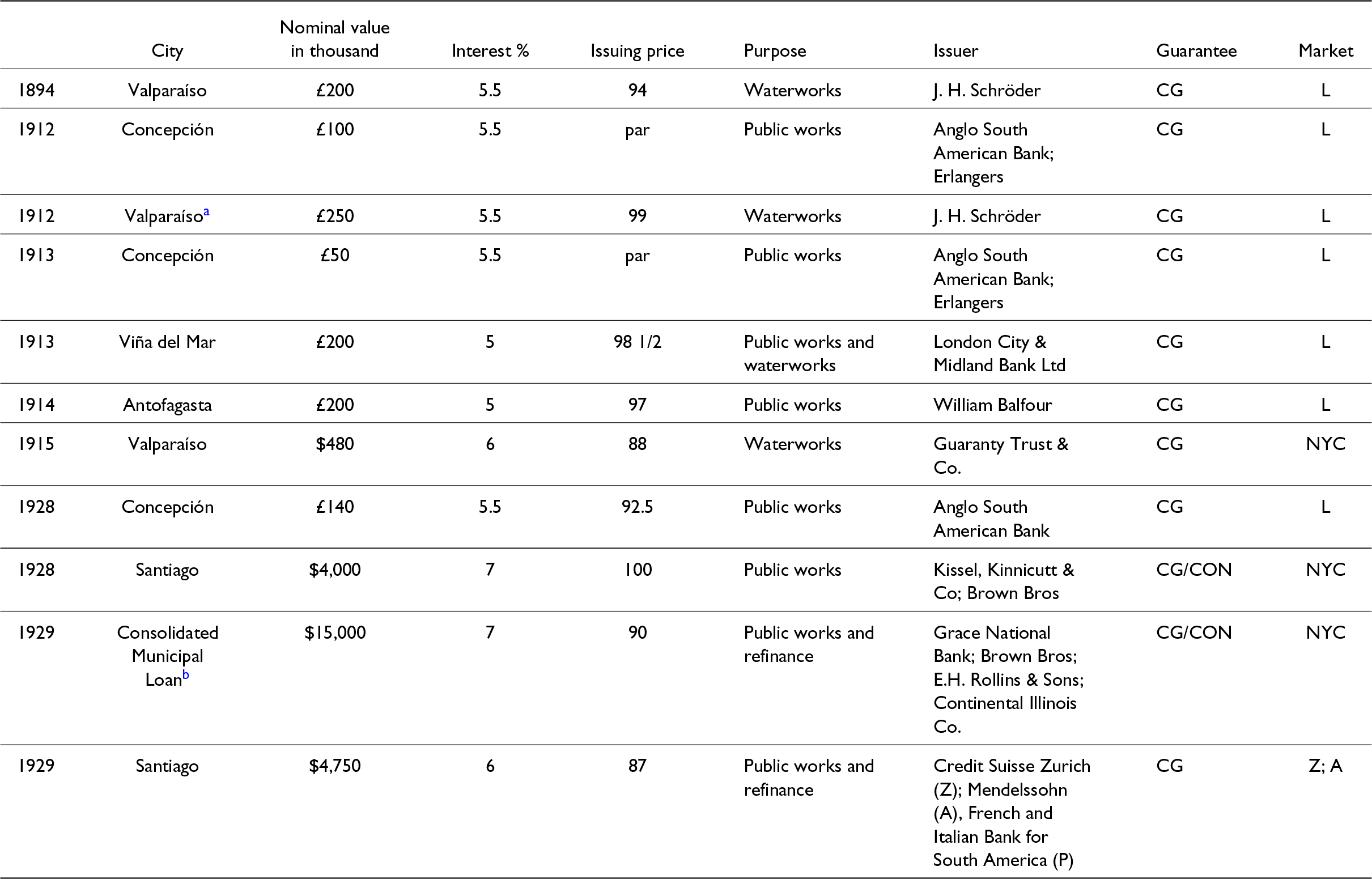
APPENDIX
List of all Latin American municipal bonds issued in foreign capital markets between 1887 and 1929
Market: L-London; P-Paris; NYC-New York City; B-Berlin; F-Frankfurt; H-Hamburg; BS-Brussels; A-Amsterdam; SW-Switzerland (city not specified).
Guarantee: CG-Central Government; CG/CON-Controlled by the Central Government; ST/PRO- State/Provincial; O-Other
1. Argentina

Sources: Stock Exchange and Investors sources: Annuaire de la Compagnie des Agent de Change. Available at ≪ https://dfih.fr/≫. Access 02/04/2025; Reports Council of the Corporation of Foreign Bondholders 1887–1929. For the cases of Rosario loans: London Archives Corporation of Foreign Bondholders: Correspondence CLC/B/060. Various, Hambros Bank Limited. Loans and prospectuses. London Stock Exchange Guildhall Library, London: Rosario 188715B/230, 1888 17B148, 1898 49B/577, 1901 72B/35, 1905 98B/300, 1908 117B/365; Official Documents: Boletín Oficial de la República Argentina. Various Years Memoria del Departamento de Hacienda 1887–1932; Newspapers: Investors Monthly Manual 1887–1929, The Economist 1887–1929, The Times 1887–1929, Financial Times 1887–1929, Commercial and Financial Chronicle 1887–1929, The New York Times 1887–1929. Bibliography: Cortes Conde (1995), Marichal (Reference Marichal1989); Stallings (1990). Database: The database shared by professors Peter Lindert and Carlos Marichal was used to cross-check information on nominal value and issuing price of Buenos Aires (1909, 1913, and 1914); Córdoba (1887, 1927); Rosario (1887; 1888, 1889); Paraná (1889). Many thanks to professors Carlos Marichal and Peter Lindert for sharing their database.
2. Brazil

a The Rio de Janeiro 1904 Loan was a £4,000,000 internal loan issued in sterling by the Banco da Republica do Brasil. From the total amount issued, £1,000,000 was issued in London by Seligman Brothers.
b Internal loan in pound sterling also issued in London.
c Funding loan.
d Funding loan.
Sources: Stock Exchange and Investors sources: Annuaire de la Compagnie des Agent de Change. Available at ≪ https://dfih.fr/≫. Access 02/04/2025; Reports Council of the Corporation of Foreign Bondholders 1887–1929; London Archives Corporation of Foreign Bondholders: Correspondence CLC/B/060. Various; Loans and prospectuses. London Stock Exchange Guildhall Library, London Belo Horizonte 104B/46, Porto Alegre 1909 123B/566; Rio de Janeiro 1889 26B/476, 1890 26B/449, 1905 96B/41, 1905 101B/41, 1909 127B/1052, 1909 127B/162, 1912 166B/800, 1912 166B/802; Official Documents: Diário Oficial da União. Various Years, Relatórios do Ministério da Fazenda 1887–1932, Relatórios dos Governadores dos Estados 1887–1932; Newspapers: Investors Monthly Manual 1887–1929, The Economist 1887–1929, The Times 1887–1929, Financial Times 1887–1929, Commercial and Financial Chronicle 1887–1929, The New York Times 1887–1929, The Brazilian Review 1899–1913. Jornal do Commercio (RJ); 1887–1929. Jornal do Commercio Retrospecto Comercial (RJ) 1887–1929. O Paiz (RJ) 1887–1929. Correio da Manhã (RJ) 1901–1929. A Federação (RS): 1887–1929.
Bibliography: Abreu (1973), Bouças (Reference Bouças1955), Hanley (Reference Hanley2018), Levy (1985), Marichal (Reference Marichal1989), Stallings (1990), Lewis (Reference Lewis1938). Database: The database shared by professors Peter Lindert and Carlos Marichal was used to cross-check information on nominal value and issuing price of: Manaus (1906); Salvador da Bahia (1906, 1912); Belo Horizonte (1905); Belém (1905, 1912, 1919); Recife (1910); Niterói (1928); Rio de Janeiro (1889, 1904, 1912, 1921, 1928, 1928); Pelotas (1912); Porto Alegre (1909, 1922, 1926); São Paulo (1908, 1919, 1922, 1927); Santos (1888, 1927). Many thanks to professors Carlos Marichal and Peter Lindert for sharing their database.
3. Chile

a Issued by the Compañia de Aguas de Valparaíso, but under full responsibility of the municipality. Considered Municipal by the Central Government Official Records.
b Contracted by a syndicate of 65 municipalities of the country, of which 55 never had funded debt. Supervised by the Central Government.
Sources: Stock Exchange and Investors sources: Annuaire de la Compagnie des Agent de Change. Available at ≪ https://dfih.fr/≫. Access 02/04/2025; Reports Council of the Corporation of Foreign Bondholders 1887–1929; London Archives Corporation of Foreign Bondholders; Loans and prospectuses. London Stock Exchange Guildhall Library, London Antofagasta 1914 182B/523; Concepción 1913 171B/255; Concepción 1914 179B/191, Valparaíso 1894 34B/150, 1912 168B/1042; Viña del Mar 1913 176B/899.; Official Documents: Diário Oficial de la República, Various Years, Dirección Nacional de Estadísticas de Chile. Finanzas Bancos y Cajas Sociales 1928–1939. Archivo Nacional, Dirección Nacional de Estadísticas de Chile. Hacienda 1910–1927. Archivo Nacional, Dirección Nacional de Estadísticas de Chile. Municipalidades 1873–1910. Archivo Nacional, Municipalidad de Valparaíso/Intendencia de Valparaíso 1884–1914. Archivo Nacional, Municipalidad de Antofagasta 1911–1916—Archivo Nacional, Municipalidad de Concepción 1912–1915—Archivo Nacional, Newspapers: Investors Monthly Manual 1887–1929, The Economist 1887–1929, The Times 1887–1929, Financial Times 1887–1929, Commercial and Financial Chronicle 1887–1929, The New York Times 1887–1929, El Mercurio (Chile) 1887–1929. Bibliography: Marichal (Reference Marichal1989); Stallings (1990), Lewis (Reference Lewis1938). Database: The database shared by professors Peter Lindert and Carlos Marichal was used to cross-check information on nominal value and issuing price of: Antofagasta (1912); Concepción (1913, 1928); Santiago (1928, 1929); Valparaíso (1912, 1915); Viña del Mar (1913). Many thanks to professors Carlos Marichal and Peter Lindert for sharing their database.
4. Colombia, México, Peru, and Uruguay

Sources: Stock Exchange and Investors sources: Annuaire de la Compagnie des Agent de Change. Available at ≪ https://dfih.fr/≫. Access 02/04/2025; Reports Council of the Corporation of Foreign Bondholders 1887–1929; London Archives Corporation of Foreign Bondholders; Newspapers: Investors Monthly Manual 1887–1929, The Economist 1887–1929, The Times 1887–1929, Financial Times 1887–1929, Commercial and Financial Chronicle 1887–1929, The New York Times 1887–1929. Bibliography: Avella (2003), Ferrando (1969), Marichal (Reference Marichal1989), Stallings (1990), Lewis (Reference Lewis1938), Gamboa (1982). Database: The database shared by professors Peter Lindert and Carlos Marichal was used to cross-check information on nominal value and issuing price of Mexico City (1889). Many thanks to professors Carlos Marichal and Peter Lindert for sharing their database.