I
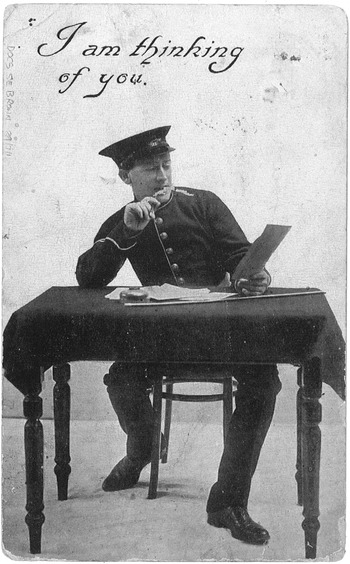
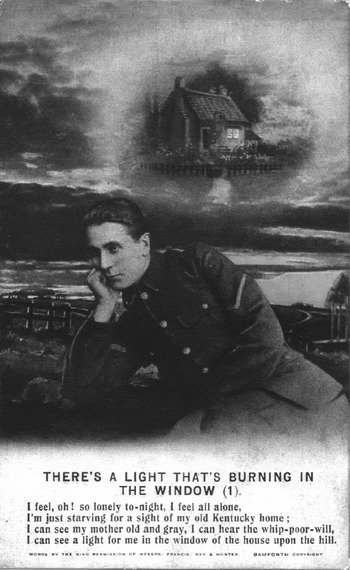
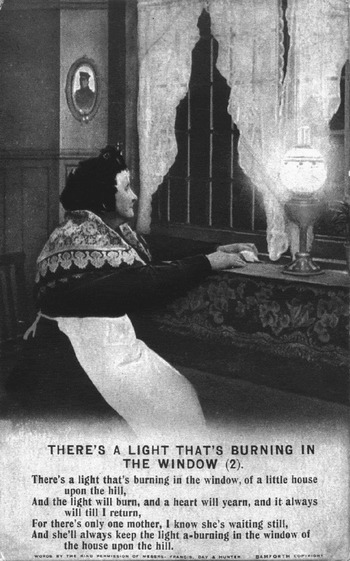
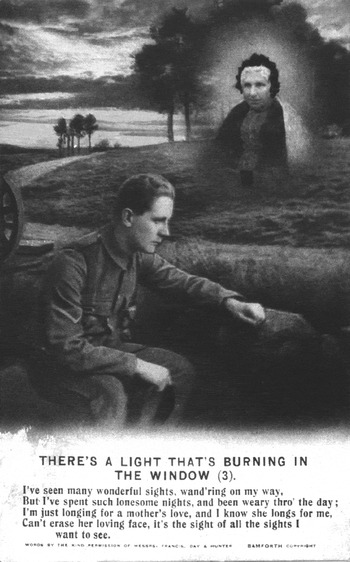
As he prepared to embark for France in late 1914, Stephen Brown wrote a postcard to his mother in Deptford, London (see Figure 1). It shows a soldier with a letter in his hand, poised to begin his reply. The caption reads ‘I am thinking of you’. A studio image, to the modern eye it seems stilted and the words even slightly comic. The soldier wears a braided uniform and he sits at a desk with an ostentatious quill pen; soldiers on active service were more likely to write home in pencil with notepaper balanced on their knees. This postcard is one of many depicting soldiers writing home. They evoke the apparent power of nostalgia to bring loved ones separated by war together (see Figures 2–4).
Postcard from S. E. Brown to mother, date illegible, papers of S. E. Brown, Department of Documents, Imperial War Museum, 89/7/1, copyright Michael Brown.


Fig. 3.

Fig. 4.

Such images were generic, but they nonetheless conveyed deeply personal meanings for the writer and recipient. Jack Dyson sent an almost identical postcard to his wife, though its caption, ‘To the one I love’, and the inset portrait photograph of a young woman, suggest romantic rather than familial affections (see Figure 5).Footnote 1 Writers adapted their postcards so they more closely fitted the personal circumstances and particular feelings they wanted to convey. In his postcard to his mother, for example, Frederick Guy added the word ‘all’ to the caption ‘I am thinking of you', indicating – unlike Dyson who wished only to address his wife – that he intended his sentiments to apply to the whole family.Footnote 2
Postcard from Jack Dyson to wife, The Great War Archive, University of Oxford (www.oucs.ox.ac.uk/ww1lit/gwa), copyright Miriam Naylor, www.oucs.ox.ac.uk/ww1lit/gwa/document/8950, accessed on 7 Nov. 2010.

This article addresses the ways in which British soldiers imagined home in the First World War. How did the soldier's age and domestic situation affect the way he felt, and how might his memories of home have influenced his responses to trench warfare on the Western Front? The emotions evoked in Brown's and Dyson's postcards would have been familiar not only to his First World War comrades, but also to generations of soldiers. Indeed, the very word ‘nostalgia’, ‘nostos’ meaning return home, and ‘algia’ meaning pain, was first associated with soldiers, having been identified by the late seventeenth-century Swiss physician Johannes Hofer, who had observed the melancholic yearning for home of mercenary soldiers.Footnote 3 Significantly, Hofer found that it was the young soldier, unable to return home, who was most likely to suffer from nostalgia.Footnote 4 The term was introduced into English as a translation from the German ‘Heimweh’, or ‘homesickness’, in the mid-eighteenth century.Footnote 5 The question of what social and political conditions are likely to encourage nostalgia has concerned cultural historians, who however have tended to regard it as a collective malaise and a distortion of the past, rather than an individual psychological state with social consequences.Footnote 6 Although Freud and Klein had little to say about nostalgia, the intense affect attached to nostalgic memories has been a subject of some interest among psychoanalysts. They point out that nostalgia has both a spatial aspect, relating to home as a place, and a temporal dimension, the latter giving nostalgia its particular ‘bittersweet quality’, as the longed-for past cannot be returned to. As a result, says the psychoanalyst Castelnuovo-Tedesco, nostalgia is always characterized by pain and ambiguity.Footnote 7
In what follows, I consider the states of mind that were associated with soldiers' memories of home. The concept of nostalgia, I argue, helps illuminate the pre-war structures of feeling through which army recruits – the majority of them amateurs – responded to military institutions and to their experiences of warfare. Nostalgia reflected Edwardian cultural conventions associated with home and domesticity, but also arose from individual circumstances and life-histories, while the emotional pressures of trench warfare provoked particular kinds of psychological conflict among soldiers as they remembered home. The emotions associated with the married man's memories of his home, for example, were not the same as the single man's.Footnote 8 ‘Home’ meant different things to different men, and the emotional attachments to home played on the minds of soldiers in various ways.
For British soldiers serving on the Western Front, postcards and letters formed the most direct means of staying in touch, and they furnish historians with a rich source of expressions of nostalgia. Nostalgia was a dominant emotion, writers often relating direct memories of a shared past, but also – especially in valedictory lines – confessing their wish to be home again. The sheer volume of mail indicates the soldier's need to sustain his attachment to home: in 1917, for example, the British army on the Western Front dispatched 8,150,000 letters a week.Footnote 9 The longing for mail from home could feel like a physical craving, and men quickly grew disgruntled if the flow was interrupted. H. P. Jarvis felt ‘starved for want of news from home and I don't get enough to eat.’Footnote 10 When his wife mistakenly put the wrong Brigade number on her envelope, delaying its arrival, Joe Evans used his precious green envelope letter (these could be longer than normal and were not subject to censorship by the platoon officer) to send it back to her, with the tart comment that ‘if only you knew the Pangs I have had over it you would always make sure’.Footnote 11 The British soldier's resilience on the Western Front after 1916, remarks Keith Grieves, was due in no small part to the effectiveness of the army postal service.Footnote 12
Other reminders of home were equally important. Edward Chapman decorated his dug-out with pictures drawn by his twelve-year-old sister, Hilda, and he protected himself against the cold with a leather jerkin his mother had given him, and a thick grey cardigan his recently deceased father had worn.Footnote 13 Jarvis carried a photograph of his wife and a message card from her ‘next to my heart I prize them very much’.Footnote 14 He asked her for a ‘mascot’, such as a piece of ribbon, which he might wear.Footnote 15 The poem sent by Joe Evans's daughter ‘To my own dearest Dada’ crumples in the reader's hand and is worn through on the folds: it looks as if it was carried on his person throughout the war.Footnote 16 Many soldiers carried keepsakes, but physical signs of the loved one seem to have been particularly significant in fledgling relationships.Footnote 17 Billy Wightman had married just before leaving for France. Unbeknown to his wife, he took with him a button from her silk dress as a talisman.Footnote 18
The postal service made it possible for soldiers to receive regular supplies of home parcels, although their frequency and contents varied according to families' prosperity.Footnote 19 By 1917, over a million parcels a week were being sent to the British army and the volume increased greatly during anniversaries such as Christmas.Footnote 20 While some would have been organized by comfort funds and other voluntary bodies, a substantial proportion was sent by families direct to their loved ones. The smell and taste of food in their home parcels had a powerful capacity to transport soldiers back in time.Footnote 21 Cecil Christopher thought that potted meat sent by his mother had ‘quite a bit of home about it’, while Matt Webb's appetite for his mother's cakes could not be sated after subsisting on bread and jam for four days.Footnote 22 Married men were just as keen for home-made food. ‘I shall love to have a cake made by you’, wrote Wightman, having enjoyed a supper of sardines, cake, and biscuits sent by his wife.Footnote 23
Despite the personal importance of domestic objects like these and in spite of the volume of post sent to and by soldiers, historians have disagreed about how far attachments to home were sustained in the face of trench warfare. Paradoxically, although Paul Fussell drew on the letters of men like Owen to convey the horrors of trench warfare, he nevertheless argued that their experiences were largely incommunicable to those at home. The ignorant or wilful assimilation of horror into ‘safe and comfortable’ terms by civilians, moreover, exposed the ‘cultural chasm’ between the fronts.Footnote 24 Eric Leed claimed that the memory of home served as ‘a residence for fantasies of security and esteem’, but that the longer the war persisted and the more privation and violence men experienced, the more detached from reality such fantasies became.Footnote 25 After the war, such idealizations ‘often shattered under the impact of demobilization, unemployment, poverty, and the sheer strangeness of what was once familiar’.Footnote 26 More recently, Jon Lawrence has pointed to widespread fears among civilians about the potential for violence among returning soldiers.Footnote 27
By contrast, other historians have demonstrated the continuing vitality of soldiers' attachments to home. A study of personal correspondence, Joanna Bourke has argued, reveals how deeply men ‘continued to be engrossed in the day-to-day lives of their family and friends’.Footnote 28 In her study of conscripts, Ilana Bet-El also notes the extent to which the soldier's identity remained grounded in his civilian past, while Adrian Gregory argues that the ‘constant flow of letters to and from the army and leave’ between soldiers and civilians ‘maintained the links’.Footnote 29
Thus, while some historians stress the continued strength of family ties, and their role in sustaining the soldier's morale, others view the longing for home as a kind of defence against the reality of dehumanized slaughter. Evidence for both perceptions can be found in letters written by British soldiers to their families, and in what follows I want to demonstrate the range of emotions that could be expressed within evocations of home. This requires a method of reading letters that is attentive to the writer's age, as well as his place and role within the home from which he was separated, whether as a husband, father, or son. It also entails thinking about the intended recipient of the letter, and the layers of communication, unconscious as well as conscious, that was directed to a mother, wife, son, or daughter. Historians of trench warfare, reverting to commonsense ideas of motivation or regarding the sentiments expressed in letters only as instances of discourse, have not properly appreciated the psychological imperatives of writing and the range of emotions that trench warfare could arouse. Expressions of longing for home and disenchantment have been divided from each other within historical scholarship, when they were frequently part of the same emotional experience for soldiers. The post-war mood of bitter disaffection noted by Leed and others, I shall argue, was pronounced among soldiers who were in their late teens and early twenties and unmarried during the war; those members of the so-called ‘war generation’ who had known little or no adult existence other than as soldiers. These young men's experiences of mechanized slaughter gave their memories of home a particularly ambivalent aspect. A study of nostalgia suggests that post-war disenchantment had its roots in the emotional landscape of trench warfare.
Whilst soldiers vividly conveyed their affections for those back home in letters, sometimes their messages were mixed. Brown's and Dyson's postcards, for example, both had flip-sides. Dyson's card to his wife is sprinkled with crosses and has a loving valediction, ‘Good night and God bless you both/your ever loving/ husband Jack’, but it communicates something ominous. He has told the medical officer about the troubles with his teeth but is likely to join the draft of 300 men soon to leave. He ends by promising to ‘let you no love’ about his fate.Footnote 30 Brown's message opens with the standard epistolary conventions of the rank-and-file soldier, a convention often mocked by his officer:
Just a few lines to let you know that I am quite well I am for the front on Teusday [sic] But if you write to the Commanding [officer] and say I am only seventeen it will stop me from going get it here before Teusday for I cannot get a pass to come and see you don't forget from Stephen.Footnote 31
Brown's postcard, we now see, was not just a fond greeting prior to setting off for the Western Front: he had cold feet. His mother must intervene to ‘stop me from going’, and he gives her precise instructions about how she should do so, explaining that she must send the message herself and indicating explicitly to whom she must address the message. If the picture on the front represents the bearing of a military man, scrupulously dressed and back erect, in the text on the reverse Brown appears little more than a child, wanting his mother's help to save him from going to war.
Most nostalgic memories involve feelings of loss and mourning, but the pain of separation from loved ones in the First World War was sharpened by the conflict's dangerous nature. Fear taxed men's capacities to cope, and gave their memories of home a particularly bittersweet character. Stresses of trench warfare could cause even a seasoned professional soldier to suffer from debilitating homesickness. As Divisional musketry officer, Captain Herbert Leland was based for much of summer 1917 in areas behind the front-line trenches, which were frequently bombarded by the German big guns. Frustrated by continual delays in his leave, he wrote to his wife Lena in August 1917 that all he wanted to do was to ‘get home … and tumble into bed, and sleep for a month, or a year’.Footnote 32 He consoled himself by imagining the home-cooked food that Lena and his aunt would serve on his return. ‘All I want’, he said, was ‘fish, fowl and milk’. ‘No beef’, he instructed Lena, having become heartily sick of the tinned variety in his army rations.Footnote 33 A month before being admitted to the Special Hospital for Officers in December 1917, Leland wrote to Lena in desperation: ‘I want to come home. It is cowardly to talk like this, but I do feel so rotten. I have not fed for two days.’Footnote 34 The months of bombardment had created a longing for home whose intensity felt shameful. The trench soldier's ‘secret batttle’, as A. P. Herbert showed in his remarkable book of this name in 1919, was against the debilitating effects of anxiety, and in nostalgia we get revealing glimpses into this psychological battle and how it was waged.Footnote 35
In an article on Northern civilian soldiers in the American civil war, ‘So lonesome I could die’, Frances Clarke argued that a fundamental shift occurred between the mid-nineteenth century and the First World War in the way nostalgia was understood. During the civil war, soldiers could be hospitalized for nostalgia; some would weep ‘like children’ to return home, and some ultimately died of their yearnings.Footnote 36 By the First World War, however, Clarke claimed that it was deemed ‘inconceivable’ that homesickness could trouble a man to this extent. By then, breakdown was widely thought to arise from traumatic conditions of the war itself rather than from longing for home, as the term ‘shell-shock’ suggested. Clarke attributed the strength of homesickness among Northern soldiers to nineteenth-century domestic ideologies, and the central importance placed on the home and mothers as a source of moral goodness and affections.Footnote 37
Clarke is surely right about the importance of mothers, but it is less clear that trauma replaced homesickness as the principal cause of emotional distress among soldiers by the time of the First World War. For British soldiers on the Western Front, nostalgia could itself be a way of communicating trauma. By the First World War, medical professionals may no longer have believed that homesickness could ‘drive a soldier to the edge of reason’, but the pining that Leland expressed in his letters home was probably not so different from the refrain of an American civil war soldier hospitalized for nostalgia: ‘I will go home.’Footnote 38 Despite differences in time and culture, there were elements of similarity between soldiers' emotional responses. Comparing the psychological survival strategies of German and British soldiers in the First World War, Alex Watson makes a similar point. According to Watson, such strategies are ‘not dependent on national culture, race, or religion, although sometimes coloured by these factors; rather, they were basic universal human responses to a situation of intense danger and uncontrollability’.Footnote 39
II
To whom did soldiers in the First World War express nostalgia, and about what were they nostalgic? The images on Brown's and Dyson's postcards suggest that the state of longing for home is a solitary one, but in writing home, men were inevitably confiding feelings to another person. Nostalgia was a way of conducting relationships at a distance, and its themes are revealing about such relationships and how they helped men to survive.
Like its French and German counterparts, the British army was predominantly made up of young men. Of those who served in the war, 70 per cent were under thirty and around 40 per cent were under twenty-four.Footnote 40 Anyone over twenty-three, thought the subaltern officer, Donald Hankey, was ‘an “old man”’.Footnote 41 The young bore the brunt of casualties as well: Jay Winter estimates that around three-quarters of the men who were killed or died in the war were under thirty and unmarried.Footnote 42 The character Paul Bäumer in Eric Maria Remarque's classic First World War novel All quiet on the Western Front (1929) articulates the position of men like Brown as the ‘war generation’ who were born in the 1890s and split between the adult masculine identity of a soldier, and a youth cast adrift from his family: ‘We are like children who have been abandoned and we are as experienced as old men.’Footnote 43
It was often to mothers that young soldiers confided their longing for home. A survey of eighty-one collections of letters written by unmarried men on the Western Front to their birth families, now held by the Imperial War Museum, found that nearly half (47·5 per cent) were addressed to mothers.Footnote 44 Almost six times as many letters are addressed to mothers as to fathers. As Arnold Hooper put it: ‘I said when I saw my mail the other day to a chap standing near. In the long run who is it that writes every mail and who always writes a good letter? Why one's Mother. One's first friend.’Footnote 45 In writing about maternal loyalty, Hooper was of course flattering his own mother, and it would be mistaken to conclude from such statements, however effusive, that sons focused exclusively on their mothers. Patterns of correspondence could also differ markedly between families. It was quite common for sons to address letters to both parents (around 22 per cent of the Imperial War Museum sample are addressed to both parents or to the whole family); and many corresponded avidly with siblings (letters to brothers and sisters constitute around 16 per cent of the sample). Letters addressed to mothers were, in any case, often intended for the whole family, as Bert Chapman revealed in a valedictory message to his mother: ‘Please remember me to all. By all you know who I mean. Give my love to everybody at Home Sweet Home+I will say Ta-Ta.’Footnote 46
Among young unmarried men, the sense of home as a place was particularly strong. It was not just the person of the mother, father, siblings that they brought to mind. They imagined ordinary domestic scenes and could even grow nostalgic about furniture. Tom Corless, a twenty-one-year- old volunteer serving in an Oldham Pals unit, had lost his mother and was estranged from his step-mother, and his thoughts were occupied by his grandmother's house in Oldham. Corless tried to ‘imagine I was having tea with you at dear old Delph Cottage, in my customary favourite seat near the piano. I always like that seat somehow just because I always used it as a youngster.’Footnote 47 The repeated ritual, sitting in the same seat since he was a child, created a vivid connection in Corless's mind to his adopted home. Webb had received a letter from Mrs Tunnell, a family friend, which ‘made special mention of the beauty of the garden just now of which I can form a very good mind-picture+only wish I could be there in the flesh once again’.Footnote 48
Although military service might have offered a welcome way out of a difficult marriage for some married men,Footnote 49 they were drawn more slowly into the conflict than single men. Throughout 1915 as Adrian Gregory has shown, there was public debate about whether or not they should volunteer.Footnote 50 The original intention of Lord Derby's scheme before the introduction of conscription was to help ensure that attested single men up to the age of forty would be mobilized before attested married men of any age, and the married men proved more reluctant to attest than single men.Footnote 51 The first conscription act in January 1916 was called the ‘Bachelor Bill’ because it targeted single men, and it was not until a second act in May 1916 that married men were called up.Footnote 52 The army made little adjustment for married men, though their responsibilities as husbands and fathers were felt by some to give them special entitlements. A father who had lost his daughter in a motor accident was refused compassionate leave on the grounds, his officer explained, that ‘since the child is dead, the father can do no good by going home’.Footnote 53 Samson Smith was upset that he could not get back to see his mother before she died, and he thought it ‘bad to keep us married men out here so long with out a leave’.Footnote 54 At the same time, censoring letters gave subaltern officers an insight into the home lives of husbands and fathers, and they could be, to a point, sympathetic towards married men's domestic problems. Captain Leland was infuriated by his batman Hilton's unexplained absences, drunkenness, and appalling cooking, but was loath to dismiss him as Hilton's wife had written saying that she was leaving him.Footnote 55
Whereas sons tended to address their letters to their mothers but include the wider family, married men, and especially young husbands, addressed their wives exclusively. It was less the generalized image of home they had in mind than the figure and face of a loved one; something that is reflected in their requests for photographs, personal trinkets, and other reminders of her person. On opening a parcel from his wife, Wightman was caught off guard by a sensual memory: ‘some of the tissue paper must have been used for wrapping up something pretty of yours for it smelt so sweetly of your perfume you use. Oh how far away it seemed but how sweetly reminiscent of your dainty self.’Footnote 56 Each Saturday that passed was an anniversary, and Wightman would ‘picture you in all your sweetness as I saw you’ on the day of his wedding.Footnote 57 Munton's stirrings for his wife Nellie stand out among his spiritual reflections on their separation: ‘How I long for the touch of your hand, your breath on my cheek, or to listen to the cadence of your voice.’Footnote 58 The total absorption in intimate memory that romantic love could allow – what one soldier described as that ‘good married feeling’ – was envied by the single man.Footnote 59 Watching his fellow soldiers writing letters in a French café, Harold Anderton judged from their occasional ‘beatific smiles’ that they were ‘sealing down in their envelopes thoughts so amorous as to lift them for a moment out of this world of strife. I almost wish some fair charmer could similarly affect me.’Footnote 60
While the attention of married men tended to centre on their wives, sons, and daughters, their memories might also include the domestic setting. Munton had been married to Nellie for three years when he left for France, and in his letters home he imagined her going about her daily life, doing her sewing, and at the market selling her blouses. He was buoyed by the thought of ‘getting the house ready for my return, what an exciting time that will be it will be better than any honeymoon, at least I hope so, for we have lived together for just over three years.’Footnote 61
Munton was lucky in having a home of his own. For others, rapid marriages, the financial cost of sustaining a separate household, and the loneliness of wives, meant that there was no conjugal home. When Wightman left for France immediately after his wedding, his wife went to stay with her mother and their wedding presents were put in storage.Footnote 62 Norman Macleod got married just before the war and his wife Irma seems to have lived with her mother-in-law for much of the war.Footnote 63 With little or no experience of a shared home-life to draw upon, these men imagined the prospect of a home together. Cyril Newman did not marry until 1919, but as Anthony Fletcher has remarked, his letters to his fiancée Winnie contained detailed discussion about ‘the furnishing of their future home and thoughts about their life together’.Footnote 64
Men with children related to home through two identities, that of father and husband, something which Davis articulated when he signed his letter ‘Daddy/Harry’.Footnote 65 Fathers often included notes for their children in letters to their wives, or passed on messages to their children through their wives. The exchange of news about children and their development encouraged intimacy. His son Boytie ‘knows little nursery songs and can begin to sing them’, A. C. Baker wrote proudly to his mother after receiving a letter from his wife.Footnote 66 E. G. Buckeridge enclosed sketches for his young sons in his letters home, which showed them on holidays or travelling about, or himself on the boat to France, with his gas mask on (‘Doesn't he look funny’), and marching in the rain.Footnote 67 In this way, he brought himself closer to his children's lives, and gave them an insight into his life as a soldier. Many fathers sent their children cards at birthdays and Christmas which were lavished with kisses. Evans's valediction to his daughter Irene was typical: ‘I am sending you some nice kisses’, followed by two dozen crosses.Footnote 68 Wilfred Owen, having censored his men's mail, thought that ‘the Daddy's letters are specially touching’, and it may indeed have been the case, as Tim Fisher argues, that they were more affectionate to their children in writing than they would have been in the flesh.Footnote 69 They were well aware, however, that their cards and letters might be the only evidence of a father's love that a son or daughter would one day possess.
III
What sorts of emotional needs were served by memories of home, and how far did they help soldiers to endure the stresses of the Western Front? Nostalgia typically involves idealization, the imagining of a purer, simpler time and place, the ambiguities of past relationships being replaced by seemingly unalloyed affections.Footnote 70 In the First World War this tendency was exacerbated by dirty and uncomfortable living conditions, regimented routines, and the carnage of trench warfare.Footnote 71 Loaded up with a pack and pick, wrote the thirty-four-year-old tunneller Jack Hickson to his brother, or in trenches where you might ‘get lost altogether+die of exposure+starvation’, he longed for a feather bed and a ‘bright fire at home’.Footnote 72 The tendency to idealize home was perhaps more pronounced among young single soldiers, whose primary associations were still with their families of birth and who in some cases had only known one home. As a rector's son, Edward Chapman, wrote to his mother after a gruelling experience on the Somme:
All this area is one vast cemetery. Dead bodies taint the air wherever you go. It has robbed thousands and thousands of men of life, and thousands more of the things that made life seem worth living. I have come to look upon peace and quiet and home life as the Summum bonum. I feel now that all I want is to be able to live quietly, and tend a garden, and study a bit.Footnote 73
Such was the contrast between home and the Western Front that even pre-war events that were felt to be unfortunate at the time of their occurrence could subsequently become fond memories. Later in the same letter, for example, Chapman transformed a serious illness into a reminiscence of fond maternal care, recalling ruefully that ‘This time last year I was in bed with typhoid; what a very happy time that was for me, at all events.’Footnote 74
Such idealizations drew upon Edwardian cultural scripts extolling the hearth and home and the mother as the ‘Angel of the home’.Footnote 75 The war gave added impetus to these conceptions and the widespread experience of separation spawned commercial paeans to home and mothers, doubtless intended as much for mothers as for sons. Around Christmas time, thousands of embroidered cards paying tribute to the virtues of mothers – some hand-made by soldiers – would be sent home from the Western Front, and mothers were celebrated in poems.Footnote 76 In his first letter home after joining his Regiment in France, the 2nd Manchesters, Wilfred Owen wrote
Inevitably, this message was intended as a testament to the strength of Owen's own affections, as much as his men's, but at the same time it reveals a wider desire among young men to want to reassure mothers of their love. In this sense, nostalgia functioned as a form of impression management, projecting an image of soldiers as dutiful sons, anxious to spare mothers worry and to show that home-values continued to be their lodestar. Having no sweetheart to write to, Harold Anderton penned a tribute to his mother:
I've no need to use poetic language to convey to you my appreciation of your person and your goodness. You know perfectly well what I do think of home, and I can assure you a few months out here make one appreciate home life more than ever. Oh! for just one evening in clean clothes in a nice arm chair, round a nice fire chatting to my dear parents.Footnote 78
The image that Anderton conjured was squarely within conventional Victorian ideals of hearth and home. It assured his parents of his devotion to them and especially his attachment to his mother's moral teachings.
Written three years into the war amidst shortages and rationing, the tone of a letter written by Frank Merivale epitomizes confidence and optimism:
I look forward very much to next summer when the war will end and everything and every one will begin to look fresh+happy again, and having been uncomfortable+miserable long enough to realize what comfort+happiness mean we shall really begin to enjoy life. We will have learnt how to enjoy just sitting in an armchair before a warm fire with all whom we care for either sitting beside us or not far away, our minds free from all fears of casualties for ourselves or others. Cheer up Mummy dear+buck up Blanche its bound to end some day.Footnote 79
Merivale strove to buoy his mother's and sister-in-law's spirits by imagining a year hence when the war would certainly be over, warding off fears in late 1917 that it might never end. He held out the hope that the war would actually strengthen family bonds. Descriptions such as these, assuring mothers of the continued importance of a civilized life amidst the brutal reality of trench warfare, could allow mothers, such as Mary Charteris, to say of her son Yvo that ‘the strange scenes in which he found himself, seemed only to intensify his love for his family and home’.Footnote 80
Among married men, the connection to home was likely to be expressed as much in practical matters as moral sentiments. Their responsibilities drew them into a mode of communication that was responsive to the news and predicaments related by their loved ones. The financial support of wives and children was a common theme, and they were more attuned than sons to the impact of rising prices and scarcity. Writing in November 1917, Hickson pitied his wife having to drink tea without sugar and milk.Footnote 81 The health of their children concerned them. Jarvis was pleased his children's feet were healing, and Hickson hoped that, now his daughter had cut her double teeth, she would be ‘much better’.Footnote 82
Some fathers gave advice on the upbringing of their children, though being on active service exacerbated the already ambiguous role of fathers in Edwardian society, whose formal authority within the home was undermined by their responsibilities without.Footnote 83 Davis thought his daughter Trixie should not be allowed to swim on her own, but in his absence, conceded that he must ‘leave that to you’. He would be less sympathetic than his wife towards Trixie's choosiness about clothes; ‘put her in a sack’, he joked.Footnote 84 Perhaps thinking ahead to the need to make a man of his two-year-old son, Baker writes ‘I think we had better start getting Boytie used to his real name’, though he himself continued to use it.Footnote 85 Fathers tried to influence their children's behaviour by appealing to their affections. On learning that his daughter was unwell, Evans wrote to ‘my dear little Girlie’: ‘For your Old Dad now you must eat up all your dinner and you will soon get well’, he counselled, ending with a row of ‘some kisses. I had a nice lot from you.’Footnote 86 Letters were one of the few disciplinary weapons at their disposal: ‘I hope Trixie has been a good girl since I sent her a letter’ writes Davis, and ‘if she has I will send her a nice card next time I write.’Footnote 87
The realistic orientation of married men's letters extended to the risks they faced. Some wrote about the provision they had made in wills, and what wives should do in the event of their death. Soon after arriving in France Hickson wrote to his wife telling her that he had made a will and appointed an executor. He hoped that she would re-marry if he should die, and had set aside enough to ‘tide you over a rough time till you get married again, but I sincerely hope I shall be safely restored to you’. He wanted her to be prepared; it was ‘no using having a fool's paradise’.Footnote 88
Another function of nostalgia was to give men, often thrown together with strangers, possibly drawn from different regions and social backgrounds, a common topic of conversation. In talking about home they renewed connections with lives they had left, and started to know more about one another. Comradeship thrived on relating family histories. Lyndall Urwick, for instance, was grateful for daily letters he received from his mother, as 2nd Lieutenant Montgomery, the man with whom he shared his tent, ‘chats a little about home every night before we turn in. I am so glad always to have an idea or a little bit of gossip to help on the conversation.’Footnote 89 Elsewhere, my grandfather, Robert Roper, recalled the first home post after the battle of Lone Pine at Gallipoli in 1915, when men in his platoon gathered around in animated conversation about their news from home, even though such news was already months out of date.Footnote 90 A man might share the contents of his parcels, so that his comrade could also savour the taste of his home. ‘Gee, didn't we enjoy ourselves, eating cake like Mother makes it’, wrote Bert Chapman, adding that ‘Even the Sergt had a dip+said how nice the cake was.’Footnote 91 ‘Clark has been talking about your rock cakes ever since your last parcel’, wrote Edward Chapman to his mother.Footnote 92 Who a soldier confided news from home to showed whom he counted as a comrade, and such knowledge would, in turn, foster links between families and soldiers.
Nostalgia had a social role in consolidating bonds between men in an alien and unstable living situation. It could also provide a private source of comfort to men removed from their origins, and facing the discomforts and dangers of life in the trenches.Footnote 93 ‘He has gone home’, remarked the French novelist, Henri Barbusse, of a man lost in thought as he wrote a letter.Footnote 94 Fantasies of return are often expressed in the present or future tense, which suggests their significance in providing comfort.Footnote 95 Jim Tomlinson, for example, described how, whilst peering out into the gloom of no man's land on sentry duty, alone and sometimes cold, he would imagine his family getting ready for bed:
I think of home …+imagine just what is going on there you all waking up or about 10 o/c Pa toddling off with his ‘good night Ma’ You still to come in Ma reading the paper in front of the fire Hilda just getting ready to go. then at say 2 0r 3 o/c I fancy you all fast asleep+there am I leaning against something struggling to keep my eyes open.Footnote 96
The trench soldier invested his memories of home with a strong sense of the present. Chapman wrote to his mother of how ‘I think consistently of home, and know exactly what everything will be looking like, and the smell about the damp garden. I always wish I could pop in to tea, and find you all sitting round the table, and Hilda in the act of committing a bad manner!’Footnote 97 Chapman's use of the present tense allows him to convey the vivid connection that he felt to his family. Such was the clarity with which he felt able to conjure what ‘everything will be looking like’, that it might almost be possible to ‘pop’ back. Although Chapman wrote these lines six weeks after arriving on the Western Front, six months later and now – having fought through the battle of the Somme – a seasoned soldier, his memories were undiminished. As he wrote in late February 1917: ‘I look forward to tea in the garden, and the flavour of bread and butter eaten out of doors. To hearing you read some quiet tale aloud to us. To going for walks round the Warminster road. And to all the other things that make up home.’Footnote 98 When Arthur Gibbs wrote the following lines to his mother, he had been serving on the Western Front for over twenty-one months: ‘Thanks too for your letter of Sept. 4, written outside the summer house. You were sitting out in the sun just as I was when I wrote to you sitting outside my dug out, and probably just about the same time too.’Footnote 99
Such remembering, however, had psychological costs, for although men needed to feel that the scenes they constructed in their minds were contemporaneous, they were actually composed from past experiences. While people on the home front were adjusting to the war in all sorts of ways, coping with food shortages and rationing, and taking up voluntary or paid war work, in the soldier's mind, life remained unchanged. Accordingly, they were suspicious of anything that appeared to disrupt the emotional investment in home as a stable core. Wightman, for example, was concerned that his wife's duties as a nurse would ‘overtax your strength’, and wished she would do something ‘a little more worthy of your gifts and talents’.Footnote 100 Harold Bantin did not want his wife to have to work, and was preoccupied by how to support her and his child on his pay and the separation allowance.Footnote 101 Arnold Hooper was displeased at the thought of his mother performing war work: ‘In the name of all that is good, do not do any more. If you love me don't. You do too much as it is … Your job is to keep in touch with your loving Sons, and to remain your dear self. Our most treasured part of our life. Our greatest Blessing.’Footnote 102 There was a controlling element in some soldiers' attitudes towards domesticity. They wanted women to remain largely within the home, their attention fixed on absent husbands and sons.
Nostalgia was also double-edged because the very vividness of memory and the sense of connection to home it brought could itself be a source of pain. Hickson longed to be with his wife and daughter Nin, but was careful to keep his memories in check. It was ‘no use longing for impossibilities, so shall have to make the best of it’.Footnote 103 Three weeks later he wrote to his wife that, living as they are ‘like tramps … dirty+muddy+worse than that’, he thinks often of the comforts of home. To ‘dwell too much on home’, however, ‘would drive one mad’; and in any case his wife was not home much these days.Footnote 104 The more vivid the memory, the greater the potential disappointment.
The need for release could become so intense that nostalgia was not just a momentary diversion, but jeopardized the very awareness of the difference between fantasy and the real upon which sanity depended. After describing the ants, beetles, snakes, centipedes, and ‘noxious forms of vermin’ on the Gallipoli peninsula, Willis Brown appended a wistful postscript to his letter, a flight of fancy: ‘I wish I could come home the same time as the letter.’Footnote 105 In another postscript, Bert Chapman recounted having had a ‘dream of Home Sweet Home last night,+then woke up and could have kicked myself’.Footnote 106 A similar dream that transported a man back home, followed by profound disorientation on waking, was described by Remarque in All quiet on the Western Front, and was explicitly linked to the longing for a mother's comfort. Paul Bäumer, falling into a deep sleep after laying out barbed wire during the night, awakes disorientated and distressed, believing that he had fallen asleep in the garden at home: ‘I don't know whether it is morning or evening, and I lie there in the pale cradle of dawn waiting for the gentle words which surely must come, gentle and comforting – am I crying? I put my hand to my face; it is baffling, am I a child?’Footnote 107 The lure of nostalgia, which in sleep, day-dreams, or letter-writing allowed the fantasy of flight to feel real, could also threaten to drive someone mad.
As a psychological resource, nostalgia took different forms. It could be connected to the future and the promise of return, or backward looking. For the young soldier, whose closest relationships were likely to be with parents and siblings, nostalgia was predominantly retrospective. Crouched in a trench during shelling, he might not only act on a rational impulse of self-preservation, but on a pre-conscious or even a prenatal urge.Footnote 108 ‘My one desire was to hug closely to mother earth’, wrote Private Norman Gladden, as he recalled going over the top at Ypres in 1917.Footnote 109
The emotional stresses of war and of separation could rekindle the disturbances of infancy. The platoon commander, Ernest Smith, wrote to his mother after suffering from terrible nightmares wherein his men lay naked in no man's land in the pouring rain.Footnote 110 Lyndall Urwick's violent stomach cramps during the battle of the Aisne were much worse, he told his mother, than his childhood tummy aches.Footnote 111 The presence of danger could produce what the psychoanalyst, Nandor Fodor, describes as a ‘yearning for our prenatal home’, a seeking of the safety and comfort of the womb.Footnote 112 Roland Mountfort asked his parents to send chocolate, cake, and butterscotch every four days, to coincide with his time in the front line, for on sentry duty he ‘simply craved for … something to suck’.Footnote 113 The oral gratification provided by sweets in this instance recapitulates the pre-conscious memory of maternal feeding.Footnote 114 The tank commander and later psychoanalyst, Wilfred Bion, experienced a similar need for solace while waiting to lead his tanks into battle at Amiens in summer 1918:
The strain had a very curious effect; I felt that all anxiety had become too much; I felt just like a small child that has had a tearful day and wants to be put to bed by its mother; I felt curiously eased by lying down on the bank by the side of the road, just as if I was lying peacefully in someone's arms.Footnote 115
In these examples anxiety was assuaged by bringing a maternal presence to mind, but the memory of home could equally be a vehicle for expressing discontent. This type of nostalgia emphasized the supposed comfort and safety of loved ones so as to bring the writer's own piteous circumstances into view. Will Hate told his mother that ‘I'd rather be at home today for dinner than out here. We have just had our usual tho’ greasy stew. I did not find it very appetiseing [sic] … I cannot say that I am getting very far with what we are getting.'Footnote 116 Webb contrasted the garden at home with the war-torn landscape of France:
Matters have been fairly quiet out here the last two or three days; there has been no further attempt to blow us all up again but one never knows what may happen any day. The weather has lately been very fine+hot. I expect the garden is looking lovely again. When I think of what it was last summer+compare it with this war stricken+devastated country, where crops are trampled upon, human habitations intact are very few+far between, it seems to me to be a little paradise in itself.Footnote 117
In trying to fathom the meaning of such accounts, we must place ourselves in the position of mothers, fathers, and siblings, to ask: what do these descriptions make us feel? Webb begins with an intimation of the fact that he has been in danger – the reference to shelling – before moving to the weather, which makes him envisage the garden. To his readers, his mother, and to us now, however, the ‘paradise’ of home possesses a less visceral reality than the deadly trenches (‘one never knows what may happen any day’). Such reminiscences pull families on to the scene. Starting from close to home, they plunge loved ones into the war-torn landscape, constituting what a Kleinian psychoanalyst might call ‘projective identifications’: raw and intolerable emotional impulses which writers expel into an external object, in this case the reader/mother.Footnote 118
Whereas a son might gain some solace from his past family life and the reminders of it that arrived in his letters and parcels, men who were betrothed or married frequently looked forward to the end of the war and rehearsed in their minds the moment of their return. William Clarke's letter to his fiancé, written just before the battle of the Somme, suggests how love could sustain a man's spirits: ‘keep a brave heart for my sake and just pray that this war will soon be over and I can come back to take care of you and never leave you anymore’.Footnote 119 ‘Wishing I was home with you darling, never mind I shall not be long now pet’, wrote Cecil Littlewood to his daughter Mary in his Christmas greeting.Footnote 120 In Joseph Bullock's card to his daughter, a young girl in a night-dress embraces her uniformed father while he looks solemnly into the distance, greatcoat and cap in hand. The caption ‘Say good-night, Daddy, not good-bye!’ plays on the promise of return.Footnote 121
Love was felt by some to have actually kept them alive. Writing his memoirs at the age of eighty-eight, Charles Templer reflected that it was the promise of marriage to his sweetheart Dais that had got him through the war. He had been motivated by the thought that, if he should be killed, ‘Dais was something I would not know.’Footnote 122 When ‘the shells are coming over and are falling unpleasantly near’, writes Wightman to his wife, he thinks how much ‘I want to live so as to come back to you, my darling.’Footnote 123 Will Munton's letter to his wife in spring 1918 conveyed a similar hope that love would keep him from harm. During the German advance he became stranded in no man's land, ‘caught between Fritz's machine guns and our own’. Writing to Nellie shortly afterwards, he tells her:
I have thought such a lot about you Darling during that time … I have sat on the roadside at midnight or the early hours of the morning, tired+dirty+hungry+lost+have wondered whether just at that moment you might be awake,+thinking of me,+I thanked God you didn't know what I was doing. Though I knew if you were awake you would be praying for me.Footnote 124
Their mutual love, Munton believed, captured in the image of each bringing to mind the other in synchrony, had helped him avoid being taken prisoner by the Germans.
The store that men set on surviving for the sake of sweethearts and wives, however, could bring its own anxieties. The newly wedded soldier may have been buoyed by the prospect of a domestic life together, but romantic relationships conducted at a distance could also be fragile. Wightman had often rehearsed in his mind the moment of his home-coming. He would ‘picture you sometimes as you will look when I get out of the leave train … once I have taken you in my arms I am sure I shall never let you go again.’Footnote 125 Just as he was about to demobilize, however, his wife wrote saying that she had been going out to dances with an American soldier. Wightman was incensed at the behaviour of the man ‘who you honour by calling him “my Yank”’, and sternly reprimanded her for using the fact of being married in order to enjoy his company. He wanted to ‘take you in my arms, my dearest little wife and tell you with a hundred loving kisses of my love for you’, but he also issued a threat: ‘I would tell you too that if any other man ever tried to kiss you I would do my best to break every bone in his miserable body.’ Footnote 126 A week later Wightman was still feeling ‘utterly depressed’ and unable to sleep, turning over and over in his mind the image of his wife with the American soldier. Had she driven to the dances ‘alone with that man’, he wondered, and had she been wearing, on her beautiful white neck, the locket which he had given her, and ‘in which I wrote “I love you”’?Footnote 127 Wightman was not alone in fearing that his wife might be unfaithful, and pointedly mentioned the case of Colonel Rutherford, who had shot his wife's lover, an allusion which she found unfair and deeply hurtful.Footnote 128 He was upset that, when ‘death seemed near’ during 1918 and he ‘used to pray to God to spare me so that I might live to have the joy of my darling wife's companionship’, she appeared not to have shown ‘very much respect for my love for you’.Footnote 129
For fathers, separation was painful because they were missing out on their children's development. The younger the child, and the longer they were absent, the more they feared being forgotten. Hickson wanted reassurance that his young daughter missed him. In his first letter after visiting home prior to leaving for France, and still flush with the memory of being with his family, he writes ‘Did Nin miss me when she woke up.’Footnote 130 Three months later, he asks ‘How is Nin doing on. does she ever ask for me now’; and a week later, ‘does she ever ask where I am or has she forgot me altogether.’Footnote 131 Hickson tried to write every second day, not only for his wife's benefit but so as to sustain his connection with Nin. He was relieved to hear that Nin had ‘not altogether forgotten me+that she looks out for my letters, it is not so bad when we can keep writing’.Footnote 132 Whereas young men were sustained by memories frozen at the point of their leaving, new fathers relied on letters to keep them in touch with what their children were becoming. Rather than drawing on the deep structures of early experience, the relationships of these fathers, like those of newly wedded men, felt tenuous and had to be energetically nurtured in writing.
IV
The emotional functions of nostalgia could range from solace and escape, through the evocation of romantic love as a life-force, to resentment and the projection of fear into loved ones. Much depended on a man's state of mind at the moment of writing, his domestic situation, and to whom he was writing. In what follows, I wish to trace some of these different psychological processes through two case-studies, one a father of eight and the other one a young single man.
Samson Smith had been a farm labourer, groom, and gardener in Cherington, Warwickshire, before the war. His military service began in January 1915 when he was thirty-six, and he fought through the battles of Messines Ridge and 3rd Ypres before being gassed in late 1917. His eldest child Edith was born in 1901, while the youngest, Doreen, was born in March 1915 after Smith had joined up. Although Smith's spelling and punctuation were poor – he was clearly unused to writing – and his letters are brief, they convey the impact of long separation on an older married man with dependants. In writing, Smith was guided by the topics that his wife raised. He did not conceal things from her; a letter in September 1915, for example, mentions German bombardments and being fired on by snipers, and he was frank in his assessment of his chances of getting through the war.Footnote 133 After his wife wrote saying that a local man had been listed as missing, he replied ‘don't think their will be many of [sic] get back home safe again but I trust god will spare me for the sake of all you loved ones at home’.Footnote 134
Smith's family seems to have depended largely on their smallholdings to get by, which his wife had to manage in his absence. His correspondence over the three years, much of which consists of advice on farming, follows the rural cycle of planting, harvesting, and ploughing. Has she got the beans in yet, he asks in March 1916; in May 1918 he hopes she has been able to plant the barley, and in June he tells her not to plant any more potatoes, and to give the pig what is left.Footnote 135 Samson took his cues from the weather in France. Heavy rain in November 1915 made him concerned for the wheat crop, and in October 1917 he writes telling his wife to get the barley in ‘now that the weather has turned bad’.Footnote 136 Samson's desire to come home, rather than being a psychological flight from the war, was motivated as much by the thought of how much his wife had to do. If only he was able to ‘come home now for a few days and help plant the potatoes’, he writes in June 1917.Footnote 137
Smith also responds to the various troubles of his children, particularly their difficulties in finding work. He was relieved to learn that in 1916 that thirteen-year-old Eunice, the second eldest child, had found a place, and that Bevan had started work as a ploughboy, but sorry that Edith's employment with a Mrs Cheney in Tiddington did not seem to be working out.Footnote 138 Like other fathers he dispensed advice through his wife. Of Bevan he writes, ‘tell him he is to be a good boy and help you all he can’.Footnote 139 While sympathetic towards his wife's troubles in coping on her own, his tone was sometimes firm: ‘now my Dear you must not worre yourself as that wont make thing eney better’, he writes in March 1916, when snow had prevented them from ploughing.Footnote 140 Smith himself found it ‘hard to be parted’ and in almost every letter he writes of how much he misses his family.Footnote 141 He also missed his farm, though his evident satisfaction that ‘the pig is going on well’, was born less of sentiment than hunger, as, confined to army rations, Smith yearned for ‘soft meat’.Footnote 142 The pork in his parcel, he writes with the flourish of a travelled soldier, was ‘tray bon’.Footnote 143
Though Smith missed his children, news of them allowed him to imagine home with greater vividness. When his wife bought new clothes for the boys, he replied ‘I hope they will keep them clean I should love to see them and all of you it is hard to be from you for so long.’Footnote 144 He treasured the snapshots that his wife had sent him, but worried that their youngest daughter, Doreen, would not know who he was: ‘i hope you will have the babs photo taken as i should love to see her now she can run about she wont know me when I come back home again I don't think we shal be home this year by what I can see of it’.Footnote 145 Although Smith found the separation from his youngest children difficult, the letters do not dwell on this. Smith seems to have applied the same stoic attitude to himself as to his wife: ‘we must cheer up’.Footnote 146
Arthur Hubbard's background could hardly have been more different from Smith's. Unmarried and around a decade and a half younger than Smith, he was a member of the suburban lower middle class who signed up enthusiastically en masse early in the war.Footnote 147 Hubbard was a Territorial soldier and many of his fellow soldiers were from his local neighbourhood. From his barracks in Roehampton he had been able to visit his home in Streatham Vale, dropping off his washing, and occasionally making it home for Sunday dinner. One should not underestimate the sense of dislocation that a man like Hubbard felt on reaching France, having left a world that had revolved around his parents, four siblings, his sweetheart in Fulham, and his local work colleagues. The letter that he wrote on 17 June 1916, a Saturday evening, was composed just after Hubbard had learned that his Regiment, the 1st Scottish, was to be involved in a major attack.Footnote 148 This information drips out piecemeal in a letter to his mother.
Hubbard's opening passages appear intended to allay his family's concerns, but they actually produce the opposite effect: ‘a few lines to you to let you know I am still keeping fairly well. I had a bad cold the early part of last week through getting wet footed, but glad to say is as [sic] partly left me.’Footnote 149 He then informs his mother about his friend Isaacs, whose rifle was hit and blown up while he was in the front line, after which he ‘gets so nervous, and seems to tumble down all the holes in the dark’. Isaacs ‘looks quite like an old man’.Footnote 150
Hubbard then explains that the glass and hands of his wrist watch had broken. It was not unusual for men to mention watches in letters home, partly because they were sometimes gifts from loved ones, and because they frequently broke down and had to be repaired. A man's report of his watch, however, could also serve as an indicator of his state of mind.Footnote 151 Hubbard explained that he had returned the watch to his brother Will for repair, but that he did not want to receive it back just yet. The reason for this request initially appears mysterious, but the next sentence provides a clue of what Hubbard is contemplating: ‘I shall be glad when the news comes through for us to cease fire and pack up to return for good.’Footnote 152 The possible fate of his watch serves to underline the dangers to which Hubbard himself will soon be exposed; hence it is better if his watch does not have to endure battle.
At this point, having mentioned his hope for a cease-fire, Hubbard produced a recollection of home, creating through this, a space in which to confess his anxiety and its cause:
I can picture you all sitting around the table about 8.30 enjoying a good breakfast and me miles away in this miserable place which is being and has been blown to hell by the Huns who are at present as far away from us as you are from Mr Snelling's house but I am very pleased to think that Will and Wal are not out here, that sets my mind to rest more than anything else. Poor old Wal would not stand the sights that I have seen since my short stay here, and the battle is not started yet so goodness knows what it is going to be like. I hope it doesn't come off myself.Footnote 153
Hubbard tries to keep fond memories of home separate from ‘this miserable place’, but mention of Mr Snelling's house puts the danger of the trenches firmly within his family's frame of reference. The idealization is shattered. The references to Will and Wal ostensibly convey relief that they will be spared from having to go into battle, but by obliging his family to imagine his younger brothers on the Western Front, Hubbard was actually putting the perils he faced firmly in their minds.
Hubbard's closing reference shows how the fear of death both animated and soured the pleasure of nostalgia: ‘hoping you are all keeping well and looking after things in general. Should like to be able to see the garden before this season is over I guess it looks nice so close with fondest love to you all.’Footnote 154 These lines appear unremarkable, with conventional references to the health of loved ones, domestic upkeep and the beauty of the summer garden. Nonetheless, they articulated deep anxieties, not just expressing a general wish that the war will be over by the end of summer, but also a personal wish that Hubbard will not be among the victims of the battle to come.
The letters home of young soldiers such as Hubbard could be regarded as unconscious attempts to force their absent loved ones to understand. Their points of reference were domestic, concerning love and care, matters to which mothers, in particular, would be attuned. Whilst, on the one hand, the writers seek to preserve the hearth and home unblemished, on the other, their letters unsettle their reader: as he thinks of his family enjoying a ‘good breakfast’, Hubbard's mind is drawn to his own dangerous situation. These were not just fond memories, but ways of disturbing those at home, and writing was the means through which men projected their distress. Nostalgia often begins as a kind of mental diversion – a release from anxiety – but ends up being a chief vehicle of its expression.
V
One of the limitations of letters as a source of evidence about the domestic attachments of soldiers, is that they tend to reflect the experiences of more active correspondents, and these were likely to be men who were closer to, and more reliant upon, their families. Such collections may lead us to overstate the significance of home. That said, the letters of sons, husbands, and fathers discussed here do suggest that nostalgia played a significant role as a coping mechanism, providing a sense of familiarity and release to men in disorientating, sometimes frightful and lonely situations. ‘Mind-pictures’ of home and loved ones, along with humour, superstition, charms, and religion, helped to sustain their morale. At the same time, while in writing home they might hope to keep alive the possibility of a world beyond the war, the traumatic scenes they had witnessed would often overwhelm the capacity of memory. W. H. R. Rivers voiced the sentiments of many a soldier in his comments to the War Office Committee of Enquiry into shell-shock. The normal mechanisms of repression simply would not work, he said, when men had seen ‘friends at their side with their heads blown off and things of that sort’. It was no use telling a man to ‘Put it out of mind, old fellow … imagine that you are in your garden at home.’Footnote 155
Young soldiers' relationships to their homes were likely to be particularly ambivalent. Barely adults, they were likely to be less psychologically resilient than older men, and it was harder for them to retain a sense of identity outside the war and soldiering. Romantic love could possess an intensity that took the betrothed or newly married man's mind off the war and gave him a reason to return. Fathers, caught up in domestic business, were constantly reminded that their principal responsibilities and attachments lay outside the army. In his evidence to the War Office enquiry into shell-shock, Squadron Leader W. Tyrell made a telling comment on the relationships between marital status and emotional survival: ‘He should say “shell-shock” was more likely in a single man, as his thoughts and interests are more self-centred and selfish. The happily married man takes one thought for himself and two for his wife and children. The unhappily married man was generally a good soldier and usually got killed.’Footnote 156 Tyrell's view, though steeped in a pre-war mentality which equated introspection with selfishness, is however suggestive of some of the differences we have explored here. It begs an interesting question: might the happily married man have found more reason to hold himself together than either the unmarried man or the unhappily married man?
In some recent scholarship on the First World War, there has been an attempt to place the ‘soldier's story’ of disillusionment in a historical context. Janet Watson, for example, has suggested that although commended at the time of publication for their capacity to portray the ‘elusive “truth”’ of trench warfare and its horror, the canonical work of authors such as Edmund Blunden, Robert Graves, and Siegfried Sassoon – all of them born in the 1890s and part of the ‘war generation’ – were actually more products of post-war problems than of the war itself. It was the disillusionment of the 1920s, the political instability, failed settlement schemes, and soaring unemployment, that created the institutional frame for the memory of the war. For Watson, these works ‘were much more about life after the war than about the war itself. They were part of the construction of memory, not experience.’Footnote 157 In a different context, in Remembering war (2006), Jay Winter observed that the selection and editing of correspondence after the war can yield insights into the production of ‘cultural memory’ in different national contexts. Winter doubted the capacity of letters to furnish evidence of experience, since experience ‘changes when identities change, and has no inert, external objective existence outside of the people who contemplate it.’ Families clung to soldiers' letters as incontrovertible evidence of what the war ‘meant’, but these letters had no essential meaning.Footnote 158 In part, Winter and Watson are seeking to correct a tendency among Fussell and others to approve literature of the ‘war generation’ for its capacity to portray the reality of the war's horror in the face of Edwardian conventions that were hopelessly outdated.
What I have sought to do here is to consider soldiers' letters in the context of their age and particular types of family tie. Such an approach suggests that the feeling of disillusionment, whilst it may have caught the public imagination in the late 1920s, was actually a consequence of the stresses which war imposed on young men in particular. They were able to stay in close touch with their mothers and homes, and yet ultimately – no matter how well supported – they had to fend for themselves. It was the residues of this deeply divided emotional experience, partially articulated in letters home, which would be mentally processed in the war literature of the later 1920s and 1930s.Footnote 159 This powerful psychological legacy has, however, been obscured by the concept of cultural memory.
Writing about Australia, Stephen Garton has observed the widespread nostalgia for the war among returned soldiers, and has concluded that it was a response to discontents of the war itself. Men uprooted from their social circle became suspicious and resentful, their anger fixed on figures of the shirker, profiteer, and unfaithful woman. After the war, the idealization of comradeship was matched in its intensity by the disparagement of civilian society and values.Footnote 160 Wartime discontent, however, while it was a reaction to the dislocations of army life, was also animated by fears of dying, being wounded, and suffering pain, which gave nostalgia a particularly bitter aspect. Sleeping peacefully in their comfortable beds, those at home would be made to understand something of the terrors the young soldier faced, and nostalgia supplied one means of doing so.