1. Introduction
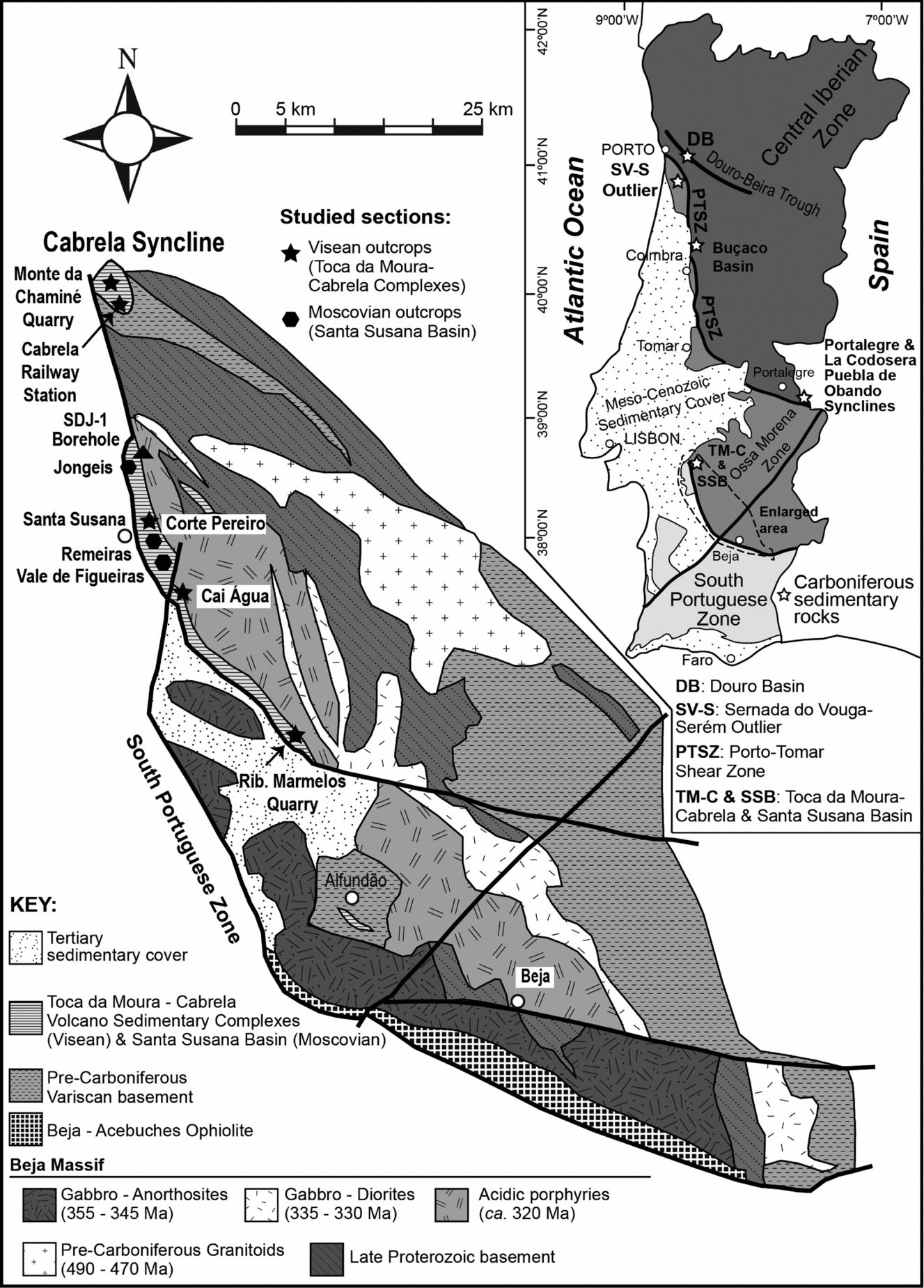
The Ossa Morena Zone is a palaeogeographic domain of the Iberian Massif, the southern branch of the European Variscan Chain (Chacón et al. Reference Chacón, Oliveira, Ribeiro, Oliveira and Comba1983; Oliveira, Oliveira & Piçarra, Reference Oliveira, Oliveira and Piçarra1991). It comprises Upper Proterozoic to Upper Palaeozoic rocks that are organized into different tectonostratigraphic units (Oliveira, Oliveira & Piçarra, Reference Oliveira, Oliveira and Piçarra1991). The Beja Massif is the southern tectonostratigraphic domain of the Ossa Morena Zone and is in faulted contact with the Upper Devonian clastic and metamorphic rocks of the Pulo do Lobo Antiform, the geological units that belong to the South Portuguese Zone, which is the southernmost tectonostratigraphic domain of the Iberian Massif (Fig. 1).
Simplified geological map of the southwestern border of the Ossa Morena Zone and the South Portuguese Zone in Portugal, with the location of the studied outcrops of the Toca da Moura – Cabrela volcano-sedimentary complexes and Santa Susana Basin. The map of Portugal shows the location of the different Carboniferous sedimentary rocks, whose organic maturation is discussed in this work. Adapted from Pereira, Oliveira & Oliveira (Reference Pereira, Oliveira and Oliveira2006).
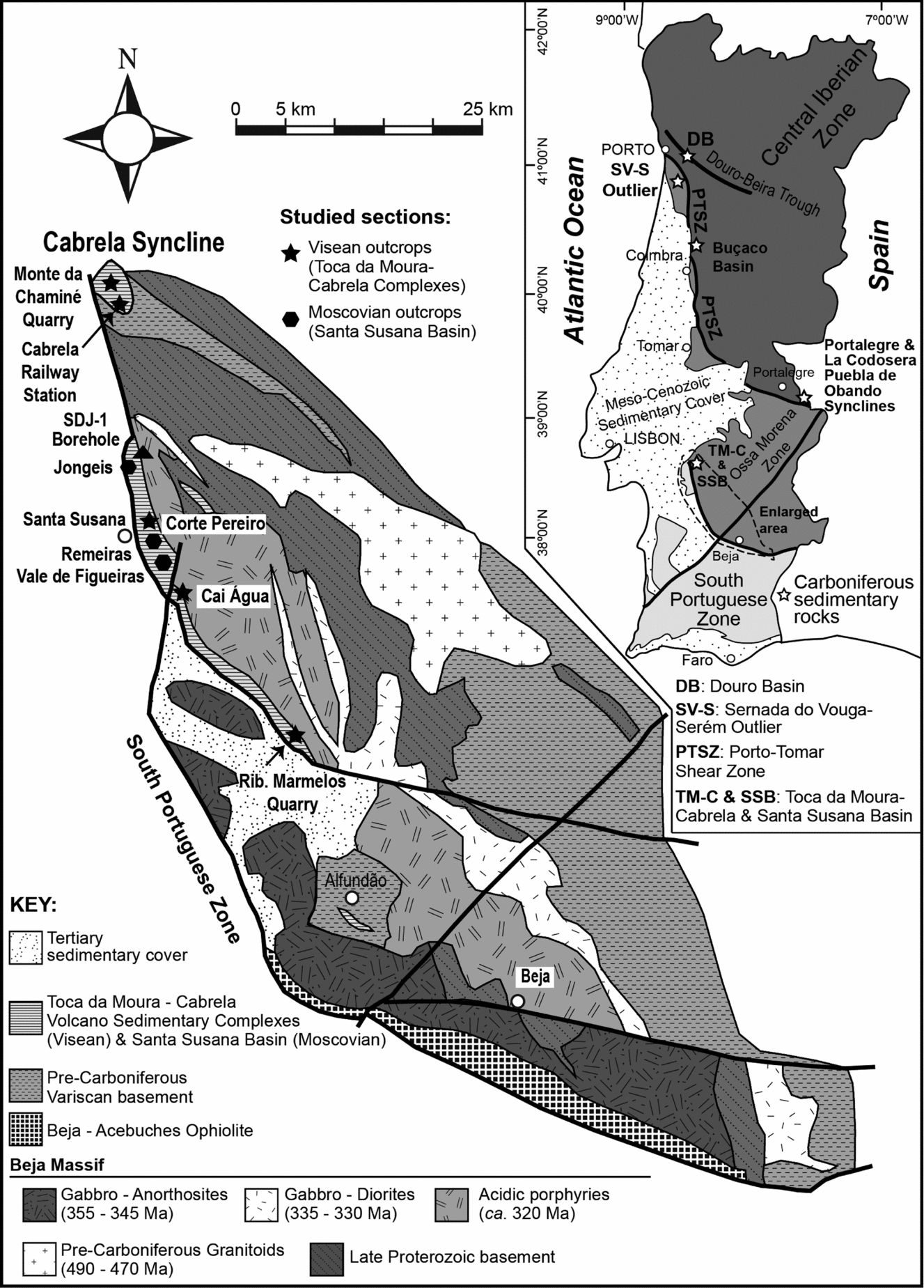
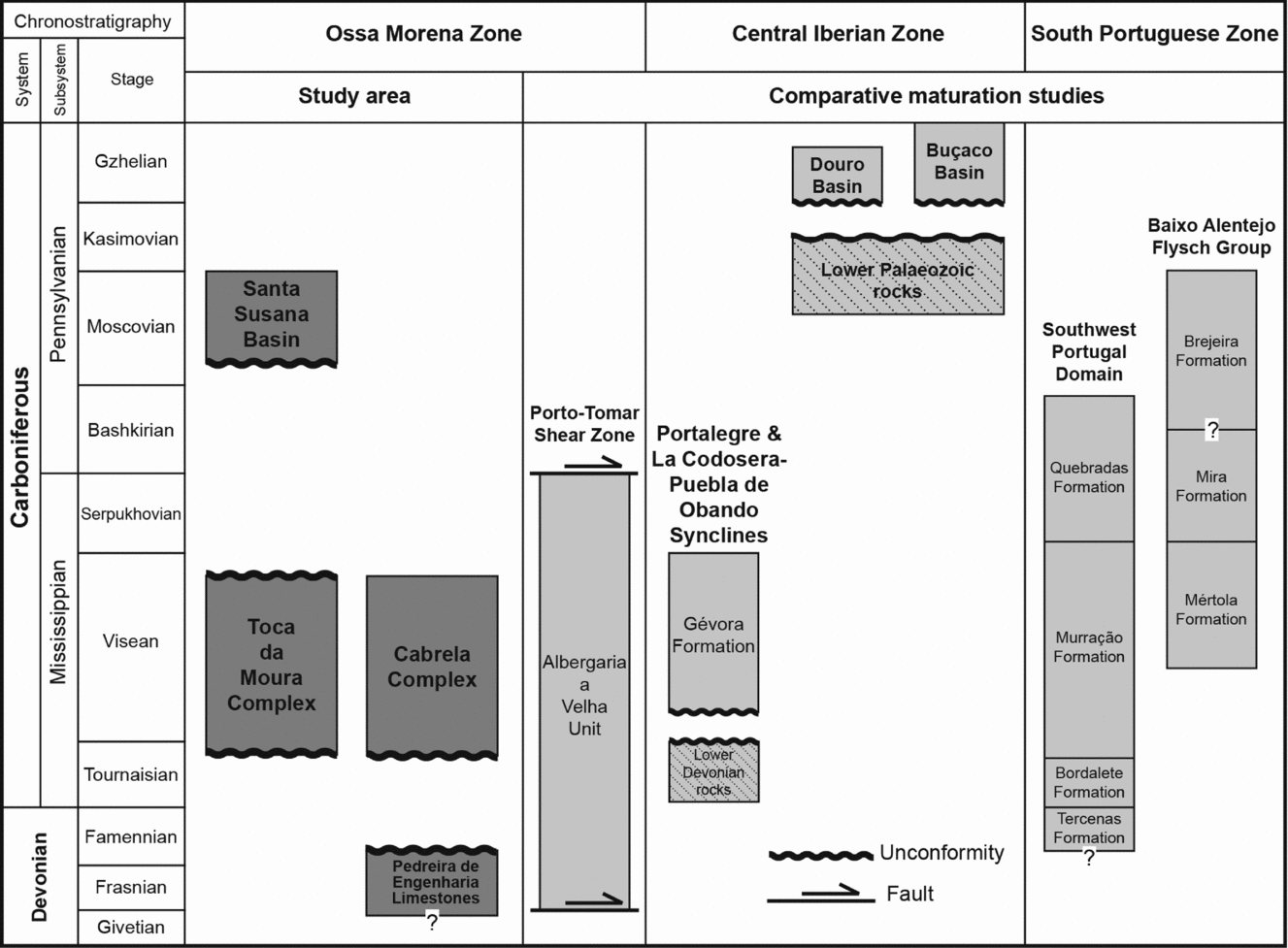
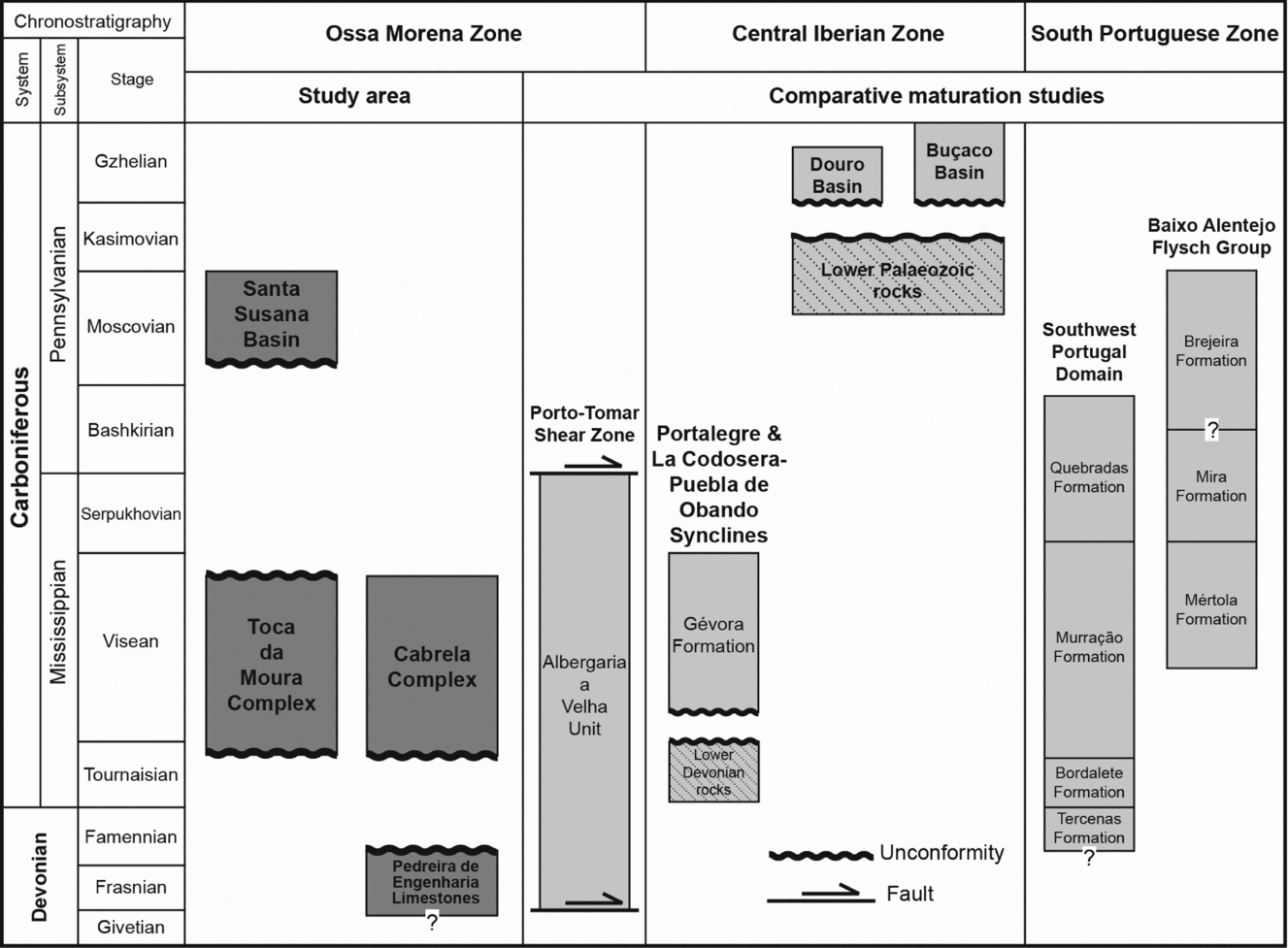
Outcrops of the Mississippian Toca da Moura and Cabrela volcano-sedimentary complexes are scattered along the SW boundary between the Ossa Morena Zone and the South Portuguese Zone (Fig. 1). These rocks are the remnants of possibly more extensive marine sedimentary basins that developed in intra-volcanic arc settings related to the collision between the Ossa Morena Zone of Gondwanan affinities (von Raumer, Stampfli & Bussy, Reference von Raumer, Stampfli and Bussy2003; Solá et al. Reference Solá, Pereira, Williams, Ribeiro, Neiva, Montero, Bea and Zinger2008) and the South Portuguese Zone of Avalonian affinity (Oliveira & Quesada, Reference Oliveira and Quesada1998; de la Rosa, Jenner & Castro, Reference de la Rosa, Jenner and Castro2002; Jorge et al. Reference Jorge, Fernandes, Rodrigues, Pereira and Oliveira2013; Rodrigues et al. Reference Rodrigues, Chew, Jorge, Fernandes, Veiga-Pires and Oliveira2015). The rocks of the Toca da Moura Volcano-Sedimentary Complex are unconformably overlain by the Pennsylvanian continental coal-bearing clastic rocks of the Santa Susana Basin (Wagner & Sousa, Reference Wagner, Sousa, Sousa and Oliveira1983; Gonçalves & Carvalhosa, Reference Gonçalves, Carvalhosa and Zbyszewski1984) (Fig. 2).
Simplified stratigraphy of the study area and of the Upper Devonian and Carboniferous sections in the Iberian Variscan tectonostratigraphic zones discussed in the comparative maturation studies section. Adapted from Sousa & Wagner (Reference Sousa, Wagner, Sousa and Oliveira1983), Pereira, Oliveira & Oliveira (Reference Pereira, Oliveira and Oliveira2006), Chaminé et al. (Reference Chaminé, Gama Pereira, Fonseca, Moço, Fernandes, Rocha, Flores, Pinto de Jesus, Gomes, Soares de Andrade and Araújo2003), Flores et al. (Reference Flores, Gama Pereira, Ribeiro, Pina, Marques, Ribeiro, Bobos and Pinto de Jesus2010) and Lopes et al. (Reference Lopes, Pereira, Fernandes, Wicander, Matos, Rosa and Oliveira2014).
The geological features and age of these Carboniferous sedimentary successions are important considerations when reconstructing the geological evolution of the Ossa Morena Zone, in particular the chronological sequence of the different tectonic and thermal events that occurred during the Variscan Orogeny, culminating in the aggregation of Pangaea. The vitrinite reflectance data presented in this work were used to characterize the organic maturation levels and the thermal histories of the Carboniferous Toca da Moura and Cabrela volcano-sedimentary complexes and the continental Santa Susana Basin. The contrasting thermal histories shown by these two unconformity-bounded stratigraphic successions elucidate the thermal events and the geological evolution of the southwestern margin of the Ossa Morena Zone during the Variscan Orogeny.
2. Geological background
The Toca da Moura Volcano-Sedimentary Complex (abbreviated to ‘Toca da Moura Complex’) is a bimodal volcano-sedimentary succession associated with the Beja Massif, a calc-alkaline magmatic suite (c. 355–300 Ma; Salman, Reference Salman2004; Jesus et al. Reference Jesus, Munhá, Mateus, Tassinari and Nutman2007; Pin et al. Reference Pin, Fonseca, Paquette, Castro and Matte2008), located at the southwestern border of the Ossa Morena Zone (Fig. 1). The Toca da Moura Complex crops out between the villages of Santa Susana and Alfundão (Fig. 1) and consists of interbedded black to grey shales and siltstones (often bioturbated) intercalated with and intruded by basalts, reworked pyroclasts, andesites, rhyolites, diabases and microdiorites (Gonçalves, Reference Gonçalves1985; Santos et al. Reference Santos, Mata, Gonçalves and Munhá1987). The outcrops of the Toca da Moura Complex are usually in faulted contact with the igneous rocks of the Beja Massif and various lithostratigraphic units of the South Portuguese Zone. The rocks of the Toca da Moura Complex are poorly exposed, with workable outcrops restricted to road-cuts, disused quarries and riverbanks. Miospores recovered from outcrops and the subsurface from the SDJ-1 exploration borehole indicate a late Tournaisian to middle late Visean age for the Toca da Moura Complex (Andrade et al. Reference Andrade, Santos, Oliveira, Cunha, Munhá and Gonçalves1991; Pereira, Oliveira & Oliveira, Reference Pereira, Oliveira and Oliveira2006; Lopes et al. Reference Lopes, Pereira, Fernandes, Wicander, Matos, Rosa and Oliveira2014) (Fig. 2). The total thickness of the Toca da Moura Complex is unknown because the basal contact has not been observed, though measured sections suggest that it is over 500 m thick (Pereira, Oliveira & Oliveira, Reference Pereira, Oliveira and Oliveira2006; Lopes et al. Reference Lopes, Pereira, Fernandes, Wicander, Matos, Rosa and Oliveira2014).
The Cabrela Volcano-Sedimentary Complex (abbreviated to ‘Cabrela Complex’) is only exposed in the Cabrela Syncline (Fig. 1). In the southwestern limb of the syncline, the stratigraphic succession comprises, in ascending order, a 2 m thick polymictic conglomerate and the 10 m thick Pedreira da Engenharia limestones (Fig. 2). These are unconformably overlain by the Cabrela Formation (Ribeiro, Reference Ribeiro1983; Carvalhosa & Zbyzewski, Reference Carvalhosa and Zbyzewski1994). The base of the Cabrela Formation consists of 10 m thick mud-supported conglomerates with limestone clasts, followed by shales and greywackes interbedded with acidic volcaniclastic rocks, with a total thickness of c. 200 m. The Cabrela Formation yielded miospores of late Tournaisian to middle Visean age (Fig. 2). In the northern limb of the Cabrela Syncline, the Pedreira da Engenharia limestones are not exposed and the stratigraphic succession commences with a c. 2 m thick polymictic conglomerate bed that rests unconformably on deformed and metamorphosed rocks of the Ossa Morena Zone of uncertain age (Silurian?) (Pereira, Oliveira & Oliveira, Reference Pereira, Oliveira and Oliveira2006). This basal conglomerate is overlain by shales interbedded with greywackes of the Cabrela Formation.
The Pedreira da Engenharia limestones contain conodonts of late Eifelian age (Boogard, Reference Boogard1972), whereas the limestone clasts at the base of the Cabrela Formation in the southern limb of the Cabrela Syncline yielded conodonts of late Frasnian age (Boogard, Reference Boogard1983). The unconformity between the Pedreira da Engenharia limestones and the Cabrela Formation has been interpreted as a consequence of the first Variscan orogenic episode in the Ossa Morena Zone based upon the time gap between the age of the Pedreira da Engenharia limestones and the age of the limestone clasts at the base of the Cabrela Formation (Ribeiro, Reference Ribeiro1983; Quesada, Robardet & Gabaldon, Reference Quesada, Robardet, Gabaldon, Dallmeyer and Martinez-Garcia1990; Ribeiro, Quesada & Dallmeyer, Reference Ribeiro, Quesada, Dallmeyer, Dallmeyer and Martinez-Garcia1990). This interpretation was disputed by Pereira, Oliveira & Oliveira (Reference Pereira, Oliveira and Oliveira2006) and Oliveira et al. (Reference Oliveira, Relvas, Pereira, Munhá, Matos, Barriga, Rosa, Dias, Araújo, Terrinha and Kullberg2013), who interpreted the Frasnian limestone clasts as olistoliths on the basis of in situ and younger late Tournaisian to middle Visean miospore assemblages recovered from Cabrela Formation shales. According to these authors, the limestone clasts of Frasnian age within the Cabrela Formation represent gravity slide deposits that formed during the erosion of an extensive carbonate platform that developed at the southern margin of the Ossa Morena Zone during Middle to Late Devonian times. The destruction of this platform resulted from tectonism related to basin formation processes of the Cabrela and Toca da Moura basins during Tournaisian to middle Visean times (Pereira, Oliveira & Oliveira, Reference Pereira, Oliveira and Oliveira2006; Oliveira et al. Reference Oliveira, Relvas, Pereira, Munhá, Matos, Barriga, Rosa, Dias, Araújo, Terrinha and Kullberg2013). Other geological evidence also supports this interpretation, such as the contrast between the tectonic fabric of the Toca da Moura and Cabrela complex rocks that shows only one weak tectonic cleavage and the underlying basement rocks that show three strong tectonic cleavages. This suggests that the deposition of the Toca da Moura and Cabrela complexes pre-dated only the last phase of Variscan deformation in the Ossa Morena Zone and does not mark the first Variscan deformational episode.
Recycled palynomorphs are a conspicuous feature of the Toca da Moura and Cabrela complexes, as they are more abundant than in situ miospores (Pereira, Oliveira & Oliveira, Reference Pereira, Oliveira and Oliveira2006; Lopes et al. Reference Lopes, Pereira, Fernandes, Wicander, Matos, Rosa and Oliveira2014). The reworked assemblages recovered are represented by spores and acritarchs ranging from middle–late Cambrian to early Carboniferous in age, suggesting the Visean exhumation of a well-structured mountain chain that included well-exposed Lower to Upper Palaeozoic rocks of the Ossa Morena Zone (Lopes et al. Reference Lopes, Pereira, Fernandes, Wicander, Matos, Rosa and Oliveira2014). Therefore, both the Toca da Moura and Cabrela complexes share a similar age and geotectonic setting, being deposited in small intra-arc basins at the southern margin of the Ossa Morena Zone during late Tournaisian to the middle Visean times (Pereira, Oliveira & Oliveira, Reference Pereira, Oliveira and Oliveira2006; Oliveira et al. Reference Oliveira, Relvas, Pereira, Munhá, Matos, Barriga, Rosa, Dias, Araújo, Terrinha and Kullberg2013; Lopes et al. Reference Lopes, Pereira, Fernandes, Wicander, Matos, Rosa and Oliveira2014).
The Santa Susana Basin is a Pennsylvanian intra-continental sedimentary depocentre located within a NNW–SSE- to N–S-trending shear zone that separates the Ossa Morena Zone and the South Portuguese Zone. The Santa Susana Basin rests unconformably on the Toca da Moura Complex (Gonçalves, Reference Gonçalves1983; Santos et al. Reference Santos, Mata, Gonçalves and Munhá1987; Pereira, Oliveira & Oliveira, Reference Pereira, Oliveira and Oliveira2006) and the igneous rocks (microdiorites and porphyry rocks) of the Beja Massif (e.g. Gonçalves, Reference Gonçalves1983, Reference Gonçalves1985). Its maximum length is 15 km and it is only 1 km wide (Fig. 1). During the 1950s, a borehole drilling revealed the extension of the Santa Susana Basin to the south, where it is concealed by Tertiary clastic deposits (Andrade, Guerreiro & Santos, Reference Andrade, Guerreiro and Santos1955). A significant part of the southern outcrop of the Santa Susana Basin is now flooded by the Pêgo do Altar reservoir and is, therefore, inaccessible. Thus, only three small outliers of the Santa Susana Basin remain today, which are, from N to S: Jongeis, Remeiras and Vale de Figueiras (Fig. 1). The basin had several thin and discontinuous coal seams that were mined until 1944 (Sousa & Wagner, Reference Sousa, Wagner, Sousa and Oliveira1983).
The stratigraphy of the Santa Susana Basin has only been summarily described in papers that dealt mainly with palaeobotanical studies. Continuous outcrops of the Santa Susana Basin can only be found along some streambeds and reservoir banks. Machado, Silva & Almeida (Reference Machado, Silva and Almeida2012), based on outcrop and well data, identified two major sedimentary rock units within the basin: a basal rock unit composed of polymictic conglomerates and coarse sandstones interbedded with a few finer-grained sedimentary rocks. Outcrops of the basal unit are found in the Remeiras outlier and along the limits of the Vale de Figueiras and Jongeis outliers. It was also recognized in most of the wells drilled in the basin (Andrade, Guerreiro & Santos, Reference Andrade, Guerreiro and Santos1955), and was interpreted as alluvial fan deposits with the clasts transported, probably, by high-energy torrential fluxes. The upper rock unit consists of intercalated quartz/quartzite-rich conglomerates, sandstones, shales and coal beds of variable thickness. This unit occupies most of the current Santa Susana Basin surface area and was interpreted as fluvial to lacustrine deposits. The conglomerates of the Santa Susana Basin have clasts of rocks that can be traced to the Toca da Moura – Cabrela complexes and to the Beja Massif igneous lithologies, indicating that these geological units were exposed and were the source of most of the sediments for the Santa Susana Basin conglomerate beds (Machado, Silva & Almeida, Reference Machado, Silva and Almeida2012).
The Santa Susana Basin's geometry and tectonics have received little interest, and few general descriptions and interpretations have been published (e.g. Domingos et al. Reference Domingos, Freire, Gomes da Silva, Gonçalves, Pereira, Ribeiro, Sousa and Oliveira1983; Carvalhosa & Zbyszewsky, Reference Carvalhosa and Zbyzewski1994). Almeida et al. (Reference Almeida, Silva, Oliveira and Silva2006) and Oliveira, Silva & Almeida (Reference Oliveira, Silva and Almeida2007) interpreted the Santa Susana Basin as a pull-apart basin resulting from a Pennsylvanian transtensive dextral tectonic style along the Santa Susana Shear Zone. Their interpretation was later supported by Machado, Silva & Almeida (Reference Machado, Silva and Almeida2012), who also showed that the northern part of the basin was inverted and was partially eroded during post-Pennsylvanian times (especially between the Jongeis and Remeiras outliers) while the southern part has been mostly preserved.
Studies on the age of the Santa Susana Basin were mostly based on its palaeobotanical content and date back to the 1800s (Gomes, Reference Gomes1865; Lima, Reference Lima1895–Reference Lima1898). Later, Teixeira (Reference Teixeira1938–1940, Reference Teixeira1945) revised the previous works and compared the floras of the Santa Susana Basin with other Carboniferous basins in Spain and elsewhere in Europe. Wagner & Sousa (Reference Wagner, Sousa, Sousa and Oliveira1983) revised the taxonomy and stratigraphic importance of the Santa Susana Basin fossil plant assemblages, considering them as ‘very late Westphalian D or earliest Cantabrian’. Fernandes (Reference Fernandes, Fombella Blanco, Fernandez Gonzáles and Valença Barreira2001) studied the palynology of borehole cutting samples, and the organic residues obtained yielded a palynological assemblage attributed to the late Moscovian to early Kasimovian age miospore biozones Thymospora obscura – T. thiessenii (OT) and/or Angulisporites splendidus – Latensina trileta (ST) of Clayton et al. (Reference Clayton, Coquel, Doubinger, Gueinn, Loboziak, Owens and Streel1977). More recently, Machado, Silva & Almeida (Reference Machado, Silva and Almeida2012) studied the palynology of surface samples from several locations and confirmed the previous ages for the upper rock unit of the Santa Susana Basin in the Vale de Figueiras outlier (ST miospore Biozone) and described a slightly older assemblage (middle to late Moscovian) from the Jongeis outlier (Fig. 2). Middle to late Moscovian ages were also described by Lopes et al. (Reference Lopes, Pereira, Fernandes, Wicander, Matos, Rosa and Oliveira2014) from samples of the Santa Susana Basin in borehole SDJ-1 (SL Biozone) and from a control sample (OT Biozone) from the old Jongeis coal mine housed in the LNEG Geological Museum in Lisbon.
There are no comprehensive organic maturation studies of both the Toca da Moura – Cabrela complexes and the Santa Susana Basin. Pereira, Oliveira & Oliveira (Reference Pereira, Oliveira and Oliveira2006) stated that the colour indices of the in situ and reworked palynomorphs recovered from the Toca da Moura and Cabrela complexes are identical with thermal alteration indices (TAI) of 4-/4 and 5, suggesting that both palynological assemblages were exposed to the same temperatures during burial. Regarding the organic maturation of the Santa Susana Basin, Sousa et al. (Reference Sousa, Marques, Flores, Rodrigues, Neiva, Ribeiro, Victor, Noronha and Ramalho2010) quoted a vitrinite reflectance (VR) value of 1.51% Roran (%Roran – mean random vitrinite reflectance in oil immersion), indicating a low volatile bituminous coal rank, measured in a coal sample from the old Moinho da Ordem mining concession (Jongeis outlier).
3. Materials
The samples analysed in this study were obtained from outcrops, a coal exploration borehole (SDJ-1) and from the stratigraphic collections held at the Geological Museum of the LNEG in Lisbon, Portugal. Black and grey shales from the outcrops and from borehole SDJ-1 were the main lithologies sampled for organic maturation studies. A thin coal lens (0.5 cm thick) in a shale sample from the old Jongeis coal mine collection of the Santa Susana Basin, housed in the LNEG Geological Museum, was also studied as a control sample for the organic maturation levels of this basin.
In the Toca da Moura and Cabrela complexes, samples from five different outcrops were studied. The outcrops Corte Pereiro, Cai Água and Ribeira dos Marmelos Quarry are from the Toca da Moura Complex, whereas the Cabrela Railway Station and Monte da Chaminé Quarry were the studied sections from the Cabrela Complex (Figs 1, 4, 5). The lithological descriptions and palynological results of these outcrops are after Pereira, Oliveira & Oliveira (Reference Pereira, Oliveira and Oliveira2006). The same sample references used in the latter study are also used in this work, as they correspond to spare rock samples that were collected from the same levels. With the exception of the Cabrela Railway Station outcrop, igneous rocks of various thicknesses and compositions intrude the studied outcrops (Figs 4, 5). However, there is a major compositional difference between the igneous intrusive rocks: the Toca da Moura Complex outcrops are dominated by basic intrusions whereas the Cabrela Complex outcrops are dominated by acidic intrusive rocks. Table 1 shows all the VR results obtained from the outcrops of these two rock units.
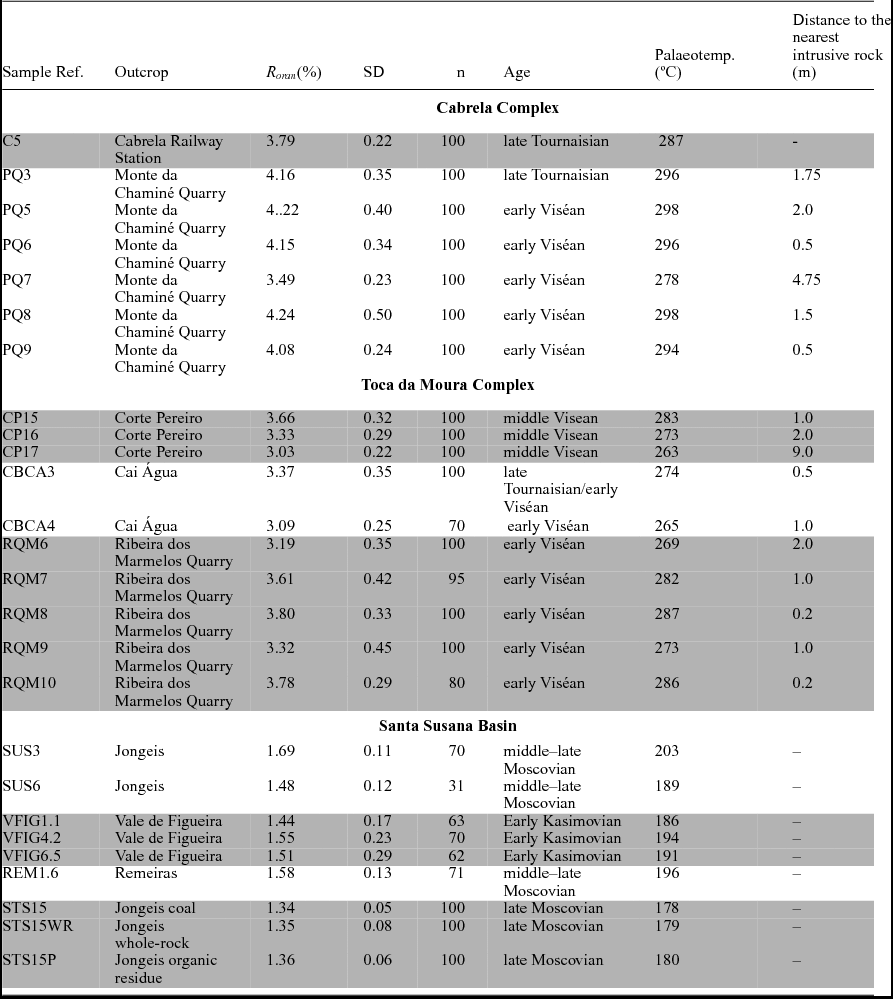
Organic maturation results and calculated palaeotemperatures (ºC) using the method described by Barker (Reference Barker and Magoon1988), for the Toca da Moura – Cabrela volcano-sedimentary complexes and Santa Susana Basin
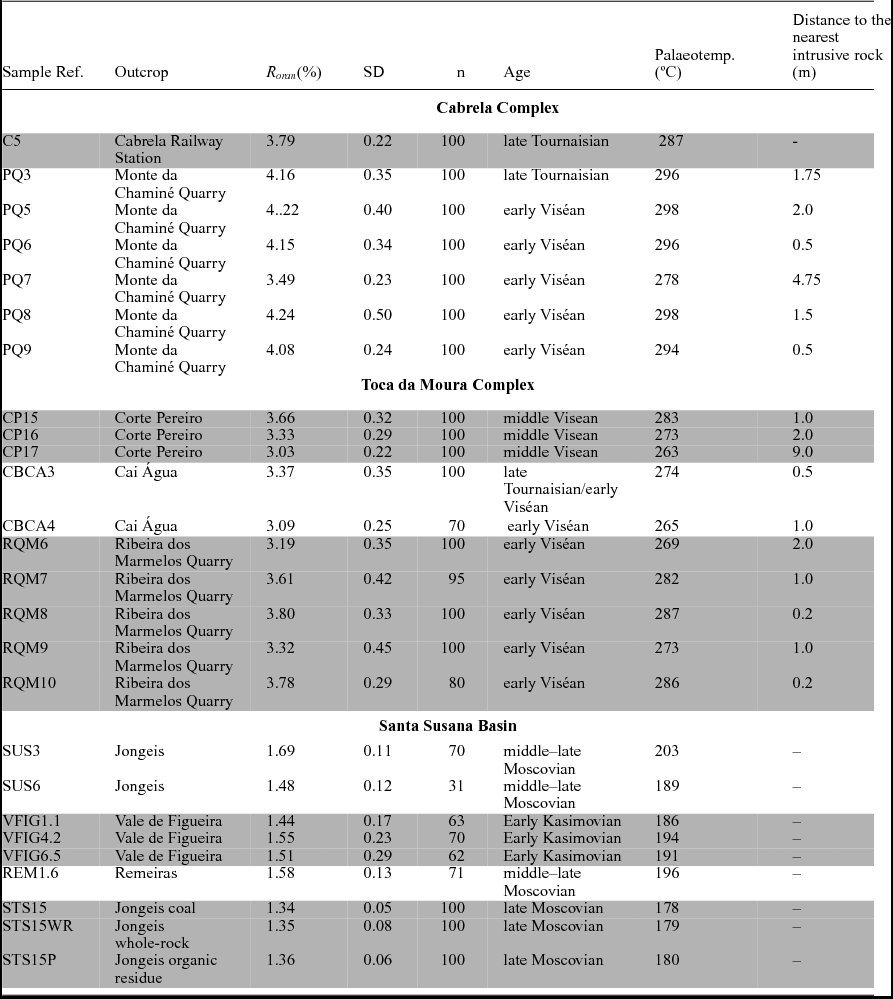
All samples are shales with the exception of sample STS15, which is a thin coal lens. Roran (%) – values of mean random vitrinite reflectance in oil immersion; SD – standard deviation; n – number of vitrinite particles measured.
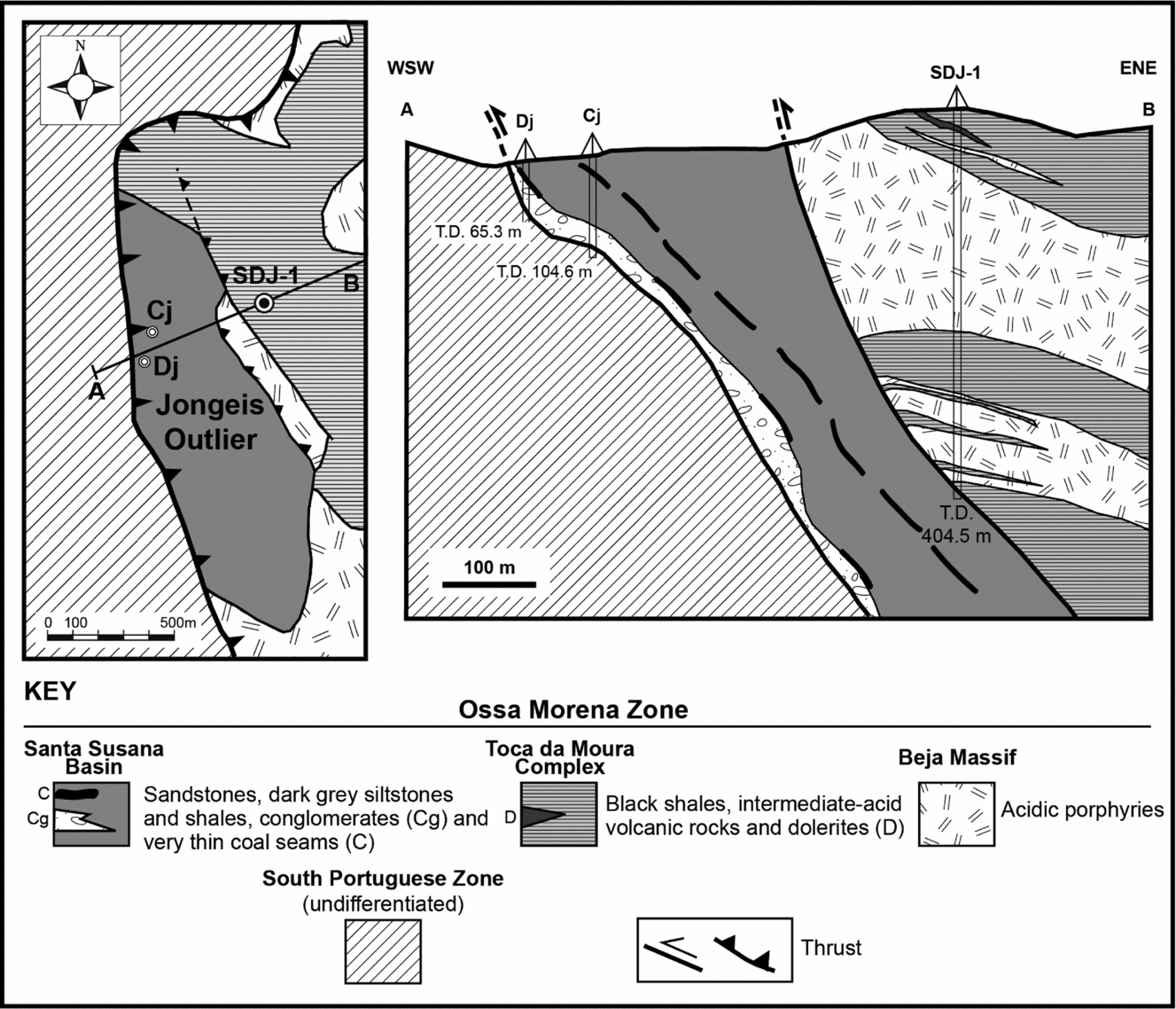
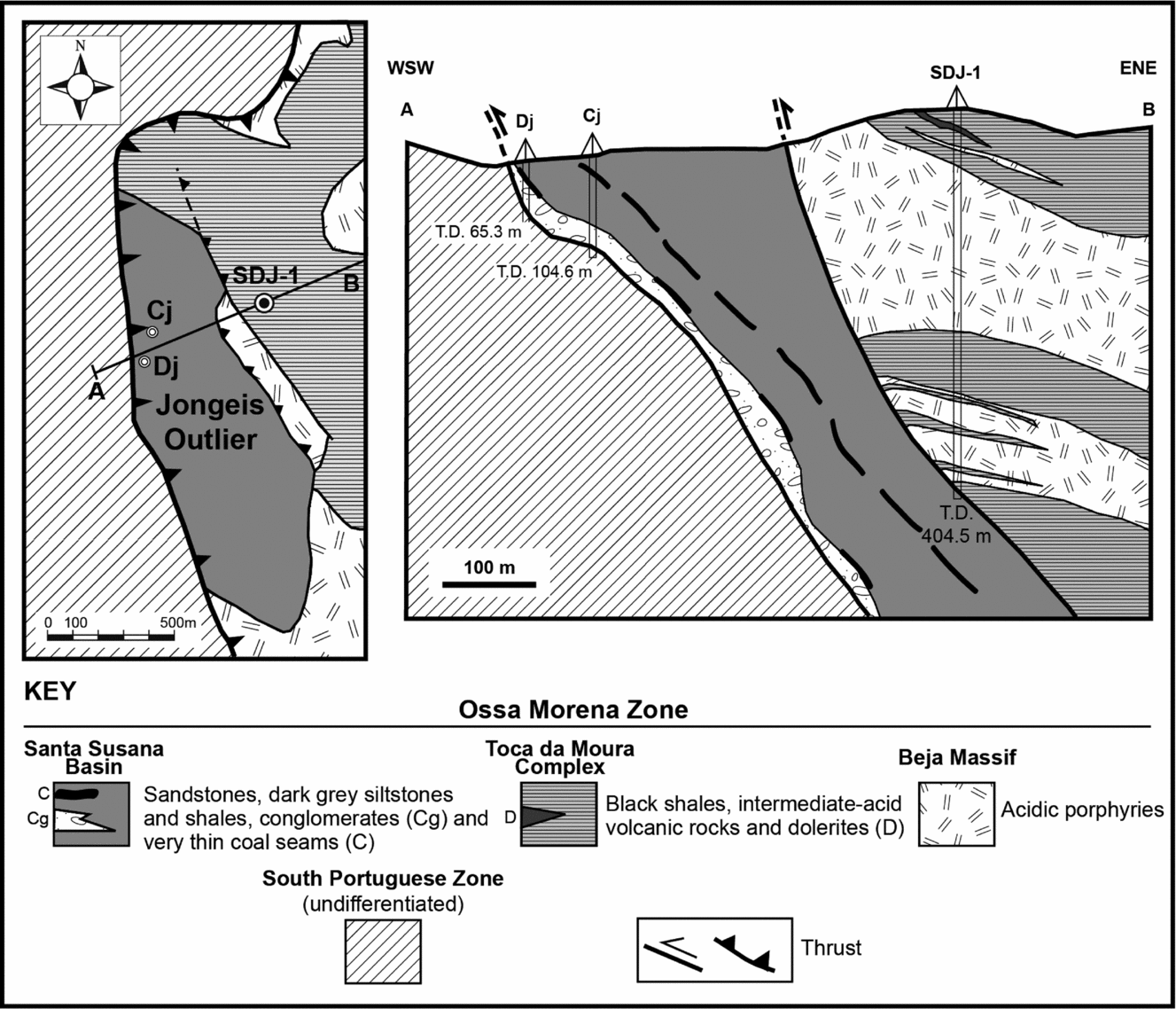
Borehole SDJ-1 (Fig. 3), with a total depth of 404.5 m, was drilled in 1991 by the Portuguese ‘Serviço de Fomento Mineiro’ to investigate an underground electromagnetic anomaly thought to represent coal-bearing strata of the Santa Susana Basin (Oliveira & Matos, Reference Oliveira and Matos1991). The borehole is one of the few in this region that contain both the Toca da Moura Complex and the Santa Susana Basin succession in the subsurface (Lopes et al. Reference Lopes, Pereira, Fernandes, Wicander, Matos, Rosa and Oliveira2014). A total of 40 samples from different depths in this borehole were collected for organic maturation studies. The detailed lithological description of the borehole is presented in Lopes et al. (Reference Lopes, Pereira, Fernandes, Wicander, Matos, Rosa and Oliveira2014). In general, the borehole sequence consists of five different lithological intervals, which are, from base to top (Figs 3, 6), (i) 404.5–397.8 m depth: very fractured black to grey shales that yielded in situ palynomorphs of late Moscovian age, indicating the presence of Santa Susana Basin lithologies in this depth interval; (ii) 397.8–300 m: volcanic rocks and minor black shales beds; (iii) 300–231.1 m: grey to black shales with rare sandstones; (iv) 231.1–59 m: felsic porphyritic rocks (mainly rhyodacites); and (v) 59–3.5 m: black shales and minor basic and felsic igneous intrusions. With the exception of interval (v), shales from the other lithological intervals yielded palynomorphs of middle–late Visean age belonging to the Toca da Moura Complex (Lopes et al. Reference Lopes, Pereira, Fernandes, Wicander, Matos, Rosa and Oliveira2014). The palynological results obtained from this borehole suggest that the Toca da Moura Complex has been thrust over the Santa Susana Basin (Fig. 3), implying also ‘that compressive Variscan tectonism took place post Santa Susana Basin deposition, i.e. later than the late Moscovian’ (Lopes et al. Reference Lopes, Pereira, Fernandes, Wicander, Matos, Rosa and Oliveira2014).
Geological map and interpretative geological profile of the Toca da Moura Complex and Santa Susana Basin in the Jongeis Outlier, with the location of boreholes Cj and Dj (projected) and SDJ-1. Adapted from Lopes et al. (Reference Lopes, Pereira, Fernandes, Wicander, Matos, Rosa and Oliveira2014) and Oliveira & Matos (Reference Oliveira and Matos1991).
The outcrop samples studied from the Santa Susana Basin are from three different locations: Jongeis, Vale de Figueira and Remeiras outliers (Fig. 1). These outcrops were described by Machado, Silva & Almeida (Reference Machado, Silva and Almeida2012) and, in this study, the sample references of these authors are used for these outcrops. The samples studied correspond to spare rock samples of the work of Machado, Silva & Almeida (Reference Machado, Silva and Almeida2012). A thin coal lamina (0.5 cm thick) in grey shales with plant impressions from the stratigraphic collection of the old Jongeis coal mine (housed in the LNEG Geological Museum, Lisbon) was selected as a control sample for the organic maturation studies of the Santa Susana Basin. In addition to the coal, the organic content of the host shale was also studied in order to compare its maturation level with the rank of the coal.
4. Organic matter extraction techniques and methods of vitrinite reflectance study
Organic particles were extracted from the rock samples using standard cold hydrofluoric acid (40% HF) techniques. The organic residues used for the maturation studies were mounted and polished using a method adopted from that described by Hillier & Marshall (Reference Hillier and Marshall1988), whereas the coal (STS15C) and whole-rock sample (STS15R) of the control sample were mounted and polished following the guidance of ICCP (1971) and standard ISO 7404-2 (1985).
Mean random vitrinite reflectance in oil immersion (%Roran ) was the vitrinite reflectance (VR) parameter chosen for maturation assessment of the shale and coal samples because the mounting techniques used provide non-oriented vitrinite particles. VR measurements on all samples were made using an Olympus BX 51 microscope equipped with a black and white digital camera. The greyscale (8-bit) digital images of vitrinite particles were analysed using a MatLab routine. This routine is a graphical tool that runs within the MIRONE suite (Luís, Reference Luis2007) and calibrates the scale of 256 grey levels with standards of known reflectivity (Fernandes et al. Reference Fernandes, Luís, Rodrigues, Marques, Valentim, Flores, Oliwkiewicz-Miklasinka, Stempien-Salek and Laptas2010, Reference Fernandes, Musgrave, Clayton, Pereira, Oliveira, Goodhue and Rodrigues2012, Reference Fernandes, Rodrigues, Borges, Matos and Clayton2013). The reflectance values of the standards used were: 0.428%, 0.595%, 0.897%, 1.314%, 1.715%, 3.15% and 5.37%. VR was measured in incident light with a wavelength of 546 nm and immersion oil with a refractive index of 1.518.
5. Maturation results
5.a. Toca da Moura and Cabrela complexes
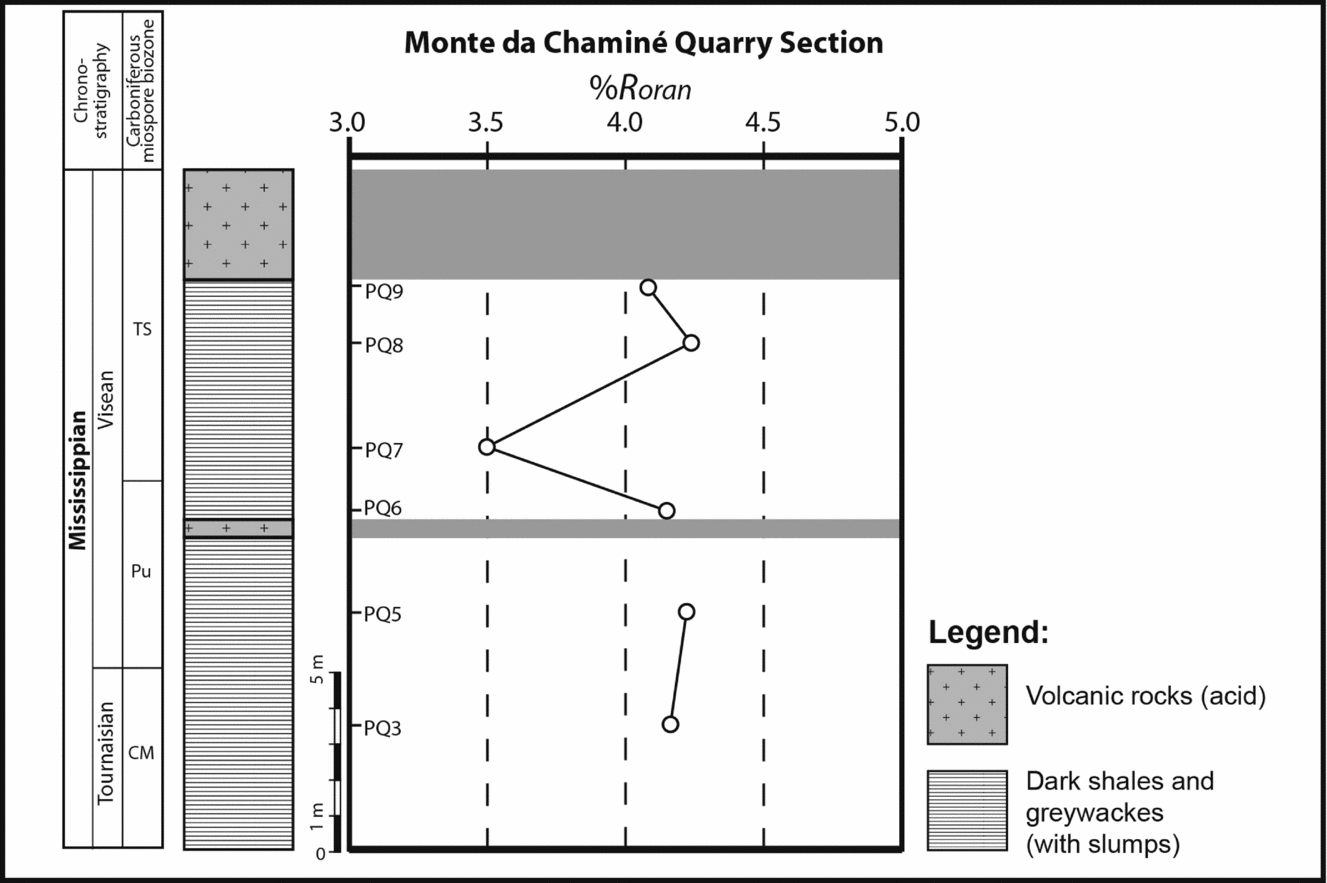
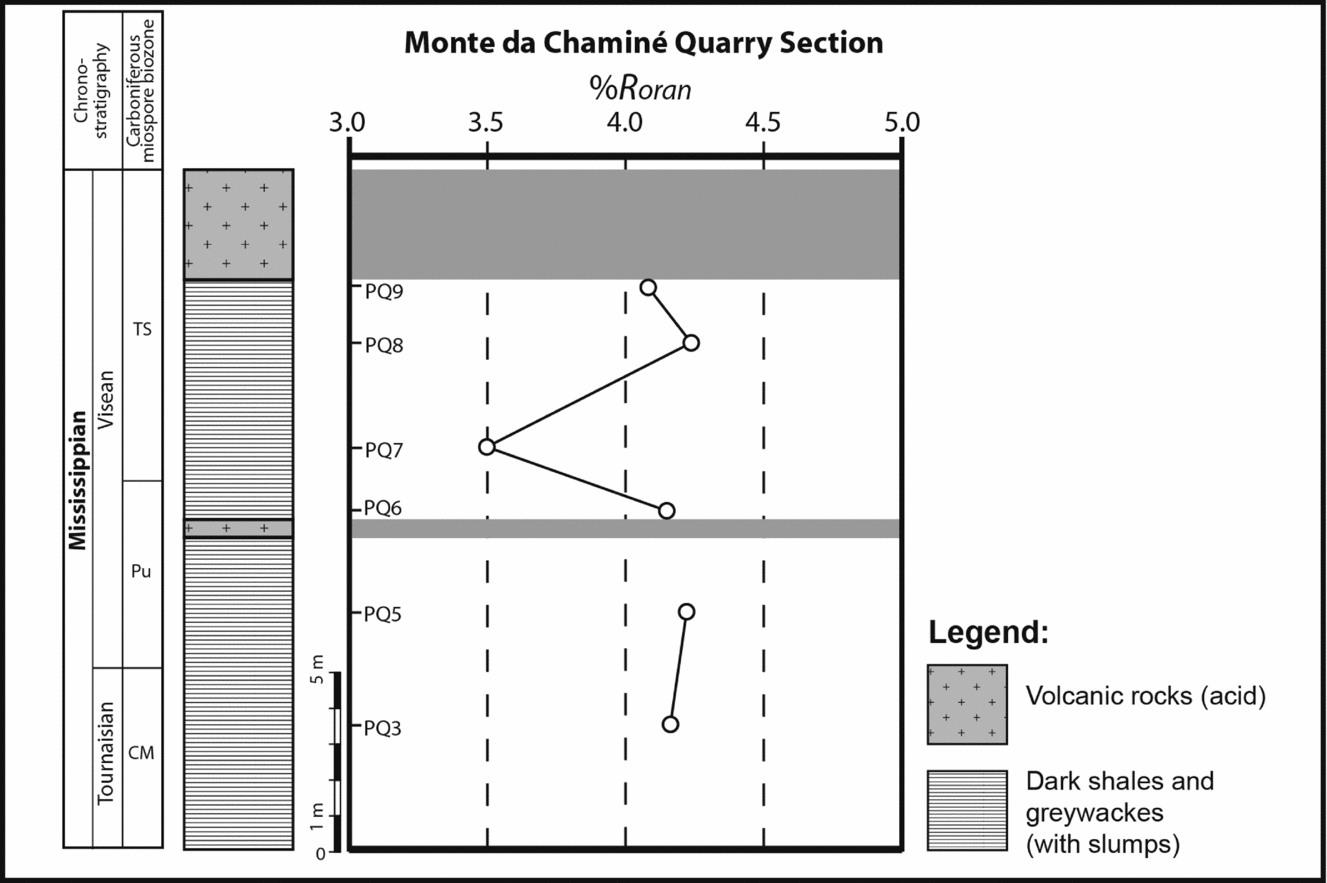
In the Cabrela Railway Station outcrop of the Cabrela Complex, a value of 3.79% Roran was measured from sample C5 near the bottom of a c. 25 m thick section. The Monte da Chaminé Quarry section is also c. 25 m thick and is intruded at the top of the section by a c. 5 m thick felsic intrusion and in the middle of the section by a minor felsic intrusion of c. 0.5 m thick. Several samples were collected from shales at different distances from the contacts with the intrusive rocks, and the VR measured varies from 3.49 to 4.24% Roran (Table 1). In this section, there is a crude trend of VR values increasing towards the contacts with the intrusive rocks (Fig. 4). Although values above 4.0% Roran were obtained for the samples near the contact with the intrusive rocks, a value of the same magnitude, 4.16% Roran , was measured in sample PQ3 located over 7 m away from the visible intrusive rocks of this outcrop. This may be owing to concealed igneous intrusions, a very irregular geometry of the intrusive rocks or the percolation of hot fluids. The lowest value (3.49% Roran ) was measured in sample PQ7 located 2 m from the nearest intrusion contact.
Vitrinite reflectance profile of the Monte da Chaminé Quarry section, located in the Cabrela Syncline.
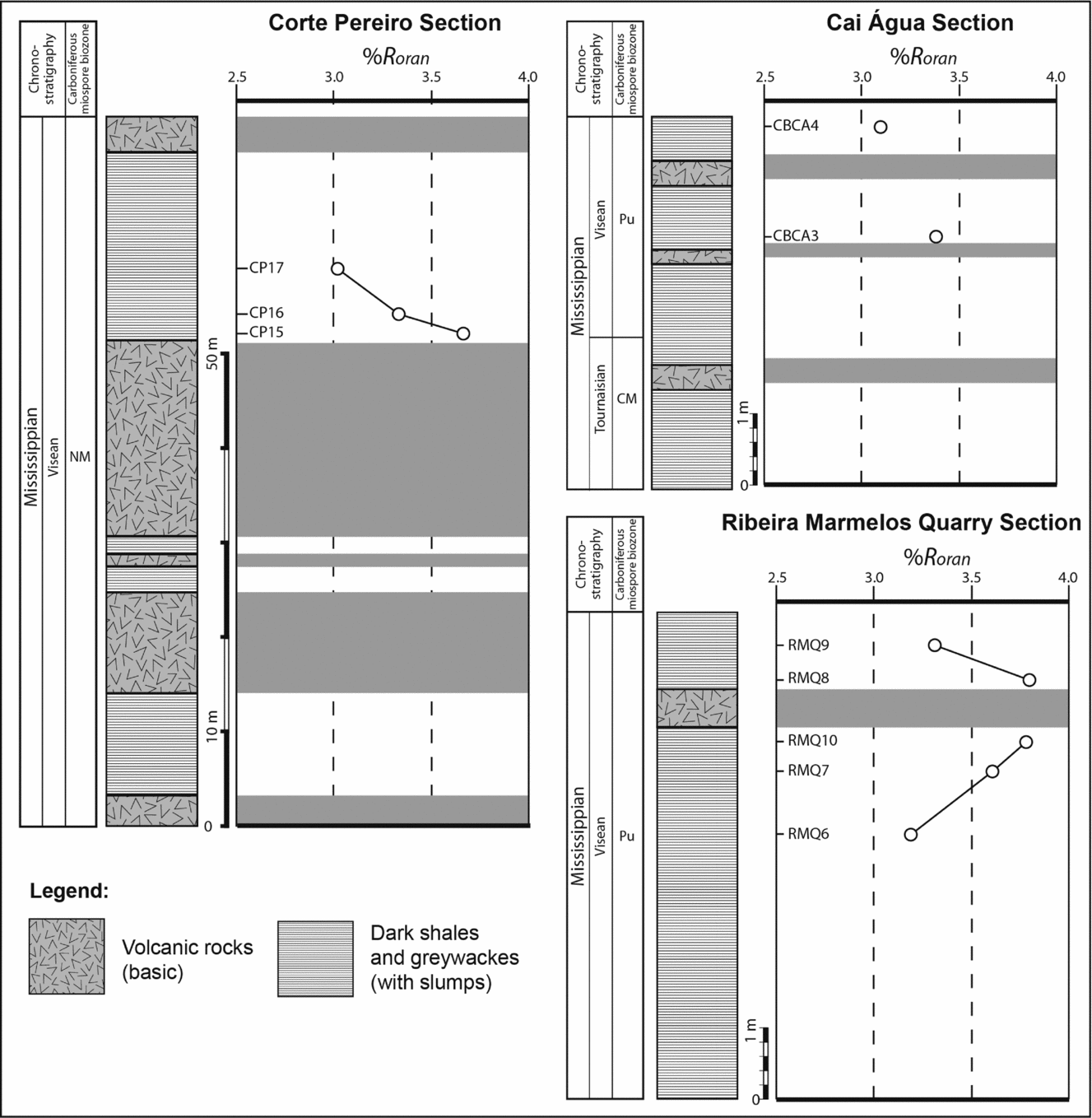
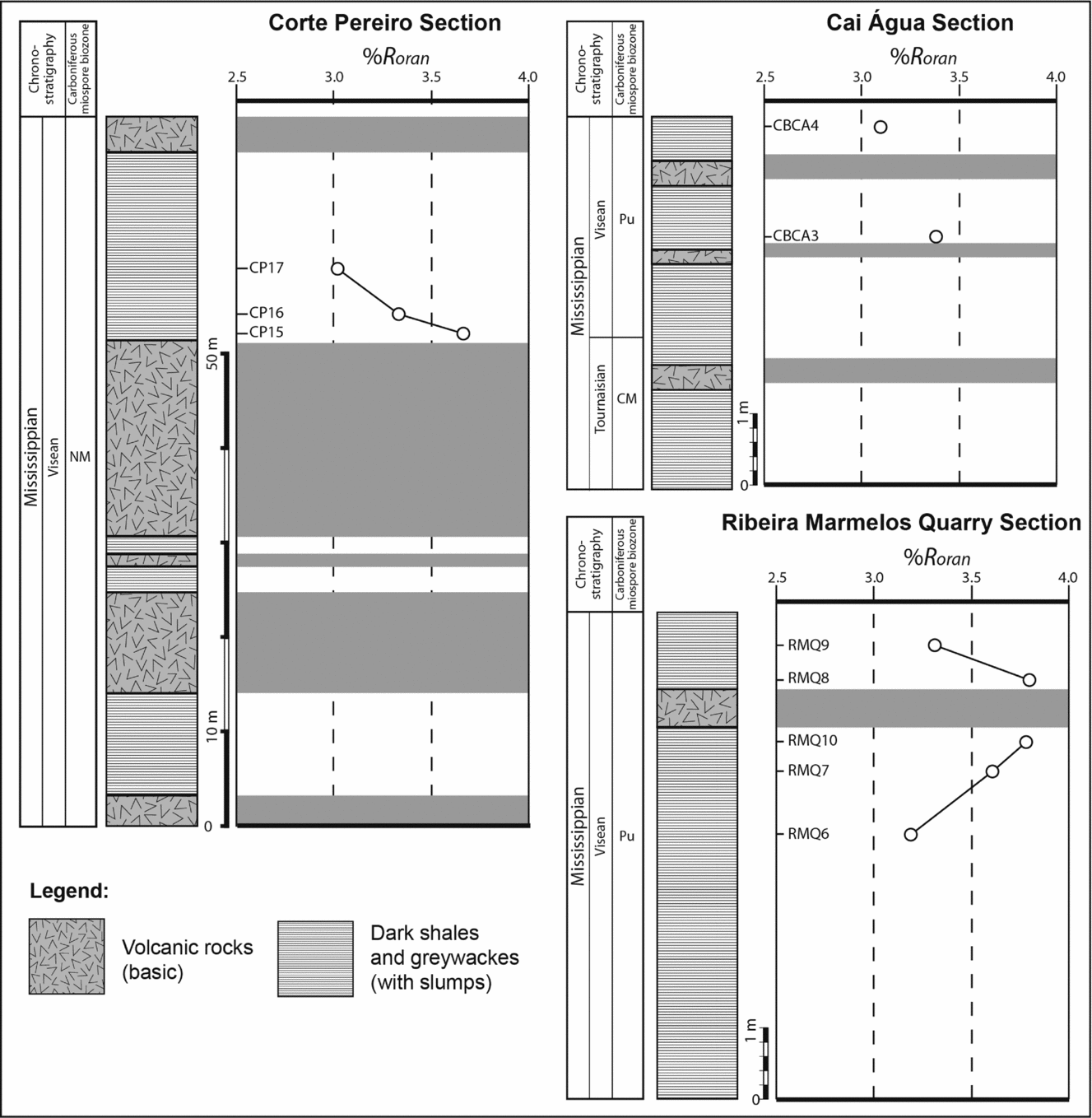
The outcrops of the Toca da Moura Complex investigated show a general increase in maturity near the contact with the igneous intrusive rocks. This trend is attributed to conductive heating due to the intrusions. In the Corte Pereiro outcrop, VR increases from a background level of c. 3.0% Roran to 3.66% Roran near the upper margin of a thick basic sill (Fig. 5). The effects of heat related to intrusions on the organic maturation levels were also observed in the samples studied near a sill, less than 1 m thick, in the outcrop of the Ribeira dos Marmelos Quarry section (Fig. 5). In the Cai Água outcrop, only two samples were studied, which is too few to confirm any increase in organic maturation due to igneous intrusions. The highest VR value measured (3.37% Roran ) is from sample CBCA3 located 50 cm from the nearest basic sill (Fig. 5; Table 1). Owing to the pervasive effects of heating by the intrusion, it is not possible to estimate accurately the regional background maturation for the Toca da Moura and Cabrela complexes. However, taking into account the VR values of samples that were apparently not affected by intrusions, a VR value of c. 3.0% Roran can be regarded as the regional background maturation level for the Toca da Moura Complex.
Vitrinite reflectance profiles of the Toca da Moura Complex studied sections.
5.b. Borehole SDJ-1
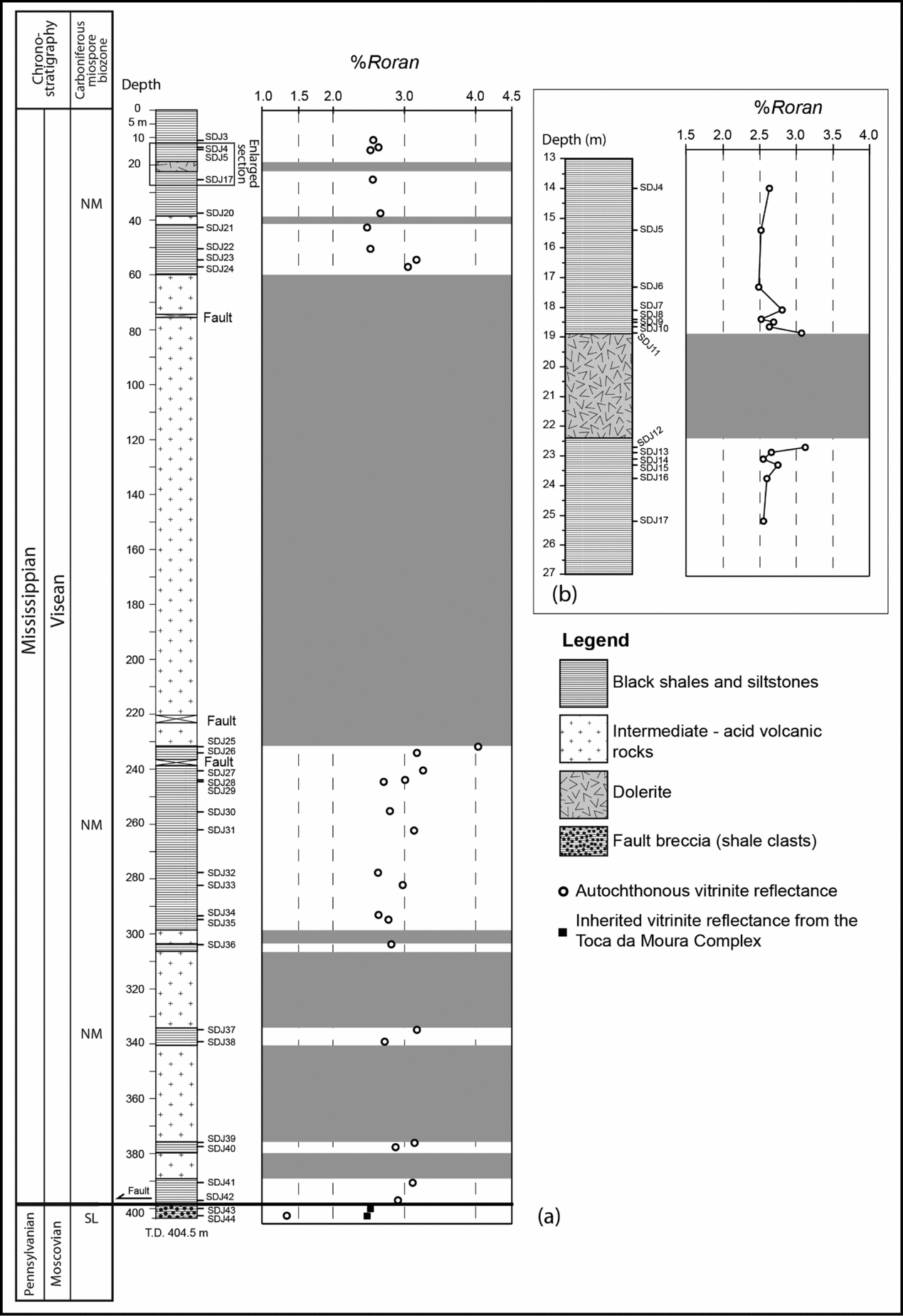
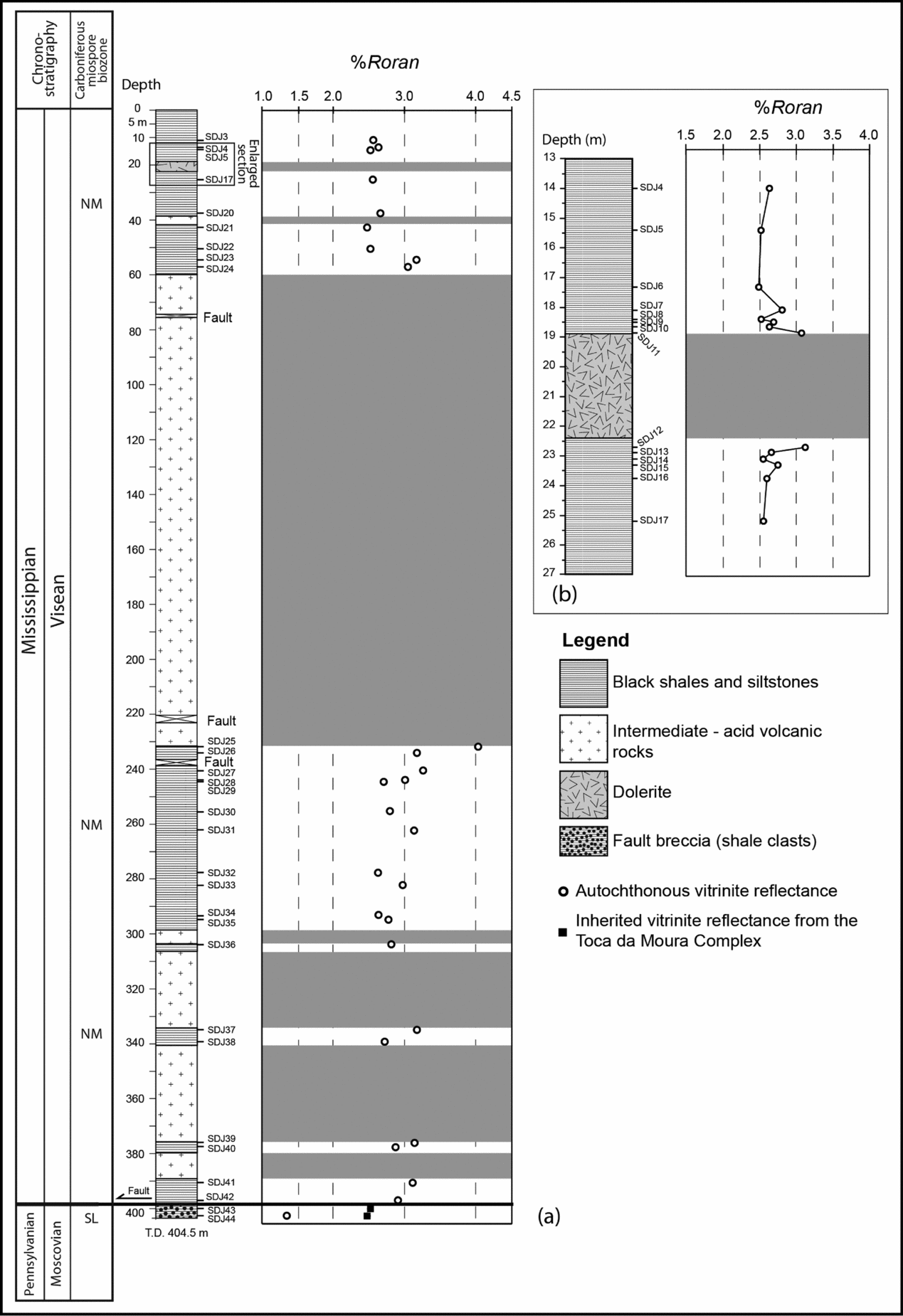
Borehole SDJ-1 penetrated lithologies of the Toca da Moura Complex, which are thrust over the basal c. 7 m of the borehole core that consists of mudstones from the Santa Susana Basin (Figs 3, 6). In contrast with the outcrop sections of the Toca da Moura Complex that are dominated by mafic intrusions, the igneous rocks in borehole SDJ-1 are mainly of felsic composition. Only a 3.5 m thick dolerite sill at c. 19 m depth was identified. Thirty-eight shale samples of the Toca da Moura Complex collected at different depths and two shale samples of the Santa Susana Basin near the bottom of the borehole were studied by means of VR to ascertain the organic maturation levels and the thermal history. Detailed sampling was also completed above and below the intrusive contacts of the dolerite sill in order to assess the effects of this intrusion upon organic maturation (Fig. 6; Table 2).
Detailed log and vitrinite reflectance profile from the SDJ-1 borehole. The inside figure shows the variation of VR results above and below the 3.5 m thick doleritic sill, c. 19 m depth.
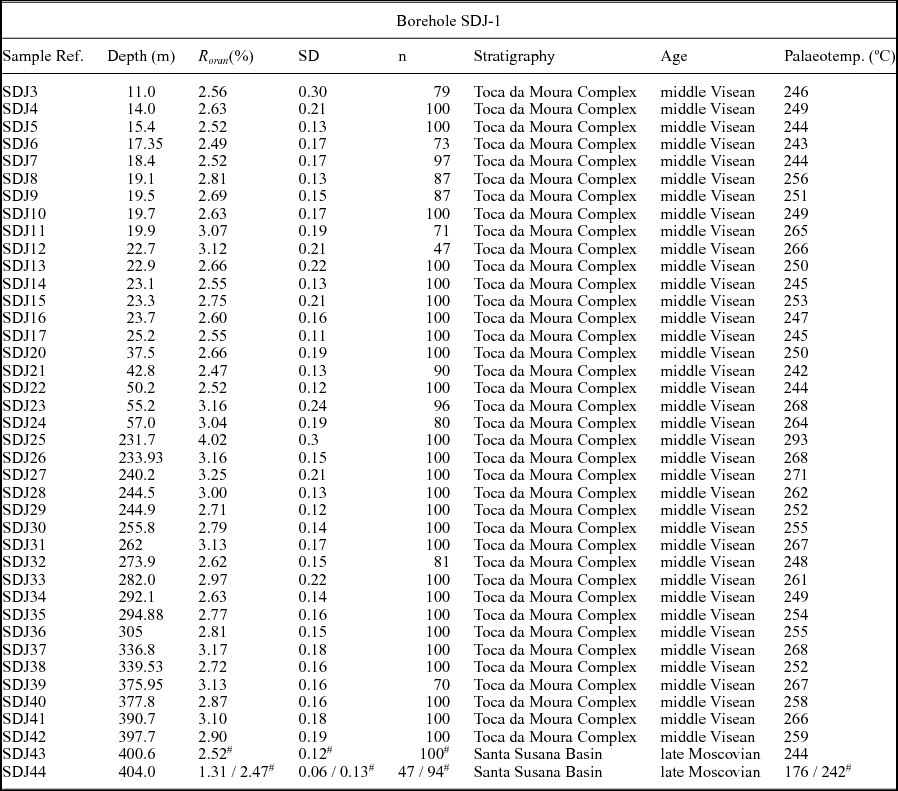
Organic maturation results and calculated palaeotemperatures (ºC) using the method described by Barker (Reference Barker and Magoon1988), for the SDJ-1 borehole
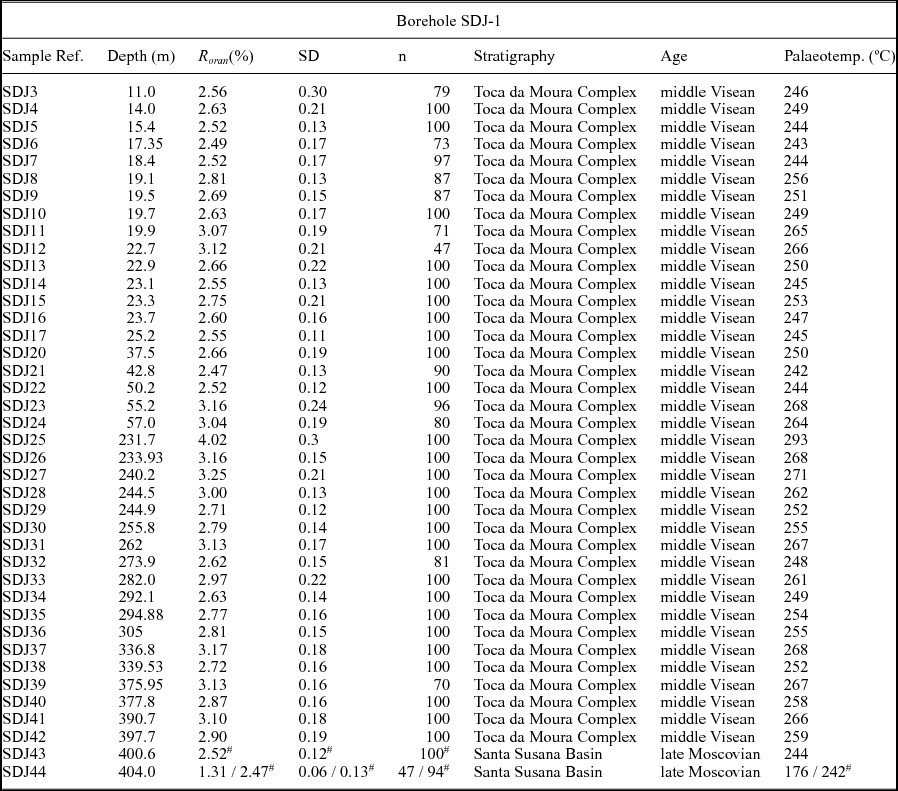
All samples are shales. Roran (%) – values of mean random vitrinite reflectance in oil immersion; SD – standard deviation; n – number of vitrinite particles measured. # indicates VR of the inherited vitrinite population in samples of the Santa Susana Basin.
VR values measured for the Toca da Moura Complex shales varied from a minimum of 2.47% Roran to a maximum of 4.02% Rv (Table 2). This range is related to the proximity of intrusive igneous rocks rather than the effects of an increase in temperature due to burial. With the exception of samples located near the contact with the intrusive rocks, the samples studied from the two thickest shale intervals in this borehole (300 to 231.1 m depth and 59 to 3.5 m depth) have VR values that vary from c. 2.5 to 3.0% Roran . The heat flow associated with the intrusions had clear effects on the VR values measured from samples located close to the contacts with the intrusive igneous rocks. Thus, a clear increase in the VR values measured in the samples near the contacts with the intrusive rocks was detected (Fig. 6). This was assessed in the samples below and above the 3.5 m thick mafic sill near the top of the borehole (Fig. 6), with a rapid increase in the VR values from a background value of c. 2.5% Roran to values of c. 3.0% Roran at distances of 15–20 cm away from the sill walls. Higher VR values related to heating from igneous intrusions were also detected for other intrusive rocks, such as in the thick porphyritic rock between c. 60 and 230 m depth, where at its basal contact, a value of 4.04% Roran was measured. The shale-dominated interval between c. 230 and 300 m depth has a background VR value of c. 2.7% Roran , which is slightly higher than the background value (2.5% Roran ) established for the shale-dominated interval from the top of the borehole to 60 m depth. Owing to the abundance of the igneous intrusive rocks through the entire borehole section, it is unlikely that the increase in burial heating was the only reason for this small increase in the organic maturation with depth. From 321.1 to 397.8 m depth the borehole section is dominated by intrusive igneous rocks whose heating effects are clearly marked on the intruded shales, as shown by the increase in VR measured near the contacts (Fig. 6). Moreover, the abundance of intrusive volcanic rocks penetrated by the borehole core and the effect of the associated heat flow on the VR values measured prevent the estimation of a regional maturation gradient.
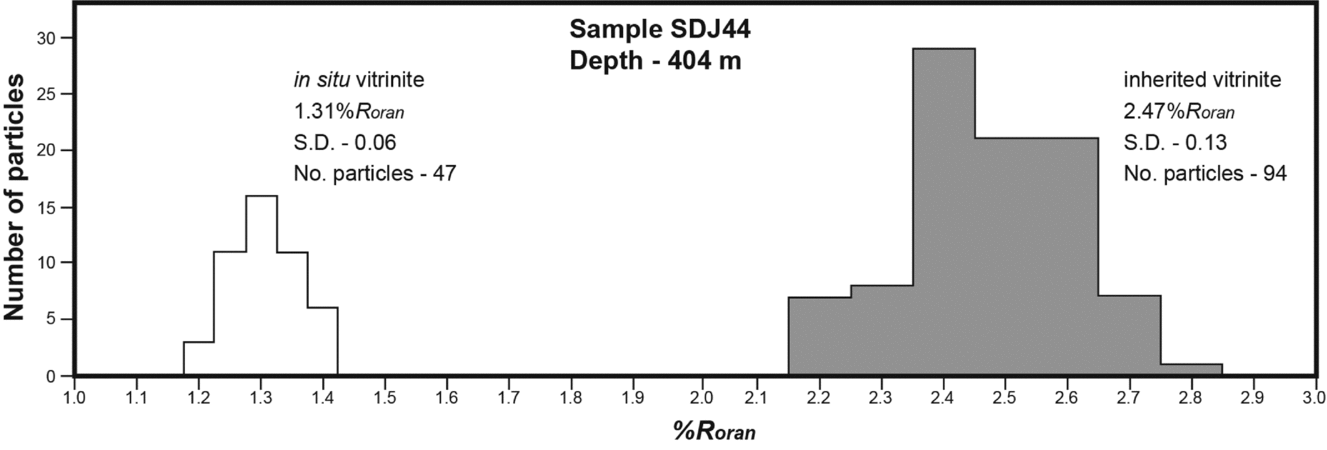
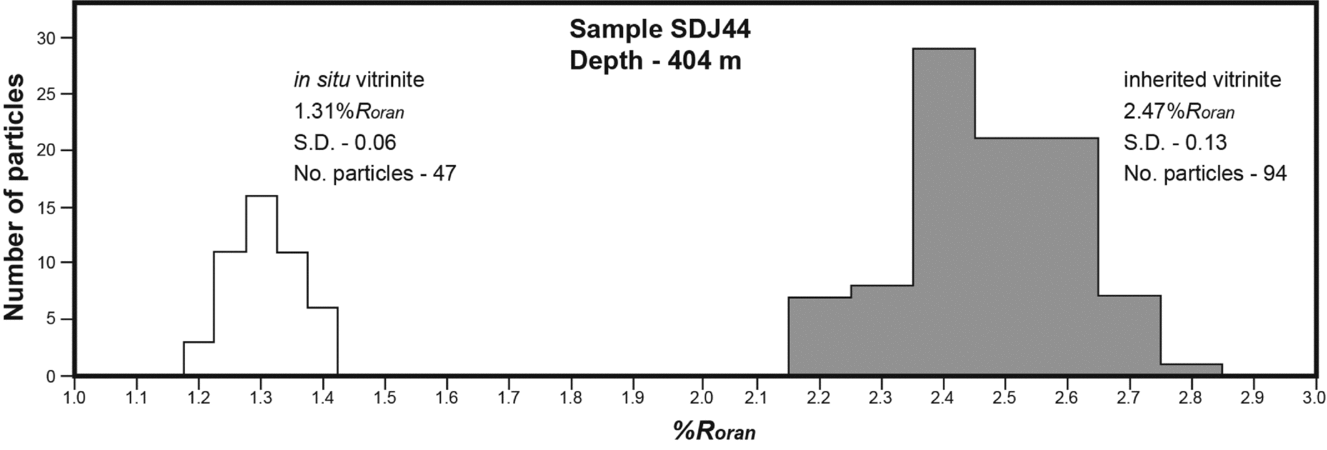
The two samples studied from the 404.5–397.8 m depth interval were dated as late Moscovian, belonging, therefore, to the Santa Susana Basin succession (Lopes et al. Reference Lopes, Pereira, Fernandes, Wicander, Matos, Rosa and Oliveira2014). The samples studied from this interval are from a tectonically disrupted part of the borehole section consisting of a mud-supported breccia composed of shale clasts. This is most probably a fault breccia. The VR value measured in sample SDJ(43) (2.52% Roran ) at 400.6 m depth does not differ significantly from the VR values measured for the Toca da Moura Complex samples that are unaffected by the thermal effects of intrusions and located higher in the borehole section. However, in sample SDJ(44) at 404 m depth, only 0.5 m above total depth, two vitrinite populations were identified. A VR value of 2.47% Roran was measured for the population with the higher number of vitrinite particles, and a lower VR of 1.31% Roran was measured for the second population with fewer vitrinite particles (Fig. 7; Table 2). The VR value of the population with the higher VR value is comparable in magnitude to the VR values measured for the Toca da Moura Complex samples in this borehole, whereas the lower VR value measured for the second population compares in magnitude to those determined for the Santa Susana Basin (see details in Section 5.c). Thus, in sample SDJ(44), the vitrinite population with the lowest reflectance corresponds to in situ vitrinite particles and the vitrinite population with the higher reflectance corresponds to inherited vitrinite particles. The origins of the inherited vitrinite particles may have been the Toca da Moura Complex.
Vitrinite reflectance histograms for the in situ vitrinite population and inherited vitrinite population, in sample SDJ(44) of borehole SDJ-1.
In samples SDJ(43) and SDJ(44), Lopes et al. (Reference Lopes, Pereira, Fernandes, Wicander, Matos, Rosa and Oliveira2014) identified an important assemblage of recycled palynomorphs whose age ranged from Tournaisian to middle Visean (NM Biozone). However, the lack of recycled palynomorphs and vitrinite (Machado, Silva & Almeida, Reference Machado, Silva and Almeida2012; Lopes et al. Reference Lopes, Pereira, Fernandes, Wicander, Matos, Rosa and Oliveira2014) in the samples of the Santa Susana Basin, together with the particular location of samples SDJ(43) and SDJ(44) in the borehole (a fault breccia made up of shale fragments), makes possible an alternative explanation. Thus, there are no recycled palynomorphs in sample SDJ(44), as interpreted by Lopes et al. (Reference Lopes, Pereira, Fernandes, Wicander, Matos, Rosa and Oliveira2014), because the fault breccia contains a mixture of clasts from the Toca da Moura Complex and from the Santa Susana Basin shale lithologies, which were lithologically indistinguishable. This hypothesis may also explain the lack of an indigenous vitrinite population in sample SDJ(43); the close proximity of this sample to the main fault plane led to the incorporation of shale clasts of the Toca da Moura Complex and few clasts of the Santa Susana Basin sequence in the breccia. Thus, in situ vitrinite particles of the Santa Susana Basin were rare in the organic residue obtained. This conclusion is, in part, supported by the scarcity of in situ late Moscovian palynomorphs in samples SDJ(43) and SDJ(44), constituting only 6% of all palynomorphs identified (Lopes et al. Reference Lopes, Pereira, Fernandes, Wicander, Matos, Rosa and Oliveira2014).
Regardless of the hypothesis for the origin of the two populations of vitrinite in sample SDJ(44), the organic maturation data from the outcrops and from borehole SDJ-1 show that there is a clear contrast in VR values between the Toca da Moura – Cabrela complexes and the Santa Susana Basin, suggesting that peak temperatures were different and that the timing of organic maturation of the Toca da Moura – Cabrela complexes pre-dates the deposition of the Santa Susana Basin sediments.
5.c. Santa Susana Basin
The organic maturation levels measured for the Santa Susana Basin outcrops and for the control sample housed in the LNEG Geological Museum indicate VR values ranging from 1.34 to 1.69% Roran (Table 1). A VR value of 1.34% Rr was measured from the thin coal lamina of the control sample, whereas VR values of 1.35% Roran and 1.36% Roran were obtained from the whole-rock sample and organic residue from the shale that hosted the coal lamina, respectively. These variations in the VR are negligible, suggesting that there are not major differences in VR values measured from the coal, whole-rock and palynological residue. The VR of the control sample is also similar in magnitude to the VR value determined for the in situ vitrinite population from sample SDJ(44) of borehole SDJ-1.
The samples investigated from the outcrops of the Santa Susana Basin (Fig. 1; Table 1) have VR values that average c. 1.50% Roran . The organic maturation levels attained also match previous maturation studies from the Santa Susana coals (Sousa et al. Reference Sousa, Marques, Flores, Rodrigues, Neiva, Ribeiro, Victor, Noronha and Ramalho2010) that indicate a VR of 1.51% Roran for a coal from the old Moinho da Ordem coal concession, located in the Jongeis outlier.
6. Thermal history and discussion
The geological structures of the Toca da Moura Complex and the Santa Susana Basin in the Jongeis outlier were established by Lopes et al. (Reference Lopes, Pereira, Fernandes, Wicander, Matos, Rosa and Oliveira2014) based on new palynological data from borehole SDJ-1 and from the work of Andrade, Guerreiro & Santos (Reference Andrade, Guerreiro and Santos1955) who compiled data from shallow boreholes that penetrated the Santa Susana Basin in the subsurface (Fig. 3). The interpretation of the regional geological data suggests an important hiatus between the Toca da Moura Complex and the beginning of deposition of the Santa Susana Basin succession. This is also emphasized by the maturation levels measured for these two units in this study. The extent and the difference between the VR levels measured in the two basins, c. 2.5–3.0% Roran and c. 1.35–1.50% Roran , for the Toca da Moura Complex and Santa Susana Basin, respectively, implies that peak temperatures in the two basins were attained at different times and were of different magnitude. The Toca da Moura Complex and the Cabrela Complex record an early thermal event with peak temperatures attained in post-middle Viséan and pre-late Moscovian times. The close association of the Toca da Moura – Cabrela complex sediments with contemporaneous bimodal volcanism and igneous activity (Santos et al. Reference Santos, Mata, Gonçalves and Munhá1987; Jesus et al. Reference Jesus, Munhá, Mateus, Tassinari and Nutman2007) suggests that the geothermal gradients were relatively high in these basins during sedimentation and produced a regional VR of c. 2.5–3.0% Roran , at the boundary between the semi-anthracite and anthracite coal ranks. Higher VR values were recorded from samples affected by the heating produced by igneous intrusions.
In this work, we postulate high geothermal gradients during the deposition of the Toca da Moura – Cabrela complexes that persisted until the beginning of deposition of the Santa Susana Basin succession. We favour this hypothesis rather than post-middle Visean to middle Moscovian thick sedimentary cover and low regional palaeogeothermal gradients as there is no evidence of thick middle Mississippian to early Pennsylvanian sedimentary successions in the Ossa Morena Zone (Quesada, Robardet & Gabaldon, Reference Quesada, Robardet, Gabaldon, Dallmeyer and Martinez-Garcia1990; Oliveira, Oliveira & Piçarra, Reference Oliveira, Oliveira and Piçarra1991; Colmenero et al. Reference Colmenero, Fernández, Moreno, Bahamonde, Barba, Heredia, González, Gibbons and Moreno2002). Also, the presence of clasts of the Toca da Moura – Cabrela lithologies in conglomerates of the Santa Susana Basin suggests that the Toca da Moura – Cabrela complexes were exposed in late Moscovian times. A combination of high subsidence rates followed by rapid uplift and erosion of the Toca da Moura Complex during a time span of c. 30 Ma appears very unlikely. The presence of a high proportion of Devonian and Tournaisian recycled palynomorphs in the Toca da Moura – Cabrela complexes (Pereira, Oliveira & Oliveira, Reference Pereira, Oliveira and Oliveira2006; Lopes et al. Reference Lopes, Pereira, Fernandes, Wicander, Matos, Rosa and Oliveira2014) was not replicated in its vitrinite population. A comparable situation was described by Pereira, Oliveira & Oliveira (Reference Pereira, Oliveira and Oliveira2006) for the recycled and indigenous palynomorphs of the Toca da Moura – Cabrela complexes, both showing the same exine colours, suggesting an overprint of older thermal histories by this post-middle Visean to pre-Moscovian thermal event. Thus, the maturation event recorded by the Toca da Moura – Cabrela complexes was short lived, with high geothermal gradients probably due to coeval volcanism that was associated with the genesis of intra-arc volcanic marine basins along the southern margin of the Ossa Morena Zone (Oliveira, Oliveira & Piçarra, Reference Oliveira, Oliveira and Piçarra1991; Oliveira et al. Reference Oliveira, Relvas, Pereira, Munhá, Matos, Barriga, Rosa, Dias, Araújo, Terrinha and Kullberg2013). The recycled palynomorphs also indicate rapid uplift and erosion of the hinterland regions of the Ossa Morena Zone during the deposition of the Toca da Moura – Cabrela complexes (Pereira, Oliveira & Oliveira, Reference Pereira, Oliveira and Oliveira2006; Lopes et al. Reference Lopes, Pereira, Fernandes, Wicander, Matos, Rosa and Oliveira2014).
A second thermal event that produced the peak VR of c. 1.35–1.50% Roran (middle bituminous coal rank) was attained in post-Moscovian times and is only recorded in the Santa Susana Basin rocks. The organic maturation levels attained during this second thermal event were lower and superimposed on the older thermal event recorded by Toca da Moura – Cabrela complexes in which already high organic maturation levels remained unaffected. The timing of this second, younger event implies that the structural geometry of the Santa Susana Basin was due to tectonic events that postdate the organic maturation of this basin. There is no evidence that igneous activity affected the organic maturation of the Santa Susana Basin; therefore, burial under a ‘normal’ geothermal gradient was the most likely organic maturation process to account for the VR values measured.
Palaeotemperatures were calculated using the empirical equation of Barker (Reference Barker and Magoon1988) that computes palaeotemperatures from VR value ((T(°C) = 104ln(Roran )+148), where T(°C) is the maximum palaeotemperature attained by the rock, ln the natural logarithm and Roran the VR value measured in the rock). This indicates that the Toca da Moura sedimentary rocks attained peak temperatures of c. 240–270°C. Peak palaeotemperatures modelled for the Santa Susana Basin using the same method range from 180 to 190°C (Tables 1, 2).
The organic maturation levels estimated for the Toca da Moura – Cabrela complexes and Santa Susana Basin indicate a position at the beginning of the wet gas zone and within the dry gas zone, respectively. This also suggests that the shales in these two units may have some potential for shale gas if the right geological conditions are met. The limited extent of the outcrops of these units and the lack of details regarding their distribution in the subsurface may be two of the main obstacles for shale gas exploration. An additional critical aspect is the timing of the two maturation events. Our data suggest that during the first thermal event, peak gas generation occurred in late Mississippian to early Pennsylvanian times and affected only the Toca da Moura – Cabrela complexes. However, some of the hydrocarbons produced were probably lost during uplift and erosion contemporaneous with the deposition of the Santa Susana Basin succession. The second thermal event occurred in post-late Moscovian times and caused the first generation of hydrocarbons in the Santa Susana Basin and a second phase of generation in the Toca da Moura –Cabrela complexes. This was due to reburial, but was relatively minor compared with that associated with the first thermal event. The second thermal event pre-dates the last phase of compressive deformation with associated thrusting (latest Pennsylvanian – Early Permian?) in the southern margin of the Ossa Morena Zone. During this last tectonic phase, faulting and associated uplift were structures that probably promoted the escape of hydrocarbons and not its accumulation and preservation.
7. Comparative maturation studies
Carboniferous sedimentary rocks are represented in all Variscan tectonostratigraphic zones of Portugal (Figs 1, 2). In this section, the maturation levels and thermal histories of the various Portuguese Carboniferous basins are summarized and compared with results from the Toca da Moura – Cabrela complexes and Santa Susana Basin. Locations of the onshore Carboniferous rocks of Portugal are discussed in this section and are depicted in Figures 1 and 2.
In the South Portuguese Zone, an external zone of the Iberian Variscan Chain, Carboniferous rocks crop out extensively, whereas in the Central Iberian and Ossa Morena zones, Carboniferous rocks are restricted to narrow, sometimes long, outcrops located along major Variscan shear zones situated at the boundary between two different tectonostratigraphic zones (e.g. Porto-Tomar Shear Zone) or within these zones (e.g. Douro Basin). Carboniferous rocks of the South Portuguese Zone are fully marine, whereas, in the Central Iberian and Ossa Morena Zones, Mississippian rocks were deposited in marine environments and Pennsylvanian rocks in continental intramontane basins.
The South Portuguese Zone stratigraphic succession comprises middle Visean to Moscovian deep-water turbiditic sands interbedded with shales of the Baixo Alentejo Flysch Group (Oliveira, Horn & Paproth, Reference Oliveira, Horn and Paproth1979; Oliveira, Reference Oliveira, Dallmeyer and Martínez García1990), and Tournaisian to upper Bashkirian platform carbonates and shales of the Southwest Portugal Domain (Oliveira, Reference Oliveira, Dallmeyer and Martínez García1990; Pereira, Reference Pereira1999) (Fig. 2). McCormack, Clayton & Fernandes (Reference McCormack, Clayton and Fernandes2007) and Fernandes et al. (Reference Fernandes, Musgrave, Clayton, Pereira, Oliveira, Goodhue and Rodrigues2012) made comprehensive maturation studies of the South Portuguese Zone. VR from the Baixo Alentejo Flysch Group ranges from 3.80 to 5.55% Roran , corresponding to maturation levels indicative of meta-anthracite rank and palaeotemperatures of 290–325°C. In the Southwest Portugal Domain, VR values are slightly lower, ranging from 3.26 to 4.34% Roran . The lack of any increase in VR with the age of strata in the South Portuguese Zone was interpreted as the result of advective heating by gravity-driven hot fluids expelled during Variscan folding and thrusting that originated relatively uniform hot temperatures in the upper crust (Fernandes et al. Reference Fernandes, Musgrave, Clayton, Pereira, Oliveira, Goodhue and Rodrigues2012). The complex thermal history and the maturation levels attained by the Carboniferous rocks of the South Portuguese Zone are, thus, not compared to the maturation history of the Toca da Moura – Cabrela complexes and Santa Susana Basin.
In the Central Iberian Zone, Mississippian sedimentary rocks are located in the core of the Portalegre Syncline (Fig. 1), the western prolongation of the La Codosera – Puebla de Obando Syncline in Spain (Carta Geológica de Portugal 1:1000000, LNEG-LGM, 2010; G. Lopes, unpub. Ph.D. thesis, Univ. Algarve, 2013; González et al. Reference González, Varea, Lodeiro, Martín Parra, Poyatos and Matas2007). Mississippian sequences consist of shales interbedded with sandstones and limestones intruded by mafic igneous rocks, known in Spain as the Gévora Formation (González et al. Reference González, Varea, Lodeiro, Martín Parra, Poyatos and Matas2007) (Fig. 2). This formation is dated by palynomorphs and conodonts as middle to late Visean in age and rests unconformably on deformed Lower Devonian phyllites and quartzites. VR measured in middle to upper Visean shales from the Portalegre Syncline ranges from 3.4 to 3.62% Roran , indicative of anthracite coal rank and palaeotemperatures of 275–280°C (G. Lopes, unpub. Ph.D. thesis, Univ. Algarve, 2013). Illite crystallinity measured from the same batch of samples ranges from 0.29 to 0.31 (Δ°2θ), indicative of the anchizone of metamorphism, which is compatible with the VR values measured (G. Lopes, unpub. Ph.D. thesis, Univ. Algarve, 2013). In Spain, the organic maturation levels of the Gévora Formation were assessed by means of spore colour, indicating spore colour index (SCI) values above 7, which correlate with VR values of 2.0–4.0% Roran and palaeotemperatures above 200°C (González et al. Reference González, Varea, Lodeiro, Martín Parra, Poyatos and Matas2007). According to G. Lopes (unpub. Ph.D. thesis, Univ. Algarve, 2013), the thermal history of the Mississippian rocks in the Portalegre Syncline resulted from a combination of two processes: (i) high subsidence rates associated with extensional tectonics that followed the first compressive deformation phase of the Variscan Orogeny in the Central Iberian Zone, and (ii) high geothermal gradients during and after deposition related to one of the main periods of granite intrusions in the Central Iberian Zone (Azevedo & Aguado, Reference Azevedo, Aguado, Dias, Araújo, Terrinha and Kullberg2013). The similarity in maturation levels and the possible existence of high geothermal gradients during deposition associated with contemporaneous igneous activity are two common features of the Visean sedimentary rocks of the Portalegre Syncline and the Toca da Moura – Cabrela complex thermal histories.
In the Ossa Morena Zone, Frasnian to Serpukovian sedimentary rocks are also found in the Sernada do Vouga – Serém outlier within the Porto-Tomar Shear Zone, tectonically imbricated with Upper Proterozoic phyllites and amphibolites of lower-middle-greenschist metamorphic facies (Chaminé et al. Reference Chaminé, Gama Pereira, Fonseca, Moço, Fernandes, Rocha, Flores, Pinto de Jesus, Gomes, Soares de Andrade and Araújo2003; Fig. 1). These rocks, referred to as the Albergaria-a-Velha unit, were deposited as turbidites and basinal shales in a sedimentary system possibly associated with the Porto-Tomar Shear Zone (Fig. 2). The palynological residues from this unit yielded assemblages of Frasnian to Serpukovian age with common reworked palynomorphs as old as Early Devonian (Chaminé et al. Reference Chaminé, Gama Pereira, Fonseca, Moço, Fernandes, Rocha, Flores, Pinto de Jesus, Gomes, Soares de Andrade and Araújo2003; Machado et al. Reference Machado, Francu, Vavrdová, Flores, Fonseca, Rocha, Gomes, Fonseca and Chaminé2011). The spores, irrespective of age, show colours with a TAI > 4 and the few observable vitrinite particles have VR > 3% Roran , indicative of anthracite coal rank. Illite crystallinity measured from these shales ranges from 0.42 to 0.30 (Δ°2θ), indicating that rocks reached the low anchizone metamorphism (Chaminé et al. Reference Chaminé, Gama Pereira, Fonseca, Moço, Fernandes, Rocha, Flores, Pinto de Jesus, Gomes, Soares de Andrade and Araújo2003; Vázquez et al. Reference Vázquez, Abad, Jiménez-Millán, Rocha, Fonseca and Chaminé2007). Organic maturation levels in this region are similar to the maturation levels measured for the Toca da Moura – Cabrela complexes. However, the thermal history of the Albergaria-a-Velha unit is difficult to assess, owing to the effects of tectonism. The effects of an active, regional scale, long-lasting shear zone likely account for the recorded maturation levels.
In the Portuguese part of the Central Iberian Zone, Pennsylvanian sedimentary rocks are located in two small continental coal-bearing basins, the Douro Basin and the Buçaco Basin. Both basins are located along major Variscan shear zones: the Buçaco Basin is in close proximity to the Porto-Tomar Shear Zone and the Douro Basin is located along the Douro–Beira Trough, an important shear zone with a general NW–SE trend, within the Central Iberian Zone (Fig. 1). In these two basins, Pennsylvanian strata rest unconformably on Lower Palaeozoic rocks (Fig. 2). The basement rocks are clearly more deformed and metamorphosed than the Pennsylvanian sediments.
The Douro Basin succession consists of shales, sandstones, conglomerates and coal seams deposited in lacustrine to fluvial environments (Pinto de Jesus, Reference Pinto de Jesus2003). Plant macrofossils date the Douro Basin fill as lower Gzhelian (Wagner & Sousa, Reference Wagner, Sousa, Sousa and Oliveira1983) (Fig. 2). A transtensile tectonic regime that operated along the Douro–Beira Trough was responsible for the opening of intramontane pull-apart basins, whose depocentres migrated with time from NW to SE (Sousa & Wagner, Reference Sousa, Wagner, Sousa and Oliveira1983; Pinto de Jesus, Reference Pinto de Jesus2003). The VR of the Douro Basin coals is high, ranging from 5.5 to 7.0% Roran , indicating meta-anthracite coal rank (Sousa, Reference Sousa1978). The intrusion of large granite batholiths in the region surrounding the Douro Basin was proposed as the cause of the high maturation levels recorded (Sousa, Reference Sousa1978).
The Buçaco Basin is represented by two small and narrow syncline structures aligned N–S, parallel to the Porto-Tomar Shear Zone (Fig. 1). The eastern flanks of the synclines are either unconformable over Upper Proterozoic – Lower Palaeozoic metamorphic rocks, or are faulted against the same rocks, whereas, the western flanks are always in fault contact with Proterozoic and Palaeozoic rocks within the Porto-Tomar Shear Zone. The basin stratigraphy comprises three formations consisting of shales, sandstones, conglomerates and thin coal seams, which were deposited in continental fluvial to lacustrine environments (G. Machado, unpub. Ph.D. thesis, Aveiro Univ., 2010; Dinis et al. Reference Dinis, Andersen, Machado and Guimarães2012; Aguado, Azevedo & Gonçalves, Reference Aguado, Azevedo, Gonçalves, Dias, Araújo, Terrinha and Kullberg2013). Plant macrofossils indicate that the age of the Buçaco Basin is late Gzhelian – Early Permian (Wagner & Sousa, Reference Wagner, Sousa, Sousa and Oliveira1983), but miospore data restrict the sedimentation to the Gzhelian (G. Machado, unpub. Ph.D. thesis, Aveiro Univ., 2010) (Fig. 2). Similar to the Douro Basin, the Buçaco Basin developed in pull-apart intramontane basins formed during an episode of transtensive tectonics of the Porto-Tomar Shear Zone (Gama Pereira et al. Reference Gama Pereira, Pina, Flores and Ribeiro2008; Flores et al. Reference Flores, Gama Pereira, Ribeiro, Pina, Marques, Ribeiro, Bobos and Pinto de Jesus2010). The organic maturation levels and the source rock potential of the Buçaco Basin were assessed by means of VR and rock-eval pyrolysis (Flores et al. Reference Flores, Gama Pereira, Ribeiro, Pina, Marques, Ribeiro, Bobos and Pinto de Jesus2010). VR ranges from 0.64 to 0.77% Roran in coals and from 0.72 to 0.80% Roran in dispersed organic matter from shales, indicating a high volatile B bituminous coal rank category and peak palaeotemperatures of 120–130°C. Although the Buçaco Basin shows various geological similarities to the Douro Basin, its thermal history is very different. In the Buçaco Basin, there is no evidence of high heat flow associated with Upper Carboniferous igneous intrusions. The basin is currently structured as a tight syncline with a thin overturned western flank overthrust by the Porto-Tomar Shear Zone rock units. In addition, the upper Triassic sediments of the Lusitanian Basin unconformably cover these units and at least part of the Buçaco Basin. Thus, burial under a thrust and later reburial under a Mesozoic sedimentary cover was probably the main process responsible for the maturation levels recorded. The thermal history of the Buçaco Basin is different to that described in this study for the Santa Susana Basin. The difference in maturation levels between the two basins, higher in the Santa Susana Basin (1.35–1.5% Roran ) and lower in the Buçaco Basin (0.64–0.80% Roran ), was most probably related to burial under a thicker sedimentary cover in the Santa Susana Basin, the probable age of which was late Pennsylvanian to Permian(?), whereas in the Buçaco Basin it was a combination of burial under older thrust units and later reburial under a Mesozoic sedimentary cover.
8. Conclusions
VR determined in the sedimentary rocks of the Toca da Moura – Cabrela volcano-sedimentary complexes indicates high maturation levels corresponding to anthracite coal rank, with regional VR values ranging from c. 3.0 to 3.5% Roran and calculated peak palaeotemperatures reaching c. 240–270°C. The coeval magmatic activity increased the organic maturation levels of the sediments near the magmatic rocks and suggests high geothermal gradients during the deposition of the Toca da Moura – Cabrela complexes. The major magmatic event of the Beja Massif, corresponding to the Cuba-Alvito Gabbro/Diorites unit, occurred from 335 to 320 Ma, corresponding to a phase of late-collision magmatism throughout the southern margin of the Ossa Morena Zone (Jesus et al. Reference Jesus, Munhá, Mateus, Tassinari and Nutman2007). High geothermal gradients associated with magmatic events was also proposed as the main process for the high maturation levels recorded in the middle Mississippian rocks of the Portalegre Syncline (G. Lopes, unpub. Ph.D. thesis, Univ. Algarve, 2013) and upper Pennsylvanian rocks of the Douro Basin (Sousa, Reference Sousa1978) in the Central Iberian Zone.
The unconformity observed between the rocks of the Toca da Moura – Cabrela complexes and the overlying Santa Susana Basin is also a break in the maturation levels of these two Carboniferous sedimentary basins. Organic maturation levels in the continental middle to upper Moscovian Santa Susana Basin indicate bituminous coal rank with VR between 1.35 and 1.50% Roran and palaeotemperatures of c. 180–190°C. These maturation levels are substantially lower than the anthracite coal rank attained by the rocks of the Toca da Moura – Cabrela complexes, suggesting an important break in the thermal conditions during deposition of these two rock units. The timing of organic maturation of the Toca da Moura – Cabrela complexes pre-dates the initiation of the Santa Susana Basin and occurred during middle Visean – middle Moscovian times, representing a first and older episode of organic maturation. A second episode of organic maturation was recorded only in the Santa Susana Basin rocks because peak temperatures attained during this second episode were considerably lower than peak temperatures reached during the first episode of maturation. The second episode of maturation did not affect the Toca da Moura – Cabrela complex rocks. There is also no evidence for high geothermal gradients related to magmatism or other causes for the second maturation episode; thus, a maturation process related to burial under a post-upper Moscovian sedimentary cover was the most likely process to account for the maturation levels of the Santa Susana Basin. Although the maturation levels indicate a position in the early wet gas generation zone for the Santa Susana Basin and the dry gas zone for the Toca da Moura – Cabrela complexes, the very limited distribution of these units, both at the surface and in the subsurface, together with the tectonic deformation exhibited and the timing of the two maturation episodes, are major constraints on conventional and non-conventional hydrocarbon exploration in this region.
Acknowledgements
Paulo Fernandes wishes to thanks Dr João Matos from the LNEG-Beja, for facilitating access to the core and data for borehole SDJ-1. This work was part of the study undertaken by Gilda Lopes in her Ph.D. scholarship provided by the Portuguese Foundation for Science and Technology (SFRH/BD/48534/2008). Gil Machado acknowledges the Geoscience Department of Aveiro University and GeoBioTec for the logistical support and the Portuguese Foundation for Science and Technology Ph.D. scholarship (SFRH/BD/23787/2005) for financial support. The authors express their gratitude to the two reviewers Profs. James Hower and Cortland Eble, whose important comments and suggestions greatly improved this work. The authors also thank Prof. Miguel Ramalho and Jorge Sequeira from the Geological Museum–LNEG in Lisbon for facilitating access to the museum collections and data for sample STS15.