


Introduction
Despite experiencing higher inequality than any other advanced democracy, the white working class in the United States overwhelmingly supports conservatives and the Republican party (Piketty Reference Piketty2020), which are less friendly to labor and progressive economic policies. This pattern has long persisted and ties to the classic question of why the United States lacks a labor party (Lipset and Marks Reference Lipset and Marks2000). The absence of class-based mobilization is also evident in the limited focus on labor history in American school curricula: teachings about the American labor movement are largely absent in standard K-12 education (Cole et al Reference Cole, Megivern and Hilgert2011; Kelly Reference Kelly2023; Preston Reference Preston2018; Shaffer Reference Shapiro2002).Footnote 1 Indeed, the education system in the United States was shaped by middle- and upper-class reformers who highlighted income mobility and the ‘American Dream’, which has downstream effects on shaping beliefs that poverty is due to a lack of effort and influences preferences for redistribution (Alesina and La Ferrara Reference Alesina and La Ferrara2005; Alesina and Glaeser Reference Alesina and Glaeser2004). By contrast, many European nations, such as the United Kingdom, Scandinavia, and Germany, have emphasized rhetoric that elevates class consciousness in their education (Alesina and Glaeser Reference Alesina and Glaeser2004) and have stronger labor movements.
Here, we propose an explanation for the weak support for the labor movement in the United States and argue that these two trends are causally related: the lack of education about labor and its history in the United States impedes current coalition formation along class lines and support for the labor movement. Our argument builds on three literatures. First, longstanding scholarship in history and the history of education has demonstrated how political elites use education – and specifically history – as soft propaganda to sustain their preferred structures of hierarchy (Du Bois Reference Du Bois1935; Loewen Reference Loewen1995; Moreau Reference Moreau2003). Litt (Reference Litt1963) shows how socio-economic class determines what educational content students receive, with students from working-class backgrounds being trained for more passive political roles as compared to affluent students. Relatedly, a growing literature in political science focuses on how representations of a nation’s history can be used to sustain different forms of hierarchy and inequality, along, for example, lines of race, class, and gender (Esposito et al Reference Esposito, Rotesi, Saia and Thoenig2023; Rahnama Reference Rahnama2025). Clayton et al (Reference Clayton, O’Brien and Piscopo2024) find, for example, that the symbolic representation of the Founding Fathers in US history textbooks may partly explain men’s persistent overrepresentation in politics relative to women, while Haas and Lindstam (Reference Haas and Lindstam2024) show that inclusive historical representations of excluded marginalized groups (Muslims) can influence these group members’ self-perceived centrality to the nation and willingness to take political action.
Secondly, several pieces focus on workers’ interest in joining unions. This literature has found that there are two key preconditions that need to be met before workers form a coalition and unionize: (1) workers need to think of unions as ‘instrumental’ solutions that work and can be achieved (DeCotiis and LeLouarn Reference DeCotiis and LeLouarn1981), and (2) workers need to believe that enough co-workers and others in their community can be allies who would also support unions (Brief and Rude Reference Brief and Rude1981; Youngblood et al Reference Youngblood, DeNisi, Molleston and Mobley1984). Relatedly, Kamphorst and Willer (Reference Kamphorst and Willer2024) show that 89 per cent of Americans underestimate the benefits associated with union membership, inhibiting the first condition.
The third literature underpinning our argument has shown that seeing examples of union activity can make people think more positively about unions. Hertel-Fernandez et al (Reference Hertel-Fernandez, Naidu and Reich2021) show that exposure to strikes makes people more sympathetic towards unions, and Holmes (Reference Holmes2006) shows that in areas with a history of unionization, people are still more pro-union several decades later.
Taken together, these literatures lead us to expect that the lack of representation and attention to US labor history constrains workers’ sense that unions could be a solution to their woes and that others support unions, which impedes their interest in unionization and class-based coalitions more generally. In other words, had individuals been more exposed to positive labor history in their education, we anticipate that they would have been more positively inclined toward unions. What are the consequences of exposure to these historical omissions?
We explore this question and test our expectations using two survey experiments. In the first experiment (fielded between April and May 2024), respondents were randomized into a control group or to watch one of two labor history education videos. The first video highlights a case of overlooked early twentieth century labor mobilization history in the American South (the Southern Tenant Farmers Union), presenting the visual footage of the union as monoracial (white-only), making no explicit reference to race and only highlighting class-based rhetoric in the audio. The second video explicitly highlights historically accurate biracial collaboration in this union in both the visuals and audio. The otherwise equal characteristics of these treatments allows us to test whether emphasizing race more in this union history creates backlash or enables a strong sense of allyship and solidarity with out-groups.
Next, respondents answered a number of survey questions, including items that tap into their support for the labor movement, operationalized as support for unions, the Poor People’s Campaign (PPC) (a multiracial working-class coalition), and then a more abstract measure of support for coalitions. We further asked about six key mechanisms of what makes marginalized groups form (diverse) coalitions and take action: the perceived material benefits of unions, perceived internal political efficacy (individuals’ beliefs in their ability to understand and participate with agency in politics and organizations), linked fate (with working-class people), out-group solidarity (with Black people), a sense of allyship (with Black people and working-class people), and racial prejudice.
The population we run the first experiment on consists only of white non-college-educated adults from the US South.Footnote 2 We focus on this sample for several reasons. First, the South has a legacy of exposure to content like the ‘Lost Cause’ narrative in textbooks, which were rolled out historically in white public schools (Cox Reference Cox2003). This historical narrative is not only rooted in racial ideology but also overlooks poor whites and heightens white elite paternalistic values, with the elites that disseminated this history seeking to build intrawhite solidarity in the aftermath of Reconstruction and budding class-based mobilization of Southern Populists (Rahnama Reference Rahnama2025). Secondly, relative to other parts of the country, parts of the South have had a long history of anti-union sentiment and a low unionization rateFootnote 3 (Bureau of Labor Statistics 2022), and the policy implications of this are significant. Unionization is an important vehicle for a more equitable society (Levi Reference Levi2003) and has been shown to reduce poverty (Ahlquist Reference Ahlquist2017), and this is one of the poorer regions of the United States. Relatedly, racial divisions have historically constrained progressive redistribution and class-based politics (Alesina et al Reference Alesina, Glaeser and Sacerdote2001; Lindert Reference Lindert2004; Lipset and Marks Reference Lipset and Marks2000; López Reference López2013),Footnote 4 and Acharya et al (Reference Acharya, Blackwell and Sen2018) show long-term endurance of racially hostile attitudes among Southern whites in places with stronger legacies of slavery. Decades of research have demonstrated the role of labor unions in overcoming a number of these challenges, from contact and co-operation between union members helping to bridge racial divides (Frymer and Grumbach Reference Frymer and Grumbach2021) and strengthen social capital (Putnam Reference Putnam2000) to unions’ impact in heightening members’ working-class identification (Franko and Witko Reference Franko and Witko2023), reducing economic disparities, and advancing landmark policy reforms (Ahlquist Reference Ahlquist2017). Finally, we expect that the labor history of the Southern Tenant Farmers Union may be particularly regionally resonant for this group, who have not seen themselves represented in the historical record, given general omission of the plight of poor whites and white poverty (Barber and Wilson-Hartgrove Reference Barber and Wilson-Hartgrove2024; Merritt Reference Merritt2017).
In the second survey experiment (fielded between November 2025 and January 2026), we replicate the results of the first study, including on a broader sample with quotas representative of the US population. In addition, in this experiment we include another video treatment that focuses on contemporary biracial unionization to be able to contrast the effect of historical versus contemporary labor content on our outcomes of interest.
Our results across the two studies indicate that learning about labor union history in the US South increases support for unions and the PPC. The effects appear to be driven primarily by greater perceived material benefits and political efficacy, though linked fate, out-group solidarity, and allyship also mediate the effect of the treatment. Moreover, emphasizing biracial collaboration in union history does not alter these conclusions. We also do not find any evidence of a backlash effect or diminished treatment effects among respondents high in racial resentment. Although this paper focuses primarily on the effects of learning labor history, as social science and history curricula are a core channel for mass education on labor (Alesina and Glaeser Reference Alesina and Glaeser2004; Cole et al Reference Cole, Megivern and Hilgert2011), we find largely similar effects from learning about contemporary unionization efforts. Taken together, these studies suggest that learning about past coalitions and collective action move important mechanisms of coalition formation. These findings imply that if people are constrained in their education about the US labor movement and unions, this may also constrain their support for and interest in joining such organizations – and building a new labor movement – today.
This paper makes a key contribution to the literature on the lack of class-based mobilization and support for redistribution in the United States. This literature has advanced numerous explanations for why the United States maintains substantial net income inequality, despite a majority of below-average earners holding a majority vote on issues of redistribution (Cavaillé and Trump Reference Cavaillé and Trump2015; Lupu and Pontusson Reference Lupu and Pontusson2023; Margalit Reference Margalit2019; Neckerman and Torche Reference Neckerman and Torche2007; Rueda and Stegmueller Reference Rueda and Stegmueller2019; Shapiro Reference Shapiro2002). We advance this literature by evaluating a complementary explanation: although the labor movement was historically integral to building the middle class, many people have not adequately learned this history (Du Bois Reference Du Bois1935; Moreau Reference Moreau2003). We show how teaching this history increases present-day support for unions, providing experimental evidence to what historians have long theorized about the power of counter-histories that emphasize cross-racial and class coalitions (Loewen Reference Loewen1995; Zinn Reference Zinn1980) and elucidating the mechanisms driving these effects.
Finally, this paper adds to extensive work on content experiments in political science and education related to ethnic studies (Bonilla et al Reference Bonilla, Dee and Penner2021), constitutional principles (Green et al Reference Green, Aronow, Bergan, Greene, Paris and Weinberger2011), civic education (Litt Reference Litt1963), and critical pedagogyFootnote 5 (Nelsen Reference Nelsen2023, Reference Nelsen2021). These studies yield mixed findings on knowledge effects on academic engagement and civic participation among youth (Gill et al Reference Gill, Kautz, Segeritz, Chung and Zimmer2020; Green et al Reference Green, Aronow, Bergan, Greene, Paris and Weinberger2011), including particularly for low-income students and students of color (Nelsen Reference Nelsen2021). Building on this work, this paper focuses particularly on labor history content and its implications for labor coalition building.
Theoretical Framework
What drives individuals to support unions and other forms of class-based coalitions? A large literature highlights several important mechanisms that underpin successful coalition formation and sustained mobilization in the context of labor organizations and movements: thinking unions can improve material conditions, political efficacy, linked fate, and sense of allyship and solidarity.Footnote 6 When these mechanisms are undermined, class-based organizing can falter.
In the United States, the lack of exposure and systematic exclusion of labor history from educational curricula is an important and underexplored means through which class-based mobilization can be constrained. We argue that this erasure has multiple consequences: it obscures successful models of collective action that foster political efficacy and can improve workers’ material circumstances, it prevents workers from situating their individual struggles within broader historical patterns of class exploitation, and it conceals examples of cross-racial solidarity that might counteract contemporary racial divisions that undermine class cohesion (Milkman and Voss Reference Milkman and Voss2004). As (López et al Reference López, Molnar, Johnson, Patterson, Ward and Kumashiro2021, 6) argues, ‘it is well understood that when people lack an accurate knowledge of history, organizers find it difficult to cultivate multiracial coalitions to promote racial and economic justice’.
We propose that exposure to labor history – including particularly history that demonstrates successful cross-racial organizing – can activate these mechanisms and increase support for contemporary labor movements. Our theory builds on four interrelated literatures: work on support for labor movements (DeCotiis and LeLouarn Reference DeCotiis and LeLouarn1981; Kamphorst and Willer Reference Kamphorst and Willer2024; Youngblood et al Reference Youngblood, DeNisi, Molleston and Mobley1984), studies of political efficacy and mobilization (Niemi et al Reference Niemi, Craig and Mattei1991; Verba et al Reference Verba, Schlozman and Brady1995), research on linked fate and group solidarity (Dawson Reference Dawson1994; Sanchez and Vargas Reference Sanchez and Vargas2016), and work examining how historical narratives shape contemporary political identities and action (Clayton et al Reference Clayton, O’Brien and Piscopo2024; Haas & Lindstam, Reference Haas and Lindstam2024; Rahnama Reference Rahnama2025).
Perceptions of the Material Benefits of Unions
The belief that labor unions can improve workers’ wages and material conditions has consistently been linked to increased interest in joining unions and broader support for organized labor. For example, prior research highlights that perceptions of unions as beneficial to all workers, as well as to one’s own economic situation, positively shape support for the labor movement (DeCotiis and LeLouarn Reference DeCotiis and LeLouarn1981; Youngblood et al Reference Youngblood, DeNisi, Molleston and Mobley1984). To establish a causal relationship between these beliefs and support for unions, Kamphorst and Willer (Reference Kamphorst and Willer2024) randomly assigned participants to either receive information about the material benefits of union membership or not. Participants exposed to this information exhibited greater support for unions and a higher interest in joining them.
Although the origins of perceptions about unions’ material benefits remain partly an open question, education on labor and its history likely shapes beliefs regarding the material benefits of union membership. Since most individuals are not union members themselves and lack direct experience, their beliefs about unions depend significantly on the experiences of others and broader knowledge about unions, which education can provide (Park et al Reference Park, McHugh and Bodah2006).
The Role of Political Efficacy in Class-Based Mobilization
Political efficacy, namely individuals’ belief in their ability to effectively participate in politics and organizations (Niemi et al Reference Niemi, Craig and Mattei1991), represents a fundamental prerequisite for collective action. When workers sense that their actions cannot meaningfully influence economic and political outcomes or do not see evidence of organizations responding to their demands, the motivation to engage in costly organizing activities diminishes sharply. Scholars have consistently shown that individuals with higher levels of political efficacy are more likely to participate in various forms of collective action, including union organizing (Ahlquist and Levi Reference Ahlquist and Levi2013; Verba et al Reference Verba, Schlozman and Brady1995).
The omission of educational curricula on labor can deprive workers of political imagination and historical narratives that demonstrate the efficacy of collective action and enable them to situate their present circumstances within a legacy of collective action. Indeed, Litt (Reference Litt1963) shows that emphasis on political activity and efficacy was least reinforced in the textbooks of schools in working-class communities. Without knowledge of how ordinary workers have successfully challenged economic elites through past organized resistance, contemporary workers may not feel politically efficacious and perceive their circumstances as immutable or attributable to individual failings (Alesina and Glaeser Reference Alesina and Glaeser2004) rather than structural conditions amenable to collective challenge (Fantasia Reference Fantasia1988).Footnote 7
The Role of Linked Fate in Class-Based Mobilization
Successful class-based mobilization requires that workers perceive a shared destiny with others in similar economic positions. As (Davies et al Reference Davies, Green and Booth-Tobin2024, 5) argue, ‘organizations build solidarity by honing a belief that, despite different backgrounds or identities, our fates are intertwined’, and this sense of mutuality is instrumental to bringing people together. Originally developed as a ‘Black utility heuristic’, the concept of linked fate captures how individuals’ perceptions that their personal prospects are tied to those of their group identity shapes political attitudes and behavior (Dawson Reference Dawson1994). While Dawson’s work focused on Black Americans, the concept has been extended to other group identifications, including class (Donnelly Reference Donnelly2021). Factors that shape linked fate include a sense of shared identity, (material) experience, and historical legacies. Indeed, (Dawson Reference Dawson1994, 67) attributes linked fate partly to the transmission of historical information through social networks and formal institutions (Nelsen Reference Nelsen2023).
The development of class-based linked fate faces particular challenges in the American context, where dominant historical narratives emphasize individualism, upward mobility, and the ‘American Dream’ (Alesina and Glaeser Reference Alesina and Glaeser2004; Alesina and La Ferrara Reference Alesina and La Ferrara2005). The lack of curricula on labor further undermines class-based linked fate and critical consciousness by depriving workers of historical frameworks that might widen their sense of collective belonging, history of economic struggle, and connection to other working-class people. As Milkman and Voss (Reference Milkman and Voss2004) discuss, successful union organizing requires frameworks of common interest and shared economic vulnerabilities between different workers – something that labor history could provide.
Allyship and Out-Group Solidarity in Class-Based Mobilization
A third obstacle to class-based mobilization in the United States has been the challenge of building solidarity across racial lines. The historical elevation of white identity and status, out-group stereotyping, and racialized narratives of poverty and welfare has repeatedly undermined potential class-based coalitions and redistribution, as economic elites have leveraged racial division to constrain working-class unity (Du Bois Reference Du Bois1935; Gilens Reference Gilens2009; Ottinger and Posch Reference Ottinger and Posch2022; Rahnama Reference Rahnama2025; Suryanarayan and White Reference Suryanarayan and White2021).
The omission of interracial labor organizing from educational curricula represents an important channel through which this racial wedge strategy is sustained. The lack of past examples of successful cross-group allyship and solidarityFootnote 8 in labor struggles can pre-empt present-day workers from accessing alternative models of unified coalition building. This can further constrain their perceptions of what groups have faced similar struggles, particularly when these groups have been historically divided. Historical education that emphasizes examples of interracial solidarity in labor organizing may have the potential to reshape these perceptions. As Bilali and Vollhardt (Reference Bilali and Vollhardt2013) and Williamson et al (Reference Williamson, Adida, Lo, Platas, Prather and Werfel2021) demonstrate in different ways, historical perspectives can stimulate empathy, perspective-taking, and perceived similarity (rather than, for example, competitive victimhood) between different groups’ experiences. Moreover, exposure to such history may be counter-stereotypical when dominant narratives have emphasized one group as the face of poverty and diminished emphasis on white poverty (Gilens Reference Gilens2009). In this sense, when workers learn about past periods in which racial divisions have been transcended to pursue common class interests, this may update individuals’ perceptions about the potential for cross-racial coalitions’ present-day success.
Labor Education as a Channel for Class-Based Mobilization
Building on these theoretical insights, we argue that educational interventions that recover and center labor history can overcome constraints to class-based mobilization through multiple pathways. First, exposure to successful historical labor struggles can enhance political efficacy by providing concrete examples of how ordinary workers have effectively challenged economic inequality through past collective action, which can serve as a blueprint for what can be achieved in coalition with others in the present and future. Indeed, scholars have shown that critical pedagogy content – which encourages understanding marginalization as a systemic and historical process – increases marginalized youths’ confidence by showing how ‘common’ people worked together historically to make political change (Nelsen Reference Nelsen2023)Footnote 9 and can shape political efficacy and downstream political participation (Willeck and Mendelberg Reference Willeck and Mendelberg2022). Secondly, learning about shared historical experiences of economic exploitation and organizing across different workers can foster a stronger sense of linked fate with the broader working-class. Finally, encountering past examples of successful interracial labor solidarity can promote greater willingness to engage in cross-group coalitions in the present.
Importantly, we theorize that the content and framing of this historical education matters. Labor history presented through an exclusively class-based frame may increase general political efficacy, understanding of material benefits, and linked fate and allyship with the working class, but fail to heighten consideration about solidarity with racial out-groups. By contrast, labor history that explicitly highlights interracial solidarity may more effectively elevate a sense of allyship and solidarity with out-groups today. However, such explicitly racial framing might also potentially trigger racial threat responses and backlash among white workers, particularly among those with higher levels of racial resentment (Craig and Richeson Reference Craig and Richeson2014; English and Kalla Reference English and Kalla2021; Wetts and Willer Reference Willeck and Mendelberg2022). These considerations give rise to the following pre-registered theoretical expectations:
Expectation 1: Exposure to labor history will increase support for unions and broader class-based coalitions relative to no exposure.
Expectation 1a: An increase in support will operate through a mechanism of greater perceived internal political efficacy and a sense that unions provide material benefits.Footnote 10
Expectation 1b: An increase in support will operate through a mechanism of greater perceived linked fate and allyship with the working class, allyship and solidarity with out-groups, and a reduction in racial resentment.Footnote 11
Expectation 2: Labor history that explicitly highlights interracial solidarity will have stronger effects on out-group solidarity than labor history that exclusively employs a class-based framing.
Expectation 3: Labor history that explicitly highlights interracial solidarity will have a smaller effect on the main outcomes and mechanisms among respondents with high racial resentment relative to those with low resentment.
We next provide descriptive evidence of our argument using a nationally representative survey of Americans, followed by analyses from our two survey experiments.
The Link Between Labor Knowledge and Union Support
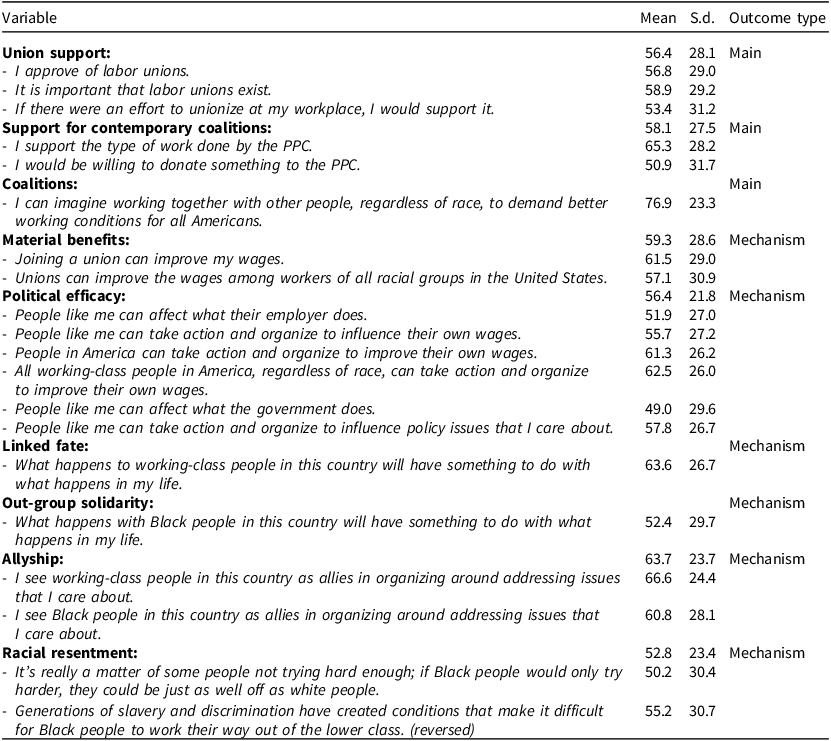
First, we examine whether historical knowledge about the labor movement correlates with support for unions. We conducted a survey with quotas matching the US census (matched on partisanship, gender, and age) in March 2025 with a sample of 1,755 American adults. The survey included a ten-question battery measuring respondents’ knowledge of the labor movement (questions available in the Appendix) and assessed union support using the three items shown in Table 1.
Overview of all the outcome variables in Experiment 1

Table 1. Long description
The table presents data on various variables related to union support and related concepts among American adults. It includes mean values and standard deviations for each variable. The table has 21 rows and 4 columns. The columns are labeled Variable, Mean, S D, and Outcome type. The variables are grouped into categories such as Union support, Support for contemporary coalitions, Coalitions, Material benefits, Political efficacy, Linked fate, Out-group solidarity, Allyship, and Racial resentment. Each row lists a specific variable, its mean value, standard deviation, and outcome type. For example, the first row under Union support lists I approve of labor unions with a mean of 56.4 and a standard deviation of 28.1, categorized as Main. The table provides a detailed overview of the different factors influencing union support and related concepts.
Note: all variables are measured on 0–100 disagree to agree scales. Means and standard deviations are measured in the control group. The mean for the bold variables shows the mean of the pre-registered indexes. Each index is composed of the variables shown underneath it.
Figure 1 presents the results. The left panel displays the relationship between the number of labor knowledge questions answered correctly and the union support index. The right panel shows regression coefficients for key demographic variables alongside labor knowledge in predicting support for unions. The standardized coefficients have a standard deviation of 1. The results suggest that labor knowledge is a stronger predictor of union support than both education and income, and comparable in magnitude to gender, race, and age. The only substantially stronger predictor is partisanship. In short, holding constant a range of controls, labor knowledge remains a significant predictor of union support. Americans who know labor history seem more inclined to support the contemporary labor movement.
Correlation between labor knowledge and support for unions.
Note: coefficients and 95 per cent confidence intervals are shown. The full regression table can be found in the Supplementary Information in Table A2. ANES: American National Election Study; DEM: strong democrat.

Next, we turn to experimental surveys to assess whether this relationship is causal and through which mechanisms it operates. We begin by providing a brief background and context on the historical case highlighted in our educational video intervention.
The Southern Tenant Farmers Union
The Southern Tenant Farmers Union was founded in 1934 in Tyronza, Arkansas, and was organized by a small group of Black and white farmers to address poor treatment of small tenant farmers, sharecroppers, and farm laborers. By 1935, membership in the union grew to 15,000. The union staged a few large-scale strikes and by 1936, the Southern Tenant Farmers Union had spread to other states, including Texas, Mississippi, Tennessee, Oklahoma, and Missouri. At its peak in 1938, the union boasted over 30,000 members in 300 localities. The union also sought to ensure the rights of sharecroppers were protected (as per the 1933 Agricultural Adjustment Act), wrote letters to protest farmer evictions, and drove the government to provide affordable rental housing to farming families. Over time, the union became less active and its members became involved in other aspects of politics. Although the union did not become a permanent fixture of American unions, it was significant during its time for bridging across deeply rooted racial divides in the South, helping to increase wages, shorten work hours, secure millions of dollars in government grants, and start collective bargaining in cotton-growing states (Hawkins Reference Hawkins2007).
Labor History Educational Video Interventions
The first survey experiment contained two main treatment arms on labor history education. These treatments are approximately five-minute-long videos that feature images alongside a consistent voice-over describing the Southern Tenant Farmers Union.
Union History Treatment
In the first main treatment condition on labor history, respondents watched a brief video on the Southern Tenant Farmers Union. In this arm, the video only shows real, archival images of the white union members and the audio does not mention the racial composition of the union. This version only highlights class-based rhetoric. The video content introduces the historic union, then provides background on the southern cotton farming economy after the Civil War and the difficult conditions of sharecropping and tenant farmers, the rise of the union, the causes they organized around, their successes, and their legacy. Importantly, the video demonstrates government responsiveness to the union’s demands. A written excerpt from the audio script and the archival visual footage can be found in Appendix A.11, with a hyperlink to the full video that respondents watched.
Biracial Union History Treatment
In the second main treatment arm, respondents also watched a brief video on the Southern Tenant Farmers Union. This video is more historically accurate and shows real archival images of both Black and white union members. The audio content is essentially identical to the former treatment arm, highlighting the same class-based rhetoric and information about the union. However, the audio in this version also speaks explicitly to the multiracial composition of the union. A written excerpt from the audio script and the archival visual footage is detailed in Appendix A.11, with a hyperlink to the full video. The otherwise nearly equal characteristics of these treatments allow us to test whether emphasizing race more in this union history creates backlash or enables a strong sense of allyship and solidarity with out-groups.
Research Design and Measurement
Survey Experiment 1
From 11 April to 16 May 2024, we recruited 2,212 participants via Cint to the study. We included participants who passed two pre-treatment, pre-registered attention checks. The sample consisted only of white, non-college-educated adult respondents from the U.S. South. Participants were randomly assigned to one of the main video treatment conditions or a control condition where they moved directly to the outcome questions. The control arm was divided 50–50 between a pure control (watching nothing) and placebo arm, in which respondents were randomized into watching one of the treatment videos at the end of the survey. We combine both the pure control and placebo control respondents together and targeted a similar sample size in the combined control arm as the treatment arms. This strategy allowed us to equate the survey length between treatment and control arms to prevent possible differential attrition due to survey length. In Section A.10 we test for differential attrition and do not find evidence for it.
After watching the videos, respondents moved to our main outcome questions. The survey contained three groups of pre-registered main outcomes. The first measure is an index capturing support for unions.Footnote 12 Respondents were shown a battery of outcomes that capture their support for and interest in joining unions.Footnote 13 Secondly, we also include an index capturing support for a specific multiracial working-class coalition: the Poor People’s Campaign. The PPC was first launched in 1968 as a movement by Martin Luther King Jr. and today continues to be a powerful coalition committed to helping low-income people through local community action and larger national marches. Respondents were introduced to the PPC and then asked if they would consider supporting their work. We also included a quasi-behavioral outcome asking whether they’d want to donate to the PPC. Finally, we also ask a more general question on support for coalitions.
Participants also responded to questions related to six mechanism outcomes: (1) the perceived material benefits of unions, (2) linked fate, (3) out-group solidarity, (4) a sense of allyship, (5) individual political efficacy,Footnote 14 and (6) racial resentment.Footnote 15 The full question wording of each item can be found in Table 1, along with the control group mean and standard deviations for each variable.Footnote 16
Our main estimand of interest is the average treatment effect and, for all outcomes, we estimate it using OLS with control variables:
 $$Y_i = \alpha + \tau D_i + {\boldsymbol{\beta}'\mathbf{X}_i }+ \epsilon _i$$
where i indexes individual respondents, Yi is the outcome variable, α is a constant, Di is coded according to the estimand of interest,
 $\boldsymbol{\beta}$
is a coefficient vector, and
 $\epsilon_i$
is an idiosyncratic error term. When analyzing the effects of the treatment conditions on our different outcomes, we control for a battery of pre-treatment, pre-registered control variables, captured by
X
i
, to increase precision. These include having connections to unions, partisanship, gender, a high-school degree or community college as the highest education level, a racial resentment index, and household income.Footnote
17
Survey Experiment 2
From 18 November 2025 to 7 January 2026, we recruited 1,252 participants to the study via Prolific. We included participants who passed a pre-treatment attention check. To examine if the findings replicate with both our main sample of interest and in a broader population beyond the specific sample of non-college-educated Southern whites in the first survey experiment, we sample with quotas representative of the US population, with oversampling of non-college-educated whites from the US South. In this study, participants were randomly assigned to either watch the identical biracial video treatment as in Study 1 (allowing us to test whether results replicate using a different survey firm) or a control condition (similarly 50–50 between pure control and watching this treatment at the end of the survey) where they moved directly to the outcome questions. In Appendix Section B, we provide details on the pre-registered experiment (and very minor changes relative to the first study). The remainder of the regression analysis is identical to that detailed above for the first experiment.
Results
Survey Experiment 1
We conduct pre-registered analyses of the effects of two different versions of labor history video treatments (see Data Availability Statement in the Appendix for the pre-analysis plan). We focus first on our main outcomes, which capture support for concrete coalitions: attitudes towards unions (a three-item index), support for the Poor People’s Campaign (a two-item index), and a more abstract general coalition outcome. These results are shown in Figure 2. Respondents who saw the biracial union-history treatment reported significantly greater support for unions (β = 8.88, t = 4.8, p < 0.001) and the Poor People’s Campaign (β = 3.00, t = 2.1, p = 0.04), corresponding respectively to 15.7 and 5.2 per cent increases in support relative to the mean levels in the control group. These effects are substantial and similar to a two-step change on the standard seven-step American National Election Study partisanship variable, for instance from ‘Strong Republican’ to ‘Independent leans Republican’.
Treatment effects for the main outcomes.
Note: coefficients and 95 per cent confidence intervals are shown. The full regression table can be found in the Supplementary Information in Table A3. Cronbach’s alpha for the union index is 0.95, and for the Poor Peoples Campaign (PPC) index it is 0.81.

Figure 2. Long description
Panel A: Union History. This panel contains three scatter plots. The first scatter plot shows the union support index with the x-axis labeled Union history treatment effect and the y-axis labeled Support for unions. The second scatter plot shows individual items related to union support with the same x-axis and y-axis labels. The third scatter plot shows the Poor Peoples Campaign (PPC) index with the x-axis labeled Union history treatment effect and the y-axis labeled PPC Campaign. The fourth scatter plot shows individual items related to the PPC campaign with the same x-axis and y-axis labels. The fifth scatter plot shows the coalition index with the x-axis labeled Union history treatment effect and the y-axis labeled Coalition. Panel B: Biracial Union History. This panel contains three scatter plots similar to Panel A but with the x-axis labeled Biracial union history treatment effect. The first scatter plot shows the union support index, the second scatter plot shows individual items related to union support, the third scatter plot shows the PPC index, the fourth scatter plot shows individual items related to the PPC campaign, and the fifth scatter plot shows the coalition index. Each scatter plot includes data points with confidence intervals and t-values indicating statistical significance.
Respondents who watched the union-history video which only showed monoracial images and focused on class-based rhetoric also reported statistically significantly greater support for unions (β = 7.05, t = 3.4, p < 0.001) and the Poor People’s Campaign (β = 5.00, t = 3.4, p < 0.001). These results translate, respectively, to a 12.5 per cent increase in support for unions and 8.6 per cent increase in support for the Poor People’s Campaign relative to the mean levels in the control group. Interestingly, these effects are not statistically different from those from the biracial treatment history.Footnote 18 This provides suggestive evidence (in this context) against arguments that talking about race leads to dominant-group backlash.
Finally, we find no significant effects of any treatment on the general coalition item. This likely reflects the abstract wording of the item, which does not align closely with the specific coalitions presented in the treatment conditions. Moreover, the control group mean on this item is substantially higher – likely due to socially desirable wording – which may have limited the potential for treatment effects.
Next, we explore whether our treatments influence the mechanism outcomes. Figure 3 presents these results. Respondents who saw the biracial union-history video treatment show the largest treatment effect sizes relative to the control condition. With regard to material benefits (β = 7.67, t = 4.8, p < 0.001), political efficacy (β = 9.38, t = 7.2, p < 0.001), linked fate (β = 5.94, t = 3.9, p < 0.001), out-group solidarity (β = 8.34, t = 5.0, p < 0.001), and allyship (β = 5.19, t = 3.8, p < 0.001), there was a 12.9 per cent increase in non-college-educated whites’ sense of the material benefits associated with unions, a 16.6 per cent increase in perceived political efficacy, a 9.3 per cent increase in linked fate with working-class Americans, a 15.9 per cent increase in their sense of out-group solidarity with Black Americans, and an 8.1 per cent increase in their sense of allyship with working-class and Black Americans (composite) relative to the mean in the control group.
Treatment effects for the mechanism outcomes.
Note: coefficients and 95 per cent confidence intervals are shown. The full regression table can be found in the Supplementary Information in Table A4. Cronbach’s alpha for indexes are 0.92 (material benefits), 0.91 (political efficacy), 0.81 (allyship), and 0.38 (racial resentment).

The treatment condition that explicitly heightened only the salience of class (and showed monoracial visual content) yielded similar findings, albeit smaller in magnitude: material benefits (β = 5.35, t = 3.4, p < 0.001), political efficacy (β = 8.09, t = 6.2, p < 0.001), linked fate (β = 5.44, t = 3.64, p < 0.001), out-group solidarity (β = 4.67, t = 2.8, p = 0.005), and allyship (β = 4.10, t = 3.6, p = 0.003). These correspond to a 9.0 per cent (material benefits), 14.3 per cent (political efficacy), 8.6 per cent (linked fate), 8.9 per cent (out-group solidarity), and 6.4 per cent (allyship) increase relative to the means in the control group. These findings lend support to Expectations 1 (including 1a and 1b).Footnote 19 Although we do not find significantly different effects on out-group solidarity between the two versions of the labor history treatment (as Expectation 2 laid out), the magnitude of the biracial union-history effects are greater for both the measures of out-group solidarity and allyship. Further, neither treatment significantly moved racial resentment, despite the biracial union-history treatment significantly moving the item of the composite asking respondents whether they think ‘generations of slavery’ have negatively influenced Black people’s economic opportunities.
Next, we use mediation analysis to explore whether the measures of material benefits, political efficacy, linked fate, out-group solidarity, and allyship are indeed mediators, and influence attitudes towards unions and the Poor People’s Campaign (the two main outcomes where we found significant effects). The results – presented in Section A.8 of the SI – indicate that the perceived material benefits of unions and political efficacy are particularly important mediators that respectively explain around 65 and 40 per cent of treatment effects on the union support composite outcome, while linked fate, allyship, and out-group solidarity are also significant mediators explaining around 20 per cent of treatment effects.
Further, we explore effect heterogeneity using random forest models, multivariate regression, and a binning estimator (Hainmueller et al Reference Hainmueller, Mummolo and Xu2019), using all of our pre-registered control variables as moderators (see Section A.6 in the Appendix). The random forest highlights racial resentment as the most important moderator. However, its effects do not appear linear: while effects are smaller on some outcomes for respondents who score high on racial resentment, it is not a significant moderator in standard multivariate regressions, nor do treatment effects differ meaningfully across binned levels of the variable. We thus find no evidence of a backlash effect or diminished treatment effects among respondents high in racial resentment – going against Expectation 3. Rather, information about past successful biracial coalitions increases openness to present-day biracial coalitions among non-college-educated whites who score high on racial resentment.
Survey Experiment 2
Replication of Study 1
We first use the second survey experiment to replicate the results of the biracial union treatment video on a sample of non-college-educated whites from the South (who were oversampled within this sample with quotas representative of the US population). The results replicate very similarly across the board with the union support outcomes and mechanism outcomes; the exception, however, is that the findings are weaker on the Poor People’s Campaign measures (see Appendix Section B.1 for all of the detailed results).Footnote 20
Robustness
Next, we use the second survey experiment to conduct two robustness analyses. First, we examine whether the treatment effects of the biracial union-history treatment extend to the broader US population. While we motivate our main sample as a group that has historically been exposed in schools to elite paternalist narratives like the ‘Lost Cause’ and has historically lower union participation, union membership is nonetheless generally low throughout the United States and it is important to understand the effects of learning labor history on broader swaths of the US population. As part of the fieldwork for this study, we collected a smaller sample with quotas reflecting the US population on partisanship, gender, age, education, and race. We then apply post-stratification weights for region, education, and race that combine this nationally balanced sample with the oversampled Southern sample to estimate treatment effects for the general US population. The results, presented in Appendix Section B.4, indicate that the effects are stronger on the full sample, albeit only significantly different for the Poor People’s Campaign outcomes.
Secondly, our argument implies that treatment effects are driven by respondents learning something new and not by other psychological processes, such as motivated reasoning. While in our first study we directly ask respondents if they learned something new (85 per cent in the union history arm self-reported ‘yes’, and similarly 87 per cent self-reported ‘yes’ in the biracial treatment), we use the second survey to explore learning systematically through an additional battery of questions measuring respondents’ knowledge of historical labor struggles. We use these measures to confirm that exposure to the biracial labor history treatment increases labor-related knowledge. In addition, to explore the role of motivated reasoning, we interact the treatment with partisanship, where if motivated reasoning was driving the effects, we would expect larger effects among individuals already predisposed to a pro-union sentiment pre-treatment (Kamphorst and Willer Reference Kamphorst and Willer2024). The results of these analyses are presented in Supplementary Information Section B.3 and show that the effects seem to be driven by knowledge acquisition and there is no evidence of motivated reasoning.
Does Exposure to Any Mobilization History Have Effects?
The theoretical argument presented thus far implies that treatment effects on our main outcomes are driven by respondents learning something new about labor history specifically, rather than a more general mechanism stemming from exposure to any type of history (such as broader excitement induced by any history of people working together). To robustly explore whether there is something distinct about labor history, one third of respondents in Survey Experiment 1 were randomized into a pre-registered non-labor history treatment where they watched a video of similar length about Americans working together in the Second World War (the full version can be found in Appendix A.11). We test whether this ‘homefront-history’ treatment influences our main and mechanism outcomes.
The results of this analysis are presented in Figure 4. For our main outcomes, respondents who watched this treatment are not more likely to support unions nor show significantly more support for the Poor People’s Campaign, with the size of the treatment effect on this latter outcome being about half compared to the two labor history treatments. The positive magnitude of this coefficient is likely explained by the fact that both treatments highlight unity and collective action, which the Poor People’s Campaign outcomes also emphasize. Regarding the mechanisms, the homefront-history treatment does not change perceptions of the material benefits of unions or move racial resentment, but it does significantly move political efficacy, linked fate, out-group solidarity, and allyship, albeit at a magnitude of about half that of the union-history treatments.Footnote 21

Taken together, these findings suggest that learning about mobilization history in general can boost individuals’ beliefs in their own political efficacy, while also fostering linked fate, out-group solidarity, and a sense of allyship with other working-class people, including those of different racial backgrounds. However, to generate enthusiasm for specific causes – such as the labor movement – people need to learn about that movement in particular. In other words, learning about collective action and the history of people working together towards a common goal can inspire a desire to act collectively, but this lesson must be tied to a clear goal to motivate action towards achieving that goal.Footnote 22
Exposure to Contemporary Unionization Efforts
The theory and framework of this paper focuses primarily on the effects of labor history education given that social science and history curricula are a core channel for mass education on labor (or the lack thereof) (Alesina and Glaeser Reference Alesina and Glaeser2004; Cole et al Reference Cole, Megivern and Hilgert2011). Nonetheless, one may wonder if education about contemporary labor and unionization efforts yields similar findings as compared to historical movements.
To examine this question, in our pre-registered survey experiment two, one third of the respondents were randomized to learn about contemporary unionization efforts, focused on United Auto Workers (UAW) unionization efforts in different manufacturing plants throughout the US South in 2024. To make this arm as comparable as possible but for the contemporary component, this treatment video was designed with a nearly identical structure and length to the biracial union-history treatment, as well as video and audio that explicitly cue the multiracial composition of the present-day UAW movement (see Appendix B for the hyperlink to the full treatment video).
Results are shown in Figure 5 for the same sample population (non-college-educated whites in the US South). We find that the contemporary unionization treatment produces effects on union support that are comparable to those observed in the historical treatments in survey experiment one and the biracial union treatment replication in survey experiment two. By contrast, effects on support for the Poor People’s Campaign are not statistically significant. For the mechanism outcomes, we observe very similar effects on perceptions of unions’ material benefits, political efficacy, and allyship. However, contemporary unionization content appears somewhat less effective at increasing linked fate and out-group solidarity. We examine these differences, as well as variation in how the contemporary versus historical treatment affect respondents’ emotions and the extent to which they find the information credible, in greater detail in Appendix Section B.2.
Treatment effects for contemporary unions on main and mechanism outcomes.
Note: coefficients and 95 per cent confidence intervals are shown. The full regression tables can be found in the Supplementary Information in Tables A13, A14, and A15. PPC: Poor People’s Campaign.

Figure 5. Long description
Panel A: The first set of graphs shows the treatment effects of contemporary unions on support for unions. The vertical bar graph and line graph share the same horizontal axis labeled Contemporary Unions treatment effect and vertical axis labeled Support for unions. The bar graph shows composite values ranging from 0 to 100, while the line graph shows individual item values ranging from 0 to 100. The graphs indicate significant positive effects on the Union support index, approval of unions, importance of unions, and willingness to unionize at the workplace. Panel B: The second set of graphs illustrates the treatment effects on political efficacy. The vertical bar graph and line graph share the same horizontal axis labeled Contemporary Unions treatment effect and vertical axis labeled Political Efficacy. The bar graph shows composite values ranging from 0 to 100, while the line graph shows individual item values ranging from 0 to 100. The graphs show significant positive effects on the Political Efficacy index, people’s belief in their ability to affect employers and influence their own wages, and the belief that all working-class people can improve wages. Panel C: The third set of graphs depicts the treatment effects on material benefits. The vertical bar graph and line graph share the same horizontal axis labeled Contemporary Unions treatment effect and vertical axis labeled Material Benefits. The bar graph shows composite values ranging from 0 to 100, while the line graph shows individual item values ranging from 0 to 100. The graphs indicate significant positive effects on the Material Benefits index, the belief that unions can improve wages for workers of all races, and the belief that unions would improve personal wages. Panel D: The fourth set of graphs shows the treatment effects on the fate of working-class and black people. The vertical bar graph and line graph share the same horizontal axis labeled Contemporary Unions treatment effect and vertical axis labeled L Fate and Out S. The bar graph shows composite values ranging from 0 to 100, while the line graph shows individual item values ranging from 0 to 100. The graphs show no significant effects on the belief that what happens with working-class and black people influences the individual. Panel E: The fifth set of graphs illustrates the treatment effects on allyship. The vertical bar graph and line graph share the same horizontal axis labeled Contemporary Unions treatment effect and vertical axis labeled Allyship. The bar graph shows composite values ranging from 0 to 100, while the line graph shows individual item values ranging from 0 to 100. The graphs show no significant effects on the Allyship index, the belief that working-class people are allies, and the belief that black people are allies. Panel F: The sixth set of graphs depicts the treatment effects on the Poor People’s Campaign (PPC). The vertical bar graph and line graph share the same horizontal axis labeled Contemporary Unions treatment effect and vertical axis labeled PPC Campaign. The bar graph shows composite values ranging from 0 to 100, while the line graph shows individual item values ranging from 0 to 100. The graphs show no significant effects on the PPC Index, support for their work, and willingness to donate.
These overall results suggest that learning about contemporary unionization efforts yields effects (on the main outcomes and specific mechanisms) that are broadly similar to those of learning about historical labor movements. While we emphasize again that movement history is a particularly powerful channel of critical pedagogy and means of educating present-day coalitional efforts (Fantasia Reference Fantasia1988; Freire, Reference Freire1978; López et al Reference López, Molnar, Johnson, Patterson, Ward and Kumashiro2021), future research should further examine if and how historical versus contemporary information differ in how they respectively shape recipients’ attitudes and perceptions.
Conclusion
Why is the American working class less organized around class than their counterparts in other advanced democracies? Our study suggests that one overlooked answer lies in the absence of education on labor history. Across two survey experiments, we find that exposure to labor history, including examples of biracial organizing, significantly increases support for unions and class-based coalitions. These effects are especially driven by two mechanisms: heightened political efficacy and a clearer sense of unions’ material benefits. Crucially, our results show that even respondents high in racial resentment respond positively to narratives about past labor solidarity, suggesting that education about shared struggle can broaden support for present-day organizing.
Although our studies allow us to causally assess educational content effects with clear evaluation of the mechanisms, they have several limitations. First, the online experiment (rather than offline classroom setting) raises external validity questions. Secondly, we cannot rule out that effects decay over time, as is common in persuasion experiments (Gerber et al Reference Gerber, Gimpel, Green and Shaw2011). However, classroom settings with repeated exposure, evaluation, and teacher reinforcement may produce longer-lasting effects than our single-exposure design. Indeed, our population-representative survey in March 2025 shows a strong link between Americans’ labor history knowledge and union support. Nonetheless, in future work, it is important to evaluate whether such an intervention endures in its influence on individuals’ attitudes and behavior around unions and multiracial coalitions using longitudinal data. Moreover, future research should examine whether these findings are externally valid and translate similarly for other groups: for example, how does learning about labor history affect Black Americans’ sense of allyship and solidarity with white working-class Americans? Would these findings from our study on working adults translate similarly for youth who may be more distant from participation in the workforce?
Our results further raise important questions for scholarship on political persuasion in the context of race and class divisions, and more broadly the challenges of multiracial solidarity (Craig and Richeson Reference Craig and Richeson2016; Pérez et al Reference Pérez, Vicuña and Ramos2024). In this space, scholars have highlighted how class-oriented messaging on progressive public policies more successfully increases support for these policies across racial groups than messaging that centers only race or both race and class, calling into question Democratic elites’ focus on centering race in policy discussions (English and Kalla Reference English and Kalla2021). Similarly, Wetts and Willer (Reference Willeck and Mendelberg2022) show that opposition to anti-racism messaging is a powerful predictor of several policy positions – including being strongly related to whites’ support for Donald Trump as political ideology. Our results echo those who have called for new narratives on race and class that resonate with all working people (López Reference López2013). We show evidence that, even absent changes to racial prejudice, exposure to history of class-based co-operation (both an explicit class-only frame and especially a class+race frame) shift non-college-educated whites’ sense of solidarity and allyship with Black Americans, their linked fate with working-class Americans, and their downstream support for unions. In other words, we suggest that positive messages about collaboration between racial groups may be a way to design messages that ‘acknowledge race [and] establish the shared stake of Americans of racial background in social [and] economic inequities’ without leading to backlash among whites (López et al Reference López, Molnar, Johnson, Patterson, Ward and Kumashiro2021, 12).
Another implication of our findings relates to ongoing political debates over what should be included in school textbooks, the stakes of which are not merely symbolic: what is taught in schools shapes not only students’ knowledge, but also their attitudes and behavior, and is therefore often a topic of political debate. For instance, the topic of study here – ‘labor history’ – is itself not a neutral or purely cognitive object, but a contested and socially embedded body of knowledge, shaped by political struggles over which histories are emphasized, omitted, or rendered legitimate (Halbwachs Reference Halbwachs1992; Phillips Reference Phillips1998). Our results echo a growing body of research showing that education can be a powerful lever for influencing public opinion (Clayton et al Reference Clayton, O’Brien and Piscopo2024; Haas & Lindstam, Reference Haas and Lindstam2024; Paglayan Reference Paglayan2024). This is particularly relevant against the backdrop of ongoing local and national-level conflicts over textbook content in public schools and the broader public space, especially when it comes to the teaching of American history. Indeed, while states like California and New Jersey have advanced recent mandates to teach labor history in schools (including the role of unions, collective bargaining, and workers’ rights) (New Jersey School Boards Association 2025), federal government efforts under the Trump administration have been advancing efforts to remove even the minimal teachings of labor history that exist from national public land (Joselow Reference Joselow2026).
In all, our findings underscore the political power of historical representation: when labor struggles are omitted from public memory, opportunities for collective mobilization are curtailed. Reintegrating labor history into civic education could thus play an important role to help revitalize the labor movement and rebuild class-based coalitions – especially in places where they have long been suppressed.
Supplementary material
The supplementary material for this article can be found at https://doi.org/10.1017/S0007123426101628.
Data availability statement
The data and replication files for this study can be found on the Harvard Dataverse (Kamphorst and Rahnama Reference Kamphorst and Rahnama2026): https://doi.org/10.7910/DVN/JGDD59.
Acknowledgments
We thank Liesbet Hooghe, Gary Marks, Robb Willer, Gwyneth McClendon, Patrick Egan, Cyrus Samii, Tara Slough, Diego Ramos-Toro, Hakeem Jefferson, and the participants at several conferences and workshops for their helpful comments. We also thank Penny Toombs and the Southern Tenant Farmers Museum for providing us with material to use in the treatment conditions. Finally, we thank Shane Muldowney for exceptional research assistance.
Author Contributions
Author order is random – both authors contributed equally and reserve the right to list themselves as first author on their resume.
Financial support
This research has been supported by the TRANSNATIONAL ERC project (Grant No: 885026) and the Politics and Social Change lab at Stanford University.
Competing interests
The authors do not report any competing interests.
Pre-Analysis Plan
The pre-analysis plans for the studies were registered with the Open Science Framework (OSF) prior to data collection and can be found here: https://osf.io/uqzvb/registrations.
Ethics
This research has been approved by New York University’s Institutional Review Board (No: IRBFY202408365) and Stanford University’s Institutional Review Board (No: RB-83225). The research adheres to APSA’s Principles and Guidance for Human Subjects Research. Participants in population survey research were compensated for their time. All participants provided informed consent. None of the studies included deception. The authors report no conflicts of interest.


 Open access

