Introduction
Recently, the off-target movement (OTM) of dicamba was deemed the source of damage to crops, particularly soybean, across vast acreages (Bradley Reference Bradley2017, Reference Bradley2018; Hager Reference Hager2017; Steckel Reference Steckel2019; Steckel et al. Reference Steckel, Bond, Ducar, York, Scott, Dotray, Barber and Bradley2017). Since its discovery in the 1950s, dicamba has been used to selectively control dicotyledonous weeds using preplant burndown applications or postemergence in cereal crops (Richter Reference Richter1958; Shaner Reference Shaner2014). In 2015 and 2016, the agrochemical industry released dicamba-resistant (DR) cotton and soybean (Wechsler Reference Wechsler2018), which were established in several areas affected by pernicious weeds with multiple herbicide resistance, such as Palmer amaranth (Amaranthus palmeri S. Wats.) (Heap Reference Heap2023; Werle et al. Reference Werle, Oliveira, Jhala, Proctor, Rees and Klein2018). DR cultivars are not damaged by over-the-top applications of dicamba, and weed management programs based on this herbicide may achieve a high level of Palmer amaranth control (Cahoon et al. Reference Cahoon, York, Jordan, Everman, Seagroves, Culpepper and Eure2015).
Reports of nontarget crop damage attributed to the OTM of dicamba have occurred since its release (Auch and Arnold Reference Auch and Arnold1978; Behrens and Lueschen Reference Behrens and Lueschen1979); however, the number of reports and the magnitude of the area damaged increased substantially after DR crops were released. For instance, state pesticide regulatory authorities reported nearly 3,000 suspected cases in 2017, and the area damaged by the OTM of dicamba was equivalent to 1.46 million hectares of non-DR soybean (Bradley Reference Bradley2017). OTM of dicamba is known to occur not only by the drift of spray particles but also by secondary movement (Boerboom Reference Boerboom2004; Maybank et al. Reference Maybank, Yoshida and Grover1978; Mueller et al. Reference Mueller, Wright and Remund2013). According to research, one of the most significant types of secondary movement in the case of dicamba is transported by volatility (Bish et al. Reference Bish, Farrell, Lerch and Bradley2019a; Egan and Mortensen Reference Egan and Mortensen2012; Jones et al. Reference Jones, Norsworthy, Barber, Gbur and Kruger2019; Mueller and Steckel Reference Mueller and Steckel2019a, Reference Mueller and Steckel2021; Oseland et al. Reference Oseland, Bish, Steckel and Bradley2020; Soltani et al. Reference Soltani, Oliveira, Alves, Werle, Norsworthy, Sprague, Young, Reynolds, Brown and Sikkema2020; Zaccaro-Gruener et al. Reference Zaccaro-Gruener, Norsworthy, Brabham, Barber, Butts, Roberts and Mauromoustakos2022).
Dicamba volatility has been studied using both field and laboratory methods. According to published research using field and enclosed chambers in the laboratory, dicamba volatility is affected by the formulation of the herbicide and environmental conditions following application (Behrens and Lueschen Reference Behrens and Lueschen1979). Later research has shown that acidification of pH of solution containing dicamba, and addition of tank partners, can impact stability of this solution and increase volatility (Mueller and Steckel Reference Mueller and Steckel2019a, Reference Mueller and Steckel2019b). The most volatile form of the herbicide is dicamba acid, which has a high coefficient of vapor pressure (4,500 µPa at 25 C) (Shaner Reference Shaner2014). The first commercial product of dicamba included the dimethylamine salt released in the late 1960s, which was labeled for pre- and postemergence applications to corn (Zea mays L.) (Behrens and Lueschen Reference Behrens and Lueschen1979). Researchers found that dicamba volatility in field trials was lower in treatments containing the diglycolamine (DGA) salt of dicamba than that of the dimethylamine formulation (Egan and Mortensen Reference Egan and Mortensen2012). More recently, field studies compared volatile emissions of treatment containing DGA salt of dicamba to that containing N,N-Bis-(3-aminopropyl) methylamine salt (BAPMA) of the herbicide and found further mitigation but not elimination of volatility (Jones et al. Reference Jones, Norsworthy, Barber, Gbur and Kruger2019). In addition to the new BAPMA formulation named Engenia, produced by BASF Co. (Research Triangle Park, NC) (Anonymous 2022a), new formulations combining an acetic acid:acetate buffering solution to the DGA salt of dicamba were released, named Xtendimax, which was manufactured by Monsanto Co., now by Bayer CropScience (St. Louis, MO) (Anonymous 2022b; MacInnes Reference MacInnes2017), and Tavium, manufactured by Syngenta Crop Protection (Greensboro, NC) (Anonymous 2022c); the latter also includes S-metolachlor. According to the United States federal pesticide regulations, only the above formulations can be used in over-the-top applications on DR crops (Anonymous 2022d; US EPA 2020). Registrants never described Xtendimax, Engenia, and Tavium as nonvolatile but rather as low-volatility formulations (US EPA 2016). Additionally, it was reported that any substance that reduces the pH in the tank with dicamba formulation increased volatility potential by the conversion into the acid form of the herbicide (Mueller and Steckel Reference Mueller and Steckel2019b).
Previous research was conducted using small-volume air sampling in field settings to quantify the fluxes and model dicamba volatilization (Riter et al. Reference Riter, Sall, Pai, Beachum and Orr2020; Sall et al. Reference Sall, Huang, Pai, Schapaugh, Honegger, Orr and Riter2020). Field experiments about the secondary movement of dicamba found an increase in volatility measures if herbicide applications were applied in conditions of temperature inversions and stable air (Bish et al. Reference Bish, Farrell, Lerch and Bradley2019a, Reference Bish, Guinan and Bradley2019b). Additionally, experiments were conducted using acrylic chambers and humidomes to quantify volatile dicamba emissions in different environments (Mueller and Steckel Reference Mueller and Steckel2019a; Ouse et al. Reference Ouse, Gifford, Schleier, Simpson, Tank, Jennings, Annangudi, Valverde-Garcia and Masters2018). Experiments using controlled environments in a laboratory allow comparisons using different treatment combinations to measure the relative impact on dicamba volatility; however, they do not represent field conditions, where multiple environmental factors interact simultaneously, affecting the potential to detect herbicide emissions. Low-tunnel experiments were carried out to examine herbicide volatility (Castner et al. Reference Castner, Norsworthy and Roberts2022; Oseland et al. Reference Oseland, Bish, Steckel and Bradley2020; Sosnoskie et al. Reference Sosnoskie, Culpepper, Braxton and Richburg2015; Striegel et al. Reference Striegel, Oliveira, Arneson, Conley, Stoltenberg and Werle2020) because they allow multiple treatment comparisons, including mixtures with dicamba, where dicamba volatility can quantified by air sampling or injury symptom evaluation on susceptible vegetation, without the impact of particle drift.
Commercial applicators often want to combine dicamba with other products to increase the spectrum of herbicidal activity of a single treatment (Underwood et al. Reference Underwood, Soltani, Hooker, Robinson, Vink, Swanton and Sikkema2017). Initially, combinations of potassium-salt of glyphosate with the new dicamba formulations were approved (Smith Reference Smith2017); later research found that adding glyphosate to dicamba lowered the mixture’s pH, resulting in an increased volatility potential (Mueller and Steckel Reference Mueller and Steckel2019b). Current label restrictions of dicamba applications include limitations of several herbicide mixtures, particularly if they promote instability and acidification of the solution (Anonymous 2022a, 2022b). For instance, in-crop applications of dicamba mixtures that include glyphosate, glufosinate, or ammonium sulfate (AMS) are forbidden. All DR crops were genetically engineered to resist glyphosate, while some DR cultivars resist postemergence applications with glufosinate as another option to promote weed control efficacy (Anonymous 2021a). Additionally, AMS is a water conditioning adjuvant that has been used for several decades to improve herbicide efficacy, particularly in applications affected by hard water (Devkota and Johnson Reference Devkota and Johnson2016; Roskamp et al. Reference Roskamp, Chahal and Johnson2013). Some industry representatives have speculated that AMS contamination in sprayers could cause the increased damage observed in non-DR soybean (Hager Reference Hager2019).
Another update of the commercial dicamba products registered for DR crops in 2020 required the addition of a volatility reduction agent (VRA) in every treatment (US EPA 2022), which were based on the use of potassium acetate (Anonymous 2021c) or potassium carbonate to serve as buffering solutions (Anonymous 2020). Additionally, previous field research concluded that the type of treated surface affects the concentration of volatile dicamba quantified in air sampled after treatment (Mueller and Steckel Reference Mueller and Steckel2021).
The use of large-scale field trials is considered the best methodology to evaluate the OTM of herbicides because it replicates field conditions where a routine treatment would be applied; however, the primary movement could still occur, and a side-by-side comparison of treatments is challenging to carry out (Hwang et al. Reference Hwang, Norsworthy, Houston, Piveta, Priess, Zaccaro-Gruener, Barber and Butts2022; Soltani et al. Reference Soltani, Oliveira, Alves, Werle, Norsworthy, Sprague, Young, Reynolds, Brown and Sikkema2020; Werle et al. Reference Werle, Mobli, Striegel, Arneson, DeWerff, Brown and Oliveira2022). Therefore, the objectives of this research were to determine the utility of low-tunnel methodology to investigate dicamba volatility as a function of 1) timing with glufosinate application and over different target surfaces; 2) AMS contamination in the tank in the presence or absence of glyphosate; and 3) potassium acetate VRA reduction of dicamba volatility in different treated surfaces.
Materials and Methods
Three experiments were conducted at the Milo J. Shult Agricultural Research and Extension Center near Fayetteville, AR (36.0989°N, 94.1792°W), from 2018 to 2022 growing seasons. The procedures employed in each of the three experiments to evaluate dicamba volatility relied on the establishment of low tunnels, high-volume air sampling, and evaluations of dicamba injury symptoms on bioindicator susceptible soybean, which were similar to published methods (Castner et al. Reference Castner, Norsworthy and Roberts2022; Oseland et al. Reference Oseland, Bish, Steckel and Bradley2020; Striegel et al. Reference Striegel, Oliveira, Arneson, Conley, Stoltenberg and Werle2020). The common methods for these experiments have been described below, followed by a detailed description of each experiment.
Common Methods Using Low Tunnels, Air Sampling, and Visible Soybean Injury Evaluations
Dicamba-susceptible soybean used as bioindicator was planted in each field with rows spaced 92 cm apart. Soybean cultivars planted differed per experiment due to limited seed availability over several years and are described later for each experiment. Soybean plants were at V3 to V5 stage when experiments were initiated. Low tunnels were positioned over two rows of soybean bioindicators using a frame of 12.5-mm-diameter PVC pipes comprising five round arches that measured 1.5 m wide by 3 m in length. Tunnels consisted of five arches connected to four 1.5-m-long PVC pipes parallel to the rows. Clear plastic sheeting (1.5 mil thickness; 28 m2) was placed and secured over the tunnels using clamps, while the excess plastic was covered with soil, preventing the dislocation of the whole structure (Figure 1). The dimensions of the low tunnel were 1.5 m wide by 6.1 m in length by 1.2 m tall at the highest point of the arch. The tunnels had two openings to allow air movement parallel with soybean rows. The area covered by a tunnel was considered a plot, and two rows of soybean (approximately 2 m) separated the plots laterally, while a 10-m buffer separated replications lengthwise.
Photos showing a close-up view of the high-volume air sampler and treated trays positioned at the center of the low tunnel (A); and the bottom side view of the tunnels in the field of dicamba-susceptible soybean (B) at the Milo J. Shult Agricultural Research and Education Center in Fayetteville, AR.

Herbicide treatments that would be evaluated were applied to sieved bare soil or cotton seedlings contained in rectangular trays measuring 53 by 41 by 5.5 cm. For every experimental run, topsoil was collected from no more than a 5-cm depth from the same field. The soil was classified as Captina silt loam composed of 24% sand, 59.5% silt, 16.5% clay, 2.5% organic matter, pH 6.3 (soil composition was determined by the University of Arkansas Agricultural Diagnostic Laboratory, in Fayetteville). Large debris and vegetation were removed from the soil before placement in trays to an approximate 2.5-cm depth. Trays were then watered to saturation prior to herbicide treatment because volatility losses of herbicides such as trifluralin and metolachlor increase under high soil moisture when low soil adsorption conditions occur (Glotfelty et al. Reference Glotfelty, Taylor, Turner and Zoller1984; Prueger et al. Reference Prueger, Alfieri, Gish, Kustas, Daughtry, Hatfield and McKee2017). As water evaporates from the soil, mass flow moves pesticides to the soil surface and then to the atmosphere (Spencer and Cliath Reference Spencer and Cliath1973). As mentioned in the previous section, the vapor pressure of dicamba acid indicates a high tendency of the acid form of the herbicide to volatilize (Hanson et al. Reference Hanson, Bond and Buhl2016; Shaner Reference Shaner2014). Thus, soil in saturated conditions has more adsorption sites occupied by free water, and an herbicide with moderately high water solubility tends to remain in soil solution (Shaner Reference Shaner2014), which promotes water evaporation (high temperature and low relative humidity in the atmosphere) and volatilization of the herbicide (Spencer and Cliath Reference Spencer and Cliath1973).
Cotton seedlings were used in Experiments 1 and 3 (described in the subsequent sections) to evaluate the impact of a vegetated target surface on dicamba volatility. In these treatments, DR cotton (Deltapine DP 1518 B2XF; Bayer CropScience) seeds were broadcasted over trays covered with potting mix and grown in a greenhouse until they reached a 3- to 4-leaf stage. The cotton seedlings on the trays provided 100% canopy closure at the application time, and plants at the edge of the tray were trimmed so the vegetated area matched the surface area of soil treatments. The cotton seedlings were watered from the bottom of the tray; hence the foliage was not wet at the time of treatment. It is expected that the volatilization rates to differ between vegetation and soil, as interactions between adsorption sites in soil are greater than with the leaf surface of plants; additionally, temperature and water evaporation differ between surfaces (Boehncke et al. Reference Boehncke, Siebers and Nolting1990).
High-volume air samplers (Hi-Q Environmental Products Co., San Diego, CA) were positioned at the center of the tunnels (one sampler per tunnel; Figure 1). The sampler inlet was located 60 cm from the soil surface. Each sampler was equipped with a glass fiber filter paper of 102 mm diameter (Hi-Q Environmental Products Co.) positioned in series with polyurethane foam (PUF) media measuring 6 cm by 7.6 cm in diameter and length (Cat. No. 22954; Restek Corporation, Lancaster, PA). Extension cords connected air samplers to gasoline-powered generators (American Honda Motor Co., Torrance, CA) placed at the edge of the field. A weather station (WatchDog model 2700; Spectrum Technologies, Aurora, IL) positioned adjacent to the entrance of a low tunnel (0.3 m) monitored environmental conditions during each experimental run. Environmental data were collected in 15-min increments and averaged in 1-h intervals for each trial until 48 h after initiation. An external sensor collected air temperature 60 cm above the soil inside the tunnels. In contrast, weather station sensors measured outside air temperature, relative humidity, rainfall, wind speed, and direction 160 cm above the soil surface.
Herbicide treatments were applied using a CO2-pressurized backpack sprayer calibrated to deliver 140 L ha−1 using TeeJet TTI 110015 nozzles (Spraying Systems Co., Wheaton, IL). Herbicide treatments lacking dicamba were applied using TeeJet AIXR 110015 nozzles (Spraying Systems Co.) with the same output. Applications happened at a site approximately 1 km from the test site with bioindicator soybean to reduce contamination through physical drift. Unless specified, herbicide treatments were mixed at a 1× rate of 560 g ae ha−1 of dicamba and applied to trays with bare soil or cotton four times, generating a 4× rate. A 4× rate of herbicide treatment was used to compensate for the size of the treated trays (area of two trays = 0.43 m2) compared to the plot (9.2 m2) and to facilitate treatment comparisons using field evaluations and air sampling. Two treated trays with bare soil or cotton (depending upon treatment) were placed at the center of each tunnel beside the air sampler. The samplers were initiated immediately and set to run constantly at 185 L min−1 for 48 h (Figure 1). A 50-mL aliquot of treatment solutions was collected before applications for pH measurement. Measurements were taken once per solution when the value remained constant for at least 3 min (HI 2211 pH Meter; Hanna Instruments Inc., Woonsocket, RI). Previous research reported that water pH could be reduced by 1.8 to 4.1 units when subjected to a CO2-pressurized application (McCormick Reference McCormick1990); however, this author observed that this reduction is minimized when the solution includes components with a buffering capacity (resisted changes in pH of solution). According to two independent preliminary tests, the pH of a 560 g ha−1 dicamba solution (XtendiMax with VaporGrip Technology; Bayer CropScience) was the same after mixing at the tank and after a CO2-pressurized application (pH = 5.54); similarly, the pH of a dicamba treatment with the potassium salt of glyphosate at 1,260 g ha−1 was 5.01 to 5.02 in the spray tank prior to and after passing through the nozzle using a CO2-pressurized system.
Three different crews conducted the tasks described above on the day of application to minimize cross-contamination: the first crew was responsible for making applications; the second crew transported the trays from the application site to the field with bioindicators immediately following application; the third crew carefully placed the trays inside each low tunnel and initiated air samplers. Individuals changed personal protective equipment (particularly gloves) to avoid cross-contamination between treatments. In addition to these measures, new plastic sheets and trays were used for each run, and air samplers and their components were cleaned using methanol to prevent contamination from one experimental run to another.
At 48 h after initiation, the filter papers and PUF samples were collected from each plot, stored in plastic bags, and kept in a freezer (−20 C) until dicamba content analysis. Treated trays, tunnel structures, and plastic were removed from the field after 48 h. The plot area matching the position of the low tunnels in the field (each plot measured 2 m wide by 6.1 m in length) was marked. Each plot was divided using flags into eight 1.5-m sections of soybean rows to allow evaluations of visible injury to the bioindicator soybean in each section of the plot. Assessments included visible injury on a scale from 0% to 100%, where 0% represented no effect, and 100% equaled plant death (Frans et al. Reference Frans, Talbert, Marx, Crowley and Camper1986). The evaluations in each row section allowed a measure of the maximum injury (most injured section) and were combined to result in the average injury per plot. Dicamba movement was almost solely in the direction of wind movement during the 48 h of volatility. Movement within the tunnel generally resulted in greater injury on one of the two rows in the downwind direction because winds were seldom parallel to the tunnels. Additionally, the lateral movement of dicamba damage was expressed by the farthest distance measured from the center of the plots to the position in which plants had 5% injury. These assessments were taken 14, 21, and 28 d after treatment (DAT).
Glufosinate Timing and Target Surface Impact on Dicamba Volatility
Three experimental runs were initiated on August 28, 2018; June 25, 2019; and September 14, 2020. The soil classification of the fields for these experiments was Captina silt loam for 2018 and 2020, and in 2019 the soil was a Pembroke silt loam (USDA-NRCS 2019). The bioindicator soybean planted in these fields was a Credenz CZ4938 LL (BASF Co., Research Triangle Park, NC) planted in each field at 346,000 seed ha−1 in rows spaced 92 cm apart.
Treatments were arranged as a two-factor randomized complete block design, with three replications per experimental run. Factor A was glufosinate application timing, at either 4 d before dicamba plus glyphosate application or in combination. Factor B was the target surface, either bare soil or cotton. The surface treatments were established in trays with bare soil (vegetation-free), which was wetted prior to treatment, or cotton plants providing 100% canopy closure. Herbicide treatments included dicamba at 560 g ae ha−1 (XtendiMax® with VaporGrip® Technology) plus glyphosate at 1,120 g ae ha−1 (Roundup PowerMAX® II; Bayer CropScience Co.), and glufosinate at 660 g ae ha−1 (Liberty®; BASF Co.) in mixture with the other herbicides or applied separately at 4 d prior to the treatment with dicamba. Dicamba solutions were applied using a CO2-pressurized backpack sprayer calibrated to deliver 140 L ha−1 using TTI 110015 nozzles. Glufosinate alone application was made using label-approved AIXR 110015 nozzles with the same output. A nontreated check treatment was included to compare the treatment impact over bioindicators. Samples of treatment solutions were collected prior to applications for pH verifications. Soybean bioindicator field evaluations included visible injury and distance to 5% injury. Air samples were collected over 48 h for determination of dicamba content.
AMS Impact on Dicamba Volatility with or without Glyphosate
Two independent experimental runs were initiated on June 10, 2019, and August 5, 2020. The soil classification for the field experiments was Pembroke silt loam (USDA-NRCS 2019). Dicamba-susceptible soybean Credenz CZ4820 LL (BASF Co.) was the bioindicator planted in each field at 346,000 seed ha−1 in a 92-cm row spacing.
Treatments were arranged as a two-factor randomized complete block design, with three replications per experimental run. Factor A was the presence or absence of glyphosate in the mixture with dicamba. Factor B was the rate of AMS added to the solution: equivalent to none; 0.005% (representing a simulated tank contamination dosage); or a 2.5% v/v, which is equivalent to the recommended use rate of a liquid AMS product (Anonymous 2017). Trays with sieved soil were wetted prior to treatment. Herbicide treatments included dicamba at 1,120 g ae ha−1, which was equivalent to a labeled preemergence application of Xtendimax prior to a change in the labeled rate in late 2020 that limited all applications to no more than 560 g ae ha−1 (Anonymous 2021b). Therefore, the total rate of dicamba applied to trays equaled 4,480 g ha−1 (after receiving spray treatment four times). Glyphosate was used at 1,260 g ae ha−1, and a 38% by weight AMS formulation (Bronc® Ammonium Sulfate Solution; Wilbur-Ellis Company LLC, Fresno, CA) at the mentioned rates. Dicamba solutions were applied using a CO2-pressurized backpack sprayer calibrated to deliver 140 L ha−1 using TTI 110015 nozzles to trays with sieved soil. A nontreated check was included in the treatment structure to allow for visible evaluations of treatment impacts on non-DT soybean (bioindicators). The pH of the solutions was measured before application. Field evaluations of visible injury and distance to 5% injury of bioindicator soybean were taken. Air samples were collected over 48 h for quantification of dicamba.
Impact of VRA on Dicamba Volatility in Different Treated Surfaces
Three experimental runs were initiated on July 21, 2021; August 10, 2021; and June 29, 2022. The soil classification for the field experiments on the first and third site years was Pembroke silt loam, while the second site year was located in a field with Captina silt loam soil (USDA-NRCS 2019). Dicamba-susceptible soybean Credenz CZ4918 LL (BASF Co.) was the bioindicator planted in each field at 346,000 seed ha−1 in 92-cm-wide rows.
Treatments were arranged as a three-factor randomized complete block design, with two replications per experimental run. Replicates were limited by the availability of air samplers for each experimental run. Factor A was the presence or absence of glyphosate in the mixture with dicamba. Factor B was the presence or absence of VRA added to the herbicide solution. Factor C was the target surface, either soil or DR cotton. The surface treatments comprised vegetation-free soil or cotton seedling established on trays. The trays with soil were wet prior to treatment. Herbicide treatments included dicamba at 560 g ae ha−1, and glyphosate at 1,260 g ae ha−1. The VRA product was a 50% potassium acetate buffer commercially known as VaporGrip Xtra®, supplied by Bayer CropScience, and applied at the rate of 1.46 L ha−1. Treatments were applied using a CO2-pressurized backpack sprayer calibrated to deliver 140 L ha−1 using TTI 110015 nozzles. A nontreated check was included in the treatment structure to allow for visual evaluations of treatment impact over bioindicators. A sample of each herbicide solution was taken to determine the pH of the solutions. In-field evaluations of soybean bioindicator injury and the distance to 5% injury were recorded. Air samples were collected over a 48-h period and submitted for dicamba content analysis.
Quantification of Dicamba in Air Samples
Filter paper and PUF samples collected from Experiments 1 and 2 were sent to an analytical laboratory at the University of Tennessee in Knoxville. The extraction and analysis method were based on a previous study (Mueller and Steckel Reference Mueller and Steckel2019a), which allowed for the quantification of dicamba on PUF and filter paper samples. In brief, PUF samples were placed in a blender with 400 mL of methanol and fragmented, poured into bottles, then secured in a reciprocating shaker, and extracted overnight. An aliquot of 40 mL of methanol was used for herbicide extraction from filter paper samples using the same shaker for a 2-h period. The extract solution was filtered and concentrated before resuspension using 5 mL of methanol. A 1-mL extraction aliquot was filtered through a 0.45-µm filter into a 2-mL autosampler vial for later chemical analysis. Quality control samples consisted of duplicates, blank matrix samples (PUFs or filter paper) without dicamba, and fortified matrix samples with external standards dissolved in methanol. Quantification was performed in a 1260 Liquid Chromatograph with a 6470 triple quadrupole mass spectrometer (LC-MS/MS) (Agilent Technologies, Santa Clara, CA). The components of interest were separated from the matrix by liquid chromatography using a C-18 column (25 cm × 4.6 mm; Phenomenex, Torrance, CA). The retention time of dicamba acid in the LC-MS/MS system was 5 min, with a detection limit equivalent to 0.1 ng mL−1 of solvent. Recovery efficiency was approximately 90%, and the detection results were corrected for dilutions. Adding herbicide residue from PUF and filter papers obtained total dicamba detected in air samples. Results were also converted to a concentration in nanograms per cubic meter (ng m−3) according to the volume of air sampled during the 48-h intervals.
Filter papers and PUF samples for all experimental runs of the last experiment were analyzed at the Mississippi State University Chemical Laboratory, in Mississippi State, MS, using a comparable methodology described above and reported elsewhere (Soltani et al. Reference Soltani, Oliveira, Alves, Werle, Norsworthy, Sprague, Young, Reynolds, Brown and Sikkema2020, Zaccaro-Gruener et al. Reference Zaccaro-Gruener, Norsworthy, Brabham, Barber, Butts, Roberts and Mauromoustakos2022). An internal standard of 13C6-dicamba (Sigma Aldrich, St. Louis, MO) was used in this method, and the detection limit was equivalent to 0.3 ng mL−1 of solvent. Results of dicamba concentrations were handled similarly to those from the other experiments.
Statistical Analyses
All data were analyzed using the Distribution platform of JMP Pro 17 software (SAS Institute Inc., Cary, NC). Distribution selections were confirmed using the best fit using the lowest log-likelihood and the corrected Akaike information criterion. Average and maximum soybean visible injury assumed beta distribution, while dicamba concentration in air samples (ng m−3) and distance to 5% injury data assumed gamma and normal distributions, respectively. Injury and distance results at 14, 21, and 28 DAT and the dicamba concentration data were subjected to ANOVA using the GLIMMIX procedure with SAS software (version 9.4; SAS Institute Inc.) (Gbur et al. Reference Gbur, Stroup, McCarter, Durham, Young, Christman, West and Kramer2012). The effect of experimental runs was checked to impact variables tested for each experiment (α = 0.05). Experimental runs were deemed a fixed effect along with other factors evaluated, while replications were random for the first two experiments. As a result of there being two replications and three experimental runs for the third experiment, runs and replications were considered random, allowing for broad inferences, with fixed effects being only the factorial treatments. A repeated-measures ANOVA was not used because we were interested in the maximum impact of injury and distance resulting from the dicamba volatility treatments, which happened at 21 DAT. Appropriate means were separated using the least-square means procedure and compared using Fisher’s protected least significant difference at α = 0.05 (SAS Institute Inc. 2022).
Results and Discussion
Dicamba Volatility Affected by Glufosinate Timing and Target Surface
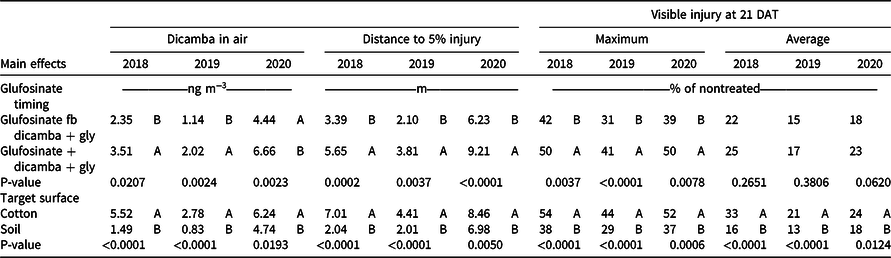
According to statistical analysis, dicamba detections varied by experimental run (year); therefore, further analyses were carried out by year. For the three independent experimental runs (2018, 2019, and 2020), a significant interaction between glufosinate timing by target surface occurred only concerning the distance to 5% injury and the maximum injury to soybean in 2018 and 2019 (Table 1). Generally, herbicides applied to cotton resulted in greater lateral movement of the dicamba damage, which was expressed by the distance to 5% injury when glufosinate was added to dicamba plus glyphosate than when glufosinate was applied 4 d before dicamba treatment. Similarly, applications made on soil resulted in a lower distance to 5% injury when glufosinate was separate from dicamba plus glyphosate. Results of the interaction of treatments for the distance to 5% injury were comparable to those of maximum injury (Table 1). The maximum visible injury from dicamba treatments was observed near the middle quadrats at the center of the plots (or the tunnel), where treated trays of cotton or soil had been placed.
Effect of glufosinate timing and target surface interaction for each experimental run (year) on the distance to 5% injury and maximum injury to sensitive soybean. a, b, c

a Abbreviations; DAT, days after treatment; fb, followed by; gly, glyphosate.
b Analyses of variance were performed by year with replicates as random variables. Distance to 5% injury assumed normal distribution, while maximum injury followed beta distribution.
c All dicamba treatments contained glyphosate at 1,120 g ae ha−1. Herbicide rates were dicamba at 560 g ae ha−1 and glufosinate at 660 g ae ha−1. Herbicide treatments were applied four times onto trays with soil or cotton with 100% canopy closure. The pH of the solutions, with a standard error in parenthesis, were 6.75 (±0.17) for glufosinate alone, 4.68 (±0.05) for dicamba plus glyphosate, and 4.70 (±0.03) for the mixture of glufosinate with dicamba and glyphosate. The pH of the water sources equaled 7.10, 7.20, and 7.26 for three independent runs of this experiment (2018, 2019, and 2020, respectively).
d P-values were calculated using the GLIMMIX procedure with SAS software (version 9.4). Means within a column for each effect that contained different letters were significantly different according to Fisher’s protected LSD (α = 0.05). The effects of glufosinate timing by target surface interactions by year were not significant for dicamba in air samples (P-values equaled 0.2120, 0.3625, and 0.6442, respectively), or average injury (P-values equaled 0.0817, 0.6947, and 0.8168, respectively), and are not shown.
The main effects of glufosinate timing and target surface affected most variables we measured, regardless of the run (Table 2). In every run of this experiment, dicamba concentration in air was higher when glufosinate was added to dicamba plus glyphosate than when applied prior to dicamba (for instance, in 2018, 2.35 ng m−3 for separate treatments and 3.51 ng m−3 of dicamba in air samples when glufosinate was added to dicamba plus glyphosate). This increase in dicamba emissions could explain why glufosinate with dicamba is a prohibited mixture for in-crop applications (Anonymous 2022b). The addition of glufosinate with dicamba is expected to have a similar impact as the addition of AMS because the herbicide is formulated as glufosinate-ammonium salt, which could promote acidification of the mixture and precipitation of Ca2+ or Mg2+ ions present, and increasing dissociation of dicamba salt to dicamba acid, which has higher volatility potential (Mueller and Steckel Reference Mueller and Steckel2019b; Roskamp et al. Reference Roskamp, Chahal and Johnson2013). The addition of glufosinate to the mixture of dicamba plus glyphosate did not reduce the pH of the mixture in comparison to dicamba plus glyphosate alone (Table 1). Previous research measured the pH of solutions that combined potassium-salt of glyphosate and AMS to dicamba, and according to those results, the pH reduction was slight by adding the ammonium additive (Mueller and Steckel Reference Mueller and Steckel2019b). It may be that glufosinate-ammonium dissociated and affected the interaction of ions in the mixture with dicamba plus glyphosate, thereby increasing the dissociation of formulated material; however, more research is needed to understand the substantial increase of dicamba emissions in the three-way solution. The ammonium salt of dicamba was deemed more volatile than other forms of the herbicide (Zollinger et al. Reference Zollinger, Howatt, Bernards, Young and Goss2016).
Effect of glufosinate timing and target surface for each experimental run (year) on volatile dicamba in air samples, distance to 5% injury, and average and maximum injury to sensitive soybean. a – e

a Abbreviations; DAT, days after treatment; fb, followed by; gly, glyphosate.
b Volatile dicamba in air samples was measured until 48 h after initiation.
c Analyses of variance performed by year with replicates as random variables. Dicamba in air assumed gamma distribution, distance to 5% injury assumed normal distribution, while average and maximum injury followed beta distributions.
d All dicamba treatments contained glyphosate at 1,120 g ae ha−1. Herbicide rates were dicamba at 560 g ae ha−1 and glufosinate at 660 g ae ha−1. Herbicide treatments were applied four times onto trays with soil or cotton with 100% canopy closure. The pH of the solutions, with a standard error in parenthesis, were 6.75 (±0.17) for glufosinate alone, 4.68 (±0.05) for dicamba plus glyphosate, and 4.70 (±0.03) for the mixture of glufosinate with dicamba and glyphosate. The pH of the water sources equaled 7.10, 7.20, and 7.26 for three independent runs of this experiment (2018, 2019, and 2020, respectively).
e P-values were calculated using the GLIMMIX procedure with SAS software (version 9.4). Means within a column for each effect that contained different letters were significantly different according to Fisher’s protected LSD (α = 0.05).
Differences in dicamba concentration in air samples were noticeably lower in 2019 than in other experimental runs. These differences could be due to environmental conditions during this trial; for instance, steady winds parallel with the low tunnels could have dissipated volatile dicamba produced by the treatments (Supplementary Figure S1). Volatility potential is expected to increase when the wind blows parallel with the tunnels, reducing relative humidity inside the structure and increasing evaporation of water and herbicide from soil and plant surfaces (Bedos et al. Reference Bedos, Cellier, Calvet, Barriuso and Gabrielle2002). The relative orientation of the low tunnels and prevailing wind direction would generally determine the distance at which dicamba lateral movement could be observed—the farthest distance could be generally related to prevalent wind in parallel with the tunnels, moving volatile herbicide farther from the original position in the tunnel. The air temperature outside the tunnels varied from 18 to 30 C, while the average temperature inside the tunnels reached a maximum of 41 C (Supplementary Figure S2). The highest air temperatures inside the tunnels were observed in trials 2018 and 2020 (43 C and 40 C, respectively; Supplementary Figure S2), and generally higher levels of dicamba detection were found in these trials compared with levels in 2019. No rainfall occurred during the trials; the average relative humidity outside the tunnel was 77% (data not shown). Different results of dicamba detections could also explain differences of distance to 5% and average and maximum injury to soybean at the field.
Dicamba detection in air samples was greater when applications occurred on vegetation (cotton seedlings) than on soil, regardless of herbicide treatment in every trial of this experiment (Table 2), which agreed with findings from previous field studies (Mueller and Steckel Reference Mueller and Steckel2021). Glufosinate timing with dicamba treatments did not affect the average soybean injury in the plots, which ranged from 15% to 25%, depending on the run; meanwhile, the average injury was affected by the target surface. As expected, treatment made to soil resulted in lower average injury than those made to cotton in every run of this experiment (Table 2).
According to these results, regardless of the type of surface treated, glufosinate mixed with dicamba treatment increased the ability to detect dicamba in every trial. Previous research reported that glufosinate plus dicamba limited translocation of dicamba on Palmer amaranth and barnyardgrass [Echinochloa crus-galli (L.) P. Beauv.], potentially affecting its efficacy (Meyer et al. Reference Meyer, Peter, Norsworthy and Beffa2020). Moreover, sequential applications of glufosinate and dicamba increased efficacy in controlling Palmer amaranth, even on weeds larger than 10 cm (Priess et al. Reference Priess, Popp, Norsworthy, Mauromoustakos, Roberts and Butts2022). Therefore, weed control applications should follow label restrictions and keep dicamba, and glufosinate products separate to minimize the OTM of dicamba.
Influence of AMS Contamination on Dicamba Volatility in the Presence of Glyphosate
According to statistical analysis, dicamba detections differed by experimental run (year); further analyses were made by year. Dicamba detections in air samples were generally greater in 2020 than in 2019. This result may be explained by environmental conditions, in which wind speed and direction were comparable, but higher air temperature inside and outside the tunnels occurred in the second year, potentially generating higher emissions of dicamba from the treated trays (Supplementary Figures S3 and S4). The hourly air temperature was higher than 25 C for 13 h in 2020 and 4 h in 2019. Rain of just 1 mm fell 41 h after the application of the first run and the average relative humidity was 72% (data not shown).The very low relative humidity in the 2019 trial compared with the 2020 trial (37% in 2019 compared with 60% in 2020 in the first hour after application; data not shown) resulted in fast evaporation of treatments from plant surfaces in the first year of the trial and minimized the length of time that dicamba volatility occurred and differences between treatments.
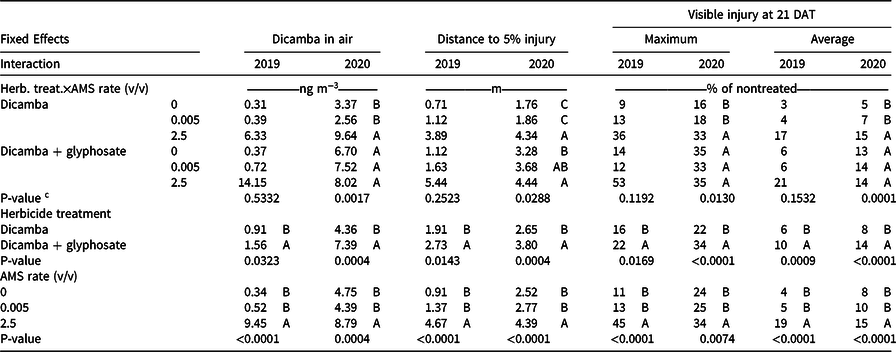
The interaction between herbicide treatment and the rate of AMS present in the tank affected dicamba concentration in air samples, distance to 5% injury, and maximum and average visible injury to soybean in 2020 (Table 3). Levels of dicamba in air samples in the second year were similar for treatments with dicamba plus glyphosate (regardless of AMS rate) and that of dicamba plus 2.5% v/v of AMS (Table 3). Trends in average and maximum visible soybean injury were similar. The distance to 5% injury was also affected by the interaction between herbicide treatment and AMS rate in 2020 (Table 3), in which the distance of damage was generally the lowest in treatments with dicamba alone or dicamba plus 0.005% v/v of AMS, which was the simulated tank contamination rate used in this experiment. The full rate of AMS resulted in the dissociation of the ammonium and sulfate ions. Then ammonium could be dissociated into ammonia, which is volatile, releasing protons (H+) in the solution, which in turn promotes dissociation of the formulated salts of dicamba into the acid form of the herbicide, which is more volatile (Abraham Reference Abraham2018). Therefore, removing AMS from the sprayer is essential to minimize dicamba volatility potential.
Effect of herbicide treatment and rate of ammonium sulfate in the tank and interaction on volatile dicamba in air samples, distance to 5% injury, and average and maximum injury to sensitive soybean. a – e

a Abbreviations; AMS, ammonium sulfate; DAT, days after treatment; fb, followed by; gly, glyphosate; Herb. treat., herbicide treatment.
b Volatile dicamba in air samples was measured until 48 h after initiation.
c Analyses of variance performed with experimental runs (year) as a fixed and replicates as random effects. Dicamba in air assumed gamma distribution, distance to 5% injury assumed normality, while average and maximum injury followed beta distributions.
d Herbicide treatments contained dicamba at 1120 g ae ha-1 and glyphosate at 1260 g ae ha-1. Treatments were applied four times onto trays with soil. The pH of the solutions, with standard error in parenthesis, were 5.40 (±0.05) for dicamba alone, 5.33 (±0.08) for dicamba plus 0.005% v/v AMS, 5.29 (±0.07) for dicamba plus 2.5% v/v AMS, dicamba plus glyphosate was 4.84 (±0.05), dicamba plus glyphosate and 0.005% v/v AMS was 4.79 (±0.01), and dicamba plus glyphosate and 2.5% v/v AMS was 4.73 (±0.01). The initial pH of water sources equaled 8.08 and 8.04 for two runs of this experiment (2019 and 2020, respectively).
e P-values were computed using the GLIMMIX procedure with SAS software (version 9.4). Means within a column for each effect that contained different letters were different according to Fisher’s protected LSD (α = 0.05).
For the trial conducted in 2019, the main effects of herbicide treatments or AMS rate present in the mixture explained the variability of dicamba in air samples (Table 3). Even considering that the rate of dicamba used in this study was 1,120 g ha−1 (which used to be a labeled preemergent application rate in DR crops), a significant reduction in dicamba concentration in air samples occurred when glyphosate was removed from the mixture (Table 3). These results were similar to reports of glyphosate’s impact on dicamba volatility in recent years in field and controlled environments (Bish et al. Reference Bish, Farrell, Lerch and Bradley2019a; Mueller and Steckel Reference Mueller and Steckel2019a, Reference Mueller and Steckel2021). AMS is often used with weak acid herbicides, such as glyphosate, to reduce the antagonism of cations in hard water on the control efficacy of these herbicides (Devkota and Johnson Reference Devkota and Johnson2016; Roskamp et al. Reference Roskamp, Chahal and Johnson2013). This research showed that regardless of herbicide treatment, adding liquid AMS at 2.5% v/v resulted in the highest level of dicamba volatility, equivalent to 9.45 ng m−3 on average in 2019 (Table 3). In comparison, dicamba concentrations in air samples for treatments without AMS or with the simulated tank contamination rate of AMS (0.005% v/v) were lower and not different from each other (Table 3).
In 2019, the maximum and average injury to soybean and distance from the center of the plot to the 5% injured soybean was affected by herbicide treatments or the AMS rate in the tank. As expected, adding glyphosate to dicamba resulted in a more considerable distance to 5% injury and maximum or average injury (Table 3). In addition, dicamba treatments lacking AMS or with 0.005% v/v AMS did differ for injury or the distance to 5% injury (Table 3).
The pH measurement of dicamba solutions lacking glyphosate was generally above 5.2, and even the presence of AMS at 2.5% v/v with dicamba did not severely affect the pH of mixtures (Table 3). As expected, adding glyphosate to dicamba, regardless of the presence of AMS, severely reduced the solution pH (Table 3). Previous research reported that the addition of glyphosate reduced the pH of dicamba solution below 5.0 and increased volatility potential (Mueller and Steckel Reference Mueller and Steckel2019b), yet current research showed that no difference in dicamba volatility for dicamba treatments plus 2.5% v/v AMS with or without glyphosate (equivalent to 11.08 ng m−3 and 7.99 ng m−3, respectively; data not shown), meanwhile these solutions differed by 0.56 pH units, on average (Table 3). Previous research reported that pH might not be the principal factor to affect dicamba volatility (Carbonari et al. Reference Carbonari, Costa, Giovanelli, Bevilaqua, Palhano, Barbosa, Lopez Ovejero and Velini2022). More research is required to characterize the impact of ammonium on the dissociation of dicamba formulations and the increase of dicamba OTM.
According to the results of this research, it is unlikely that tank contamination with AMS could result in a significant increase in dicamba volatility. It is important to note that AMS cannot be used as a water conditioner with Xtendimax, Engenia, or Tavium (Anonymous 2022a, 2022b, 2022c), and specific products should be used to prevent OTM. However, AMS could be used with appropriate pesticide applications, even before dicamba use, if proper cleaning procedures are conducted to remove the components from the sprayer.
Value of VRA on Dicamba Volatility in Different Treated Surfaces
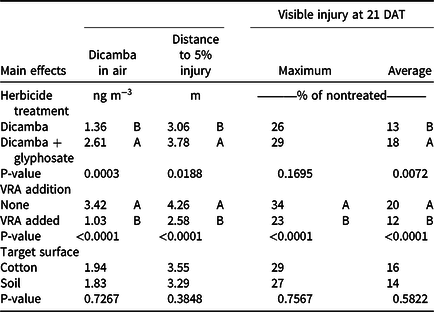
In contrast with Experiments 1 and 2, this experiment consisted of a three-factor factorial arrangement of treatments with two replicates and three runs, and due to this complex experimental design, data were analyzed considering experimental runs as a random variable. Environmental data collected during each run of this experiment showed that the air temperature outside the tunnels varied from 19 to 33 C, while the average temperature inside the tunnels reached a maximum of 44 C (data not shown). Rain of just 1 mm fell on the second night (38 h after application) of the first run, the average relative humidity was 67%, and wind speed was generally low, averaging 2.47 km h−1 (data not shown). Statistical analysis showed no significant interactions between herbicide treatment, VRA addition, and surface treatment for distances to 5% injury or the maximum and average injury (data not shown). Only the interaction between VRA addition with the target surface was significant for dicamba detection in air samples (P-value = 0.0004; data not shown). When comparing dicamba volatility from treatments sprayed on cotton, adding a VRA reduced dicamba in air samples from 2.57 ng m−3 to 1.46 ng m−3, while treatments made on soil emitted 4.56 ng m−3 without VRA and 0.73 ng m−3 when VRA was added to the treatment (data not shown). It is unclear why VRA affected the detection of dicamba in air samples differently on soil and cotton. Dicamba applied to wet soil may have promoted more dissociation of dicamba to the acid form than when applied to the vegetated surface (cotton seedlings), thereby increasing the volatility observed. It could be that when VRA is added to the solution, the formation of dicamba acid is increased if free water is available on the surface treated (in wet soil). Previous research reported that water content in the soil promotes capillary movement, displacement, and the transference of pesticides from the soil to the air, increasing volatility potential (Bedos et al. Reference Bedos, Cellier, Calvet, Barriuso and Gabrielle2002; Crosby Reference Crosby1973; Spencer and Cliath Reference Spencer and Cliath1973). However, no specific trends could be determined based on the target surface effect on other variables measured in this experiment. The target surface did not influence dicamba detection, the average or maximum soybean injury, or the distance to 5% injury (Table 4).
Effect of herbicide treatment and addition of volatility reduction agent on volatile dicamba in air samples, distance to 5% injury, and average and maximum injury to sensitive soybean. a – e

a Abbreviations: DAT, days after treatment; VRA, volatility reduction agent.
b Volatile dicamba in air samples was measured until 48 h after initiation.
c Analyses of variance were performed with experimental runs and replicates as random variables. Dicamba in air assumed gamma distribution, distance to 5% injury assumed normal distribution, while average and maximum injury followed beta distributions.
d Herbicide treatments included dicamba at 560 g ae ha−1 and glyphosate at 1,260 g ae ha−1, and the VRA (VaporGrip Xtra) at 1.46 L ha−1. Herbicide solutions were applied four times onto trays with soil or cotton with 100% canopy closure. The pH of the solutions, with a standard error in parenthesis, were 5.36 (±0.10) for dicamba alone, 5.92 (±0.08) for dicamba plus VRA, dicamba plus glyphosate was 4.75 (±0.03), dicamba plus glyphosate and VRA was 5.18 (±0.02). The initial pH of water sources equaled 7.03, 7.12, and 7.07 for three independent runs of this experiment (two in 2021 and one in 2022, respectively).
e P-values were calculated using the GLIMMIX procedure with SAS software (version 9.4). Means within a column for each effect that contained different letters were significantly different according to Fisher’s protected LSD (α = 0.05).
The main effects of herbicide treatment and VRA addition to dicamba mixtures affected dicamba in air samples (P-values equaled 0.0003 and <0.0001, respectively; Table 4). As expected, glyphosate added to dicamba doubled the concentration of dicamba in air samples. Meanwhile, regardless of glyphosate added to the dicamba solution, combining VRA in this mixture reduced dicamba emissions by 70% compared to that without the adjuvant (Table 4). The reduction in dicamba emissions was expected by including VRA, as its main component (acetate) scavenged protons in the solution, reducing the conversion of dicamba salt to the acid form of the herbicide, with a high volatility potential (Abraham Reference Abraham2018). This research used potassium acetate-based VRA (VaporGrip Xtra), which was comparable with the formulation used in previous studies that measured the of potassium carbonate-based VRA (commercially known as Sentris) and experimental potassium borate-based VRA on dicamba volatility (Castner et al. Reference Castner, Norsworthy and Roberts2022; Mueller et al. Reference Mueller, Landry, Beeler and Steckel2022). The pH measurements of solutions used in this experiment were similar to those mentioned above. The buffering activity of the potassium-acetate VRA solution used in these trials increased the pH and reduced the conversion of dicamba acid. The average pH of dicamba alone was 5.36, while dicamba plus VRA resulted in a higher measurement of 5.92 (Table 4). Adding glyphosate to dicamba resulted in a pH reduction (pH = 4.75); meanwhile, the solution of glyphosate plus dicamba and the VRA resulted in a pH above 5.0 (Table 4).
The distance to 5% injury followed similar trends compared to the concentration of dicamba in air samples (Table 4). Also, the average soybean injury was higher when dicamba and glyphosate were in combination and when VRA was not added to the treatment solutions (Table 4). The addition of VRA affected the maximum soybean injury observed in the field; meanwhile, herbicide treatment did not significantly affect it (Table 4). According to the results of this research, to minimize dicamba volatility, the addition of a VRA and the removal of glyphosate from the solution with dicamba substantially reduced the concentration of dicamba in air samples following application, and the impact to soybean bioindicator, particularly injury, and distance of lateral movement determined until 5% injured plants, regardless to surface treatment. These findings agree with those of previous research that reported that glyphosate enhanced dicamba volatility while the buffering activity of VRAs reduced its volatility by up to 89% (Castner et al. Reference Castner, Norsworthy and Roberts2022; Glenn Reference Glenn2022).
Practical Implications
The experiments in this research demonstrate the utility of low-tunnel trials to evaluate the effect of various treatment combinations on the OTM of dicamba, particularly by volatility. Research using low tunnels allowed successful differentiation of treatments while eliminating the impact of driftable spray particles in the field. The addition of glufosinate or glyphosate to dicamba increased volatility of the latter herbicide. Furthermore, a simulated contamination rate of AMS in a dicamba solution did not affect the volatility of dicamba. However, a full dosage of the adjuvant increased the concentration of dicamba detected in air samples without having a substantial effect on the spray solution pH. More research is needed to understand the effect of ammonium on volatility potential. Besides, potassium-acetate VRA added to dicamba substantially reduced volatile dicamba detection more than treatments lacking the adjuvant.
Current regulations for dicamba treatment on DR crops contain several restrictions, including those against possible tank mixtures (Anonymous 2022a, 2022b, 2022c). However, the first restrictive measures were adopted after 2018, approximately 2 yr after the first registration of dicamba for over-the-top applications, after many complaints of OTM to authorities (US EPA 2016, 2023). In the United States, federal labels restrict the use of these herbicides until June 30 on DR soybean and July 30 on DR cotton. Glufosinate and AMS cannot be mixed with dicamba formulations, and every application must include a drift reduction agent and VRA to reduce primary and secondary movement, respectively. The addition of the potassium salt of glyphosate formulation to dicamba is allowed according to federal labels; however, states such as Arkansas restrict the use of this herbicide combination after April 15 to reduce potential OTM (Arkansas State Plant Board 2021). The general methodology used in this research (low tunnel studies) allowed the comparison of several treatments and their impact on OTM of dicamba, particularly driven by volatility. Therefore, low-tunnel studies could help select safer dicamba application treatments, striving for environmental stewardship of the technology and minimizing potential OTM issues in the future.
Supplementary material
To view supplementary material for this article, please visit https://doi.org/10.1017/wet.2023.74
Acknowledgments
Technical assistance provided by the research associates and graduate students from the University of Arkansas weed science group is gratefully acknowledged. The project was partially funded by support from the Arkansas State Plant Board. No conflict of interest has been declared.