INTRODUCTION
There is increasing evidence that human-mediated environmental changes, including the erosion of geographical barriers, the introduction of exotic species, and habitat degradation, are influencing the distribution of species (e.g. Rahel, Reference Rahel2007; Hiddink & ter Hofstede, Reference Hiddink and ter Hofstede2008). The accelerated rate of human modifications of the natural environment is paralleled by an increasing number of reports documenting extensions and contractions of the historical ranges of many species (e.g. Sax & Gaines, Reference Sax and Gaines2003; Azzurro, Reference Azzurro2008; Thomas, Reference Thomas2010). The value of these studies is entirely dependent on the accurate identification of specimens, and the misidentification of material can lead to erroneous conclusions of major shifts in species' ranges.
Close to 40 nominal species of the globally-distributed genus Syngnathus are currently recognized in the Eschmeyer's Catalogue of Fishes (2010). Of these, eleven are known to occur in Europe, making this the most species-rich group of syngnathid fish in the region (Dawson, Reference Dawson, Whitehead, Bauchot, Hureau, Nielson and Tortonese1986). While nine of these species names are in common use (e.g. Dawson, Reference Dawson, Whitehead, Bauchot, Hureau, Nielson and Tortonese1986), two species from the Black Sea (S. affinis, Eichwald, 1831 and S. argentatus, Pallas, 1814) were only recently reinstated by Kuiter (Reference Kuiter2009). Kuiter (Reference Kuiter2009), however, provides no justification for the reinstatement of these species names, and a more systematic analysis of Black Sea pipefish will be necessary in order to clarify their species status. The taxonomic status of at least two additional species is also unclear. The nearshore S. agassiz Michahelles, 1829 sensu Canestrini (Reference Canestrini1872) was synonymized with S. abaster by Lueken (Reference Lueken1967), but this species was reinstated by Roig (Reference Roig1979) on the basis of an exhaustive analysis of historical and contemporary collections from the Balearic Islands and Spanish coast, a Spanish-language report that appears to have been overlooked by subsequent researchers. Genetic and morphometric analyses of pipefish material from the Mediterranean and Black Seas suggest that S. nigrolineatus Eichwald, 1831 may also represent a distinct species (Hablützel & Wilson, unpublished data). Clearly, the taxonomy of Syngnathus pipefish is in a state of flux, and the genus is in need of a full systematic revision.
Of the nine commonly-recognized species, two (S. phlegon Risso, 1827 and S. schmidti Popov, 1928) are pelagic, while the others (S. abaster Risso, 1827 sensu Canestrini (Reference Canestrini1872), S. acus Linnaeus, 1758, S. rostellatus Nilsson, Reference Nilsson1855, S. taenionotus Canestrini, 1871, S. tenuirostris Rathke, 1837, S. typhle Linnaeus, 1758 and S. variegatus Pallas, 1811) are all nearshore inhabitants (Dawson, Reference Dawson, Whitehead, Bauchot, Hureau, Nielson and Tortonese1986), and are dominant members of nearshore eelgrass habitats along the European coastline.
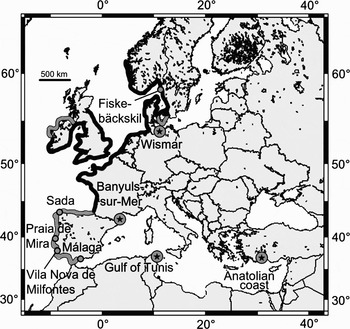
Syngnathus rostellatus (Nilsson's pipefish) was originally described from western Sweden (Nilsson, Reference Nilsson1855), and the northern French S. dumerilii Moreau, 1870 in Duméril (Reference Duméril1870) is now considered a junior synonym of this species (Fries et al., Reference Fries, Ekström and Sundevall1895; Wheeler, Reference Wheeler, Hureau and Monod1973). Ehrenbaum (Reference Ehrenbaum and Ehrenbaum1905–1909) described the distribution range of S. rostellatus as the Atlantic coast between Bergen and the Sea of Biscay (Figure 1). Syngnathus rostellatus is found at moderate densities in the Kattegat of western Sweden, and while there are scattered reports of individual specimens in the southern Baltic (e.g. Ehrenbaum, Reference Ehrenbaum and Ehrenbaum1905–1909; Otterstøm, Reference Otterstøm1917), a recent exhaustive survey of this region failed to detect this species (HELCOM, 2007). These earlier descriptions have been complemented by subsequent reports of S. rostellatus from the northern Irish coast (Douglas & Egan, Reference Douglas and Egan1983) and sites as far south as Málaga, Spain (Helling (Reference Helling1943); Reina-Hervás et al. (1981–1982)) (Figure 1). Syngnathus rostellatus has recently been reported from sites within the Mediterranean as far east as southern Turkey (Louisy, Reference Louisy2002; Gökoglu et al., Reference Gökoglu, Bodur and Kaya2004; Ben Amor et al., Reference Ben Amor, Ben Salem, Ben Soussi and Capapé2008) (Figure 1), suggesting that this species may be experiencing a major range extension.
The traditional distribution of Syngnathus rostellatus according to Dawson (Reference Dawson, Whitehead, Bauchot, Hureau, Nielson and Tortonese1986) (black), extended by reports from the Irish (Douglas & Egan, Reference Douglas and Egan1983), Portuguese (Almeida, Reference Almeida1986) and Spanish (Reina-Hervás et al., 1981–1982) coasts and the southern Baltic Sea (Ehrenbaum, Reference Ehrenbaum and Ehrenbaum1905–1909; Otterstøm, Reference Otterstøm1917) (grey); collection localities of S. rostellatus discussed in the text are indicated (circles), as are reports of S. rostellatus based on apparent misidentifications of specimens (stars).

Here, we provide a morphological diagnosis of S. rostellatus, and use this tool to evaluate recent reports of S. rostellatus outside its historical distributional range (Dawson, Reference Dawson, Whitehead, Bauchot, Hureau, Nielson and Tortonese1986). Our analyses indicate that the majority of these recent reports stem from the misidentification of specimens and that the distribution of this species remains restricted to the north-eastern Atlantic Ocean and the Mediterranean coast of the Iberian Peninsula.
MATERIALS AND METHODS
Pipefish individuals were identified on the basis of the meristic and morphometric data provided in the original articles and, if available, from pictures. The original description of Syngnathus rostellatus by Nilsson (Reference Nilsson1855), together with subsequent descriptions by Moreau in Duméril (Reference Duméril1870) and Dawson (Reference Dawson, Whitehead, Bauchot, Hureau, Nielson and Tortonese1986) were used as references, and these descriptions were supplemented with the analysis of ethanol-preserved specimens from northern Spain (Sada) and western Sweden (Fiskebäckskil) (Table 1). Methods for the measurements and meristic counts used in this article follow Dawson (Reference Dawson, Whitehead, Bauchot, Hureau, Nielson and Tortonese1986).
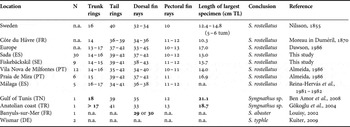
Meristic characters of Syngnathus rostellatus from the original species description (Nilsson, Reference Nilsson1855) and from more recent studies of the species. Morphological data for specimens outside the expected range for S. rostellatus are indicated in bold.

N, number; 1 tum = 2.47 cm.
RESULTS
Identification
Syngnathus rostellatus differs from all other European species of the genus by the following combination of characters: distal margins of body rings without spine-like points; 13–17 trunk rings; 35–42 tail rings; 32–45 dorsal fin rays; 10–13 pectoral fin rays; lack of brown dots in the dorsal fin; and small size (<17 cm total length (TL)) (Table 1). While the meristic counts of the Black Sea population of S. abaster (S. abaster nigrolineatus sensu Berg (Reference Berg1949)) overlap with those of S. rostellatus, this species can be clearly distinguished from S. rostellatus both morphologically and genetically (Hablützel & Wilson, unpublished data)).
Distribution
Almeida (Reference Almeida1986) reported 12 S. rostellatus specimens (including 8 pregnant males) from Vila Nova de Milfontes (PT) (Figure 1). The reproductive status of the individual specimens was not indicated in the original paper, but the data provided indicate that the smallest pregnant male in this collection had a TL of ≤ 12.1 cm. Syngnathus rostellatus, S. abaster, S. agassiz and S. typhle are the only four coast-associated species of Syngnathus in western Europe which are reported to reach sexual maturity at this size. Syngnathus abaster has fewer dorsal fin rays ( ≤ 31), S. agassiz has less tail rings ( ≤ 35) and S. typhle has more pectoral fin rays ( ≥ 14) than does S. rostellatus (Table 1). The meristic counts of the specimens collected by Almeida (Reference Almeida1986) are thus consistent with the identification of these specimens as S. rostellatus (Table 1). Almeida (Reference Almeida1986) also re-examined specimens from Praia de Mira (PT) (Figure 1) collected by Helling (Reference Helling1943) and identified these individuals as S. rostellatus. On the basis of the details provided in Almeida (Reference Almeida1986), we conclude that all of these individuals are indeed S. rostellatus.
Reports of S. rostellatus from Málaga (Figure 1) by Lozano & Rey (Reference Lozano y Rey1919) and Reina-Hervás et al. (1981–1982) also appear to be reliable. While details on the specimens analysed by Lozano & Rey (Reference Lozano y Rey1919) were not provided in the original publication, Reina-Hervás et al. (1981–1982) provided detailed information on five specimens collected from the same region. The low number of trunk rings detected in these specimens (16–17; Table 1) clearly separates them from juvenile S. acus (trunk rings: 18–19) which are otherwise similar in their general appearance. The S. rostellatus from Málaga also differ from S. abaster, S. agassiz and S. typhle in meristic counts (see above).
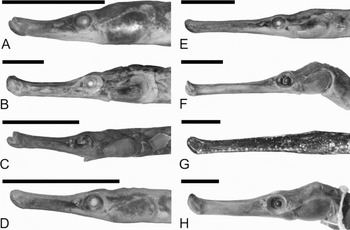
In contrast to these reliable reports of S. rostellatus from outside its historical range, several recent descriptions of S. rostellatus from sites in Tunisia and Turkey (Figure 1) appear to be in error. Photographs of the individuals included in both of these studies are provided in the original articles (Gökoglu et al., Reference Gökoglu, Bodur and Kaya2004; Ben Amor et al., Reference Ben Amor, Ben Salem, Ben Soussi and Capapé2008). Both pictures show large (18.7 cm and 21.1 cm TL), long-snouted species with high numbers of trunk rings (18 for the Tunisian and > 17 for the Anatolian individual (note that Gökoglu et al. used a non-standard trunk counting method which differs from other publications of syngnathid pipefish (e.g. Dawson, Reference Dawson, Whitehead, Bauchot, Hureau, Nielson and Tortonese1986))), indicating that neither of these specimens are S. rostellatus (Table 1; Figure 2). The specimens illustrated by Gökoglu et al. (Reference Gökoglu, Bodur and Kaya2004) and Ben Amor et al. (Reference Ben Amor, Ben Salem, Ben Soussi and Capapé2008) most closely resemble either S. tenuirostris or S. acus (Figure 2), species which are known to occur in the Mediterranean region (Kaup, Reference Kaup1856; Dawson, Reference Dawson, Whitehead, Bauchot, Hureau, Nielson and Tortonese1986).
Photographs of the head morphology of the nearshore Syngnathus species discussed in this article, along with an indication of the collection locality of the individual specimens. (A) Syngnathus abaster, Scardovari (IT); (B) S. acus, Tasende (ES); (C) S. agassiz, Naples (IT); (D) S. rostellatus, Sada (ES); (E) S. taenionotus, Scardovari (IT); (F) S. tenuirostris, Bosphorus (TR); (G) S. typhle, Venice (IT); (H) S. variegatus, Crimea (UA). Scale bar: 1 cm. Pictures (A–E, G) taken from specimens collected by the authors and collaborators (A, B, D, E, G) or from the collections of the Senckenberg Museum in Frankfurt (C, SMF 8334 and the Muséum National d'Histoire Naturelle in Paris (F, MNHN 0000-6132; H, MNHN 0000-6134). Drawings (F, H) after Rathke (1837), see Kuiter (Reference Kuiter2009) for photographs of these species.

Louisy (Reference Louisy2002) reported a single S. rostellatus female from Banyuls-sur-Mer, France (Figure 1). The author did not provide meristic data, but included two colour pictures of the living specimen. The low number of dorsal fin rays (29 or 30; Table 1) and the flattened form of the snout (versus the slightly convex snout of S. rostellatus (Figure 2)) suggest that the specimen is actually S. abaster. The report of S. taenionotus from southern France in Louisy (Reference Louisy2002) also appears to be in error, and is based on an apparent misidentification of a S. typhle individual (data not shown). Unfortunately, the photographs and identifications used by Louisy (Reference Louisy2002) have been incorporated into a recent global survey of syngnathid species (Kuiter, Reference Kuiter2009), further propagating these errors.
Confusion about the distributional range of S. rostellatus also exists at its north-eastern periphery in the southern Baltic Sea. Kuiter (Reference Kuiter2009) recently reported two specimens from Wismar, Germany. We argue that both pictured specimens are misidentified and in fact are S. typhle, recognizable by the elevation of the snout evident in these individuals, diagnostic for this species (see Figure 2). One of the two specimens also shows a colour pattern of white spots which is known only from juvenile S. typhle and is not found in S. rostellatus.
The lasting impact of historical errors on the European biogeography of Syngnathus
Dawson's (1986) key to European syngnathid species has been an important reference for researchers working on European Syngnathus species. Unfortunately, an error in the illustration included in this text has perpetuated confusion relating to species-level identification. While the meristic counts provided in Dawson (Reference Dawson, Whitehead, Bauchot, Hureau, Nielson and Tortonese1986) are accurate, the illustration of S. rostellatus included in this report was derived from a sketch originally published in Fries et al. (Reference Fries, Ekström and Sundevall1895) and subsequently reprinted by Poll (Reference Poll1947) in his review of Belgian marine fish. Unfortunately, while the original illustration (Fries et al., Reference Fries, Ekström and Sundevall1895) referred to S. typhle (plate XXIX, figure 1), Poll (Reference Poll1947) mislabelled this specimen as S. rostellatus in both the text and the figure legend of his book (p. 186, figure 126), and Dawson kept this description in his text.
Poll (Reference Poll1947) made a second labelling error in his Fauna de Belgique, including an illustration of S. rostellatus originally published in Fries et al. (Reference Fries, Ekström and Sundevall1895) in his description of S. typhle (plate XXVIII, figure 8b; note that this specimen is also inconsistently labelled as both S. rostellatus and S. acus in the original publication). Such labelling errors have undoubtedly contributed to the confusion surrounding the identification of European Syngnathus species, and we have attempted to remedy this situation here, including photographs of all of commonly recognized nearshore Syngnathus species known to occur in this region (Figure 2).
CONCLUSIONS
Considering the reliable reports of S. rostellatus from the Portuguese and the Spanish Mediterranean coasts, we suggest that the current range of S. rostellatus is broader than that indicated by Dawson (Reference Dawson, Whitehead, Bauchot, Hureau, Nielson and Tortonese1986). The contemporary range of this species extends from the Norwegian coast as far south as the western Mediterranean at Málaga, Spain (Figure 1). This distributional pattern coincides with the present frontal system between Almeria and Oran, which separates Atlantic waters to the west from Mediterranean waters to the east (Tintore et al., Reference Tintore, Violette, Blade and Cruzado1988). Reports of S. rostellatus from Mediterranean sites east of Málaga appear to be erroneous, and stem from specimen misidentifications.
ACKNOWLEDGEMENTS
We thank Alexandra Wegmann and Jasmin Winkler for their assistance in species identification. Filip Volckaert and two anonymous referees provided helpful comments on an earlier draft of this article. We further thank the SMF and MNHN for access to their pipefish collections. The study was supported by the University of Zurich, Switzerland.