INTRODUCTION
In 1994 Ceredigion District Council (CCC) initiated a project at three study sites to obtain information on boat traffic and marine mammals within the recently established Marine Heritage Coast of southern Cardigan Bay. High levels of local interest had arisen from research that highlighted both the ecology of bottlenose dolphins Tursiops truncatus, and a perceived increase in local impacts upon them from human activities (Mayer et al., Reference Mayer, Arnold and Evans1991; Mayer & Arnold, Reference Mayer and Arnold1991; Morris, Reference Morris1991; Lewis & Evans, 1993). The present project drew in further interest, incorporated additional sites and became established as a long-term monitoring programme—we are now able to report results from 14 field seasons and seven study sites. The principal aims of the project have been: (a) to monitor the presence of bottlenose dolphins at a number of coastal sites; and (b) gather data on boat traffic to aid coastal zone management.
In 2004 this region of Cardigan Bay was designated a Special Area of Conservation (SAC) under the European Union ‘Habitats Directive’, primarily for bottlenose dolphins (CCC, 2008). The area is important within the UK as it supports a regular concentration of semi-resident bottlenose dolphins (Evans et al., Reference Evans, Anderwald and Baines2003): estimates of the mean number of animals within the SAC varied between 121 and 210 animals in 2001–2007 (Evans et al., Reference Evans, Baines, Shepherd and Reichelt2002; Ugarte & Evans, Reference Ugarte and Evans2006; Pesante et al., Reference Pesante, Evans, Baines and McMath2008b). The size of this population or the proportion of the population that uses habitats within the SAC is believed to have been stable or to have increased slightly since 2001 (Pesante et al., Reference Pesante, Evans, Baines and McMath2008b). This population is now known to range extensively within the Irish Sea and has a marked seasonal occurrence in Cardigan Bay: bottlenose dolphins make intensive use of inshore waters during the summer but are relatively uncommon during the winter (Bristow, Reference Bristow2004; Pesante et al., Reference Pesante, Evans, Anderwald, Powell and McMath2008a).
Bottlenose dolphins are prone to disturbance by boats (e.g. Janik & Thompson, Reference Janik and Thompson1996; Nowacek et al., Reference Nowacek, Wells and Solow2001; Constantine et al., Reference Constantine, Brunton and Dennis2004). Adverse impacts on dolphins may include physical injury from collisions with high-speed craft, and the more subtle effects of disturbance to dolphin behaviour that incur a net energetic cost (Lusseau, Reference Lusseau2003; Yazdi, Reference Yazdi2005; Stockin et al., Reference Stockin, Lusseau, Binedell, Wiseman and Orams2008). Boat interaction that causes the cessation of feeding and a displacement of animals, for example, may reduce prey consumption and increase time spent travelling and searching for prey. Further, the temporary exclusion of animals from preferred sites may increase competition between individuals at alternative locations. Codes of conduct for recreational and commercial boat users have been developed in Cardigan Bay where high-use areas for bottlenose dolphins at headlands, bays and harbours attract boat users in summer. The codes aim to reduce both the risk of disturbance and injury. Rates of compliance with the code and the efficacy of the code to address these aims are monitored by CCC using shore-based observers (Pierpoint & Allan, Reference Pierpoint and Allan2000, Reference Pierpoint and Allan2001, Reference Pierpoint and Allan2002, Reference Pierpoint and Allan2004, Reference Pierpoint and Allan2006).
Shore-based observation is limited in scope by the topography of the study site: the height of the observation position and the available field of view. Differences in eye height (influencing the detection rate of animals as a function of range) and in the area surveyed may affect the comparability of sighting rates between sites. Further, results relating to specific near-shore sites cannot be assumed to reflect the ecology or abundance of animals in the wider area (Thompson et al., Reference Thompson, Lusseau, Corkrey and Hammond2004). Shore-based observation is, however, a useful method of recording habitat use and temporal variation in occurrence at key sites of interest, and has certain advantages over boat-based methods. Observations are made from a non-intrusive distance and data collection is unlikely to affect the behaviour of the study animals. The observation position is also stable which aids the use of binoculars, and high platforms reduce the effects of wave height on animal detection. A key advantage is that data collection does not incur vessel hire or fuel costs and requires little equipment; it is therefore relatively cheap and is suitable for use with networks of personnel operating at multiple sites. The use of volunteers can build upon local expertise and enthusiasm, promote public awareness and education, and involve communities in the management of specially protected areas. The collaboration of a large pool of observers may however, raise issues of variation in detection skill that could introduce bias to comparisons of sighting rates between sites and years (Thompson et al., Reference Thompson, Tufft, Grellier and Durban2000). We discuss the steps taken during the present study to militate against these effects during data collection and analysis.
MATERIALS AND METHODS
Data collection
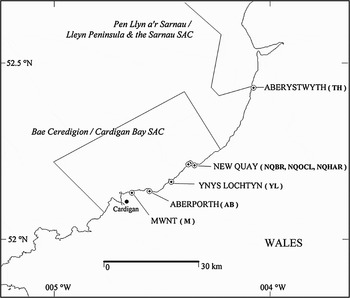
We used shore-based observation to monitor bottlenose dolphin and boat traffic at seven sites within or on the periphery of Cardigan Bay/Bae Ceredigion SAC (Figure 1) over a 14 year period. The longest time series were available for Mwnt (M: 9 years), Aberporth (AB: 11 years), Ynys Lochtyn (YL: 12 years) and New Quay. Observations at New Quay were initially carried out from the Old Coastguard Lookout (NQOCL: 1994–1997) but relocated to Bird's Rock (NQBR: 1998–2007). Volunteers from the Sea Watch Foundation and Cardigan Bay Marine Wildlife Centre collected data under the same protocol at New Quay Harbour (NQHAR) from 2004–2007. Observations at Aberystwyth (TH) north of the SAC, also began in 2004. Observations were carried out at up to six sites each year. More than 250 volunteers with varied backgrounds and levels of marine mammal experience took part in the monitoring programme, many for several successive years. Training seminars were carried out at the beginning of each year and additional support and feedback were provided in the field by more experienced observers and site coordinators. Additional training was provided by the Sea Watch Foundation for observers at NQHAR.
The location of shore-based monitoring sites (M, AB, YL, NQ and TH).

Observers scanned each area with a combination of naked eye and low powered binoculars for 2 hour observation periods. After 1994, the recording protocol was standardized by dividing each watch into eight successive 15-minute intervals. Environmental information including sea state and visibility was recorded at the beginning of each 15 minutes. Sea state was recorded using Beaufort Scale sea surface criteria. In 2004 a simple mapping system was introduced and the location, size and activity of each dolphin school were recorded at the beginning of each 15-minute interval or when the school was first seen. Position estimation was aided by map guidelines, known distances to prominent coastal features and to buoys that marked low speed boating areas. Schools were defined as animals in close proximity, within about ten body lengths. The number of calves present was recorded: calves were defined as juvenile animals less than or approximately 2/3 adult length, closely accompanied by an adult. An activity code was allocated to each group that best summarized its behaviour. Activity was divided in S-coded (staying) and T-coded (travelling) behaviour. Activity was further divided into hi-key (fast, energetic and splashy) and lo-key (slow and steady surfacing). Additional codes were available for interactions with boats. Tally counts of different types of boat visiting each site were made over the course of 2 hours. Observer effort, environmental and sighting data, details of boat encounters and 2 hour boat counts were stored as related tables in a Microsoft Access database. From 2004, the locations of dolphin schools were carefully transcribed from paper maps to a linked MapInfo Geographic Information System (MapInfo Corporation).
M, YL, NQBR and NQOCL are open, headland sites and observations were made from cliff-top locations on headlands, 50–95 m above sea level. AB, NQHAR and TH incorporate harbours with boat moorings and launching facilities. AB and NQHAR are embayments adjacent to headlands with observer heights of 20 m and 8 m respectively. At TH observer height was 15 m. The approximate field of view at each site was calculated as the area of a polygon bounded by coastal topography and an arbitrary 2 km radius from the observers' position. Thus, a standardized measure of the area surveyed at more open sites was: 6.8 km2 (YL), 6.6 km2 (M), 6.3 km2 (NQBR), 6.4 km2 (NQOCL) and 5.8 km2 (TH). At NQHAR and AB the standardized area surveyed was 4.9 km2 and 4.6 km2 respectively. Eye height was therefore relatively low and the field of view relatively restricted at NQHAR, AB and TH compared to the headland sites.
Data analysis
We used three terms to describe rates of site use: (A) bottlenose dolphin occurrence was defined as the percentage of 2 hour watches in which this species was recorded at least once; (B) site occupancy was the proportion of 15-minute intervals in which bottlenose dolphins were present; and (C) relative abundance was measured as the average count of bottlenose dolphins per 15-minute interval in each 2 hour watch. These indices were calculated for a sub-set of observations collected during 4496 watches of 2 hours' duration carried out between June and September, for which sea state was 0–3 and visibility was at least 5 km throughout each watch. The level of boat traffic was expressed as the average boat count per hour during weekend watches in July and August, the peak summer tourist period. This was an index of total boat traffic: counts of all types of boat whether motor-powered, sailed or paddled were combined.
We investigated trend in bottlenose dolphin sighting rates between 1995 and 2007 at sites for which at least nine years' data were available (AB, M, NQBR and YL). Cuzick's trend test (Cuzick, Reference Cuzick1985) was used to examine the significance of these trends by comparing mean 15-minute counts of bottlenose dolphin per watch in each year. P values are presented for one-sided tests of whether an increasing or a decreasing trend was detected. A Kruskal–Wallis test and Dwass–Steel–Critchlow–Fligner pairwise comparisons were used to examine differences in dolphin group size between sites (Conover, Reference Conover1999). Simple linear regression and correlation tests between dolphin and boat indices were carried out on log-transformed data.
RESULTS
Bottlenose dolphin occurrence
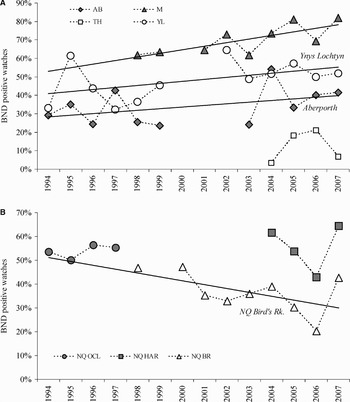
The monitoring sites were ranked by the proportion of watches in which dolphins were recorded (Figure 2). Overall, sites M, NQHAR and NQOCL ranked most highly (77%, 55% and 54% positive watches respectively) followed by YL, NQBR and AB (34–45%) and TH (11%). Of the four sites with the longest monitoring time series (9–12 years) this sighting rate varied least at M (11% CV) compared to YL, NQBR and AB (22–29% CV). In the most recent four years (2004–2007) NQHAR varied by 17% and TH by 71%. Mwnt was therefore the site with highest occurrence of bottlenose dolphin and was also the least variable between years. Simple linear regression lines are plotted in Figure 2 to highlight upward or downward tendency in annual rates.
Rates of bottlenose dolphin occurrence: 1994–2007.

Site occupancy
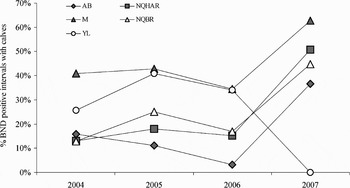
Bottlenose dolphins occupied M and NQHAR for 34% and 31% of 15-minute intervals year−1, which varied by 20% CV and 18% CV respectively between years. Site occupancy rates of 23%, 21% and 15% were recorded at YL, NQBR and AB (31–43% CV) and only 3% (34% CV) at TH. Occupancy by bottlenose dolphin calves was generally highest at M (13–24%) and YL (7–14%). In 2007, no calves were recorded at YL but were more frequent than in previous years at most other sites and especially at NQHAR. Considering only those periods in which bottlenose dolphins occupied each site, calves were present in 63% of 15-minute intervals at M in 2007, and 37%, 45% and 51% of intervals at AB, NQBR and NQHAR respectively. Using data from all sites pooled, calf occupancy rose from 20–25% of 15-minute intervals in 2004–2006 to 49% in 2007 (Figure 3).
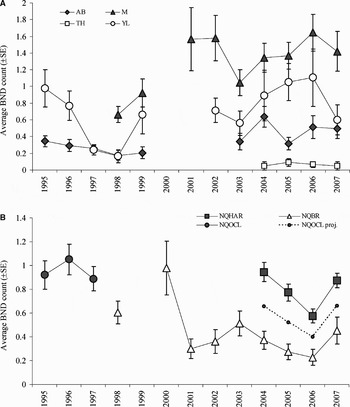
The relative abundance of bottlenose dolphins at monitoring sites 1995–2007.

Relative abundance
Counts of the number of bottlenose dolphins present per 15-minute interval ranged from one to 23 animals. Mean counts and their associated standard error are shown in Figure 4. There was a significant trend of increasing relative abundance at two of the four long-term sites: AB (Cuzick's trend, N = 766 watches over 10 years, P = 0.009) and M (N = 590, 9 years, P = 0.0002). A similar trend was only marginally non-significant at YL (N = 400, 11 years, P = 0.080). In contrast a statistically significant negative trend was found at NQBR (N = 668, 9 years, P = 0.0009). This trend was reliant however, on relatively high values recorded in the first two years of the series; if excluded, no significant trend remained from 2001 onwards (N = 538, 7 years, two-sided P = 0.708). Some additional data were available for a third site on the same headland, NQOCL. From 1994–1997 this provided partial views of both NQBR and NQHAR. Sighting rates at NQOCL were expected to be lower than those at NQHAR because some high-use areas in the latter site were not visible, but higher than those at NQBR as an expanse of sea area south-west of NQBR was found to be seldom used by dolphins. Following this supposition, the difference between NQOCL sighting rates in 1994–1997 and recent rates at NQBR and NQHAR supported the negative trend observed at NQBR (Figure 4).
Rates of site occupancy by bottlenose dolphin calves.

Group size
Mean group sizes/watch at all sites varied between 1.7 and 2.7 animals. Despite large numbers of sightings group size at NQHAR appeared lower than at other sites ( = 1.7, SD = 1.10, N = 3945). The average school size of all sightings in each 2 hour watch was compared between sites: school size at M (median 2.7, quartiles 2.0–3.7) was found to be significantly higher than at AB (median 2.0), TH (median 2.0), NQBR (median 2.0) and NQHAR (median 1.5) (Kruskal–Wallis, P < 0.05). NQBR, YL (median 2.1) and AB also yielded significantly higher group sizes than at NQHAR (P < 0.05). From 2004–2007, 44% of all group size observations were of single animals.
Levels of boat traffic
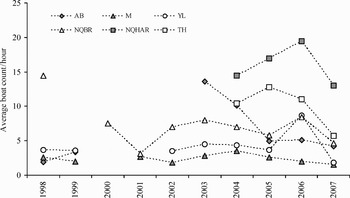
The relative levels of boat traffic at different sites were generally consistent between years. The lowest levels were recorded at M; the highest levels at NQHAR and at TH (Figure 5). All sites had lower boating levels in 2007 than in 2006, a change that was particularly marked at the busiest sites NQHAR and TH. No significant trend in the levels of boat traffic was found at AB (P = 0.316), M (P = 0.385) or YL (P = 0.268). At the fourth long-term site NQBR, the monitoring data indicated a decrease in boat traffic over the period 1998–2007. High boat counts here in 1998 seemed anomalous however, and when this year was removed from the series no significant trend remained (P = 0.519). No correlation was found between annual indices of dolphin abundance and boat traffic at these sites (P > 0.05).
Levels of boat traffic.

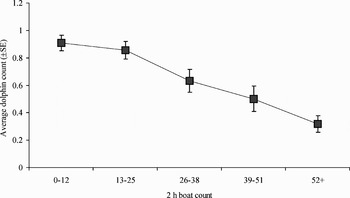
We looked in more detail at dolphin counts and boat traffic at the busiest and the least busy boating sites: NQHAR and M respectively. Average dolphin counts were compared across a range of boat traffic levels. At NQHAR average dolphin counts were significantly higher in watches with only 0–12 boats and 13–25 boats, than with counts of 26–38, 39–51 or 52+ boats (Kruskal–Wallis t = 40.2, P < 0.0001; Figure 6). There appeared to be a strong negative correlation between boat counts and average dolphin counts at NQHAR (correlation coefficient r = –0.895) but with only four annual data points available this result was not statistically significant (P = 0.105). This effect was not apparent at M where in 90% of 2 hour counts (N = 561) boat traffic totalled less than 10 boats compared to 32% at NQHAR (N = 1181).
The relative abundance of bottlenose dolphins at different levels of boat traffic in NQHAR.

Fine-scale site use
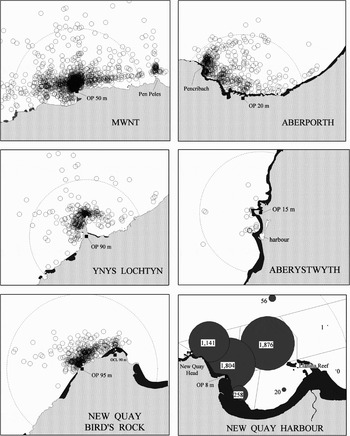
Sightings of bottlenose dolphins between 2004 and 2007 are plotted in Figure 7. Overall (excluding NQHAR), 40% of sightings were located within 500 m of the observers' position and 92% were within 2000 m. At NQHAR sightings were assigned to grid cells rather than points from which ranges from the observers' position could be calculated.
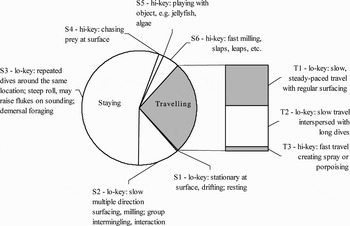
The relative frequency with which dolphin behaviours were recorded.

Clusters of sightings are evident at all sites indicating areas of particularly high use by dolphins. At M, YL, AB and NQBR dolphin sightings were concentrated where the seabed dropped away relatively steeply from the intertidal zone to 10–15 m depth. The most highly used areas at M were close to the headland and to the reef at Pen Peles. Dolphins frequently travelled between these locations, within 300 m of land. At Mwnt, 51% of sightings were located within 500 m of the observers' position at the headland; 88% were within 2 km, but the cluster of sightings at Pen Peles was located 2.6 km from the headland.
At the headlands of YL and Pencribach in AB, dolphins also approached very close to land. At AB in particular, dolphins made extensive use of an adjacent sheltered embayment. In contrast to other sites, only 9% of sightings at AB were within 500 m of the observers' position. At YL there were also relatively few sightings (14%) within 500 m of the observers' position, partly because the observer's position was set approximately 150 m inland. However, 66% of sightings were clustered close inshore at the tip of the peninsula, at 500–1000 m range. At NQBR most sightings occurred off Bird's Rock itself, an isolated stack in 5–10 m of water. The majority of sightings were close to the observers' position: 61% within 500 m and 89% within 1 km. In contrast, on the eastern side of the headland at NQHAR dolphins mostly used relatively flat areas of seabed less than 5 m deep inshore and 5–10 m deep in the outer bay between the harbour mouth, New Quay headland and Llanina Reef. Water depth at TH was also less than 5 m, with most sightings concentrated around the outcrop of Castle Rocks and off the harbour entrance.
Bottlenose dolphin behaviour
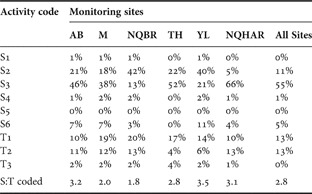
Activity codes were recorded for 2491 bottlenose dolphin sightings. S-type (‘staying’) dominated over T-type (‘travelling’) activities in very similar ratios at 4 of 6 sites: AB 76:24%, TH 74:26%, YL 78:22% and NQHAR 75:25% (Table 1). The ratio at M (67:33%) and at NQBR (64:36%) indicated a relatively higher prevalence of travelling through and around these sites. The predominant dolphin behaviour overall and at AB (46%), M (38%), TH (52%) and NQHAR (66%) was repeated diving around the same location (Figure 8), which was interpreted as foraging at or near the seabed. Lo-key circling, milling and intermingling of animals within close groups were the most frequent activities at NQBR (42%) and YL (40%). The most common travel activities were slow, steady travel and slow travel incorporating dives around specific locations, which was interpreted as travel-foraging.
The location of bottlenose dolphin sightings: 2004–2007. Radii are shown at 2 km from the observer's positions (OP). At NQHAR records were assigned to grid cells rather than points.

The relative frequency of dolphin behaviours at different sites.

AB, Aberporth; M, Mwnt; NBQR, New Quay Bird's Rock; TH, Aberystwyth; YL, Ynys Lochtyn; NQHR, New Quay Harbour.
DISCUSSION
Ceredigion County Council monitored bottlenose dolphins and boat traffic at seven coastal sites in Cardigan Bay from 1994–2007. The shore-based methods employed were non-invasive: data were collected in a manner that was unlikely to affect the behaviour of the target animals. Monitoring was also cost effective, making use of a pool of more than 250 volunteers. To improve data quality and to militate against bias due to differences in detection skills between observers, we provided training in observation and data recording at the beginning of each year and support during the field season. We also opted to use sighting rates based on presence and absence to measure bottlenose dolphin occurrence and the amount of time that the monitoring sites were occupied by this species. These rates were less likely to be affected by variation in detection skill between observers than indices that relied on counts of the numbers of animals present (Thompson et al., Reference Thompson, Tufft, Grellier and Durban2000, Reference Thompson, Lusseau, Corkrey and Hammond2004). Where it was desirable to use count-based indices to investigate the relative abundance of animals, the more robust rates of occurrence aided our interpretation of increasing, stable or decreasing trends. Our monitoring sites varied in topography: platform height ranged from 8–95 m above sea level; the area of sea surveyed also varied between open, headland sites and bays with more restricted fields of view. For this reason, other than ranking sites by rates of dolphin occurrence, we focused our analysis on the investigation of individual site use and time series, rather than comparisons between sites.
We found that bottlenose dolphin occurrence during the summer was high at all monitoring sites within Cardigan Bay SAC. In 2007 for example, dolphins were present in >80% of observation periods at Mwnt, >60% at New Quay Harbour and >40% at a further three sites (Aberporth, Ynys Lochtyn and New Quay Bird's Rock). Dolphin groups tended to remain at these sites for extended periods rather than transiting through them, and occupied habitats for up to 34% of monitoring periods annually. Although average group sizes were small, high rates of occurrence and site occupancy clearly indicated the importance of these near-shore habitats for bottlenose dolphin.
Average group size at these sites (<3 animals) was lower than that reported from boat-based surveys of the wider region of Cardigan Bay (e.g. 5.8–8.7 during summer: Grellier et al., Reference Grellier, Arnold, Thompson, Wilson and Curren1995; Gregory & Hartley, Reference Gregory and Hartley2001; Lott, Reference Lott2004) and other coastal areas of the UK and Eire (Wilson, Reference Wilson1995; Ingram, Reference Ingram2000). A similarly small average group size is reported from Belize (2.9 animals: Kerr et al., Reference Kerr, Defran and Campbell2005; 3.9 animals: Campbell et al., Reference Campbell, Bilgre and Defran2002). The proportion of sightings of single animals in our study was high (44%) in contrast with that recorded during encounters in Cardigan Bay photo-identification surveys (17%: Lott, Reference Lott2004). With a low risk of predation (reports of killer whale Orcinus orca and large sharks as rare in Cardigan Bay) the principal selective pressure on group size is likely to be the optimization of foraging efficiency. A prevalence of small groups suggests that cooperative foraging is relatively unprofitable at these near-shore sites and that dolphins typically pursue single, non-shoaling prey. Our observations contrast with sightings of the same population in North Wales during the winter, where dolphins aggregate in relatively large schools: Pesante et al. (Reference Pesante, Evans, Anderwald, Powell and McMath2008a) report a mean group size from shore-based observation of 18 and a maximum of 64 animals. A tendency for small groups of bottlenose dolphins to hunt individual prey items close inshore and for larger schools to cooperate in pursuit of shoals of fish or cephalopods in deeper water, has been observed elsewhere (Wells et al., Reference Wells, Irvine, Scott and Herman1980; Scott & Chivers, Reference Scott, Chivers, Leatherwood and Reeves1990). This wide-ranging population appears to alternate between disparate social strategies on a seasonal basis.
The use of a simple mapping system to record the estimated position of each dolphin sighting was useful as it pin-pointed a number of high-use locations. These occurred in shallow embayments; close to steeply shelving rocky headlands; at near-shore reefs; and off harbour entrances. Charted water depth at these locations was less than 20 m, often spanning the intertidal zone and areas shallower than 10 m. At four sites NQHAR, TH, AB and M, dolphins were most frequently observed repeatedly diving around the same location, and this behaviour accounted for 34% of all observations. Dolphins would arch their peduncles on diving suggesting a steep descent to forage at or close to the seabed (Shane, Reference Shane, Leatherwood and Reeves1990). Bottlenose dolphins have a varied diet and use a wide repertoire of foraging strategies (Connor et al., Reference Connor, Wells, Mann, Read, Mann, Connor, Tyack and Whitehead2000). Our study sites present a mosaic of habitats incorporating near-shore areas of soft sediment, rocky shores and headland waters. In soft seabed habitats bottlenose dolphin are reported to search for buried or partially buried prey (Rossbach & Herzing, Reference Rossbach and Herzing1997); on rocky coasts they drive fish from crevices between boulders (Würsig & Würsig, Reference Würsig and Würsig1979); elsewhere this species exploits the interaction of tidal currents on topographic features that concentrate pelagic and migratory prey (Lewis & Evans, Reference Lewis and Evans1993; Hastie et al., Reference Hastie, Wilson, Wilson, Parsons and Thompson2004; Liret et al., Reference Liret, Allali, Creton, Guinet and Ridoux1994; Ingram & Rogan, Reference Ingram and Rogan2002). In Cardigan Bay, soft sediment locations harbour burrowing species of flat fish (Pleuronectidae), dragonet (Callionymus spp.) and sand-eel (Ammodytidae) (Evans et al., Reference Evans, Baines and Shepherd2000); near-shore rock and reef habitats shelter cephalopods and fish such as pollock Pollachius pollachius and other gadids, wrasse (Labridae) and blennies (Blenniidae). Harbours and bays attract mullet (Mullidae), while salmonids and pelagic shoaling species—cluepids, mackerel Scomber scombrus and bass Dicentrarchus labrax, species known to be taken by dolphins in this region (Arnold, Reference Arnold1993; Evans et al., Reference Evans, Baines, Shepherd and Reichelt2002), are also widespread in summer.
Non-foraging behaviours predominated at two of our sites. Slow circling at the surface characterized 42% of sightings and travelling a further 35% at New Quay Bird's Rock, suggesting that this may be a less productive foraging site. At Ynys Lochtyn, our data concurred with Lewis (Reference Lewis1991) who noted elevated rates of social interaction between dolphins. Slow circling accounted for 40% of sightings and fast circling, aerobatic leaps and tail slaps another 11%, a higher frequency of apparently social behaviour than elsewhere. Resting was recorded less frequently than in some populations (Constantine et al., Reference Constantine, Brunton and Dennis2004) but at a similar rate to other European sites believed to be important foraging areas (Harzen, Reference Harzen1998; Ingram, Reference Ingram2000).
Significant long-term trends were detected in the relative abundance of dolphins. At both Mwnt and Aberporth relative abundance increased over the period 1995–2007. This positive trend was also only marginally non-significant at Ynys Lochtyn. The direction of these trends was supported by indices of bottlenose dolphin presence and absence during 2 hour observation periods. The long-term situation was less clear at New Quay. At NQBR dolphin occurrence fell between 1998 (when the observation position was established) and 2007. Average counts of the number of animals present also tracked a significant negative trend. This trend was dependant on relatively high abundance in 1998 and 2001 however; in more recent years average counts appeared to be more stable. Comparison with data from a third monitoring site on New Quay Head, NQOCL, suggested that recent levels of site use at New Quay were lower than in the mid- to late-1990s. This is in accordance with Bristow (Reference Bristow2004) who, summarizing 14 years of observations, noted a decline in the numbers of animals in the harbour area from the late-1990s to 2002 when sighting rates returned to lower levels recorded previously from 1989–1992.
Variation in sighting rates at these monitoring sites may reflect changes in the distribution of animals in Cardigan Bay rather than trends in the abundance of the population and so we do attempt to extrapolate our results to the wider region. However, trends in these data are in accordance with recent abundance estimates derived from photo-identification and line transect surveys, that indicate the number of bottlenose dolphins using Cardigan Bay is stable or slowly increasing (Pesante et al., Reference Pesante, Evans, Baines and McMath2008b). On a finer scale, our data demonstrate that sighting rates in successive years may increase and fall by similar magnitudes at adjacent sites. Local changes in site preference may reflect factors such as a change in prey availability or pressure from boat traffic.
The regular use of these coastal sites and transit routes bring dolphins close to centres of human activity in summer, and we present evidence that high levels of boat traffic can affect the rate of occurrence of bottlenose dolphins. Using a simple index of total boat traffic, we recorded higher levels of boating at NQHAR than at other sites and found that dolphin sighting rates were significantly lower when more boats were present. Between 2004 and 2007, sighting rates here showed a strong inverse relationship to the level of boat traffic. In 2007 when boating levels fell, due to poor weather during the summer tourist season, dolphin occurrence, the average numbers of animals present, and site use by females with calves rose at both New Quay sites. Lamb (Reference Lamb2004) deployed automated hydrophones (TPODs) at NQHAR during summer 2004. The results showed that dolphin occurrence was highest at night and that during the day acoustic detection rates were inversely related to the number of boats present. Site use at New Quay therefore, may be suppressed by high levels of boat traffic and some animals, perhaps individuals that are less tolerant of boats, may re-locate to nearby Ynys Lochtyn and other locations that attract fewer boats.
Bottlenose dolphins are scarce on the coast of the UK as a whole—Cardigan Bay supports higher numbers than any other region (Pesante et al., Reference Pesante, Evans, Baines and McMath2008b). Dolphins here receive protection within Special Areas of Conservation but potential impacts from boat traffic present a challenge to the successful management of coastal sites. Currently, however, there is a positive trend in the levels of site use by bottlenose dolphins at a number of key locations.
ACKNOWLEDGEMENTS
This work is published on behalf of the many dedicated volunteer observers whose work improves our understanding of bottlenose dolphins in Cardigan Bay. We would especially like to thank the site co-ordinators: Gwyneth Phillips, Rosemary Bowen, Kath Flowers, Jean Page, Phil and Paula Harris, Jenny Higgins, Lin Gander, Michelle Dunn, Roy Evans, Trish Ashley, Ruth Harding, Penny Sharp, Helen Bates, Tom Felce, Lorraine Hill, Hanna Nuuttila, Peter Pimbblett, Juliet Owen, Peter Miller and Giovanna Pesante.