

Growing evidence has linked the emotion of disgust with politics. In general, greater disgust sensitivity is associated with more conservative political beliefs, self-identification, and voting behavior (for a review, see Shook et al., Reference Shook, Oosterhoff, Terrizzi, Clay, Zeigler-Hill and Shackelford2018). Two mechanisms have been proposed to explain this association. Consistent with the behavioral immune system theory (Schaller, Reference Schaller2006), political conservatism may serve a pathogen-avoidance function (Terrizzi et al., Reference Terrizzi, Shook and McDaniel2013). Alternatively, the link between disgust sensitivity and political conservatism may be explained by individual differences in sexual strategies—or differences in whether people prefer short-term versus long-term mating goals (Tybur et al., Reference Tybur, Inbar, Güler and Molho2015). Correlational evidence has been presented to support both explanations (e.g., Shook et al., Reference Shook, Terrizzi, Clay and Oosterhoff2015; Tybur et al., Reference Tybur, Inbar, Güler and Molho2015). However, no research to date has experimentally tested either account. The goal of the current studies was to test whether manipulating disgust and sexual strategies affected political ideology.
Disgust and politics
Over the past decade, a considerable amount of research has accrued suggesting that disgust plays a unique role in politics. Specifically, greater disgust sensitivity has been consistently related to political conservatism (e.g., Inbar et al., Reference Inbar, Pizarro and Bloom2009; Inbar et al., Reference Inbar, Pizarro, Iyer and Haidt2012; Terrizzi et al., Reference Terrizzi, Shook and Ventis2010; Tybur et al., Reference Tybur, Inbar, Güler and Molho2015) and conservative party affiliation (e.g., Brenner & Inbar, Reference Brenner and Inbar2015; Shook et al., Reference Shook, Oosterhoff, Terrizzi and Brady2017; Tybur et al., Reference Tybur, Inbar, Güler and Molho2015). Disgust sensitivity has also been associated with attitudes toward specific political issues and policies (e.g., Aarøe, Petersen, & Arceneaux, Reference Aarøe, Petersen and Arceneaux2017; Clifford & Piston, Reference Clifford and Piston2017; Clifford & Wendell, Reference Clifford and Wendell2016; Kam & Estes, Reference Kam and Estes2016; Oosterhoff & Shook, Reference Oosterhoff and Shook2017; Scott et al., Reference Scott, Inbar and Rozin2016). Although disgust sensitivity is consistently associated with more conservative views on social issues, such as abortion or same-sex marriage, it is generally unrelated to economic issues, such as raising the minimum wage (e.g., Brenner & Inbar, Reference Brenner and Inbar2015; Inbar et al., Reference Inbar, Pizarro and Bloom2009; Terrizzi et al., Reference Terrizzi, Shook and Ventis2010). Some experimental evidence also suggests that inducing disgust decreases support for same-sex marriage (Adams et al., Reference Adams, Stewart and Blanchar2014). Furthermore, disgust sensitivity has been associated with voting behavior, such that those who are higher in disgust sensitivity are more likely to vote for conservative political candidates (Billingsley et al., Reference Billingsley, Lieberman and Tybur2018; Brenner & Inbar, Reference Brenner and Inbar2015; Inbar et al., Reference Inbar, Pizarro, Iyer and Haidt2012; Shook et al., Reference Shook, Oosterhoff, Terrizzi and Brady2017).
Beyond self-report, the association between disgust sensitivity and political conservativism has been demonstrated using a variety of methodologies, including neurobiological measures (e.g., fMRI; Ahn et al., Reference Ahn, Kishida, Gu, Lohrenz, Harvey, Alford and Montague2014), physiological measures (e.g., skin conductance; Smith et al., Reference Smith, Oxley, Hibbing, Alford and Hibbing2011), and visual attention measures (e.g., eye tracking; Oosterhoff et al., Reference Oosterhoff, Shook and Ford2018). In general, self-reported political conservatives exhibit stronger neural and physiological responses and greater visual attention biases to disgust-related stimuli relative to political liberals. These tendencies are specific to disgust and are not found with other negative (e.g., fear or anxiety), neutral, or positive stimuli. Further, political conservatives who are instructed to reappraise disgust endorse more liberal beliefs (Feinberg et al., Reference Feinberg, Antonenko, Willer, Horberg and John2014; Lee et al., Reference Lee, Sohn and Fowler2013), highlighting that the modulation of disgust reactions may explain differences in political ideology. Existing research provides robust evidence that consistently links greater disgust or disgust sensitivity with more conservative political ideology. However, less research has explicitly tested the mechanisms that explain these effects. Two nonexclusive explanations concerning individual differences in pathogen avoidance and sexual strategies have been used to advance theory on disgust and politics.
Pathogen avoidance explanation
According to behavioral immune system theory, a number of psychological processes evolved in part to serve as a “first line of defense” against pathogen threats (Schaller, 2007). In particular, disgust has been conceptualized as an emotion that evolved to serve a pathogen-avoidance mechanism (Curtis & Biran, Reference Curtis and Biran2001; Faulkner et al., Reference Faulkner, Schaller, Park and Duncan2004; Navarrete & Fessler, Reference Navarrete and Fessler2006). Disgust signals a potential contaminant and encourages avoidance behavior, thereby reducing the likelihood of pathogen exposure. As contact with others is a primary means of pathogen transmission, cultural values and practices may have developed to manage and limit pathogen transmission within and between groups (Gangestad et al., Reference Gangestad, Haselton and Buss2006).
In particular, socially conservative belief systems (e.g., right-wing authoritarianism) are characterized by strong adherence to social norms, in-group cohesion, and avoidance of out-group members. These features may be adaptive strategies for maintaining group norms and customs (e.g., food preparation, hygiene) that limit pathogen transmission, as well as avoiding out-group members who may carry foreign pathogens (Terrizzi et al., Reference Terrizzi, Shook and McDaniel2013; Thornhill et al., Reference Thornhill, Fincher and Aran2009). Indeed, in a cross-cultural study of 30 nations, historical national pathogen prevalence rate was positively associated with greater traditionalism, a component of right-wing authoritarianism (Tybur et al., Reference Tybur, Inbar, Aarøe, Barclay, Barlow, De Barra and Consedine2016). Of note, this pattern was not found with social dominance orientation. However, this is not necessarily surprising, as the motivations underlying traditionalism (i.e., danger and threat) are different from the motivations underlying social dominance orientation (i.e., competition) (see Duckitt et al., Reference Duckitt, Wagner, Du Plessis and Birum2002; Perry et al., Reference Perry, Sibley and Duckitt2013). As infectious disease is more aligned with danger in one’s environment, it seems logical that pathogen prevalence rates would be associated more strongly or consistently with right-wing authoritarianism than social dominance orientation (for further discussion, see Shook, Ford, & Boggs, Reference Shook, Oosterhoff, Terrizzi and Brady2017).
Some have argued that the association between disgust and political outcomes is due in part to pathogen-avoidance concerns (e.g., Shook et al., Reference Shook, Oosterhoff, Terrizzi and Brady2017; Terrizzi et al., Reference Terrizzi, Shook and Ventis2010). That is, disgust and disgust sensitivity facilitate the perception of potential pathogen threats, which motivates the adoption of socially and politically conservative ideologies because they promote security and control (Duckitt, Reference Duckitt and Zanna2001; Duckitt et al., Reference Duckitt, Wagner, Du Plessis and Birum2002; Perry et al., Reference Perry, Sibley and Duckitt2013). Thus, socially and politically conservative belief systems may serve as a means of reducing contact with potentially harmful pathogens.
Sexual strategies explanation
Other researchers have proposed that pathogen disgust sensitivity is only indirectly associated with conservatism through sexual strategies (Tybur et al., Reference Tybur, Inbar, Güler and Molho2015). That is, individuals who are higher in pathogen-avoidance concerns tend to endorse more monogamous rather than promiscuous sexual strategies as a means of reducing pathogen transmission through sexual intercourse. These varying sexual strategies then influence personal beliefs, such that individuals who endorse more monogamous strategies adopt more socially conservative attitudes to reinforce their reproductive strategy. Indeed, some evidence indicates that sexual disgust sensitivity and attitudes about sex account for associations between pathogen disgust sensitivity and political conservatism (Billingsley et al., Reference Billingsley, Lieberman and Tybur2018; Tybur et al., Reference Tybur, Inbar, Güler and Molho2015). Other research suggests that the pathogen-avoidance and sexual strategies accounts are not incompatible and has found both direct effects of pathogen disgust sensitivity and indirect effects of sexual strategies on social conservatism (Shook et al., Reference Shook, Terrizzi, Clay and Oosterhoff2015).
Present research
The pathogen-avoidance and sexual strategies explanations for the relation between disgust and political ideology may not be mutually exclusive, in that both may influence political ideology. A primary limitation of the existing research is that the data are correlational. To date, no experimental studies have been published testing the causal link between pathogen-related disgust and political ideology or sexual strategies and political ideology.
The goal of this research was to experimentally test the two proposed accounts for the relation between disgust and political ideology. Two studies were conducted, one with a college student sample and one with an online community sample, to assess replicability and generalization of findings. For each study, participants were randomly assigned to a pathogen threat (White et al., Reference White, Kenrick and Neuberg2013), low mate availability (Arnocky et al., Reference Arnocky, Woodruff and Schmitt2016), or control condition. Political ideology, attitudes toward sexual strategies, and disgust were assessed. Both studies were preregistered (https://osf.io/bfgmk/). Assuming that both accounts are partly correct, we hypothesized the following:
H1: Participants in the pathogen threat and participants in the low mate availability conditions would report greater political conservatism than those in the control condition.
H2: Participants in the low mate availability condition would report greater preference for monogamy than those in the control condition, and preference for monogamy would fully account for the effect of low mate availability on political ideology.
H3: Participants in the pathogen threat condition would report greater preference for monogamy and greater disgust than those in the control condition. Preference for monogamy and greater disgust would each partially account for the effect of pathogen threat on political ideology.
Study 1
Participants
Based on an a priori power analysis for an ANCOVA with three conditions and three covariates, assuming a small effect (Arnocky et al., Reference Arnocky, Woodruff and Schmitt2016), alpha = .05, and power = .80, a minimum of 970 participants were required. Undergraduate students were recruited from West Virginia University (n = 569) and Montana State University (n = 333). The only eligibility criterion was that participants had to be 18 years or older. Thirty participants were excluded from the analyses because of missing data or inattention to the manipulation (i.e., incorrectly describing the essay in open-ended questions).
The final sample consisted of 872 participants. The average age of the sample was 19.73 years (SD = 2.34; range: 18–42), and 70.7% were women. The median household income range was $80,000–$99,999. The sample was primarily White/Caucasian (87.2%), and 3.0% identified as Black/African American, 3.1% identified as Asian, 1.9% identified as Hispanic/Latinx, 1.0% identified as American Indian/Native Alaskan, and 3.0% identified as other. Participants identified as Democrat (33.4%), Republican (27.3%), independent (25.7%), Libertarian (7.3%), and other (5.0%). Demographic data were missing for approximately 1.0% of the sample.
Manipulations
Participants were randomly assigned to one of three conditions, in which they read a short essay or article. Pathogen threat was primed with a story about a person volunteering at a geriatric ward who is sneezed on, sees open wounds, and finds a hair in their lunch (adapted from White et al., Reference White, Kenrick and Neuberg2013). Those in the control condition read a story about a person organizing their office. White et al. (Reference White, Kenrick and Neuberg2013) found that the pathogen threat condition evoked greater disgust than the control condition. Attitude toward sexual strategies was manipulated using a fictitious magazine article about low mate availability (adapted from Spielmann et al., Reference Spielmann, MacDonald and Wilson2009). Arnocky et al. (Reference Arnocky, Woodruff and Schmitt2016) found that this manipulation affected sociosexual attitudes (with stronger effects for men), such that those in the low mate availability condition more strongly endorsed monogamy than those in the high mate availability condition. All study materials are available at https://osf.io/bfgmk/.
Measures
Attitude toward sexual strategies was measured with the attitudes subscale of the Revised Sociosexual Orientation Inventory (SOI-R; Penke & Asendorpf, Reference Penke and Asendorpf2008). The SOI-R consists of three subscales: attitudes (e.g., “Sex without love is OK”), desire (e.g., “In everyday life, how often do you have spontaneous fantasies about having sex with someone you have just met?”), and behavior (e.g., “With how many different partners have you had sex in the past 12 months?”). Each subscale is composed of three items. As previous research has just used the attitudes subscale in testing the sexual strategies account of the relation between disgust and political ideology (Tybur et al., Reference Tybur, Inbar, Güler and Molho2015), we focused on this scale as the primary index of sexual strategies. For the attitudes subscale, participants indicated the extent to which they agreed or disagreed with three items on a scale from 1 (strongly disagree) to 9 (strongly agree). Items were summed. Higher scores indicate greater endorsement of promiscuity; lower scores indicate greater endorsement of monogamy.
State disgust was assessed by having participants indicate the extent to which they currently felt disgust on a scale from 1 (not at all) to 5 (extremely). Participants also reported their feelings of fear, sadness, happiness, and excitement to contextualize the primary emotion of interest.
Political ideology was assessed with two items presented on a visual analog (slider) scale with “extremely conservative” and “extremely liberal” as endpoints and the slider starting at the midpoint. Responses were recorded from –50 (extremely conservative) to +50 (extremely liberal). One item asked participants to indicate their political ideology with regard to social issues, and the other item asked participants to indicate their political ideology with regard to economic issues. Despite concerns related to using single items to assess political ideology (Terrizzi et al., Reference Terrizzi, Shook and McDaniel2013), the duration of the manipulation effects were unknown. Utilizing single items on a sliding scale can increase response differentiation (Rice & Richardson, Reference Rice and Richardson2014) in a timely manner. Thus, this format was deemed preferable to capture the anticipated effects given our study design.
Participants also completed the Three Domain Disgust Scale (TDDS; Tybur et al., Reference Tybur, Lieberman and Griskevicious2009), which is a 21-item scale that measures disgust sensitivity in relation to its three proposed domains. Pathogen disgust items reference disgust toward potential pathogen sources (e.g., “Seeing some mold on old leftovers in your fridge”). Sexual disgust items reference disgust toward sexual acts (e.g., “Having anal sex with someone of the opposite sex”). Moral disgust items reference instances involving an ethical violation, which may be perceived as disgusting (e.g., “A student cheating to get good grades”). These items were rated on a scale of 1 (not disgusting) to 7 (extremely disgusting). The TDDS was included as a preregistered potential moderator, as studies have found that disgust sensitivity moderates the effects of experimental manipulations of disgust (Tybur et al., Reference Tybur, Frankenhuis and Pollet2014).
Procedure
Participants were recruited from university department of psychology subject pools to complete an online study. After providing informed consent, participants were randomly assigned to one of three conditions: pathogen threat, low mate availability, or control. In each condition, participants read an essay or article. To maintain their attention on the essay, participants were informed that they would be asked questions about the content of the essay at the end of the study. The essay remained on the screen for two minutes before participants could advance to the next part of the study. After reading the essay, participants completed the attitudes subscale of the SOI-R and the disgust/mood items, presented in a random order. They then completed the two political ideology items. Participants completed the TDDS and the other two SOI-R subscales (i.e., desire and behavior), presented in random order. Finally, participants completed demographic questions and two open-ended questions about the content of the essay they read. Responses to these essays were used as attention checks. Students received research credit for their time. The study adhered to the preregistration (https://osf.io/bfgmk/), except that we were unable to achieve a minimum sample size of 1,000 participants.
Results
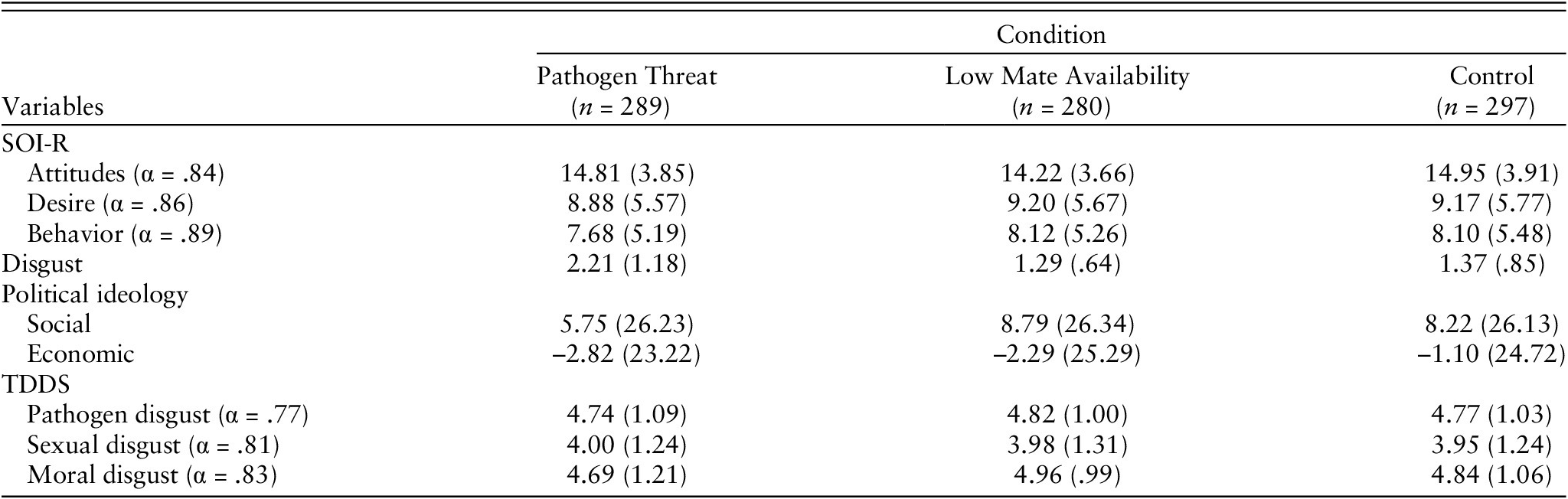
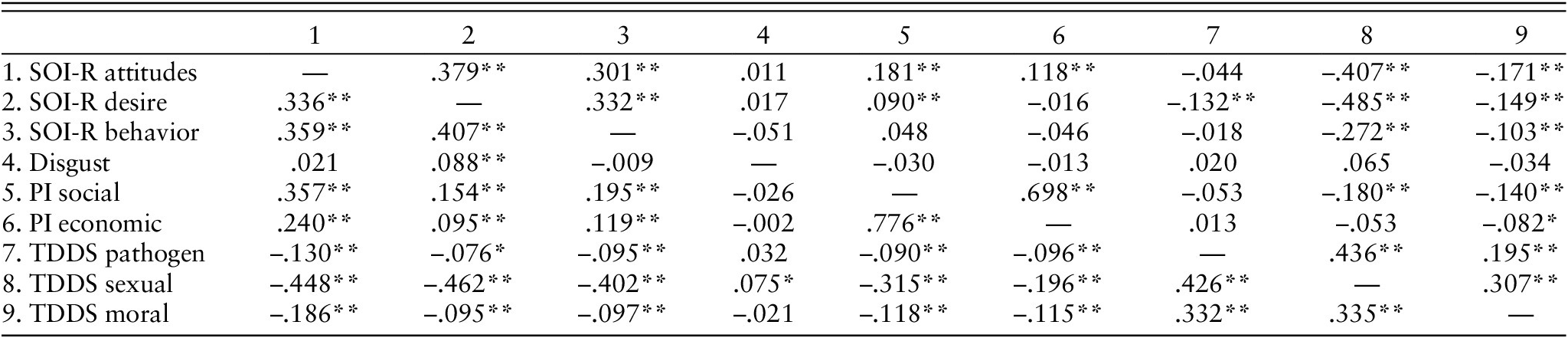
Means and standard deviations for all variables split by condition, as well as Cronbach’s alphas for all measures, are presented in Table 1. Bivariate correlations between all measures are presented in Table 2. All analyses were conducted including university as an additional factor to determine whether results differed by institution. Analyses were also conducted with and without demographic variables included as covariates. The general pattern of results were consistent and there were no significant interactions between condition and school, so results are reported excluding school as a factor and without covariates included.
Means and standard deviations for all Study 1 variables presented by condition.

Notes: Standard deviations are reported in parentheses. SOI-R = Revised Sociosexual Orientation Inventory; TDDS = Three Domain Disgust Scale.
Bivariate correlations between study variables.
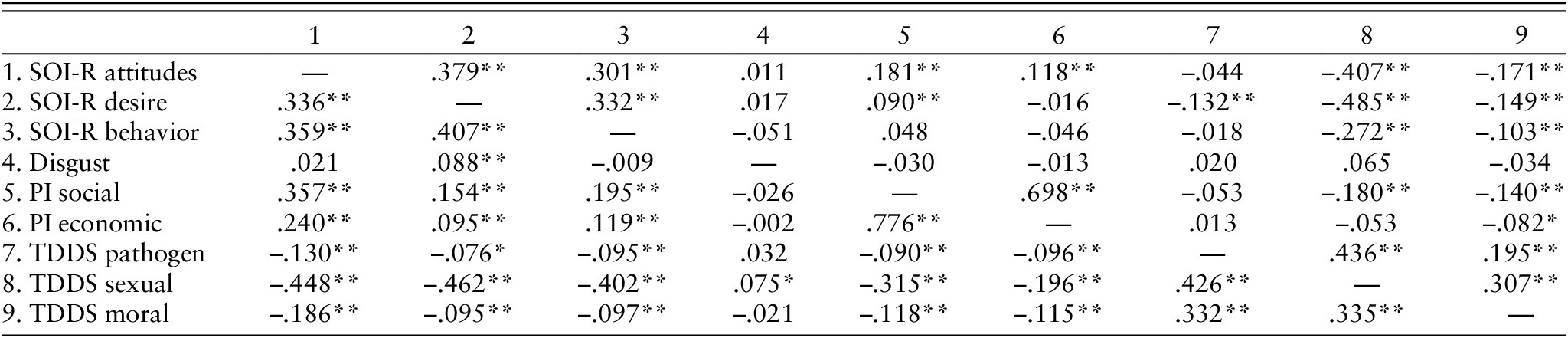
Notes: Study 1 correlations presented above the diagonal. Study 2 correlations presented below the diagonal. SOI-R = Revised Sociosexual Orientation Inventory; Pl = political ideology; TDDS = Three Domain Disgust Scale.
* p < .05; ** p < .01.
Manipulation checks
To determine whether the pathogen threat condition induced disgust, a one-way ANOVA was conducted comparing self-reported disgust following the manipulation across the three conditions. There was a significant effect, F(2, 860) = 74.46, p < .001, partial ƞ² = .170. Participants in the pathogen threat condition reported greater disgust after reading their essay than those in the control or low mate availability conditions (ps < .001). Thus, the pathogen threat manipulation induced disgust.
To determine whether the low mate availability manipulation affected attitudes toward sexual strategies, a one-way ANOVA was conducted comparing the attitudes subscale of the SOI-R across the three conditions. There was a significant effect, F(2, 860) = 3.13, p = .044, partial ƞ² = .007. Participants in the low mate availability condition reported attitudes more in favor of monogamy than those in the control condition (p = .017). The pathogen threat condition did not significantly differ from the low mate availability (p = .066) or the control (p = .58) conditions. Thus, there was some evidence that the low mate availability manipulation affected attitudes toward sexual strategies.
H1: Pathogen threat, low mate availability, and political ideology.
Two one-way ANOVAs were conducted to determine whether the pathogen threat and mate availability manipulations affected social and economic political ideology. There were no significant differences between conditions in political ideology related to social, F(2, 860) = 1.055, p = .349, partial ƞ² = .002, or economic, F(2, 860) = 0.47, p = .625, partial ƞ² = .001, issues across conditions. Thus, H1 was not supported.
Previous research has found that disgust sensitivity moderates the effects of experimental manipulations of disgust (see Tybur et al., Reference Tybur, Frankenhuis and Pollet2014 for a discussion). As pathogen disgust sensitivity did not differ across the conditions, F(2, 860) = .374, p = .688, partial ƞ² = .001, we explored whether pathogen disgust sensitivity moderated the effect of the manipulations on political ideology. We ran two hierarchical linear regression models, predicting social and economic political ideology separately. Pathogen disgust sensitivity and two dummy coded variables representing pathogen threat and low mate availability conditions were entered in the first step of the model, and the interaction terms between the dummy coded variables and pathogen disgust sensitivity were entered in the second step. There was no evidence of significant moderation by pathogen disgust sensitivity (ps > .75).
Sexual disgust sensitivity has been used as an indicator of sexual strategies (e.g., Tybur et al., Reference Tybur, Inbar, Güler and Molho2015). Potentially, those more sensitive to sexual disgust may have been affected more strongly by the manipulations. As sexual disgust sensitivity did not differ across the conditions, F(2, 860) = .152, p = .859, partial ƞ² < .001, we explored whether sexual disgust sensitivity moderated the effect of the manipulations on political ideology with a similar set of hierarchical regression analyses. There was no evidence of significant moderation by sexual disgust sensitivity (ps > .16).
H2: Low mate availability, preference for monogamy, and political ideology
To test the direct and indirect effects of low mate availability on political ideology through attitudes toward sexual strategies, mediation analyses were conducted using the SPSS PROCESS macro (Hayes, Reference Hayes2013) utilizing 5,000 bootstrap samples and bias-corrected confidence intervals (Hayes & Scharkow, Reference Hayes and Scharkow2013). Condition (1 = control, 2 = low mate availability) was entered as the predictor; attitudes subscale of the SOI-R was entered as the mediator; and social or economic political ideology was entered as the outcome variable.
Participants in the low mate availability condition reported more favorable attitudes toward monogamy than those in the control condition (b = –0.75, SE = .32, p = .018), and more favorable attitudes toward monogamy were associated with more conservative political ideology related to economic issues (b = .68, SE = .27, p = .014). The direct effect of condition on economic political ideology was not significant (b = –.68, SE = 2.08, p = .745), but there was evidence of an indirect effect through attitudes toward sexual strategies (b = –.51, SE = .30, 95% CI [–1.30, –.08]). Similarly for social political ideology, more favorable attitudes toward monogamy were associated with more conservative political ideology related to social issues (b = .99, SE = .29, p = .005). The direct effect of condition on social political ideology was not significant (b = 1.32, SE = 2.17, p = .54), but there was evidence of an indirect effect through attitudes toward sexual strategies (b = –.75, SE = .38, 95% CI [–1.73, –.18]). Although the low mate availability manipulation did not directly affect political ideology, there was evidence of an indirect effect through attitudes toward sexual strategies. Consistent with our preregistration, data were reanalyzed using model indirect in Mplus and returned similar results. Overall, H2 was partially supported.
H3: Pathogen threat, disgust, preference for monogamy, and political ideology
To test the direct and indirect effects of pathogen threat on political ideology through disgust, mediation analyses were conducted using the SPSS PROCESS macro (Hayes, Reference Hayes2013) utilizing 5,000 bootstrap samples and bias-corrected confidence intervals (Hayes & Scharkow, Reference Hayes and Scharkow2013). The attitudes subscale of the Revised Sociosexual Orientation Inventory was not included as a mediator in the model, because the pathogen threat and control conditions did not differ in attitudes (p = .67). Condition (1 = pathogen threat, 2 = control) was entered as the predictor; disgust was entered as the mediator; and social or economic political ideology was entered as the outcome variable.
Participants in the pathogen threat condition reported greater disgust than the control condition (b = –.84, SE = .08, p < .001), but disgust was not associated with political ideology related to economic issues (b = –.03, SE = .97, p = .97). The direct effect of condition on economic political ideology was not significant (b = 1.87, SE = 2.14, p = .38), and there was not evidence of an indirect effect through disgust (b = .03, SE = .83, 95% CI [–1.65, 1.65]). Similarly for social political ideology, disgust was not associated with political ideology related to social issues (b = -.30, SE = 1.06, p = .77). The direct effect of condition on social political ideology was not significant (b = 2.39, SE = 2.34, p = .31), and there was not evidence of an indirect effect through disgust (b = .25, SE = .87, 95% CI [–1.45, 2.00]). Pathogen disgust sensitivity was also explored as a moderator in these models. However, the indirect effects were still non-significant (i.e., confidence intervals contained zero). Consistent with our preregistration, data were reanalyzed using model indirect in Mplus and returned similar results. Overall, H3 was not supported.
Discussion
Study 1 was an initial experimental test of two explanations for the link between disgust and political ideology. Although both manipulations seemed to be successful (i.e., pathogen threat induced disgust and low mate availability resulted in more favorable attitudes toward monogamy), neither manipulation directly affected political ideology. There was, however, evidence that low mate availability indirectly affected political ideology through attitudes toward sexual strategies. Those in the low mate availability condition reported more favorable attitudes toward monogamy than those in the control condition, and more favorable attitudes toward monogamy were associated with more conservative political ideology. Although a significant total effect is not necessary to find an indirect effect (Hayes, Reference Hayes2009; Preacher & Hayes, Reference Preacher and Hayes2004), our findings suggest that there may be other indirect effects not included in the model. Thus, we found some evidence that altering attitudes toward sexual strategies may lead to change in political ideology.
Although the pathogen threat manipulation was effective in producing disgust, this did not translate into changes in political ideology. The pathogen threat manipulation also did not affect attitudes toward sexual strategies. Furthermore, individual differences in pathogen disgust sensitivity did not significantly moderate the effect of the pathogen threat manipulation. Thus, we did not find evidence to support the explanation that pathogen threat affects political ideology either directly or indirectly through disgust or attitudes toward sexual strategies.
The findings from Study 1 provided little to no support for our hypotheses. However, the sample consisted solely of college students and was homogenous with regard to age, race, and gender. Thus, the generalizability of the findings is limited. Also, we were not able to achieve the minimum sample size determined from an a priori power analysis. As such, the study was slightly underpowered based on our a priori calculations. In Study 2, we sought to replicate Study 1 and address these limitations. Specifically, we recruited a noncollege sample that met minimum sample size.
Study 2
Participants and procedure
Participants were recruited through Amazon’s Mechanical Turk (MTurk). Recent research has supported the use of MTurk to study political ideology, finding similar psychological characteristics between MTurk workers and the general public along political lines (Clifford et al., Reference Clifford, Jewell and Waggoner2015). The only eligibility criteria were that participants had to be 18 years or older and U.S. residents. Based on an a priori power analysis for ANCOVA with three conditions and three covariates, assuming a small effect (Arnocky et al., Reference Arnocky, Woodruff and Schmitt2016), alpha = .05, and power = .80, a minimum of 970 participants were required. A total of 1,431 respondents completed the study. However, 353 respondents were excluded from the analyses because of (1) indication of bots or inattention (i.e., incorrect responses to short answer questions about the essays) or (2) duplicate GPS coordinates or IP addresses. These measures were taken to ensure independence of observations and validity of data (Bai, Reference Bai2018).
The final sample consisted of 1,078 respondents. The average age of the sample was 39.10 years (SD = 12.74; range: 18–83), and 58.9% were women. The median household income range was $40,000–$59,999, and the median education level was a bachelor’s degree (BA or BS). The sample was primarily White/Caucasian (73.9%), and 10.3% identified as Black/African American, 6.4% identified as Asian, 4.5% identified as Hispanic/Latinx, 0.5% identified as American Indian/Native Alaskan, and 1.7% identified as other. Respondents identified as Democrat (42.9%), Republican (25.6%), independent (22.3%), Libertarian (3.2%), and other (3.1%). Demographic data were missing for approximately 2.9% of the sample.
The procedure for Study 2 was exactly the same as Study 1. Participants signed up for the study in MTurk and were provided with a Qualtrics link to complete the study. For their time, participants received $1.00. The study completely adhered to the preregistration (https://osf.io/bfgmk/).
Results
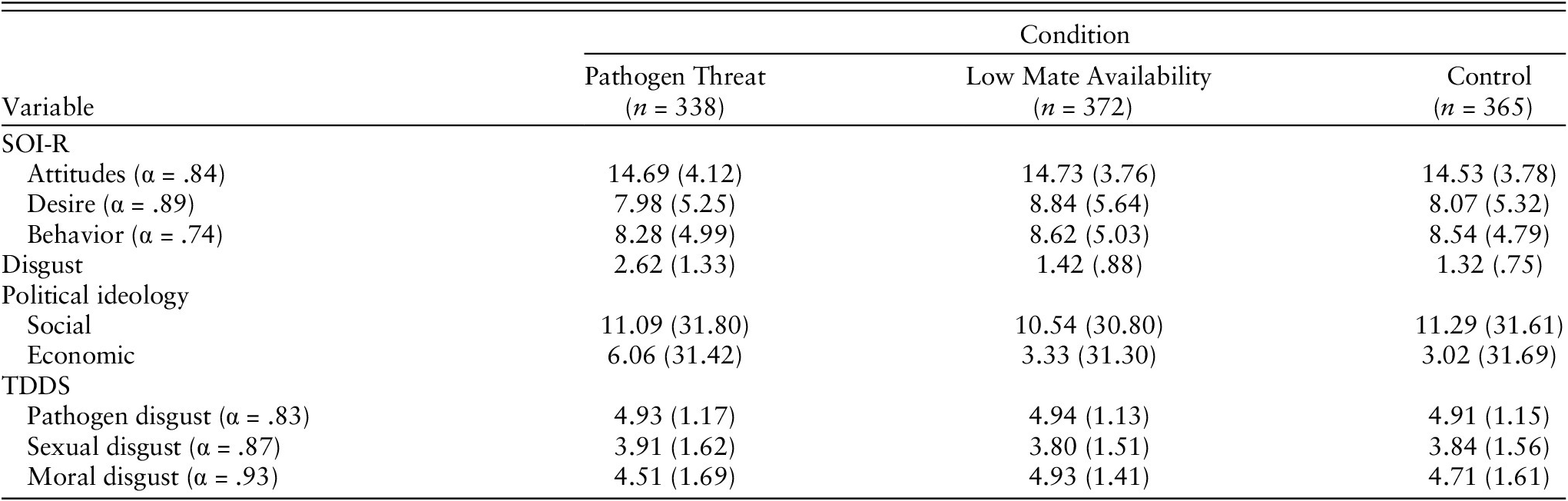
Means and standard deviations for all variables split by condition, as well as Cronbach’s alphas for all measures, are presented in Table 3. Bivariate correlations between all measures are presented in Table 2. All analyses were conducted with and without demographic variables included as covariates. The general pattern of results did not differ, so analyses are reported without covariates included.
Means and standard deviations for all Study 2 variables presented by condition

Notes: Standard deviations are reported in parentheses. SOI-R = Revised Sociosexual Orientation Inventory; TDDS = Three Domain Disgust Scale.
Manipulation checks
To determine whether the pathogen threat condition induced disgust, a one-way ANOVA was conducted comparing self-reported disgust following the manipulation across the three conditions. There was a significant effect, F(2, 1060) = 181.872, p < .001, partial ƞ² = .255. Participants in the pathogen threat condition reported greater disgust after reading their essay than those in the control or low mate availability conditions (ps < .001). Thus, the pathogen threat manipulation induced disgust.
To determine whether the low mate availability manipulation affected sexual strategies, a one-way ANOVA was conducted comparing the attitudes subscale of the Revised Sociosexual Orientation Inventory across the three conditions. The conditions did not significantly differ in attitudes, F(2, 1060) = 0.205, p = .815, partial ƞ² < .001. Thus, the low mate availability manipulation did not affect attitudes toward sexual strategies.
H1: Pathogen threat, low mate availability, and political ideology
Two one-way ANOVAs were conducted to determine whether the pathogen threat and low mate availability manipulations affected social and economic political ideology. There were no significant differences between conditions in political ideology specific to social, F(2, 1060) = 0.209, p = .811, partial ƞ² < .001, or economic, F(2, 1060) = 0.823, p = .439, partial ƞ² = .002, issues. Thus, H1 was not supported.
As in Study 1, we explored moderation by individual differences in disgust sensitivity. Pathogen disgust sensitivity, F(2, 1060) = .086, p = .917, partial ƞ² < .001, and sexual disgust sensitivity, F(2, 1060) = .43, p = .65, partial ƞ² = .001, did not differ across conditions. Neither pathogen disgust sensitivity nor sexual disgust sensitivity moderated the effects of condition on political ideology (ps > .32).
H2: Low mate availability, preference for monogamy, and political ideology
Although the low mate availability and control conditions did not significantly differ in the attitude subscale of the SOI-R (p = .488), we still tested the direct and indirect effects of low mate availability on political ideology through attitudes toward sexual strategies. Mediation analyses were conducted using the SPSS PROCESS macro (Hayes, Reference Hayes2013) utilizing 5,000 bootstrap samples and bias-corrected confidence intervals (Hayes & Scharkow, Reference Hayes and Scharkow2013). Condition (1 = control, 2 = low mate availability) was entered as the predictor; attitudes subscale of the SOI-R was entered as the mediator; and social or economic political ideology was entered as the outcome variable.
Participants in the low mate availability condition and control condition did not differ in attitudes toward sexual strategies (b = 0.20, SE = .28, p = .476), but more favorable attitudes toward monogamy were associated with more conservative political ideology related to economic issues (b = 1.79, SE = .30, p < .001). The direct effect of condition on economic political ideology was not significant (b = –.13, SE = 2.27, p = .954), and there was not evidence of an indirect effect through attitudes toward sexual strategies (b = .35, SE = .50, 95% CI [–.59, 1.42]). Similarly for social political ideology, more favorable attitudes toward monogamy were associated with more conservative political ideology related to social issues (b = 2.78, SE = .29, p < .001). The direct effect of condition on social political ideology was not significant (b = –1.44, SE = 2.17, p = .51), and there was not evidence of an indirect effect through attitudes toward sexual strategies (b = .55, SE = .78, 95% CI [–.94, 2.11]). Consistent with our preregistration, data were reanalyzed using model indirect in Mplus and returned similar results. Overall, there was not evidence to support H2.
H3: Pathogen threat, disgust, preference for monogamy, and political ideology
To test the direct and indirect effects of pathogen threat on political ideology through disgust, mediation analyses were conducted using the SPSS PROCESS macro (Hayes, Reference Hayes2013) utilizing 5,000 bootstrap samples and bias-corrected confidence intervals (Hayes & Scharkow, Reference Hayes and Scharkow2013). The attitudes subscale of the SOI-R was not included as a mediator in the model, as the pathogen threat and control conditions did not differ in attitudes (p = .593). Condition (1 = pathogen threat, 2 = control) was entered as the predictor; disgust was entered as the mediator; and social or economic political ideology was entered as the outcome variable.
Participants in the pathogen threat condition reported greater disgust than the control condition (b = –1.30, SE = .08, p < .001), but disgust was not associated with political ideology related to social issues (b = –.18, SE = 1.12, p = .87). The direct effect of condition on social political ideology was not significant (b = –.03, SE = 2.80, p = .99), and there was not evidence of an indirect effect through disgust (b = .23, SE = 1.47, 95% CI [–2.71, 3.13]). Similarly for economic political ideology, disgust was not associated with political ideology related to economic issues (b =–.11, SE = 1.12, p = .92). The direct effect of condition on economic political ideology was not significant (b = –3.18, SE = 2.79, p = .25), and there was not evidence of an indirect effect through disgust (b = .14, SE = 1.47, 95% CI [–2.66, 3.10]). As in Study 1, pathogen disgust sensitivity was explored as a moderator, but none of the indirect effects were significant. Consistent with our preregistration, data were reanalyzed using model indirect in Mplus and returned similar results. Overall, H3 was not supported.
General discussion
The purpose of the current studies was to experimentally test two explanations for the association between disgust and political ideology. Overall, our preregistered hypotheses were not confirmed, and we did not find support for the propositions that pathogen avoidance or sexual strategies explain connections between disgust and political ideology. In Study 1, there was some indication that manipulating mate availability affected attitude toward sexual strategies, which was related to political ideology. However, there was no direct effect of the mate availability manipulation on political ideology prior to examining indirect effects and this finding did not replicate in Study 2.
In both studies, the pathogen threat manipulation was successful at inducing disgust, with large effect sizes. However, this effect did not lead to a change in political ideology. Further, the pathogen threat manipulation did not affect attitudes toward sexual strategies in either study. An assumption of the experimental research design used in this study was that introducing a pathogen threat cue temporarily motivates pathogen avoidance goals that would be reflected in political ideology and sexual strategy attitudes (Tybur et al., Reference Tybur, Frankenhuis and Pollet2014). As this was not the case, multiple explanations for our null results are possible.
Contrary to both the pathogen avoidance and sexual strategies explanations of political ideology, it is possible that neither political ideology nor sexual strategies are relevant goals that are responsive to pathogen threat. This may mean that disgust does not have meaningful implications for political ideology or sexual strategies. Recently, some scholars have argued that the positive association between disgust sensitivity and political conservatism may be exaggerated by politically biased disgust sensitivity measures (Elad-Strenger et al., Reference Elad-Strenger, Proch and Kessler2020). In the current studies, pathogen disgust sensitivity was not significantly associated with political ideology, which may support these claims and/or be due to limitations of assessing political ideology with a single item (see Terrizzi et al., Reference Terrizzi, Shook and McDaniel2013 for further discussion). Some research has failed to find a significant association between pathogen disgust sensitivity and sexual strategies (Al-Shawaf et al., Reference Al-Shawaf, Lewis, Alley and Buss2015). Indeed, across the two studies, pathogen disgust sensitivity was inconsistently associated with the sexual strategy indices, and when significant, the effect sizes were small. Al-Shawaf et al. (Reference Al-Shawaf, Lewis and Buss2018) have argued that “pure” pathogen disgust should not be expected to influence sexual strategies. Rather, only pathogen cues related to the human body that activate both pathogen and sexual disgust are relevant to sexual strategies. Sexual disgust sensitivity was consistently and moderately associated with the sexual strategy indices in both of our studies. Thus, the underlying assumptions of the pathogen avoidance and sexual strategies explanations may be incorrect.
Alternatively, it is possible that trait-level disgust sensitivity and the processes by which political ideology form and change do not align with this short-term experimental design. A single experience of disgust may not shift well-formed attitudes or beliefs, such as political ideology or sexual strategies. Regular or repeated experiences of disgust—reflected in trait-level differences—may be necessary to alter ideology. Future research would benefit from considering the duration and within-person nature of change for each explanation for links between disgust and political ideology. It is also possible that the pathogen manipulation was not strong enough to result in meaningful change. Although a large effect, participants on average were not reporting high levels of disgust (Ms = 2.21 and 2.62, respectively, on a scale from 1 to 5). It may take a more intense experience of disgust to move political ideology. This speculation is consistent with prior research that has found stronger manipulation effects when using olfactory or video paradigms (Tybur et al., Reference Tybur, Bryan, Magnan and Hooper2011) or images involving human bodies and more directly activating infectious disease threat (Al-Shawaf et al., Reference Al-Shawaf, Lewis and Buss2018). The imagery involved in reading and responding to an essay may be less vivid than other disgust manipulations and thus produce smaller effects.
Although there was some evidence that the mate availability manipulation affected attitudes toward sexual strategies in Study 1, the effect was small and not replicated in Study 2. These findings call for careful consideration of the two samples used in this study. It is possible that sociosexual attitudes are more malleable among college students when a greater portion of the population may be single or motivated by mate-related goals. Further, political attitudes are thought to begin developing in adolescence and solidify over the transition to adulthood (Rekker et al., Reference Rekker, Keijsers, Branje and Meeus2015). The experimental manipulations used in this study may have been more effective in changing sexual strategies and political ideology among younger college students relative to middle-aged adults. It is also important to note that we assessed self-reported attitudes toward sexual strategies, not actual mating behavior. Although attitudes are often predictors of behavior, there are many other factors that determine behavior, particularly such a complex behavior (Ajzen, Reference Ajzen2005). This pattern of findings may place important conceptual and generalizability constraints on the sexual strategies perspective of disgust and ideology that should be considered in both theory and future research.
Political ideology is complex, multidimensional, and often a well-informed component of a person’s identity (Huddy, Reference Huddy2001). Although prior research has demonstrated meaningful changes in political ideology after undergoing short-term lab-based tasks (Bryan et al., Reference Bryan, Dweck, Ross, Kay and Mislavsky2009), these studies are rare and not preregistered. It is possible that altering a person’s political ideology to a meaningful degree is generally not feasible using short-term manipulations. Future research should consider targeting more specific, potentially malleable political attitudes (e.g., attitudes about gay rights; Adams et al., Reference Adams, Stewart and Blanchar2014) or identify populations of people who may be less committed and more flexible in their ideological stance (e.g., adolescence; those with greater political open-mindedness).
More generally, results from these studies add to the growing debate about the implications of disgust for various domains of social cognition. There have been several recent debates questioning the extent to which and under what conditions disgust sensitivity and pathogen threat manipulations are linked with moral judgments (see Landy & Goodwin; Reference Landy and Goodwin2015a; Land & Goodwin, Reference Landy and Goodwin2015b; Makhanova et al., 2018; Schnall et al., Reference Schnall, Haidt, Clore and Jordan2015), specific political attitudes (Ji et al., Reference Ji, Tybur and Vugt2019), and political ideology (Shook et al., Reference Shook, Terrizzi, Clay and Oosterhoff2015; Tybur et al., Reference Tybur, Inbar, Güler and Molho2015). Understanding whether, how, when, and why disgust and pathogen threat are connected with moral and political cognition will be aided by the availability data from preregistered studies or registered reports regardless of whether null hypotheses are rejected. This study presents two high powered, preregistered studies that fail to find evidence that short-term disease-threat manipulations alter participants’ political ideology and thus contribute to this highly nuanced area of research.
Limitations
A particular strength of this study was the use of preregistration to isolate hypothesis testing from hypothesis generation. However, results should be taken in light of certain limitations. Although this study used two independent large samples, the sample size from Study 1 was smaller than was recommended based on a priori power calculations. It is possible that the hypothesized effects were present yet smaller than anticipated. Additionally, we measured economic and social political ideology using two single items. This approach was selected in an effort to optimize potential manipulation effects by limiting dilution that may accompany longer measures. However, it is possible that single-item measures of ideology are less sensitive to manipulation given that they may reflect a multitude of specific attitudes (Terrizzi et al., Reference Terrizzi, Shook and McDaniel2013). Future research may benefit from targeting specific political beliefs. To feasibly collect enough independent data points to test our hypotheses, this research was conducted completely online. Although practical, using online methodology may have dampened the effectiveness of our manipulations due to distractions. Future research should consider using in-lab methods, which may allow for more potent manipulations and limit possible distractions.
Conclusion
Considerable research has examined the intersection of disgust and politics, yet few studies have sought to identify the mechanisms that explain this connection. Identifying why these two constructs show consistent and reliable associations is necessary to advance theory on disgust and individual differences in political attitudes. This study examined two explanations: pathogen avoidance and sexual strategies. Although findings from these preregistered studies were inconclusive, they do present several theoretical and empirical avenues for future research to elucidate the role of disgust in politics. These efforts will be especially beneficial in the form of further preregistration or registered reports.