One of the most notable developments in the Iranian art scene over the past decade has been the rapid rise of Tehran Auction. It was established in 2012 by Alireza Sami-Azar, the former director of the Tehran Museum of Contemporary Art (TMoCA), in partnership with some private gallerists and art market professionals.Footnote 1 According to its official website, Tehran Auction operates “as an independent and private initiative to introduce the best of Iranian art … [and] works widely with Iranian art galleries and collectors to ensure a vast and strong selection of paintings, sculptures and photographs.”Footnote 2 Although the auction is registered as an independent and private institution, it obtains official governmental licenses and approval from the Ministry of Culture and Islamic Guidance to hold its events.Footnote 3 In addition, “the law governing the Auction General Conditions and the arbitration clause is the law of the Islamic Republic of Iran.”Footnote 4 This positioning situates Tehran Auction at the intersection of state oversight and market autonomy.
This semi-official status is revealing; it shows that the auction operates within, rather than outside of, the cultural politics of the Islamic Republic of Iran. Tehran Auction presents itself as a private initiative, yet its day-to-day operations depend on state authorization. It must obtain permits from the Ministry of Culture and Islamic Guidance and is subject to the country’s arbitration law. These requirements tie it closely to the state’s cultural-governance mechanisms. Its autonomy, therefore, is not oppositional but carefully circumscribed, a managed form of independence that fits within a broader policy of controlled liberalization. Through this model of pseudo-privatization, the state encourages market activity while continuing to hold both symbolic and regulatory authority.
Similar to other international events, objects perceived as having artistic value are sold through competitive bidding at Tehran Auction. However, Tehran Auction does not provide detailed transparency about its vetting committee; its catalog preferences indicate that decisions are made by “reputable experts,” and “[artworks’] authenticity and their attribution to the creator of the work will be examined.”Footnote 5 Moreover, on the “Buying and Selling” page of the official website of Tehran Auction, it is stated that “works of art will be selected by the applicants based on the qualitative value and according to the interest of the applicants and will be presented at the auction based on the base price agreed with the owner. The selected works will be open to the public in an exhibition for three days and will be auctioned on the evening of the fourth day during a ceremony.”Footnote 6
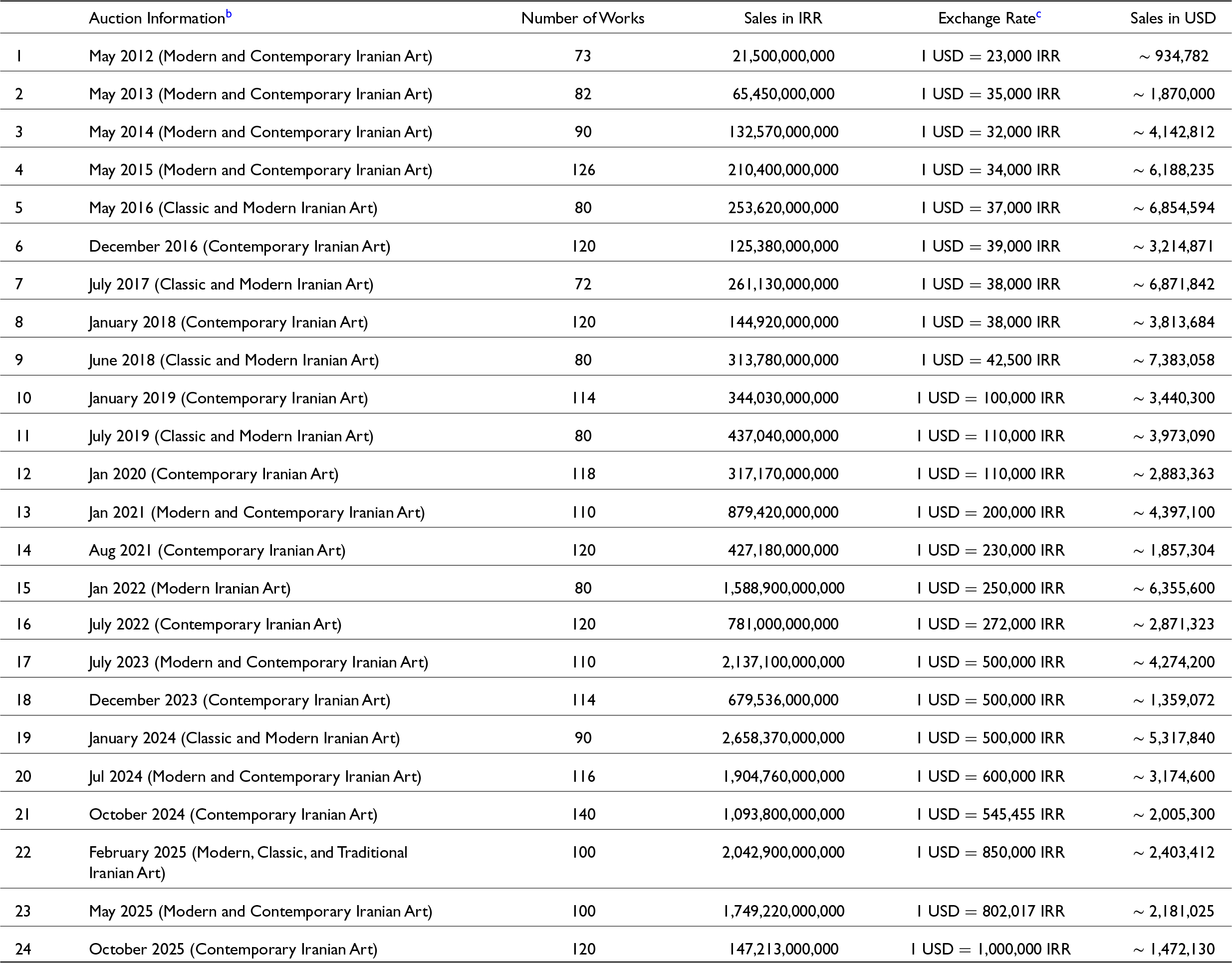
Tehran Auction’s first sale closed at just 21,500,000,000 Iranian rials (IRR), equivalent to 934,782 US dollars (USD). By 2018, total sales exceeded 7 million USD, marking a significant rise in market activity. The last in-person (live) auction, held in May 2025, achieved total sales of 1,749,220,000,000 IRR, equivalent to 2,186,525 USD. This was followed by the first online auction, held in October 2025, at which total sales reached 1,472,130,000,000 IRR, equivalent to 1,472,130 USD. It should be noted that in 2012, 1 USD was worth approximately 23,000 IRR, whereas in 2025 the approximate value of 1 USD had risen to about 800,000 IRR in May and 10,000,000 IRR in October. Accordingly, the sales grew by a factor of approximately 81.6 based on the last in-person auction and roughly 68.5 for the online auction in Iranian currency over thirteen years, an increase that indicates substantial future growth potential. Participation in the auctions also is permitted in three ways: in person, by telephone as an absentee bidder, or via power of attorney. It should be noted that, upon written request, all personal or banking information of participants is kept confidential by the auctioneer.Footnote 7
The auction has been concurrently praised and criticized by scholars and artists for various reasons. It has been praised for attracting investors and contributing to the further commercial development of Iranian art; it also has motivated younger artists, who no longer need to sell their artwork in foreign markets, and has helped prevent the export of valuable art from Iran, keeping it inside the country.Footnote 8 On the other hand, critics highlight the stark contrast between the growing art market and the persistent poverty in Iran; there have been several reports of a market in which children are traded and exploited for begging.Footnote 9 From this perspective, Tehran Auction has been interpreted as an institution operating within a context of moral and ethical ambiguity.Footnote 10
In any case, Tehran Auction has become a central gathering point for Iran’s art community, a place where selected works are brought together and given visibility. Its growing influence stems from two related factors. The first is the absence of strong institutional networks that might balance or question the market’s dominance. The second is the gradual erosion of critical engagement with the changing structure of Iranian art itself, a situation tied to the ongoing fragility and politicization of many cultural institutions.
A closer look at these institutions reveals how their diminishing capacity to facilitate critical discourse has contributed to the unchecked prominence of Tehran Auction. A clear example is the Tehran Museum of Contemporary Art. The museum is recognized for its unique modernist collection, which demonstrates the museum’s potential for curatorial experimentation.Footnote 11 Despite this potential, TMoCA has experienced repeated leadership changes, programmatic stagnation, and ideological interference throughout its history.Footnote 12 A notable case occurred in 2015–16, when a planned international exhibition of TMoCA’s Western modern and contemporary art collection was scheduled to travel to Berlin’s National Gallery, and later Rome.Footnote 13 However, this planned exhibition was abruptly cancelled; following a leadership change at the Ministry of Culture and Islamic Guidance, the export permits for the works were not granted.Footnote 14 The works were later shown domestically in 2017.Footnote 15 This episode underscored the museum’s vulnerability to political interference, limiting its capacity to sustain alternative narratives to market consecration.Footnote 16
Similarly, art universities in Iran, constrained by bureaucratic and ideological policies, rarely provide space for counter-discourses. Academic discourse often remains prescriptive and shows limited engagement with critical theory, contemporary global art discourses, or curatorial experimentation. Even when such attempts are made, they often go unheard or result in either official or unofficial, formal or informal boycotts. Censorship of student exhibitions or academic publications, as a common practice, contributes to a climate of intellectual self-regulation and disengagement. This vacuum of institutional dissent allows platforms like Tehran Auction to define artistic legitimacy with little to no resistance and to exert a disproportionate influence over the country’s art landscape.Footnote 17
Second, according to George Dickie’s institutional theory of art, which emphasizes the functional role of art institutions in defining and legitimizing art, an “artworld” is defined as “the totality of all artworld systems.” Each system constitutes “a framework for the presentation of a work of art by an artist to an artworld public.”Footnote 18 As Dickie explains, “[a] work of art in the classificatory sense is (1) an artifact [and] (2) a set of the aspects [by] which it has conferred upon it the status of candidate for appreciation by some person or persons acting on behalf of a certain social institution.”Footnote 19 In other words, artworks are not defined merely by their inherent qualities but by their acceptance and validation within institutional contexts. From this perspective, Tehran Auction functions as one of the most prominent institutions within the Iranian artworld, legitimizing artworks economically, artistically, culturally, and symbolically.Footnote 20 Together, these conditions have enabled Tehran Auction to establish its position as an arbiter of artistic value in Iran, a position largely unchallenged by other cultural bodies.
Regionally, the infrastructures of art auctions in the Middle East diverge significantly in scale, openness, and buyer composition. For example, Dubai functions as the principal international gateway for modern and contemporary Middle Eastern art, with Christie’s Dubai-led sales attracting cross-border bidders and maintaining regular online and live cycles; its April and May 2025 online sale realized 2.52 million USD.Footnote 21 Doha’s auction activity, by contrast, peaked in the early 2010s; Sotheby’s April 2013 contemporary art sale totaled 15.2 million USD, a record for the Middle East at the time, but the city did not develop a sustained marquee-auction calendar.Footnote 22 Istanbul, meanwhile, sustains a competitive domestic ecosystem through houses such as Beyaz Müzayede and Artam Antik A.Ş., which run regular modern and contemporary sales under codified conditions.Footnote 23
Against this backdrop, Tehran Auction functions as a domestically oriented platform shaped by the constraints of international sanctions, which make it extremely difficult, if not impossible, for foreign buyers to participate directly.Footnote 24 Therefore, even while replicating the formal structures and protocols of global auction houses, it is a market ecosystem insulated from transnational participation.Footnote 25 This comparative frame clarifies both what is specific to Iran and its artworld and what aligns with wider regional dynamics, including catalog-driven validation and price-visibility feedback.
In light of these observations, in this article I ask how Tehran Auction reshapes the cultural and aesthetic function of art in postrevolutionary Iran. I argue that the auction operates not merely as a market platform but as a symbolic institution that redefines artistic legitimacy and visibility under neoliberal conditions.
Sources and Data
This study is based on the sales results of twenty-four auctions published on the official website of Tehran Auction between 2012 and October 2025. These data form the empirical basis of the analysis and aim to elucidate how Tehran Auction (re)shapes the cultural, financial, and artistic value of modern and contemporary Iranian art. Primary materials include the auction catalogs and the official website, which provide details on artists, lots, realized prices, and dates. When inconsistencies arose, the figures reported in the official post-sale results were used. To enable cross-comparison, realized prices originally listed in IRR were converted into USD using the contemporaneous official exchange rates provided on the auction’s website.Footnote 26 Accordingly, USD values are presented primarily for readability, and the analysis emphasizes IRR values and relative changes over time.
This study joins wider debates on how art markets, cultural production, and social prestige intersect in Iran’s postrevolutionary, neoliberal setting. I show that art institutions, working within a climate of political uncertainty and economic strain, often find themselves negotiating between global market pressures and local ideas of artistic worth. In this environment, capital exerts a strong pull, and art increasingly takes on a different role, less a space for critique or collective reflection and more a marker of status and aspiration within contemporary Iranian society.
The data set used for this study comes with several limitations. Although the names of many buyers are publicly available, this information does not allow ownership patterns to be traced or the structure of demand to be fully understood. The procedures of selection, vetting, and consignment are also largely hidden from view, so the data reveal only the works that reached the sale stage rather than the full range of what was submitted. In addition, sanctions and banking restrictions have confined the market to principally domestic participants, making it difficult to compare directly with international trends. Finally, although the data set records prices and rankings, it cannot capture the aesthetic dimension of value; that aspect is considered here through the lens of symbolic capital and institutional validation. Acknowledging these limitations, this study treats auction outcomes as cultural evidence rather than econometric data. They are approached as symbolic signals that reveal patterns of validation and exchange within the art market. In this way, the analysis illuminates how market practices shape legitimacy and visibility in contemporary Iranian art.
Concepts and Indicators
To understand Tehran Auction’s role in (re)shaping the function of Iranian art, I take into account theoretical frameworks that explain the mechanisms behind the production of social hierarchies and symbolic values in the current Iranian art field and art market. I engage with Pierre Bourdieu’s idea of “belief production” and the concept of “symbolic capital”; George Dickie’s institutional theory; Jacques Rancière’s politics of aesthetics, particularly his notion of the “distribution of the sensible”; and Gregory Sholette’s critique of “neoliberal enterprise culture.”
To align these frameworks with the available evidence, each is tied to observable signals in the auction data.Footnote 27 Bourdieu’s idea of “belief production” frames the way Tehran Auction operates. Rather than being limited to a market, Tehran Auction functions as a cultural institution that produces and sells forms of prestige and social status in Iranian society, a dynamic examined through the lens of Bourdieu’s concept of symbolic capital.Footnote 28 The auction itself also reinforces this notion by presenting itself as a “national innovation in response to increasing interest in artistic creation.”Footnote 29 The role of Tehran Auction is framed as culturally significant beyond commercial outcomes, by portraying its participants as those “who play a commendable role in preserving and promoting the cultural and artistic heritage of Iranians.”Footnote 30 Symbolic capital also is reflected in the repeat appearance of certain artists among the top-sold lots and in the premium prices their works command. Following Dickie’s institutional theory, the auction’s licensed status, cataloging practices, and ritual of sale operate as institutional mechanisms that confer status in Iranian society.
Rancière’s concept of the politics of aesthetics, particularly his notion of the distribution of the sensible, is employed to explain how Tehran Auction may limit access to symbolic capital by producing social exclusion or by prioritizing certain individuals within the cultural field.Footnote 31 I engage with Sholette’s notion of neoliberal enterprise culture, positioning Tehran Auction as part of a broader global pattern in which cultural production becomes entangled with market-driven values.Footnote 32 In addition, to explain the relation between cultural validation and market pricing of the artworks, the study further draws on Olav Velthuis’s approach to art markets and their effects on the artworld. These allow Tehran Auction to be interpreted as a site where value, legitimacy, and visibility are produced under specific politico-economic conditions.
Together, these perspectives illustrate that Tehran Auction’s role in Iranian art cannot be understood merely as a commercial venue but rather as a meaning-producing institution within modern and contemporary Iranian art. Accordingly, the study compiles lot-level “price realized” data from Tehran Auction’s official digital archive for all twenty-four sales held between 2012 and October 2025.Footnote 33 Rather than assessing aesthetic value per se, these data enable a comparative analysis of pricing patterns and the shifting positioning of artworks.Footnote 34 For interpretive clarity, the analysis tracks the following: first, the top three lots by price in each sale; second, the repeat appearances of the same artists among these top lots; and third, the relative price gaps between the highest-priced lot and other top-listed sales in each auction.
Drawing on theoretical frameworks and market analysis, the selected measures are interpreted as indicators of reputational visibility, price escalation, and institutional validation. These patterns are not read simply in economic terms but as expressions of social distinction and hierarchy. The analysis then places these results within the larger story of Iran’s postrevolutionary artworld, where cultural and ideological shifts shape what becomes visible or valuable. In this light, artistic worth appears less as a matter of pure aesthetics and more as the outcome of overlapping institutional pressures, symbolic recognition, and the tastes of an elite collecting public.
It is worth adding that although some studies have examined the politics of Iranian art after the Islamic Revolution,Footnote 35 the role of auction institutions in mediating artistic legitimacy in Iran remains largely unaddressed. Meanwhile, scholarship on regional art markets has explored how auctions in Dubai, Doha, Istanbul, and other centers operate within global circuits of patronage and cultural diplomacy.Footnote 36 Studies on the Levant have likewise analyzed the political dimensions of cultural institutions and provided key insights into modern Arab art within both regional and global frameworks.Footnote 37 Taken together, this body of research underscores that the Iranian case remains distinct, shaped by its own institutional and economic conditions.
Within this context, the present article approaches Tehran Auction as an interpretive case study; lot-level prices, rankings, and repeat appearances are treated as indicators of symbolic valuation, institutional validation, and visibility. Rather than modeling price formation causally, the analysis offers a contextual reading of how a private, licensed auction determines what becomes visible, valuable, and legitimate within Iranian art under the current political and economic constraints. I further explain Tehran Auction as a site of aesthetic and ideological transformation, shaped by state regulation, sanctions, institutional fragility, and the broader logics of global markets and neoliberal cultural policy.
Tehran Auction
Tehran Auction follows the model of other similar international art auctions; however, its sales figures will seem relatively humble in comparison (see Table 1 for more details).Footnote 38 To understand the extraordinary significance of the sales, certain contextual facts help put them into perspective. The auction’s remarkable growth coincided with a period when Iran was subject to unprecedented international embargoes and documented governance challenges.Footnote 39 Amid these conditions, in 2012, the year the auction was founded, Iran’s economic growth stood at −5.8 percent. In the following years, according to the latest official report by the World Bank Group in 2023, 2.5 percent of Iran’s population lived in absolute poverty, surviving on less than 3.00 USD per day in purchasing power.Footnote 40 Additionally, in 2025, the official minimum monthly wage for a worker was roughly equal to 122.12 USD.Footnote 41
Overview of Twenty-Four Auctions (2012–25)a

a For details on data sources, exclusions, and currency conversion, see the “Source and Data” section of this article. See also Tehran Auction, “Auctions,” Accessed June 2025. https://tehranauction.com/en/auctions.
b The categorization of artworks, and consequently the artists, in these auctions is not always consistent. For example, artworks by Hossein Zenderoudi have appeared under “Modern and Contemporary Iranian Art” (e.g., first and second auctions), “Contemporary Iranian Art” (e.g., sixth and eighth auctions), and “Modern Iranian Art” (e.g., 15th auction).
c Given the constant fluctuation in the IRR’s exchange rate relative to the USD over the past years, the rate used for each sale is taken from official figures reported by Tehran Auction. Minor discrepancies between IRR totals and USD equivalents reflect rounding or reporting inconsistencies.
These figures highlight the sharp contrast between the everyday realities of most Iranians and the elite consumption represented in Tehran Auction sales. This disparity is not merely contextual; it shows how the auction has become a stage for social distinction, where buying art at high prices signals privilege and cultural authority. In this context, high-priced art becomes a means of consolidating cultural capital amid systemic economic inequality. The segmentation of cultural consumption is evident: high-end art acquisition at Tehran Auction operates as a form of status consolidation for a narrow economic elite, rather than reflecting broader economic conditions. On the other hand, even though the market is nominally organized by a supply-and-demand mechanism, the patrons—most of whom remain unidentified but are known to be mostly wealthy Iranians—do not appear to genuinely operate according to conventional dynamics in the world of business.Footnote 42 Buyers’ behavior is mediated by sanctions-related frictions and institutional opacity. According to Transparency International’s Corruption Perceptions Index, Iran ranked 147th among 180 nations in 2022; this position declined further to 151st in 2024.Footnote 43 Moreover, the Statistical Centre of Iran reports a Gini coefficient of 0.387 in 2024–25, and the World Inequality Database series documents persistent top-decile concentration.Footnote 44
Although these factors reflect marked socioeconomic inequality resulting from a wide wealth gap, the way art has come to participate in this economic field signals aesthetic transformations with considerable implications. First, the solidarity of the arts is being realigned along the lines of capital networks. Given the politico-economic context of the auction, this is unsurprising, as there is a correlation between the ability to spend large sums on artistic luxuries and being a primary beneficiary of, or advocate for, the status quo. Second, the known highest-bidders in the auction have so far been banks, which, for example, spent under 1 million USD in 2015 and just over 1 million USD in 2018 to purchase two paintings by Sohrab Sepehri (1928–1980; see Table 3 for further information on his auctioned works).Footnote 45
Cultural production is evidently regulated by institutions of power on the one hand, and finance on the other. Therefore, the officially accelerated commodification of art has contributed to the emergence of a new aesthetic regime:Footnote 46 the greater art relies on institutions of finance and power, the less likely it is to sustain, or be inclined to have, a critical edge that challenges the ideological apparatuses of dominance and oppression. This development raises important questions about the extent to which it reflects a broader tendency in cultural policy to prioritize artistic production that aligns with the status quo.
From Postrevolutionary Art to the Triumph of Capital the Triumph of Capital
To understand how Tehran Auction replaces collective artistic ethics with neoliberal values, it is necessary to trace the historical transition from revolutionary art’s spiritual ethos to today’s market-oriented aesthetic regime. It can be observed that new aesthetic landscapes, measured by economic factors, are replacing the traditional “sacred” values of Iranian art. These values were based on divine messages, spiritual significance, and moral elevation. Historically, under this value system, neither the artist’s fame, social recognition, nor financial gain played a central role in the valuation of the artwork.Footnote 47 Instead, artistic merit was often assessed through its alignment with ethical, religious, or metaphysical ideals.Footnote 48
These values were revived and reinforced, especially after the Islamic Revolution in 1979. They merged with the Islamic revolutionary narrative and its doctrinal commitments, with significant emphasis on ideological alignment.Footnote 49 This “developing revolutionary discourse … was concerned with relating artistic production to the masses, and also with the propagandistic extension of revolutionary aspirations.”Footnote 50 Through state institutions such as the Ministry of Culture and Islamic Guidance and the Art Council, postrevolutionary art was policed to align with revolutionary ideology and to serve collective and Islamic spiritual values.
This resulted in the creation of an artistic concept known as hounar mardumi, or people’s art, which was strongly endorsed, encouraged, and supported by the state as one of the core principles of postrevolutionary Iranian art.Footnote 51 The aim was to pivot to producing art for the lower socioeconomic classes and the general public as the new and primary audience, as opposed to the perceived art-oriented elitism that characterized the Pahlavi era (1925–79).Footnote 52 This shift was not only ideological but also institutional, as resources and recognition were redirected to artists who aligned with these inclusive, revolutionary principles. Furthermore, “Social commitment and storytelling that conveyed a religious or political message were among the most important features of these [postrevolutionary] works.”Footnote 53 These principles were institutionalized in the Iranian artworld through state-sponsored exhibitions and funding. They were strongly emphasized for an extended period, leading to the prioritization of artworks that promoted Iranian Islamic revolutionary ideas.
As an instance of postrevolutionary art exhibitions, Keshmirshekan cites an exhibition organized in 1983 at the Tehran Museum of Contemporary Art to celebrate the fifth anniversary of the Islamic Revolution. The exhibition featured works aligned with revolutionary principles and conveying its ideological message.Footnote 54 A more recent example of a state-sponsored art event is the Fajr Visual Arts Festival, which features works that emphasize Iranian postrevolutionary doctrine, serving as a strategic cultural platform rather than merely an art showcase.Footnote 55 Artists like Habibollah Sadeghi (1957–2022), Kazem Chalipa (b. 1957), and Naser Palangi (b. 1957) became known for producing works that reflected these values.Footnote 56 In particular, their paintings of wartime sacrifice and spiritual themes were widely exhibited in public cultural centers and reproduced in school textbooks and posters. Such initiatives illustrate how the revolutionary regime sought to promote artistic forms that resonated with the lower socioeconomic classes. Postrevolutionary artistic productions were redirected from elite, Western-influenced modernism to what was considered accessible, moral, and communal content.
Now, less than a half a century later, despite the Islamic postrevolutionary discourse on art, this framework has been replaced by new priorities and commercial logics. Although state-imposed ideological oversight still persists, there has been a marked increase in the privatization of cultural spaces and reliance on market mechanisms.Footnote 57 Tehran Auction, as the country’s current most prominent art market platform, symbolizes this shift: it plays an increasingly central role in determining artistic value, prestige, and professional standing. This recalibration does not signal the disappearance of ideological frameworks but rather their coexistence with, and at times subordination to, market mechanisms in determining artistic visibility and professional advancement.
Notably, the primary targeted buyers at Tehran Auction fall into two dominant categories. First are wealthy Iranian institutions and individuals who view art as a strategic investment, either for expected financial gain or for future social returns.Footnote 58 The second group is a segment of the Iranian population that may be referred to as art enthusiasts, whose central “motivation for art purchases [lies] in the utility that originates from the aesthetics of the work of art.”Footnote 59 This latter group typically consists of individuals with an academic background in artFootnote 60—although their education rarely serves as a direct source of income—or those who engage in art as a personal hobby.Footnote 61 What unites these two groups, however, is their shared position at the peak of the economic strata of Iranian society, a connection readily evident from the substantial sums paid at these auctions, as described. Therefore, the art promoted by Tehran Auction, contrary to revolutionary doctrines, aspires to be on par with luxurious manufactured goods, accessible only to a very small minority.Footnote 62 This convergence of elite economic status and art consumption reflects a broader commodification of artistic value, best exemplified by the sale pattern at Tehran Auction.Footnote 63
Sohrab Sepehri (1928–80)
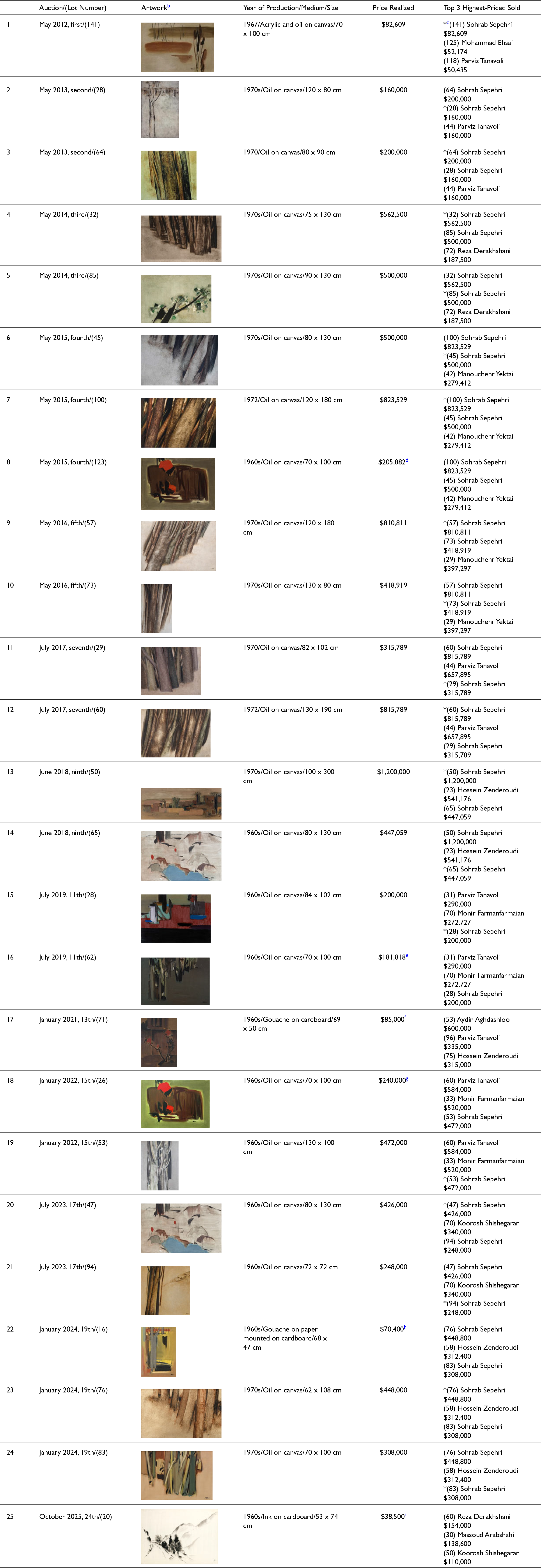
Over the past thirteen years, the Tehran Auction has been held twenty-four times. Based on the total worth of the three highest-priced lots in these auctions, the artworks of Sohrab Sepehri, Parviz Tanavoli (b. 1937), Monir Farmanfarmaian (1922–2019), (Charles) Hossein Zenderoudi (b. 1937), and Farhad Moshiri (1963–2024) have achieved the highest total sales, with their names listed in descending order of total sales value.Footnote 64 The 6.4-fold gap between the sale value of Sohrab Sepehri’s and Parviz Tanavoli’s artworks underscores Sepehri’s prominence, with Tanavoli appearing as the second artist in this list (Table 2).
Top Five Highest-Selling Artists at Tehran Auction (2012–25)a

a Tehran Auction, “Auctions,” Accessed June 2025. https://tehranauction.com/en/auctions.
b For details on Sohrab Sepehri’s auctioned works, see Table 3.
c Parviz Tanavoli’s works were auctioned in the first (3 works), second (2 works), fourth (3 works), fifth (2 works), seventh (2 works), ninth (3 works), 11th (2 works), 12th (1 work), 13th (2 works), 15th (2 works), 17th (1 work), 18th (1 work), 19th (1 work), 21st (1 work), and 23rd (1 work) auctions of Tehran Auction.
d Monir Farmanfarmaian’s artworks appeared in the fifth (2 works), sixth (2 works), seventh (2 works), eighth (2 works), ninth (2 works), tenth (2 works), 11th (3 works), 12th (1 work), 13th (1 work), 15th (2 works), 16th (1 work), 17th (1 work), 19th (2 works), 21st (1 work), and 23rd (1 work) auctions held by Tehran Auction.
e Tehran Auction featured Hossein Zenderoudi’s works in its first (1 work), second (1 work), third (1 work), fifth (2 works), sixth (2 works), seventh (2 works), eighth (1 work), ninth (3 works), tenth (2 works), 11th (1 work), 12th (2 works), 13th (1 work), 15th (2 works), 17th (1 work), 19th (2 works), 20th (1 work), and 23rd (1 work) auctions.
f In the third (1 work), fourth (1 work), sixth (2 works), eighth (2 works), tenth (2 works), 12th (1 work), 14th (1 work), 16th (1 work), 17th (1 work), and 20th (1 work) auctions of Tehran Auction, Farhad Moshiri’s works were included.
In thirteen auctions, Sohrab Sepehri’s paintings were presented, and in eleven of them eighteen of his works consistently ranked among the top three most expensive items sold. His works often are sold at a significant premium compared to the next highest item. For example, in the ninth auction, the second most expensive work of art, by (Charles) Hossein Zenderoudi, was hammered for almost half the price of Sepehri’s painting (Table 3).
Sohrab Sepehri’s Auctioned Paintingsa

a Tehran Auction, “Auctions,” Accessed June 2025. https://tehranauction.com/en/auctions.
b All the works are untitled; only numbers 11 and 23 are registered as “Untitled from the Tree Trunks Series.”
c The star (*) indicates the listed artwork in this row.
d This work of Sepehri stands as the fifth most expensive artwork sold at the fourth Tehran Auction.
e This work is the sixth highest-priced piece sold at the 11th Tehran Auction.
f This painting holds the position of the 11th highest-selling piece at the 13th Tehran Auction.
g This work is the fifth most valuable piece sold at the 15th Tehran Auction.
h This work, the least expensive painting by Sohrab Sepehri sold at Tehran Auction, stands as the 25th most valuable artwork of the 19th Tehran Auction.
i This work is the seventh highest-priced piece sold at the 24th Tehran Auction.
It also should be noted that Sohrab Sepehri holds the record for the most expensive artwork ever sold at Tehran Auction: 1,200,000 USD in the ninth auction, held in 2018. The next three highest prices in the auction’s history have likewise been achieved by Sepehri’s paintings: at the fourth auction 823,529 USD; seventh auction 815,789 USD; and fifth auction 810,811 USD.Footnote 65 Moreover, the combined value of Sohrab Sepehri’s top three auction sales is more than double the total realized by the four other highest-grossing artists at Tehran Auction (Table 2).Footnote 66
Given the significant sales prices of Sohrab Sepehri’s paintings and the current economic situation of Iran, it is relevant to provide some context about the artist and his position in the Iranian visual artworld. This will offer a clearer view of new transformations in art and its present function in Iran. Sohrab Sepehri officially began his artistic career in 1948 by enrolling in the faculty of fine arts at the University of Tehran. He published his first collection of poems, The Death of Color, in 1951, while he was still an art student. In 1957 he moved temporarily to Paris. He later visited Japan in 1960 and New York in 1964, both of which had a profound impact on him.Footnote 67
In Sepehri’s letter to Ahmadreza Ahmadi (1940–2023) during his residency in New York, Sepehri mentions, “I’m painting during the day … but my painting doesn’t align with the galleries here. Painting is one of those things, it strips the skin off a person. And yet, it still demands more… . Sometimes, I think poetry is gentler… . At night, I read poetry. I haven’t written yet. I will.”Footnote 68 Although he practiced painting for much of his life, he later became primarily known for his poems and gained widespread recognition from the public within Iranian society.Footnote 69 In other words, despite his education and practice in art before the rise of Tehran Auction, “Sohrab Sepehri is dominantly, and correctly, known as a poet and not a painter.”Footnote 70
Sepehri is regarded as one of the five most prominent Iranian poets of modern Persian poetry, known as Sheʿr-e Now, or New Poetry.Footnote 71 His poetry is distinguished by its specific techniques and short, simple sentences. He often addressed familiar and straightforward topics and “brought elements that had never truly existed in the realm of literature, and … dignified them.”Footnote 72 “His poems are of such unabashed abandon, and ecstasy, his praise of nature, light (nur), truth (haqiqat), and love (‘eshq) are so direct… . For the most part, the poet’s subject matter and the object of his celebration consist of nothing but the simple realities of life.”Footnote 73
Sepehri’s style of poetry contrasts with the lengthy and complex nature of classical Persian poetry, which, although appealing, can be difficult to fully grasp without a solid background in literature. Decoding the commonly used multifaceted language, complex metaphors, and ambiguous syntax in classical Persian poetry requires a developed knowledge of literature, philosophy, and mysticism for a full appreciation and understanding. This would limit the primary target audience of classical Persian poetry to a specific segment of the population, rather than the general public.
In contrast, Sepehri’s poetry avoids the alienation that can come from literary complexity, offering the majority of readers a sense of connection and inclusion. His approachable style enabled him to connect with Iranians across diverse social and educational backgrounds. Accordingly, his accessible language allowed almost all Farsi-speaking Iranians to become familiar with his work and made him widely known by the majority of people in Iranian society.
Despite Sepehri’s considerable reputation as a poet, the significant sums paid for his paintings at Tehran Auction present a puzzle. Considering that the other names in Table 2 are recognized as prominent artists in the field of Iranian modern visual art, an important question arises: featured among an average of ninety to one hundred items at each auction, why do Sepehri’s paintings consistently attract the highest financial interest from buyers? Can the high prices fetched at auction for his paintings be interpreted as evidence of their artistic value? And does this suggest that his paintings should receive the same level of critical attention that his poetry has long commanded within Iranian society?
Sepehri, the Poet Painter
Sepehri’s success at auction clearly shows how Tehran Auction turns reputation and public admiration into monetary value. In this setting, symbolic capital, built on fame and recognition, becomes financial capital, demonstrating how cultural prestige is translated into market terms within Iran’s contemporary art economy. The prices achieved for Sepehri’s works act not only as financial measures but also as signs that carry meaning within the broader cultural landscape.Footnote 74 As studies of the global art market suggest, auction prices do not merely reflect market demand but actively shape perceptions of artistic worth and professional standing.Footnote 75 In other words, “aesthetic or artistic value is … a particular form of economic value.”Footnote 76 Joseph Stiglitz similarly notes that “price serves a function in addition to that usually ascribed to it in economic theory: it conveys information, and affects behaviour … beliefs about quality, about what it is that is being traded, depend … on price.”Footnote 77
However, although price may carry symbolic weight, it is not always a rational indicator of artistic value. Various factors, such as the mechanisms and strategies an auction employs, the presale benchmarks, the economic conditions of the country, and the reputation and validation of the artists, collectively influence the pricing of artworks at auctions.Footnote 78 Nevertheless, buyers’ “consumption or investment decision cannot be calculated by rational means. Uncertainty arises in the market because neither the production costs nor the objective functions of art objects provide clues to assist in the formation of an appropriate price.”Footnote 79
The less consistent the understanding of artistic quality, the more important the established reputational hierarchies of artists and artworks in society become.Footnote 80 The conferred reputation of an artist “is perceived as a quality signal by buyers, and is therefore the basis for determining the economic value of art works.”Footnote 81 Moreover, auction price data suggest that among the more specific metrics of artistic reputation, public recognition gained through broad media visibility and constructed by public discourse is the most influential.Footnote 82 This recognition lends legitimacy to an artwork’s perceived quality, serving to reduce the uncertainty associated with evaluating the quality of modern and contemporary art. As previously argued, this can result in higher prices that buyers are willing to pay for the artwork, further reinforcing the role of price in conferring artistic legitimacy. Therefore, the answers to the raised questions lie not in Sepehri’s artistic talent as a painter, but in his undeniable fame, such that his social recognition, or what Bourdieu refers to as symbolic capital, is converted into economic capital and a marketable asset.Footnote 83
Sepehri and the Iranian Art World
Sepehri’s reputation has been constructed outside the realm of the art field, and his name is far more widely recognized within the Iranian general public. This has led to Sepehri’s broader public visibility, in contrast to the niche recognition of other listed artists, such as Parviz Tanavoli, Monir Farmanfarmaian, or (Charles) Hossein Zenderoudi. Although they are all known as pioneers of Iranian modern art, with years of significant contributions to the field, their reputations remain largely confined to the Iranian artworld.
To elaborate this further, it is worth pointing out the case of Zenderoudi. Zenderoudi’s medium of focus at the auction has been mainly the same as Sepehri’s, and he studied alongside Sepehri in Paris as well. His importance in Iranian art is reflected in the statement that he “stands at the forefront of the art and spirit of the Saqqā-khāneh” school of painting, one of the pivotal movements of Iranian modern art.”Footnote 84 In praise of his works, he is, for instance, referred to as an “epistemological aesthetic.”Footnote 85 Nevertheless, it can be reasonably argued that he is only marginally recognized by the majority of the Iranian general public when compared to the widespread recognition of Sepehri.Footnote 86
As a result, the artworks of other participating artists in these auctions may or may not hold greater artistic value than Sepehri’s. However, Sepehri’s fame carries a cultural cachet that lends credibility and influences market value. Owning a painting by him brings great social recognition and praise to the owner; it enhances the cultural prestige and status of the collector far more than owning a piece by other artists, whose names are relatively unknown to the general public. In other words, Sepehri’s social recognition assigns cultural legitimacy and financial worth to his paintings and their owners.
Sepehri’s international reputation also rests far more securely on his poetry than on his painting; his poems are widely translated and anthologized, whereas his visual works remain relatively few in major international collections. Yet Tehran Auction leverages this cross-disciplinary fame to elevate his canvases into symbols of national modernity, projecting him as a cultural face of Iran to the outside world.Footnote 87 This framing resonates with the broader ways Iranian art is positioned within global circuits of visibility, illustrating how symbolic capital rooted in literary fame is transformed into painterly value within the Iranian art economy.Footnote 88
This glorification of the individual, both the artist and the collector, is not only an economic phenomenon but also an aesthetic and ideological one, echoing a preference for depoliticized visibility over critical engagement.Footnote 89 This dynamic is akin, although on a different scale, to the role of luxury brands such as Hermès or Chanel in elevating the social standing of their owners in the streets of Tehran:Footnote 90 this is a form of borrowed prestige, much like the driving force behind Tehran Auction. Within this framework, the valorization of individual genius displaces earlier values such as the collectivity, spirituality, and social commentary that once defined revolutionary Iranian art. This transformation aligns with neoliberal patterns globally, in which symbolic capital is accumulated through market visibility rather than social or ideological commitment.
This performative logic can be further illuminated by an analogy with formats such as Candid Camera or prank shows. In these productions, an unsuspecting participant enters a carefully staged situation, unaware of the larger plan, and is guided through a sequence of orchestrated cues designed to elicit predictable reactions. The audience’s amusement derives from observing this constructed performance. In their desire to create and lead a show, pranksters share a deep pleasure with the organizers of the auction: the pleasure of acting, of making others believe, however temporarily, in a narrative. In both cases, the “show” depends on managing appearances and shaping audience perception: the prankster crafts comedic surprise, whereas the auction constructs an aura of cultural exclusivity. Both present constructed narratives, one offering cultural prestige and the other entertainment, framing the performative dimensions of legitimacy in both art and media contexts.
Scripted Art
In this process, the beneficiaries of the politico-economic system leverage cultural prestige within the existing politico-economic framework in which art is shaped by public perception. But the public has increasingly limited access to cultural participation, despite the professed commitment to inclusivity of early Islamic revolutionary art. This further aggravates an exclusionary cultural system that has conditioned access to expression through various ideological factors.
More precisely, the so-called sacred function of Iranian art, rather than exposing the apparatuses of oppression, often tends to obscure underlying structural inequalities, as it fails to shed light on the actual relations of power. In fact, a guiding principle in its production is an entrepreneurial logic, often disengaged from themes of systemic critique or social justice, posing a major challenge to contemporary art. Moreover, the auction reinforces the elevation of individual success and status within market-driven valuation frameworks, advancing a neoliberal aesthetic regime modeled on global market institutions but localized through Iranian cultural and political conditions. Tehran Auction, in this sense, overlooks the broader structural role of auctions within global market systems, in which such mechanisms function as the business models of socio-political organizations, often associated with free market ideology.
The auction shares its own “creative” processes: to achieve its aim, it resorts to the most immediately available pathway, following tried models regardless of the contexts they borrow from or in which they operate. It is natural, then, that modern and contemporary Iranian art risks being instrumentalized by a political structure that benefits from its symbolic value without necessarily engaging with its critical potential. This process can involve the selective attribution of prestige or a distanced engagement with art that preserves its cultural legitimacy while limiting critical confrontation. This corresponds to the framework of neoliberal cultural production, such that Iranian art is subsumed into financial structures that tend to reproduce and sustain systemic inequalities.Footnote 91 In this context, the collaboration can be understood as a transformation of art into a form of soft power: the exercise of soft power over artists through selection processes, and the imposition of a hierarchy of prestige on society.
This mechanism exemplifies Rancière’s concept of the politics of aesthetics, in which cultural forms participate in either reinforcing or challenging prevailing power structures.Footnote 92 In other words, Tehran Auction puts into practice a “distribution of the sensible.” It is as if the goal of art were the narration of a success story: a tale of the prominence of an artist within prevailing institutional structures. The artist, who, consciously or unconsciously, willingly or unwillingly, receives rewards for engaging in practices that align with prevailing norms of power, wealth, and social and cultural prestige and so becomes emblematic of the system.
Furthermore, Tehran Auction, now an established and influential art mediator in the Iranian artworld and effectively coproducer of Sepehri’s work of art, also “produces belief.”Footnote 93 The shaping influence of Tehran Auction has firmly established Sepehri’s reputation as a renowned visual artist, even among the more exclusionary circles of the Iranian artworld, in addition to his fame as a poet.Footnote 94 Regarding the high prices at which Sepehri’s paintings are sold at Tehran Auction, it has been observed that “when consumers have very little information on the product, they tend to regard price as an index of quality.”Footnote 95
Conclusion
In this article I have examined how Tehran Auction functions not merely as a commercial platform but also as a cultural institution that consecrates artistic legitimacy, aesthetic visibility, and symbolic capital in Iran’s art scene. The commodification of Iranian art is exemplified by Tehran Auction’s practices. Iranian art is now increasingly embedded in a new, emerging aesthetic regime, one that tends to prioritize market visibility over critical engagement; a regime that favors socially and politically disengaged art and aligns artistic production with market demands rather than critical inquiry. As a result, less than half a century after the Islamic Revolution, Iranian art increasingly resembles a luxury commodity and is treated as an object of conspicuous consumption that signifies social status for an exclusive privileged few, and for whom aesthetic value is, more often than not, a secondary concern.
This shift suggests that the aesthetic sphere in Iran is being reshaped by the dual pressures of celebrity culture and investment logic. It constructs a system in which economic capital is transmuted into cultural prestige. This blurs the boundary between the artistic merit of cultural production and the economic strategies shaping Iranian art. Artistic value is no longer tied to expressive or communal resonance; instead, it is reoriented toward visibility, brand recognition, and saleability. The auction system encourages artists to self-censor or aestheticize their critique, aligning their work with neoliberal expectations. Tehran Auction, in this regard, influences normalization of structural inequalities within the prevailing politico-economic system, in which capital overtly determines both visibility and cultural worth. Within this framework, Tehran Auction reflects a broader ideological transformation in Iranian art, shifting from revolutionary inclusivity toward patterns consistent with neoliberal exclusivity. Ultimately, I contend that Tehran Auction epitomizes the neoliberal reorientation of Iranian aesthetics: a system in which price becomes the arbiter of artistic legitimacy, visibility is conflated with value, and cultural prestige is accumulated through market recognition rather than critical or communal engagement.
Tehran Auction’s framing of Sepehri also mirrors the position of Iranian art within global circuits of legibility, where depoliticized cultural icons become exportable symbols of national modernity. The auction functions as a producer of belief, reinforcing the association between price and value and between prestige and perceived quality. This dynamic consolidates a visibility regime governed by market logics that privilege recognition and reward over aesthetic equality. In this landscape, the artworld is no longer a community of mutual recognition but a structure governed by economic consecration, consistent with the institutional account. In parallel, as Sholette’s notion of “neoliberal enterprise culture” suggests, Tehran Auction selectively elevates market-compliant artists for cultural and social recognition; a process that tends to naturalize inequality within the art system under the guise of merit and investment value. In conclusion, Tehran Auction demonstrates the convergence of symbolic capital with institutional validation and visibility regimes, thereby reshaping Iranian art.
This study highlights the lack of influential alternative cultural bodies capable of resisting the commodified value system and fostering spaces for critical discourse and alternative curatorial experimentation. These findings highlight the value of approaching Tehran Auction data as cultural indicators interpreted through theory, rather than as exhaustive causal explanations of market behavior. There may be many ways out of this emerging landscape of beauty in Iran; their elaborations require further scholarship. This research might investigate the interplay of institutional forces and explore the emergence of alternative counter-market platforms or underground spaces that challenge the prevalence of auction-based legitimacy.