Introduction
There are 46.8 million people living with dementia worldwide (Alzheimer's Disease International, 2015), and dementia is a major cause of care dependency among older people (World Health Organization & Alzheimer's Disease International, 2012). In Germany, two-thirds of the 2.6 million people in need of care live at home (Statistisches Bundesamt, 2015). Of those, 1.25 million receive support exclusively from an informal caregiver, while 616,000 are also supported by a professional home care provider (Statistisches Bundesamt, 2015).
Caregivers are crucial for enabling persons with dementia (PwDs) to stay at home as long as possible (Brodaty et al., Reference Brodaty, Green and Koschera2003). Studies have shown the potential impact of informal caregiving: A decrease in physical and psychological health (Schulz and Sherwood, Reference Schulz and Sherwood2008), increased rates of depression (Clyburn et al., Reference Clyburn, Stones, Hadjistavropoulos and Tuokko2000), and increased social isolation or negative financial consequences (Brodaty et al., Reference Brodaty, Green and Koschera2003). Caregiver burden has been frequently linked to challenging behaviors among PwDs, i.e. behaviors that staff or relatives experience as challenging and that are often referred to as neuropsychiatric symptoms or behavioral and psychological symptoms of dementia (Reuther et al., Reference Reuther, Dichter, Bartholomeyczik, Nordheim and Halek2016); caregiver burden has also been linked to the reduced ability of PwDs to perform activities of daily living (ADL) (Clyburn et al., Reference Clyburn, Stones, Hadjistavropoulos and Tuokko2000; Brodaty and Donkin, Reference Brodaty and Donkin2009). Additionally, caregivers’ characteristics (Etters et al., Reference Etters, Goodall and Harrison2008; Brodaty and Donkin, Reference Brodaty and Donkin2009), their perceptions of their role as caregivers (Etters et al., Reference Etters, Goodall and Harrison2008) and their coping styles (Brodaty and Donkin, Reference Brodaty and Donkin2009; van der Lee et al., Reference van der Lee, Bakker, Duivenvoorden and Dröes2014) have been associated with burden.
Pearlin's stress model (Pearlin et al., Reference Pearlin, Mullan, Semple and Skaff1990) has often been used in previous research as a reference to explain the complex burden variables and their correlates. Zank and Schacke applied Pearlin's model as a framework to develop the “Berlin Inventory of Caregivers’ Burden of Dementia Patients” (BIZA-D) for use in the German-speaking context (Zank et al., Reference Zank, Schacke and Leipold2006). Primary and secondary strains of Pearlin's model (Pearlin et al., Reference Pearlin, Mullan, Semple and Skaff1990) were translated into objective and subjective burden variables in the BIZA-D; and similar to the measures of gain and competence suggested in Pearlin's model, the BIZA-D assesses role conflicts but also the potential for personal development through caregiving (Zank et al., Reference Zank, Schacke and Leipold2006). Objective burden refers to aspects such as the amount of time spent on care and the type and number of caregiving tasks; subjective burden refers to the caregiving experience and how characteristics of the PwD, the caregiver, and the social context influence this experience (Wolfs et al., Reference Wolfs2012). By addressing the positive aspects of caregiving in addition to burden, the instrument provides data that have received increasing attention and relevance in caregiving research in the past decade (Zarit, Reference Zarit2012).
In Germany, dementia has become a health priority, and the government has initiated a networking program and established regional dementia alliances to meet its goal of improving support for PwDs and their family caregivers (Federal Ministry for Family Affairs Senior Citizens Women and Youth & Federal Ministry of Health, 2014). In recent years, regional DCNs have been established to link different dementia support services and stakeholders and overcome the high degree of fragmentation that characterizes the German healthcare system (Schäfer-Walkmann et al., Reference Schäfer-Walkmann2013a). However, DCNs vary widely in different aspects, including size, number of stakeholders and staff, and funding and cooperation structures (Michalowsky et al., Reference Michalowsky2013). Most networks have the common aim of providing appropriate and timely care for PwDs (Hokema and Sulmann, Reference Hokema, Sulmann, Böhm, Tesch-Römer and Ziese2009; Landesinitiative Demenz-Service Nordrhein-Westfalen, 2012). They often intend to maintain or increase the quality of life of people affected by the disease and to reduce caregiver burden (Schäfer-Walkmann et al., Reference Schäfer-Walkmann, Traub and Peitz2013b; Gräske et al., Reference Gräske2016; Wübbeler et al., Reference Wübbeler2016). DCNs may be considered a model of integrated care (Wübbeler et al., Reference Wübbeler2015), with some DCNs reflecting a more health-oriented mission and other DCNs exemplifying a broader understanding of integrated care that focuses on person-centered, coordinated care, and support (Laporte Uribe et al., Reference Laporte Uribe2016; Wübbeler et al., Reference Wübbeler2016). DCN services can include geriatric assessments, treatment, and support through coordinated services and information sharing by realigning some aspects of their services and contributing resources to joint initiatives (Lemieux-Charles et al., Reference Lemieux-Charles2005). The cooperation between network members such as doctors, home care providers, hospitals, or residential care homes is typically organized by a coordinator and is usually stipulated in formal agreements, such as cooperation contracts (Gräske et al., Reference Gräske2016). Depending on its organizational structure and members, a DCN might be set up in a hospital with mostly medical doctors and therapists and aim to provide early and differential diagnosis and comprehensive therapy, whereas other DCNs might be community-based, run by volunteers, and aimed at providing information and overcoming stigma (Wübbeler et al., Reference Wübbeler2016).
Although models of integrated care have been promoted as priority areas of dementia policy development (World Health Organization, 2008), research specifically focused on DCNs is still rare. This gap was addressed by DemNet-D, a multi-center, interdisciplinary evaluation study of DCNs in Germany. For the first time, data on German DCNs were collected to describe them comprehensively and to broaden knowledge on the governance and financial structures of DCNs, the characteristics of network users – i.e. PwDs and caregivers, and the knowledge management processes. DemNet-D aimed to provide a network-type taxonomy and to deliver specific recommendations regarding network structures and processes that can lead to a systematic implementation of DCNs (Laporte Uribe et al., Reference Laporte Uribe2016). Based on analyses of qualitative data, four network governance types were characterized: “Stakeholder DCN” (focused on providing support through information and education by linking regional care providers and actively involving stakeholders), “Organization DCN” (characterized by a high level of internal formal governance and a defined control center), “Hybrid DCN” (characterized by the ability to quickly adapt strategies to accommodate changing requirements), and “Mission DCN” (characterized by user-focused, specific care-related aims that are followed through consistently) (Schäfer-Walkmann et al., Reference Schäfer-Walkmann, Traub, Peitz, Holle, Thyrian and Wolf-Osterman2014; Laporte Uribe et al., Reference Laporte Uribe2016). The characteristics of each governance type described here are the ones that are predominantly typical of a certain type of DCN, but they are not exclusive of each other. As a result of DemNet-D, each of the participating DCNs was characterized using one of the four governance types as the guiding category, but elements and characteristics of the other three governance types were also included. Given the heterogeneity of DCNs, in the context of this current analysis, we focused on determining whether different types of DCNs are similarly successful in addressing caregiver burden; e.g. whether DCNs that are specifically user-oriented are more likely to contribute to a positive change in burden over time than DCNs that focus on linking different stakeholders. If such differences are present, they might have an impact on the recommendations regarding the systematic implementation of DCNs in Germany.
Whereas a substantial body of literature demonstrates the negative psychological, physical, and social consequences of caring for a PwD, there is a need for longitudinal studies to identify factors that mediate caregiver burden (van der Lee et al. (Reference van der Lee, Bakker, Duivenvoorden and Dröes2014). Moreover, very few studies have investigated burden in caregivers who are supported by DCNs (Köhler et al., Reference Köhler2014). Furthermore, to our knowledge, no study has investigated whether different types of DCNs address caregiver burden differently. Therefore, the present study aimed to describe the changes in burden experienced by informal caregivers who utilized a DCN over a 12-month period and the associated factors. Of particular interest was whether possible changes in caregiver burden vary according to participation in different types of DCNs.
Methods
Sample
The analysis was based on data from PwDs and their caregivers who were utilizing 1 of the 13 DCNs participating in this study. The study was funded by the Federal Ministry of Health, which also determined the study eligibility of the DCNs. The ethics committee at Ernst-Moritz Arndt University in Greifswald approved the study (registration number BB 107/12).
PwDs were eligible to participate if they lived at home, had dementia (formally diagnosed by a medical professional or reported by the caregiver), had a primary informal caregiver and utilized 1 of the 13 DCNs. Caregivers were eligible if they were informal caregivers of a PwD – i.e. a person (family member, friend, or neighbor) with primary responsibility for a PwD who has no professional training as a caregiver and generally receives no payment for his/her support other than constant attendance allowance – and if they were able to provide detailed information about the PwD. Both the PwD and the caregiver had to provide written informed (proxy) consent to participate in this study. Potential participants were identified and contacted by employees of the DCNs.
Data assessment
Data were collected in face-to-face interviews with 560 PwDs and their caregivers at baseline and at the 12-month follow-up. Interviews were conducted in the participants’ homes by interviewers who had either a medical or nursing background and had received standardized one-day training and an interviewer manual.
Caregiver burden was assessed using the BIZA-D standardized questionnaire (Zank et al., Reference Zank, Schacke and Leipold2006), which contains no cut-off scores. The BIZA-D consists of 20 sub-scales and 88 items covering the objective and subjective burden experienced by caregivers of PwDs. These 20 sub-scales can be summarized into four main categories: “Burden due to Practical Care Tasks” (six sub-scales), “Subjective Burden due to Changing Behaviors” (six sub-scales), “Perceived Conflicts of Needs” (six sub-scales, e.g. reduced health status, financial disadvantages), and “Role Conflicts” (two sub-scales: conflicts between work or family and care). The category “Burden due to Practical Care Tasks” assesses objective burden. Each task is rated on a five-point Likert scale based on the frequency of the support needed. Then, each item asks who provides this support. The product of both item scores yields a score between 0 and 16 for each task. The remaining three categories represent the subjective burden, as perceived by the caregiver of a PwD. Every item is rated on a five-point Likert scale indicating the frequency with which a certain aspect or behavior is perceived as being burdensome. The mean values of all items yield sub-scale scores between 0 and 4 points. For the items related to the PwD's changing behaviors, the level of burden is assessed on a five-point Likert scale. Higher scores indicate a higher level of burden, except for the sub-scale “Personal Development” (from the category “Perceived Conflicts of Needs”). The BIZA-D and its application in DemNet-D have been described in greater detail elsewhere, including examples of items (Laporte Uribe et al., Reference Laporte Uribe2016).
The following socio-demographic variables were assessed: the PwD's sex (at baseline and follow-up), the caregiver's sex (at baseline and follow-up), the caregiver's familial relationship with the PwD (at baseline), living situation (the PwD's own/shared household with spouse at baseline and follow-up), and the PwD's socio-economic status (social stratum at baseline). The social stratum was operationalized using the Scheuch–Winkler-Index (Winkler and Stolzenberg, Reference Winkler and Stolzenberg1999), which considers the education, income and (former) occupational status of the PwD, with higher scores indicating a higher social stratum. Additionally, the following clinical variables were included: First, the PwD's challenging behavior, as assessed with the Cohen–Mansfield Agitation Inventory (CMAI) (Cohen-Mansfield et al., Reference Cohen-Mansfield, Marx and Werner1992) using a dichotomous variable, with 0 indicating that no challenging behaviors were occurring and 1 indicating that at least one challenging behavior (aggressive behavior, physically non-aggressive behavior, or verbally agitated behavior) was present in the PwD at baseline; second, the functional competence of the PwDs using the baseline score generated with the Lawton Instrumental Activities of Daily Living (IADL) scale (Lawton and Brody, Reference Lawton and Brody1969), which yielded scores between 0 (highest level of functional impairment) and 8 points (no impairment); third, the caregiver's general health status, assessed at baseline using a self-administered health index (EQ-5D L; (Rabin and de Charro, Reference Rabin and de Charro2001) comprising five dimensions (mobility, self-care, usual activities, pain/discomfort, and anxiety/depression) and yielding a score between 0 and 1, with higher values indicating a better caregiver health status. All instruments have shown good reliability and validity, as described previously (Laporte Uribe et al., Reference Laporte Uribe2016).
Statistical analyses
Descriptive statistics were used to describe the distributions, central tendencies, and variability of the study population by calculating the mean, variance, and standard deviation. A paired t-test and Wilcoxon matched-pairs test were applied to test for differences between baseline and follow-up. The Mann–Whitney U test and t-tests were used to test for differences between groups (drop-outs vs. completers).
The 20 BIZA-D sub-scales were examined at follow-up and to determine the difference in scores between baseline and follow-up. The four main categories were analyzed to determine the difference between the two assessments using the mean values of the respective sub-scales.
Multivariate linear mixed models, which were estimated using a maximum-likelihood estimation, were applied to analyze the influence of a number of independent variables on the change in the four main burden categories. The DCNs were considered a random effect, and the network governance types were considered a fixed effect. Based on a rapid literature review and a consensus round among the authors (FLU, BH, SH), the following baseline socio-demographic and clinical baseline variables were also included as fixed effects: PwD sex, caregiver sex, caregiver is/is not the spouse of the PwD, CMAI score ≥ 1 (yes/no), IADL score, EQ-5D L value, social stratum, and the baseline burden score for the respective main burden category. Because of strong associations between the variables participants’ age, sex, relationship, and living situation, nested models were applied, i.e. the age and living situation variables were excluded from the multivariate model. An ANOVA was applied for factor variables with more than two categories (network governance types: reference “Stakeholder DCN” and social stratum: reference “lower”) before assessing single contrasts. The difference in burden for each main category between baseline and follow-up was investigated as a dependent variable.
Variables were considered statistically significant if their p-value was ≤ 0.05. All analyses were conducted using SPSS® (version 21.0; Armonk, NY: IBM Corp.) and R (version 3.1.3; (R Core Team, 2014).
Results
Sample characteristics
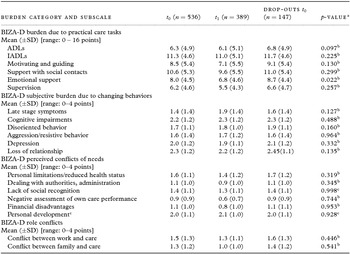
Of the 536 PwD-informal caregiver dyads that were enrolled in the study at baseline, 389 completed the follow-up assessment. Loss to follow-up occurred for the following reasons: death of the PwD (11.4%, n = 61), the PwD or caregiver did not want to or could no longer participate (13.1%, n = 70), the participant had moved (2.2%, n = 12), and unknown (0.7%, n = 4). For the sub-scale burden in relation to emotional support, the participants who did not complete the follow-up assessment had significantly higher burden scores at baseline (8.7 points, SD 4.4) than the participants who completed the follow-up assessment (7.7 points, SD 4.5); however, no such differences were observed for any other burden sub-scale (Table 1).
Burden of the informal caregivers at baseline (t 0) and at follow-up (t 1) and the mean baseline scores (t 0) of those not completing (drop-outs)

Note. aGroup comparison between the t 0-values of completers (n = 389) versus drop-outs (n = 147).
b Mann–Whitney-U-test, paired, missing analysis.
c t-test.
d high points indicate a positive result.
Abbreviations. BIZA-D: Berlin Inventory of Caregivers’ Burden of Dementia Patients, SD: standard deviation, ADLs: basic activities of daily living; IADLs: instrumental activities of daily living.
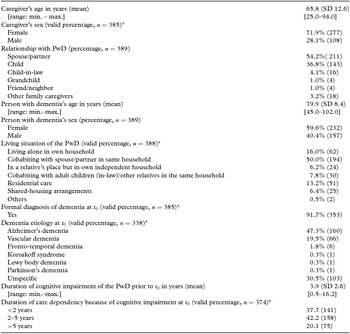
Sample characteristics are presented in detail in Table 2. Additionally, the majority of the caregivers were living with the PwD (57.8%, n = 224); were unemployed or retired (65.3%, n = 252); and did not have a migration background, with 92.6% (n = 350) and 92.1% (n = 350) having a father or mother who was born in Germany, respectively.
Sample characteristics at follow-up (t 1; n = 389)

Note. aTotal numbers may vary because of missing values. Cases with missing values were excluded from the calculation of frequencies and means.
Abbreviations. PwD: person with dementia; SD: standard deviation.
Caregiver burden at 12-month follow-up
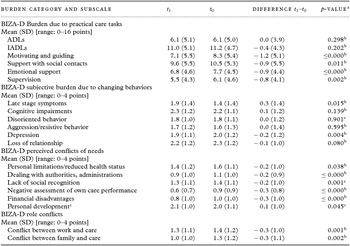
Considering the possible range of scores, the overall, objective, and subjective burden scores were moderate to low (Table 3). The objective burden sub-scales were rated highest for “Helping the PwD with IADLs” and “Support with Social Contacts.” The mean burden scores were significantly lower for four of the six objective burden sub-scales and for 10 of the 14 subjective burden sub-scales compared with the baseline results (Table 3). All sub-scales of the categories “Perceived Conflicts of Need” and “Role Conflicts” significantly improved between baseline and follow-up. Caregiver burden in relation to the PwD's changing behaviors differed somewhat from these findings. There were significantly reduced mean burden scores in relation to the PwD's depressive symptoms but also significant worsening of the burden caused by the PwD's late stage symptoms (+0.3 points, SD 1.4). None of the other variables changed significantly between assessments.
Burden of informal caregivers at follow-up and at baseline in the follow-up study sample (n = 389) and the difference in burden between follow-up (t 1) and baseline (t 0)

Note. aComparison between values t 0 and t 1.
b Wilcoxon test, paired, missing analysis.
c t-test, paired, missing analysis.
d high points indicate a positive result.
Abbreviations. BIZA-D: Berlin Inventory of Caregivers’ Burden of Dementia Patients; SD: standard deviation; ADLs: basic activities of daily living; IADLs: instrumental activities of daily living.
Factors associated with change in caregiver burden between baseline and follow-up
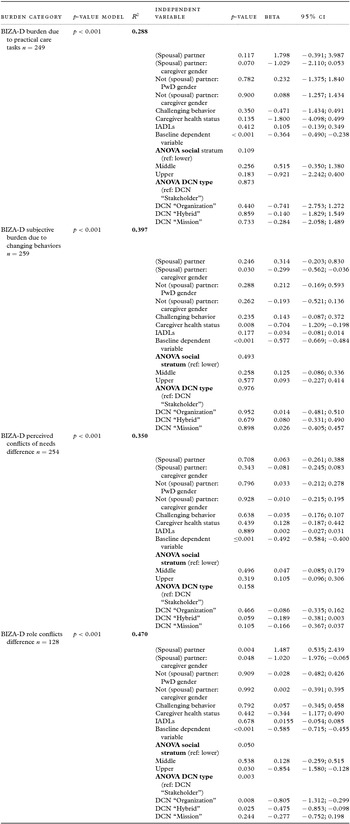
A change in burden between baseline and follow-up was associated with a number of factors (Table 4). All four burden category outcomes were associated with their respective baseline score variables. Additionally, a change in subjective burden in relation to the PwD's changing behaviors was significantly correlated with the spousal caregiver's gender (p = 0.030, β = −0.299) and the caregiver's health status (p = 0.008, β = −0.704). This model explained 40% of the variance (p < 0.001; R 2 = 0.40). Additionally, a change in burden with regard to “Role Conflicts” was associated with the caregiver–PwD relationship (p = 0.004, β = 1.487), the spousal caregiver's gender (p = 0.048, β = −1.020), the PwD's social stratum (p = 0.050, β = −0.854), and the DCN type (p = 0.003). The model explained 47% of the variance in burden (p < 0.001; R 2 = 0.47).
Multivariate linear mixed models with PwD gender nested in (spousal) partner for the difference between baseline and follow-up (t 1-t 0)

Note. Reference categories for binary variables: “no” for yes/no-variables, “male” for gender variables.
Abbreviations. BIZA-D: Berlin Inventory of Caregivers’ Burden of Dementia Patients; PwD: person with dementia; IADLs: instrumental activities of daily living; DCN: dementia care network; CI: confidence interval; R 2: explained variance of the association of the independent variables with burden category; ref: reference categories.
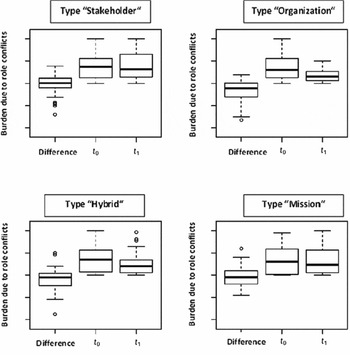
A change in burden between baseline and follow-up was not associated with the DCN governance type (Table 4) except for the change in burden due to role conflicts: “Stakeholder” DCNs were significantly different from “Organization” (p = 0.008), and “Hybrid” DCNs (p = 0.025). A decrease in caregiver burden associated with role conflicts was observed for the DCN types “Organization” and “Hybrid” but not “Stakeholder” (Figure 1).
Boxplots of the dependent variable “Burden due to Role Conflicts” at baseline and follow-up as well as the difference between the assessments (t 1–t 0) differentiated by DCN governance type.

Discussion
This study aimed to understand how caregivers of PwDs experience objective and subjective burden over the course of one year when utilizing a DCN in Germany and what factors are associated with changes in burden over time.
In 14 of the 20 sub-scales, small but significant changes in burden were found, indicating that the burden experienced by the caregivers in this sample improved within 12 months. Objective burden in relation to motivating/guiding, support with social contacts, emotional support, and supervision improved. These findings differ from those of LEANDER, a study in which the burden of more than 800 informal caregivers was evaluated over the course of three years (Zank and Schacke, Reference Zank and Schacke2007). In that study, a decrease in objective burden was primarily observed for informal caregivers who looked after a PwD in residential care and less often for those living in the community (Zank and Schacke, Reference Zank and Schacke2007). Regarding the subjective burden due to changing behaviors, no change was detected for burden in relation to cognitive impairments, disoriented and aggressive or resistive behavior of the PwD or the loss of the caregiver–PwD relationship, confirming the findings from LEANDER (Zank and Schacke, Reference Zank and Schacke2007). Similar to LEANDER, the burden worsened in association with the PwD's late stage symptoms. The decrease in burden in relation to the PwD's depressive symptoms confirmed the findings from the IDemUck-study conducted between 2008 and 2010 in one of the rural DemNet-D DCNs (Köhler et al., Reference Köhler2014) as well as those from LEANDER (Zank and Schacke, Reference Zank and Schacke2007). The burden aspects related to “Perceived conflicts of needs” all improved significantly in DemNet-D between baseline and the one-year follow-up, whereas in LEANDER, only some aspects improved (Zank and Schacke, Reference Zank and Schacke2007). However, differences between the findings of these studies might be caused by a possible selection bias for participants (reactive recruitment through newspaper advertisements) and the inclusion criteria for being diagnosed with dementia in Zank and Schacke (Reference Zank and Schacke2007). Additionally, while the changes observed in our study were statistically significant, they are rather small. Nevertheless, they support the call for assessing caregiver burden not only over time but also using measures other than an overall burden when the goal is to reduce caregiver burden (Thyrian et al., Reference Thyrian2016). This allows DCNs to tailor interventions to dimensions that are important to caregivers at any point of time and to validly evaluate such interventions by specifically measuring these dimensions (Thyrian et al., Reference Thyrian2016). For example, in a different line of analysis of the DemNet-D data, we found that caregivers who needed information on dementia support services were both successful at obtaining such information through their DCNs and more successful in this regard than non-DCN users (Heinrich et al., Reference Heinrich, Uribe, Wübbeler, Hoffmann and Roes2016). This finding is also reflected in our current analysis, where we found a significant reduction in caregiver burden in relation to the “Dealing with authorities, administrations” burden sub-scale. This sub-scale includes the items “having to battle authorities,” “feeling hindered in obtaining information about support services for household care,” and “feeling alone when trying to obtain professional support.” With most networks aiming to provide appropriate and timely care for PwDs and to reduce caregiver burden, these results can be carefully interpreted to show that DCNs are effectively achieving these goals by providing caregivers with the information they seek at the right time. In this context, the BIZA-D proved to be a useful multidimensional tool for assessing a specific dimension of caregiver burden and its change over time, a measurement that is not only highly relevant to DCN users but also at the core of many DCN interventions. Overall, our findings provide some indication of the success of DCNs in supporting PwDs living in the community and their caregivers and in reinforcing an understanding of burden as an indicator of the care process that requires ongoing adaptation to meet changing circumstances rather than a view of burden as a static outcome (Pearlin et al., Reference Pearlin, Mullan, Semple and Skaff1990; Zarit, Reference Zarit2012).
A number of factors were found to be associated with a change in burden between baseline and follow-up and allowed the following interpretations. Within a spousal relationship or partnership, women – compared to men – were more likely to feel a decrease in burden after 12 months in terms of the PwD's changing behaviors and role conflicts. This finding is in line with the baseline observation that women – specifically wives – experienced higher levels of burden but also greater potential for personal development than men (Laporte Uribe et al., Reference Laporte Uribe2016). Wennberg et al. (Reference Wennberg, Dye, Streetman-Loy and Pham2015) found that “gender greatly influences differences in caregiving style and experiencing burden”; whereas women experience a greater psychological burden, men seem to experience a similar emotional burden but are less likely to express those feelings, and they detach themselves from their role by approaching caregiving as a “job.” However, in a recent review, Sharma et al. found that the results on gender differences in caregiving burden are inconclusive (Sharma et al., Reference Sharma, Chakrabarti and Grover2016), confirming earlier reviews (Etters et al., Reference Etters, Goodall and Harrison2008; Brodaty and Donkin, Reference Brodaty and Donkin2009). The authors also found that the results of studies on gender differences in satisfaction with caregiving were inconclusive, partially because of a lack of studies on this topic (Sharma et al., Reference Sharma, Chakrabarti and Grover2016). Given the multiple possible explanations for the gender differences observed in our study, including gender differences in coping, social support, personality traits, PwD characteristics, and caregiver demographics (Sharma et al., Reference Sharma, Chakrabarti and Grover2016), these results have to be interpreted with some caution. However, in light of our baseline findings, they add to the small body of research on caregiving satisfaction and should be investigated in future studies.
In addition to gender, health emerged as a factor associated with a change in burden. Caregivers with a better health status at baseline were more likely to report improvement in their subjective burden (changing behaviors and role conflicts). Caregivers who were not the spouse or partner of the PwD were more likely than spouses to feel less burdened by role conflicts between being a caregiver and their work or family after 12 months. Finally, caregivers from a higher social stratum were more likely to experience a decrease in burden over 12 months compared with those from a lower social stratum. Relationship, caregiver gender, caregiver health status, and PwD socio-economic status have been previously identified as predictors of burden (Papastavrou et al., Reference Papastavrou, Kalokerinou, Papacostas, Tsangari and Sourtzi2007; Brodaty and Donkin, Reference Brodaty and Donkin2009; van der Lee et al., Reference van der Lee, Bakker, Duivenvoorden and Dröes2014; Chappell et al., Reference Chappell, Dujela and Smith2015; Wennberg et al., Reference Wennberg, Dye, Streetman-Loy and Pham2015). Nevertheless, factors mediating change in burden over time have been less investigated, and further research is needed.
The current analysis indicated that caregivers who were supported through DCNs of the “Organization” and “Hybrid” governance types seemed to be more likely to experience a positive change in burden with regard to role conflicts over a one-year period compared with caregivers who were supported by a “Stakeholder” DCN. “Organization” DCNs were characterized as having a high level of internal formal governance that offered structured support, often using case management, whereas “Hybrid” DCNs are able to adapt their strategy quickly to changing requirements (Schäfer-Walkmann et al., Reference Schäfer-Walkmann, Traub, Peitz, Holle, Thyrian and Wolf-Osterman2015). These characteristics might contribute to the reduced burden observed in caregivers involved with these two network governance types. However, the current analysis also showed that it was not particularly the governance structure of DCNs but other factors, such as PwD and caregiver characteristics, that seem to be relevant for mediating burden in DCN users. As the number of studies on DCNs is still very limited, it is currently not possible to draw strong conclusions regarding whether certain governance types of DCNs are better suited than other DCN governance types to addressing certain aims of dementia support.
Limitations
Certain methodological issues threaten the validity and thus the generalizability of the results. First, the results may not be generalizable because of the regional clustering of the participating DCNs. However, funding was limited, and with a total of 13 different networks included, we believe the results can be considered valid. Second, we cannot rule out a selection bias regarding the participating PwDs and caregivers, as the participants were contacted, enrolled, and assessed through DCN employees. Third, a control group not utilizing a DCN was not included, and conclusions regarding the impact of DCNs drawn from this study are therefore somewhat limited. Additionally, the severity of the cognitive and functional impairments of the PwDs might have been over- or under-stated compared with a clinical evaluation. Finally, a single follow-up assessment after 12 months might not reflect the development of caregiver burden very accurately. More assessments during that time may have provided a more detailed picture of the dynamics of burden.
Conclusions
This was one of the first studies to longitudinally examine the burden of caregivers who access DCNs in Germany. Some findings can be understood as an indication of the success of DCNs in supporting PwDs living in the community and their caregivers with regard to caregiver burden. In this context, our data provide the first indications that different DCN governance structures seem to be similarly well suited to support network users and might contribute to a reduction in caregiver burden over the course of one year. However, further studies set in DCNs over a longer period of time are necessary to confirm this possibility. Additionally, further research on factors that mediate changes in caregiver burden over time is needed to draw strong conclusions regarding the effectiveness of DCNs. The support offered by DCNs should consider gender differences and the PwD–caregiver relationship to most effectively address burden in different caregiver socio-demographic groups. Using repeated multi-dimensional burden measures over time could prove useful for DCNs by allowing them to tailor interventions to the dimensions that are important to caregivers at any point in the course of dementia and to validly evaluate their goal of reducing caregiver burden by specifically measuring these dimensions.
Conflict of interest
None.
Description of authors’ roles
F. Laporte Uribe assisted with designing the study, performed the data analysis, and wrote the paper. J. Gräske assisted with designing the study, conducted the interviewer training sessions, and critically contributed to revising the paper. S. Grill conducted the multivariate data analysis, contributed to the description of the statistical analysis, and critically revised the paper. S. Heinrich contributed to the conception and interpretation of data and critically revised the paper. S. Schäfer-Walkmann planned and designed the study and conceptualized and interpreted the qualitative data. J. R. Thyrian planned and designed the study and critically revised the paper. B. Holle planned and designed the study, critically revised the paper, and contributed to the conception and interpretation of data.
Acknowledgments
This work was supported by the Federal Ministry of Health (BMG) of Germany's funding scheme “Zukunftswerkstatt Demenz” (grant numbers IIA5-2512FSB031, IIA5-2512FSB032). The authors have not entered into an agreement with the funding organization that has limited their ability to complete the research as planned and publish the results. The authors have had full control of all primary data. The authors are grateful for the time and consideration given by the persons with dementia and their caregivers who participated in this study. We would also like to thank the people behind the participating DCNs for their support of this research.