Introduction
In an insightful article, Arjun Guneratne (Reference Guneratne1998) demonstrated the important role of state policies in the creation of collective identities in modern South Asia through an examination of Tharu mobilization in Nepal. Guneratne opened his inquiry by noting a puzzling divergence in the self-representation of autochthonous Tharus in the southeastern lowlands of Uttarakhand (India) and those who resided in the adjoining tracts of southwest Nepal. Although the two groups were indisputably related, the Tharu within India proudly identified as a distinct group of “tribals” (adivasi), whereas those in Nepal claimed affinity with the numerous heterogenous peoples inhabiting the roughly 800-kilometer-long Tarai lowlands bordering the Indian plains. Attributing this divergence to India's constitutional commitment to affirmative action, Guneratne skillfully charted the mobilization of local elites in the Tarai to the absence of a similar corrective policy in Nepal, which had, by the 1990s, earned the disparate lowlander groups significant clout with the political center of Kathmandu through the adoption of a shared “Tharu” identity (Guneratne Reference Guneratne1998).
In forming his arguments with the juxtaposition of Nepali Tharus and Indian adivasis, Guneratne hinted at a complementary and possibly even more powerful factor affecting the reformulation of collective identities in modern South Asia: the demarcation of borders in and between polities (Gellner Reference Gellner2013; Michael Reference Michael2012). Responding to recent interventions on borderlands and Zomian spaces, this article explores the long-term consequences of newly instated borders on the mountain (pahari) communities of the Indian Himalaya. It argues that the redrawing of political boundaries by the British East India Company (EIC) at the beginning of the nineteenth century laid the foundation for the current division of the Khas ethnic majority that inhabited the Uttarakhand-Himachal Pradesh borderland into “tribal” and “caste Hindu” societies.Footnote 1 For, in delineating a boundary between the directly controlled highlands of Jaunsar and Bhawar (Uttarakhand) and their indirectly ruled westerly neighbors in the Shimla Hills (Himachal Pradesh), British policy gravely disrupted a sociopolitical order that had binded and bounded the two regions for centuries.
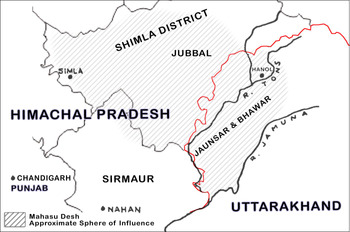
Enacted through a politically potent form of popular religion that is locally referred to as “government by deity” (devta ka raj), this order centered on the quasi-imperial god-king Mahasu, whose cult and followers encompassed large tracts on both sides of the Tons River (see figure 1), as is apparent in the pre-1967 appellation of Shimla District as “Mahasu District.” The severance of the western dominions from the Mahasu establishment sparked new competition between the lesser cults that had hitherto answered to the god-king beyond the river and the “secular” headmen with whom the EIC had entrusted the area's management. Manifesting in a series of popular uprisings, this competition gravely undermined the EIC's attempts at “stabilization” and was only overcome with the transformation of the regional economy in the 1860s, when its forests began to be exploited for commercial gain on a mass scale (Moran Reference Moran2007; Rangaranjan Reference Rangaranjan1994, 162–67). Their coffers filled to the brim, the hitherto embattled headmen used their wealth to reorient kingship along Indic (Brahmanical and bhakti-based) lines, engendering a qualitative difference between their courtly culture and the popular traditions of their followers. Over time, this recasting of the Shimla Hill States as miniature versions of “Hindu kingdoms” trickled down to society writ large, bequeathing it a “caste Hindu” status to be contrasted with its relatives in the adjoining “tribal” region to the east.
Mahasu Desh, not to scale. Cartography: Nadav Brill.

Centering on the rarely examined uprisings of the 1820–30s in the princely state of Jubbal, this article investigates the dynamics of state formation in the Shimla Hills at the dawn of colonial rule. Located at the seam between the easterly Mahasu cult heartland and the rest of the Shimla Hill States to its south and west, the modest-sized thakurai of Jubbal is uniquely placed for exploring these dynamics owing to its considerable geographic overlap with the “Zomian” realm of “tribals” and its “secular” rulers’ close links with the Rajput states that surrounded it.Footnote 2 As Chetan Singh (Reference Singh2013) observes, the Shimla Hill States are uniquely placed for analyzing this combination of religion and politics. For, despite public acknowledgment of their royal status, the relations of these polities’ leaders with their devta-led subjects were less institutionalized and therefore more open to negotiation than those of their peers in larger states. The Shimla Hill States’ adaptation to British rule may thus be read as a narrative about the mediation and reformulation of “secular” and “religious” authorities over the long nineteenth century, and of how this refashioning engendered new ways for envisioning and articulating political authority.Footnote 3 Exploring the transition to modernity in this part of the hills also sheds light on a tenacious conundrum of regional historiography, namely, how and why did this remarkably small region sprout such a dazzling variety of polities, and what enabled their survival as distinctly separate entities?
The argument is developed in three stages. The structure and function of “government by deity” (devta ka raj) are introduced first through an analysis of the Mahasu cult in and around the heartland of Jaunsar and Bhawar (Uttarakhand). By reading archival records dating to the early colonial encounter in conjunction with travelers’ accounts and recent ethnographic data, it explicates the religious and political mechanisms that supported “Mahasu Desh.”Footnote 4 An examination of coeval conditions at the fringes of the cult's territory follows. Focusing on the early colonial encounter in Jubbal, it traces the recurrence of popular revolts to the nexus of devta politics, local elites, and poorly devised administrative reforms that were imposed from above. Culminating in the abdication of Jubbals’ British backed-ruler (rana) in 1832, the details of this period suggest the distinction between “religion” and “politics” advanced in British circles at the time was at least partly responsible for the political mayhem plaguing the hills.
The last section traces the recasting of kingship in Jubbal through the adoption of popular religious currents from the plains in the latter half of the nineteenth century. Investing the considerable capital derived from the burgeoning trade in timber in the sponsoring of pan-Hindu Brahmanical rites, the inauguration and embellishment of temples, and the patronage of a novel historiographic tradition in Sanskrit, succeeding generations of ranas successfully repositioned themselves as superior sovereigns in the hills. Posteriorly attributed to the ruling line's engrossment with devotional (bhakti) Vaishnavism, these actions completed the substantiation of Jubbali kingship, increased its authority over the potentially subversive elements connected to grassroots cults, and ultimately reshaped it as a pan-Indian institution.
Mahasu Desh: God-Kings and Their Followers
Historical evidence indicates the highland societies between the Ganges and Ravi Rivers have been organized in a political-theistic system in which deities (devtas) function as kings for at least two centuries.Footnote 5 As with human kings, devta rule is supported by a host of institutions: regular management is entrusted to a (ideally, rotating) committee of officers (kardars) who represent the followers’ main lineages; royal decrees are pronounced through an official spokesperson (mali or gur) in séances of possession; and territorial control manifests in carefully calculated tours, during which the deity or its mark (nishan) is carried on a palanquin through its domain, as well as in visits to neighboring devtas and to centers of sacred power (shakti). Peter Sutherland, the author of several detailed studies (Reference Sutherland1998, Reference Sutherland, Berkemer and Frenz2003, Reference Sutherland2004, Reference Sutherland2006) of this system of “government by deity” or devta ka raj, further distinguishes between the aggregate territories (ghoris) of multi-caste villages that constitute the devtas’ spatial domain and the militias (khunds) that constitute its core followers, and that protect and enforce its policies (Sutherland Reference Sutherland2006, 88). Answering to elders or “seanas” (also sayanas) who raised troops and represented the group in the face of higher authorities, the khunds were considered a warrior caste whose martial ethic continues to inform regional identity and manifests in nearly all public occasions to date (Sax Reference Sax2002).Footnote 6
If the basic mode of sociopolitical organization in the region consisted of predominantly warrior societies under ruling deities, whose affairs were jointly managed through local institutions to enable a distribution of agency between gods and followers (Halperin Reference Halperin2016), the grouping of several such units would assume various forms. In areas conducive to settled agriculture or situated along central trade and pilgrimage routes, khund-based polities were subsumed under man-led kingdoms, where their subordination to the (invariably “Rajput”) ruler's chosen deity (ishta devta) was displayed in state-level rituals. As a result, the religious institutions and practices of the West Himalayan (frequently, Vaishnava) elite and their (predominately Shaiva and Shakta) publics formed a single “hegemonic system,” in which
[t]he devotees of a deota [devta] were regarded as his subjects (raiyat), and temporal relations between the subjects of different deotas were closely interwoven with the relationship of their respective deotas with each other. Village deotas were invariably subordinate to a more powerful territorial deity even if there were occasional disagreements between them. As a result, their followers too, were drawn into a corresponding position of subservience. This was not where the matter rested. At the top of the pyramid of political and religious authority were situated the raja and the reigning deity of the State. (C. Singh Reference Singh2013, 9)
It is the nature and historical development of the relationship between “the raja and the reigning deity” of West Himalayan states that concern this essay. The validity of Singh's model notwithstanding, its manifestation in different parts of the hills displays considerable variance. Thus, the expansive valley of Kullu along the Upper Beas River and the strategically positioned kingdom of Bashahr, which grew along the course of the Sutlej River between West Tibet and the Shimla Hills, both developed complex sociopolitical cultures wherein local deities still participate in grand state-level rituals (see, respectively, Moran Reference Moran2013, Reference Moran2007).Footnote 7 While this fusion of elite and popular political cultures (and their ritual expressions) characterizes most regional Rajput states, in less strategic and more topographically challenging areas that hindered the centralization of authority, khund society followed a somewhat different trajectory. Instead of a single lineage monopolizing political power in the name of its chosen deity, the competition over resources (namely, grazing pastures, cultivable fields, and livestock) was played out between khunds under the banner of their respective devtas. This enabled powerful deities to expand their territory and attain a quasi-imperial status over their neighbors without the sanction of a royal dynasty (the upper layer in Chetan Singh's pyramidal outline). The cult of Mahasu Devta is a case in point.
Radiating from its ritual center at Hanol, where three of the four central images of Mahasu are enshrined, the cult and its followers extend throughout the mountains between the Yamuna and Sutlej Rivers (see figure 1). Although its presence is strongest in the heartland of Jaunsar and Bhawar that encircles Hanol, the cult's influence extended into the Shimla Hills (Himachal Pradesh) beyond the Tons River through the travels of a fourth image, Chalda (“walking”) Mahasu, which continues to visit its temples and followers in the region today (Handa Reference Handa2001, 72–76; Shalev Reference Shalev2015). The entirety of this area, which G. S. Bhatt (Reference Bhatt2010) aptly names “Mahasu Country” or Mahasu Desh, thus constituted a highly anomalous and uniquely egalitarian, khund-based polity centered on a ritual capital at Hanol. Surrounding Mahasu Desh were khund-based societies that had been subsumed under human rulers, namely, Garhwal to its east and south, Sirmaur to its west, and Kullu and Bashahr to its north. The mobility inherent to devta ka raj meant that these borders were porous by definition and Chalda Mahasu frequently invaded (and continues to encroach upon) villages located in neighboring polities, resulting in recurrent contestations of authority at the fringes of the cult's territory (see, for example, Sax Reference Sax2002, 157–85).
The congruence of tracts headed by local noblemen with those administered by the cult of Mahasu were particularly pronounced in the Shimla Hills across the Tons River, where several small “lordships” or thakurai were already in existence at the close of the eighteenth century.Footnote 8 Although widely acknowledged as members of the West Himalayan aristocracy writ large, thakurai leaders still had to contend with the powerful cults of their khund subjects, that of Mahasu included. These dynamics were significantly altered with the arrival of the EIC, which had replaced Nepal as overlord following its victory in the Anglo-Gorkha War (1814–16).Footnote 9 This was chiefly due to the superpower's redrawing of political and administrative boundaries in favor of royal dynasties to the ostensible exclusion of religious elements, which added new constraints to the scope of action open to both khunds and their (human and divine) masters. If larger polities with easily recognizable human kings (e.g., Sirmaur, Bashahr, and parts of Garhwal) were granted limited autonomy in return for guided supervision in the form of managers (Fisher Reference Fisher1991), regions with “no apparent form of government,” such as the Mahasu Desh heartland in Jaunsar and Bhawar, were made into civil districts and directly governed by the British. The thakurai of the Shimla Hills were caught somewhere in between: on the one hand, their rulers’ publicly acknowledged hereditary rights rendered them akin to the rajas of larger polities and so secured their autonomy, whereas on the other hand, their territories’ overlap with politically powerful cults undermined their claim to absolute authority. The enactment of sovereignty in Mahasu Desh on the cusp of British rule provides a preliminary explanation for the divergences that would emerge between the god-governed land and its human-led neighbors in the decades that followed.
The Practice of Sovereignty in Mahasu Desh, circa 1800
The earliest reports on record indicate the Mahasu Desh heartland consisted of twenty-eight seana-led khunds (twenty-six in Jaunsar, two in Bhawar) and four superior leaders called chauntrus.Footnote 10 The chauntrus represented the cult in communications with external powers and were internally subordinate to “the chief priest at Hanol,” a certain “Raghunath.” In the decades that preceded EIC rule, this grassroots theocracy of Jaunsar and Bhawar was officially subservient to the westerly kingdom of Sirmaur, but in practice was almost entirely independent. Thus, apart from a biannual forwarding of revenues to the Sirmauri capital of Nahan (about 15 percent of which were remitted for maintaining the cult headquarters at Hanol),Footnote 11 local administration lay in the hands of Mahasu and his officiates, who exercised authority through a variety of ritual and legal devices.
As an early witness of the cult observed, “the Mahassoo Dewtah tenets, which are generally observed throughout Jounsar and Bhawur” and “very prevalent in every other direction near the place of its birth,” consisted of three basic requirements: (1) a prohibition on sleeping on a raised bed (charpaee); (2) a prohibition on drinking milk (buttermilk was allowed, but clarified butter or ghi was reserved for the deity); and (3) an encouragement to sacrifice the “finest goats” exclusively to Mahasu.Footnote 12 This, to the best of my knowledge, earliest written documentation of the cult's practices displays the extensive control it had over the personal and social conduct of its adherents. While the third “tenet” may be dismissed as common to most West Himalayan cults insofar as animal sacrifices are a foundational religious practice in the hills (Govindrajan Reference Govindrajan2015), the prohibitions on sleeping arrangements and the ban on the consumption of milk—still observed in areas where Mahasu is powerful todayFootnote 13—suggest the cult regulated its adherents’ lives to a far greater degree than any human ruler could have hoped to attain.
The regulation of dietary habits, sleeping arrangements, and ritual practice was complemented with near absolute judicial authority. Given its distance from the capital of Sirmaur, the majority of legal cases in Mahasu Desh were trialed by its seanas, chauntrus, and the deity itself through the decrees of the “chief priest” (alias “raja”) in Hanol.Footnote 14 The “principles of justice” in Jaunsar and Bhawar were, according to another report, “to take blood for blood, to deprive a thief of his eyes, to punish other crimes … by cutting off the nose, hands or fingers, or by confinement or the lash,” and in a somewhat surprising departure from the reportedly lax attitude towards conjugal relations that recur in travelers’ accounts, cases of infidelity entitled husbands to mete capital punishment on spouses, “as well as [on] the seducer and all his accomplices” (OIOC 1816f, fo. 92). This latter point may be explained by the marked disparity between the sexes in Mahasu Desh and the polyandrous social organization that was concomitant with it insofar as dissolving family units fundamentally undermined the integrity of the mawasa households, wherein several brothers “share a hearth” with one wife (G. S. Bhatt Reference Bhatt2010, 71–73; Majumdar Reference Majumdar1962).Footnote 15 As EIC officials were quick to discover, the hold of the cult on its followers rendered it impossible to bring persons who had committed crimes in Jaunsar and Bhawar to justice, the offenders invariably being trialed by the tribunals of their respective khunds.Footnote 16
In elaborating the forms and functions of the Mahasu cult establishments, these early commentators sought to decipher the logic behind the seemingly hermetic, autonomous society of Jaunsar and Bhawar. Having enjoyed substantial liberties under the Gorkhas (1803–14), the cult and its followers were subjected to closer regulation under the British (1815–1947), who assumed its direct administration in the form of a civil district. The motivation for this motion was officially based on the lack of any locally acknowledged “secular” leaders in the region and on the area's strategic position between the Great Indian Plains and the Tibetan Plateau. An official discourse rebuking the khunds’ devolution into a vendetta-driven society complemented the measure from early on. Thus, the first settlement officer deputed to Mahasu Desh, Captain Geoffrey Birch, advanced a historical explanation for its “descent into chaos” by postulating that “the power at first invested in the ch ontroo was by degrees assumed by the inferior seeanas and at length by individuals, which has occasioned the deep rooted animosities now existing between villages, when from want of the first cause being properly decided on retaliation has occurred and descended from one generation to another” (OIOC 1816f, fo. 93).
Similar views were echoed by James Fraser, who accompanied his brother (and future Resident at Delhi) William on an armed expedition to the hills in 1813–15 as part of the EIC's operations against Nepal.Footnote 17 Fraser's carefully documented Journal of a Tour through a Part of the Snowy Range of the Him ā lā Mountains (1820) is the earliest published account of the region by a foreigner. Although imbued with the freshness of discovery and replete with meticulously collected data, the text assumes a disparagingly somber tone when discussing the region's inhabitants. These “semi-barbarous” peoples, whose only contact with “civilized people” was with “little civilized” kingdoms adjoining the plains (e.g., Sirmaur), were marked as singularly hopeless, the “typical highlander” being “wily, cunning, and treacherous, and certainly revengeful,” and his leaders “petty tyrants,” who do little other than “attack and plunder their neighbours” (Fraser Reference Fraser1820, 200–201). For Fraser and his contemporaries, the highlanders’ “lawless and violent conduct” derived from the challenges of topography and an endemic weakness in “the laws of the sovereign.” While the mixture of environmental determinism and Hobbesian readings that inform these early views persist in popular writings today, the ethnographically informed understanding of Mahasu Desh suggests the highlanders were actually bound to a greater law that was aimed at perpetuating and extending the cult's influence through the regulation of its followers’ personal and social conducts. It was precisely this logic that had the leaders of certain khunds serve as Mahasu's executive ministers or “wazirs” (and this on top of devtas that carry the same title and fulfill similar functions), thereby deepening the ties between the egalitarian warrior-communities and the cult center at Hanol.
The difficulties entailed in this setup materialized soon after the Anglo-Gorkha War. As part of its redrawing of political borders along “natural barriers,” the EIC requested seana Rup Singh of Bhawar to transfer a small tract of land from his holdings west of the Tons in return for a negotiated compensation. Although a seana and therefore the head of a discrete political entity with its own devta-king, Rup Singh also occupied a place of prominence in the cult of Mahasu as one of the deity's wazirs.Footnote 18 The conflict of interests engendered by this duality exposed the limits of seana authority in Mahasu Desh, as Rup Singh professed his inability to transfer any of his lands without the consent of “the Chief Priest at Honole.” Inquiries with regional headmen revealed the cult's authority over lands and peoples predated the EIC's arrival, as a similar initiative advanced by the raja of Garhwal some years before saw “all of that [Mahasu] faith rise in its defence” (OIOC 1816c, fo. 200–201).Footnote 19 The cult's hold on the inhabitants of Jaunsar and Bhawar thus thwarted aspirations for administrative reform by both local and foreign superiors.
In the decades that followed, Mahasu and his officiates were repeatedly criticized for the “oppressions” carried out in the deity's name. These ranged from instances of physical harm to the overall impoverishment of the region through Mahasu's royal tours, which hosting villages were expected to finance.Footnote 20 In order to curtail the cult's “tyranny,” the EIC banned Chalda Mahasu from circulating in Jaunsar and Bhawar in 1827, and, in 1848, abolished the office of “Chauntru.”Footnote 21 Although intended to reduce the cult's powers, these motions may have unintentionally compounded the situation of highlanders in the Shimla Hills, since Mahasu—if the decree of 1827 was indeed abided by—would have likely turned to followers beyond the Tons for subsistence. The obligations of the Shimla Hills’ khunds towards superior authorities would have consequently been increased, partly explaining the rise in popular protests beyond the Tons during the 1820–30s that would culminate in the rana of Jubbal's abdication.
The Priest Who Would Be King? Puran Chand of Jubbal, 1815–40
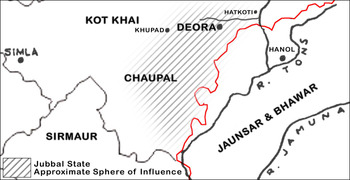
If the British establishment's struggle to separate religion from politics in Jaunsar and Bhawar had the cult of Mahasu as its obvious target, the situation west of the Tons was more complex. Contrary to the seana and chauntru political leadership of the Mahasu Desh heartland, the western hills featured numerous headmen of ostensibly royal descent who were purportedly beyond the control of the cult center at Hanol. For the veterans of the Anglo-Gorkha War who managed the region, these rana and thakur nobles became the primary address for extracting revenue, much as their peers in the larger states that surrounded them did. The tumultuous protests that characterized the reign of rana Puran Chand (b. 1772, r. 1802–32, d. 1840) in Jubbal, whose eastern part bordered the Mahasu Desh heartland (see figure 2), suggests this interpretation was not as well founded as its propagators seemed to believe. Culminating with the rana's abdication, these early trials were downplayed in texts written during the latter part of the century.
Jubbal State, circa 1860–1947, not to scale. Cartography: Nadav Brill.

The Imperial Gazetteer of India (1908) merely notes that Puran Chand had “misgoverned the state, and in 1832 abdicated in favour of the British Government, but soon, however, repented, and in 1840 the state was restored to him” (Secretary of State for India 1908, 14:204). The Gazetteer of the Shimla Hill States (1910) expands on this slightly, explaining the rana was already “quite incapable of managing the hereditary wazirs” under his charge when the EIC had first entered the hills and that his reportedly questionable faculties fueled further insubordination in succeeding years, bringing the state into a “critical condition” that induced its transfer to the EIC in 1832. Puran Chand signaled his regret shortly afterwards by refusing his allotted pension (4,400 rupees per annum) and, after a “lengthy correspondence,” regained the state, which came under a British appointee (tahsildar) till his five-year-old successor attained majority, at which point the hitherto rebellious factions were expelled and the state set on a steady course towards prosperity (Punjab Government Reference Government1910, 7).
This précis of Puran Chand's reign, intended as it was for a civil servant readership, hides a significantly more complex reality that is preserved in archival records and that can be explained by recourse to ethnographic literature. Prompted by the deep structural changes that engulfed South Asian societies in the era of EIC expansionism (Bayly [1998] Reference Bayly2003, 79–135; Washbrook Reference Washbrook1993), Puran Chand's abdication was at least partly encouraged by EIC personnel on the frontier. Originating in the latter's particular reading of sociopolitical dynamics in Jubbal, the conflicts between the rana and his wazirs pitted the British establishment (in ostensible support of the rana) against the wazirs, the erstwhile connectors between the rana and his khund subjects. Since differences between the rana and his cardinal intermediaries are said to be at the heart of these events, it is worth exploring just who these persons were and how their relations were connected to the workings of state. As the archival records and coeval travelers’ accounts reveal, the conflicts between the parties were in no small part indebted to the redrawing of borders in Mahasu Desh.
The Early Colonial Encounter in Jubbal
In his pioneering travelogue, Fraser describes Jubbal during the Anglo-Gorkha War as a “ravaged country … on the brink of anarchy,” whose “little imposing” rana lived “on charity” while his wazir ran the state. Recounting his meeting with Puran Chand on May 17, 1815, Fraser told of “a thin and sickly looking young man, about twenty-five years of age; his complexion pale and yellow, his features meagre and prominent, his eyes large, prominent, and bloodshot, the lids tinged with antimony,” the overall impression being that of “a poor Calcutta shop-keeper, or sircar.” The next day, the party encountered the rana's contrastingly impressive wazir, Dangi, “a far better looking subject for a chief than the miserable creature who claims that distinction,” and who was fittingly accompanied by “a large military attendance, and much more state than waited on his master” (Fraser Reference Fraser1820, 163–64).
Fraser's callous prose notwithstanding, his portraits of the rana and the wazir indicate Jubbal possessed a coherent political structure that had withstood the Gorkha occupation (1803–14) and in which access to power was inverse to rank. Thus, if the rana barely interacted with Fraser's contingent (and that too through “the usual custom of suffering an attendant to speak for him”), it was because Dangi, “under the title of vuzzeer, exercised the prince's authority, collected the revenues, and directed the whole state” (Fraser Reference Fraser1820, 145).Footnote 22 Dangi maintained these functions under the EIC, negotiating Jubbal's obligations and privileges with the new masters—including an exemption from the most palpable expression of sovereignty, conscripted labor (begar)—and extracting revenue on the state's behalf as he had earlier done under the Gorkhas. Dangi fell terminally ill soon afterwards and was succeeded by his son, Sajram, who collaborated with wazir Prem Singh, the second most powerful person in Jubbal. Like Dangi before him, Prem Singh quickly rocketed to the summit of Jubbali politics, holding court, adjudicating cases, raiding villages in neighboring territories, confiscating arms and goods from enemies within the state, and imposing a variety of taxes on landholders (zamindars) for important social events and transactions (e.g., births, deaths, and marriages) as well as on numerous other occasions.Footnote 23
In the meantime, rana Puran Chand remained under the watch of his guardians, whom British authorities eyed with a fair amount of suspicion. In an “unofficial letter” from 1817, the political agent at Subathu and future founder of Shimla, Charles Pratt Kennedy (1789–1875), warned that “the rana is incapacitated for all public functions or considered at least to be so,” and that “he is popularly believed to be suffering under the agency of witchcraft.” Manifested in the rana's “mental imbecility so remarkable,” Kennedy wondered whether this condition was “natural or induced by the mode in which he has been brought up,” namely, with a habit for consuming opium “from infancy” that was encouraged by his guardians, and by the queen mother and state treasurer (bhandari) in particular. The latter, explained the agent, were bent on destroying the rana's “intellect of their unfortunate charge” in an apparent attempt to assume control of the state, which they secured by concealing “all means of improvement or information” from its sickly ruler (OIOC 1817, fo. 69–70).
Over the next fifteen years, the agency at Subathu made successive interventions in Jubbal, and on at least two occasions appointed subedars from the Gorkha Battalion at Subathu as its managers (mukhtars). The rana related the details of this period at length in a letter dated December 1, 1832:
[After salutations]
When the Company conquered the Hills I obtained the state of Joobul as [a] grant from the Governor General, and made [wazir Dangi's son] Sajram and Praim Sing my ministers. But neglecting my welfare, and having no care for the prosperity of the country, they tested and fined my subjects arbitrarily, and out of the revenue they gave me whatever allowance they thought fit. I represented this to [your predecessor] Captain Ross, who reflecting on the state of confusion into which my country had fallen, gave the management of it to Nuipush Sing Subadar (in the Nussuree [Gorkha] Battalion). In consequence everything went on well for seven years [circa 1822].
When the Subadar died, Captain Ross then made Dani Sing manager (mookhtar) of my affairs. This arrangement succeeded for a short time, but Dani Sing in the end uniting with the old ministers (Sajram and Praim Sing) began to behave ill, on which account he was dismissed. I again gave Sajram and Praim Sing the management of the country. Hoping that they would now at last conduct my affairs and property, but again taking the government of the country completely into their own hands, they have given me as much of the revenue as they thought fit and appropriated the rest to themselves, throwing the country into the greatest confusion.
Being helpless, I wish to explain that I cannot manage the country. My subjects have become too powerful for me, and I am thought nothing of. I ask, therefore, that you will make one arrangement in Joobul [… by introducing a] “Gorgie ke Bandubast”, that is, giving to each landholder a note detailing the amount of land in his possessions, the annual amount of revenue payable by him, and that government will appoint an agent (mookhtar) to manage my offices, and that the ministers may be prevented from interfering.… Whatever arrangement shall be made, I will be contented with it. If the ministers Sajram and Praim Sing be dismissed, I shall be free from annoyance and my subjects from oppression. I am not wise enough to manage the country. (OIOC 1832, fo. 10–11)
A seeming preamble to the “bond of agreement” (ikrarnama) that was to reify the rana's abdication,Footnote 24 the letter weaves a remarkably coherent narrative for one penned by an alleged opium addict. It is indeed difficult to reconcile the carefully presented sequence of events and the meticulous delineation of causal factors, let alone the detailed explanation of the tax system to be instated in Jubbal (gorgie ke bandubast), with the “miserable creature” described by Fraser or with Kennedy's more alarming portrait in private correspondence. If the letter's agreement with the discourse of EIC officialdom suggests it was crafted by someone other than the rana (most likely Kennedy himself), its content belies the means and goals of British expansionism in the early colonial Himalaya, namely, to appoint managers to subject polities who would increase revenues by shifting from community- to individual-based taxation. These top-down solutions prompted resistance from those most likely to lose from them, in the present case, the Jubbali wazirs Sajram and Prem Singh. The latter, however, were careful to declare subservience to the EIC backed-rana in official communications, thereby tying the Subathu establishment's hands and severely reducing the chance for implementing meaningful changes in Jubbal's administration. The apparent gridlock in the thakurai’s political leadership can be further explained by adopting a bottom-up approach that accounts for khunds, devtas, and the their relations to the wazirs.
An Ethnographically Informed Explanation of the Conflicts in Jubbal
Although the records pertaining to Jubbal tend to focus on the rana and his immediate underlings, the settlement report tables that intersperse them provide crucial data about the substrata of khunds and devtas that underlay the state's political leadership. The earliest reports indicate Jubbal was divided into eighteen administrative units (parganas) under the same number of seanas, and that these were further grouped into “four unequal shares” or wazirats: three under the wazirs and the smallest part of “Deora” (present-day “Jubbal”) under the rana.Footnote 25 That the parganas were governed by seanas suggests they were synonymous with khunds, or more precisely ghoris insofar as they refer to discrete geographic subregions within the state. The similarities with the theocratic neighbor at Hanol are significant, and more clearly drawn out in the Jubbali khunds’ identification as descendants of the warring sides of the Mahabharata. This classification cuts across cultic lines throughout the region and is readily perceived in the organizational structure of the Mahasu cult, which subsumes the epic rivals’ descendants under the Pashi (Pandava) and Shati (Kauravas) wazirs, who answer only to the chief authority at Hanol.Footnote 26
This is not entirely surprising given Jubbal's shared border with the Mahasu Desh heartland and the overwhelming preponderance of temples dedicated to the deity in the Shimla Hills more broadly (Handa Reference Handa2001, 72), suggesting substantial links with the cult over centuries. The main temple in the Jubbali capital of Deora is thus still dedicated to Mahasu and the traveling (Chalda) deity was, until the 1970s, a regular visitor to its capital (Sutherland Reference Sutherland2004, 91). Mahasu also appears in several historical ballads, either as a protagonist or in the background of other personages (e.g., Joshi Reference Joshi2007, 120). The cult's strong presence in Deora notwithstanding, there is no direct evidence of the rana or his wazirs having fulfilled official positions in the cult's apparatus as the seana of Bhawar did.Footnote 27 The implied interchangeability of Jubbal's “parganas” with “ghoris” and the incorporation of its khunds in the broad division of Shatis and Patis indicate that its sociopolitical setup at the grassroots level abided by the prevalent medium of devta ka raj familiar from regional ethnographies (e.g., R. P. Bhatt, Wessler, and Zoller Reference Bhatt, Wessler and Zoller2015; Sax Reference Sax2002; Shalev Reference Shalev2015; Sutherland Reference Sutherland1998). Shifting the perspective of analysis from the rana and his wazirs to the egalitarian khunds, the abuses attributed to Dangi, Sajram, and Prem Singh resonate strongly with the “excesses” of the chauntrus of Jaunsar and Bhawar, suggesting the Jubbali wazirs played a role similar to their peers’ in the Mahasu Desh heartland, that is, as the superior representatives of khund confederacies.
If the wazirs’ powers were contingent on cultic status, assessing which of Jubbal's devtas were active in their territories may provide further clues regarding the sources of their authority. The state's leading cults, all of which possessed considerable tax-free lands (muafi jagirs) courtesy of the rana, were those of Banar, Mahasu, and the complementary deities of Shirgul-Bijat, whose followers were respectively concentrated in its eastern, northern (Deora), and southern (Chaupal) parts of the state (Punjab Government Reference Government1910, 39).Footnote 28 This would indicate that although the Mahasu cult did have an important presence in the small valley surrounding the capital, it was superseded by that of Shirgul-Bijat, which flourished in the much larger and more prosperous wazirat of Chaupal to its south.Footnote 29 Chaupal was also the home and powerbase of the rana's two “rebellious” wazirs, suggesting their acts of “insubordination” were most likely executed in the name of Bijat. The bottom-up perspective of Jubbali history thus reveals the wazirs’ acts of “rebellion” were more reflective of their role as supreme office holders in a regional cult commanding several khunds than they were of retaliation against the rana.
The correlation of cultic affiliation with access to power in Jubbal, consistent as it is with the defining characteristics of devta ka raj, affords a more persuasive explanation for the wazirs’ actions than the cultural stereotypes advanced in British circles. It is thus not an inherent propensity for tyranny among the highland elites that motivated the wazirs’ increasing autonomy, but their position as key office holders in the leading cults of Chaupal. Simply put, Chaupal yielded greater income than Deora, which increased the social and material capital of its devtas, and ultimately facilitated the rise of its wazirs as the most powerful agents in Jubbal. The polity's multiple cults were thus largely congruous with its wazirats, suggesting the wazirs occupied important positions in their respective regional cults. These, in turn, created a buffer between the rana and his subjects that may have inadvertently shielded Puran Chand from popular resentment. If the overlap in cultic and political powers explains the repeated resurgence of Chaupal's wazirs as central players during the early colonial encounter, it fails to account for their sustained acknowledgment of the rana as state leader. To resolve this paradox, it is necessary to take a closer look at the sources that sanctioned Puran Chand's authority.
The Composite Political Culture of Jubbal
Despite repeated failings, the EIC's attempts at empowering Puran Chand were consistent with the inner workings of Jubbal's political culture insofar as the rana continued to be acknowledged as the head of state throughout the troubled transition to British rule. In a “prolix note” summarizing his preliminary settlement of Jubbal in 1816, Captain Robert Ross pointed to the “divine right of princes” as the central factor that sustained the rana's authority. Since this “right” was “considered as vested in the family rather than in any individual,” Ross argued, the prospects of the non-royal wazirs usurping his position were practically inconceivable (though they did not preclude rivalries between the latter). Ross arrived at this realization after several months of extensive tours in the hills, which had persuaded him to withdraw an earlier proposal that Jubbal be divided into four separate states according to its “traditional shares” (wazirats).Footnote 30 In support of his reversal of judgment, the officer outlined the highlands’ political history as gleaned from local informants.
According to Ross, the “population of the hills, originally wholly of the caste called Koonds,” had once been conquered by “Rajpoot emigrants from the south westward,” who then “formed them into states of which they constituted themselves rulers,” and maintained this position by avoiding marriages with their “koond” subjects (OIOC 1816d, fo. 56–60). This easily comprehensible explanation, a precursor of the common explanation of regional history today, is consistent with the endogamy that had reportedly sustained the status of local elites for centuries. Congruent with the strategy of dominant lineages in various parts of South Asia, this social strategy's weight in Mahasu Desh was accentuated in light of the polyandrous khunds; if the sharing of a wife between brothers was the norm, then the sovereign's numerous spouses (and the capital needed to secure them) comprised its royal exception. In this respect, Ross correctly assessed descent from endogamous lineages as fundamental to Jubbal's political culture. However, since this element failed to command the complete compliance of the subjects and their wazirs, it only partly explains the sources of Puran Chand's authority.
Bearing in mind that both Jubbal and the Mahasu Desh heartland constituted political constructs that incorporated regional khunds through various mediating strata, let us consider once more Fraser's description of Puran Chand at twenty-five. The rana in those early days was portrayed as a “miserable creature” with “no signs of ability,” whose communication with outsiders relied on the services of a specially designated attendant. Recall, also, the bloodshot eyes, the antimony tinged-eyelids, and the habitual consumption of opium (Fraser Reference Fraser1820, 163), and the image conjured proves less the peon-clerk of Fraser's imagination and more akin to the chief priest of a cult, whose authority derives from a continual and intimate connection with its governing deity that is most commonly manifested in spirit possession.Footnote 31 Although the identity of the deity possessing Puran Chand during his meeting with Fraser is difficult to ascertain, a probable candidate would be the family goddess (more on which below), which would be consistent with elite religious practices insofar as rulers are frequently—and indeed ought to be, if their authority is to carry any weight—expected to be possessed by their family deities (Berti Reference Berti2006, 54).
Seen in this perspective, the structural affinities between the “secular” state of Jubbal and the “religious” establishment in Jaunsar and Bhawar become evident: the rana, like the “chief priest” at Hanol, united khunds under his authority through the services of superior postholders (wazirs) that paralleled his neighbor's chauntrus,Footnote 32 and whose devoirs included communication with external powers (the nominally superior kingdom of Sirmaur and later the EIC) even as they remained internally subordinate to a political center that formed the nucleus of a state cult. In terms of political, economic, and human geography, both regions were mountainous peripheries of Sirmaur, yielded similar revenues (approximately 10,000 rupees in Jubbal, 17,000 in Jaunsar and Bhawar), and had roughly comparable population sizes (18 khunds in Jubbal, 28 in the Mahasu Desh heartland, distributed over “445 households” in 1815).Footnote 33 These roughly comparable tracts thus formed complex sociopolitical structures wherein a seemingly removed figurehead reigned supreme while the brunt of governance was assumed by an intermediary stratum of official (wazirs, seanas, chauntrus) and regional devtas. If Puran Chand in Jubbal fulfilled the same role as the “chief priest” Raghunath did in Hanol, then the line separating the highlands’ “secular” polities from their theocracies would have been a fine one indeed.
While indirect rule over the Shimla Hill States and the direct administration of Jaunsar and Bhawar played a key role in reshaping what were largely commensurable societies as “caste Hindu” and “tribal” societies, their divergent trajectories were not exclusively indebted to the novel demarcation of borders by the British. In the case of Jubbal, this divergence can be further traced to two fundamental differences with the Mahasu Desh heartland: (1) the existence of several powerful cults (including Hanol's) in the rana's territory, which allowed prominent headmen to increase their power at the expense of the center; and (2) the royal pedigree of its ranas, which linked them to a regional elite and alternative religious cultures. This latter point is particularly important, for if the theocracy of Jaunsar and Bhawar had Mahasu and its chief priest as its masters, the ranas of Jubbal had several deities to contend with in order to sanction their authority. For one, the rana's family goddess (kul devi), Piri Devi,Footnote 34 would have played a central part in his curriculum of ritual activities as it does in neighboring states. This did not, as seen above, suffice to restrain the wazirs, who drew support from their standing in other regional cults. It was rather, as the late nineteenth-century royal chronicle (vamsavali) reveals, the rana's devotion to Vishnu that both sustained his position and brought about his downfall. Since this religious orientation had a pronounced impact on Jubbal's recasting as a pan-Hindu kingdom, it is worth inquiring into the details of its account of Puran Chand's reign.
Devotional Vaishnavism in Jubbal
Commissioned at the height of Jubbal's power by Puran Chand's grandson, the Lalitakāvyam (LK, Sharma [1894] Reference Sharma1912) narrates the history of Jubbal and its rulers through the prism of devotional (bhakti) Vaishnavism.Footnote 35 According to the LK, Puran Chand was no ordinary king, but “a sadhu, a man of tapas (tapasvī), devoted to the worship of Hari (haribhakt),” who was “much delighted by singing bhajans for days and nights” (Sharma [1894] Reference Sharma1912, verses 63–64). Sensing opportunity in the “soft-hearted” (rahamdili) rana's disposition, a “wicked (duṣṭ) minister by the name of Nañd” (Dangi) took steps to usurp power (96). Realizing the threat, Puran Chand offered his kingdom to the “white kings” (gauranṛpa) for protection on condition that his son retain management of its foreign relations. Confident that his conditions would be met, Puran Chand ceded the kingdom to the EIC and retired till his death.Footnote 36 When his successor came to power in 1854, he expelled the erstwhile usurper and his family and razed their homes to the ground (111–12).
Here then is an entirely different understanding of Jubbal's transition to modernity: Puran Chand was an ascetic devoted to Vishnu (haribhakt), his concerns otherworldly, and his actions far removed from the trifles of this ephemeral world. While it would be tempting to dismiss this explanation as a retroactive superimposition, the existence of a royally sanctioned temple to Vishnu (thakurdwara) in Jubbal's capital a century before the British conquest suggests devotional Vaishnavism had gained a foothold in the state well prior to the cultural innovations introduced by Puran Chand's successors (OIOC 1833a, fo. 47).Footnote 37 Consider Puran Chand's immediate successor son, rana Karm Chand (b. 1835, r. 1839/54–77). Widely remembered as a grand patron of religion, Karm Chand is credited with steering Jubbal towards prosperity, stability, and an overall increase in dharmic activities. Financed with the incredible income afforded by the state's nascent timber industry, these activities spanned a variety of creeds that fulfilled disparate functions.
Claims to sovereignty, for one, were substantiated through the construction and refurbishment of temples. Thus, the foundation of a temple to Giri Ganga at the source of the Giri River just below the peak of Kuphad underlined sovereignty on the western border with Kot Khai, while its marble images, which were imported from Jaipur (Rajasthan), increased Jubbal's standing as a pan-Indian state (Sharma [1894] Reference Sharma1912, 121–29).Footnote 38 Karm Chand also sponsored readings of the Bhagavata Purana (s aptāhayajnya) and “the seven stories of the sins of Kali” in Jubbal and neighboring (civil district) tracts (135–42). The readings, performed by “the famous pundit Brijlal” of Hoshiarpur in the Punjab, strengthened the rana's standing as a pan-Hindu ruler on a par with his peers in the plains. The shift in the royal line's reorientation towards pan-Hindu orthodoxy was completed by Karm Chand's successor, who adopted his father's Sarasvati Brahmin reciter as rajguru. A committed Vaishnava, rana Padam Chand (r. 1877–1910) went on pilgrimages to regional (Jwalamukhi) and pan-Indian (Haridwar) sites immediately after his coronation. He then proceeded to sponsor various religious sites and activities, including a temple to Shiva that his late father had intended to build and that was completed in a record three years in 1886, and ultimately commissioned the verse account of his family's history by the aforementioned pundits (Sharma [1894] Reference Sharma1912, 143–74).
The multiple audiences of these activities had the combined effect of substantiating the monarchy while remaining attuned to the local, devta-based sentiments of its subjects. This is clearly illustrated in the considerable investment in refurbishing, constructing, and contesting ownership over Hatkoti. Situated at the eastern end of Jubbal, this Shakta site was reportedly inhabited by Brahmins since the ninth century CE and a hub of religious activity for surrounding khunds that also attracted pilgrims from farther afield.Footnote 39 Although the income from the latter was insignificant, ownership of the site was vehemently contested between Jubbal, Bashahr, and Rawain (a small tract to its east) in a lengthy legal battle that culminated in joint-ownership in the 1940s.Footnote 40 Professing a familial link with the site that reportedly stretched back to the very foundation of the dynasty (Sharma [1894] Reference Sharma1912, 4–10), the rana's investments are reflective of the multiple religious strands at play in British Indian Jubbal: local “grassroots” sentiments (as a Shakta site of importance to khunds), a signifier of sacred geography (and a counterpart to the state's western boundary in Kuphad), and a pan-Hindu appeal aimed at audiences in and beyond the hills.
The LK provides important data for complementing the archives and travelers’ accounts consulted above. The biases informing each of these sources notwithstanding, their accounts of Puran Chand's turbulent reign underline key features from that hint at an aggregate of fundamental factors that helped secure his status throughout the popular rebellions of the 1810–30s. Like a Necker cube, Puran Chand's sources of authority shifted as per the point of view of the beholder, rendering him god, king, and subject at one and the same time. For the British, his position was secured by virtue of lineal descent, the “divine right of kings,” a criterion that also carried weight in Jubbali society through the ruling family's adherence to endogamy and cultic affiliation with the family goddess Piri Devi. The country's elites were further drawn to the rana by virtue of his connections (whatever their nature) with the sophisticated world of devotional Vasihnavism and its links with the plains, from which his family claimed descent. It was thus the distance between this imported strand of belief and the grassroots medium of devta ka raj that secured Puran Chand's status, his apparent aloofness reflecting a substantially different religious orientation that set him apart from the mass of khunds, seanas, and devtas. By the close of the century, the empowerment of Jubbal placed its rulers on an altogether different level. As contemporary documents reveal, it was now the rana who granted Mahasu the right to collect taxes from followers in his territory (G. S. Bhatt Reference Bhatt2010, 380–81), rendering the ruling line's transformation into a pan-Indian dynasty capable of contesting the most powerful deity in its vicinity complete.
Conclusion
The divergence of Khas societies into “caste Hindus” and “tribals” that solidified with the entrenchment of British rule underscores the long-term consequences of borders on social identities. Exemplified in the transformation of the erstwhile “tribal” subjects of Mahasu into “caste Hindu” citizens of the Shimla Hill States, these processes demonstrate the overarching effects of systems of governance on collective identities. Subjected to a detailed analysis, the correlations between cult- and human-led polities in the West Himalayan borderland corroborate the frequently encountered (and largely intuitive) claim that devta ka raj “provided the model of governance for the hill states by defining, through popular participation, what constituted legitimate state authority” (Alam Reference Alam2008, 130). Combining ethnographic data with primary textual research, the shared patterns of theistic governance that characterized the “religious” establishment in Hanol and the “secular” polities (thakurais) beyond the Tons followed starkly divergent trajectories, the latter devising a multiplicity of methods to assert their autonomy when faced with an increasingly restricted cultic center that had come under the direct control of the British. In Jubbal, whose rulers had been balancing lineal, regional, and pan-Indian creeds for (at least) a century prior to the arrival of the British, these disruptions resulted in a hampering of the wazirs’ traditional role as mediators between khund society and the rana (primarily evident in the reign of Puran Chand) that would ultimately be countered through a drastic reformulation of political culture as per the composite model familiar today.
The West Himalayan transition to modernity may be fruitfully extended to explore similar evolutions in political culture across the continent. While the Chaubisi Rajya of West Nepal are the most obvious candidates for such an exercise (e.g., Rupakheti Reference Rupakheti2012), the analogy may be extended to the entirety of northern South Asia, where borders retain a considerable impact on sociocultural dynamics (e.g., Gellner Reference Gellner2013). While the effects of these policies were most strongly experienced by communities that had traditionally traversed international boundaries (e.g., Bergmann Reference Bergmann2016; Shneiderman Reference Shneiderman2015), their impact on those residing on the inner frontiers of South Asia was no less dramatic. In pursuing a policy that preferred Jubbal's human leaders to the sovereignty of regional cults, the EIC sowed the seeds for social transformations that are apparent today. Thus, according to the Census of India's statistics for 2011, the areas that constituted British Indian Jubbal today hold a minority of Scheduled Castes alongside a “caste Hindu” majority, whereas the Mahasu Desh heartland of Jaunsar and Bhawar boasts a decisive Scheduled Tribes majority (Census Organization of India 2015).
The political and material implications of these distinctions aside, their development in a sub-regional borderland points to broader affinities with similar spaces in northern South Asia. As Kumkum Chatterjee (Reference Chatterjee2009) notes in reference to the “little kingdom” of Bishnupur at the Bengal periphery, the rulers of such “fringe states” promoted ambitious cultural programs that incorporated “secular” (Mughal and Rajput) and “religious” (Vaishnava) elements to entrench their position as leaders of consequence on a supra-regional scale well prior to British imperialism. However, contrary to early modern Bishnupur, where the adoption of North Indian courtly culture and devotional Vaishnavism gave rise to a cosmopolitan elite, the cultural program advanced by Jubbal's nineteenth-century rulers remained closely committed to the religiously sanctioned functions of grassroots-political religion and its devtas. Thus, if the innovations introduced in Bishnupur induced vassals to integrate courtly culture (K. Chatterjee Reference Chatterjee2009, 149), investment in sustaining the khunds’ autonomy through established mores continues to supersede pan-regional integration in the “high” political culture of the subcontinent today.
This is plainly evident in the former rana of Jubbal's entry into the political arena in the 1970s. Although intimately tied to the tract surrounding the capital at Deora, the rana contested and won elections in the exceedingly more populated (and wealthier) Chaupal, the base of his ancestors’ most vehement opponents.Footnote 41 Devotional Vaishnavism, though clearly on the rise in recent decades, would thus seem to be of limited import for electoral politics in the face of resilient popular traditions (Vidal Reference Vidal2006). In this respect, the hold of devtas on local society continues to determine political behaviors and sensibilities among the regional elite. The dynamics of state formation in the West Himalaya consequently displayed a multiple directional flow of ideas and innovations, wherein “cosmopolitan” rulers would aggrandize their ancestors through the prism of devotional Vaishnavism even as they recrafted their boundaries to earn the respect (nowadays translated into votes) of their devta-led subjects. The result is the composite political culture that is synonymous with the Indian West Himalayan states today.
Acknowledgments
My thanks to the anonymous reviewers for important comments on an earlier draft of this paper. Research for this paper was facilitated by the European Commission's Marie Curie fellowship program (FP7-334489).