



Significant outcomes
-
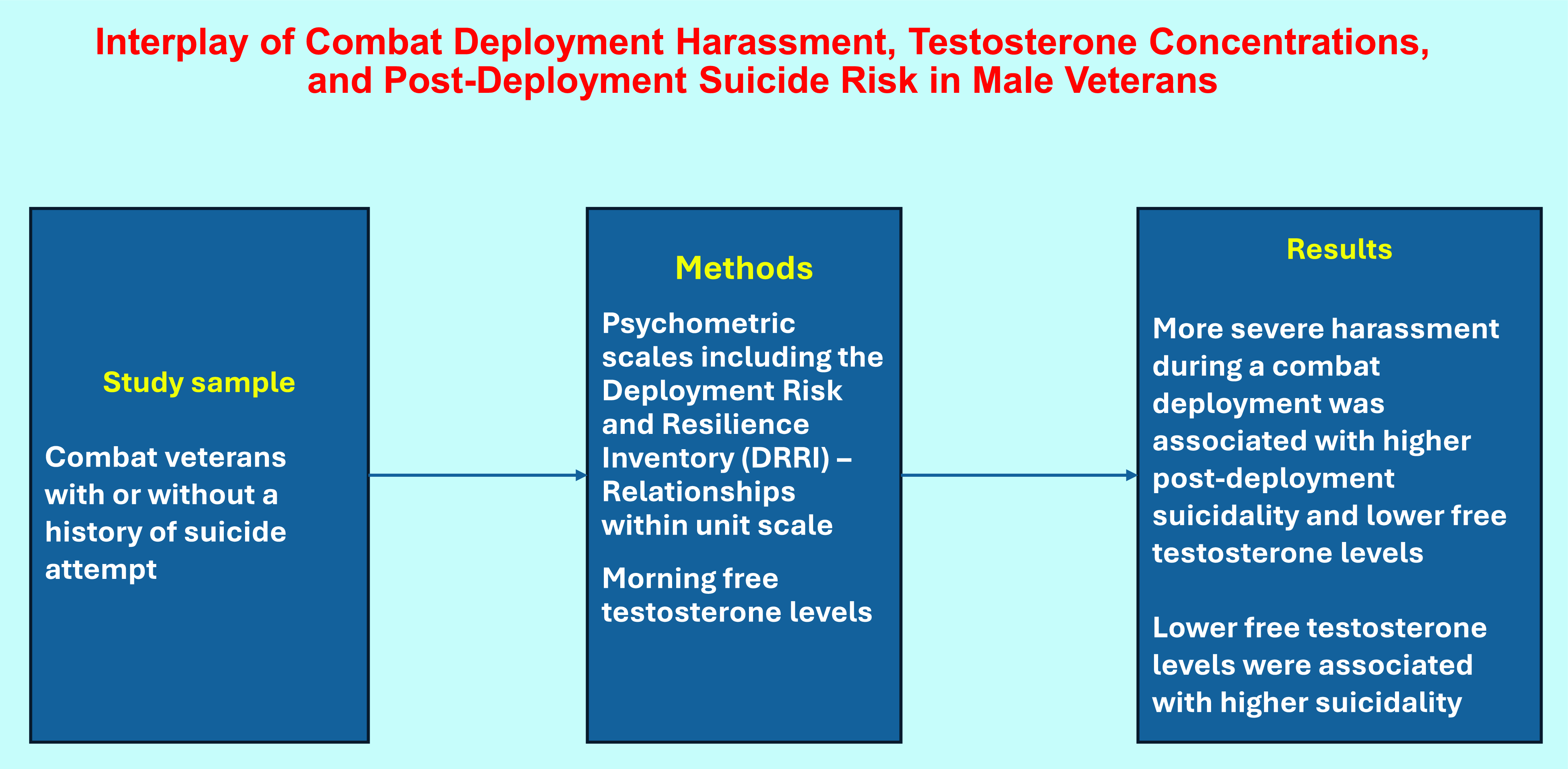
More severe harassment during a combat deployment was associated with higher post-deployment suicidality.
-
More severe harassment during a combat deployment was associated with lower testosterone levels.
-
Lower free testosterone levels were associated with higher suicidality.
Limitations
-
A modest sample size.
-
Only combat veterans who volunteered to participate in the research project were included in the study.
Introduction
Studies suggest that many combat veterans exhibit suicidal ideation and behaviour (Kang and Bullmann, Reference Kang and Bullman2008; Pietrzak et al, Reference Pietrzak, Goldstein, Malley, Rivers, Johnson and Southwick2010; Sher and Yehuda, Reference Sher and Yehuda2011; Cigrang et al., Reference Cigrang, Balderrama-Durbin, Snyder, Talcott, Tatum, Baker, Cassidy, Sonnek, Smith Slep and Heyman2015; Denneson et al., Reference Denneson, Teo, Ganzini, Helmer, Bair and Dobscha2015; Monteith et al., Reference Monteith, Hoffmire, Holliday, Park, Mazure and Hoff2018; Reger et al., Reference Reger, Tucker, Carter and Ammerman2018; Sher, Reference Sher2024). A study of about 300 Iraq/Afghanistan war veterans reported that 12.5% had contemplated suicide in the 2 weeks preceding the survey (Pietrzak et al, Reference Pietrzak, Goldstein, Malley, Rivers, Johnson and Southwick2010). One study found a higher suicide rate in service members who were currently deployed or previously deployed compared with those who had never been deployed (Schoenbaum et al., Reference Schoenbaum, Kessler, Gilman, Colpe, Heeringa, Stein, Ursano and Cox2014). A more recent study found that there was an increased risk of suicide when all Iraq/Afghanistan war veterans were compared to the US population (Bullman and Schneiderman, Reference Bullman and Schneiderman2021). Both male and female veterans had an increased risk of suicide when compared to their gender-specific non-veteran counterparts. After 15 years of follow-up, Iraq/Afghanistan war veterans continued to have a suicide rate that exceeds that of the US population.
The relationship between combat deployments and suicidality are not fully understood. Studies suggest that the deployment environment may affect post-deployment suicide risk (Lemaire & Graham, Reference Lemaire and Graham2011; Monteith et al., Reference Monteith, Hoffmire, Holliday, Park, Mazure and Hoff2018). For example, it has been observed that experiences of harassment are associated with suicidal ideation in Iraq/Afghanistan war veterans (Lemaire & Graham, Reference Lemaire and Graham2011). Exposure to harassment, that is, to unwanted negative behaviour that is intended to cause damage and/or is perceived as unpleasant, hostile and damaging is a psychosocial factor which frequently has powerful negative effects on mental health, including suicidality (Hom et al., Reference Hom, Stanley, Spencer-Thomas and Joiner2017; Mitchell et al., Reference Mitchell, Jones and Turner2021; Campbell-Sills et al., Reference Campbell-Sills, Sun, Kessler, Ursano, Jain and Stein2023; Thomas et al., Reference Thomas, Hummel, Schäfer, Wittchen and Trautmann2023).
Research observations indicate that high levels of endogenous testosterone promote behaviour intended to dominate (Mazur and Booth, Reference Mazur and Booth1998; Dreher et al., Reference Dreher, Dunne, Pazderska, Frodl, Nolan and O’Doherty2016; Inoue et al., Reference Inoue, Burriss, Hasegawa and Kiyonari2023). Research findings link testosterone with both aggressive and non-aggressive status-seeking. A fraction of testosterone circulates as non-protein-bound or free testosterone. Only this free fraction is biologically active. Therefore, it is possible that men with higher free testosterone levels are less likely to be harassed.
In this study, we tested a hypothesis that harassment during a combat deployment is associated with post-deployment suicidality and testosterone function.
Materials and methods
Fifteen male combat veterans who made post-deployment suicide attempts within 5 years preceding the day of initial evaluation and 17 demographically matched veterans without a history of suicide attempts were enrolled in our study. Suicide attempts were defined as a potentially self-injurious behaviour for which there is evidence that the individual probably planned to kill himself/herself. Veterans without a history of suicide attempts were selected from the same group of individuals with psychiatric disorders as suicide attempters at the James J. Peters VA Medical Center (JJP VAMC). At a time deemed clinically appropriate, JJP VAMC inpatient, outpatient or emergency department clinical staff working with the veteran introduced the study. Inclusion criteria included age 18–65 years and being able to provide informed consent. Exclusion criteria included primary psychotic disorder and major medical or neurological illness. All veterans who participated in the study had a physical examination and laboratory tests, including toxicological screenings to exclude medical or neurological abnormalities that could influence their psychiatric state.
Veterans were informed that study participation was completely voluntary and choosing to participate or to decline participation will not affect VA clinical treatment or services. Written informed consent was obtained prior to study enrolment. The research project was approved by the Institutional Review Board at the JJP VAMC.
Study participants were interviewed by a trained clinician using the Mini-International Neuropsychiatric Interview (MINI) (Sheehan et al., Reference Sheehan, Lecrubier, Sheehan, Amorim, Janavs, Weiller, Hergueta, Baker and Dunbar1998) to establish DSM-IV diagnoses, the Deployment Risk and Resilience Inventory (DRRI) – Relationships within unit scale (DRRI) (King et al., Reference King, King, Vogt, Knight and Samper2006) to examine harassment during a combat deployment, the Scale for Suicidal Ideation (SSI) (Beck et al., Reference Beck, Kovacs and Weissman1979) to examine suicidal ideation, and the Brown–Goodwin Aggression Scale (Brown and Goodwin, Reference Brown and Goodwin1986) to assess the severity of aggression, a characteristic often associated with suicidal behavior.
Fasting blood samples were drawn between 8:00 and 8:30 am. Free testosterone kits utilise a competitive immunoassay created and validated for the in vitro diagnostic determination of testosterone in human blood. The free testosterone assay sensitivity is 0.018 pg/mL. The intra-assay and inter-assay coefficients of variation for the free testosterone assay are 8.1% and 6.9%, respectively. The interval between the interviews and the blood tests did not exceed 2 weeks.
Demographic, clinical and biological data were compared using Student’s t-test, chi-square test, and their association evaluated using correlations, as appropriate. We used the t-test to analyse continuous variables. The chi-square test was employed to test for differences in proportions between the groups. We used correlations to examine the linear relationship between two continuous variables. DRRI harassment scores and morning free testosterone levels were also compared between attempters and non-attempters by means of a general linear model, with ‘Group’ as fixed factor and ‘DRRI harassment scores’ or ‘testosterone levels’ as dependent factor. ‘Mood disorders’, ‘posttraumatic stress disorder (PTSD)’, ’substance use disorders’ and ‘aggression severity’ were included in these analyses as covariates. The SPSS 27 program was used for statistical analysis.
Results
There were no differences regarding demographic parameters because the groups were demographically matched (Table 1). SSI scores were higher among veterans with a history of suicide attempts in comparison with non-attempters (Table 1).
Demographic and clinical features of combat veterans with or without a history of suicide attempts

*R, range.
DRRI harassment scores were higher among suicide attempters in comparison with non-attempters (Table 1). The difference between attempters and non-attempters in DRRI harassment scores remained significant after the adjustment for mood disorders, PTSD, substance use disorders, and aggression severity (df = 1,26, F = 5.62, p = 0.025). In the whole sample, SSI scores positively correlated with DRRI harassment scores (n = 32, r = 0.40, p = 0.02).
In the whole sample, morning free testosterone levels negatively correlated with DRRI harassment scores (n = 32, r = −0.36, p = 0.04) and with SSI scores (n = 32, r = −0.57, p < 0.001). Morning free testosterone levels were lower in suicide attempters in comparison with non-attempters (Table 1). The difference between attempters and non-attempters in testosterone levels remained significant after the adjustment for mood disorders, PTSD, substance use disorders and aggression severity (df = 1,26, F = 8.43, p = 0.007).
Aggression scale scores positively correlated with DRRI harassment scores among non-attempters (n = 17, r = 0.56, p = 0.02) but not among attempters (n = 15, r = −0.19, p = 0.49).
Discussion
Harassment and suicidality
We have found that higher deployment harassment scores are associated with post-deployment suicide attempts and greater post-deployment suicidal ideation. Our findings are consistent with research reports suggesting that various forms of harassment are associated with suicidality in veteran and non-veteran populations (Lemaire & Graham, Reference Lemaire and Graham2011; Hom et al., Reference Hom, Stanley, Spencer-Thomas and Joiner2017; Griffith, Reference Griffith2019; Thomas et al., Reference Thomas, Hummel, Schäfer, Wittchen and Trautmann2023). For example, a cross-sectional review of mental health evaluations of about 2,000 Iraq/Afghanistan war veterans showed that general (non-sexual) harassment was associated with suicidal ideation (Lemaire & Graham, Reference Lemaire and Graham2011). A study of about 13,000 US soldiers found that sexual harassment was associated with a fivefold increase for risk of suicide (Griffith, Reference Griffith2019).
A feature of military life is its institutional nature (Griffith, Reference Griffith2019). Life in the military takes place nearly completely in one setting. In comparison with the civilian population, military units are closed systems. This can be an additional stress on targets of harassment because they have limited opportunity to obtain support outside the military unit.
Harassment frequently involves an individual being put in a position where this person has problems defending him/herself. Harassed individuals frequently feel helpless, stressed out, anxious, and hopeless and expect to become subject of further negative treatment. It has been suggested that lower resilience and higher hopelessness may mediate the relationships between harassment and suicidality (Livingston et al., Reference Livingston, Tannahill, Meter, Fargo and Blais2022). Stress and anxiety may also increase suicide risk.
Testosterone
We have observed that free testosterone levels negatively correlated with harassment scores. This may indicate that individuals with higher testosterone levels are less likely to be harassed. Indeed, studies suggest that being victorious in competitive circumstances, including situations involving aggression, can result in the heightened testosterone levels, and this can accrue across recurrent victories to raise the testosterone levels of more successful men (Carre and Archer, Reference Carre and Archer2018). Studies and theoretical papers suggest that testosterone mediates diverse types of status-seeking behaviour, augmenting competitive or aggressive behaviour, and stimulating prosocial behaviour to attain and preserve social status or dominance (Mehta and Beer, Reference Mehta and Beer2010; Terburg et al., Reference Terburg, Syal, Rosenberger, Heany, Stein and Honk2016; Carre and Archer, Reference Carre and Archer2018). Repeated social defeat decreases testosterone levels, subsequently decreasing dominance drive. Social anxiety is associated with lower testosterone levels (Hutschemaekers et al., Reference Hutschemaekers, de Kleine, Davis, Kampman, Smits and Roelofs2020). Harassment can be regarded as a state of social defeat associated with anxiety. Therefore, harassment may reduce testosterone levels. It should be noted that studies indicate that there is a significant individual and situational variability in the testosterone–behaviour connection. For example, studies have shown that both low and high testosterone levels may be associated with suicidality (Sher, Reference Sher2023). Variations in the results of these studies may be related to differences in patient populations and the research methodology.
Our observations that harassment scores are associated with suicidality and testosterone levels and suicidality is associated with testosterone levels may indicate that there is a link between deployment harassment, testosterone function and suicidality.
Aggression
We found that that aggression scale scores positively correlated with harassment scores among suicide non-attempters but not among attempters. This indicates differences in the psychobiological regulation between suicide attempters and non-attempters and is consistent with some previous observations (Sachs-Ericsson et al., Reference Sachs-Ericsson, Hames, Joiner, Corsentino, Rushing, Palmer, Gotlib, Selby, Zarit and Steffens2014; Sher et al., Reference Sher, Bierer, Flory, Makotkine and Yehuda2020; Sher et al., Reference Sher, Bierer, Makotkine and Yehuda2021). For example, we have previously observed that plasma neuropeptide Y (NPY) levels positively correlated with aggression scale scores among suicide attempters but not among non-attempters (Sher et al., Reference Sher, Bierer, Flory, Makotkine and Yehuda2020).
Limitations
A modest sample size is a limitation of this study. Also, only combat veterans who volunteered to participate in the research project were included in the study. This could influence the outcomes of the study. Differences in combat experiences, severity of psychiatric conditions and medication use could also affect the results of the study.
Conclusion
Multiple psychological and biological factors affect suicidality in both civilians and military veterans (Lemaire & Graham, Reference Lemaire and Graham2011; Rihmer and Gonda, Reference Rihmer and Gonda2012; Elman et al., Reference Elman, Borsook and Volkow2013; van Heeringen and Mann, Reference van Heeringen and Mann2014; Ejdesgaard et al., Reference Ejdesgaard, Zøllner, Jensen, Jørgensen and Kähler2015; Shen et al., Reference Shen, Cunha and Williams2016; Sher, Reference Sher2023; Department of Veterans Affairs, 2022). Harassment is one of these factors and an important issue in the military. It can have significant negative effects on psychological health and lead to suicidal behaviour. Prevention of harassment in the military is a critical task.
Commanders can deter harassing behaviour because they observe and control military personnel (Gilberd, Reference Gilberd2018; Griffith, Reference Griffith2019). This shows the importance of selections and effective training of military leaders which affects a lot of individuals and processes that make up the Armed Forces. Effective military leaders are expected to value their subordinates and protect them from harassment. If harassment complaints are substantiated, military leadership is expected to take appropriate disciplinary or administrative action against the harasser (Gilberd, Reference Gilberd2018).
The results of our study are relevant to clinical practice and research. Our results suggest that including assessments of deployment harassment may have clinical utility for understanding the degree of suicide risk in veterans. Our study indicates that combat veterans with a history of deployment harassment need to be frequently screened for suicidality. The adequate treatment for psychiatric and medical disorders including targeted psychotherapeutic interventions for trauma, depression, and other symptoms, and effective social assistance may mitigate negative long-term effects of deployment harassment. The results of our study may also contribute to the development of biomarkers for suicidal behaviour among military veterans.
Future studies of harassment in the military should investigate possible mediators in the association of harassment with suicidal behaviour such as shame, perceived burdensomeness, and social alienation. Also, we need studies of what psychotherapeutic and psychopharmacological interventions for victims of harassment in the military are the most effective.
Supplementary material
The supplementary material for this article can be found at https://doi.org/10.1017/neu.2024.12.
Author contribution
Authors LS and RY designed the study and wrote the protocol. Author LS managed the literature searches and undertook the statistical analysis. All authors contributed to and have approved the final manuscript.
Financial support
This study was supported by a Lightfighter Trust Foundation Grant to Prof. Leo Sher.
Competing interests
None.
Ethical standards
The authors assert that all procedures contributing to this work comply with the ethical standards of the relevant national and institutional committees on human experimentation.



