Political observers have detected a noticeable uptick in American political incivility in recent years, culminating with several moderate senators recently citing the rise of hard-core partisanship as the reason for their retirement. Supporting these accusations of unprecedented incivility with empirical evidence can be difficult, as notions of what constitutes appropriate, civil behavior are subjective and can vary across the political context of different eras. Was it more uncivil, for example, for William Jennings Bryan to accuse his political opponents of crucifying other Americans on a cross of gold than it was for a member of Congress to yell “You lie!” at the president in the nation's Capitol? Assessing the incivility of these statements requires determining the effect each had on political opponents' abilities to maintain a functional relationship despite their disagreement over policy outcomes. Nevertheless, many politicians, political observers, and scholars are truly concerned that current levels of incivility are indeed worse, not only damaging the ability to resolve complex public problems, but threatening the long-term stability of America's governing institutions. Largely focusing on changes in institutional structures and elite behavior, scholars identify numerous explanations for this trend.
For some people, political incivility is merely an extension of the coarsening of American culture and society. Like many of today's cocky athletes, perhaps politicians prefer taunting to sportsmanship. Others suggest the changed media environment pollutes the political discourse either by highlighting extreme viewpoints to “gin up” ratings or because radio hosts, cable news hosts, and websites provide aggressively biased information that erases any objectivity or tolerance for others' viewpoints. Three more political components receive particular attention, including the use of vitriolic language in politics and campaigns, a growing ideological gulf between the two parties, and—likely due to this partisan polarization—a growing unwillingness among political elites to accept compromise.
Although scholars often focus on these institutional causes and on elite behavior, few focus on how the American electorates' response to such episodes exacerbates the spiral of political incivility. To address this, we rely on results from three surveys, conducted from April 2010 through the midterm Election Eve, to examine the public's reactions to political incivility, particularly focusing on people's perceptions of the political debate and the tone of the campaign, along with their willingness to embrace deliberation and compromise. The complex interaction of these elements makes these difficult to untangle to highlight their independent influences on our current political discourse much less how they fit together.
Our findings suggest, however, that a secondary layer of partisan polarization among the electorate extends beyond particular issue positions and ideological differences. We argue rebuffing consensus is not just a consequence of polarization, but a second level of hostility that provides important additional insight into the intense nature of the current partisan divide. In short, incivility contributes to conditions that make future consensus even less possible, as the emphasis on partisan divisions, political incivility, and unwillingness to compromise demobilizes those voters who prefer civil deliberative politics and mobilizes those who favor the balkanized party positions. This electoral outcome provides elected officials with an explicit mandate that they should refuse to reach out to colleagues in the opposing party. To this point, little disincentive for politicians to cease their bare-knuckled political tactics exists. The public's views tighten an already uncomfortable knot and discourage the type of introspection that would allow partisan elected officials to untie it.
CIVILITY AND COMPROMISE
Division and hard-edged politics should not shock scholars who study politics. We tell our introductory-level students that, at its core, politics is about conflict over who gets what, when, and how. From this perspective, consensus may be the hardest part of politics to understand. As a discipline, we often fail to focus on why civility and the type of compromises civil interactions can facilitate are so important. Yet politeness promotes cooperation among potentially strong adversaries, and civility helps to maintain these types of functional relationships by minimizing fears of looming opposition and dominance (Brown and Levinson Reference Brown and Levinson1987). As Herbst (Reference Herbst2010) convincingly argues, civility and incivility should be perceived as tools that political actors use to pursue desired outcomes rather than positive or negative personality traits. When a desired outcome requires cooperation with adversaries, strategic political actors are more inclined to be civil to one another. When they believe they can or must defeat an opponent to obtain a desired outcome, demonizing the opposition to rally the base may be perceived as a better tactic.
This transactional view of civility fits with Jamieson and Hardy's article in this symposium in which they contend that congressional members have historically valued civility because they recognized the need to engage in deliberation and compromise despite their differences. Similarly, Drew (Reference Drew2000) argues that recent congressional failures can be attributed to abandoning civility and compromise in favor of standing firm on principle. Much of our understanding of the benefits of civil deliberation are derived from studies of social networks rather than political leaders. Although how much or little political disagreement and debate occurs among Americans (Huckfeldt, Johnson, and Sprague Reference Huckfeldt, Johnson and Sprague2004; Mutz Reference Mutz2006) is disputed, scholars agree that exposure to political disagreement makes people better understand opposing political viewpoints (Huckfeldt, Morehouse Mendez, and Osborn Reference Huckfeldt, Morehouse Mendez and Osborn2004; Mutz Reference Mutz2002). This leads to greater political tolerance (Mutz Reference Mutz2002) and increases political knowledge if people approach the process with open minds (Barabas Reference Barabas2004). This overview is not intended to indict the act of standing firm on one's political principles, which can be seen as a noble and courageous political act. Yet, great leaders throughout American history knew how to balance both of these strategic impulses. More often than not, they avoided gridlock by embedding discussions of principles within a deliberative process that also allowed participants to maintain a functional relationship and to seek compromise.
A SECOND LAYER TO PARTY POLARIZATION
In the past four decades, the two political parties have become more ideologically pure following the shift of Southern conservative Democrats to the Republican party (Black and Black Reference Black and Black2002; Carmines and Stimson Reference Carmines and Stimson1989), as well as the countering trend of Northeast liberal Republicans embracing the Democratic party (Reiter and Stonecash Reference Reiter and Stonecash2011). These shifts mean that the parties are further divided than at any point in modern American history. The level and nature of this division has been at the center of a tremendous scholarly debate over the past decade. Morris Fiorina and colleagues claim that average American voters are sorted but not highly polarized, while Alan Abramowitz and colleagues argue that partisan divisions in the electorate run very deep. Fiorina and colleagues (Fiorina and Abrams Reference Fiorina and Abrams2009; Fiorina, Abrams, and Pope Reference Fiorina, Abrams and Pope2005) argue that political elites and party activists, encouraged by a sensationalist media, are ideologically extreme—but that the general public continues to hold moderate political views. On one hand, political observers, Fiorina and colleagues claim, often wrongly assume the extreme ideological choices party leaders and activists provide match the more moderate electorate's policy preferences. Because this “disconnect” occurs when election results have been close, the misperception that America is deeply divided has grown when, in fact, it is only closely divided (Fiorina and Abrams Reference Fiorina and Abrams2009) (Fiorina, Abrams, and Pope Reference Fiorina, Abrams and Pope2005). Abramowitz (Reference Abramowitz2010; Abramowitz and Saunders Reference Abramowitz and Saunders2008), on the other hand, contends that polar issue positions, preferences, and ideology encompass the public broadly and are not limited to political leaders and activists.
The heart of the debate goes beyond increased partisan issue divisions and implicitly asks whether partisan ideological disagreements damage civility and consensus-seeking between the parties, especially as they move from the electoral to the legislative arena. This outcome is one that the Columbia School scholars feared long ago, warning: “Extreme interest goes with extreme partisanship and might culminate in rigid fanaticism that could destroy democratic processes if generalized throughout the community” (Berelson, Lazarsfeld, and McPhee Reference Berelson, Lazarsfeld and McPhee1954, 314). In contemporary times, Fiorina and Abrams cut to the chase, arguing that the general public rejects rigid fanaticism, as they believe that moderation extends to a preference for consensual politics as well as issue positions. Fiorina and Abrams claim that the “… dogmatic, divisive, and uncivil style of ‘debate’ engaged in by many members of the political class is not appreciated by ordinary Americans, who are for the most part less certain, more open to compromise, and more polite than their leaders” (Fiorina and Abrams Reference Fiorina and Abrams2009, xix–xx).
Empirical evidence to support or disprove this claim is key. An electorate deeply separated on nuts-and-bolts policy questions, but willing to accept compromise, differs substantially from an electorate deeply divided on policy and unwilling to budge from its positions. Further, a second dimension of polarization may encourage intransigence if partisans simply lay blame for incivility and gridlock on the opposition's doorstep. Our findings support the claim that a substantial number of Americans not only have strong policy preferences, but also reject consensual politics. Further, we find that Republicans and Democrats differ greatly on their views of civility, whether it is more important for politicians to compromise to get things done, or stand firm on principle, and who is to blame for incivility. Partisan differences also help explain who is demobilized or mobilized by campaign negativity. Partisan strength exacerbates these attitudes and, in combination with a desire for politicians who to stick to their guns, makes future consensus even less likely.
PARTISANSHIP, COMPROMISE, AND CAMPAIGN NEGATIVITY
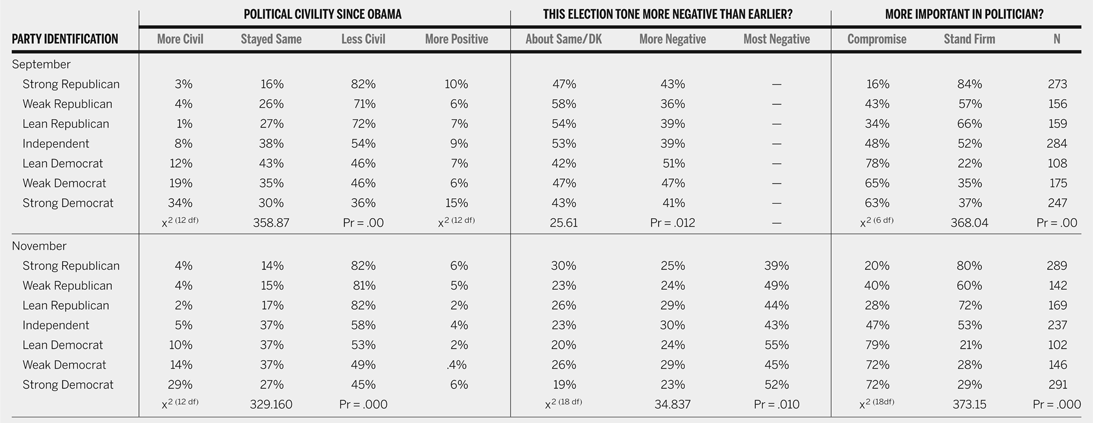
Our findings emerge from three surveys by Allegheny College's Center for Political Participation. The first was administered in April 2010 in the wake of the Affordable Care Act passage. The second wave was administered in mid-September, and the final wave covered the last days of October up through the night before the 2010 midterm election.Footnote 1 Because we merge campaign-related data, we largely concentrate on the latter two waves. Table 1 provides a descriptive overview of voters' attitudes across all levels of partisan identity, regarding political civility since the Obama presidency, their perceptions of the midterm election's tone, and their preferences for either politicians who stand firm or who compromise. The noteworthy finding is that, in the November sample, the number of partisans at the polar extremes is nearly as great (for Republicans) or greater (for Democrats) than those who merely identify or lean toward the party. Whereas a majority of 2010 midterm voters were not strongly aligned with one party or the other, a substantial 42% of the November wave's respondents were strong partisans. Further, our findings correspond to previous work indicating that partisan leaners tend to hold stronger attitudes than weak partisans (Abramowitz Reference Abramowitz2010). Clearly, the partisan divide reported here is both numerically and substantively significant.
Party Identification Strength and Views of Political Civility, Campaign Tone, and Importance of Politicians Compromising

Note: Data in percentages are weighted. Chi-square tests run on unweighted data.
Perhaps not surprisingly, respondents' views of civility worsened across all three waves of the survey. Of the respondents in the four days leading up to the November midterm elections 63% said that politics had become less civil since President Obama took office, up from 48% in the April survey and 58% in September. Clearly partisanship influenced the evaluation of civility, likely due to the inclusion of Obama's name in the question. Yet except for strong Republicans, all groups were more likely to see the tone of the 2010 as more negative than past campaigns or the most negative they had ever seen.
Stark differences existed among the partisan respondents about their desire to elect politicians who stand firm versus those who compromise, with a clear majority of Republicans wanting principled stands and a large majority of Democrats wanting politicians to compromise. The Pew Research Center has noted that Democrats have been significantly more likely to prefer compromise than Republicans since 1987 (77% to 66%), with this gap growing over time (87% to 70% in 2007). Furthermore, the Pew Research Center also conducted a poll during the 2010 midterm elections. They found breakdowns of Democrats and Republicans similar to our findings, although they asked whether respondents admired politicians who were willing to compromise versus those who “stick to their positions” (Pew Research Center 2007, 2010). One reason for this divide could be the historical party make-up of Democrats who, born of the New Deal, were always forced to compromise with one another to build a viable coalition, whereas the more homogenous Republicans could afford the luxury of making principled stands.
A second reason may be, as Hetherington and Weiler (Reference Hetherington and Weiler2009) contend, that the parties reflect contending worldviews, with Republicans who tend to prefer the social status quo and view “others” with suspicion, and Democrats who tend to embrace diversity and oppose the static social order upheld by Republicans. Clearly, the specific reason for the partisan gap on whether politicians should compromise or not is beyond the scope of this article. Further, principled political positioning and seeking compromise are both reasonable political tactics, and we do not suggest one is superior to the other. Yet the distinction between partisan respondents in 2010 is clear. Moreover, this preference also has an impact on politicians' strategic choices and on overall levels of political civility during and after the election.
CAMPAIGN NEGATIVITY AND MOBILIZATION
Having read the classic works on campaign negativity written by our fellow contributors to this symposium, we are not naïve enough to suggest that campaign negativity is inherently bad (Geer Reference Geer2006; Jamieson, Waldman, and Sherr Reference Jamieson, Waldman, Sherr, Thurber, Nelson and Dulio2000). Negative advertising informs voters, but may backfire if it is perceived to be unfair or uncivil. We broadened this insight about the strategic benefits and drawbacks of campaign negativity by asking respondents to rate the 2010 campaign tone subjectively, as well as asking them whether this tone influenced their likelihood of participating in politics and whether this tone was good or bad for democracy. We found that most respondents who described the tone of the 2010 campaigns as negative also reported being less likely to participate in the campaign. In short, negativity does appear to suppress some voters' anticipated political participation. However, this demobilization effect was mitigated by respondents' partisanship, partisan strength, as well as by their attitudes toward political compromise.
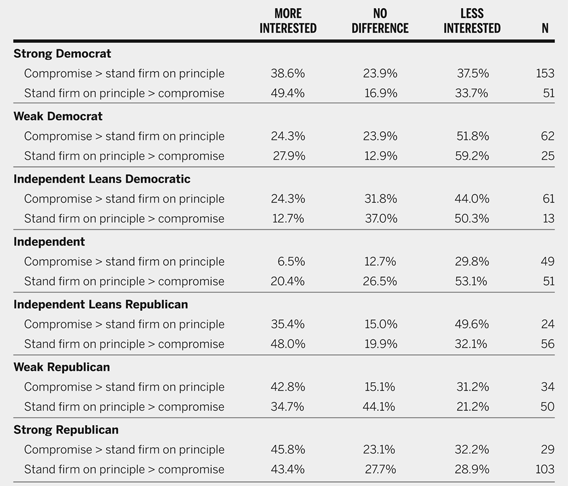
Table 2 includes respondents from the Election Eve wave of the survey who said that 2010 was the most negative campaign they had ever seen and that they thought the tone of the campaign was bad for democracy. Perceptions of a negative campaign combined with the belief that this type of campaign is damaging to democracy should, arguably, result in demobilization. Yet demobilization is far from a consistent response to these perceptions for several reasons. First, as table 1 illustrates, Democrats were far more likely to view the 2010 campaign as negative compared to Republicans, and, not surprisingly, more Democrats claimed that the campaign was bad for democracy. Second, although they evaluated the campaign tone as negative for democracy, the Republicans in table 2 were less likely to be demobilized by the campaign tone than weak and leaning Democrats and Independents. Third, strong partisans had a tendency to be mobilized by perceptions of negative campaigning—even when they believed that negative political campaigns are bad for democracy. For Democrats in particular, this pattern was exacerbated by a preference for principled stands over compromise. Indeed, the participatory interests of strong Democrats who wanted politicians to compromise—the modal group of Democrats who viewed the campaign as the most negative ever and bad for democracy—were slightly more willing but approximated the wish to participate of other Democrats. To the contrary, those strong Democrats who wanted politicians to stand firm on principles were even slightly more likely than strong Republicans to want to vote.
Among Those Who Believe 2010 Was the Most Negative Campaign Ever and Tone Was Bad for Democracy: Respondent Interest in Participating in Politics by Compromise/Stand Firm on Principle

Note: Data are weighted.
Also of note, the boost for Republican participation is not strictly a Tea Party-driven story. Similarly situated Tea Partiers were only marginally more apt to be mobilized than the strong Republicans described in table 2. (This pattern results, in part, from the heavy cross-over between these two groups, as 78% of respondents who self-reported an affiliation with the Tea Party also described themselves as Republicans.)
More than an interesting story about how negative campaign tones affect participation differently depending on a complex mix of party, partisan strength, and views on political compromise, table 2 shows that this particular 2010 midterm election provided Republican candidates with an explicit mandate to avoid compromising with the other side. By the numbers, this campaign tone resonated with their partisans, even the minority who viewed the campaign tone as the most negative ever and bad for democracy. Perhaps not surprisingly, then, these officials had no intention of forging a cooperative relationship with their Democratic colleagues or with the Obama administration. A core portion of strong uncompromising Democrats also were motivated to vote based on the negativity. After it is initiated, it seems that a negative mandate can be a hard cycle to disrupt.
INCIVILITY: WHO'S TO BLAME?
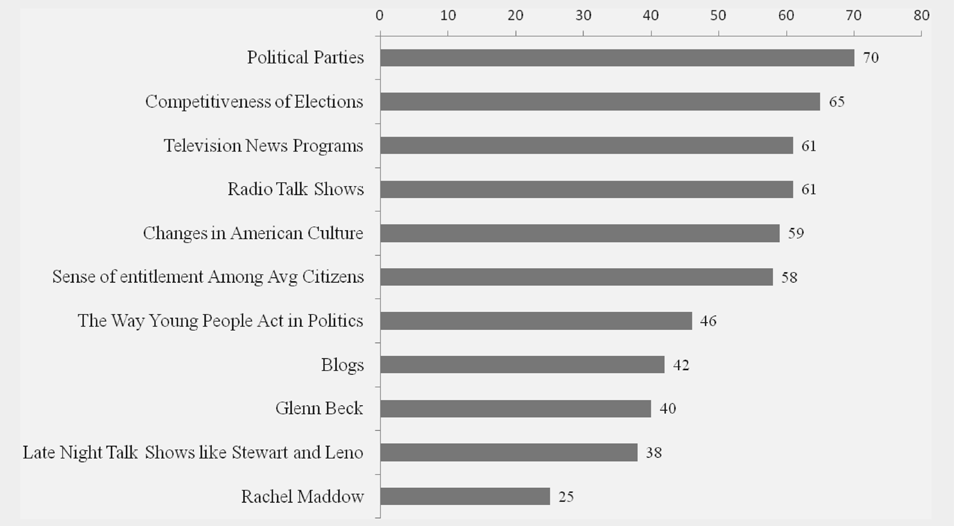
Political observers often hold out hope that more moderate voters, tired of incivility and gridlock, will disrupt this cycle of incivility by holding politicians accountable for their behavior. In the public's eye, are politicians alone to blame or are they caught up in a broader social explanation of incivility? Respondents were asked in the April wave of the survey to identify who was to blame for rising levels of political incivility. They could identify multiple sources of incivility and in figure 1 they cast blame across multiple political, social, and media institutions. Not surprisingly, the American public identifies the same institutions and actors fingered by political pundits and scholars alike. Parties and their competitiveness receive the highest levels of blame, but so too do various political media outlets and broader trends in American society and culture.
Who or What Has Pushed Politics to Become Less Civil?
Source: Nastiness, Name-calling & Negativity: The Allegheny College Survey of Civility & Compromise in American Politics. April 20, 2010. p. 21

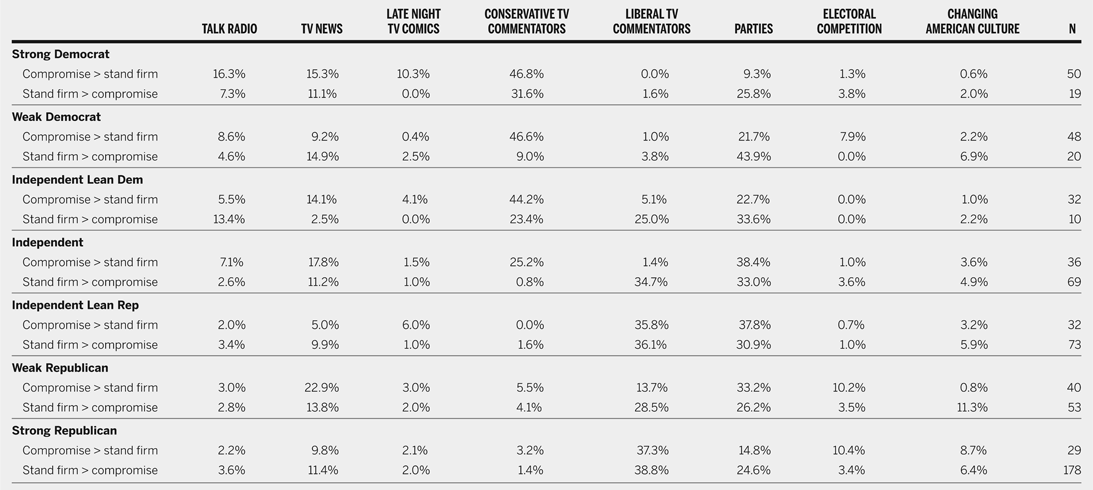
To gain a more nuanced sense of how different types of respondents rank blame, table 3 focuses only on those who think incivility has increased since the election of President Obama and allows respondents to only choose one answer. The table reveals that sources of most intense blame vary considerably according to both partisan strength and preferences for principled or compromising politicians. Replicating the pattern first uncovered in table 2, a respondent's partisanship and appetite for compromise explains a great deal. Independents, for example, are most apt to blame the parties for political incivility, but Independents also castigate ideological television commentators, with Independents who prefer principled politicians being especially critical of liberals on television. Indeed, Independents' appetite for compromise seems to serve as a proxy for their partisan outlook on politics.
Responsibility for Incivility by Party Identification & Whether Politicians Should Compromise/Stand Firm

Note: Cases are only include those who said incivility had gotten worse since President Obama had taken office. Data are weighted. N = 690
Strong partisans are similarly inclined to blame television commentators from the opposite ideological pole the most, with Democrats adding talk radio to their list of culprits. A key distinction among partisans, however, emerges from their outlook on compromise as a quarter of strong Democrats and strong Republicans partisans who want politicians to stand firm on principle blame the “parties” for current levels of incivility. It seems highly unlikely that a strong Republican who does not want politicians to compromise will blame his or her own party for incivility. Strong partisans who want principled stances are simply inclined to blame the problem on the other side. When strong partisans place the entire blame for rising levels of incivility on their opponents, it seems unlikely that they will be the first to initiate the return to a civil, deliberative dialogue. Rather, they are apt to justify “returning fire” as the only appropriate response to their perception of opponents' blatant misconduct.
DISCUSSION
These findings can be interpreted to support those on either side of the party polarization debate. Those who agree with Fiorina will find ample evidence to support the claim that most Americans dislike strident political positions and tactics, and they see the parties as the source of rising political incivility over the past several years. Yet, at least during the 2010 election cycle, Abramowitz' position is bolstered by a substantial percentage of the electorate strongly identified with one party or the other. Unlike other Americans, this intense and large minority is characterized by stark differences in policy preferences and ideological orientations. Furthermore, many strong partisans can also be characterized by their opposition to political compromise and an unwillingness to recognize their own contributions to rising levels of political incivility.
As long as a strong, intense partisan base espouses a preference for principled stands, politicians are apt to rely on negativity and political incivility to rally support from their most reliable supporters. Such endeavors have a two-fold effect, both of which make a downward spiral of political incivility difficult to disrupt. First, such tactics, at least in 2010, demobilized weak and leaning Democrats and most Independents. According to their responses to other questions, these voters preferred politicians who were willing to compromise. These were also the voters most likely to hold politicians accountable for negativity and incivility that could undermine deliberation. Second, if deliberation is no longer a viable option, even those voters who desire compromise may no longer view it as a reasonable political tactic.
Despite significant support for more congenial politics, many strong party supporters favor the strident tone of contemporary American politics and make it difficult to overcome. Any substantial change to campaign law, media coverage, or political institutions to counter incivility looks like it would run into a considerable partisan base whose intensity and commitment to principle would overwhelm reform. Perhaps a reprieve can be expected only when the political incentives change so that one (or both) side(s) decides incivility or negativity does not provide any significant benefits. In turn, one side could win a clear, decisive electoral victory typically associated with a realigning election. As Shea and Sproveri showed in their article in this symposium, the current pitch of debate shows some similarities to realigning eras. If a realignment produced a new majority party, civil deliberation could then proceed within a new majority party. The longer the majority party remained in power, the more likely the members of the minority party would be to reestablish a functional relationship through civility as likely political tactic.
The data here, however, suggest that the incentives stand to further division over deliberation. Further, no established commonly defined, historical or conceptual balance point for consensus and division exists as Shea and Sproveri demonstrate through the wide variance of incivility descriptors in their 200-plus year content analyses. Will theAmerican public prefer a return to a more civil debate, or will current uncompromising and uncivil trends continue and perhaps sharply rise? If either of these latter occur, it is likely due to this second layer of party division as much as it is due to the substantive political issue distinctions between the parties.