

1. Introduction
1.1 Motivation for field assessment
During a recent play in New York's Under the Radar Festival named Invisible Atom, the protagonist Atom begins to question his own existence in the light of recent personal and world troubles. It appears to him that through attempts for growth and discovery, humankind has brought destruction. The theory of the atom – the never-ending quest by scientists to reduce the atom to smaller and smaller parts – serves in the play as an allegory to excess and greed, which also led to the economic crisis that personally affects Atom, and to the dark consequences of ‘progress’.
Like Atom's questioning and quest for truth, the biological community has continually inspected its progress. Recent NIH and DOE workshops have explored the impact of modeling on biology and the potential utilization of next-generation computing technology by the biological community (DOE, 2009; IMAG, 2009). Recognizing the immense challenges in biology in the 21st century, the NAS has urged for biology's integration with other fields as well as biology's consolidation of its many sub-disciplines (NAS, 2009). Furthermore, the general realization that many problems in biology have turned out to be much more difficult than originally perceived (Hayden, Reference Hayden2010) also affects the impact that modeling can have on solving them. Finally, suggestions have been made of a growing gap between academe and industry as far as molecular modeling is concerned (Nicholls, Reference Nicholls2010) and a cultural disparity between academic and industrial sectors, including basic versus applied research (Mowery et al. Reference Mowery, Nelson, Sampat and Ziedonis2004; Washburn, Reference Washburn2005).
Taken together, it is now valuable to consider progress in the field of biomolecular modeling and simulation, which appears in a critical ‘coming-of-age’ time, roughly 40 years after it started. How has modeling fulfilled initial expectations? Has it become a field on its own right? Are the technological advances paying off? How successful are expansions of the scope of the simulation subjects – molecular size, complexity and simulation time? How is modeling perceived in the experimental community, by scientists outside of academe, and by the general public? What are future prospects for the field?
Through specific examples, some of which were provided in response to a questionnaire (Appendix A), we sketch the field's progress over the past few decades; see Schlick et al. (Reference Schlick, Skeel, Brünger, Kalé, Board, Hermans and Schulten1999) for an early assessment of algorithmic challenges in computational molecular biophysics, and recent perspectives regarding protein-folding advances (Dill et al. Reference Dill, Ozkan, Shell and Weikl2008), protein modeling's impact on biomedical research (Schwede et al. Reference Schwede, Sali, Honig, Levitt, Berman, Jones, Brenner, Burley, Das, Dokholyan, Dunbrack, Fidelis, Fiser, Godzik, Huang, Humblet, Jacobson, Joachimiak, Krystek, Kortemme, Kryshtafovych, Montelione, Moult, Murray, Sanchez, Sosnick, Standley, Stouch, Vajda, Vasquez, Westbrook and Wilson2009) and the usage of dynamics simulations to interpret single-molecule pulling experiments (Lee et al. Reference Lee, Hsin, Sotomayor, Comellas and Schulten2009), for example.
Our examination of computing trends and specific examples of success suggest that biomolecular modeling and simulation is a vibrant field with demonstrated successes and immense potential to impact biology, medicine, and technology. Thus, despite unrealistic high expectations expressed in the late 1980s, technical advances in computer technology and algorithms have transitioned the field well onto a productive and exciting trajectory of being not only full partner with experiment but eventually a field on its own right.
In the next section, we provide a brief historical perspective of the field. Section 2 presents metrics of the field's rise in popularity, as reflected by publication records and computer power progress. Section 3 collects statements concerning the field's expectations, and Section 4 presents a proposed expectation curve for the field. Sections 5 and 6 discuss in turn examples of success and failure. Our summary in Section 7 is followed by general recommendations to accelerate the field's progress. The appendix presents our community questionnaire, used to sample some opinions rather than represent the field exhaustively, and mentions some observations shared by respondents.
1.2 What is molecular modeling?
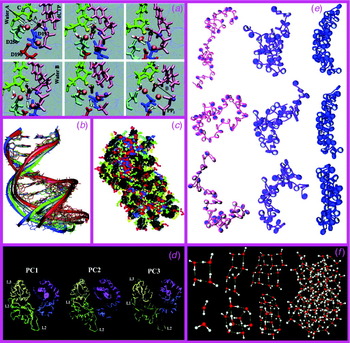
Molecular modeling is the science and art of studying molecular structure and function through model building and computation. The model building can be as simple as plastic templates or metal rods, or as sophisticated as interactive, animated color stereo-graphics and laser-made wooden sculptures. The computations encompass ab initio and semi-empirical quantum mechanics, empirical (molecular) mechanics, visualization, homology modeling, docking, molecular dynamics (MD), Monte Carlo, free energy and solvation methods, enhanced sampling and pathway methods, principal component analysis (PCA), structure/activity relationships (SAR), chemical/biochemical information and databases and many other established procedures and methods (see Fig. 1 for examples).
Examples of various modeling methods and applications. (a) QM/MM pathway (from top left to bottom right) of DNA repair enzyme polymerase β nucleotide incorporation (Radhakrishnan & Schlick, Reference Radhakrishnan and Schlick2006); (b) superimposed MD configurations from a solvated dodecamer simulation; (c) mesoscale oligonucleosome model with nucleosome cores in grey and tails and linker histones in color (see Arya & Schlick, Reference Arya and Schlick2009; Schlick, Reference Schlick and Fish2009a for details); (d) top three principal component motions in the thumb and finger subdomains of DNA polymerase β (Arora & Schlick, Reference Arora and Schlick2004); (e) representative Monte Carlo snapshots in the sampling of 48-unit oligonucleosomes at three different salt environments using the model shown in (c); and (f) minimized water clusters.

The questions being addressed by computational approaches today are as intriguing and as complex as the biological systems themselves. They range from understanding the equilibrium structure of a small biopolymer subunit to the energetics of hydrogen-bond formation in proteins and nucleic acids, binding affinities of ligands/drugs to their target, complex kinetics of protein folding and the complex functioning of a supramolecular aggregate. Indeed, given many experimental triumphs, modeling approaches are needed to pursue many fundamental questions concerning the biological motions and functions of complex systems like ion channels, signaling receptors, membrane transporters, ribosomes, nucleosomes and non-coding RNAs. Modeling can provide a way to systematically explore structural/dynamical/thermodynamic patterns, and test and develop hypotheses to help understand and extend basic laws that govern molecular structure, flexibility and function.
With improved modeling algorithms, better force fields, faster computers and experimental advances (e.g. single-molecule techniques and high-speed X-rays), modeling and simulation have expanded in both quality and scope. Problems and approaches that were insurmountable a few years ago are now possible.
Yet, a field's maturity also implies that some current users may not be familiar with caveats and inherent approximations that field pioneers clearly recognized. Indeed, the readily available programs for simulation and visualization make usage much more facile but possibly also easier to abuse. Moreover, advanced programs and simulation methods like MD and folding are far from generally applicable automated procedures; their application relies on user expertise as well as biological intuition.
1.3 Field roots
The field of biomolecular modeling is relatively young, having started in the 1960s, with pioneers like Lifson, Scheraga, Allinger, Levitt, Warshel and others. Building upon the simulation technique described in 1959 by Alder and Wainwright and applied to hard spheres (Alder & Wainwright, Reference Alder and Wainwright1959), Rahman and Stillinger described in the early 1970s the first MD simulation of a polar molecule, liquid water (Rahman & Stillinger, Reference Rahman and Stillinger1971, Reference Rahman and Stillinger1974).
These developments led quickly to using molecular mechanics force fields with energy minimization as a tool for refinement of crystal structures in the late 1970s (Jack & Levitt, Reference Jack and Levitt1978; Konnert & Hendrickson, Reference Konnert and Hendrickson1980), enzyme energetics (Warshel & Levitt, Reference Warshel and Levitt1976) and later to MD approaches (McCammon et al. Reference McCammon, Gelin and Karplus1977) (see below) that excited practitioners.
It took a few more years, however, for the field to gain legitimacy, because the work of these computational chemistry pioneers could not be easily attributed to a specific discipline; moreover, the notion of transferability of force field parameters was criticized by spectroscopistsFootnote 1.
When the first-generation biomolecular force fields were established, the rising power of supercomputers widened the possibilities for application. Most programs and force fields today, for both small and large molecules, are based on the works of the pioneers mentioned above and their co-workers, with the addition of water force fields developed in the late 1970s and early 1980s by Berendsen and co-workers (e.g. Ryckaert et al. Reference Ryckaert, Ciccotti and Berendsen1977) and by Jorgensen and co-workers (Jorgensen et al. Reference Jorgensen, Chandrasekar, Madura, Impey and Klein1983) (SPC and TIP3P/TIP4P, respectively), concepts in protein electrostatics and enzyme/substrate complexes in solution by Warshel and colleagues (Warshel & Levitt, Reference Warshel and Levitt1976; Warshel & Russell, Reference Warshel and Russell1984), and pioneering pharmaceutical applications by the late Peter Kollman (Wang et al. Reference Wang, Donini, Reyes and Kollman2001).
1.4 Current simulation trends
Modern versions of these and other molecular simulation packages have led to competition for ‘better, bigger, and faster’ program design. Programs like NAMD (Phillips et al. Reference Phillips, Braun, Wang, Gumbart, Tajkhorshid, Villa, Chipot, Skeel, Kalé and Schulten2005), Desmond (Bowers et al. Reference Bowers, Chow, Xu, Dror, Eastwood, Gregersen, Klepeis, Kolossvary, Moraes, Sacerdoti, Salmon, Shan and Shaw2006), or GROMACS (Berendsen et al. Reference Berendsen, van der Spoel and van Drunen1995; Lindahl et al. Reference Lindahl, Hess and van der Spoel2001) have focused on efficient multi-processor implementations. In addition, a specialized computer hard wired for long MD simulations, called Anton, has been launched with the explicit goal of generating long simulations (approaching the millisecond and beyond) (Shaw et al. Reference Shaw, Deneroff, Dror, Kuskin, Larson, Salmon, Young, Batson, Bowers, Chao, Eastwood, Gagliardo, Grossman, Ho, Ierardi, Kolossváry, Klepeis, Layman, McLeavey, Moraes, Mueller, Priest, Shan, Spengler, Theobald, Towles and Wang2007, Reference Shaw, Dror, Salmon, Grossman, Mackenzie, Bank, Young, Deneroff, Batson, Bowers, Chow, Eastwood, Ierardi, Klepeis, Kuskin, Larson, Lindorff-Larsen, Maragakis, Moraes, Piana, Shan and Towles2009, Reference Shaw, Maragakis, Lindorff-Larsen, Piana, Dror, Eastwood, Bank, Jumper, Salmon, Shan and Wriggers2010).
For a historical perspective (see details in Schlick, Reference Schlick2010), the first MD simulation of a biological process was for the small protein BPTI (bovine pancreatic trypsin inhibitor) in vacuum (McCammon et al. Reference McCammon, Gelin and Karplus1977). In 1998, a 1 μs simulation of a villin-headpiece (using periodic boundary conditions) made headlines (Duan & Kollman, Reference Duan and Kollman1998; Duan et al. Reference Duan, Wang and Kollman1998) as its duration was longer by three orders of magnitude than all prior simulations. Three years later, the longest simulation of 38 μs reflected aggregate dynamics by the ingenious folding@home distributed computing approach (Shirts & Pande, Reference Shirts and Pande2000) – many short trajectories performed on contributed processors worldwide to simulate the microsecond timescale – for the C-terminal β-hairpin from protein G (16 residues) (Zagrovic et al. Reference Zagrovic, Sorin and Pande2001); see later works in (Ensign et al. Reference Ensign, Kasson and Pande2007; Snow et al. Reference Snow, Nguyen, Pande and Gruebele2002) extending the work up to hundreds of 1 μs simulations.
Modelers have continued to simulate larger biomolecular systems (e.g. entire satellite mosaic virus with one million atoms (Freddolino et al. Reference Freddolino, Arkhipov, Larson, McPherson and Schulten2006)) as well as longer time frames (e.g. B-DNA dodecamer (Pérez et al. Reference Pérez, Luque and Orozco2007), ubiquitin (Maragakis et al. Reference Maragakis, Lindorff-Larsen, Eastwood, Dror, Klepeis, Arkin, Jensen, Xu, Trbovic, Friesner, Palmer and Shaw2008), and β2 AR protein receptor (Dror et al. Reference Dror, Arlow, Borhani, Jensen, Piana and Shaw2009) for over 1 μs, and small proteins for one millisecond (Shaw et al. Reference Shaw, Maragakis, Lindorff-Larsen, Piana, Dror, Eastwood, Bank, Jumper, Salmon, Shan and Wriggers2010)) with specialized MD programs and dedicated supercomputers. In fact, these achievements suggest by simple extrapolation that 1-second simulations will be attainable by 2015 (Fig. 2f)! At the same time, coarse-grained models and combinations of enhanced sampling methods are emerging as viable alternatives for simulating complex biomolecular systems (recently reviewed in (Earl & Deem, Reference Earl and Deem2008; Klein & Shinoda, Reference Klein and Shinoda2008; Lei & Duan, Reference Lei and Duan2007; Liwo et al. Reference Liwo, Czaplewski, Oldziej and Scheraga2008; Maisuradze et al. Reference Maisuradze, Senet, Czaplewski, Liwo and Scheraga2010; Schlick, Reference Schlick2009b, Reference Schlickc)).
Long simulations, however, open interesting questions regarding the adequacy of force fields as well as long-time stability and error propagation of the simulation algorithms. Although for some proteins, folding simulations can be very successful (e.g. Bowman et al. Reference Bowman, Beauchamp, Boxer and Pande2009; Day et al. Reference Day, Paschek and Garcia2010; Dror et al. Reference Dror, Arlow, Borhani, Jensen, Piana and Shaw2009; Freddolino & Schulten, Reference Freddolino and Schulten2009; Kelley et al. Reference Kelley, Huang, Tam, Spiess, Frydman and Pande2009; Mittal & Best, Reference Mittal and Best2010; Noé et al. Reference Noé, Schutte, Vanden-Eijnden, Reich and Weikl2009; Pitera et al. Reference Pitera, Swope and Abraham2008; Voelz et al. Reference Voelz, Bowman, Beauchamp and Pande2010), long simulations can reveal inadequacies in force fields and therefore help advance force field development. For example, a 10 μs simulation of the β-protein Fip35 (Freddolino et al. Reference Freddolino, Liu, Gruebele and Schulten2008) did not provide the anticipated folded conformation nor the folding trajectory from the extended state, as expected from experimental measurements; it was determined in a subsequent work that force field inaccuracies for β-protein interactions affected the results and not incorrect sampling (Freddolino et al. Reference Freddolino, Park, Roux and Schulten2009).
Overall, the sampling problem in MD remains a fundamental limitation of the technique's general utility, including its usefulness in drug design applications.
2. Metrics of the field's rise in popularity
As mentioned above, protein folding has attracted many to biomolecular modeling and simulation, as indicated by the rise of CASP (critical assessment of techniques for protein structure prediction) participants in Fig. 2a. To measure the rise in popularity of the field of biomolecular modeling, more generally, Fig. 2b shows the rise in the number of scientific publications since 1970 (see caption for key words searched). A notable increase can be seen with sharper linear increase since 2005.
Metrics of the field's rise in popularity and the evolution of computational performance. (a) CASP predictions (left-axis) and participants (right-axis); (b) modeling papers in peer-reviewed journals as found in the ISI Web of Science using the query words molecular dynamics, biomolecular simulation, molecular modeling, molecular simulation and/or biomolecular modeling; (c) papers from (b) appearing in high-impact-factor journals; (d) papers from (b) decomposed by method; (e) citations to the original papers of four popular MD packages; (f) computational systems ranked first, 500th, and highest-ranked academic facility assembled in the Top500 supercomputer lists (http://www.top500.org). The total speed for folding@home is also shown for 2007 and 2009. Some biomolecular modeling milestones are also connected to a specific computing system, assuming that the computations were performed about a year prior to publication, except for the two 1998 publications which we associate with computations started in 1996, for: 24-bp DNA system using NCSA SGI machines (Young & Beveridge, Reference Young and Beveridge1998), β-heptapeptide using SGI Power Challenge (Daura et al. Reference Daura, Jaun, Seebach, Gunsteren and Mark1998), villin using the Cray T3E900 (Duan & Kollman, Reference Duan and Kollman1998), bc1 membrane complex using the Cray T3E900 (Izrailev et al. Reference Izrailev, Crofts, Berry and Schulten1999), B-DNA dodecamer using MareNostrum, Barcelona (Pérez et al. Reference Pérez, Luque and Orozco2007) and fip35 protein ran on NCSA Dell clusters (Freddolino et al. Reference Freddolino, Liu, Gruebele and Schulten2008), with full details presented in Schlick (Reference Schlick2010); also shown are future predictions (Duan et al. Reference Duan, Kollman, Harvey, Keinam and Schechter2000) (see text).

The quality and relevance of the publications, however, speaks more for a field's stature than sheer number alone. As an estimate of the change in relevance and quality of the publications in the field of biomolecular modeling, we quantify the number of papers in several high-impact journals in Fig. 2c. Again, we note a sharp rise in the number of biomolecular modeling papers around 1990. Since the selected journals are not specialized in modeling, this trend also implies that the field is gaining more attention from a wider community of scientists.
A decomposition of the papers measured in Fig. 2b according to the simulation technique can be seen in Fig. 2d. Clearly, MD overwhelms all other techniques, and it is followed by Monte Carlo simulations, ab initio quantum mechanics (QM), coarse graining, and quantum-mechanics/molecular-mechanics (QM/MM) methods. Indeed, several sophisticated MD programs and force field packages are now available; Fig. 2e shows trends in citations to the original papers of popular MD programs (Amber (Pearlman et al. Reference Pearlman, Case, Caldwell, Ross, Cheatham, Debolt, Ferguson, David, Seibel and Kollman1995; Wang et al. Reference Wang, Wolf, Caldwell, Kollman and Case2004), CHARMM (Brooks et al. Reference Brooks, Bruccoleri, Olafson, States, Swaminathan and Karplus1983), GROMACS (Berendsen et al. Reference Berendsen, van der Spoel and van Drunen1995; Hess et al. Reference Hess, Kutzner, van der Spoel and Lindahl2008; Lindahl et al. Reference Lindahl, Hess and van der Spoel2001) and NAMD (Phillips et al. Reference Phillips, Braun, Wang, Gumbart, Tajkhorshid, Villa, Chipot, Skeel, Kalé and Schulten2005)); the low number of 2009 citations likely represents a lag in the update of manuscript databases rather than a decrease in program usage. While the number of citations for Amber and CHARMM has remained steady in recent years, the number of citations for GROMACS and NAMD continues to rise, likely because the latter are especially suitable to parallelized computer architectures and present open-source environments.
Has the biology community utilized computer power well? A dramatic increase in computational power over the past 20 years has certainly helped fuel the field, but how do the computers used compare with the fastest computer system available?
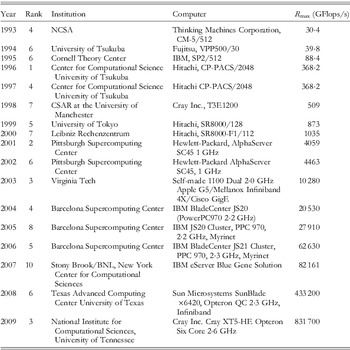
Figure 2f shows that since 1993 the speed of the fastest computer system in the world has increased exponentially according to the Top500 list (http://www.top500.org), a biannual list of the 500 fastest non-distributed computers ranked by their performance on the LINPACK benchmark. From the Top500 list, the speed of the fastest computer systems used in academia is shown in Fig. 2f and listed in Table 1. We have also added the current total speed achieved by the folding@home project which has now passed the Petaflop mark. These trends of computer power follow an exponential growth. The figure also shows that many milestones in the field of biomolecular simulation – including the villin (Duan & Kollman, Reference Duan and Kollman1998) and bc1 membrane complex (Izrailev et al. Reference Izrailev, Crofts, Berry and Schulten1999) on the Cray T3E900, B-DNA dodecamer on MareNostrum (Pérez et al. Reference Pérez, Luque and Orozco2007), and fip35 protein on NCSA Dell clusters (Freddolino et al. Reference Freddolino, Liu, Gruebele and Schulten2008) – have been obtained using one of the fastest Top500 computers available.
Fastest academic computer systems as ranked in the November's Top500 lists, http://www.top500.org. Rank represents the position of the fastest academic system in the Top500 list per year. The systems are ranked in terms of Rmax, which is an estimate of the maximum performance of a computer measured using a freely available implementation of the High Performance Computing LINPACK Benchmark

More generally, this publication volume and computation perspective is optimistic. The trends suggest that biomolecular researchers have utilized well and will continue to have access to ever more powerful machines that in turn push the frontiers of the field.
3. Field expectations
As the field of biomolecular modeling gained momentum in the late 1980s with the increasing availability of high-speed computers, introduction of standardized programs, and significant technological innovations, the notable application and algorithmic (for minimization, integration, and data analysis) successes that followed stirred a new enthusiasm in the molecular biophysics community and beyond. Biomolecular modeling and simulation, in addition to high-throughput structure technology and other experimental information, was expected to revolutionize many applications through systematic structure-to-function links.
As early as 1986, the computational quantum chemistry pioneer Henry Schafer wrote (Schaefer, Reference Schaefer1986):
It is clear that theoretical chemistry has entered a new stage … with the goal of being no less than full partner with experiment.
Commenting in 1988 on two exciting MD applications to materials and liquids, the late Sir John Maddox, former editor of Nature, wrote (Maddox, Reference Maddox1989):
Molecular dynamics is clearly well on the way to being a universal tool, as if it were the differential calculus. So much is plain from the range of problems now being tackled, and sometimes at least partially solved, by the application of this technique. Gone, it seems, are the days when people's ambitions in the field were restricted to the calculation of the properties of smallish molecules, with only distant hopes of being able to tackle the problems of, say, protein molecules. Now, molecular dynamics is being used to tackle problems which are quite general.
A decade later, as technological advances in high-throughput technology provided biological data as never before, it was believed that computers would allow us to quickly sift through all these data and transform it into relevant biological information. The New York Times reporter Andrew Pollack wrote in 1998 (Pollack, Reference Pollack1998):
In a marriage of biotech and high tech, computers are beginning to transform the way drugs are developed, from the earliest stage of drug discovery to the late stage of testing the drugs in people.
Similarly, Stu Borman, reporter for Chemical & Engineering News, wrote in connection to drug design using combinatorial chemistry approaches in 1998 (Borman, Reference Borman1998):
Recent advances in solid-phase synthesis, informatics, and high-throughput screening suggest combinatorial chemistry is coming of age.
Commenting on the two 1998 Chemistry Nobel Prize awardees in quantum chemistry – Walter Kohn of the University of California, Santa Barbara and John Pople of Northwestern University who ‘have developed computational methods to crunch the numbers involved in quantum theory in ways that allow chemists to make sense of the behavior of atoms as they bond together to form molecules’ – a reporter in The Economist went as far to suggest that experimentalists will soon face competition (Economist, 1998):
In the real world, this could eventually mean that most chemical experiments are conducted inside the silicon of chips instead of in the glassware of laboratories. Turn off that Bunsen burner; it will not be wanted these ten years.
Have these high expectations been met? While it remains to be seen how effective in-silico biology will be over the long run, it appears that those early expressed hopes for quick breakthroughs have not been realized consistently. Or, perhaps, expectations were simply too high for this young field.
In response to our questionnaire question regarding fulfillment of initial expectations (Appendix A), computer scientist Jacques Cohen writes:
These are very difficult modeling problems and nature has to be considered as the ultimate referee.
Structural biologist and crystallographer Stephen Neidle put it best:
My expectations have been conservative, and the reality has thus not disappointed me.
For the subfield of computer-aided drug design (CADD), a 2007 perspective (Drie, Reference Drie2007) suggests that only since 2000 have structure-based design and virtual screening technologies begun to pay off in a realistic way; still, the future is considered bright, with new avenues for CADD – like new drug target classes, novel drug mechanisms, multiple drug targets and automated technologies – expected to bear fruit.
In their 2005 review of MD and protein function, Karplus and Kuriyan state that, at the very least, simulations have reached the stage that they can be critically evaluated by experimentalists (Karplus & Kuriyan, Reference Karplus and Kuriyan2005):
The combination of increased computer power and improved potential functions has resulted in an ability to generate simulations that approach the point at which they can survive critical examination by the experimentalists who determine the structures of the proteins being simulated.
They continue to write that statistically meaningful folding simulations of proteins with all-atom models are not yet possible but that it is likely that within the next decade (i.e. by around 2015) folding mechanisms and folded structures might be simulated directly from sequence by MD. Indeed, recent dynamics simulations of protein folding have already been impressive using innovative conformational sampling approaches like Markov state models (Noé et al. Reference Noé, Horenko, Schütte and Smith2007, Reference Noé, Schutte, Vanden-Eijnden, Reich and Weikl2009; Voelz et al. Reference Voelz, Bowman, Beauchamp and Pande2010), network models (Berezhkovskii et al. Reference Berezhkovskii, Hummer and Szabo2009), or replica-exchange MD (Day et al. Reference Day, Paschek and Garcia2010; Garcia & Pascheck, Reference Garcia and Pascheck2008; Kelley et al. Reference Kelley, Huang, Tam, Spiess, Frydman and Pande2009; Mittal & Best, Reference Mittal and Best2010; Ozkan et al. Reference Ozkan, Wu, Chodera and Dill2007; Pitera et al. Reference Pitera, Swope and Abraham2008).
In 2000, Duan et al. projected that, in 20 years, simulating a second in the lifetime of medium-sized proteins will be possible, as well as in 50–60 years, the entire life cycle of an Escherichia coli cell; these projections assume a computational power increase of one order of magnitude every 3–4 years (Duan et al. Reference Duan, Kollman, Harvey, Keinam and Schechter2000). From Fig. 2, this computational increase has been more than met, but the issues of force fields and sampling have not been taken into account in setting those goals.
Folding simulations have of course received substantial attention. Folding proteins by 2005 was the stated goal of the IBM Blue Gene over a decade ago. When a new computer game called Foldit based on Rosetta@home software was launched for the general public, a reporter in the local newspaper ScienceDaily enticed readers with the headline (ScienceDaily, 2008):
Computer Game's High Score Could Earn The Nobel Prize in Medicine.
Foldit has since showed great promise, because some folding tasks are better handled visually than automatically (Cooper et al. Reference Cooper, Khatib, Treuille, Barbero, Lee, Beenen, Leaver-Fay, Baker, Popović and Players2010). More generally, a rise in the community's participation in CASP predictions shows the rising interest in protein folding (Fig. 2a): since CASP1 in 1994 where 35 research groups participated to predict 33 target proteins, CASP8 in 2008 has attracted 233 participant groups to predict 121 target proteins.
Medical applications remain the most prominent driving force for modeling. Current NIH Director Francis S. Collins recently wrote (Collins, Reference Collins2010):
The power of the molecular approach to health and disease has steadily gained momentum over the past several decades and is now poised to catalyze a revolution in medicine.
Modeling and simulation is certainly playing an important role in this new era.
4. Field evolution assessed via an expectation curve
In reference to the unanticipated challenges that we face today concerning unveiling the genetic basis for disease, NIH Director Francis S. Collins also stated (Borman, Reference Borman2010):
It's been said that a truly transformational technology will always have its immediate consequences overestimated and its long-term consequences underestimated.
Based on the data collected here, this certainly appears to be true for the field of biomolecular modeling and simulation.
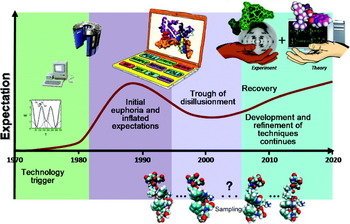
In 1993, computer scientist James Bezdek introduced the general notion of a technology expectation (or hype) curve in his first editorial of the new journal he founded on fuzzy models, a branch of mathematics that attempts to formulate the notion of vagueness (Bezdek, Reference Bezdek1993). Bezdek's technology development framework was later popularized by the Gartner group. This expectation curve describes the evolution of a new technology or field by several common stages in terms of expectation levels: (1) a technology trigger that serves as the starting point for the field; (2) an early high peak corresponding to initial euphoria and inflated expectations when a frenzy of publicity envelopes some isolated successes; (3) a trough of disillusionment or depth of cynicism, when failures become apparent, obstacles appear, and general support and interest wane; (4) recovery phase, where practitioners continue to develop and refine the technique or technology; and (5) steady progress of productivity when realistic expectations and true benefits emerge. Not all new technologies reach the final stage; some new approaches fade away after the cynicism stage.
Our version of the expectation curve for biomolecular modeling and simulation is presented in Fig. 3. Based on the quotes above and general information discussed here, the starting point for the field is the 1970s, when force field pioneers began reporting their applications. Rising expectations continued (especially from the late 1980s) until the late 1990s, where the height of naive euphoria for biomolecular modeling occurred (stage 2). Structure-based rational drug design was then well recognized and expected to replace older, less efficient and laborious ways of screening. Some disappointments became apparent as this 21st century began: pharmaceutical industries have expended huge resources on drug design modeling initiatives that only led to modest successes at best (Munos, Reference Munos2009), and the revolutionary transformations expected following completion of the Human Genome Project in our understanding of ancestry and human disease diagnosis and treatment did not bear fruit right away as our appreciation of the enormous complexity of biology set in (Hayden, Reference Hayden2010). While the new technologies helped generate voluminous amounts of data, the complexity of information storage involved (in genes, regulation, etc.) has also escalated into a picture of intertwined complex layers of regulatory networks. This problem is also manifested in the recent declining production of new drug entities (Munos, Reference Munos2009) (further discussed in Schlick, Reference Schlick2010).
Proposed expectation curve for the field of biomolecular modeling and simulation, with approximate timeline. The field started when comprehensive molecular mechanics efforts started, and it took off with the increasing availability of fast workstations and later supercomputers. Following unrealistically high expectations and disappointments, the field is expected to make more realistic progress so that eventually theory and experiment will be hand-in-hand partners.

Although it is difficult to pinpoint exactly where the trough in the expectation curve (stage 3) lies for the field, we suggest that it may have occurred roughly one decade ago. Our optimism also suggests that the productivity phase is well underway, following the appreciation for the field's great potential to help understand biological systems, despite the apparently complex intertwined regulatory networks and the realization that force fields and sampling algorithms require improvement.
5. Modeling and simulation successes
Many notable successes in various areas – from experimental interpretation to structure prediction to drug design – have been reported for biomolecular modeling, and it is instructive to examine them. Our examples include MD theory and applications, algorithms for biomolecular simulation, structure prediction, protein-folding theory, modeling-aided drug design, and interpretation of complex experimental phenomena.
5.1 MD as a technique to study atomic motions
A spectacular example of success reflecting a modern marriage among modeling theory, technology and biology involves the theory and practice of MD. Essentially, MD is statistical mechanics by numbers, or Laplace's vision of Newtonian physics (de Laplace, Reference de Laplace1820) on modern supercomputers. The impressive progress in the development of biomolecular force fields, coupled to spectacular computer technology advances, has now made it possible to transform this vision into a reality, by overcoming the difficulty noted by Dirac of solving the equations of motion for multi-body systems (Dirac, Reference Dirac1929).
Since successful applications were reported in the 1970s in protein dynamics (McCammon et al. Reference McCammon, Gelin and Karplus1977), MD – with variations and extensions – has now become a popular (Fig. 2d) and universal tool, ‘as if it were the differential calculus’ (Maddox, Reference Maddox1989). MD is in fact one of the few tools available, by both experiment and theory, to probe molecular motion on the atomic scale. By following the equations of motion as dictated by a classic molecular mechanics force field, complex relationships among biomolecular structure, flexibility, and function can be investigated.
Today's sophisticated dynamics programs, like NAMD or GROMACS, adapted to parallel and massively parallel computer architectures, and specialized hardware have made simulations of biomolecular systems in the microseconds feasible in several weeks of computing. Anton's hardware/software co-design is pushing the envelope to the millisecond timeframe (Shaw et al. Reference Dror, Arlow, Borhani, Jensen, Piana and Shaw2009, Reference Shaw, Maragakis, Lindorff-Larsen, Piana, Dror, Eastwood, Bank, Jumper, Salmon, Shan and Wriggers2010). Although the well-recognized limitations of sampling in atomistic dynamics, as well as in the governing force fields, have led to many innovative sampling alternatives to enhance coverage of the thermally accessible conformational space (as recently reviewed in Earl & Deem, Reference Earl and Deem2008; Klein & Shinoda, Reference Klein and Shinoda2008; Lei & Duan, Reference Lei and Duan2007; Liwo et al. Reference Liwo, Czaplewski, Oldziej and Scheraga2008; Schlick, Reference Schlick2009b, Reference Schlickc), many still rely on MD for local sampling.
Overall, MD simulations have been used for numerous applications, including to refine experimental structures, extending most recently to low-resolution crystal data (Schröder et al. Reference Schröder, Levitt and Brunger2010), interpret various experimental data such as single-molecule force-extension curves (e.g. Lee et al. Reference Lee, Hsin, Sotomayor, Comellas and Schulten2009) or NMR spin-relaxation in proteins (e.g. Case, Reference Case2002; Henzler-Wildman et al. Reference Henzler-Wildman, Thai, Lei, Ott, Wolf-Watz, Fenn, Pozharski, Wilson, Petsko and Karplus2007; Tsui et al. Reference Tsui, Radhakrishnan, Wright and Case2000), improve structure-based function predictions, for example, by predicting calcium-binding sites (Altman et al. Reference Altman, Radmer and Glazer2009), link static experimental structures to implied pathways (e.g. Golosov et al. Reference Golosov, Warren, Beese and Karplus2010; Radhakrishnan & Schlick, Reference Radhakrishnan and Schlick2004), estimate the importance of quantum effects in lowering free-energy barriers of biomolecular reactions (Hu et al. Reference Hu, Elstner and Hermans2003), make structural predictions, deduce reaction mechanisms, propose free-energy pathways and associated mechanisms (e.g. Faraldo-Gomez & Roux, Reference Faraldo-Gomez and Roux2007; Radhakrishnan & Schlick, Reference Radhakrishnan and Schlick2005), resolve or shed light on experimental ambiguities (see Subsection 5.6), and design new folds and compounds, including drugs and enzymes (e.g. Baker et al. Reference Baker, Kuhlman, Dantas, Ireton, Varani and Stoddard2003; Hornak & Simmerling, Reference Hornak and Simmerling2007; Jiang et al. Reference Jiang, Althoff, Clemente, Doyle, Röthlisberger, Zanghellini, Gallaher, Betker, Tanaka, Barbas, Hilvert, Houk, Stoddard and Baker2008; Neidle et al. Reference Neidle, Read, Harrison, Romagnoli, Tanious, Gowan, Reszka, Wilson and Kelland2001). Challenging applications to complex systems like membranes, to probe associated structures, motions and interactions (e.g. Grossfield et al. Reference Grossfield, Pitman, Feller, Soubias and Gawrisch2008; Khelashvili et al. Reference Khelashvili, Grossfield, Feller, Pitman and Weinstein2009; Vasquez et al. Reference Vasquez, Sotomayor, Cordero-Morales, Schulten and Perozo2008) are also noteworthy. Specific success stories from such MD simulations are discussed separately in the subsections below.
5.2 Establishment of reliable algorithms
Rigorous algorithm development and analysis provide a clear framework by which to define the important notions of accuracy, stability and error control. This understanding in turn provides practical guides to parameter selection and trajectory analysis. Three notable areas of algorithmic contributions in recent years include methods for MD integration, evaluation of non-bonded electrostatic interactions and enhanced sampling methods for biomolecules.
The establishment of symplectic integrators such as leap frog, velocity Verlet, and constrained dynamics formulations (e.g. Leimkuhler & Reich, Reference Leimkuhler and Reich2004; Schlick, Reference Schlick2010) has allowed researchers to correctly generate MD trajectories and analyze the stability of a simulation in terms of energy conservation, and the robustness of the simulation with respect to the timestep size.
Highlighting resonance artifacts in MD simulations (Mandziuk & Schlick, Reference Mandziuk and Schlick1995; Schlick et al. Reference Schlick, Mandziuk, Skeel and Srinivas1998), predicting resonant timesteps, and establishing stochastic solution to resonances (Barth & Schlick, Reference Barth and Schlick1998; Schlick et al. Reference Schlick, Barth and Mandziuk1997; Sweet et al. Reference Sweet, Petrine, Pande and Izaguirre2008) have all led to an improved understanding and quality of MD simulations (Morrone et al. Reference Morrone, Zhou and Berne2010).
The advent of efficient and straightforward-to-program particle mesh Ewald (PME) (Darden et al. Reference Darden, York and Pedersen1993; Essmann et al. Reference Essmann, Perera, Berkowitz, Darden, Lee and Pedersen1995; York & Yang, Reference York and Yang1994) and related methods (Duan & Krasny, Reference Duan and Krasny2000; Greengard & Rokhlin, Reference Greengard and Rokhlin1987; Saito, Reference Saito1992, Reference Greengard and Rokhlin1997; Sandak, Reference Sandak2001; Skeel et al. Reference Skeel, Tezcan and Hardy2002) for evaluation of the long-range electrostatic interactions, which constitute the most time-consuming part of a biomolecular simulation, has made possible more realistic MD simulations without non-bonded cutoffs. A problem that in part remains unsolved in their implementation involves the optimal integration of PME methods with multiple-timestep methods and parallelization of PME implementations. The presence of fast terms in the reciprocal Ewald component limits the outer timestep and hence the speedup (Morrone et al. Reference Morrone, Zhou and Berne2010; Procacci et al. Reference Procacci, Marchi and Martyna1998; Qian & Schlick, Reference Qian and Schlick2002; Stuart et al. Reference Stuart, Zhou and Berne1996; Zhou et al. Reference Zhou, Harder, Xu and Berne2001). Moreover, memory requirements create a bottleneck in typical PME implementations in MD simulations longer than a microsecond. This is because the contribution of the long-range electrostatic forces imposes a global data dependency on all the system charges; in practice, this implies communication problems (Fitch et al. Reference Fitch, Rayshubskiy, Eleftheriou, Ward, Giampapa, Pitman and Germain2006). Thus, much work goes into optimizing associated mesh sizes, precision, and sizes of the real and inverse spaces to delay the communication bottleneck as possible (e.g. Shaw et al. Reference Dror, Arlow, Borhani, Jensen, Piana and Shaw2009), but overall errors in long simulations are far from trivial (Morrone et al. Reference Morrone, Zhou and Berne2010; Snir, Reference Snir2004).
In addition to MD integration and electrostatic calculations, sampling the vast configurational space has also triggered many innovative approaches to capture ‘rare events’. The many innovative enhanced sampling methods are either independent of MD or based on MD. In the former class, as recently surveyed (Earl & Deem, Reference Earl and Deem2008; Liwo et al. Reference Liwo, Czaplewski, Oldziej and Scheraga2008; Schlick, Reference Schlick2009b), are various Monte Carlo approaches, harmonic approximations, and coarse-grained models. These can yield valuable conformational insights into biomolecular structure and flexibility, despite altered kinetics. Although Monte Carlo methods are not always satisfactory for large systems on their own right, they form essential components of more sophisticated methods (e.g. transition path sampling (Dellago & Bolhuis, Reference Dellago and Bolhuis2007) or Markov chain Monte Carlo sampling (Pan & Roux, Reference Pan and Roux2008)), as recently surveyed (Schlick, Reference Schlick2009c).
More generally, MD-based methods for enhanced sampling of biomolecules can involve modification of the potential (like accelerated MD or AMD (Grant et al. Reference Grant, Gorfe and McCammon2010; Hamelberg et al. Reference Hamelberg, Mongan and McCammon2004), simulation protocol (like replica-exchange MD or REMD (Sugita & Okamoto, Reference Sugita and Okamoto1999)), or algorithm; as well as global reformulations, such as transition path sampling (Bolhuis et al. Reference Bolhuis, Chandler, Dellago and Geissler2002; Dellago & Bolhuis, Reference Dellago and Bolhuis2007), forward flux simulation (Borrero & Escobedo, Reference Borrero and Escobedo2008), and Markov state models (Noé & Fischer, Reference Noé and Fischer2008). Simple modifications like AMD can aid in the interpretation of residual dipolar coupling and chemical shift measurements in NMR (Cervantes et al. Reference Cervantes, Markwick, Sue, McCammon, Dyson and Komives2009; Markwick et al. Reference Markwick, Bouvignies, Salmon, McCammon, Nilges and Blackledge2009, Reference Markwick, Cervantes, Abel, Komives, Blackledge and McCammon2010). Global formulations, however, are needed more generally not only to generate more configurations or to suggest mechanistic pathways but also to compute free-energy profiles for the reaction and detailed kinetics including reaction rates.
Divide and conquer methods for sampling and for piecing together reaction rate information are especially suitable for readily available computer cluster networks. REMD is a popular method, with many extensions (e.g. Roitberg et al. Reference Roitberg, Okur and Simmerling2007), but implementations for large systems are problematic due the need for many replicas and the non-uniform sampling. There are many successful reports of using tailored enhanced sampling methods for biomolecular applications (e.g. Abrams & Vanden-Eijnden, Reference Abrams and Vanden-Eijnden2010; Berezhkovskii et al. Reference Berezhkovskii, Hummer and Szabo2009; Chennamsetty et al. Reference Chennamsetty, Voynov, Kayser, Helk and Trout2009; Noé et al. Reference Noé, Horenko, Schütte and Smith2007, Reference Noé, Schutte, Vanden-Eijnden, Reich and Weikl2009; Ozkan et al. Reference Ozkan, Wu, Chodera and Dill2007; Radhakrishnan & Schlick, Reference Radhakrishnan and Schlick2004; Voelz et al. Reference Voelz, Bowman, Beauchamp and Pande2010), but applications at large to biomolecules and/or in the absence of experimental data remain a challenge.
Among the numerous other examples of algorithms, PCA, clustering techniques and simple consistency tests have helped to analyze complex groups of experimental data. For example, clustering graphs of RNA secondary structures led to a proposal of novel RNA motifs that are RNA-like (i.e. physical) and non-physical (Kim et al. Reference Kim, Chivian and Baker2004a, Reference Kim, Shiffeldrim, Gan and Schlickb); some in the former class have been designed computationally and also later experimentally confirmed (Kim et al. Reference Kim, Izzo and Schlick2010; Schlick, Reference Schlick2010). Interestingly, a simple tool to analyze PDB structures in terms of quantifying the interior protein volume called RosettaHoles (Sheffler & Baker, Reference Sheffler and Baker2008) detected a group of significant outliers, some of which were traced to a single author; this eventually led to the retraction of structures (Borrell, Reference Borrell2009).
Thus, algorithms are playing an increasing role in a wide range of problems dealing with biomolecular structure, thermodynamics, and dynamics, as well as design.
5.3 Structure predictions that preceded experiment
Although the general problem of structure prediction is far from solved, predicting a peptide structure has been more amenable to present modeling, and there have also been notable success stories for larger systems, as early as the late 1980s, for human immunodeficiency virus (HIV) protease (PR), and for complex RNAs, by sequence alignment. The successes for RNA are especially noteworthy since far fewer structures of RNAs are available at atomic resolution and the field is younger than protein prediction. Some interesting early prediction cases are collected below, following general trends for peptides and proteins.
5.3.1 HIV-1 PR
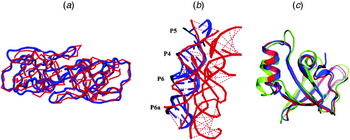
HIV-1 PR is an aspartic PR essential for the replication of the HIV. Already in 1987, Pearl & Taylor attempted to predict the HIV-1 PR tertiary structure by computational modeling alone (Fig. 4a) (Pearl & Taylor, Reference Pearl and Taylor1987). Their approach involved multiple sequence alignment to predict a secondary structure followed by a knowledge-based method that matches fragments from large related structures to produce a tertiary structure model.
Examples of folding predictions that preceded experiment. (a) HIV PR: tertiary structure of the homodimer (red), predicted by homology modeling (Pearl & Taylor, Reference Pearl and Taylor1987), superimposed with the crystal structure 3HVP (blue), 198 residues shown (Wlodawer et al. Reference Wlodawer, Miller, Jaskolski, Sathyanarayana, Baldwin, Weber, Selk, Clawson, Schneider and Kent1989); (b) group-I intron: P4–P6 domain (red), predicted by a comparative modeling (Michel & Westhof, Reference Michel and Westhof1990), aligned with crystal structure 1GID (blue), 38 residues (Cate et al. Reference Cate, Gooding, Podell, Zhou, Golden, Kundrot, Cech and Doudna1996); (c) CASP protein prediction by the Baker group for target T0492 (Raman et al. Reference Raman, Vernon, Thompson, Tyka, Sadreyev, Pei, Kim, Kellogg, DiMaio, Lange, Kinch, Sheffler, Kim, Das, Grishin and Baker2009), kindly provided by Srivatsan Raman and David Baker; crystal structure, 73 residues (blue) of this all-β protein (SH3-like barrel fold) is shown against the best detectable template found by comparative modeling (green) and the predicted structure (red) built using Rosetta using the best template found.

Two years later, another theoretical model was produced (Weber et al. Reference Weber, Miller, Jaskolski, Leis, Skalka and Wlodawer1989) using related information from the Rous sarcoma virus (RSV) determined at 3 Å resolution (Miller et al. Reference Miller, Jaskolski, Rao, Leis and Wlodawer1989). In the same year, the HIV-1 PR structure was resolved by X-ray crystallography at 3 Å resolution (Navia et al. Reference Navia, Fitzgerald, McKeever, Leu, Heimbach, Herber, Sigal, Darke and Springer1989). Interestingly, the authors noted a local structural discrepancy with respect to the predicted models (Pearl & Taylor, Reference Pearl and Taylor1987; Weber et al. Reference Weber, Miller, Jaskolski, Leis, Skalka and Wlodawer1989) in the topology of the N- and C-terminal regions and the helix near the C-terminal; some of these residues at the N-terminal were not observed in the electron density map, and so inherent disorder and flexibility were presented as possible explanations for these differences. However, when another structure of HIV-1 PR at 2·8 Å resolution was solved soon after, residues not captured in the first crystal were explicitly resolved (Wlodawer et al. Reference Wlodawer, Miller, Jaskolski, Sathyanarayana, Baldwin, Weber, Selk, Clawson, Schneider and Kent1989), and subsequent analysis showed excellent agreement with the modeling predictions rather than the previous crystal. The studies of HIV-1 PR initiated by the theoretical models and confirmed later by the crystallography eventually led to development, largely due to molecular modeling, of the first PR inhibitor, saquinavir, which was approved by FDA in 1995, and nine other PR inhibitors approved by 2006.
5.3.2 Group I intron
The group I intron is a self-splicing ribozyme present in a wide range of pathogenic organisms. The conserved core of a tertiary structure, where two parallel coaxial stacking of helices were juxtaposed to form an active site, was first modeled in 1990 by Michel & Westhof using comparative sequence analysis (Michel & Westhof, Reference Michel and Westhof1990). Specifically, they aligned the 87 available sequences of group I introns and derived some tertiary contacts from a distance covariation analysis. Using stereochemical modeling, a tertiary structure of the conserved core of group I introns was then predicted. It took six additional years until the predicted model was confirmed by crystallography of the catalytic core structure (P4–P6 domain) at 2·8 Å resolution (Cate et al. Reference Cate, Gooding, Podell, Zhou, Golden, Kundrot, Cech and Doudna1996) (Fig. 4b). Since the self-splicing function of group I introns from ribosomal RNA genes is essential for maturation of ribosome, inhibition of self-splicing is a therapeutic goal. Indeed, various subsequent RNA–ligand interaction studies have led to the design of inhibitors for RNA function (Labuda et al. Reference Labuda, Pushechnikov and Disney2009).
5.3.3 Peptide structure prediction
Unlike many proteins, peptides can adopt a variety of conformations in solution depending on the conditions and presence of ligands, and thus there has been great interest in design of stable peptides, such as the synthetic β-peptides composed of β amino acids. Already in 1998, reversible β-peptide folding in solution in atomic detail was demonstrated (Daura et al. Reference Daura, Jaun, Seebach, Gunsteren and Mark1998), in agreement with NMR data (Daura et al. Reference Daura, Gademann, Jaun, Seebach, Gunsteren and Mark1999). Other interesting examples include an engineered 20-residue Trp-cage peptide with a novel fold and fast folding kinetics (Neidigh et al. Reference Neidigh, Fesinmeyer and Andersen2002), Amber-based folding of the Trp-cage peptide at 1 Å resolution (Simmerling et al. Reference Simmerling, Strockbine and Roitberg2002) and mini-protein simulations using folding@home whose predicted folding rates agree well with experimental measurements of mean folding times and equilibrium constants by circular dichroisms and fluorescence (Snow et al. Reference Snow, Nguyen, Pande and Gruebele2002). Some successful programs for peptide prediction include PEPstr which uses clever initial modeling followed by Amber-based energy minimization (Kaur et al. Reference Kaur, Garg and Raghava2007), PepLook based on a Monte-Carlo refinement procedure in the peptide conformational space sampled systematically (Thomas et al. Reference Thomas, Deshayes, Decaffmeyer, Eyck, Charloteaux and Brasseur2009) and Robetta (a descendant of Rosetta) based on homology modeling and knowledge-based potentials (Kim et al. Reference Kim, Chivian and Baker2004a).
5.3.4 Protein structure prediction: lessons from CASP
The high-profile community-wide exercise for protein structure prediction, CASP, held biannually since 1994, has sharpened our understanding of what works and what fails in current protein structure prediction. The exercise consists of released protein sequence targets, soon to be resolved by X-ray crystallography or NMR spectroscopy, serving as prediction targets in various categories: template-based or template-free modeling for tertiary structure prediction, substructure prediction for high-resolution models, disordered protein-region identification, function prediction, and more; predictions are then collected and assessed by independent experts who meet together with the predictor teams to discuss the work. The growth of participants in CASP (Fig. 2a) has also led to significant computational advances in structure determination and has identified select groups whose methods were consistently found to score high. For example, Baker's group has been singled out as a good performer using template-based predictions (assembly of short fragments of known proteins using a Monte Carlo sampling procedure followed by all-atom refinement) with the Rosetta program; in CASP8, prediction of accuracy up to 1–2 Å resolution were demonstrated (Raman et al. Reference Raman, Vernon, Thompson, Tyka, Sadreyev, Pei, Kim, Kellogg, DiMaio, Lange, Kinch, Sheffler, Kim, Das, Grishin and Baker2009) (e.g. Fig. 4c).
More generally, comparative modeling (template based) and knowledge-based approaches (using statistical potentials based on analysis of known protein structures) have been found to produce reasonably good structural models, with notably more accurate predictions becoming possible. Predicting regions that are substantially different from the target appear far more difficult.
This is somewhat disappointing to devotees of ab initio folding, relying on physics-based force fields, a technique that has shown some, but more modest, progress (see next section). Still, template-free approaches based on statistical instead of molecular mechanics potentials have also emerged as competitive. Nonetheless, force-field-based approaches are essential for interpreting protein interactions and energies, such as required for drug design, and also for later stages of refinement, following template and homology modeling.
Ultimately, modeling work in this field is invaluable because it teaches us to ask, and seek answers to, systematic questions about sequence/structure/function relationships and about the underlying forces that stabilize biomolecular structure.
5.4 Protein-folding theory
Besides the folded protein structures discussed above, other parts of the protein-folding puzzle that have intrigued experimentalists and theoreticians alike are understanding the associated protein-folding code (thermodynamics) and pathways (kinetics) (Dill et al. Reference Dill, Ozkan, Shell and Weikl2008). A statistical–mechanics framework based on the density of states has been pioneered by Frauenfelder, Wolynes, Dill, Onuchic, Thirumalai and others for answering these questions (e.g. Dill et al. Reference Dill, Ozkan, Shell and Weikl2008; Frauenfelder et al. Reference Frauenfelder, Sligar and Wolynes1991; Wolynes, Reference Wolynes2005) by analyzing energy landscapes of proteins on the basis of various experimental studies of proteins (fluorescence spectroscopy, NMR, single-molecule experiments, fast-laser temperature jumps, mutational studies, etc.). Essentially, the density of states arranged in the funnel landscape describes the conformational heterogeneity of the protein. Such free-energy landscapes can help interpret conformational substates and folding mechanisms and thereby relate protein dynamics, folding kinetics, and function. For example, fast protein folders must navigate through mostly local contacts in smoother free-energy landscapes, while slow-folding kinetics can be attributed to rugged energy landscapes, with more global contacts and more conformational traps and barriers. Standard chemical kinetics and transition state theory in combination with simplified models have also been important in analyzing folding events (e.g. Berezhkovskii et al. Reference Berezhkovskii, Hummer and Szabo2009; Best & Hummer, Reference Best and Hummer2006; Ozkan et al. Reference Ozkan, Wu, Chodera and Dill2007; Yang & Grueble, Reference Yang and Grueble2003).
By relating folding kinetics to mutation profiles, mutation experiments have also helped further validate the utility of such theoretical frameworks. For example, recent folding kinetics experiments on mutants of α-spectrin, a protein of the intracellular matrix of red blood cells important for membrane elasticity (Wensley et al. Reference Wensley, Batey, Bone, Chan, Tumelty, Steward, Kwa, Borgia and Clarke2010), have confirmed the notion that slow kinetics is correlated to rugged landscapes. By swapping domains through chimeric constructs for protein domains of α-spectrin, the reasons for disparate folding rates (by three orders of magnitude) of the protein relative to two homologues were traced to internal friction resulting from residue-specific interactions that can lead to misdocking of helices. For this membrane protein, slow unfolding kinetics can be advantageous because fewer rearrangements during the cell's lifetime, and hence fewer possible degradations, result.
That theory contributes significantly to experiment was also echoed by Fersht and colleagues in a separate work on a three-helix bundle protein and various mutants which showed via simulation that folding intermediates are on the folding pathway (Mayor et al. Reference Mayor, Guydosh, Johnson, Grossmann, Sato, Jas, Freund, Alonso, Daggett and Fersht2003):
… combining molecular dynamics and experiment has now allowed us to characterize all of the necessary structures along the pathway. … Simulation could well be the answer in general for solving such problems in mechanism.
Numerous other general areas of theory, such as protein electrostatics and enzymatic reactions (Kamerlin et al. Reference Kamerlin, Haranczyk and Warshel2009; Warshel et al. Reference Warshel, Sharma, Kato, Xiang, Liu and Olson2006), conformational transitions in DNA polymerases in relation to fidelity mechanisms (Bebenek et al. Reference Bebenek, Garcia-Diaz, Foley, Pedersen, Schlick and Kunkel2008; Foley & Schlick, Reference Foley and Schlick2009; Golosov et al. Reference Golosov, Warren, Beese and Karplus2010; Radhakrishnan et al. Reference Radhakrishnan, Arora, Wang, Beard, Wilson and Schlick2006), and interpretation of NMR signals (Case, Reference Case2002; Henzler-Wildman et al. Reference Henzler-Wildman, Thai, Lei, Ott, Wolf-Watz, Fenn, Pozharski, Wilson, Petsko and Karplus2007; Markwick et al. Reference Markwick, Cervantes, Abel, Komives, Blackledge and McCammon2010; Tsui et al. Reference Tsui, Radhakrishnan, Wright and Case2000) have also benefited from simplified theoretical frameworks and models developed to interpret complex biological phenomena.
5.5 Modeling-aided drug discovery and design
Modeling molecular structures and dynamics has already helped to define molecular specificity and clarify functional aspects that are important for drug development (see also Schwede et al. Reference Schwede, Sali, Honig, Levitt, Berman, Jones, Brenner, Burley, Das, Dokholyan, Dunbrack, Fidelis, Fiser, Godzik, Huang, Humblet, Jacobson, Joachimiak, Krystek, Kortemme, Kryshtafovych, Montelione, Moult, Murray, Sanchez, Sosnick, Standley, Stouch, Vajda, Vasquez, Westbrook and Wilson2009). Although modeling suggestions are not always verified by experiment, they help make important suggestions and offer general leads.
Clearly, as biological structures and functions are being described, natural disease targets that affect the course of disease can be proposed. Examples include specific regions of HIV enzymes or misfolded protein fibrils known as amyloids (for related misfolding disorders like Alzheimer's and Creutzfeltdt–Jakob disease). Modeling work is important for pinpointing specific targets in these regions from structural, stability, and flexibility considerations and also testing resulting interactions (as reviewed in Ghosh et al. Reference Ghosh, Nie, An and Huang2006; Zhou, Reference Zhou2008). For example, the sequence-specific triggers for amyloid formation, as recently uncovered (Goldschmidt et al. Reference Goldschmidt, Teng, Riek and Eisenberg2010) – self-complementary segments that can stick together – suggest capping alterations to slow down their formation or small molecules to act as folding chaperones (Schnabel, Reference Schnabel2010). Supplementing these structure–function drug design paradigms is a systems-biology approach that attempts to modify response of genes, proteins and metabolites by integrating organ- and system-level modeling (Csermely et al. Reference Csermely, Agoston and Pongor2005; Kitano, Reference Kitano2007).
The solved HIV enzymes (PR, integrase, and reverse transcriptase) led to the development of many inhibitors that are now in clinical usage, some of which were aided by computer simulations. For example, besides the structural determination mentioned above for HIV PR, MD simulations using various HIV PR models have suggested that a fully open conformation of the PR ‘flaps’ may be favorable for drug access to the active site (Collins et al. Reference Collins, Burt and Erickson1995; Hamelberg & McCammon, Reference Hamelberg and McCammon2005; Hornak et al. Reference Hornak, Okur, Rizzo and Simmerling2006; Tozzini & McCammon, Reference Tozzini and McCammon2005). Recent simulations have also led to design proposals (Scott & Schiffer, Reference Scott and Schiffer2000) and other insights into PR/drug interactions (Hornak & Simmerling, Reference Hornak and Simmerling2007).
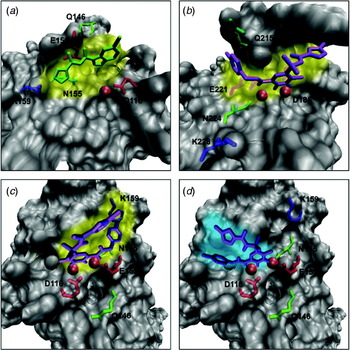
The solved complex of HIV integrase with an inhibitor in 1999 (Goldgur et al. Reference Goldgur, Craigie, Cohen, Fujiwara, Yoshinaga, Fujishita, Sugimoto, Endo, Murai and Davies1999) attracted considerable attention since it provided a general platform for the drug design of another class of HIV inhibitors besides PR inhibitors. MD simulations have suggested that inhibitors could bind in more than one orientation to HIV-1 integrase, preferred and flipped (Perryman et al. Reference Perryman, Forli, Morris, Burt, Cheng, Palmer, Whitby, McCammon, Phillips and Olson2010; Schames et al. Reference Schames, Henchman, Siegel, Sotriffer, Ni and McCammon2004), as shown in Fig. 5, which also shows an X-ray structure of an inhibitor bound to an evolutionary similar virus (Hare et al. Reference Hare, Gupta, Valkov, Engelman and Cherepanov2010). Simulations also showed that binding modes can be selected to exploit stronger interactions in specific regions and orientations (Hazuda et al. Reference Hazuda, Anthony, Gomez, Jolly, Wai, Zhuang, Fisher, Embrey, Guare, Egbertson, Vacca, Huff, Felock, Witmer, Stillmock, Danovich, Grobler, Miller, Espeseth, Jin, Chen, Lin, Kassahun, Ellis, Wong, Xu, Pearson, Schleif, Cortese, Emini, Summa, Holloway and Young2004; Lin et al. Reference Lin, Perryman, Schames and McCammon2002; Schames et al. Reference Schames, Henchman, Siegel, Sotriffer, Ni and McCammon2004) and that different divalent-ion arrangements are associated with these binding sites and fluctuations (Perryman et al. Reference Perryman, Forli, Morris, Burt, Cheng, Palmer, Whitby, McCammon, Phillips and Olson2010). Thus, modeling can help outline new possibilities that stimulate further modeling and experimentation. More generally, emerging experimental findings combined with modeling are expected to aid the development of antiretroviral drugs.
Drug/inhibitor-binding pockets to HIV integrase as solved experimentally and as predicted by modeling. (a) Preferred (or primary) binding (yellow shading) of the inhibitor 5-CITEP (green) to the active site of the HIV-1 integrase core domain as determined by crystallography (Goldgur et al. Reference Goldgur, Craigie, Cohen, Fujiwara, Yoshinaga, Fujishita, Sugimoto, Endo, Murai and Davies1999); (b) preferred binding (yellow shading) of the anti-HIV drug Raltegravir (purple) to the active site of the prototype foamy virus (PFV) integrase, a structural homologue of HIV-1 integrase, as determined by crystallography (Hare et al. Reference Hare, Gupta, Valkov, Engelman and Cherepanov2010); (c) predicted preferred binding (yellow shading) for Raltegravir to the HIV-1 integrase catalytic core domain as determined by modeling (Perryman et al. Reference Perryman, Forli, Morris, Burt, Cheng, Palmer, Whitby, McCammon, Phillips and Olson2010); (d) alternative, or flipped binding (turquoise shading) for Raltegravir to the HIV-1 integrase catalytic core domain as determined by modeling (Perryman et al. Reference Perryman, Forli, Morris, Burt, Cheng, Palmer, Whitby, McCammon, Phillips and Olson2010). C and D are based on PDB entry 1QS4, with missing residues in panel (A) reconstructed by homology. The magnesium ions are shown as orange spheres.

Other examples of drug successes based on molecular modeling include the design of potent thrombin inhibitors to treat a variety of blood coagulation and clotting-related diseases by tailoring ligands to the enzyme pocket (Brady et al. Reference Brady, Stauffer, Lumma, Smith, Ramjit, Lewis, Lucas, Gardell, Lyle, Appleby, Cook, Holahan, Stranieri, Lynch, Lin, Chen, Vastag, Naylor-Olsen and Vacca1998), the SARS virus inhibitor (Dooley et al. Reference Dooley, Shindo, Taggart, Park and Pang2006), glutamate nanosensors to monitor neurologic functions (Okumoto et al. Reference Okumoto, Looger, Micheva, Reimer, Smith and Frommer2005), agonists to treat anxiety and depression (Becker et al. Reference Becker, Dhanoa, Marantz, Chen, Shacham, Cheruku, Heifetz, Mohanty, Fichman and Sharadendu2006), and a migraine treatment (Boyd, Reference Boyd1998).
While both the monetary cost and development time required for each successful drug remains very high (Amir-Aslani, Reference Amir-Aslani2008; Munos, Reference Munos2009), and great successes are now few and far between, it is clear that molecular modeling will be important for the future of drug discovery and for many other design applications in biomedicine and nanotechnology. What is not obvious, however, is what type of modeling tool will prove to be most useful. This is because the usage of MD simulations by pharmaceutical scientists appears to be minimal (Nicholls, Reference Nicholls2010), compared to tools from cheminformatics, ligand similarity searches and visualization, which are heavily used, and quantitative structure-activity relationships (QSAR), docking, homology modeling, bioinformatics and quantum mechanics, to a lesser extent. Limitations of force fields and sampling are most often quoted as reasons for the curbed application of dynamics to real-life problems.
The emergence of another class of successful drugs distinct from the traditional small-molecule drugs, namely biologics – biomolecules derived from living cells – might also increase the role of modeling in pharmaceutical discovery. This is because understanding the complex biomolecular function is important to this alternative approach, which also relies on a systems biology viewpoint. Overall, it is becoming clear that integrated advances on several fronts – small-molecule drug design, biologics, high-throughput approaches, pharmacogenomics and other innovations – are required to develop new paradigms to manage the complex scientific, technological and economic factors involved in drug design.
5.6 Interpretation of experimental structures and related data disparities
In a recent review of their group's applications of biomolecular dynamics for interpretation of atomic force microscopy studies and electron microscopy structures, Schulten and colleagues write (Lee et al. Reference Lee, Hsin, Sotomayor, Comellas and Schulten2009) that:
… the power of molecular dynamics (MD) simulations to make relevant discoveries on their own, i.e., without corroborating experimental evidence, is a hotly debated topic today.
They continue to argue that:
… many important research problems in modern cell biology require a combined experimental-computational approach and computing has to be a reliable partner. Indeed, in many cases, experimental researchers must team up with MD experts who complement and resolve ambiguity in experimental data.
Other examples were provided above in Subsection 5.1, on using MD simulations and other modeling techniques (spectral decompositions, enhanced sampling methods, QM/MM techniques, etc.) to gain insights into biological structure and function. Many of these predictions can ultimately be tested by further experimentation.
Importantly, modeling can help sift through conflicting experimental information. Two such examples where different experimental techniques have produced different structural perspectives involve the organization of G quadruplexes and of chromatin fibers.
5.6.1 G-quadruplexes
G-quadruplexes are organized topologies of G-rich sequences in telomeric DNA (chromosome ends) held by Hoogsteen base pairing. Such sequences are of great interest because of their role in preserving genomic stability; a better understanding of their structural properties could help interpret processes related to human aging caused by chromosome degradation.
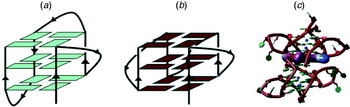
Crystal structures of short telomeric sequences are available, as are several NMR solution structures. The topologies from these studies, however, differ in the orientation of the loops connecting the G-tetrad planes (Fig. 6) and in the overall stacking arrangement of the complexes. Namely, whereas the crystal topologies suggest parallel stranded constructs, the NMR structures suggest anti-parallel backbone arrangements with stabilizing ions (Burge et al. Reference Burge, Parkinson, Hazel, Todd and Neidle2006).
G quadruplex architecture and drug binding. (a) Antiparallel and (b) parallel folds of human telomeric G-quadruplexes; (c) biological unit of the complex between the drug candidate molecule BRACO-19 and two bimolecular human telomeric quadruplexes (Campbell et al. Reference Campbell, Parkinson, Reszka and Neidle2008). Figure kindly provided by Stephen Neidle.

By modeling guanine-rich quadruplexes using MD, free-energy simulations, and PCA, Neidle and co-workers determined stable structures of these complexes in parallel orientations and predicted higher-order organizations (Haider & Neidle, Reference Haider and Neidle2009; Haider et al. Reference Haider, Parkinson and Neidle2008). These structures help propose plausible models on longer systems that could not be solved experimentally as well as build higher-order repeat models. Such detailed models can examine the relative stability of parallel and anti-parallel arrangements and suggest conditions under which each form will be stable. Ultimately, atomic models could be used for ligand-binding drug design, already an active area to fight cancer (Neidle & Parkinson, Reference Neidle and Parkinson2002). Figure 6c shows a crystal structure of an anti-cancer drug, at the interface of two parallel-folded quadruplexes and stabilized by a water network, bound between two human telomeric quadruplexes (Campbell et al. Reference Campbell, Parkinson, Reszka and Neidle2008). The structure confirms and extends modeling predictions and underscores that, while theory provides generally correct ideas, experimental data clarify and refine the modeling suggestions.
5.6.2 Chromatin organization
Chromatin structure represents another higher-order structure of great interest. Understanding chromatin organization is important because the chromatin structure affects genome accessibility to the protein synthesis machinery. Hence, transcription regulation is ultimately a structural problem.
Although several levels of folding are recognized for the chromatin fiber, only the basic unit of the chromatin fiber – the nucleosome, or the protein octamer core around which about 200 bp of DNA are wound (Davey et al. Reference Davey, Sargent, Luger, Mäeder and Richmond2002; Kornberg & Thomas, Reference Kornberg and Thomas1974; Luger et al. Reference Luger, Mäder, Richmond, Sargent and Richmond1997) – and the associated low-level packaging are well characterized (Felsenfeld & Groudine, Reference Felsenfeld and Groudine2003).
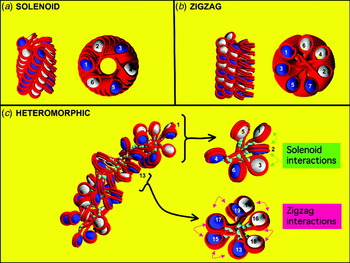
At physiological ionic strengths, it is believed that the chromatin forms a ‘30 nm’ chromatin filament observed by electron microscopy, but several models for this polynucleosomal level of folding have been suggested based on X-ray crystallography and electron microscopy imaging, with yet no consensus (Tremethick, Reference Tremethick2007; van Holde & Zlatanova, Reference van Holde and Zlatanova2007). For example, the two-start zigzag model, where the nucleosomes crisscross one another around the helical axis with straight linker DNA (Dorigo et al. Reference Dorigo, Schalch, Kulangara, Duda, Schroeder and Richmond2004) is evident in the recent crystallographic structure of the tetranucleosome (Schalch et al. Reference Schalch, Duda, Sargent and Richmond2005), while the solenoid topology (Finch et al. Reference Finch, Lutter, Rhodes, Brown, Rushton, Levitt and Klug1977), in which the nucleosomes arrange helically around the fiber axis with bent linker DNA, is supported by electron micrographs (Fig. 7).
Chromatin organization: ideal models and simulation-generated model. (a) Ideal solenoid model for the chromatin fiber (side, top, and upper top layer views), in which DNA linkers are bent and neighboring nucleosomes (i±1) are in closest contact; (b) ideal zigzag model for the chromatin fiber (side, top, and upper top-layer views), in which DNA linkers are straight and next-nearest neighbors (i±2) are in closest contact; (c) heteromorphic architecture obtained by modeling (Grigoryev et al. Reference Grigoryev, Arya, Correll, Woodcock and Schlick2009) at divalent ion environments with the chromatin model shown in Fig. 1c in which mostly zigzag forms with straight linker DNAs are interspersed with bent DNA linkers. In all views, linker and wrapped DNA are colored red; odd and even nucleosomes are white and blue, respectively; and linker histones are turquoise.

Only recently have researchers begun to dissect the influence of key internal and external factors such as length of the connecting linker DNA segments between nucleosomes (which can vary from 10 to 70 bp), the binding of linker histones, and the presence of various concentrations of monovalent and divalent ions on chromatin structure (e.g. Kruithof et al. Reference Kruithof, Chen, Routh, Logie, Rhodes and van Noort2009; Robinson et al. Reference Robinson, Fairall, Huynh and Rhodes2006). Modeling has played an important role (e.g. Arya & Schlick, Reference Arya and Schlick2006; Grigoryev et al. Reference Grigoryev, Arya, Correll, Woodcock and Schlick2009; Schlick & Perisic, Reference Schlick and Perisic2009; Stehr et al. Reference Stehr, Kepper, Rippe and Wedemann2008; Sun et al. Reference Sun, Zhang and Schlick2005; Wong et al. Reference Wong, Victor and Mozziconacci2007) in examining different models, dissecting the dependence of fiber width on the linker DNA length, the effect of linker histones of fiber structure and the condensation roles of divalent ions on chromatin organization. For example, our Monte Carlo simulations of a coarse-grained oligonucleosome model have suggested a compact zigzag organization for the chromatin fiber at typical linker DNA lengths with linker histones and a more heteromorphic architecture of zigzag forms with straight linker DNA interspersed with bent DNA linkers at divalent ion environments (Fig. 7) (Grigoryev et al. Reference Grigoryev, Arya, Correll, Woodcock and Schlick2009); this view thus merges the two ideal models and provides further explanations to the prevalence of both structures by experiments. While studies are ongoing, modeling has underscored the notion that the chromatin structure is heteromorphic (Grigoryev et al. Reference Grigoryev, Arya, Correll, Woodcock and Schlick2009; Wong et al. Reference Wong, Victor and Mozziconacci2007) rather than a single dominant structure.
Interestingly, recent folding simulations of proteins have indicated that conformational space may be more heterogeneous than originally believed (Ensign & Pande, Reference Ensign and Pande2009; Freddolino & Schulten, Reference Freddolino and Schulten2009).
6. Some modeling and simulation failures
Although publications of failures are not common, several general areas of failure can be noted in biomolecular modeling.
6.1 CASP failures in structure prediction
As mentioned above, prediction of successes for small proteins can be documented by the CASP experiments, especially from template-based modeling; indeed, proteins with >35% sequence similarity tend to be folded alike. However, exceptions are well known (Gan et al. Reference Gan, Perlow, Roy, Ko, Wu, Huang, Yan, Nicoletta, Vafai, Sun, Wang, Noah, Pasquali and Schlick2002). In a recent CASP8 experiment, two protein targets (56 residues each) for template-based modeling were released containing >90% sequence identity; the first protein falls in the α fold class, while the second has an α/β topology. Surprisingly, all 159 participant teams except four failed to recognize the two different folds. Instead, most predictors attributed the α/β fold to both targets; the difficulty was traced to steric clashes occurring at the side chain of the non-identical residues (Alexander et al. Reference Alexander, He, Chen, Orban and Bryan2007).
More common are failures in de novo or ab initio folding predictions. In CASP8, several groups submitted predictions for up to 10 targets. Except for one group that performed well, the performance of the others was inconsistent, i.e. some bad and some good predictions (Kryshtafovych et al. Reference Kryshtafovych, Fidelis and Moult2009). One difficult target, which contained five α-helices and four antiparallel β-strands, received no correct predictions (Ben-David et al. Reference Ben-David, Noivirt-Brik, Paz, Prilusky, Sussman and Levy2009). It has also been established that high-resolution modeling (<2 Å) for new folds is far beyond the current capacity of even the best of programs (Zhang, Reference Zhang2008). Moreover, protein structure refinement appears to be quite a difficult task, as evident from performance in CASP8 for this new refinement category (MacCallum et al. Reference MacCallum, Hua, Schnieders, Pande, Jacobson and Dill2009).
6.2 Failures in configurational sampling
Sampling the high-dimensional rugged function of biomolecules to locate all the thermally accessible configurations is a well-recognized bottleneck in MD. Moreover, despite all the clever enhanced sampling methods that have been designed, the problem is far from solved. The sampling problem is also exacerbated by the parameter approximations in force fields and algorithms, and this rigorously requires stochastic frameworks for modeling as well as data analysis. In practice, this means that most MD simulations sample local states that are initial configuration, model, and parameter dependent, as shown for the narrow sampled ranges in dihedral angle distributions in peptides (Sugita & Okamoto, Reference Sugita and Okamoto1999), or the limited configurational space sampled for the ring peptide cyclosporin A, which could not be found in the all trans conformation except at very high temperatures (O'Donohue et al. Reference O'Donohue, Burgess, Treutlein and Walkinshaw1995). Thus, convergence of structures in the global sense can almost never be proven in practice, even with simplified coarse-grained models and enhanced sampling methods.
6.3 Force field biases
Force field problems are well recognized, for example, in predicting β proteins (Ensign & Pande, Reference Ensign and Pande2009; Freddolino & Schulten, Reference Freddolino and Schulten2009; Maupetit et al. Reference Maupetit, Derreumaux and Tufféry2009; Mittal & Best, Reference Mittal and Best2010) and the related over-stabilization of helices (Best et al. Reference Best, Buchete and Hummer2008; Freddolino et al. Reference Freddolino, Park, Roux and Schulten2009; Hornak et al. Reference Hornak, Okur, Rizzo and Simmerling2006; Tanizaki et al. Reference Tanizaki, Clifford, Connelly and Feig2008), possibly due to systematic errors in protein backbone potentials and the approximate treatment of hydrogen bonds. Noted also in implicit solvent models are structural biases (e.g. towards α helices) compared to explicit-water systems (Roe et al. Reference Roe, Okur, Wickstrom, Hornak and Simmerling2007) and limitations in electrostatic treatments due to simple atom-centered charged models (Beachy et al. Reference Beachy, Chasman, Murphy, Halgren and Friesner1997; Chen & Brooks, Reference Chen and Brooks2008; Halgren, Reference Halgren1999); polarizable force fields thus represent a more accurate description of molecular properties (Ponder et al. Reference Ponder, Wu, Ren, Pande, Chodera, Schnieders, Haque, Mobley, Lambrecht, DiStasio, Head-Gordon, Clark, Johnson and Head-Gordon2010).
Although modern force fields perform comparably in MD simulations (Price & Brooks, Reference Price and Brooks2002), the general parameterization problem is difficult for several reasons. These include the enormity of the parameter space, the difficulty in validating models against the varied experimental data, the desire to simplify models, while at the same time extending the biological scope of the modeling, and the practical issue that force field development may not be as scientifically rewarding as are applications. Thus, no force field can accurately reproduce all the complex interactions and properties of real systems, but force fields need not be perfect to be meaningful! Their overall utility is in generating qualitative and quantitative insights into structural, energetic, and dynamic properties of complex systems through systematic studies, especially when trends are compared for a related group of biological systems (like single base-pair variants of DNA or protein mutants). Ultimately, predictions or interpretations can be tested experimentally.
7. Summary
From the information and examples provided here, it appears that biomolecular modeling and simulation is a vibrant field with many avid proponents and numerous exciting areas of exciting activity. Like many new promising technologies, however, initial expectations might have been set too high. Indeed, the general appreciation for a greater biological complexity than originally believed in the wake of the Human Genome Project and beyond, together with the realization that more work on algorithms is essential to bridge the gap between experimental and theoretical time frames, has transitioned the field from a trough of sorts to a more realistic and productive phase of activity (Fig. 3). Clearly, a recognized strength of researchers in the field is their ability to synthesize information from various sources and develop innovative tools that build upon knowledge in different disciplines. The unprecedented opportunities in 21st century biology, in general, and biomolecular modeling, in particular, argue for a focused effort by the community to define key scientific challenges that build upon existing knowledge and technical capabilities to advance modeling to new levels of accuracy and reliability; concerted advances can undoubtedly help our understanding of biological systems and lead to many beneficial applications in health, environment, and technology (NAS, 2009).
8. Recommendations
To help propel the field onto its productive trajectory, the following general recommendations and areas that require further progress can be identified.
8.1 Bridging Scales
Given the enormous range and complexity of biological temporal and spatial dimensions, work should continue on all levels of biomolecular modeling, from all-atom representations to coarse-grained models on both the classical and quantum-classical levels, despite imperfections and approximations. This is needed to study processes ranging from macromolecular folding (proteins, RNA, and other complexes) to biochemical binding and reaction mechanisms (enzyme catalysis or protein/ligand interactions) to macromolecular pathways (DNA replication and repair or chromatin organization) and up to supramolecular cellular processes like protein-signaling networks. Because for biology the ‘devil is in the details’, simulation efforts are required on all levels of biological complexity rather than focusing on very accurate studies on the finest level. This means that many approaches in addition to all-atom modeling are important to continue, such as coarse-grained modeling and mesoscale models. New methodological developments are needed in all levels (see the next item) so that, ultimately, an integration of all these tools could allow a kind of ‘telescoping’ from one level of resolution to the other to focus on specific aspects of a variety of biological processes.
8.2 Methodology advances
Studying biological systems and problems on the above levels successfully and reliably requires new methods and models to be systematically developed, including force fields, hybrid quantum/molecular mechanics models, enhanced sampling techniques, rigorous coarse graining of multiscale models, and tool integration. As mentioned for force fields (next item), developing models on other scales requires consolidated efforts of concept development, parameterization, and code sharing.
8.3 Force fields
Improved force fields are needed to address the above biological problems, with parameterization and validation conducted systematically and rigorously on both all-atom and coarse-grained models. The ideas needed to improve force fields appear to be known, like polarizable force fields (Ponder et al. Reference Ponder, Wu, Ren, Pande, Chodera, Schnieders, Haque, Mobley, Lambrecht, DiStasio, Head-Gordon, Clark, Johnson and Head-Gordon2010), but efforts need to be consolidated, prioritized, and organized. Special funding for such consolidated efforts could help attract researchers to work on these tasks.
8.4 Open-source codes
Better methods for data sharing are needed, including for force fields, algorithms, and many computer programs associated with research papers. For example, a requirement to deposit computer codes when submitting methodology papers, as done in some computer science journals, could help reviewers test the programs and ultimately allow users in the community to apply the algorithms. This will go a long way toward validating algorithms and identifying the most effective techniques. For enhanced sampling methods, which tend to be home grown, this program sharing could help practitioners apply clever ideas to important systems.
8.5 Better interdisciplinary education
One origin for a poor perception of the field is that many applications of molecular modeling packages as black boxes are not reliable, although the images may be impressive. This problem could be alleviated with better multidisciplinary education, including in modeling, to teach the basics of modeling studies and analysis, to stimulate modeling experimentation, and to cultivate sound scientific practices (such as parameter testing, statistical interpretations, and sensitivity analysis). For example, programs in computational biology or bioinformatics could offer undergraduate and graduate-level courses like bio/molecular modeling, computational chemistry, or modeling tools for experimentalists. Courses should introduce the fundamentals in the fields as well as provide practical experience through simple programming and modeling assignments to introduce students to common caveats and encourage critical thinking and healthy skepticism (e.g. as in Schlick, Reference Schlick2010).
8.6 Research collaborations
Although funding agencies have led to many teams working together, there remain many duplicate research efforts. A better deployment of truly interdisciplinary teams working together to advance specific areas of methodology and application will be beneficial. This could be achieved through large community efforts on several key fronts of algorithms (like MD, QM/MM and sampling), force fields, and specific applications.
8.7 Community assessment efforts
The CASP exercise has been an exemplary success in defining the state-of-the-art in protein folding and helping propel a field forward in an organized, community-wide manner. Similar efforts are needed for nucleic acids, force field development, MD practices, enhanced sampling methods, quantum-classical mechanics simulations, coarse-grained models, implicit solvation, and others.
8.8 Faster processors
Computer technology has certainly impacted the field tremendously, and will continue to do so. Efforts must continue to make available large central computing resources like supercomputing centers to biomolecular modelers. The sharing of an Anton supercomputer with the community is a commendable effort. In addition, because data management becomes an issue for biomolecular data, and queue times can be long when computations are conducted remotely, algorithms and programs that utilize distributed computing platforms and local networks of fast processors are also important.
8.9 Shared resources
Systematic advances in algorithms, force fields, and modeling approaches require establishment of better software repositories and shared resources. Infrastructural support for generating and analyzing such voluminous molecular data requires the development of efficient simulation management tools such as clustering, archiving, comparison, debugging, visualization, and communication protocols.
8.10 Better communication between academe and industry
Greater efforts are needed to bring open dialog and constructive research efforts concerning tools and applications used in academia and those in the pharmaceutical industry. For example, cross-community interactions could help lead to better efforts in establishing needed databases, such as for protein/ligand structures, or developing better approaches for binding free energies. Overall, better modes are needed for transforming basic or translational research efforts in academia to more applied problems in industry and technology. Economic incentives for such collaborations would be needed, and these could come from a combination of industrial, academic and government agencies.
8.11 Reports of failure
Progress in the field could be expedited by a venue that would allow scientists to publish modeling failures. Understanding the problems or failures could go a long way in helping finding the right solutions. Perhaps journal sections dedicated to such publications could inspire scientists to share such information.
Of course, these wide suggestive strokes require many of the details to be filled in. We invite readers to share comments and suggestions. Such concerted efforts can help move the field away from a local trough of disappointment (or a shattering of inflated expectations) toward a more realistic productive phase, where modeling and experiment can be hand-in-hand partners (Fig. 3).
9. Acknowledgments
Support from NSF, NIH, ACS and Philip-Morris International are gratefully acknowledged. The authors thank questionnaire respondents for their time and opinions: Russ B. Altman, Armando Bravo Garcia, Axel Brunger, Monica Canalizo, James Canary, Jianlin Cheng, Jacques Cohen, Gemma Comellas, Xavier Daura, Nanjie Deng, Carmen Domene-Nunez, Kevin Drew, Eric Drexler, Meredith Foley, Simone Furini, Hin Hark Gan, Jan Hermans, Kenneth L. Ho, Jonathan Ipsaro, Yuansheng Jiang, Nessim Kichik, John Klepeis, Axel Kohlmeyer, Elmar Krieger, Jonathan Lai, Christian Laing, Eric H. Lee, Ben Leimkuhler, Francis Lemon, Yunlang Li, Jing Ma, Aviv Madar, Tom Markland, John Markley, Andy McCammon, Steve McKeever, Jules Moskowitz, Veronica Murphy, Stephen Neidle, Mauricio Esguerra Neira, Chris Oostenbrink, Vijay Pande, Alex Pearlman, Ognjen Perisic, Giulio Quarta, David Rooklin, Harold A. Scheraga, Bohdan Schneider, Ned Seeman, David Shaw, Bob Skeel, Stephen Smith, Andrew Sundstrom, Bill Taylor, Alexander Vologodskii, Marcus Weck, John Zhang, and Nengjie Zhou.
10. Appendix A
The following questions were sent to a small sample of about 125 computational and biological scientists from students to experts across the globe.
1. Your background: Describe your field of research and professional position.
2. Overall assessment (a): Do you believe that bimolecular modeling has fulfilled the expectations for the field during the past three decades (e.g. in drug design, protein folding pathway prediction, etc.)? Why or why not?
3. Overall assessment (b): Do you consider molecular modeling to be a complement to experiment or a field in its own right?
If you are an experimentalist, do you use molecular simulation results/techniques to interpret experimental data?
–OR–
If you are a theoretician, does your work help interpret experimental work? Please elaborate as possible.
4. Success story: Can you describe a striking example of a successful biomolecular modeling application, from your lab and/or one from another lab, i.e. cases in which molecular simulations have led to innovative scientific contributions or have correctly helped interpret experimental results?
5. Failure: Can you describe a striking example of failure of biomolecular modeling, i.e. an example in which excessive/incorrect claims regarding the validity of molecular simulations have lead to misinterpretations of experimental data or misleading conclusions?
6. Future (a): In the long term, what applications do you think will benefit most from the field of biomolecular modeling (e.g. medicine, research, technology, etc.)?
7. Future (b): What specific advances do you believe the field of biomolecular modeling would benefit the most from (e.g. improved force fields, faster processors, increased funding, etc.).
Fifty-eight responses were obtained, most from academic scientists. Although the sample is small, it was striking to see the difference in opinions regarding the field's progress as assessed by mostly algorithm developers (mathematicians, computer scientists, etc.) on one hand versus computational chemists and biologists on the other. The former group was far more reserved, and perhaps disappointed, at the relatively modest impact of algorithmic advances. Perhaps technology advances have overshadowed algorithmic work. Of course, without the formal guidance that rigorous algorithms provide (see Subsection 5.2), many of the simulations and applications would not have been possible. Regarding the independence of the field, opinions were divided in that almost all respondents believed that modeling is a complement to experiment. About half of the respondents also added that the field has become a discipline on its own right.
The majority of respondents believe that initial field expectations were not met, but agree that these might have been set too high.
Although no straight-forward approach to rational drug design has succeeded due to the underlying complexity of the systems and associated energy landscapes, modeling and simulation, specifically MD, has provided a way to probe molecular function. Many admit that modeling helps suggest new experiments and generate hypotheses.
Thus, respondents agree that modeling has provided a variety of creative tools for investigating biomolecular interactions, structures and energies, and that all these tools have evolved substantially. Researchers also admit that, to outsiders, these advances may not be as apparent, convincing, or useful. We suggest here that this is because tools and programs are not yet automated to the point that they could be used as ‘black box’ tools for specific applications. Still, a general optimism for the future is shared by many respondents, especially in biomedical applications.
Force field improvement was by far the most important advance that respondents recognized as essential for future progress of the field; this is followed by algorithm development. Some believe that better sampling, due to theoretical and computational advances, will impact drug modeling and design applications in particular.