INTRODUCTION
Removing children from their parental home is one of the most radical interventions the state can use against parents and/or to reform children.Footnote 1 In Denmark, this intervention into family life has been carried out for decades primarily by laypersons who acted on behalf of the state. For seventy years, from 1905 to 1975, a municipally established institution known as the Children’s Welfare Boards (CWBs; værgeråd and later børneværn) had the responsibility of supervising and monitoring vulnerable families, issuing warnings to parents, and ultimately removing children from their home with or without the parents’ consent.
There is extensive scholarship on the important role of municipalities in Danish welfare state history,Footnote 2 but the bulk of literature focuses on policy-making from the parliament.Footnote 3 However, Michael Lipsky reminds us that we need to look elsewhere to understand the policy-making process: “Public policy is not best understood as made in legislatures or top-floor suites of high-ranking administrators, because in important ways it is actually made in crowded offices and daily encounters of street-level workers.”Footnote 4 Some social policy areas are highly structured and regulated without much room for discretion—for example, unemployment benefits—but child welfare is indeed characterized by a high degree of discretion. This discretion is only enhanced by the fact that for seven decades the work was carried out by nonprofessionals in an opaque state/municipal structure. The history of out-of-home placements weaves into the history of the welfare state, and it is thus also a history of state building and social welfare in Denmark. By analyzing local case files concomitantly with legislation, white papers, circular letters etc., I emphasize the importance of unraveling the process of policy-making from the bottom-up while including the judicial and administrative framework for doing this work.
This article argues that street-level organizations such as the CWBs are important points of orientation for understanding the history of the child welfare policy on a broader scale. “Street-level organizations are critical sites for welfare state politics,” as Evelyn Z. Brodkin cogently points out: “They occupy a structural position in the welfare state, where they effectively mediate between individuals and the state and, in more practical terms, between formal policy and informal provision.”Footnote 5 By analyzing the CWBs’ administrative practices, this article attempts to show the implementation of the child welfare policy carried out by an essentially nonstate organ and that the CWBs occupied a vital societal position as interpreters of state policy and links between government and citizens.Footnote 6
By focusing on administrative practices, I demonstrate that changes in child welfare policy did not necessarily derive from the introduction of new legislation or instructions from official handbooks. Instead, change happened in a much more gradual and pragmatic way in the local-level practices of the increasingly decentralized structure of the child welfare system. The local CWBs, I argue, comprised fragmented and informal decision-making processes. These empirical findings suggest a conflictual relationship between those responsible for state policies and local CWBs’ discretionary practices. I will show that we gain insight into what constituted child welfare policy by focusing our attention on the work of a street-level bureaucratic institution such as the CWBs.
The article is organized as follows. First, I discuss the implications of using case files as historical sources. Second, I account for the historical context of the first Child Welfare Act in Denmark at the turn of the twentieth century, including the slow professionalization of social work and the local administration. Finally, I analyze the social work in practice, with a focus on the conflict of interests and different logics operating between the state’s standardized approach and the CWBs’ preference for individualized treatment of cases. The analysis’ point of departure consists of two procedural elements of what is a standard case record in child welfare cases: the use of forms, which construct the case, and the actual hearing where the CWB heard or interacted with clients (who in this case were the parents and, in rare instances, the child in question). The analysis of these two procedural elements serve to reveal the, at times, conflictual relationship between the state and the CWBs as the institution with executive power as well as the parents’ roles and rights within the system. With this article, I show that one needs to be cautious about accepting the official political narrative about the history of out-of-home placements as a linear development in which the treatment of the families involved gradually become more democratic and ensured more legal rights. In fact, we need to investigate how the policy became policy and how it was actually implemented.
READING CASE FILES AS POLICY MAKING
This paper investigates 225 out-of-home placement cases as they were practiced from three different CWBsFootnote 7 in Denmark from 1905 to 1975. It is the first systematic investigation of the Danish CWBs’ seventy years of service. Additionally, I examine shifting child welfare acts, ministerial letters, handbooks, and articles from the professional journal Børnesagens Tidende (Child Welfare News) in order to capture the institutional setting and power structures in which the CWBs operated.
However, it is a challenging task to work with case files, not the least of which is comparing them over time. Because the cases have been handled by nonprofessionals, not all of the case files (and at times only parts of them) can be found in the archives. Moreover, local archives have made drastic discarding of “welfare case files” and kept only “typical cases,” whatever that might mean. In addition, locating all relevant documents connected to one case file can be an almost insurmountable task because the case file can be scattered in many different archives: The national archive, local archives (and if a family moved around it could be more than one), and institutional archives (and again, most children and youth were placed in more than one children’s institution). These factors contribute to the fragmented state in which most case files are found, but furthermore it can be difficult to determine whether some documents are missing, to be found in a different archive, or whether they have simply never been produced.
The preservation of the case files is in itself a methodological challenge for the historian (not least potentially despairing for care-leavers who cannot access their own files), but case files also have some particular characteristics worth mentioning here. The purpose of the case file is, as underlined by Chris Brickell, to “keep track” of their subjects, assisting wardens and doctors to monitor young people over a period of time.”Footnote 8 Franca Iacovetta and Wendy Mitchinson emphasize that documents in a case files have other functions than to surveil, as they also produce nonstandardized documents such as letters and testimonies.Footnote 9 This variety of document types can thereby offer a glimpse of the life stories of the families involved, although not necessarily equivalent to life stories that care-leavers themselves would recognize.Footnote 10 The case files are thus a reflection of the power relations at play.Footnote 11
The case files offer insights into how contestations and policy conflicts were expressed and played out in the encounters with the families. It is thus more than an exploration of the implementation of policies, although that, too, is important. Drawing on Michael Lipsky, I argue that it is crucial to investigate how the casework was done and decisions formed because it was in the daily routines and practices of the CWBs that policies were made. Lipsky uses the term “street-level bureaucrats” to denote the teachers, police officers, and social workers who work with ordinary citizens/clients and who can exercise discretion in the way they interpret and apply administrative regulations. The CWB members differ from Lipsky’s street-level bureaucrats, as they worked voluntarily and had different backgrounds, from doctors to housewives. However, the working methods and conditions shared many characteristics: an enormous workload, a chronic lack of resources, often ambivalent or even contradictory expectations for job performance that were difficult to measure, and clients who were often nonvoluntary.Footnote 12 As is the case for most public service goals and legislation, the Danish child welfare policies were conspicuously marked by an absence of purpose.Footnote 13 Thus, it was the task of the CWB members to operationalize the latitude given them and to give Danish child welfare policy a more concrete form.Footnote 14
The CWBs were but one of the “many hands” of the state, and with this metaphor, Kimberly J. Morgan and Ann Shola Orloff capture a notion of the state not as a unified actor but as: “encompassing multiple institutions, varying forms of interpenetration with civil society, multiple scales of governance, and multiple and potentially contradictory logics.”Footnote 15 According to Morgan and Orloff, the boundaries between state and society are blurred. Although they confine this definition of the state to the American context, I will argue here that the “many hands” of the state metaphor can be usefully applied to the development of the Danish child welfare system. The Danish child welfare system was not only delegated to the municipals but also even further bestowed to the CWBs. Thus, the CWBs operated in indistinct boundaries between the philanthropic traditions of child saving and the state’s increasing involvement of child protection.
ESTABLISHING THE CHILD WELFARE SYSTEM
In the Nordic setting, removals of children have been highlighted as part of the so-called Nordic Model. This model is often described as differing markedly from the Anglo-Saxon juvenile court system in the sense that there exists a distinction between the way in which out-placement of children has been entrusted to different authorities within society.Footnote 16 In the Nordic countries, decisions on out-of-home placements were assigned to members of the general public with no professional knowledge about judicial matters or even professional knowledge about children or children’s welfare. The common ground between the Nordic and Anglo-Saxon systems has been that child welfare constituted a delegated area of the welfare state with strong philanthropic roots.
The first Child Welfare Act (CWA; Børneloven) of 1905 followed in the wake of a string of social protection laws in DenmarkFootnote 17 as well as the implementation of Child Welfare Acts in Norway in 1896 and Sweden in 1902.Footnote 18 The Danish CWA of 1905 constituted the state’s right to (forcibly) remove children from their parents’ home. Prior to the CWA’s implementation, responsibility for out-of-home placements was mainly carried out by poorhouses,Footnote 19 by informal placement arrangements,Footnote 20 or private charities. However, the private charities did not cease working with child protection after 1905, and this was particularly the case regarding children’s institutions.Footnote 21
In Denmark, the CWBs could intervene in cases where children had committed criminal offenses, usually theft, or were deemed immoral in some other fashion or had been abused and/or neglected by their parents. A unique feature of the Nordic child welfare systems was their strong historical connection to criminal laws and poor relief.Footnote 22 Many ministerial directives and letters testify to the blurred lines of authority between the various social measures directed at the poor, at criminals, and now child welfare.Footnote 23
Similar voluntary committees existed elsewhere than in the Nordic context, but they did not seem to enjoy the same decision power as did the CWBs. In Australia, each district had voluntary Ladies Committees, a construction favored by the Davenport Hill sisters, in charge of supervising and finding foster homes.Footnote 24 However, they were not directly involved in the decision-making process of the child’s removal from home. The number of women in these Ladies Committees dropped in the interwar years, and the committees were officially abolished in 1954.Footnote 25 The CWBs are thus remarkable in a comparative perspective because they were introduced and disbanded comparatively late, in 1905 and 1975, respectively.
Before the CWA was agreed upon, a commission had been asked to investigate the extent to which the state had any responsibility at all for criminal children and children in need. The commission was comprised of members involved in philanthropy—that is, the warden of a children’s institution, a jurist, a judge, and the president of the Danish Criminality Association (Dansk Kriminalistforening). All members were men, and their professional background merged the preoccupation of that time with child protection through the prism of philanthropic child saving and criminology. The commission responded positively to the state’s involvement in child protection. The subsequent discussion centered on whether the problem was best solved within a courtroom or some other organ. The court-system law was quickly dismissed because children were viewed as unsuitable as objects of court proceedings:Footnote 26 “Imagine an unmarried judge who has never dealt with children’s upbringing. For this matter, we need another type of competence than that of a judge.”Footnote 27 The commission pointed out that experience from abroad showed that punishment was useless against children, in the worst cases, outright harmful, as children were not capable of comprehending a criminal offense and the consequences thereof.Footnote 28 The Danish commission expressed a deep concern for what they considered to be an increase of criminal offenses among children and youth, especially boys.Footnote 29 Statistics and criminological studies were used as a vehicle for making the discussion about the “problem” of children and youth more scientific.Footnote 30 Urbanization, industrialization, and poverty were regarded as perilous phenomena closely linked to the increasing rates of juvenile delinquency. The growing state capacity rendered possible measures to combat this development of society.Footnote 31 Many of the children involved in juvenile delinquency were “illegitimate,” and the commission referred to them as “partial orphans.”Footnote 32 The state should thus function in loco parentis. Footnote 33
Another argument for the municipal boards emerged alongside the commission’s work, and it centered on gender. A Minister of Justice, commenting on another matter, had stated that “women are preferentially suited for this [work], and I haven’t imagined anything but mostly women forming part [of the boards].”Footnote 34 Earlier research has underlined the prominence of maternalism in the early welfare state history,Footnote 35 and the argument persisted throughout the period that women should form an essential part of the CWBs.Footnote 36 At this point, women were thought to have an intrinsic maternal quality because of their believed nurturing nature women were deemed qualified to perform social work, perhaps even more so than men.Footnote 37 The numbers of female CWB members, only 34% in 1954, indicate that maternalism as an ideal was widespread within the Danish child welfare system, but in practice it was primarily men deciding on the fate of young children.Footnote 38
The legislation on child welfare changed five times during the CWBs’ 70 years of service,Footnote 39 but the CWBs remained largely undisturbed by these changes. The CWBs’ overall structure remained the same: a handful of elected local citizens (elected by the city council), some of whom were from the city council, primarily working voluntarily. However, some important changes did occur. The incremental changes consisted of the CWBs’ position within the local administration and in the balance of the power with the state apparatus. In the first decades of the CWBs’ service, a central agency of jurists called the Central Board (Overværgerådet, later Landsnævnet for Børne- og Ungdomsforsorg) monitored and approved all out-placements. This decision-making process changed when new legislation was instituted in 1922, and the CWBs were granted more self-determination. The local CWBs, having decided that a child should be removed from their parental home, no longer had to wait for Central Board approval. The CWBs’ decision-making power was now autonomous. The change in the formal setting was decisive for the performance of the local CWBs, and it was indicated by the decreasing emphasis on documentation practices and more fragmented, less complete case files. Therefore, it is important to chart the internal structure of the child welfare system, the shifting division of power, and the overall power dynamics within the CWBs and between CWBs and the state in order to understand the routine administrative practices established by the CWBs. These were not established in a vacuum.
The new legislation in 1933 made the CWBs a de facto subcommittee to the municipal’s Social Boards, the result of which was that the CWBs lost some of their independence within the local administrative structure. The motivation behind the reorganization of the local administrations was that the Danish Minister for Social Affairs, K. K. Steincke, wanted social problems to be tackled as a whole, and his solution was to unify all social policies.Footnote 40 Furthermore, the local administrations were given a boost by the construction, with the exception of the small rural municipalities, of Social Service Offices (Socialkontorer), with staff employees assisting clients on relief or parents dealing with the local CWB.
Although the establishment of the Social Service Offices was part of a professionalization of the local government, the professionalization of social work developed comparatively slowly. The first Danish School for Social Work was established in 1937,Footnote 41 but it was not until establishing family counseling was made mandatory in every municipality in 1964 that social workers entered this field of work in greater numbers.Footnote 42 Prior to this change, social workers, few in numbers indeed, were primarily engaged within the hospital sector or working for a national organization set out to help mothers, especially single, Mødrehjælpen (Relief for Mothers).Footnote 43 During the seventy years of the CWBs’ existence, the local administrations increased in size and scope, thus providing the CWBs with more administrative support. However, the local administration employees were generally not professionals. They had mostly a short course on office administration training or none at all.Footnote 44 In the rural and small municipalities, local administrative support to the CWBs was minimal or simply nonexistent. The child welfare system thus left a prominent role to nonprofessionals, the argument being that they had specific local knowledge and other intrinsic qualifications.
With the announcement of new legislation in 1958 that focused on parental consent and temporary placements, one could think that the Danish child welfare system would have undergone a perceptible change. This was certainly the intention of Minister for Social Affairs Julius Bomholt, who proclaimed that “[the legislation] … has thus far been a threat to negligent homes, a veritable institution for removals. In the future, it will become a service institution that seeks to help guide households and parents as a good counselor.”Footnote 45 The Minister for Social Affairs passed a relative harsh judgment on the CWBs’ work, but his statement should be viewed in a more general distrust of the CWBs, visible in the public debate.Footnote 46 The new reform was supposed to redress the critique, which centered mostly on a concern of lack of due process in as much as the CWB members investigated, prepared, and decided on the cases with very little regard for parental rights. The new legislation emphasized cooperation, provision of service, and counseling as replacement for the prior use of compulsion and control.Footnote 47 One of the new policy instruments that facilitated this new direction within the Danish child welfare system was the use of voluntary placements. However, the heightened focus on cooperation and voluntariness did not result in fewer placements or more rights for parents, or for children for that matter.
The CWBs were dismantled in 1975, and the out-of-home placement cases were assigned to the municipal administration’s social service boards.Footnote 48 As James Mahoney notes, it is important to pay attention to the implementation phase of a new policy or administrative structure, as the establishment of such a system can cause a certain inertia.Footnote 49 One can easily identify a path dependency from the establishment of the CWBs up until today, where it is the municipal’s board for family and children, comprised of elected local government politicians, who are in charge of the final decision in out-of-home placement cases.Footnote 50 The Danish child welfare system was thus marked by a strong voluntary participation tradition, and arguments for more professionalization within this particular welfare area were contested with reference to the importance of democracy in the local community and of the voluntary “labor of love.”Footnote 51
THE STATE AT THE STREET LEVEL?
The CWBs were intertwined with the state as well as the municipality in question. The state was responsible for the legislation, administrative guidelines, ministerial letters, etc., whereas the municipalities supervised the administrative work (except for the small and rural municipalities). Furthermore, the CWBs’ elections of members followed the city council’s four-year term, and from 1933 and onward, most members were in many CWBs in fact members from the city councils. Appointment is probably a more precise wording, as the members were approved by the members of the city council and it was not part of a local election process. The four-year term resulted in high turnover and lack of continuity in some CWBs.Footnote 52 The economic burden of the placements was divided such that the municipality had the expenses of investigating cases and the initial placement with a provisional foster family or, as in most cases, in a children’s institution, and subsequently the cost for the placement was divided between the state and the municipality.Footnote 53
Municipalities were examples of local democracy and decentralization, and with the increasing influence from the local Social Democrats from the beginning of the twentieth century, schools were improved, retirement homes built, and other welfare schemes implemented.Footnote 54 At the same time, the municipalities’ self-governance was also more generally understood as a bulwark against developing a too centralized state.Footnote 55 This decentralized construction produced a polyphonic dynamic in which the CWBs had to navigate.
Even though the tendency during the period was a reduction of the number of municipalities, from almost 1,400 municipalities in 1905Footnote 56 to 277 municipalities in 1970,Footnote 57 rural and urban municipalities still developed at different rates. It remained difficult for rural municipalities with their limited economic resources and no professional expertise to manage the difficult casework involving problem children and family conflicts.Footnote 58 The difficulty of accumulating experience and expertise was particularly challenging for rural municipalities, which could experience long periods without any placements. In 1955, 1,119 out of 1,294 rural municipalities and 35 out of 85 towns had not placed out a single child that year.Footnote 59 By contrast, the Danish capital, Copenhagen, was responsible for almost 40% of all placements in 1954.Footnote 60 Frequency of meetings and number of out-placement cases also varied. For example, in the city of Odense they met every fortnight, and in 1971 the Odense CWB out-placed 51 children.Footnote 61 The year before, a small rural CWB near Silkeborg had only removed one child from its parental home.Footnote 62
The CWBs had to navigate the occasionally conflicting interests, logics, and demands from the state as well as from the municipality. These conflicts often had casework as the underlying basis in the form of the Central Board using various measures to regulate and standardize the social casework performed locally by the CWBs. It is thus within the CWBs’ work that we can identify the material manifestations of this tension between standardization of routines and the treatment of individual families. As Lipsky stresses, social work is characterized by discretion.Footnote 63 However, establishing that the CWBs had a high degree of latitude in their performance of social work does not mean that this performance was not structured by its institutional setting. Tony Evans and Peter Hupe define discretion as relational: “Discretion presumes some form of hierarchical relationship. A body or person grants a degree of circumscribed freedom to another body or person, to be exercised in a particular setting according to particular standards.”Footnote 64 In this circumscribed context, the state, acting through the Central Board, granted a degree of freedom to the CWBs, and the Central Board employed various administrative instruments in order to demarcate the boundaries of this circumscribed freedom.
STANDARD FORMS AS BOUNDARIES
There were numerous attempts to regulate the CWBs’ work through legislation, ministerial letters, guidelines, and specific forms to be completed. Standard forms constitute an interesting case in point to illustrate the meeting between state bureaucratic ideals of social work and the actual practitioners of the work. The state delegated power to the CWBs to assess families,Footnote 65 but they still had to use the state’s standard assessment and reporting formats. The reporting forms thus offer an insight into how the state identified problems in the family, how the state’s approach changed over time, and how the CWBs interpreted and then responded to the state’s requirements, crammed with value-laden assumptions.
There were several points of friction. The CWBs had difficulties in understanding the purpose of using forms in their everyday work. This conflict saw the light of the day in one of the professional journals at the time, Børnesagens Tidende (Child Welfare News) in 1933. The background to the conflict was the emergence of yet another mandatory form to be used in out-of-home placement cases, and the head of office in the city of Vejle, Niels Kyed, complained that the local CWB did not have sufficient administrative support to fill in all these forms and to gather all the documentation needed: birth certificate, doctor’s note, etc. The form, with more than 55 items of information to be provided, was now the third form that needed to be completed in every removal case. Not only was it redundant to do this work, wrote Kyed, it was also viewed as meaningless because CWB members had signed up for the task in order to make a difference, not to do paperwork.Footnote 66 From the perspective of the central administration, however, the forms served a practical function. They ensured transparency, comparability, and consistency in administrative processes. Or at least that was the intention.
Another practical function of the form was that it enabled the Central Board to aggregate national statistics on out-of-home placements. However, the Central Board was still relying on laypersons’ input of information, and some of the board members had indeed meager experience in doing casework. Many CWB members, especially those in rural areas, had not developed a routine procedure for handling these sorts of cases, making it difficult for them to accumulate experience and knowledge.
One such rural CWB, the CWB of Gjern, was obviously not accustomed to routine paperwork. In 1911, the local CWB sent a notice on a placement of a fourteen-year-old girl named Marie to the Central Board.Footnote 67 She had been placed by her parents on a farm as a worker. While at the farm, however, Marie set the barn on fire, stating that two farmhands had teased her because she had fallen asleep in a haystack. This was Marie’s own statement, according to the court protocol, but as Megan Birk emphasizes in an American context, youth placed in rural environments were especially vulnerable because of the isolation and lack of supervision.Footnote 68 There might have been other explanations for the arson that were not evident from the case file. The Gjern CWB sent the court protocol to the Central Board together with a letter stating that they had placed Marie in a different farm. The response from the Central Board was to bombard the CWB with all the procedures that had to be done for an out-of-home placement to be legally approved, and one of these procedures was the form.Footnote 69
The Gjern CWB tried to accommodate the requests from the Central Board, but if one reads the form, it is impossible to determine why exactly Marie was placed out in the first place. The question regarding the cause of placement was answered with a blatant “No,” and the response to the question about the child’s character was “Nothing known about that.”Footnote 70 The first question of the form was phrased in full length: “The reasons for the placement are: On the part of the home and parents.” The form’s question about reasons for placement implied that the parents, in every case, carried some of the blame for their child’s removal from home. The form’s less than neutral presumptions about parental culpability resulted in a form that complicated, or even distorted, the case.Footnote 71 One of the purposes of the form was to provide an overview of the case, but instead it gave the reader no clue as to the actual content of the case. How the Central Board drew up statistics based on forms like Marie’s remains unclear, but it does show that standardized and regulatory documents were often unsystematic and often contained value-laden problematizations.Footnote 72
The example from 1911 depicted a rural CWB without any knowledge about how to proceed with a removal case, use the standard documents, or meet the needs of the central authorities. Misconceptions about the purpose of the standard form were also a recurring problem. Marie was not the only case where the local CWB answered “No” to the question about the reasons for the placement.Footnote 73 This answer gives no indication about the grounds for the removal, but some of the CWB members probably took the subquestion on parental guilt literally: If the parents were not to be blamed for a boy or a girl’s misbehavior, the answer was “No.”
The CWB members’ literal interpretation of parental guilt even blurred crimes committed by the child. In a case from the city of Odense from 1910, regarding a fourteen-year-old boy, the reasons given for the placement were stated as “The mother is not guilty of actual neglect, but she is believed to be loose, and to lack the ability and will to raise and supervise the child properly.”Footnote 74 The case file in question contains record of a police investigation describing how the boy was granted a withdrawal of charges conditional on his removal from home. The police investigation was triggered by the boy’s “fornication” with an eleven-year-old girl:
The boy ordered an 11-year-old girl with a promise of payment to lie down and expose herself in the stable, where he was working, and he then fornicated with the girl in the presence of another boy of the same age. When the sexual intercourse was completed, he scolded her and chased her out without giving her the promised sum of money.Footnote 75
The question inferring parental culpability in the need for removal put focus on the mother’s moral habitus. In many cases, one could argue that several causes could be cited as an explanation for the intervention. In the above-mentioned case, it was almost as straightforward as possible because the charges against the boy had been withdrawn conditioned on his removal from home, which was a common practice for children involved in all various delinquent activities. The moral inclination of parental culpability embedded in the form produced a strong focus on parents.
The forms illustrate the state’s naming of within-families deviances that justify an intervention from the local CWB. The state charted a course with the forms, but the forms were activated and translated into practice by the members of CWBs.Footnote 76 As Morgan and Orloff point out, the boundaries between state and society are blurred,Footnote 77 but the standardized forms used in removal cases could constitute such a boundary, becoming a concrete vehicle by which the state did the work of governing, work filled with contradictory logics.
The CWBs as Mediators
The CWBs’ role as mediator between government and citizens emerges when scrutinizing meeting minutes contained in the case files. That parents appeared before the CWBs highlights the unequal power structure and the issues of legitimacy of the CWBs’ administrative practices. Meeting minutes were another example of an instrument in the process that was required from the Central Board. During these meetings, parents were summoned to give evidence in the case, and in principle it was an opportunity for parents to be heard and perhaps to object to the CWB’s intervention. Parents thus had a right to be heard, but it was not until 1964 that parents could access their case file.Footnote 78 Even the parents’ attorney only had restricted access. In the 225 case files I have reviewed, I have found only one example of a mother using the services of an attorney.Footnote 79
The structure of the administrative system once again proved to be an obstacle for the smaller CWBs. In order to write up the minutes of the meeting, it is helpful to have orderly conditions for holding a meeting. Most often, the CWB would meet in a room at the local town hall, but this was not true for all the CWBs. In 1907, a CWB member filed a complaint that the CWB was not permitted to hold its meetings in the local school. The Ministry of Justice simply replied that they ought to meet at the chairperson’s house because there was no warrant in the legislation to pay for expenses for meeting rooms for smaller CWBs.Footnote 80 The distinction between public and private was thus further blurred by the physical surroundings. Moreover, there was some confusion regarding the format of the meeting minutes, which prompted a circular letter in 1905 specifying the formalities: the minutes should include the date of the meeting, list of attendees, and a list of the documents of the case and the decisions taken at the meeting.Footnote 81 These documents were then to be sent to the Central Board, but the instructions indicate the lacking level of administrative professionalism within the local CWBs.
The CWBs received reprimands from the Central Board because some of the CWB decisions became town gossip. In 1922, a jurist and head of the Central Board, L. C. Brun, insisted in an article in Børnesagens Tidende that these meetings were confidential: “The negotiations take place ‘behind closed doors.’ Unauthorized persons are not allowed to attend meetings. The parents must be able to speak freely and openly about intimate subjects, without the risk of the details receiving press coverage or private gossip.”Footnote 82 The boundaries between private and public were ostensibly not that clear to many CWB members, and the public–private muddle was most likely accentuated by their lack of training and professional titles and the fact that some of these meetings took place in private homes.
Not only would some parents have to participate in the meeting in the private homes of CWB members; the parents also risked having to confront up to 13 CWB members. The issue was problematized in a white paper in 1957 stating that “It is namely a discomfort for the parents who could easily feel pressured before a large assembly.”Footnote 83 Parents were thus in every sense a subordinated minority before the CWB members, some of whom the parents might know if they lived in a village or in a rural area.
The number of CWB members was not the only indicator of a distorted power structure. In 1952, a white paper showed that only 39% of all removed children lived with both parents, 48% of the fathers were unskilled workers, 40% of the mothers worked outside the home, and 19% of the children were born out of wedlock.Footnote 84 In the examined 225 case files, more than half of the parents were divorced, of whom 86% of the children lived with a single mother.Footnote 85 Removals of children were indisputably contingent on social class.Footnote 86 The CWBs had no warrant to remove children from home solely based on poverty, but as others have pointed out in other studies, distinguishing between ordinary poverty and sheer neglect was often difficult,Footnote 87 and it was not until 1964 that the CWBs themselves could grant benefits to families in financial distress.Footnote 88 The CWBs primary relief measures were thus supervising families or removing children from their parental homes.
There was a great disparity in administrative practices between rural and city CWBs, but even within the same CWB, case handling could be inconsistent. In Odense, one of the larger towns in Denmark, the divergence between the various meeting records is illustrative. The differences consisted of the level of details and in the execution in the minutes. In 1909, one protocol is very detailed and structured, as though the questions were no more than a checklist:
Meeting in town hall in Albanigade, Odense. Attendees […] The mother of the child, widow of tanner assistant [Kirsten Andersen] summoned and present and has been presented to the report and the complaints of her child’s repeated absence from school. She acknowledged that her personal relationships were as described in the report but claimed that the child neglected school because of illness. She explains that she is 38 years old, and besides the 4 children she has from her marriage, she has given birth to 2 illegitimate children with two different fathers. The two youngest children from her marriage are under the Child Welfare System. The oldest son is taking an apprenticeship but lives at home. The 4 children living at home are supported by her sewing. She refuses to have any prior criminal charges and belongs to the Evangelical Lutheran Church in Denmark. She has not received poor relief. On confrontation, she consents to transfer custody…. When asked, she remarks that she earns 1 DKR a day by sewing, and she is thus not capable of paying sustenance for the care of the child during its removal. Approved.Footnote 89
The “approved” above referred to the mother’s acceptance of the written summary, possibly read aloud to her. The meeting minutes continued after the mother left the meeting. It was stated that the CWB accepted that the mother was unable to pay any fees connected to her child’s removal from home, but they did not believe her explanation about her son’s truancy being due to illness. She could keep him until after Christmas, as she had requested. The meeting had been held on December 20, 1909, but in the future, she was not to expect to have her son to come visit her.
Less than six months later, Odense CWB held a new meeting, but this time, the format was very brief and esoteric:
Attendees […] Based on the available information on the conditions in the home of the child, and the announcement that the stepfather has returned, it has been decided unanimously to remove [] from home with reference to the Child Welfare Act § 1.Footnote 90
The parents, or the mother and the stepfather, were apparently not heard at this meeting, just as the “available information” was not accounted for in the minutes. This meeting document is yet another example of the clash between the Central Board’s principle of examined cases showing clear grounds for intervention and the local CWB, where members perhaps knew the family and were well-aware of the reasons why this case was put forward but neglected to insert these “matters of course” into the case records. The varying practices were between different types of CWBs, but they also adhered to individual assessments of what needed to be documented or how much information needed to be gathered to determine the case at hand.
One could perhaps expect to find a rising degree of rule of law in the handling of cases from 1905 to 1975, but because removals with parental consent were given a higher priority from 1958 and onward, case records, including meeting documents, were not executed more “professionally.” If anything, the case files became more fragmented, mostly with notes, and almost no official documents such as reports, forms, etc. This development was attributable to the general decentralization of the child welfare system but also to fewer requirements for those cases where parental consent was given for a voluntary placement. These cases required almost no further documentation. In 1969, more than 75% of all removals in Denmark were carried out with parental consent and thus legally categorized as a “relief measure” (hjælpeforanstaltning).Footnote 91 The increased use of voluntary placements resulted in more frequent informal appearances at the local Social Service Office, where parents made appeals to a caseworker, documented only as notes in the case files if documented at all, and fewer formalized meetings with the CWBs were documented by formal meeting minutes.
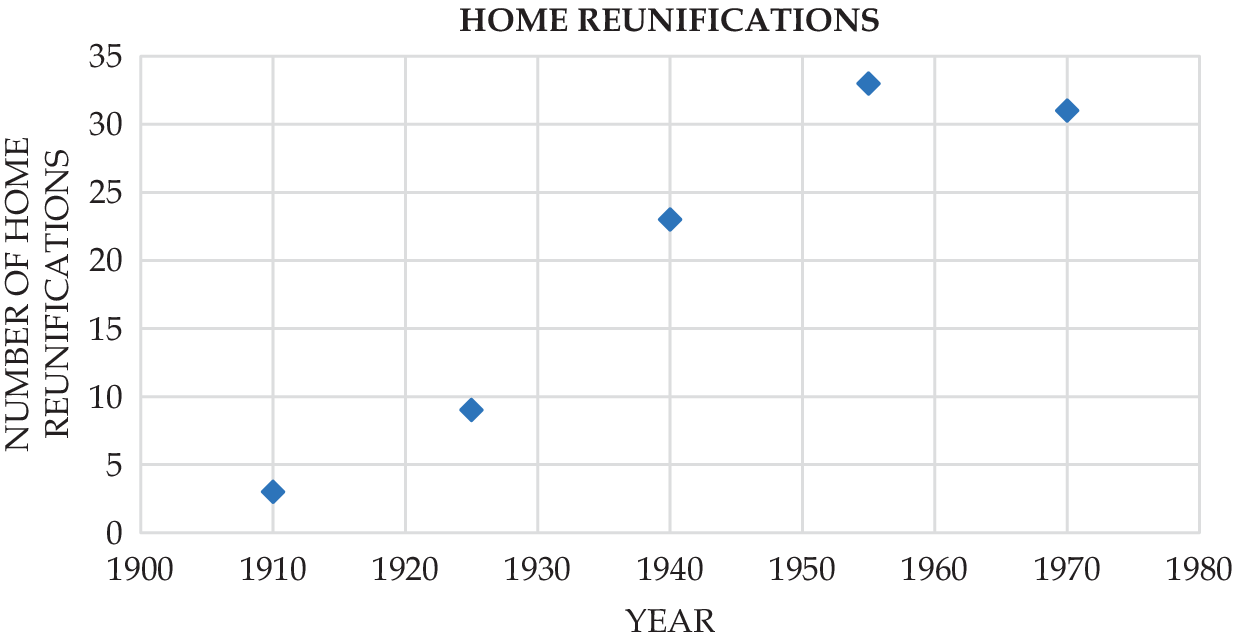
The voluntary removals emerged with the new legislation in 1958, supposedly transforming the CWBs from an institution of control and removals into an institution of social service.Footnote 92 The focus on service and cooperation between the CWBs and parents did not lead to more rights, but apparently it was considered sufficient in terms of shifting the thinking to “working with families” rather than just removing children from their homes. The intention with the new legislation was to democratize the relationship between the families and the CWBs, to have fewer removal cases, and when a child was indeed removed from home, the goal was that that the removal should be voluntary and the placement temporary.Footnote 93 When analyzing case files prior to the enactment of the new legislation, it turns out that placements with consent and temporary placements had already been integrated into the CWBs’ administrative and informal practices. The increasing number of temporary home reunifications provides one example of such an informal practice.
Figure 1 shows that home reunifications in Denmark indeed increased around the time of the implementation of the new legislation in 1958, but home reunifications were already a well-established and widespread practice. A home reunification could be set in motion by a request from the parents in the form of a phone call or letter, by making an appearance at the Social Service Office, or by request from the warden of the children’s institution.
Number of Home Reunifications in Denmark, 1905–1975
Source: Author’s calculations of the reviewed 225 case files from three local archives (The city archives of Copenhagen, the city archives of Odense, and the local archive of Silkeborg).

The informality of the procedures could indeed work to the advantage of parents: 99 children out of 225 were home reunified one time or more times, but conversely the parents had to be aware that this option of addressing a request to the CWB existed. If stated in the case record, the grounds for home reunifications went every which way: The child’s bad or good behavior in the location of placement, the parents’ willingness to cooperate, or parental obstinance. It must have been extremely difficult for parents to navigate the negotiation under these informal and opaque terms. The gray area of home reunifications was accentuated by the fact that the CWB members were nonprofessional laypersons. On one hand, the negotiations might have been more maneuverable for the parents; on the other hand, parents were at the mercy of the local CWB who had far-reaching authority to interpret the individual case.
Parental consent also formed part of the administrative practices prior to framing it in the legislation. In the sample of case files that was examined, 225 in total, only 7% of the cases did not have parental consent to the placement.Footnote 94 The high proportion of parental consent can be attributed to several factors. First, consent in an out-of-home placement case is not tantamount to knowing the implications of that consent. It is not at all clear how parents were informed about consenting to the CWB’s decision. In fact, there are some indications that the consequences of the consent were at times taken for granted. One example thereof is that parents thought that they could ask for a home reunification on their own terms simply because they had given their consent to the placement.Footnote 95 Another example is from the standardized form, in which one question was whether the CWB had informed the parents that they were normally not allowed to have visits from their out-placed child. In this case a CWB member answered, “Considered obvious.”Footnote 96 Of course, it might not have been that obvious to the parents. A second indication raising doubts about the validity of the high numbers of parental consent was that the CWBs tried to persuade parents to consent. About 30% of the examined cases are categorized as initiated by parents themselves, but an internal note from the CWB reminds us that we should be wary when gathering information from case records: “The parents were not to be induced to request the placement themselves.”Footnote 97 Case files describing voluntary parental consent and parental requests for out-of-home placement must thus be read with some caution.Footnote 98 It is important to highlight that the CWBs constituted a sort of monopoly: Parents had no other place to turn if they were dissatisfied with the “service” offered by the CWB. Parental cooperation, voluntariness, and consent must bear this premise in mind.
When voluntary placements came into effect with the legislation of 1958, this sort of cooperation had in practice already been well established. Changes thus occurred incrementally at the local level, but that does not mean that policy changes had no effect on the practices given that the introduction of new legislation strengthened the informal way of doing social work in the CWBs. Bringing focus to policy making from the bottom up exposes the unintended consequences of policy changes, in this case a de facto lowering of standards and requirements within the child welfare system.
CONCLUSION
The practices of the CWB members were marked by discretion and informality in the decision-making process. Attempts were made by central organs to regulate and document the work, but there seemed to be a great distance between center and periphery, with continuing conflict between bureaucratic and legal conceptions of the procedures of out-of-home placement case handling versus the local CWBs’ discretionary measures in their individual assessments of the families. Changes in practices occurred only incrementally, but with the increasing self-determination locally and with less political focus on rule of law, the casework became even more fragmented. The decentralization also prompted more informal negotiations and direct involvement of the parents. This does not mean that legislation was irrelevant. As I have argued, the decentralization was a stimulus for the performance of social work. However, the legislation also left a high degree of latitude for the local CWBs. This tendency toward more local autonomy has implications for unraveling of the CWBs’ exercise of power as well as citizens’ rights within the welfare system.
The social work of the CWBs was characterized by discretionary measures, with a huge cleavage between the rural and town CWBs. Moreover, within the same CWB, cases were handled very differently, some being well documented while others were not. The most transparent and documented cases tended to be cases in which the CWB members themselves were in doubt and needed to investigate the matter more thoroughly, whereas other cases were treated as more routine and quickly resolved.
A huge amount of power to interpret and to make decisions was delegated to the local CWBs. They came to be representatives of the state on the matter of child welfare. Local knowledge about conditions and family life, personal relationships with families, and individual handling of cases were preferred in different state committees over establishing expertise, developing professionals in the field, and ensuring rights and equal treatment for families. The tradition of voluntary aid to families had strong roots in the early Danish welfare state, especially in child welfare. This way of thinking and doing social work within the child welfare system was marked by a certain inertia, and the CWBs’ perceived “labor of love” was continuously thought to be the best possible means for the state to delegate this enormous public responsibility. At the same time, central agencies such as the Central Board demanded that certain fixed bureaucratic procedures be followed, and the intent with the CWBs’ “labor of love” clashed in practice with professional requirements. Once the establishment of the CWBs was in place, the system proved to be difficult to renew or rethink, especially because it went hand in hand with the notion of delegating power locally as a bulwark against a (much too) centralized state.
Tracing the CWBs’ seventy years’ history highlights a different story of the Nordic welfare states than does the conventional narrative of a strong state with a large public sector. The welfare state handed over important tasks of intervention in intimate family matters to a “difficult-to-classify public-private hybrid,” the CWBs, an institution born out of the charitable child-saver tradition but implemented within a state/municipal structure with bureaucratic requirements and procedures. The CWBs thus developed under difficult conditions, and these conditions continued to shape the kind of service they provided. The CWB members occupied a prominent role within the welfare state, but as nonprofessionals they struggled to follow professional standards required by the welfare state.