Gastroenteritis illness, norovirus being the leading cause, is a significant cause of morbidity and mortality in the elderly.Reference Harris, Edmunds, Pebody, Brown and Lopman1–Reference Lindsay, Wolter, De Coster, Van Damme and Verstraeten3 In the United States, norovirus is more likely to affect the elderly as long-term care facilities (LTCFs) are the most common setting for outbreaks.Reference Cardemil, Parashar and Hall4 LTCF residents exhibit a combination of nutritional and immune factors that predispose the population to poor norovirus infection outcomes.Reference Iturriza-Gómara and Lopman5,Reference Lai, Wang, Wu, Hung, Jiang and Wu6 This combination of susceptibility to infection and increased risk of mortality in this age group is particularly concerning because persons >65 years old are expected to comprise one-quarter of the US population by 2060.7
Several characteristics facilitate the transmission of norovirus in LTCFs. First, norovirus resists killing by many healthcare-grade environmental disinfectants. Second, transmission of norovirus requires a very low inoculum and is easily transferred person to person through the fecal–oral route, by direct contact, and through aerosolization, particularly among persons with crowded living conditions. Lastly, immunity is short-lived, on the time scale of months, and researchers have yet to develop a norovirus vaccine.
Given this high disease burden, there is a need to better understand the factors that predispose LTCFs to norovirus outbreaks. Using 9 seasons of surveillance data collected by the Philadelphia Department of Public Health (PDPH) from LTCFs, our objectives were to identify outbreak and facility characteristics associated with gastroenteritis outbreak incidence as well as outbreak duration and size. In addition, we aimed to understand the impact of outbreak control interventions on outbreak features to guide future gastroenteritis outbreak responses.
Methods
Study design and settings
We conducted a retrospective cross-sectional study on gastroenteritis outbreaks in LTCFs in Philadelphia County, which has a population of 1.584 million people, during 9 consecutive norovirus outbreak seasons (November 2009 through May 2018).
Data sources
We obtained data from 2 major sources: the PDPH norovirus outbreak database and the Nursing Home Compare database (NHC, www.medicare.gov/nursinghomecompare). The PDPH norovirus outbreak database is a secure data collection and tracking tool used by the PDPH surveillance staff to capture and characterize all reported norovirus outbreaks. All healthcare facilities in Philadelphia County are required to report norovirus outbreaks. Data were collected by PDPH from staff interviews and included numbers of affected patients and staff, dates of first and last cases, laboratory results, and implementation of outbreak management interventions. The NHC database is a publicly available dataset with information on every Medicare and Medicaid-certified nursing home and is regularly updated by US Centers for Medicare and Medicaid Services. This database includes facility-specific data on ownership type, number of beds, average bed occupancy, Medicare nursing home ratings, and nursing staff hours by license type. We also used the PDPH Facility Mapping database to access facility-specific data on numbers of beds in shared and private rooms in Philadelphia LTCFs.
Data definitions
Norovirus outbreak season was defined as November through May based on the distribution of reported outbreaks during each year of the study period (Supplemental Fig. 1B online). Norovirus outbreaks, defined as 2 or more residents at a facility presenting with acute gastroenteritis of 12–72 hours with associated vomiting and/or diarrhea,Reference Brown, Roy and Shah8 were categorized into 3 norovirus outbreak types. Outbreaks reported to the PDPH with ≥1 patient sample testing positive for norovirus were defined as confirmed norovirus outbreaks. Outbreaks reported to the PDPH with no patient samples sent for laboratory testing were defined as suspected norovirus outbreaks.Reference Lai, Wang, Wu, Hung, Jiang and Wu6 Lastly, outbreaks reported to the PDPH with all patient samples testing negative for norovirus were defined as other gastroenteritis outbreaks.
LTCFs were defined as any nursing home, skilled nursing facility, assisted living facility, or personal care facility that provided residential medical and/or personal care to dependent persons. LTCFs were further categorized as skilled nursing facility/nursing home (SNF/NH) and assisted living facility/personal care facility/other (other).
The patient illness rate was calculated as the number of ill patients over the course of the entire outbreak divided by the number of total patients in a facility at the time the outbreak was reported. Outbreak duration was defined as the number of days between the start dates of the first and last reported patient or staff cases within an outbreak. Time to outbreak resolution was defined as the number of days between the date of the first report to the PDPH and the start date of the last reported patient or staff case within an outbreak.
Total number of licensed nursing staff hours worked by registered nurses (RN) versus licensed practical nurses/licensed vocational nurses (LPN/LVN) was used to assess the level of education of a facility’s staff (typically RN have at least 2 years of training whereas LPN/LVNs have 1 year of training).
Interventions
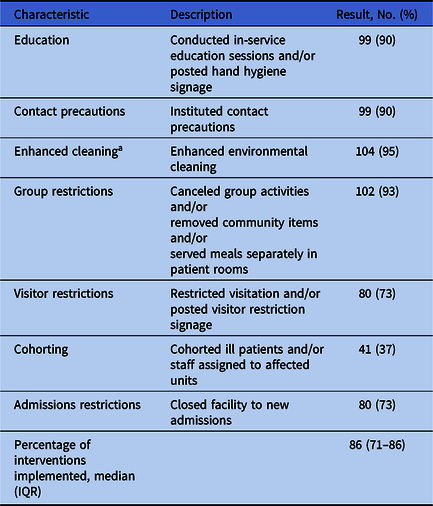
Interventions were categorized based on data captured in the norovirus outbreak database. Various interventions were aggregated thematically into the following 7 categories: education, contact precautions, enhanced cleaning, group restrictions, visitor restrictions, cohorting, and admissions restrictions (Table 1). Categorical interventions were evaluated as implemented if any of the individual component interventions were used during the outbreak. The proportion of interventions implemented was calculated as the number of categorical interventions implemented out of 7 possible categories.
Data analysis and statistical methods
Data were assembled and analyzed using Excel software (Microsoft, Redmond, WA) and SAS version 9.4 software (SAS Institute, Cary, NC) on a secure server. Outbreaks were categorized by month and year in which the outbreak was first reported to PDPH. Facility characteristics from the NHC database were last updated on July 24, 2019 (accessed August 1, 2019). Facility characteristics from the PDPH facility mapping database were derived from data collected through surveys administered in 2017. Because NHC only reports data on licensed SNF/NHs, we limited our comparison of characteristics between facilities with and without norovirus outbreaks to SNF/NHs only. All variables for which any data element was missing from 1 or more outbreaks are indicated in the corresponding table or figure. We summarized the prevalence of various characteristics as frequencies with percentages for categorical variables and as medians with interquartile range (IQR) or means with 95% confidence intervals for continuous variables. Upon review of the distribution of outbreak duration and illness rates, we constructed 2 definitions. We defined prolonged outbreaks as those that lasted 25 or more days and compared characteristics of outbreaks based on duration. We defined large outbreaks as those with a patient illness rate of at least 0.30 and compared characteristics of outbreaks based on size. We utilized χ2 analyses to compare frequencies, t test analyses to compare means, and Mann-Whitney U test analyses to compare medians.
Results
Characteristics of gastroenteritis outbreaks
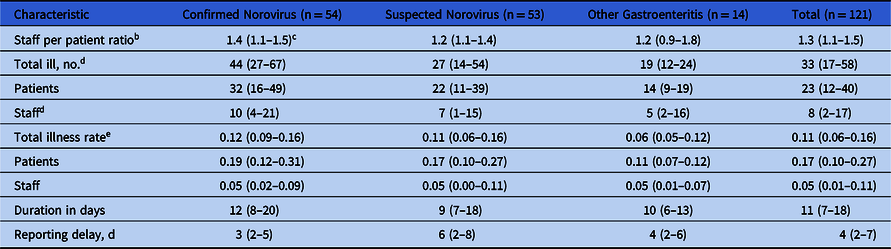
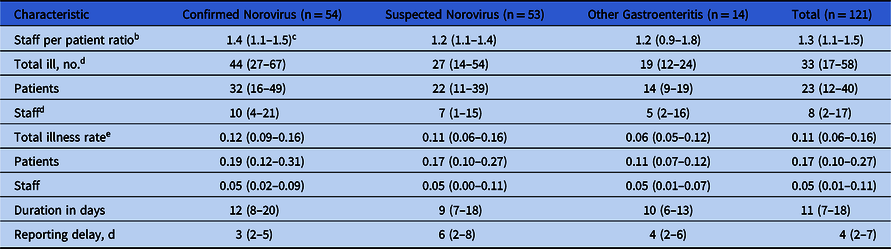
Among the 121 outbreaks reported during the 9 outbreak seasons in the study period, 54 (45%) were laboratory-confirmed and 53 (44%) were suspected norovirus outbreaks (Table 2). There were 8 to 19 outbreaks reported each season and outbreaks were most commonly reported during the months of January and February (Supplemental Fig. 1 online). There was variation in outbreak duration (Supplemental Fig. 2B online) and outbreak size, with a range of 2 to 211 affected patients and a median patient illness rate of 17% (Supplemental Fig. 2A online). Among the 94 outbreaks for which ill staff were reported, we calculated a median staff illness rate of 5%. Outbreak-related patient hospitalizations were reported in 35 (32%) outbreaks, including 9 outbreaks with ≥3 patient hospitalizations. Also, 4 patient deaths related to norovirus were reported during 4 unique outbreaks.
Characteristics of Interventions Implemented for 110 Gastroenteritis Outbreaks That Reported Intervention Data to the Philadelphia Department of Public Health (PDPH) Between November 2009 and May 2018

Note. IQR, interquartile range.
a Enhanced cleaning intervention described for 109 outbreaks due to missing data.
Characteristics of 121 Gastroenteritis Outbreaks Reported to the Philadelphia Department of Public Health (PDPH) Between November 2009 and May 2018 by Outbreak Statusa
Note. IQR, interquartile range.
a Outbreak status was defined by norovirus laboratory testing using the following criteria: (1) confirmed norovirus: suspected norovirus outbreak with ≥1 patient laboratory test positive for norovirus; (2) suspected norovirus: suspected norovirus outbreak with no patient samples sent for laboratory testing; (3) other gastroenteritis: suspected norovirus outbreak with all patient laboratory tests negative for norovirus.
b Numbers of staff and patients at the time of outbreak calculated for 116 outbreaks due to missing data.
c Characteristics expressed as median (IQR).
d Median number of total ill and staff ill calculated for 116 outbreaks due to missing data.
e Median total illness rates and staff illness rates calculated for 112 and 116 outbreaks, respectively, due to missing data.
Characteristics of facilities that had gastroenteritis outbreaks
Of the 49 facilities that reported a gastroenteritis outbreak, most were SNF/NH (n=39, 80%) and almost half (n = 23, 47%) reported more than one outbreak during the study period with a median of two outbreaks per facility (interquartile range [IQR], 1–3). Approximately half of outbreak facility ownership status was classified as for-profit facilities (n = 23, 47%) compared to nonprofit facilities (n = 26, 53%). Among the 42 facilities that reported number of beds, outbreak facilities had a median of 164 beds (IQR, 120–206), predominately in multibed rooms, and >85% occupancy at the time of the outbreak report. Among the 31 facilities that reported number of beds in shared rooms to the PDPH facility mapping database, the median percentage of beds in shared rooms was 95% (IQR, 64%–98%).
Of the 49 outbreak facilities, 34 were included in the NHC database, which comprised 71% of Philadelphia County SNF/NH facilities (n = 48) in this database. Outbreak facilities in the NHC database averaged a mean overall nursing home rating, reported on a scale of 1 to 5, of 2.41 (95% confidence interval [CI], 1.94–2.88). We noted a slightly lower occupancy rate (88% vs 91%; P = .033) and a trend toward lower total bed number (122 vs 176; P = .071) for facilities that did not report any outbreaks compared with those that did report outbreaks. Outbreak facilities had higher numbers of nursing staff hours provided by licensed practical nurses (55 vs 47; P = .055) compared to that of registered nurses. The overall nursing home rating and number of health citations were similar for facilities that did and did not report any outbreaks.
Impact of interventions
Information about the specific outbreak response interventions deployed was available for 110 outbreaks; virtually all reported increased surveillance for diarrheal illnesses. Similarly, enhanced cleaning and suspension of group activities were implemented in almost all outbreaks. An onsite inspection by PDPH was conducted after slightly more than half of reported outbreaks (n = 58). Among the 90 outbreaks that were reported to PDPH before outbreak resolution, the median time to resolution, time between the first report to the PDPH, and the start date of the last case of norovirus, was 7 days (IQR, 5–17 days). No specific interventions were associated with more rapid resolution after public health reporting (data not shown).
Characteristics of large or prolonged gastroenteritis outbreaks
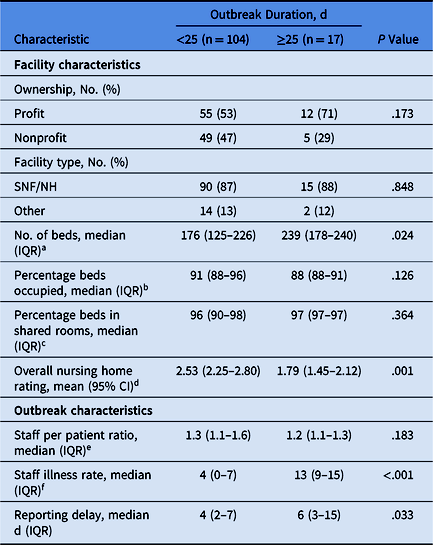
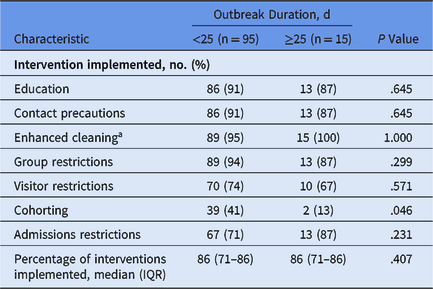
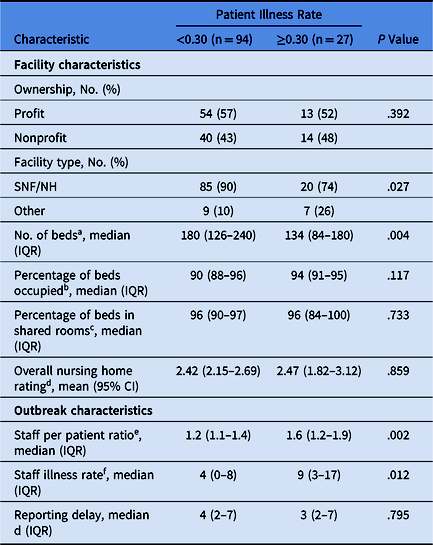
We found that prolonged outbreaks were associated with a reporting delay, larger number of total beds, and lower average nursing home rating (Table 3). Cohorting was less commonly deployed during outbreaks of prolonged duration (13% vs 41%; P = .046) (Table 4). There was a marked difference in the reported staff illness rate in outbreaks with a duration ≥25 days as compared to those with a duration of <25 days (13% vs 4%; P < .001). Outbreaks with a high patient illness rate were more likely to have occurred in a SNF/NH and typically were associated with a high staff illness rate (Table 5). We identified 5 outbreaks that lasted >30 days (Supplemental Fig. 2C online).
Characteristics of 121 Gastroenteritis Outbreaks by Outbreak Duration

Note. SNF, skilled nursing facility; NH, nursing home. IQR, interquartile range; CI, confidence interval.
a Median number of beds calculated for 113 outbreaks due to missing data.
b Median percentage of beds occupied calculated for 103 outbreaks due to missing data.
c Median percentage of beds in shared rooms calculated for 95 outbreaks due to missing data.
d Nursing home ratings from the Nursing Home Compare (www.medicare.gov/nursinghomecompare). Mean overall nursing home rating calculated for 103 outbreaks due to missing data.
e Median staff per patient ratio calculated at time of outbreak for 117 outbreaks due to missing data.
f Median staff illness rates calculated for 116 outbreaks due to missing data.
Characteristics of Interventions Employed for 110 Outbreaks That Reported Intervention Data by Total Duration

a Enhanced cleaning intervention described for 109 outbreaks due to missing data.
Characteristics of 121 Gastroenteritis Outbreaks by Patient Illness Rate

Note. SNF, skilled nursing facility; NH, nursing home. IQR, interquartile range; CI, confidence interval.
a Median number of beds calculated for 113 outbreaks due to missing data.
b Median percentage of beds occupied calculated for 103 outbreaks due to missing data.
c Median percentage of beds in shared rooms calculated for 95 outbreaks due to missing data.
d Nursing home ratings from Nursing Home Compare (www.medicare.gov/nursinghomecompare). Mean overall nursing home rating calculated for 103 outbreaks due to missing data.
e Median staff per patient ratio calculated at time of outbreak for 117 outbreaks due to missing data.
f Median staff illness rates calculated for 116 outbreaks due to missing data.
Discussion
In this report, we describe the largest retrospective analysis of gastroenteritis outbreaks in LTCFs. We found that facility characteristics and evidence of gastroenteritis in staff as well as patients were associated with more severe outbreaks. In addition, reporting delays and absence of health interventions were associated with prolonged outbreaks.
Several facility characteristics, including occupancy, level of staff training, size and perceived quality, were associated with increased outbreak likelihood and severity. First, among SNFs, higher facility occupancy and lower level of staff training were associated with the likelihood of reporting an outbreak within our study period. Higher facility occupancy not only burdens the facility staff and resources but also increases the potential for gastroenteritis introduction by both patients and visitors. Our findings about staff with less training, as described by lower proportion of registered nurse staffing, is supported by other studies that emphasize the relationship between nurse staffing and quality of care in long-term care settings.Reference Harrington, Zimmerman, Karon, Robinson and Beutel9–Reference Collier and Harrington11 Second, larger facility size and lower overall nursing home rating were significantly associated with prolonged outbreaks. Facility size has previously been noted to be associated with risk of outbreaks of communicable diseasesReference Li, Birkhead, Strogatz and Coles12 and may be a marker of institutions at greater risk of experiencing staffing shortages. Lower overall nursing home ratings suggest that measures of facility quality may be associated with clinically relevant patient outcomes.Reference Dellefield, Castle, McGilton and Spilsbury13
Reported transmission in staff as well as patients was associated with more severe outbreaks. Higher staff illness rates were also significantly associated with both prolonged outbreaks and higher patient illness rates. Presenteeism, or the phenomenon of “working while ill,” has been noted as an underlying issue in other outbreaks of viral gastroenteritis in LTCFsReference Widera, Chang and Chen14 and is common in many healthcare settings.Reference Szymczak, Smathers, Hoegg, Klieger, Coffin and Sammons15 A case-cohort study of nursing homes in New York State noted that the availability of “paid sick leave” was associated with a 60% lower risk of an institution experiencing a respiratory illness or gastroenteritis outbreak.Reference Li, Birkhead, Strogatz and Coles12 These findings suggest that heightened surveillance for gastroenteritis among staff along with sick leave policies that support healthcare workers may play an important role in controlling ongoing gastroenteritis transmission in healthcare settings.
Finally, public health responses and reporting delays were associated with outbreak duration. This observation may be explained by delayed outbreak recognition and subsequent implementation of control measures, in turn increasing the outbreak duration and illness rate. Although most interventions observed did not appear to impact outbreak outcomes, cohorting was significantly associated with shorter outbreak duration. Cohorting of ill patients and staff assigned to ill units decreases the potential for transmission of this highly contagious pathogen, which can be difficult to eradicate from the patient care environment.Reference Wu, Fornek and Schwab16
Several potential limitations should be considered in our study. First, due to passive reporting, we suspect that norovirus outbreaks may have been substantially underreported and that reporting may have been biased. Facilities that chose to report an outbreak may differ from those that may have had an outbreak but chose not to report it. For example, reporting facilities may have had a higher awareness of the serious nature of norovirus outbreaks among this fragile patient population. Additionally, we recognize the limited accuracy and completeness of the PDPH gastroenteritis outbreak database; most of data were collected through phone interviews with facility staff reporting the suspected norovirus outbreak. Some outbreak reports included approximated or missing values for number of beds, ill staff, and total staff at the time of the outbreak. In particular, the number of ill staff associated with an outbreak may have been difficult to quantify because staff may not have always provided reasons for not presenting to work. Misclassification bias may also have influenced our findings; approximately half of reported outbreaks did not have laboratory confirmation. However, the classic clinical presentation and seasonal clustering of our outbreaks suggest that many, if not most, were due to norovirus. Finally, we are unable to measure the specific impact of public health engagement because we cannot differentiate the interventions initiated by the facility compared to those prompted by a public health consultation.
In summary, our findings offer valuable insight into facility characteristics such as occupancy, level of staff training, and quality ratings as they relate to gastroenteritis outbreak likelihood and outcome. This study also highlights the importance of ill staff and their contribution to outbreak severity, suggesting that LTCFs should focus on outbreak prevention and that containment interventions should focus on not only patient but also staff populations. Furthermore, our results emphasize the importance of early outbreak detection and cohorting of ill patients to prevent ongoing transmission. To further elucidate the impact of specific interventions on outbreak outcomes, additional studies are necessary that incorporate data collection with timing of intervention implementation.
Supplementary material
To view supplementary material for this article, please visit https://doi.org/10.1017/ice.2020.263
Acknowledgments
None.
Financial support
H.K. received grant support from the Infectious Disease Society of America Grants for Emerging Researchers/Clinicians Mentorship Program.
Conflict of interest
All authors report no conflicts of interest relevant to this article.