Introduction
The pine bark adelgid, Pineus strobi (Hartig) (Hemiptera: Adelgidae), is an herbivore that feeds primarily on eastern white pine, Pinus strobus Linnaeus (Pinaceae) (Doane Reference Doane1961). Although it is an occasional aesthetic pest on Christmas trees and ornamentals, feeding by P. strobi does not appear to affect P. strobus health, even when adelgid densities are high (Clark and Brown Reference Clark and Brown1960). Thus, little, if any, P. strobi management is necessary. The species has been reported in the Pacific Northwest of North America on Pinus monticola (Douglas ex Don), and its pest status there is undetermined (Darr et al. Reference Darr, Salom, Brooks, Foottit, Miller and Havill2018). It is also an occasional nursery pest in the United Kingdom (Matosevic and Zivkovic Reference Matosevic and Zivkovic2013).
While P. strobi is not considered a significant pest, it shares its geographic range with non-native adelgids that inflict substantial ecologic and economic damage. One invasive species is the hemlock woolly adelgid, Adelges tsugae (Annand) (Hemiptera: Adelgidae), an ecologically and economically destructive invasive species introduced to the eastern United States of America from Japan that feeds on hemlock (Tsuga Endlicher (Carrière); Pinaceae) species (Havill et al. Reference Havill, Shiyake, Lamb-Galloway, Foottit, Yu and Paradis2016). Another, the balsam woolly adelgid, Adelges piceae (Ratzeburg) (Hemiptera: Adelgidae), from Europe and Central Asia is invasive across the United States of America and Canada and causes high mortality in native North American fir (Abies Miller; Pinaceae) species (Jenkins Reference Jenkins2003; McManamay et al. Reference McManamay, Resler, Campbell and McManamay2011). In addition, the pine adelgid, Pineus boerneri Annand (Hemiptera: Adelgidae), was introduced to New England, United States of America where it is reported to damage red pine, Pinus resinosa Aiton (McClure Reference McClure1982; Centre for Agriculture and Bioscience International 2017). The origin of P. boerneri is not clear, but it may be native to East Asia (McClure Reference McClure1984). Biological control is an important option for controlling invasive adelgids on a landscape scale (Mausel and Salom Reference Mausel and Salom2014; Montgomery and Havill Reference Montgomery and Havill2014). It is reasonable to consider that predators of P. strobi may also use these alien species because they are related to P. strobi and share habitats.
In the northern reaches of the native range of P. strobi, a number of naturally occurring predators have been identified from the families Coccinellidae (Coleoptera), Chamaemyiidae (Diptera), Cecidomyiidae, and Hemerobiidae (Neuroptera), as well as Laricobius rubidus LeConte (Coleoptera: Derodontidae) (Wilson Reference Wilson1938; Raske and Hodson Reference Raske and Hodson1964; Sluss and Foote Reference Sluss and Foote1973; Montgomery and Lyon Reference Montgomery and Lyon1995a). Laricobius rubidus is considered a specialist predator of P. strobi and is not reported on other prey native to eastern North America (Brown Reference Brown1944; Clark and Brown Reference Clark and Brown1960; Lawrence and Hlavac Reference Lawrence and Hlavac1979; Montgomery and Lyon Reference Montgomery and Lyon1995a). Previous studies of L. rubidus phenology report that adults are present from March to June and eggs are laid within P. strobi ovisacs during April and May (Clark and Brown Reference Clark and Brown1960; Zilahi-Balogh et al. Reference Zilahi-Balogh, Broeckling, Kok and Salom2005). There are four instars, each of which, like the adult, feeds on all P. strobi life stages. The last instar is believed to drop to the soil for pupation (Clark and Brown Reference Clark and Brown1960). This phenology is highly synchronised with that of P. strobi. In the Appalachain Mountains of southwestern Virginia, United States of America, P. strobi reproduction begins in early April with a large spike in egg production following a quiescent period during the winter (Wantuch et al. Reference Wantuch, Kuhar and Salom2017).
Following the introduction of the hemlock woolly adelgid, it became apparent that L. rubidus could also feed and complete development on this invasive prey species (Montgomery and Lyon Reference Montgomery and Lyon1995b; Zilahi-Balogh et al. Reference Zilahi-Balogh, Broeckling, Kok and Salom2005; Mausel et al. Reference Mausel, Salom, Kok and Fidgen2008; Story et al. Reference Story, Vieira, Salom and Kok2012). Adelges tsugae has a similar life cycle to P. strobi in that the majority of individuals are wingless and immobile following the first instar and reproduce asexually (Raske and Hodson Reference Raske and Hodson1964; McClure Reference McClure1989; Havill and Foottit Reference Havill and Foottit2007). However, there are differences in that P. strobi is not active in the winter (Raske and Hodson Reference Raske and Hodson1964; Wantuch et al. Reference Wantuch, Kuhar and Salom2017); whereas, A. tsugae has two distinct generations per year with nymphs developing to adults by late winter and laying eggs in late winter to early spring, and adult A. tsugae aestivate over much of the summer (McClure Reference McClure1989; Lamb et al. Reference Lamb, Salom and Kok2007; Mausel et al. Reference Mausel, Salom, Kok and Fidgen2008). In contrast, P. strobi does not diapause and has multiple overlapping generations resulting in all life stages being apparently available to predators from March to November in southwestern Virginia (Wantuch et al. Reference Wantuch, Kuhar and Salom2017). Because forest stands of P. strobus are often intermixed with eastern hemlocks, Tsuga canadensis (Linnaeus) and Carolina hemlock, Tsuga caroliniana Engelman (Burns and Honkala Reference Burns and Honkala1990), L. rubidus has ample opportunity for interaction with A. tsugae. Laricobius nigrinus Fender (Coleoptera: Derodontidae), a close relative of L. rubidus from the Pacific Northwest has been released in the eastern United States of America as a biological control agent of A. tsugae (Mausel et al. Reference Mausel, Salom, Kok and Davis2010; Davis et al. Reference Davis, Havill, Adelman, Caccone, Kok and Salom2011). These two Laricobius Rosenhauer species are known to produce fertile hybrids in the field, and both species and their hybrids are all known to feed on A. tsugae and P. strobi (Havill et al. Reference Havill, Davis, Mausel, Klein, McDonald and Jones2012; Fischer et al. Reference Fischer, Havill, Brewster, Davis, Salom and Kok2015).
Little is known regarding predators of P. strobi, particularly in the southern portion of its range. Host switching of Laricobius species, and possibly other predators, between native and non-native adelgids warrants investigation of the incidence and phenology of P. strobi predators in its previously unstudied southern range. The predator complex of P. strobi may exert pressure on these exotic adelgid species, and newly introduced biological controls could impact the native community of predators on P. strobi. The current study documents the predator complex associated with P. strobi in the forests of the Appalachain Mountain Range in southwestern Virginia, with specific attention to the phenology of L. rubidus.
Materials and methods
Specimens were collected from three sites in southwestern Virginia: Peak Creek, at Gatewood Park and Reservoir, Pulaski, 37.06217°N, 80.83633°W; Hussy Mountain, in Mount Rogers National Recreation Area, Speedwell, 36.77223°N, 81.17521°W; and Dismal Falls, in George Washington and Jefferson National Forest, Giles County, 37.19263°N, 80.89230°W. Sampling occurred approximately every two weeks from 13 September 2013 to 28 April 2016. This coincided with a study of P. strobi phenology at these same sites (Wantuch et al. Reference Wantuch, Kuhar and Salom2017). Samples were taken from eastern white pine trees colonised by P. strobi and were limited to parts of trees accessible from the ground with hand pruners. Mature trees, saplings, and seedlings were sampled opportunistically wherever P. strobi was present. Because of the patchy distribution of this insect, it was not possible to implement a structured sampling scheme with regard to tree age class. At each site, on each sampling date, a minimum of 50 trees infested with P. strobi were sampled using a beating sheet. Because P. strobi populations were scarce in these forest environments, it was not possible to ensure that infested trees that had been beating-sheet sampled were not sampled on future visits via beat sheeting or branch tip excision. In addition, excised infested branch tips of various lengths and bark samples were collected during each visit and examined under a dissecting microscope in the laboratory and predators were removed. Infested tree samples were not restricted to any certain size, but instead were chosen so as to maximise the number of adelgids collected on each. The number of tree samples collected varied based upon adelgid density, with the goal being to collect a minimum of 100 nonegg P. strobi from each site on each date. Beat sheet samples consisted of adult insects, with the exception of coccinellid larvae, and all other immature predators were collected from branch tips using a dissecting microscope. All predator specimens were stored in a freezer at −20 °C, and immature insects were placed in 95% ethanol.
Adult insects were identified using morphological characters; voucher specimens are deposited in the Virginia Tech Insect Museum, Blacksburg, Virginia, United States of America and in the University of Georgia Collection of Arthropods, Athens, Georgia, United States of America. All larval specimens were identified using DNA barcoding, with the exception of L. rubidus. Laricobius larvae can be identified to genus using morphology, but cannot be distinguished to species morphologically, and so it is possible to confuse L. rubidus and L. nigrinus. The collection sites were located in a region that should only have L. rubidus because the closest release site for L. nigrinus to any collection site was 19 km away. Nevertheless, a subset of larvae were identified with DNA barcodes (Davis et al. Reference Davis, Havill, Adelman, Caccone, Kok and Salom2011) to ensure that the non-native L. nigrinus or their hybrids were not present in the populations. All other predator larvae were identified by comparing DNA barcodes to records in the Barcode of Life Database (BOLD) (Ratnasingham and Hebert Reference Ratnasingham and Hebert2007). For all specimens, DNA was extracted using the Mag-Bind Blood and Tissue Kit (Omega Bio-Tek, Norcross, Georgia, United States of America). The cuticles were preserved after proteinase digestion and slide mounted as vouchers, which were deposited at the Yale Peabody Museum of Natural History (New Haven, Connecticut, United States of America). The 5′ end of mitochondrial cytochrome c oxidase subunit I (COI) was amplified using primers LepF1 and LepR1 (Hebert et al. Reference Hebert, Penton, Burns, Janzen and Hallwachs2004), and sequencing was performed at the DNA Analysis Facility on Science Hill, Yale University using an ABI 3730 sequencer (Life Technologies, Grand Island, New York, United States of America). Chromatograms were edited using Geneious v7 (www.geneious.com; Kearse et al. Reference Kearse, Moir, Wilson, Stones-Havas, Cheung and Sturrock2012). Samples were identified to the most specific taxon possible by searching the Barcode of Life Database (www.barcodinglife.org). All DNA sequences generated for this study were deposited in GenBank with accession numbers MH119461–MH119573.
Results
Coleoptera: Derodontidae
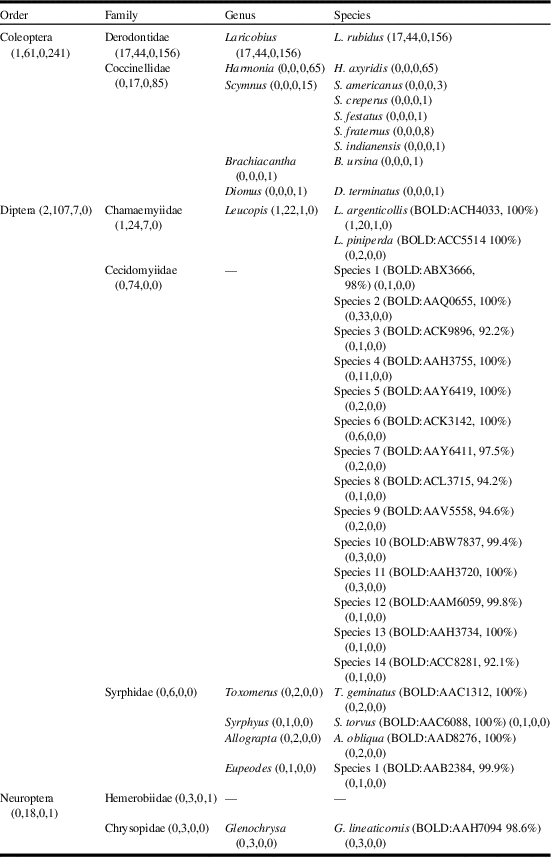
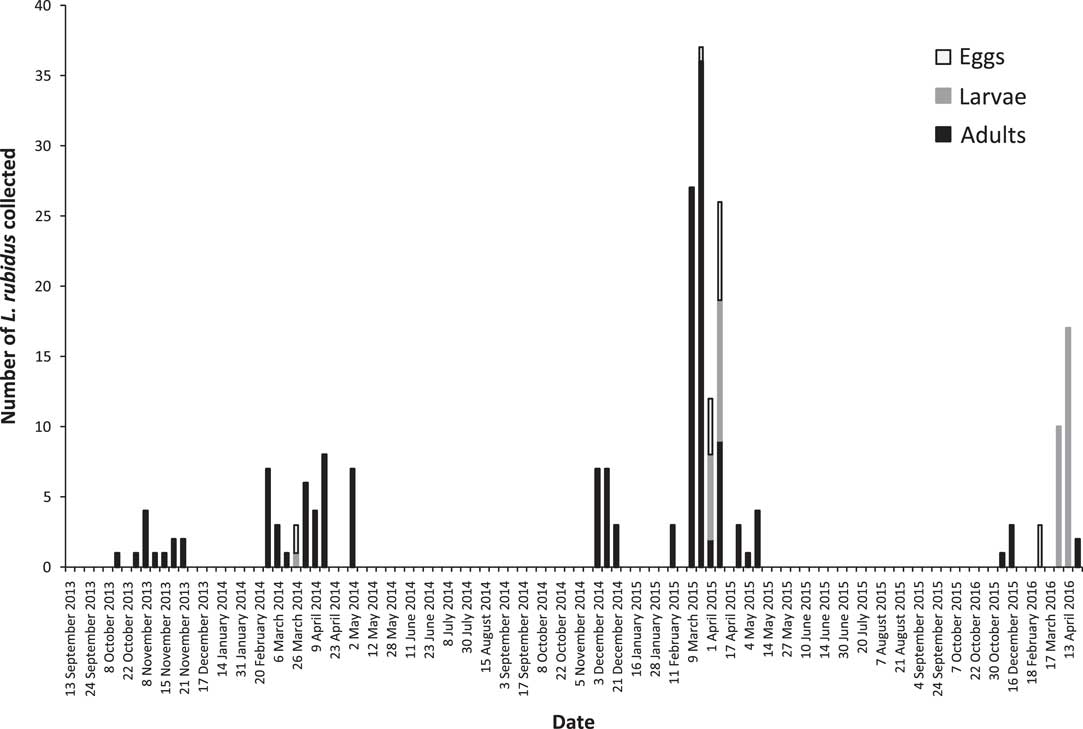
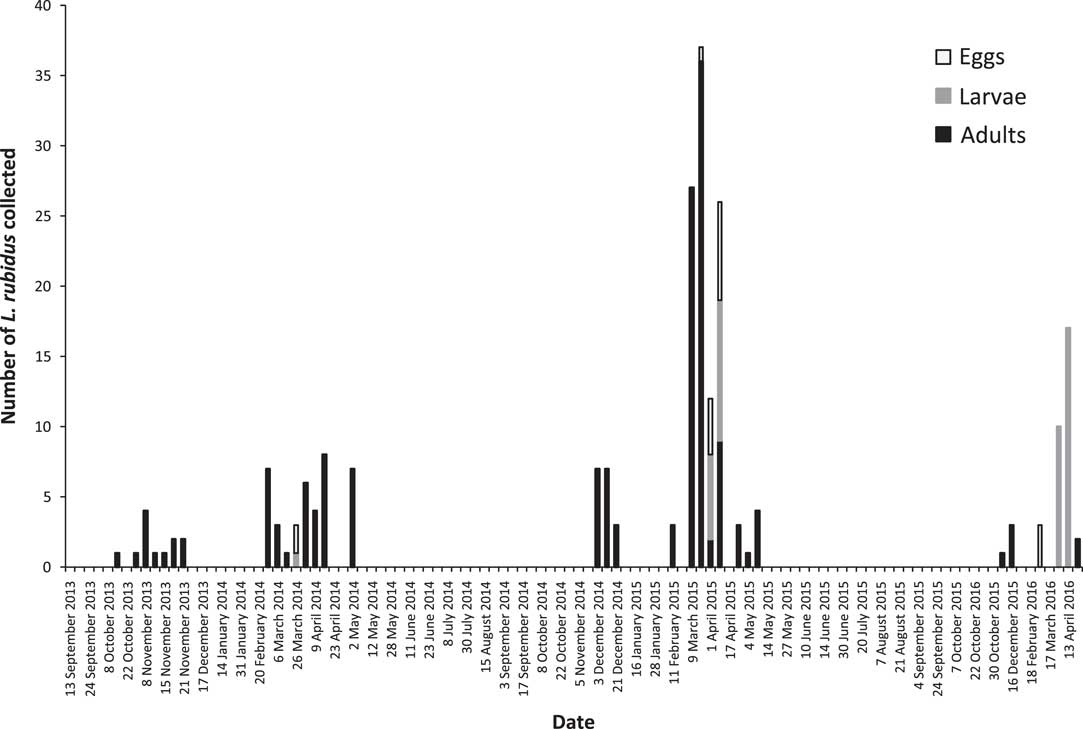
A total of 156 adults, 44 larvae, and 17 eggs of Laricobius rubidus were collected at all three sites over the course of the study (Table 1). Adult L. rubidus were consistently active beginning in the fall during October 2013 and early December of 2014 and 2015 (Fig. 1). Across all years there was a period of inactivity during the coldest parts of the winter during which no adults were collected. In 2013, this occurred from December to late February. In 2014, no beetles were observed from January to mid-February, and in 2015, adults were not collected from January to April. In addition, two eggs were found in late March 2013, one egg was found in March 2015, 11 eggs and 9 larvae recovered from branch tips in April 2015, three eggs were found in March 2016, and 33 larvae were collected from branch tips in April 2016. Laricobius rubidus activity ceased no later than May and appeared to have only one generation per year.
Predatory species associated with Pineus strobi on Pinus strobus in southwestern Virginia collected 2013–2016 with the number of each life stage collected (eggs, larvae, pupae, adults).

Notes: Specimens were identified to various levels; counts of broader levels include those of narrower levels within them. Cecidomyiid specimens could not be identified to species. Those that could be grouped together based on their closest match to a DNA Barcode of Life Database (BOLD) barcode index numbers (BINs) are given arbitrary species numbers. Their BINs are shown in parentheses, and the percent sequence match follows each BIN.
Number of Laricobius rubidus of each life stage collected on each sampling date (2013–2016) in southwest Virginia.
Coleoptera: Coccinellidae
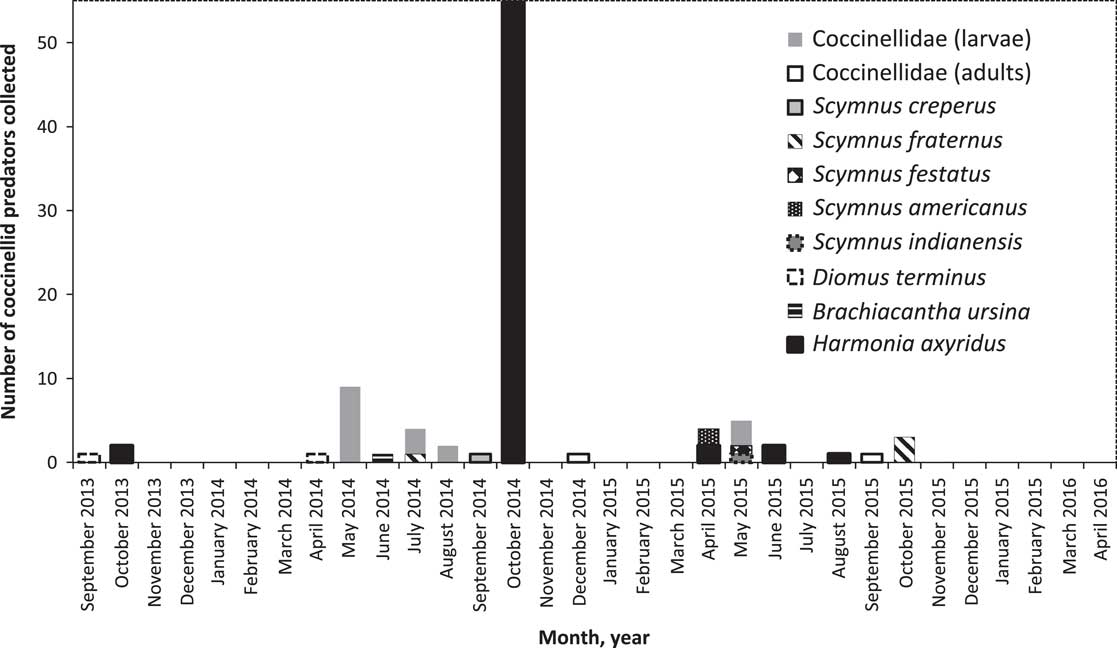
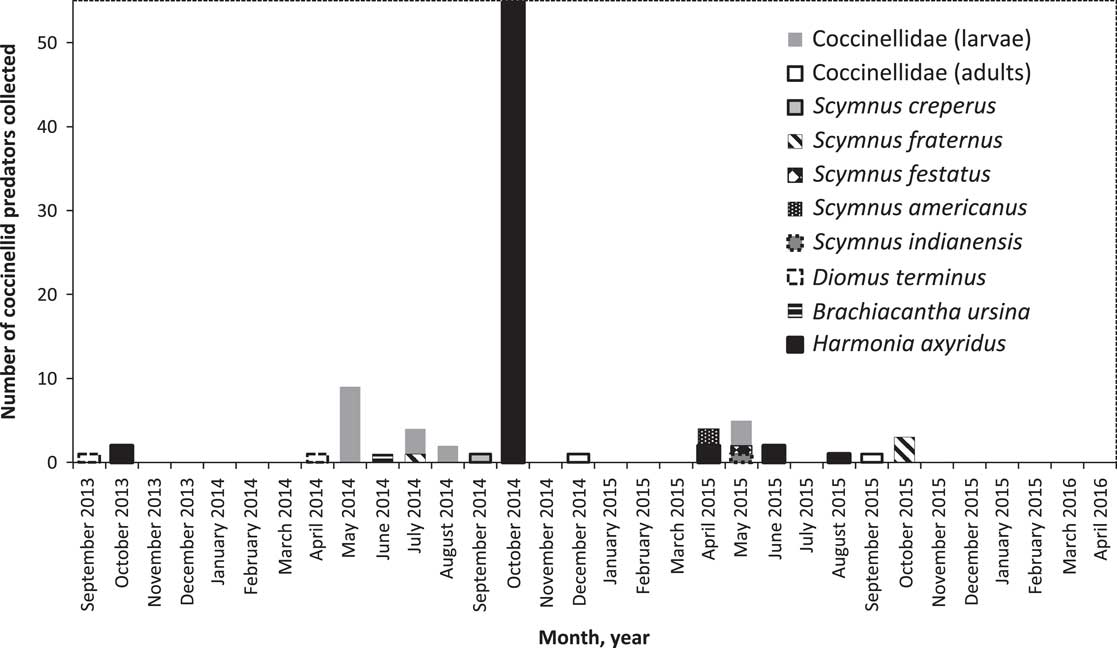
Adult Coccinellidae were collected October 2013, May–October 2014, and April to late September 2015. Larvae were observed from May to July of 2014 and 2015 (Table 1; Fig. 3). The most frequently collected species identified was Harmonia axyridis (Pallas). Five species of the genus Scymnus Kugelann were also collected on eastern white pines infested with P. strobi: S. indianensis Weise, S. festatus Wingo, S. americanus Mulsant, S. creperus Mulsant, and S. fraternus LeConte. Other adult coccinellid species found in association with P. strobi were Brachiacantha ursina (Fabricius) and Diomus terminatus (Say).
Diptera: Chamaemyiidae
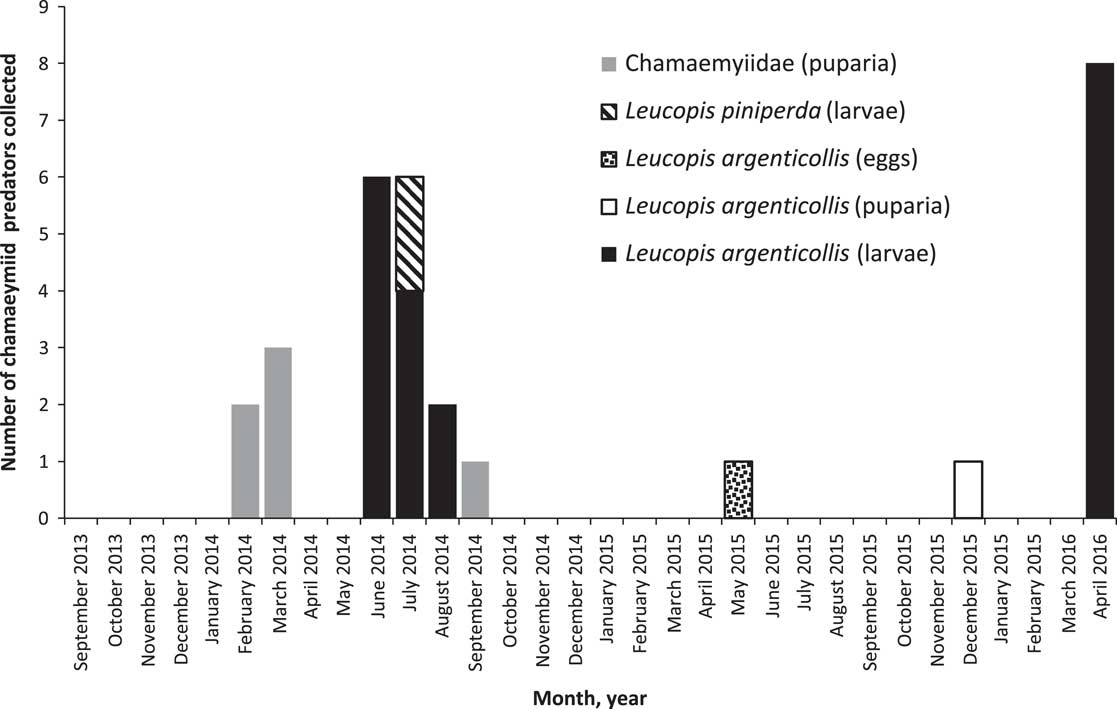
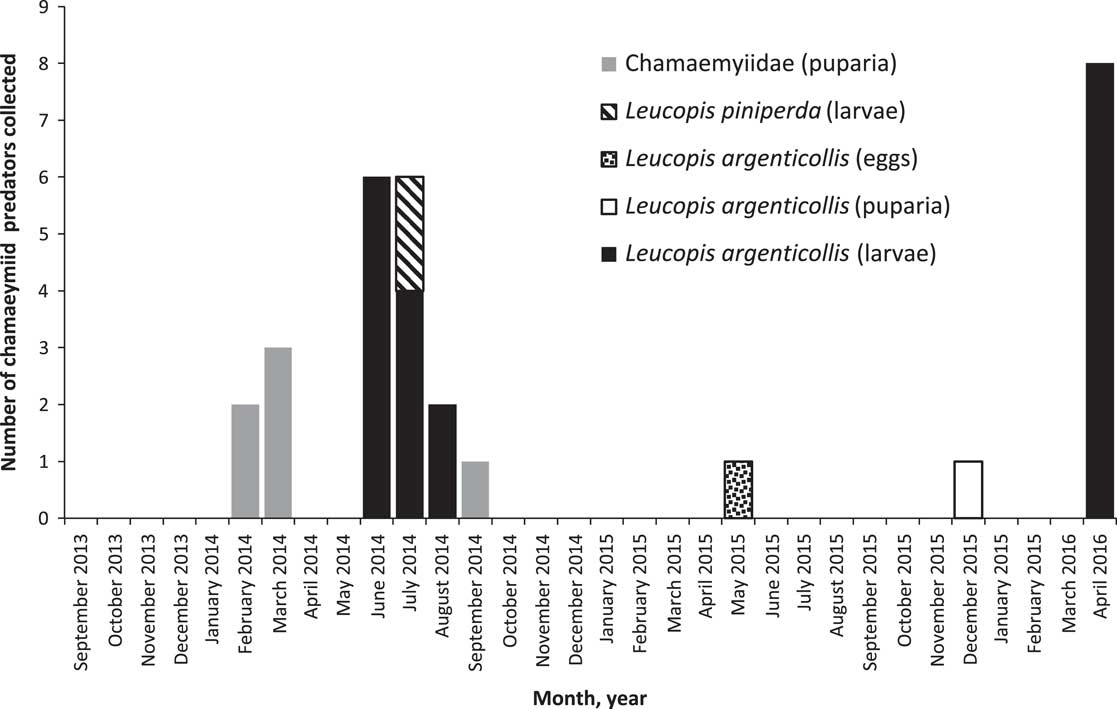
Leucopis argenticollis Zetterstedt larvae were collected from branch tips from April to August and L. piniperda Malloch from June to July. Five empty Leucopis Meigen puparia were collected from mid-February through late March and in September of 2014, but it was not possible to identify these two species. One puparium was collected in December 2015 from which an adult L. argenticollis emerged (Table 1; Fig. 2).
Diptera: Cecidomyiidae
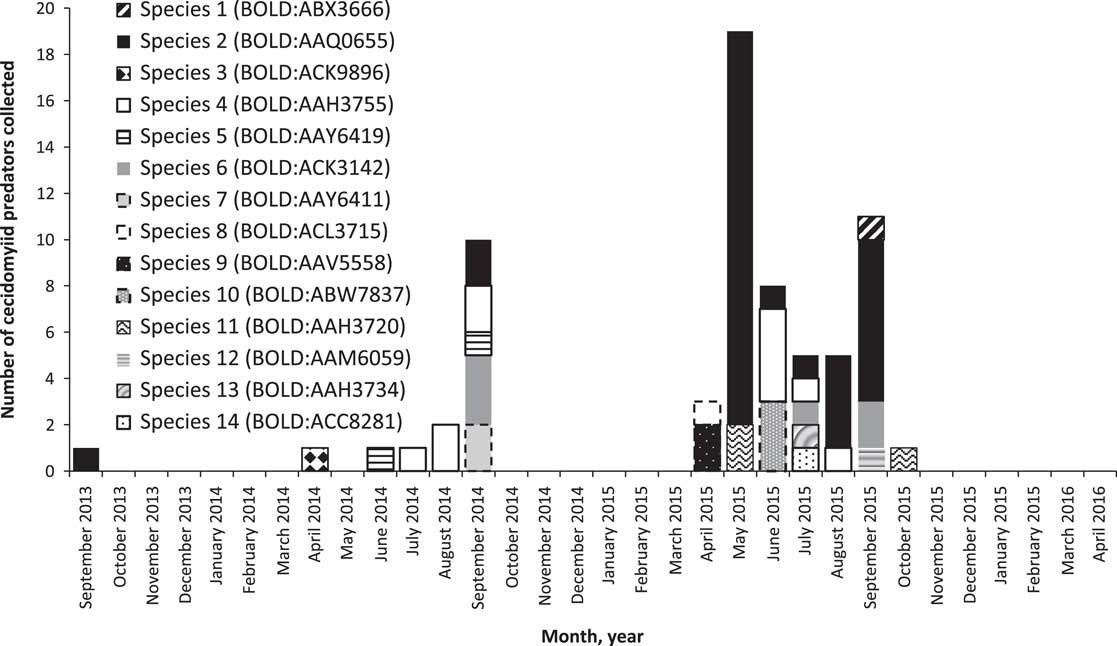
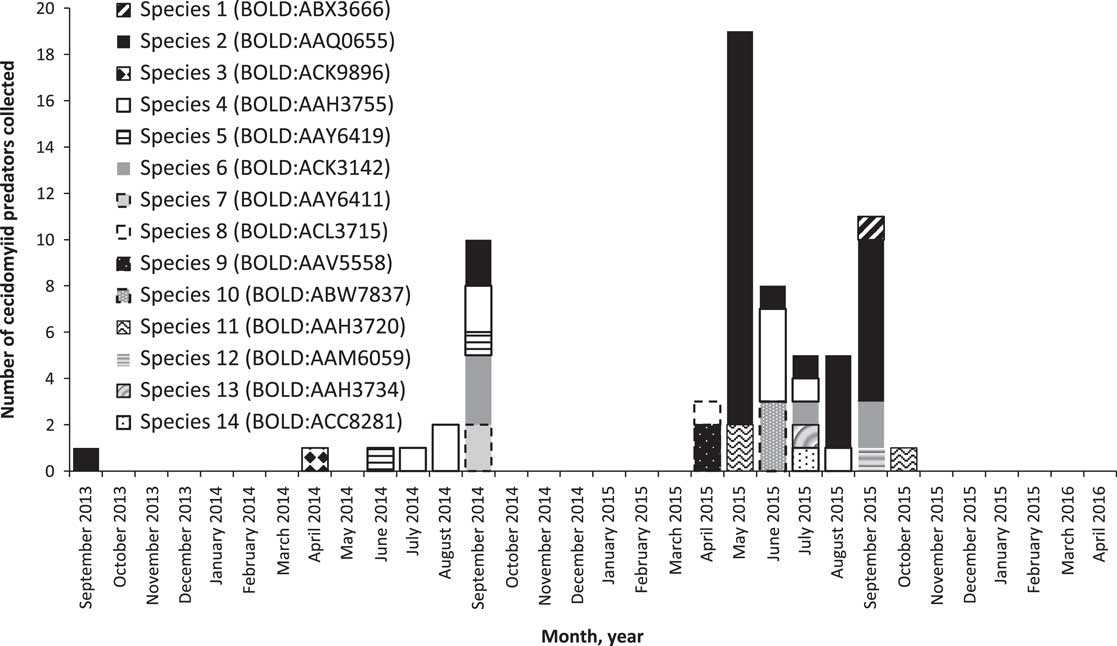
Cecidomyiid larvae were found on branch tips from April to October (Table 1; Fig. 4). Fourteen putative species were identified using DNA barcoding, however none matched records identified to species in the Barcode of Life Database. Specimens from eight of these putative species (species 2, 4, 5, 6, 11, 13, and 14) were collected from within P. strobi ovisacs, suggesting that they are likely predaceous. An individual of species 5 was observed eating an adult adelgid and its eggs. Specimens of the other putative species were collected on or near the adelgids.
Diptera: Syrphidae
Four species of syrphid larvae were collected: Allograpta obliqua (Say) in May 2015, Syrphus torvus Osten Sacken in April 2016, Toxomerus geminatus (Say) in June 2014 and October 2015, and Eupeodes Osten Sacken species in September 2013 (Table 1).
Neuroptera: Hemerobiidae
Hemerobiid larvae were observed in the field during late April and May of 2014 and 2015, and an adult was observed in December 2013 (Table 1). Larval DNA barcoding was inconclusive because DNA sequences recovered from these samples matched to those of Sciaridae (Diptera) and Chironomidae (Diptera) in the Barcode of Life Database, suggesting that sequences originated either from larval gut contents or from remnants of carcasses that they are known to carry as camouflage.
Neuroptera: Chrysopidae
Three specimens of Glenochrysa lineaticornis (Fitch) were collected on 18 September 2015 (Table 1).
Discussion
The phenology of L. rubidus observed in this study differs markedly from previous observations in the northern range of the beetle, where adults were found from March to June and eggs were laid in April and May (Clark and Brown Reference Clark and Brown1960; Zilahi-Balogh et al. Reference Zilahi-Balogh, Broeckling, Kok and Salom2005). In the present study, L. rubidus was present as early as mid-October through the beginning of May, and absent from late December to mid-February. Eggs were found March to April, and larvae were collected in April (Fig. 1). These data suggest an approximately one month shift in activity between southern and northern ranges of L. rubidus from late winter through summer with regard to adult, egg, and larval presence, which may be explained by warmer southern temperatures. The absence of adults from December to mid-February may be due to L. rubidus retreating into the soil in order to avoid cold winter temperatures.
Laricobius rubidus and L. nigrinus are very closely related species (Montgomery et al. Reference Montgomery, Shiyake, Havill and Leschen2011), but they have different prey preferences. Laricobius rubidus prefers pine adelgids while L. nigrinus prefers hemlock adelgids (Zilahi-Balogh et al. Reference Zilahi-Balogh, Kok and Salom2002, Reference Zilahi-Balogh, Broeckling, Kok and Salom2005; Arsenault et al. Reference Arsenault, Havill, Mayfield and Wallin2015). Laricobius rubidus can be found feeding on A. tsugae in the field but in lower numbers than on P. strobi (Montgomery and Lyon Reference Montgomery and Lyon1995b; Zilahi-Balogh et al. Reference Zilahi-Balogh, Broeckling, Kok and Salom2005; Mausel et al. Reference Mausel, Salom, Kok and Fidgen2008; Havill et al. Reference Havill, Davis, Mausel, Klein, McDonald and Jones2012; Story et al. Reference Story, Vieira, Salom and Kok2012; Fischer et al. Reference Fischer, Havill, Brewster, Davis, Salom and Kok2015). Conversely, L. nigrinus can be found feeding on P. strobi in the field, but in lower numbers than on A. tsugae (Fischer et al. Reference Fischer, Havill, Brewster, Davis, Salom and Kok2015). Despite the difference in host preference, these species share many phenological and behavioural traits (Mausel et al. Reference Mausel, Salom, Kok and Fidgen2008). Both Laricobius species are active in the spring and fall, but they are not found on adelgid prey during late Spring through mid-Fall (mid-May to late October for L. rubidus in Virginia). This would seem maladaptive for L. rubidus because all stages of P. strobi are available as prey during this time (Wantuch et al. Reference Wantuch, Kuhar and Salom2017). However, two other species of Laricobius, L. osakensis Shiyake and Montgomery and L. erichsonii Rosen (Coleoptera: Derodontidae), a European predator of A. piceae, are also univoltine, with a period of aestivation while their prey are still available (Buffama Reference Buffama1962; Zilahi-Balogh et al. Reference Zilahi-Balogh, Humble, Lamb, Salom and Kok2003; Vieira et al. Reference Vieira, Lamb, Shiyake, Salom and Kok2013). Since this trait is shared among all Laricobius species with known life cycle, it is likely that the existence of an obligate period of aestivation is fixed within the genus and not readily available for adaptation.
Two species of chamaemyiid flies were found on branch tip samples infested with P. strobi. The predaceous larval stage was observed from May to August in 2014 and in April 2016 (Fig. 2). Leucopis argenticollis was more abundant than L. piniperda. Both species are known to be predators of the native lineage of A. tsugae in western North America (Havill et al. Reference Havill, Gaimari and Caccone2018). These Leucopis species have not been reported on A. tsugae in the eastern United States of America, and eastern and western lineages of both Leucopis species have distinct genotypes that appear to specialise on different adelgid species. The western strains are currently being evaluated and released as biological control agents for A. tsugae (Ross et al. Reference Ross, Grubin, Kohler and Wallin2010; Grubin et al. Reference Grubin, Ross and Wallin2011; Kohler et al. Reference Kohler, Wallin and Ross2016; Motley et al. Reference Motley, Havill, Arsenault-Benoit, Mayfield, Ott and Ross2017; Havill et al. Reference Havill, Gaimari and Caccone2018). The current study shows that both Leucopis species are present in southwestern Virginia prior to release of the western lineages, which may aid establishment and ease ecological concerns regarding the introduction of foreign organisms to a new ecosystem. Not represented in this survey of predators was Neoleucopis pinicola (Malloch) (Diptera: Chamaemyiidae), a species previously found feeding on P. strobi (Clark and Brown Reference Clark and Brown1957).
A large number of cecidomyiid larvae were found on branch tips in association with P. strobi. They were collected beginning in early April of 2014 and 2015 through September 2014 and October 2015. They were also collected in September 2013 (Fig. 4). DNA barcoding results suggest that there are 14 distinct species represented, although none match records that have been identified to species. This is not surprising as much is unknown about this highly diverse group (Mamaev and Krivosheina Reference Mamaev and Krivosheina1965; Gagné Reference Gagné1989). In fact, Hebert et al. (Reference Hebert, Ratnasingham, Zakharov, Telfer, Levesque-Beaudin and Milton2016) suggested that Cecidomyiidae is likely the most diverse insect family in all of Canada, after an extensive survey of over one million samples using DNA barcodes. Cecidomyiids have been documented as predators of other adelgid species as well. In the 1960s, a native predator of A. piceae, Aphidoletes thompsoni Mohn (Diptera: Cecidomyiidae), was released in North America as a biological control agent for A. piceae, though it was not effective (Humble Reference Humble1994). Cecidomyiids were also a large proportion of predators collected by Wallace and Hain (Reference Wallace and Hain2000) in western North Carolina in association with A. tsugae, though they were only found in June and July. Cecidomyiids have a broad range of life histories. Most are plant feeders and form galls, but some feed on fungi, sap, or are predators (Mamaev and Krivosheina Reference Mamaev and Krivosheina1965; Gagné Reference Gagné1989). Although it is possible some species collected in this study are not predaceous and were perhaps feeding on tree sap or fungi, one species was directly observed consuming P. strobi, and the presence of larvae from seven other species found within adelgid ovisacs is certainly suggestive of predatory behaviour. Species 2 and 4 with 33 and 11 specimens, respectively, were the most abundant and are therefore most likely to have the largest impact on P. strobi populations and could be investigated further.
The presence of several more generalist predators is consistent with other studies of adelgid predator communities (Montgomery and Lyon Reference Montgomery and Lyon1995a, Reference Montgomery and Lyon1995b; Wallace and Hain Reference Wallace and Hain2000). Adult and larval coccinellids were collected from April to October. The most frequently collected of these was Harmonia axyridis, an exotic beetle introduced to North America from eastern Asia as a biological control agent for aphid and scale pest management (Roy et al. Reference Roy, Brown, Adriaens, Berkvens, Borges and Clusella-Trullas2016). The genus Scymnus includes predators of adelgids and aphids. Five members of this genus were found in association with P. strobi in this study: S. americanus, S. creperus, S. festatus, S. fraternus, and S. indianensis. Southwestern Virginia is within the known native ranges of all of these Scymnus species. A single Diomus terminatus specimen was found; this species is considered to be a generalist aphid feeder and is native to the eastern and Midwestern United States of America (Gordon Reference Gordon1976). Also collected was one adult Brachiacantha ursina, known to feed on coccids within ant nests and native to Virginia (Vandenberg Reference Vandenberg2002) (Fig. 3). Several members of this family are predators of other adelgids in other regions. Wallace and Hain (Reference Wallace and Hain2000) found H. axyridis to be very common on A. tsugae in western North Carolina, United States of America as well, but only from late March to June, whereas the current study found them in large numbers later in the year during October. Green and brown lacewing larvae as well as syrphid larvae were also found in association with P. strobi. Chrysopid, hemerobiid, and syrphid species have all been described as predators of A. piceae in its native range (Montgomery and Havill Reference Montgomery and Havill2014). It is important to note, however, that it is not possible to say for certain that these predators were feeding on P. strobi.
This study is the first to document the predator complex associated with P. strobi in its southern range. The native P. strobi specialist L. rubidus has an expanded period of activity compared to its northern range, which may allow it greater opportunity for interaction with the invasive A. tsugae, as well as the closely related biological control agent L. nigrinus with which it hybridises. Laricobius rubidus has been observed mating with L. nigrinus in the field (Mausel et al. Reference Mausel, Salom, Kok and Fidgen2008), and the pairings are known to produce fertile offspring (Havill et al. Reference Havill, Davis, Mausel, Klein, McDonald and Jones2012). The result is a geographic mosaic of hybridisation between the two Laricobius species (Fischer et al. Reference Fischer, Havill, Brewster, Davis, Salom and Kok2015). Despite concern regarding a threat to L. rubidus species integrity and resulting ecological repercussions, hybridisation may have aided in establishment of L. nigrinus to the eastern United States of America (Havill et al. Reference Havill, Davis, Mausel, Klein, McDonald and Jones2012). Recent studies indicate that complete hybrid assimilation is unlikely due to the strong respective host preferences of each species (Fischer et al. Reference Fischer, Havill, Brewster, Davis, Salom and Kok2015). Additionally, two species of chamaemyiid currently under consideration as A. tsugae biocontrol agents were found to be present in the environment already in southwestern Virginia and apparently feeding and developing on P. strobi. Many cecidomyiid midges were collected, some of which are likely adelgid predators. Although the cecidomyiid community on P. strobi remains to be fully characterised, this study provides valuable presence data, DNA barcode sequences, and museum vouchers, in advance of their taxonomic identification. It is notable that the P. strobi predator complex includes members of the Derodontidae and Chamaeymyiidae, as well as the genus Scymnus (Coccinellidae) all of which specialise on adelgids. This is consistent with other adelgid predator guilds, as is the presence of cecidomyiid midges (Humble Reference Humble1994; Kohler et al. Reference Kohler, Stiefel, Wallin and Ross2008; Montgomery and Havill Reference Montgomery and Havill2014). Not only does this work describe the network of species that may use the native adelgid, P. strobi, it may also serve to inform future biological control programmes designed to manage invasive adelgid species with which it shares its environment. In addition, increased knowledge of the predator–prey interactions involving P. strobi will make it easier to detect and avoid undesirable disturbance to the native ecosystem by introduced predators, such as those intended for A. tsugae management (Figs 2–4).
Number of Coccinellidae predators associated with P. strobi collected during each month of the sampling period (2013–2016) in southwest Virginia. Multiple samples were taken monthly and specimen counts are pooled here according to month and year. Specimens not identified beyond family are shown as Coccinellidae (larvae) and Coccinellidae (adults), respectively.
Chamaemyiidae predators associated with P. strobi collected during each month of the sampling period (2013–2016) in southwest Virginia. Multiple samples were taken monthly and specimen counts are pooled here according to month and year. Specimens not identified beyond family are shown as Chamaemyiidae (puparia).
Number of Cecidomyiidae predators associated with P. strobi collected each month during the sampling period (2013–2016) in southwest Virginia. Multiple samples were taken monthly and specimen counts are pooled here according to month and year. Specimens could not be identified by species but were grouped by barcode index number (BIN) and given arbitrary species designations. BOLD, Barcode of Life Database.
Acknowledgements
We thank the following individuals for their assistance in sample and data collection: Tom McAvoy, Ryan Mays, Jacqueline Brown, Kat Tanner, Emily Lawrence, Mariah Price, Sara Seeba, Liz Fread, and Rachel Leeth. We appreciate Eric Day’s assistance with morphological identification, including the use of his identification laboratory. Thanks also to the United States Department of Agriculture Forest Service and the Town of Pulaski, Virginia for providing research sites for this study. This work was supported by United States Department of Agriculture Forest Service Region 8 grant number 11-DG-11083150-010.