INTRODUCTION
There is often considerable conflict between social and biological goals of fisheries and marine protected area management. This conflict frequently leads to poor success in the implementation of management (McClanahan Reference McClanahan1999; Christie Reference Christie2004; Hilborn Reference Hilborn2007). Sustainable management relies heavily on the perceptions of resource users and managers and their ability to share and implement common values and goals (Nelson Reference Nelson1995; McClanahan et al. Reference McClanahan, Davies and Maina2005a, Reference McClanahan, Maina and Daviesb; Gelcich et al. Reference Gelcich, Edwards-Jones and Kaiser2005, Reference Gelcich, Edwards-Jones, Kaiser and Castilla2006, Reference Gelcich, Edwards-Jones and Kaiser2007). Marine resource management can be grossly categorized into seven actions and their permutations, including restrictions on area, time, size, gender, species, gear and effort. Preferences for these restrictions can be based on real or perceived costs, culture, education, occupations, past history of interactions around resources, and be informed by scientific or qualitative investigations about the efficacy of different management strategies (Aswani Reference Aswani2005; McClanahan Reference McClanahan, Davies and Maina2005a, Reference McClanahan, Maina and Daviesb; Richardson et al. Reference Richardson, Kaiser and Jones2005). These preferences often lead to heterogeneity in perceptions and behaviour, which can arise at a number of scales (from the individual, to the village, to managed and non-managed sites). Many of the conflicts over marine resources arise because of heterogeneity in perceptions about specific restrictions and identifying responsibility for control.
Management is likely to be successful when resource users and managers can agree on the types of management that they prefer, and work collaboratively towards their implementation (Jentoft et al. Reference Jentoft, McCay and Wilson1998; Jentoft Reference Jentoft2003; Defeo & Castilla Reference Defeo and Castilla2005). This may require a blending of ‘top-down’ and ‘bottom-up’ approaches to management (Berkes Reference Berkes2007), and a first step towards this blending is to evaluate the perceptions of these two groups and to identify areas of conflict and agreement (Cocklin et al. Reference Cocklin, Craw and McAuley1998). In principle, once this is achieved there is a greater chance that conflicts and agreement on shared perceptions can be recognized, constructively addressed, and potential solutions implemented (McClanahan et al. Reference McClanahan, Castilla, White and Defeo2009). Conflicts and the sustainable use of natural resources can be resolved in a number of ways, both in terms of the technologies and social organization around key institutions (Beddington et al. Reference Beddington, Agnew and Clark2007; McClanahan & Castilla Reference McClanahan and Castilla2007).
In East Africa, there has been a historical conflict between local social norms governing the use of marine resources and legislated national-level management systems (McClanahan et al. Reference McClanahan, Glaesel, Rubens and Kiambo1997, Reference McClanahan, Verheij and Maina2006; Walley Reference Walley2004; Cinner Reference Cinner2007). In some instances, these conflicts have been resolved through participatory processes and co-management (McClanahan Reference McClanahan, McClanahan and Castilla2007; Wells et al. Reference Wells, Samoilys, Anderson, Kalombo, Makoloweka, McClanahan and Castilla2007a). But in other instances, participatory processes have failed to reconcile these differences (Walley Reference Walley2004; McClanahan Reference McClanahan, McClanahan and Castilla2007). For example, Mafia Island Marine Park (MIMP) in Tanzania has a well-described history of conflicts between government, conservation non-governmental organizations (NGOs) and communities (Walley Reference Walley2004). In the mid 1990s, Mafia Island residents turned to the Park to help manage marine resources when traditional marine tenure institutions weakened (Walley Reference Walley2004), as can happen with increasing globalization (Cinner Reference Cinner2005). Specifically, the rising incidents of ‘outsiders’ fishing near Mafia Island meant that the social pressures and norms generally applied to residents to prohibit behaviours such as fishing with dynamite were no longer effective means of governing common resources (Walley Reference Walley2004). Despite a well-intentioned participatory process in the early stages of Park development, utilitarian community visions could not be reconciled with the preservationist goals of conservation groups promoting the Park, which prohibited local residents from fishing in core areas (Walley Reference Walley2004). In this context, we were interested in examining whether different types of management (i.e. time, size, gender, species, gear, effort) might meet both community utilitarian visions and the conservation goals of managers. We examined preferences for different types of management and perceptions of benefits among resource users and managers. We also examined heterogeneity in resource users by examining whether and how responses were related to (1) the proximity of the respondents and villages to the area management, (2) livelihood portfolios and (3) socioeconomic status. By comparing villages with different proximity and interaction with the marine protected area the chances for teasing apart the effects of socioeconomic status from historical interactions are increased.
METHODS
Study sites
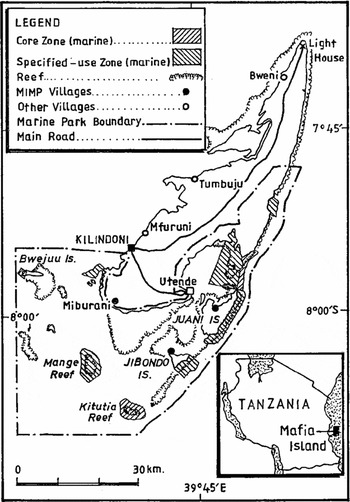
Mafia Island is a chain of small islets centred at 7.40°S and 39.41°E and located 20 km off the Tanzanian coastline east of the Rufiji River delta (Fig. 1). Mafia District comprises an area of 972 km2, of which 407 km2 is dry land and 565 km2 is seawater. Approximately 40 000 people live in Mafia District (United Republic of Tanzania [URT] 2003, 2006) mostly within 20 villages. Mafia District is c. 120 km south-east of the capital city Dar es Salaam, and trade is closely connected to the capital by boat traffic through a pier located at Kilindoni (Fig. 1). The island is Pleistocene reef covered by a sandy loam, and rainfall is moderate, monsoonal and varies inter-annually. People largely depend on agriculture, notably coconuts, husbandry, artisanal crafts and fishing, but also tourism and trade with the capital (Caplan Reference Caplan2002). Local agriculture does not provide sufficient food, and food is therefore imported also from the mainland. Generally, fishing activities in Mafia Island are artisanal and mainly concentrated on inshore waters, and there is a surplus of fish that is exported to the mainland. The main reasons for shallow sea fishing are low travel costs and a lack of capital to purchase larger fishing vessels to engage in deep-sea fishing.
Map of Mafia Island, the marine protected area boundaries and villages sampled in this study.

Mafia Island has a long and complex history that has been characterized by centuries of domination by Arabs, Persians, mixed-African-Arabs, merchants, slavers and plantation owners, followed by German and British colonialists. The indigenous people of Mafia are the Wambwera, who are culturally similar to the people living between Kisiju and the mouth of Rufiji river delta (Mahongo Reference Mahongo1994). Most of them are Muslims, which is their source of morality and social organization. Despite historically having a rigid social hierarchy based on slavery and colonialism, much of the social hierarchy inherited from the past has been dissipated by the legacy of the socialist policies from the 1960s (Mahongo Reference Mahongo1994; Walley Reference Walley2004). As a consequence of these policies and because all children inherit by Islamic law, the wealth of the indigenous people has reduced. Decline in the global price of coconuts in recent years has reduced many household incomes.
The government took an initiative to gazette Chole Bay and Kitutia reef as marine reserves in 1975, but without implementing effective enforcement (Horrill et al. Reference Horrill, Darwall and Ngoile1996). MIMP was the first marine park to be successfully established in Tanzania in 1995, and covers an area of about 822 km2, more than 75% of it below the high water mark. The managed area is located on the southern section of the main island and is part of a 33-km long broken reef that ends in one of the two fisheries closures at Kitutia reef (Wells et al. Reference Wells, Burgess and Ngusaru2007b). Landward of the fringing reef, the seabed is shallow (<50 m deep) and contains a number of large patch reefs that are within the managed area. MIMP's general management plan includes a zoning scheme of core, specified use and general use zones (URT 2000). Core zones are fisheries closures in areas with high or unique biodiversity and include Kitutia Reef and Kinasi Pass. Specified use zones have intermediate levels of protection that allow resource-users to fish with restrictions on gear and species, whereas general use zones have levels of protection that are similar to national laws (no illegal and destructive gear).
Six villages were surveyed for management preferences and socioeconomic information. Three of these (Bweni, Tumbuju and Mfuruni) are located on the main Mafia Island outside MIMP, and were not included in the 11 villages involved in the original community workshops and consultative meetings held by the Park from 1991. The three villages within MIMP that were included in the original village workshops and consultative meetings include Miburani on the western side of the main island, while Juani and Jibondo are located on small islands. Of the six villages studied, Jibondo is located on fossilized coral rock where crop farming and animal husbandry are unreliable and all non-marine food must therefore be imported from outside the village. Villagers in Jibondo conflicted with the Park management in 2001 when there was disagreement and arrests over establishing Kitutia Reef as a closed area (Fig. 1), which was relied on by villagers for net and octopus fishing. Since that time, Jibondo has been one of the villages that do not follow Park regulations.
Interview field methodology
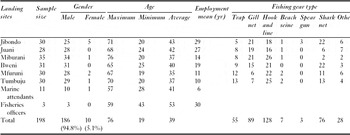
Villagers and managers were interviewed to elicit (1) their preferences for management, (2) their perceptions of who benefits from existing management measures, (3) reasons for the impacts and conflicts around management and (4) personal and household socioeconomic information. Villagers were asked to list and rank their household's occupations and, if they fished, to rank the importance of the gear they use. Managers were asked to identify their affiliation and job rank. Interviews were undertaken between April and May 2007 by local research assistants (two secondary school teachers) familiar with the environment, people and language. Interviews included a total of 184 heads of household sampled nearly evenly among the six villages (Table 1). Heads of household were interviewed, usually at their homes, but sometimes at landing sites during non-fishing days as they repaired fishing gear and vessels. To avoid bias every nth person or household was sampled where n was determined by size of the village, such that similar sample sizes were obtained for each village (c. 30 samples per village). The questionnaire was also administered to 11 MIMP professional staff and three district fisheries officers. Government officials interviewed represented > 50% of the total number of MIMP salaried employees and officers of the district fisheries department on Mafia Island.
Number of respondents in terms of their occupations, gender, age, employment and frequency of gear use.

Interviewees were presented with questions and statements about six different management options, namely (1) area management, (2) spatial closures, (3) seasonal closures, (4) management of gear, (5) limits on size of fish captured and (6) limits on species caught, and asked to mark their level of agreement with these statements on a five point Likert scale from strong disagreement to strong agreement, with a ‘don't know’ option (six options in total) (McClanahan et al. Reference McClanahan, Maina and Davies2005b). Questions were structured as such: ‘do you believe that area management is a good way to sustain fisheries in this location?’, where area management could be replaced by the various restrictions. Secondly, they were asked to scale their perceptions of benefits of six management options and who they perceived to benefit from each of these various management options, where three groups were identified, namely themselves, their community and the national government (10 point scale from 0 = no benefit to 10 = greatly benefits). They were also asked to state their reasons for the management preferences. These answers were grouped by their content and then tallied and presented if > 30% of the respondents in a village mentioned the same causative factor. Respondents were also asked about fishing gear that they believed should be restricted. Respondents were then asked to scale their perception of the need to restrict it by marking an x along a 10-cm line with a low need to restrict it represented at one end and a high need to restrict it represented at the other end. The actual distance of the respondent's mark from the low end was treated as a Likert scale score.
Socioeconomic questions included their typical biweekly expenditures, number of employed people and type of occupations among their household members, and the ownership of 33 material items. To further reduce the indicators and to develop a single material style of life index, we ran a principal component analysis (PCA) based on the remaining material items. We performed several iterations of the PCA, removing items with low frequencies and weak loading scores. The resultant PCA scores were then used as a material style of life index in the analyses of respondent questions. The respondent was asked to provide personal information, including age, gender, level of education, years in their current occupation and area of origin. The relative importance of each occupation was determined by having the respondent rank the occupations that their household undertook from least to most important (Pollnac & Crawford Reference Pollnac and Crawford2000).
Data analyses
The data were normally distributed and therefore standard ANOVA tests of statistical significance were undertaken among the various occupations and villages (Sall et al. Reference Sall, Lehmaan and Creighton2001). Two factor and nested ANOVAs were used dependent on the factors examined where the first was used to test for differences and interactions between the perceptions of the different occupations and the second for testing for differences among respondents from Park and non-Park villages. For most statistical analyses the government officials were pooled together due to the low sample size of fisheries officers, but presented separately in tables and graphs for visual comparisons. Step-wise multiple regression analyses were undertaken on the agreement with restrictions and perceptions mean benefits (average of self, community and national government) for the various management options using the respondent's age, biweekly expenditure, material-style of life index, years in the occupation and years of education as the independent factors.
RESULTS
Respondent socioeconomic characteristics
The material style of life analysis resulted in 12 items in the final analysis, with one factor explaining 46% of the variance. The majority (95%) of household respondents were male and the few female respondents were from Jibondo, Miburani and Tumbuju (Table 1). Average age for the occupations and villages was 39 ± 12.1 (± SD) years, with the youngest individual respondent being 19 years and the oldest 76 years. Fishers using each gear type were well represented with hook and line, gillnets, sharknet and traps being the commonly used gears.
Education and biweekly expenditure were significant higher among government officials than villagers (education F = 62.2, p < 0.01; expenditures F = 37.5, p < 0.01). Government officials had 12.0 ± 1.6 years of education and biweekly expenditure of Tsh 71 500 ± 38 500, respectively, compared to 6.0 ± 2.7 years of education and biweekly expenditures of Tsh 37 668 ± 16 422 among villagers (US$ 1 = 1000 Tsh). Non-Park villagers had both higher levels of education and expenditures compared to Park villagers (education F = 34.6, p < 0.01; expenditures F = 23.4, p < 0.01).
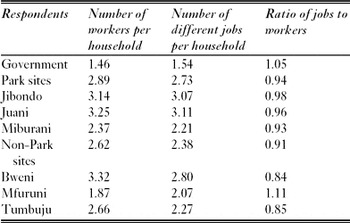
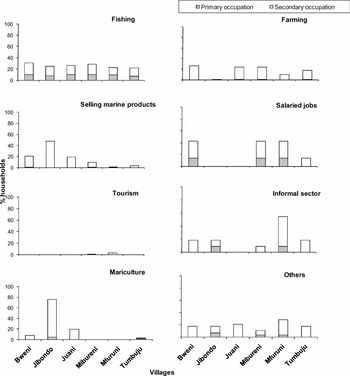
Government officers had fewer workers (F = 20.2, p < 0.0001) and jobs (F = 16.9, p < 0.0001) per household but a higher ratio of the two than villagers (Table 2). There were also differences in these measures between Park and non-Park villagers and within non-Park villagers. Non-Park villagers had a lower number of jobs per household than Park villagers, except at Mfuruni, which had the highest jobs per worker ratio among all villagers and occupations, having high employment in the informal sector and salaried jobs (Fig. 2). Fishing was the most important occupation, undertaken by 21–30% of working people in all the villages. Generally those who undertook fishing and salaried jobs ranked it as their primary occupation. Subsistence farming occurred in all the villages except Jibondo, and no cash crops or salaried employment were recorded at Jibondo and Juani, which had the highest employment in mariculture.
Numbers employed and occupations per household for the interviewed occupations and fishers by villages.

Percentage of individuals by employment sector in the six villages, where the villages Bweni, Jibondo and Juani are in or close to the Park, and Mibureni, Mfuruni and Tumbuju are outside the Park.

Management options
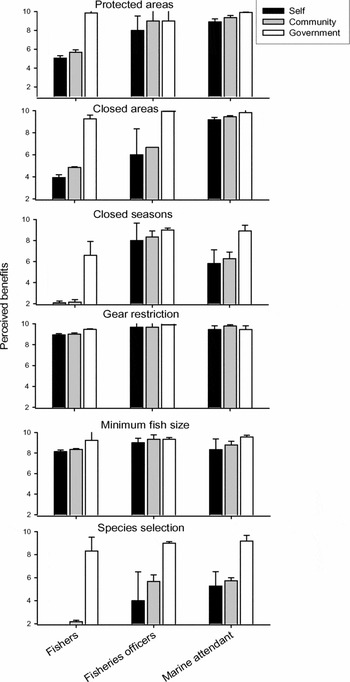
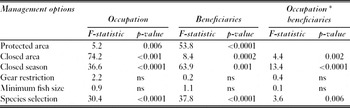
All occupations rated the management benefits of gear and minimum size restriction highly, with no statistical differences between occupations (Fig. 3, Table 3). Government officials listed a larger, but not statistically different (F = 2.2, p = 0.14), minimum size restriction on target species (14.5 ± 2.2 cm) than villagers (11.2 ± 4.8 cm). Common reasons given for gear restrictions were that they were destructive and killed juvenile fishes. Reasons given for minimum lengths included the need to protect future stocks, the lack of a market, being wasteful and protecting target species.
Likert scale (relative 0 to 10 scale) responses for the interviewed people pooled by occupations (fishers, fisheries officers and marine attendants) of their perceptions of the benefits of management options (namely protected areas, closed areas, closed seasons, gear restrictions, minimum fish size restrictions and species selection) and those who are perceived to benefit. Table 3 provides the results of a two-factor ANOVA with interaction for these scaled perceptions. Error bars = SE.

Tests of significance comparing management preferences of the resource managers and users (occupations) and who they believe benefits from these management restrictions (beneficiaries) and their interaction (values given in Fig. 3). ns = not significant.

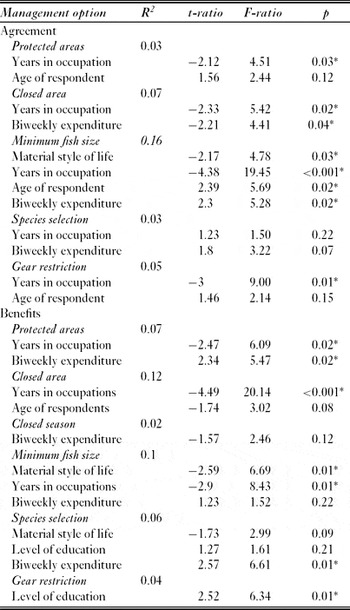
There were a number of significant relationships between the agreement with restrictions, perceptions of who benefits, and socioeconomic variables. Despite weak relationships among villagers for the whole model, there were a number of statistically significant variables (Table 4). Agreement with protected areas was negatively related to years in occupation, but positively related to age. Perceived benefits from protected areas was also negatively related to years in occupation, but positively related to biweekly expenditures. Support for closed areas was negatively related to years in occupation and biweekly expenditures, while perceived benefits were negatively related to years in occupation and age. Agreement with and perceived benefits from minimum sizes of fish were negatively related to material style of life and years in occupation, but agreement was positively related to age and biweekly expenditures. Agreement with gear restrictions was negatively related to years in occupation, and benefits were positively related to level of education.
Factors influencing fishers' levels of agreement and perceived benefits responses for various management options, based on step-wise multiple regression analysis. Variables included are those that remained after the step-wise screening procedure. *p < 0.05.

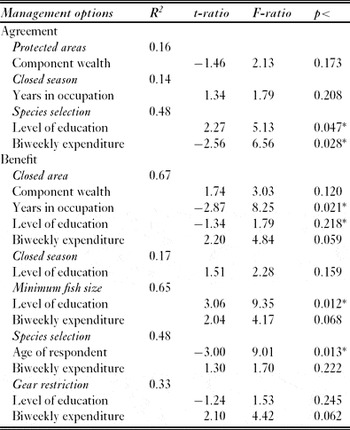
There were stronger whole model relationships between government officials and socioeconomic characteristics for a few of the responses, but low sample sizes were unlikely to produce statistical significance for weak relationships (Table 5). Nonetheless, all government officials agreed with restrictions on gear and minimum sizes with no statistically significant relationships with their socioeconomic characteristics. There was a positive association between the government official's level of education and perception of who benefits from minimum size restrictions. There were marginally positive (p < 0.07) associations between the government official's biweekly expenditures and perceptions of who benefits from minimum size and gear restrictions.
Factors influencing managers' agreement response and perceived benefits of various management options for the government officials' responses based on step-wise multiple regression analysis. Responses and variables included are only those that remained after the step-wise screening procedure where only those whole models that were statistically significant are presented. *p < 0.05.

The agreement with restrictions and perceived benefits of marine protected areas, permanent and seasonal closures, and species restrictions were different between occupations (Fig. 3, Table 3). Government officials were in agreement with and saw large benefits from protected areas, closed areas and closed seasons and generally saw these as benefiting the self, community and national government. Agreement and perceived benefits were shared by all officials as there were no significant associations between the collected socioeconomic variables and the levels of agreement with the exception that the perceived benefits of closed areas were negatively associated with the number of years in the occupation.
Villagers did not see protected and closed areas as benefiting themselves and their communities, but they did see it benefiting the national government. There were negative associations between the agreement with restrictions and perceived benefits with protected and closed areas and the years in their occupation and biweekly expenditures (Table 4). There was, however, a positive relationship between perception of who benefits from protected areas and biweekly expenditures. Respondents who supported protected areas said that they reduced illegal gear and that they had no negative effect on them. Respondents who did not support protected areas said they reduced the fishing grounds and that control of resources was attributable to natural phenomena or God (as opposed to management). Villagers who supported closed areas said that they had no negative effect on them, acknowledged benefits if they were small and improved conservation of resources. Villagers who disagreed with closures mentioned increased conflicts, a lack of benefits or alternatives, reduced fishing grounds or ineffectiveness because natural phenomena or God controlled changes in resources.
Villagers saw lower benefits of closed seasons than government officials, but saw moderate to high benefits for the national government (Fig. 3, Table 3). Government officials and villagers agreement with closed seasons was not associated with the socioeconomic variable, but villagers' scaled perceptions of benefits was negatively associated with years in the occupation and positively associated with biweekly expenditures (Table 5). Respondents who agreed with closed seasons stated that it improved the resource, while those that did not listed reduced yields and incomes, a lack of alternatives and the control of resources by natural phenomena or God.
All occupations saw species restrictions as benefiting the national government, but not self or communities, with villagers more strongly viewing this disparity in the beneficiaries (Fig. 3, Table 3). This view was pervasive among villagers, as there were no significant relationships between socioeconomic variables and agreement with this restriction apart from a positive association with their biweekly expenditures (Table 4). Respondents who agreed with species restrictions listed protecting future stocks or climate effects on the stocks as reasons for restrictions. Government officials' agreement with species restrictions was positively associated with the level of education and negatively with biweekly expenditures, while the perception of benefits was negatively associated with the age of the respondent (Table 5). Respondents who disagreed with restrictions believed it was not possible to enforce them, that they would have a bad effect on the economy or that these species were not under control by human management.
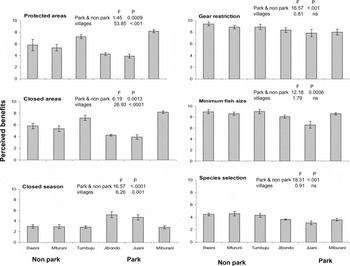
Comparison of respondents in villages nested within Park and non-Park categories found that Park villages perceived lower benefits from protected and closed areas, gear restrictions, minimum fish lengths and species selection, but greater benefits from closed seasons than non-Park villages (Fig. 4). Village respondents nested within these categories were different for protected areas, closed areas and closed season as the Park villages of Jibondo and Juani differed from Miburani; villagers in Miburani perceived benefits in a manner similar to the non-Park villages. There was general agreement among occupations on the gears to be discouraged by managers and villagers (F = 1.47, p = not significant) with beach seines and spearguns rated the highest for restrictions, poisons and explosives rated moderately, and traps and hook and line rated the lowest.
Likert scale perceptions (relative 0 to 10 scale) of benefits of management options (namely protected areas, closed areas, closed seasons, gear restrictions, minimum fish size restrictions and species selection) within the six studied villages. Bweni, Jibondo and Juani villages are in or close to the Park, and Mibureni, Mfuruni and Tumbuju are outside the Park. Results of a nested ANOVA testing for differences between Park and non-Park sites with villages nested within these categories are presented (ns = not statistically significant).

DISCUSSION
Identifying and understanding differences in stakeholder worldviews and attitudes toward management (Gelcich et al. Reference Gelcich, Edwards-Jones and Kaiser2005) is a first step towards resolving the historical conflicts surrounding the MIMP (Walley Reference Walley2004). There was general agreement about the benefits of gear restrictions and minimum size of catch. The national government was perceived to receive the largest benefits, and these declined from there to the community and individual. Nevertheless, we found considerable differences among the perceptions of who benefits from restrictions, which may be among the primary causes for conflicts between local social norms governing marine resource use and the legislated and national-level management systems. For example, government officials saw the communities as a whole benefiting from restrictions more than the resource users themselves. This reveals a fundamental problem of observer subjectivity in prescribing the most appropriate actions for resolving conflicts. Conflicts are moulded by factors such as the person's history and knowledge of resources and management effects, reliance on the resource, the time and social scale of their perceptions of benefits. These are further influenced by socioeconomic and educational status, connections to wider sources of information and alternative resources and markets, politics over the control of resources and complex interactions between these factors.
Preferred management and perceptions of benefits differed based on occupations, the location of the villages in relationship to the Park and other geographic and socioeconomic factors. Positive views on restrictions were frequently associated with education and, in some cases, biweekly expenditures. Perception of benefits and management options was frequently associated with the interviewees' time employed in their occupation, but the relationships were often negative, particularly for closure benefits. These general findings are consistent with several recent studies exploring factors related to heterogeneity in fishers' perceptions of management and the environment (McClanahan et al. Reference McClanahan, Davies and Maina2005a, Reference McClanahan, Maina and Daviesb; Gelcich et al. Reference Gelcich, Edwards-Jones and Kaiser2005, Reference Gelcich, Kaiser, Castilla and Edwards-Jones2008). Studies of management restrictions in southern Kenya found fishers to be more supportive of gear than other forms of management (McClanahan et al. Reference McClanahan, Davies and Maina2005a, Reference McClanahan, Maina and Daviesb). Perceptions can change with experience however, as McClanahan et al. (Reference McClanahan, Davies and Maina2005a) found stronger support for closures with the increasing age of the closure and Gelcich et al. (Reference Gelcich, Kaiser, Castilla and Edwards-Jones2008) found greater concern for water quality issues with that length of time that Chilean fishers were engaged in co-management.
There were weak associations between agreements on restrictions and perceived benefits and most of the socioeconomic variables for the villagers. In some cases they became increasingly negative with increased length of time in their occupations and material wealth of their household. Biweekly expenditures of villagers were, however, both positively and negatively associated with various restrictions. The strongest factors in the villagers' responses was the position of the villages in terms of Park boundaries, management, history of interaction with the Park service and other economic options. Jacobson and Maynowski (Reference Jacobson and Marynowski1997) reported similar findings, where the most knowledgeable resource users had more negative views towards conservation and ecosystem management than recreational users and the general public. Consequently, positive attitudes towards conservation may be enhanced by a general education, but adversely affected when there has been a history of conflicts between resource users and managers and restrictions directly affect access to known resources required for income or survival.
Differences among Mafia villages and comparison with Kenyan findings (McClanahan et al. Reference McClanahan, Davies and Maina2005a, Reference McClanahan, Maina and Daviesb) may provide insight into how perceptions at Mafia were formed. In Kenya, those fishers having higher levels of education and fishing adjacent to older managed areas had more positive perceptions of restrictions and management. Additionally, Kenyan fishers had more positive perceptions towards gear restrictions than permanent closures, and the wealth of the resource user and the history of community programmes at the landing sites were not associated with positive perceptions towards restrictions. In Mafia, we found similar responses, but unlike the Kenyan study we compared Park and non-Park villages and found that respondents in two Park villages with a history of interacting with Park and conservation employees (namely Jibondo and Juani) had the most negative perceptions towards restrictions and benefits. The Park villagers of Miburani had a similar history, but more positive perceptions towards restrictions than the other Park villagers. Miburani village is closest to the pier, and associated trade at Kilindoni and their fishing grounds (Mange) restrict the use of gears and collection of species. This contrasts with the full closures adjacent to Jibondo and Juani and suggests the full closures, limits to trade and the lack of salaried employment are largely responsible for the negative perceptions of management in Jibondo and Juani. Interactions with conservation authorities have failed to improve the villagers' perceptions.
Livelihood diversity is often seen as an important economic buffer for people living near parks but, ironically, MIMP villages had higher household job diversity than non-Park villages. Consequently, livelihood diversity was not associated with positive perceptions towards restrictions and higher compliance. Better access to markets or salaried employment associated with proximity to Kilindoni may be more important than the number of livelihoods. A large number of livelihoods may be a risk-spreading strategy that can arise from poverty and not a sign of increased economic security (Campbell Reference Campbell1990; Carter Reference Carter1997). Accordingly, heavy reliance on marine resources, fewer options for involvement in that cash and tourism economy, historical conflicts with management and resources contained within closures could combine to produce the lower levels of support for national government area management and some of the associated restrictions.
Both long-serving government officials and villagers shared negative perceptions towards closures and some other restrictions. This is likely to reflect a long history of conflict and some cynicism about their value or likelihood of reconciliation (Walley Reference Walley2004). In contrast, older villagers did not always hold these negative perceptions, and so it is unlikely to arise from a simple increase in cynicism over restrictions with age, but rather with occupational experience that might be associated with a conflict or knowledge about the economic value of closures. Although resources in these closures have responded positively to the closure (Kamukuru et al. Reference Kamukuru, Mgaya and Ohman2004), a long-term study of closures in Kenya has found that it can take many years for the full biomass to recover and that spillover effects can be limited to areas very close to closures (McClanahan & Mangi Reference McClanahan and Mangi2000; McClanahan et al. Reference McClanahan, Graham, Calnan and MacNeil2007). Many of the parks in the region may not be economically competitive with resource extraction options in the absence of high levels of tourism (McClanahan Reference McClanahan1999). Various conflicts that arose in the early years have still not been resolved 12 years after the Park's implementation (Walley Reference Walley2004). It is possible that the transition to the benefits of closures has not and may not be made until these issues are resolved.
CONCLUSIONS
Conflicts may not be easily resolved until socioeconomic and management factors have been addressed. If better educated individuals with more wealth have positive perceptions towards conservation and are more supportive of management restrictions (Cinner & Pollnac Reference Cinner and Pollnac2004), then increased education and wealth are seen as a common solution to resource degradation (Grossman & Krueger Reference Grossman and Krueger1995; Stern Reference Stern1998). However, findings here and elsewhere suggest that local geographic conditions, such as urbanization and market influences (Cinner & McClanahan Reference Cinner and McClanahan2006; Clausen & York Reference Clausen and York2008a, Reference Clausen and Yorkb) and disagreement on restrictions and the management process (Walley Reference Walley2004) are more important than simply improving socioeconomic conditions (Dunlap & York Reference Dunlap and York2008). Consequently, policy prescriptions based solely on development (such as increasing wealth, livelihood options and education) in isolation of these other social and political concerns are likely to be ineffective at resolving conflicts and may even create perverse outcomes (Allison & Ellis Reference Allison and Ellis2001). Likewise, failing to simultaneously address underlying socioeconomic and education issues is also unlikely to lead to success.
Closures are important for the protection of biodiversity, ecosystem processes and preservation of national resources, and they should ultimately be part of national conservation programmes (McClanahan et al. Reference McClanahan, Verheij and Maina2006; Reference McClanahan, Graham, Calnan and MacNeil2007). Nonetheless, focusing efforts on those areas of management that are most agreeable to the largest numbers of individuals, namely gear and minimum size restrictions, could provide a transition to more severe closure restrictions. The use of gear and size restrictions along with a simultaneous effort to improve agriculture, access to regional markets and salaried employment should assist in improved perceptions towards area and closure management. Even resource users in villages with the most negative perceptions acknowledge the value of area management, closures and species restrictions at the national level, but they see a disparity between themselves and their communities in receiving these benefits, and this creates these difficult to resolve subjective conflicts. A combination of temporary compensation, enhancing access to cash economies and the staged implementation of stricter restrictions are alternatives that are expected to reduce these conflicts.
ACKNOWLEDGEMENTS
The Western Indian Ocean Marine Science Association (WIOMSA) Marine Science for Management (MASMA) programme and the Wildlife Conservation Society funded this research. We are grateful to Mr L. Josephat and Mr L.S. Jaribu, and the staff of MIMP, particularly the Park Warden (Mr G. D. Msumi) for help with the interviews and the Faculty of Aquatic Sciences, University of Dar es Salaam for logistical assistance.