


Introduction
Depression and anxiety are common in children and adolescents (Costello, Mustillo, Erkanli, Keller and Angold, Reference Costello, Mustillo, Erkanli, Keller and Angold2003; Ford, Goodman and Meltzer, Reference Ford, Goodman and Meltzer2003). Cognitive behaviour therapy (CBT) has been found to be an effective intervention for such problems (Klein, Jacobs and Reinecke, Reference Klein, Jacobs and Reinecke2007; Cartwright-Hatton, Roberts, Chitsabesan, Fothergill and Harrington, Reference Cartwright-Hatton, Roberts, Chitsabesan, Fothergill and Harrington2004; Ishikawa, Okajima, Matsuoka and Sakano, Reference Ishikawa, Okajima, Matsuoka and Sakano2007), and as such CBT is now recommended by the UK National Institute of Clinical Excellence for the treatment of depression, obsessive compulsive disorder and posttraumatic stress disorder in children and adolescents (NICE, 2005a, b, c). However there is a lack of CBT specialism in Child and Adolescent Mental Health Services (CAMHS) (Stallard, Udwin, Goddard and Hibbert, Reference Stallard, Udwin, Goddard and Hibbert2007). Thus, in recent years, work has begun to focus on ways of increasing access to CBT, such as through the use of computers.
In adults, a number of studies (Bergstrom et al., Reference Bergstrom, Andersson, Karlsson, Andreewitch, Ruck, Carlbring and Lindefors2008; Craske et al., Reference Craske, Rose, Lang, Welch, Campbell-Sills, Sullivan, Sherbourne, Bystrisky, Stein and Roy-Byrne2009; Kessler et al., Reference Kessler, Lewis, Kaur, Wiles, King, Weich, Sharp, Araya, Hollinghurst and Peters2009; Learmonth, Trosh, Rai, Sewell and Cavanagh, Reference Learmonth, Trosh, Rai, Sewell and Cavanagh2008; Titov, Andrews, Schwencke, Drobny and Einstein, Reference Titov, Andrews, Schwencke, Drobny and Einstein2008; Warmerdam, van Straten, Jongsma, Twisk and Cuijpers, Reference Warmerdam, van Straten, Jongsma, Twisk and Cuijpers2010; Whitfield, Hinshelwood, Pashely, Campsie and Williams, Reference Whitfield, Hinshelwood, Pashely, Campsie and Williams2006) and reviews and meta analyses (Barak, Hen, Boniel-Nissim and Shapira, Reference Barak, Hen, Boniel-Nissim and Shapira2008; Cuijpers et al., Reference Cuijpers, Marks, Van Straten, Cavanagh, Gega and Andersson2009; Reger and Gahm, Reference Reger and Gahm2009; Spek et al., Reference Spek, Cuijpers, Nyklicek, Riper, Keyzer and Pop2007) have demonstrated the effectiveness of computerized CBT (cCBT) for depression and anxiety disorders. Such work has demonstrated a number of benefits of cCBT, such as increased availability (Griffiths and Christensen, Reference Griffiths and Christensen2007), and the ability to use cCBT in your own home (Beattie, Shaw, Kaur and Kessler, Reference Beattie, Shaw, Kaur and Kessler2009; Graham, Franses, Kenwright and Marks, Reference Graham, Franses, Kenwright and Marks2000). Computerized CBT is now recommended by NICE for depression and anxiety in adults (NICE, 2008), and dissemination into the UK National Health Service is underway.
There is, however, less work on the effectiveness of cCBT for depression and anxiety in children and adolescents (see Richardson, Stallard and Velleman, Reference Richardson, Stallard and Velleman2010, for a review). The software package, “BRAVE Online”, has been shown to be effective for the treatment of anxiety disorders in those aged 7 to 14 years (Spence, Holmes, March and Lipp, Reference Spence, Holmes, March and Lipp2006; March, Spence and Donovan, Reference March, Spence and Donovan2009), whilst case studies of “Cool Teens” for anxiety disorders in adolescents have been encouraging (Cunningham et al., Reference Cunningham, Muthrich, Rapee, Lyneham, Schniering and Hudson2009). A case series on the intervention “Stressbusters” showed reductions in depression diagnoses in adolescents aged 12 to 16 years (Abeles et al., Reference Abeles, Verduyn, Robinson, Smith, Yule and Proudfoot2009), whilst other work has shown positive results for those with sub-clinical depression (Gerrits, Van Der Zanden, Visscher and Onijn, Reference Gerrits, Van Der Zanden, Visscher and Onijn2007; Van Voorhees et al., Reference Van Voorhees, Fogel, Reinecke, Gladstone, Stuart and Gollan2009).
There is thus a relatively limited literature on cCBT for children and adolescents, and in particular there are few software packages that have been developed specifically for this age group. The aim of this study is to describe the development of a software package (Think, Feel, Do) for depression and anxiety in children and adolescents, and report preliminary results on feedback and outcomes from a pilot randomized controlled trial.
Method
Participants
Ethical approval was obtained from the local National Health Service ethics committee. Participants were recruited from Tier 3 CAMHS. Inclusion criteria were: aged 11 to 16 years and presenting with a primary problem of an anxiety disorder (generalized anxiety disorder, specific phobia, social phobia or panic disorder) or mild/moderate depression. Participants were excluded if English was not their first language and if they had severe depression or serious self-harm or psychosis. Those who had recently been the victims of abuse or had significant co-morbidities such as PTSD, autism, ADHD or learning difficulties were also excluded.
Referrals to Tier 3 CAMHS were offered an initial appointment with a member of the multidisciplinary team to assess the extent and nature of their problems and whether specialist intervention from the team was indicated. If an intervention was required, the assessing clinician decided upon the most suitable approach, e.g. family therapy or CBT, and the child was placed on a waiting list for their designated therapy. Those who were assessed as suitable for specialist CBT were invited to take part in the study whilst waiting to see a CBT therapist.
Design
A pilot randomized controlled trial was conducted initially comparing computerized CBT (Think, Feel, Do) to a waiting list control. However, after the first two referrals the design was changed to increase uptake so that participants were randomized to receive either immediate or delayed cCBT. Baseline assessments were completed before randomization. Those in the TFD group then had the 6 sessions and then a follow-up assessment, whilst those in the control group waited for approximately 4 weeks before completing the follow-up assessments and beginning the TFD sessions.
Measures
At baseline and follow-up assessments parents/carers completed the Strengths and Difficulties Questionnaire (SDQ) Parent Version (Goodman, Reference Goodman1997). This consists of 25 items rated on a 3-point scale. The items are summed to produce 5 subscales (Emotional symptoms; Conduct problems; Hyperactivity/inattention; Peer relationship problems; Prosocial behaviour). There is also a score to measure the impact of these problems. This measure is designed for use with those aged 4 to 16 years, with different norms being provided for different age groups. The measure has been shown to have good psychometric properties with high reliability (Goodman, Reference Goodman2001).
Children completed the Spence Children's Anxiety Scale (SCAS) Child Version (Spence, Reference Spence1998). This is a self-report measure of 44 items each rated on a 4-point scale of frequency. The items are summed to produce the 6 subscales of Separation anxiety, Panic/agoraphobia, Social phobia, Obsessive compulsive disorder, Generalized anxiety, and Physical injury fears. Norms are provided for boys and girls separately from ages 8 to 15, but the measure has often been used with adolescents up to the age of 18 (Muris, Merckelbach, Schmidt, Gadet and Bogie, Reference Muris, Merckelbach, Schmidt, Gadet and Bogie2001). This measure has been shown to have good psychometric properties (Spence, Barrett and Turner, Reference Spence, Barrett and Turner2003).
The Adolescent Well Being Scale (AWS; Birleson, Reference Birleson1980) is a self-report measure of depressive symptoms for those aged 11 to 16 years. There are a total of 18 items that are summed to make a total score. A total score of 13 or above indicates possible depression.
The Rosenberg Self-Esteem Inventory (RSEI; Rosenberg, Reference Rosenberg1965) is a self-report measure of global self-esteem consisting of 10 items rated on a 4-point scale of agreement. Items are summed to make a total score, with a score below 15 indicating low self-esteem.
The Schema Questionnaire for Children (SCQ) (Stallard and Rayner, Reference Stallard and Rayner2005) is a self-report measure of schemas/thinking patterns that consists of 15 items such as “No one understands me” which are responded to on a scale of 1 (Don't really believe at all) to 10 (Very strongly believe). The items are summed to produce an overall score.
Procedure
Participants were assessed for suitability during their initial appointment at CAMHS. If they met study inclusion criteria they were given an information sheet with an opt-in reply slip to return to the researchers. Participants who completed the opt-in form were then contacted and a visit to their home was arranged. Participants were given further information, shown a short video of TFD, and encouraged to ask any questions. For those who wanted to take part both parent and child completed a consent form. The standardized measures were then used to conduct a baseline assessment. Randomization was conducted by another member of the research team using blank envelopes. The 6 cCBT sessions were then delivered immediately for those in the experimental group, or after a few weeks in the control group. For those in the TFD group, a post assessment was completed after the sessions were finished, comprising the standardized measures and a short feedback questionnaire. The post intervention assessor was always different from the psychology assistant who delivered the intervention. The TFD sessions were delivered in the participants’ homes at a time of their choice. For one participant, sessions were delivered in school. Sessions were usually weekly but sometimes had to be more frequent so as to be completed before CAMHS appointments began.
Data analysis
Missing data were minimal. Out of a total of 3630 assessment items, 16 were not completed by participants. When this occurred the mode value for all study participants for that specific item was calculated and was entered by the researcher. Subscale scores was then calculated as normal. One-tailed paired samples t-tests were used to compare pre and post scores within the TFD and control group separately.
The intervention – Think, Feel, Do (TFD)
“Think, Feel, Do” is a 6-session CD-ROM based on the CBT workbook Think Good – Feel Good (Stallard, Reference Stallard and Graham2004). Each session lasts approximately 30–45 minutes, and the programme is designed to be facilitated by a professional such as a psychology assistant, teacher or nurse. There is a plentiful supply of psychology assistants and this offers a potentially low cost way in which CBT skills and ideas can be made more accessible.
The TFD facilitator is not a CBT therapist and only minimal CBT expertise and training is required to guide the young person through the programme. The facilitator's role is to discuss and elaborate on the programme content, as well as to provide support and clarify misunderstandings. The facilitator also helps the young person reflect on the material presented and apply the lessons learnt to their own experiences. The facilitator is present throughout the delivery of the programme.
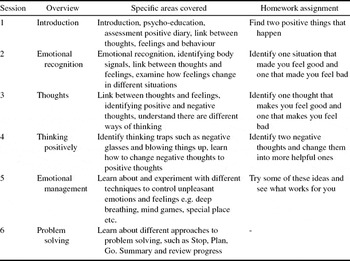
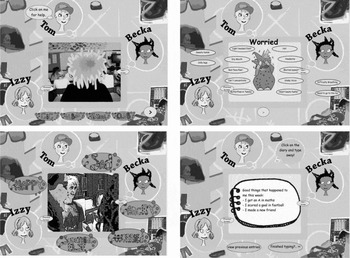
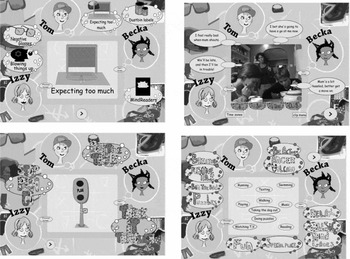
“Think Feel Do” was developed with the help of young people and four focus groups that were used to inform the graphics, music and cartoons. Young people also spoke the voice-overs and acted in the video clips used in the programme. TFD is interactive with responses to quizzes and exercises being entered directly into the programme. It is also multimedia with sounds, photos, cartoons and music, and uses narrators to guide the user through the sessions. Responses are saved so that previous work can be reviewed. At the end of each session, participants are given a brief assignment to complete. Table 1 gives an overview of the topics covered in each of the six sessions. Figures 1 and 2 provide examples of the graphics and content of TFD.
Topics covered in each session

Examples of TFD content. From top left clockwise: Character placement in a situation video, Identifying body signals, Recording good things that have happened, Identifying emotions in different situations.

Examples of TFD content. From top left clockwise: Identifying thinking traps, Identifying thoughts in a situation video, Looking at ways to stay calm, Examining problem solving techniques.

Results
Participant flow and characteristics
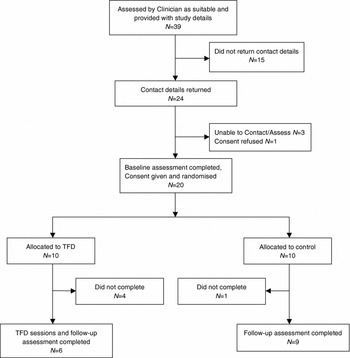
A total of 39 individuals were identified by CAMHS clinicians as suitable for the trial and were provided with information. Figure 3 shows the flow of participants through the trial. Twenty individuals provided consent and were randomized with 10 in each condition. In the control group, one individual did not complete the post assessment as they had begun appointments at CAMHS. In the TFD condition, four individuals did not complete all sessions and the post-assessments. Two of these had begun CAMHS appointments, one had a family emergency, and one could not be contacted to begin sessions.
Flow chart of participants in the trial.

Those completing the trial in the TFD condition were aged 11 to 14, with a median age of 12 years; 4 were male and 2 were female. Completers in the control condition were slightly older, ranging in age from 11 to 17, with a median of 15 years, but with a similar gender distribution; 6 were male and 3 were female. In the TFD condition, four presented with anxiety, one with depression, and one with OCD. In the control condition six presented with depression and three presented with anxiety.
Outcomes
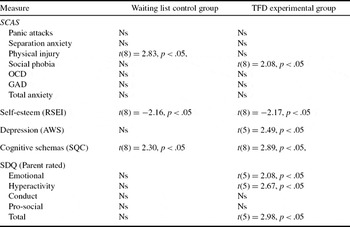
One-tailed paired samples t-tests were used to examine any changes within the TFD and control condition separately. Table 2 demonstrates the significant changes. All significant differences represent an improvement in scores. As Table 2 demonstrates, there were significant improvements on seven subscales in the TFD group, compared with three in the control group.
Changes in standardized measures for control and TFD groups individually

Feedback
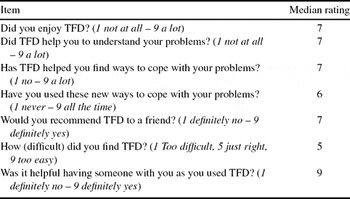
A total of 17 participants completed all 6 sessions of TFD and completed a feedback questionnaire. Table 3 shows the median rating for each item, with average scores being medium to high for all items.
Median feedback scores

Discussion
This small pilot study examined the use of a novel cCBT intervention for children and adolescents with depression and anxiety. Uptake was lower than expected, in line with previous work demonstrating scepticism from young people about cCBT (Stallard, Velleman and Richardson, Reference Stallard, Richardson and Velleman2010). However, once children agreed to participate they appeared to engage fully with the programme. Although some individuals in the cCBT condition did not complete the intervention, none of these participants dropped out because of dissatisfaction with the intervention. This is important as drop-out is often high with computerized CBT (Waller and Gilbody, Reference Waller and Gilbody2009).
The sample size here is very small and the results need to be treated with appropriate caution. Nonetheless, these preliminary findings are encouraging and indicate that cCBT resulted in significant post treatment improvements on more measures than the waiting list control group. These results tentatively suggest that child mental health can be improved through the provision of a supported cCBT intervention whilst on a waiting list for specialist face to face CBT. This is in line with previous work that has found improvements in cognitions, self-esteem and depressive and anxiety symptoms in children and adolescents after cCBT (Abeles et al., Reference Abeles, Verduyn, Robinson, Smith, Yule and Proudfoot2009; March et al., Reference March, Spence and Donovan2009; O'Kearney, Gibson, Christensen and Griffiths, Reference O'Kearney, Gibson, Christensen and Griffiths2006; Spence et al., Reference Spence, Holmes, March and Lipp2006). Exactly why the reductions for self-reported anxiety were less pronounced than those for depression and secondary outcomes such as self-esteem is unclear. Previous meta-analyses have suggested that cCBT is more effective for anxiety than depression in adults (Barak et al., Reference Barak, Hen, Boniel-Nissim and Shapira2008; Spek et al., Reference Spek, Cuijpers, Nyklicek, Riper, Keyzer and Pop2007), and this may become more apparent with a larger sample.
There were no changes in the control group in terms of parent rated mental health, yet there were improvements on subscales of emotional symptoms, hyperactivity and total difficulties for the cCBT group. Thus the cCBT intervention seemed to make visible changes to the child's emotional symptoms and behaviour in the family environment.
Quantitative feedback from the children and adolescents suggested moderate to high satisfaction with TFD. Ratings suggest that participants found TFD enjoyable, and that it had helped them understand their problems and to find new ways to cope with them. Similarly, most participants would recommend the program to any friend experiencing similar problems. Importantly, despite the considerable variation in the ages of the participants, most found that TFD was on average “just right” in terms of difficulty. Pitching CBT at the right level for young people is vital but complicated (Stallard, Reference Stallard and Graham2004), and research with adults suggest that participants often find cCBT too difficult (Andersson et al., Reference Andersson, Bergstrom, Hollandare, Carlbring, Kaldo and Ekselius2005). Participants also reported that having someone present to help them use the program was definitely helpful. The effects of professional support and supervision is complicated, with some work with cCBT for children and adolescents finding that improvements can be made with limited or no supervision (Abeles et al., Reference Abeles, Verduyn, Robinson, Smith, Yule and Proudfoot2009; March et al., Reference March, Spence and Donovan2009; Spence et al., Reference Spence, Holmes, March and Lipp2006). However other work with children and adults suggest that professional support during cCBT enhances outcome (Hicks, Von Baeyer and McGrath, Reference Hicks, Von Baeyer and McGrath2006; Spek et al., Reference Spek, Cuijpers, Nyklicek, Riper, Keyzer and Pop2007), and a recent survey of clinicians found that many thought a lack of therapeutic relationship would be a major weakness of cCBT (Stallard, Richardson and Velleman, Reference Stallard, Velleman and Richardson2010).
This study suffers from having a small sample size, but the preliminary results are encouraging and suggest that the cCBT programme examined here is an acceptable and clinically effective intervention for depression and anxiety in children and adolescents. Future research with a larger sample and an extended follow-up period would help better understand the outcomes from this software package.
Disclosure of interests
Paul Stallard holds intellectual property rights for the intervention being studied here (Think, Feel, Do).
Acknowledgements
Many thanks to all those from the Mental Health Research Network and local CAMHS who helped with recruitment. This research was funded by the National Institute for Health Research (NIHR) under its Research for Patient Benefit programme. The views expressed are those of the author(s) and not necessarily those of the NHS, the NIHR or the Department of Health.



Comments
No Comments have been published for this article.