In section 6 of the target article, Del Giudice reports a significant gender difference in insecure attachment: Whereas females are more likely to be ambivalent, males are more likely to be avoidant. However, gender differences have rarely been reported in prior studies. We believe that a cross-cultural perspective may help to reconcile this apparent contradiction. In particular, attachment studies in Asian cultural samples, such as China, should be taken into account for a more comprehensive analysis.
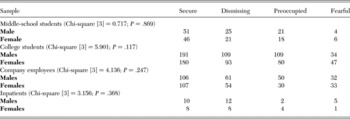
Our recent studies in China suggest that there are no gender difference in insecure attachment styles (Li & Du Reference Li and Du2005; Li & Kato Reference Li and Kato2006; Li et al. Reference Li, He, Guo and Lu2006a; Reference Li, Li and Li2006b; Reference Li, Wang and Guo2006c; Reference Li, Li and Zhu2007; Reference Li, Li, Qin, Guo, Wang and Liu2008; Wan & Li, in press). Table 1 summarizes the results of our relationship questionnaire (RQ) among various samples, including middle school and college students, company employees, and inpatients. Pearson Chi-square tests showed that neither sample had significantly different attachment patterns between males and females. We also note that in the urban mother sample, anxious/ambivalent is most popular among three insecure patterns, with 60.8% secure, 18.5% dismissing, 10.8% preoccupied, and 9.9% fearful (Li Reference Li2005).
Gender-based comparison of attachment patterns from Chinese samples

Del Giudice argues that males and females strive to maximize their reproduction of genes. Gender differences in mating, reproduction, and parenting efforts lead to diverse attachment styles: insecure females tend to be anxious/ambivalent, while insecure males tend to be avoidant (sect. 6.3.1, para. 5). However, reproductive investment alone does not account for the total cost of reproduction and parenting. Females have the privilege of selecting the most suitable male to help with child-rearing (Clutton-Brock Reference Clutton-Brock1991). Transitional China, since the 1980s, has been one such example, where parental investment is significantly higher than that in Western nations (Wang & Ollendick Reference Wang and Ollendick2001). During the 1980s, the Chinese government began to implement a family planning (“one child”) policy to control population growth; this policy profoundly changed the demographic as well as cultural values in Chinese society (Arnold & Liu Reference Arnold and Liu1986; Xu et al. Reference Xu, Xie, Liu, Xia and Liu2007). First, this policy does not allow males to have multiple children, which requires males to invest in the quality of offspring, rather than in the quantity (Wang & Ollendick Reference Wang and Ollendick2001). This greatly reduces the likelihood of males taking a zero-parenting strategy. Second, the traditional preference for sons was even exaggerated, and the “one child” policy often became a “one son” policy, creating an unbalanced gender ratio (Chan et al. Reference Chan, Eric and Chan2006). In this case, males have to compete for a limited number of females. Finally, the women's rights movement has been widespread since the communist liberation in the early 1950s, when the socio-economic status of women improved considerably. Recent studies have shown that during family purchase decisions, females now play a status role equal to that of males (Dong & Li Reference Dong and Li2007). Thus, for contemporary Chinese females, although they cannot shift the balance between parenting and mating effort as easily as men do, they do not need to develop an anxious/ambivalent attachment strategy to invite paternal investment.
A gender difference in insecure attachment could also be explained from the perspective of intergeneration transmission. According to Bowlby (Reference Bowlby1980), people develop their mental representations of the environment and significant others on the basis of their experience with parents or other caregivers. Bowlby labeled this mental representation as an internal working model (IWM). Once formed, IWMs tend to remain stable for the person's entire lifespan (Hu & Meng Reference Hu and Meng2003). The stability of IWM produces similar attachment patterns from childhood to adulthood. This argument is supported by cross-sectional and longitudinal studies (Brennan et al. Reference Brennan, Clark, Shaver, Simpson and Rholes1998; Durrett et al. Reference Durrett, Otaki and Richards1984; Fraley & Spieker Reference Fraley and Spieker2003; Hu & Meng Reference Hu and Meng2003; Li & Kato Reference Li and Kato2006; Nakao & Kato Reference Nakao and Kato2003). Li (Reference Li2006) summarized the distribution of attachment styles in infants and adults in Chinese and American samples. He found that the proportion of each attachment style was similar for both infants and adults. This result suggests that the attachment style may remain relatively stable across the lifespan. Longitudinal studies on attachment development also support the stability of attachment styles within generations (Emery et al. Reference Emery, Paguette and Bigras2008; Shemmings Reference Shemmings2006). The stability of attachment from infancy to adulthood suggests that the influence of mate selection and sex competition in early adulthood on attachment patterns is trivial. This may well explain the lack of gender difference in insecure attachment in Chinese samples.
In conclusion, we propose that the gender differences of insecure attachment are not universal, but rather, depend on culture input. In China, parenting strategies and intergeneration transmission result in similar attachment patterns between males and females.
ACKNOWLEDGMENTS
This study was supported by the Natural Science Foundation of China (No. 70572007). We thank Mark Sheskin and Adam Pearson for useful comments and suggestions.