INTRODUCTION
The north-east coast of Venezuela hosts a great diversity of megafauna, particularly related to increased productivity due to coastal upwelling. This area is characterized by the existence of large round sardinella schools (Sardinella aurita) among other species of importance for commercial fisheries (Guzman et al., Reference Guzmán, Gómez, Penott and Vizcaíno1999; Cárdenas & Achury, Reference Cardenas and Achury2000; Mendoza et al., Reference Mendoza, Booth and Zeller2003). This would explain why the area supports a wide range of marine top predators, including cetaceans.
Acevedo (Reference Acevedo2007) detailed the distribution of 11 species of marine cetaceans, among them common dolphins (Delphinus spp.), and Guiana dolphins (Sotalia guianensis) as important species within shelf and coastal habitats all along the Venezuelan coast. Over 50% of the cetaceans (35 species) reported in the south Caribbean Sea occur in the study area (Acevedo, Reference Acevedo2001; Oviedo & Silva, Reference Oviedo and Silva2001, Reference Oviedo and Silva2005; Romero et al., Reference Romero, Agudo, Green and Notarbartolo Di Sciara2001; Bermúdez-Villapol & Boher, Reference Bermudéz Villapol and Boher2003; Bolaños-Jiménez & Villarroel-Marín, Reference Bolaños-Jiménez and Villarroel-Marín2005; Oviedo et al., Reference Oviedo, Silva, Bermúdez and Odell2005). There only exists one marine protected area (MPA) in the north-east coast basin that provides their protection, even though it was not designed for cetacean conservation, the Mochima National Park (Mochima NP), covering an important part of the coastline and waters off Anzoátegui and Sucre States (Rodriguez & Rojas-Suárez, Reference Rodríguez and Rojas-Suárez1999; Hoyt, Reference Hoyt2005; Acevedo et al., Reference Acevedo, Oviedo and Silva2007). Cetacean conservation all along north-eastern Venezuela is, or will eventually be, compromised by anthropogenic activities such as oil and gas production facilities, fisheries interactions and commercial shipping traffic (Oviedo, Reference Oviedo2005).
The current status of cetacean populations in the waters off north-eastern Venezuela is uncertain, at least from a quantitative point of view, mainly because research efforts are novel and sparse. Therefore, comparison with historical records or estimates is not possible. There still exist many gaps of information on cetacean biology and ecology that prevent the establishment of a solid baseline that could be used for management decisions. Acevedo (Reference Acevedo2007) identified the southern coast of Margarita Island and the northern coast of Araya Peninsula as key areas for the conservation of odontocete cetaceans, particularly for common and Guiana dolphins. The complex bathymetry and enhanced productivity due to upwelling processes promotes the occurrence of dolphin populations, as well as fisheries resources.
Within the region bounded by the 100 m isobath inside the Cariaco Basin, the upwelling seasonal plume usually covers a surface area that ranges between 0 and 1000 km2 from August to October, and which then typically extends over an area greater than 12,000 km2 in March (Müller-Karger et al., Reference Müller-Karger, Varela, Thunell, Astor, Zhang, Luerssen and Hu2004). This would have a direct effect on the distribution of the main cetacean prey: round sardinella (S. aurita). Therefore species such as common dolphin should disperse over this greater area of complex topography, upwelling influence and sardines abundance.
The most recent study on the distribution of common dolphins in the western Atlantic indicated that common dolphins are not, in fact, a common species (Jefferson et al., Reference Jefferson, Fertl, Bolaños-Jiménez and Zerbini2009). These authors described four putative stocks, including the western North Atlantic, the south Brazil Bight, the Brazil–Argentinean and the Venezuelan stocks. According to Jefferson et al. (Reference Jefferson, Fertl, Bolaños-Jiménez and Zerbini2009), the Venezuelan stock ‘is an isolated, coastal population of D. capensis that occurs over the continental shelf in central/northeastern Venezuela. Its abundance is unknown, but its status is of concern due to past and current threats’.
The taxonomic identity of the Venezuelan stock of common dolphins is currently unresolved (Jefferson et al., Reference Jefferson, Fertl, Bolaños-Jiménez and Zerbini2009). According to a morphometric study by Esteves & Oviedo (Reference Esteves and Oviedo2007a) it was theorized that Venezuelan populations of common dolphins could constitute a potential distinct morphotype of Delphinus. In their review, Esteves & Oviedo (Reference Esteves and Oviedo2007a) found that their results supported the Natoli et al. (Reference Natoli, Cañadas, Peddemors, Aguilar, Vaquero, Fernandez-Piqueras and Hoelzel2006) hypothesis that suggested an independent origin of the long-beaked form in different regions, where selection for this ‘Venezuelan morphotype’ would represent ‘adaptation to local environments and may drive a potential speciation’. Consequently, we refer Delphinus spp. to the common dolphin form addressed in this report, under the premise that the taxonomic denomination will be elucidated in the near future. Research effort on taxonomy including evolutionary circumstances that might have triggered a geographical isolation is currently in progress.
During the last years, the evaluation of the status of the genus Delphinus in the Atlantic Ocean has also been strongly recommended by the Scientific Committee of the International Whaling Commission (IWC, 2007, p. 306). In this study, we evaluate the abundance, distribution, behaviour and habitat use of common dolphins on the basis of opportunistic and systematic surveys made independently by the authors between 1997 and 2008. Determination of critical habitat is the key to proposed designation of any special management status in any specific locations of the cetacean habitat (Lusseau & Higham, Reference Lusseau and Higham2004; Hoyt, Reference Hoyt2005). Hence, the ultimate goal of this paper is to determine what portions of the maritime habitats on the north-eastern coast of Venezuela represent key areas in the distribution and abundance of common dolphins. Based on the fact that spatial information is important for environmental management on an ecosystem basis (Watson & Pauly, Reference Watson and Pauly2001), we propose the identification of potential critical habitats.
MATERIALS AND METHODS
Study area
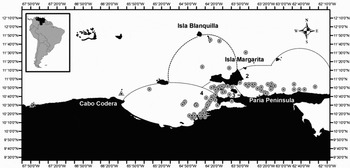
The study area has been subdivided at a major scale into four sections of the five subdivisions proposed by Acevedo et al. (Reference Acevedo, Oviedo and Silva2007) as important areas of conservation for mysticete cetaceans (Figure 1). Overall the four sections comprise approximately 35% (>5700 km2) of shelf habitat and 65% (>10,500 km2) of oceanic environment off the shelf break:
(1) The shelf edge on the north coast of Margarita Island and La Blanquilla Island (approximate area 6752 km2). This portion is a transition zone between the neritic and pelagic habitats; lesser upwelling centres are present on the northern coast of Margarita Island, including Macanao Peninsula. Although fishermen use the area, it has the lowest level of disturbance and change because of human activities. It is quite important to point out that this location is currently considered for oil industry exploration and exploitation activities in the near future (Oviedo, Reference Oviedo2005; Martín et al., Reference Martín, Malavé, Sánchez, Aparicio, Arocha, Bone, Bolaños, Bolaños-Jimenez, Castañeda, Cardenas, Carbonini, Díaz, Guada, Klein, Lazo, Lemus, Lentino, Lira, Lodeiros, Lopez, Marin, Martinez, Marque, Marquez, Molinet, Morales, Posada, Prieto, Riera, Rodriguez, Ramirez, Senior, Solana, Severeyn, Spiniello, Valera, Yanes and Zoppi2006).
(2) Margarita Island's eastern coast and Margarita-Los Testigos submarine platform (approximate area 3898 km2). The continental shelf in this section of the study area is wide and relatively even, with both muddy and muddy–sandy bottoms. The latter features mostly constitute a key shallow neritic habitat, also influenced by the upwelling off Carupano's coast (Central Paria Peninsula). This zone has a traditional use of marine resources by humans; the coastal human population densities have been increasing in recent years, and also have significant land-based sources of pollution associated with port development and tourism (Oviedo, Reference Oviedo2005).
(3) The northern coast of Araya Peninsula, including Coche and Cubagua islands (approximate area 1812 km2). This region has a complex submarine topography due to the presence of Margarita, Coche and Cubagua Islands; an upwelling area is located off north Araya Peninsula, whose intensity is highly influenced by the seasonal variations associated with the annual cycles of trade winds. The most important human impacts are fisheries, chemical and acoustic pollution and commercial shipping traffic. For this study, common dolphin behaviour assessment was centred in this sub-area.
(4) The Cariaco Basin, south-west of Margarita and Cumaná, including the Cariaco Gulf (approximate area 3889 km2). Although one portion of this area is protected under National Park status (Mochima NP), the human impact on the marine portion of the ecosystem is intense. The threats include fisheries, chemical and acoustic pollution, development of oil and gas production facilities, commercial shipping traffic (Oviedo, Reference Oviedo2005) and unregulated dolphin watching activities (Jefferson et al., Reference Jefferson, Fertl, Bolaños-Jiménez and Zerbini2009).
Study area in north-eastern Venezuela, divided according to Acevedo et al. (Reference Acevedo, Oviedo and Silva2007): (1) The shelf edge on the north coast of Margarita Island and La Blanquilla Island; (2) Margarita Island's east coast and Margarita-Los Testigos submarine platform, including Central Paria Peninsula; (3) the north coast of Araya Peninsula, including Coche and Cubagua Islands; (4) the Cariaco Basin south-west of Margarita and Cumaná, including the Cariaco Gulf. Records of Delphinus spp., are represented by filled circles with concentric dot, records from the central coast around the area of influence of the Cabo Codera' upwelling, are denoted by a filled triangle with concentric dot, including those reported in Cobarrubia & Bolaños-Jiménez (Reference Cobarrubia-Russo and Bolaños2008).

Dolphin sightings and data analysis
Opportunistic data collection on cetacean encounters (sightings) off north-eastern Venezuela has been carried out aboard several vessels since 1997 by the authors, resulting in an extensive database of published and non-published records that includes more than ten species including wintering humpback whales (Silva et al., 2006; Acevedo et al., Reference Acevedo, Oviedo and Silva2007, Reference Acevedo, Oviedo, Silva and Bermúdez2008) along with Balaenoptera edeni (Oviedo & Silva, Reference Oviedo and Silva2001, Reference Oviedo and Silva2005; Acevedo et al., Reference Acevedo, Oviedo and Silva2007), B. physalus (Lira et al., Reference Lira, Bolaños-Jiménez and Mondolfi1995; Acevedo et al., Reference Acevedo, Oviedo and Silva2007; Bolaños-Jiménez & Villarroel-Marín, Reference Bolaños-Jiménez, Villarroel-Marín, Rodríguez and Rojas-Suárez2008), Physeter macrocephalus, Tursiops truncatus (Oviedo et al., Reference Oviedo, Silva, Bermúdez and Odell2005; Oviedo & Silva, Reference Oviedo and Silva2005), Stenella frontalis, Stenella attenuata (Rangel, Reference Rangel2007; Rangel & Cobarrubia-Russo, Reference Rangel and Cobarrubia-Russo2008a), Stenella coeruleoalba, Feresa attenuata, Grampus griseus, S. guianensis (Esteves & Oviedo, Reference Esteves and Oviedo2007b; Oviedo & Esteves, Reference Oviedo and Esteves2008) and Delphinus spp.
Sighting records of long-beaked common dolphins from 1997–2006 (N = 146) were pooled together with observations from the Araya Peninsula area; these sighting records, however, have been collected from systematic surveys during 2007–2008 (N = 38). All records (N = 184) were analysed through descriptive statistics and integrated into a Geographical Information System (ArcGIS 9.2). Observations included information on date, seasonality (dry: December–April; rainy: May–November), time, group size, sea state (Beaufort scale), geographical coordinates, behaviour at initial encounter, and effort-corrected (days invested during searches) relative abundance and sighting indices (abundance per unit of effort (APUE) and sightings per unit of effort (SPUE), respectively). Behaviour records were collected according to the standard definitions of behavioural states in Garcia & Dawson (Reference García and Dawson2003), and through the recommended observational methods in Mann (Reference Mann1999, Reference Mann, Mann, Connor, Tyack and Whitehead2000).
Using the geo-statistical analysis tool of ArcGIS 9.2, densities were mapped using the effort corrected APUE and geographical coordinates as input parameters, interpolated in a 1.8 × 1.8 km grid, using a Gaussian kriging interpolation to generate thematic maps. The maps represent an empirical model of common dolphin distribution and the association with bathymetric features using effort corrected indices, following the recommendations on cetacean habitat modelling in Redfern et al. (Reference Redfern, Ferguson, Becker, Hyrenbach, Good, Barlow, Kaschner, Baumgartner, Forney, Balance, Fauchald, Halpin, Hamazaki, Pershing, Qian, Read, Reilly, Torres and Werner2006). Group sizes were also plotted log-normalized and classified by means of the standard deviation. Sample stratification in classes of APUE, and distance to 100 m isobaths were determined through a cluster analysis (group average, square Euclidean). Confidence intervals were obtained through a non-parametric bootstrap (100,000 repetitions, 95% confidence). Statistical differences were established by the Kruskal–Wallis test, concurring with the non-parametric distribution of the sample (Zar, Reference Zar1996).
RESULTS
Total field effort accounts for 153 days. From those, systematic surveys comprised 76 days of field surveys: 12 in coastal habitat plus 64 surveys distributed in shelf and transitional habitat. Overall, the encounter rate for common dolphin was over 50% of all sightings, followed by Atlantic spotted dolphins (S. frontali s, 15%) as the most common odontocete species observed.
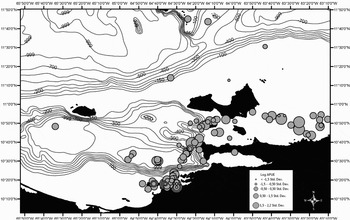
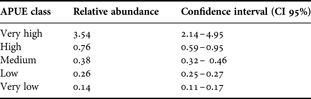
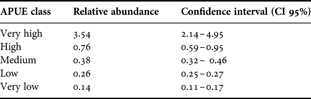
Relative abundance of common dolphins (Table 1) is represented in five classes of APUE: very high, high, medium, low and very low. Differences between estimates were statistically significant (Kruskal–Wallis, χ2:41.46, df: 4, P <0.05). Spatial distribution of common dolphin APUE (Figure 2) reflects a major abundance in the neritic habitat between the southern coast of Margarita Island–Central Paria Peninsula and north of Araya Peninsula, with important concentration of common dolphins along the Islands of the Mochima NP and within the eastern portion of the Cariaco Basin.
Distribution of effort-corrected (APUE) during initial sightings of common dolphins in the study area. Classes were grouped by means of the standard deviation.

Relative abundance of common dolphins in the study area.
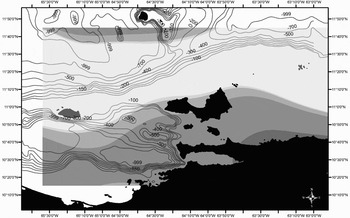
The density of common dolphin is shown in Figure 3. Approximately 63% (2094) of all the individuals recorded occurred within shelf waters. The distribution pattern in this important habitat of very high-density would concur with the distribution of APUE mentioned before, including the transitional habitat off the north-western coast off Araya Peninsula. High density would equally cover deep oceanic-like areas such as the Cariaco Basin. The lowest density would be localized at the shelf edge off the north Coast of Margarita Island. However, density would progressively increase in oceanic depths off the western coast of La Blanquilla Island. Seasonality in APUE spatial pattern was not statistically significant (Kruskal–Wallis, χ2:0.04, df: 1, P > 0.05).
Predicted density (generated from effort corrected APUE) of common dolphins off the north-east coast of Venezuela. Densities scale from the lowest values is shown in light grey to the highest values shown in dark grey.

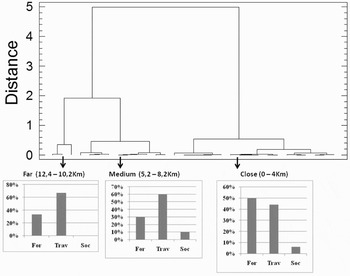
From the most recent dataset (2007–2008) assessed for behaviour patterns, only three behavioural states were recorded during ethological sampling: foraging, travelling and socializing. Foraging bouts seemed to be directly proportional to distances closer to the shelf edge (100 m isobaths), with 50% of the recorded foraging bouts located at distances equal or less than 4 km (Figure 4). The opposite trend was observed with travelling groups of dolphins, the occurrence of travelling bouts seemed to be directly associated with an increased distance from the shelf edge. Both traits are supported statistically (Kruskal–Wallis, χ2:25.23, GL: 1, P < 0.05).
Cluster analysis of frequency of behaviour bouts of Delphinus spp. by distance to the 100 m isobaths: foraging (For); travelling (Trav); socializing (Soc).

DISCUSSION
Distribution and abundance
The spatial pattern of the abundance estimates provides good insight into the wide distribution of common dolphin off the north-eastern coast of Venezuela. The species inhabits all major marine habitats, from shelf waters to transitional areas, and even oceanic habitats such the Cariaco Basin (Rangel et al., Reference Rangel, Esteves and Oviedo2005; Acevedo, Reference Acevedo2007). Information drawn from the APUE estimates indicates an uneven distribution of common dolphin abundance. The latter is an indication of a differential pattern of habitat use. Although levels of occurrence differ quantitatively and spatially, the trend of dominance and representativeness of the species over the region's cetacean diversity prevails. Common dolphin importance as the main component of the cetacean fauna off the north-east coast of the country has been previously documented, even at proportions over 50% of the total cetaceans sighted (Naveira, Reference Naveira1996; Acevedo, Reference Acevedo2001, Reference Acevedo2007; Quevedo, Reference Quevedo2004; Bolaños-Jiménez et al., Reference Bolaños-Jiménez, Bermúdez-Villapol, Sayegh and Solé2006, Reference Bolaños-Jiménez, Villarroel-Marín, Parsons, Rose, Lück, Gräupl, Auyong, Miller and Orams2007; Molero-Lizarraga, Reference Molero-Lizarraga2005; Orlando, Reference Orlando2005; Rangel, Reference Rangel2007; Rangel & Cobarrubia-Russo, Reference Rangel and Cobarrubia-Russo2008b).
Common dolphins might be a key predator for the main fishery resource of the north-east coast basin: sardines. At this point of the research progress, we can only suggest the relevance of S. aurita in the diet of common dolphins, firstly according with observations of foraging events, plus anecdotal accounts of stomach content of stranded dolphins, and secondly through the only quantitative diet assessment done on two stranded specimens by Naveira (Reference Naveira1996). Foraging habits are determinant in the distribution of the species in the rich environment of the study area.
The predicted density pattern within shelf habitat would reflect the close spatial relation between predator and preys; particularly round sardinella, and specifically on the sectors (Nos 2, 4 and 6) referred by Freon et al. (Reference Freón, El Khattabi, Mendoza and Guzmán1997) as key fishing grounds. The latter also coincides with the location of the most-important coastal upwelling area, off the coast of Central Paria Peninsula and Araya Peninsula, similar to the documented occurrence of D. delphis as an indicator species of upwelling modified waters in the eastern tropical Pacific (Ballance et al., Reference Ballance, Pittman and Fiedler2006, Fernández et al., Reference Fernández, Oviedo, Echeverría and Goodman2007, Fernández & Oviedo, Reference Fernández and Oviedo2009). Since density distribution would locally emulate that of its potential prey (Forcada, Reference Forcada, Perrin, Würsig and Thewissen2002), and consequently overlap with areas of coastal upwelling, the latter trend comprises discrete areas limited by boundaries, which defines a system diverging by physical and biological features.
The increasing trend of predicted density in oceanic waters, such as the deep waters of the Cariaco Basin and beyond the shelf break west of La Blanquilla Island, could also be interpreted in terms of prey distribution, particularly on the occurrence of mesopelagic prey species such as myctophids. There is a strong possibility that myctophids might play a relevant role as prey items, probably more in the case of common dolphins occurring in oceanic-like environments, such as the Cariaco Trench, however, the latter requires further systematic study, since it is based in anecdotally gathered observations. The elements considered above could imply the possible migration to diversified foraging grounds, similar to the local migratory movement considered by Stockin (Reference Stockin2008) with common dolphins in New Zealand waters.
Records close to Farallón Centinela (Crescini, personal communication; Figure 1), and even those from the central Venezuelan coast (Cobarrubia & Bolaños-Jiménez, Reference Cobarrubia-Russo and Bolaños2008) would be associated with the upwelling off Cabo Codera, which itself has a particular temporal and intensity pattern, when compared to the coastal upwelling in north-eastern Venezuela (Lorenzoni, Reference Lorenzoni2000). Nevertheless, it is the westernmost boundary of the Cariaco Basin, where the narrow Centinela Channel connects the basin to the Caribbean Sea (see figure 1 in Müller-Karger et al., Reference Müller-Karger, Varela, Thunell, Astor, Zhang, Luerssen and Hu2004). The influence of Cabo Codera's upwelling might turn into a gradient of productivity influencing the central coast. This might explain the recent documented records of common dolphin of Cobarrubia & Bolaños-Jiménez (Reference Cobarrubia-Russo and Bolaños2008), and even the potentially extralimital record of Ramírez-Carroz & González-Fernandez (Reference Ramírez-Carroz and González-Fernández2004), off the Venezuela Gulf (possibly associated with lesser coastal upwelling off the west coast, such as the one in Paraguaná Peninsula). Density and level of occurrence of common dolphin in these areas would not be as concentrated as in north-eastern Venezuela, where the most intense coastal upwelling is localized. Consequently, the definition of an isolated Venezuelan stock, as suggested by Jefferson et al. (Reference Jefferson, Fertl, Bolaños-Jiménez and Zerbini2009) would be supported and bounded, by a gradient of coastal upwelling influence concentrated in the Cariaco Basin.
Seasonality could have a non-significant influence in the spatial distribution of common dolphin on the north-eastern coast of Venezuela, where the species seems to be present year-round (Naveira, Reference Naveira1996, Acevedo, Reference Acevedo2007). Additionally, the effect of the Orinoco River influx during rainy season, could potentially balance the difference in productivity between dry (upwelling) and the rainy seasons (see figure 1 in Müller-Karger et al. Reference Müller-Karger, Varela, Thunell, Astor, Zhang, Luerssen and Hu2004), supporting the presence year-round of predators such as common dolphin due to prey availability.
Behaviour and habitat use
The behaviour data processed here corresponded with initial behavioural states (at first encounter with the group of dolphins) during systematic surveys, and the descriptive statistics presented are only an expression of frequencies rather than proportions. Nevertheless, there is an evident overall dominance of travelling groups over foraging and socializing. Travel dominancy in the behaviour records of common dolphin has been previously documented (Quevedo, Reference Quevedo2004; Molero-Lizarraga, Reference Molero-Lizarraga2005; Orlando, Reference Orlando2005; Rangel, Reference Rangel2007; Molero-Lizarraga et al., Reference Molero-Lizarraga, Hernández and Bermúdez2008; Rangel & Cobarrubia-Russo, Reference Rangel and Cobarrubia-Russo2008b).
A clear preliminary spatial pattern can be drawn from the clumping of the foraging bouts on localized areas at the shelf edge. That pattern is supported by half of the episodes of prey capture and consumption at close-range distance from the limiting isobaths of 100 m, which apparently is a boundary in terms of habitat used; the occurrence of socializing bouts could be interpreted as a subordinate activity, apparently associated with foraging. However, in order to elucidate any spatial pattern in social activities, further data are needed. Acevedo (Reference Acevedo2007) reported that the slope index range (a percentage value describing the complexity of submarine relief in terms of slope) for common dolphin off the north-eastern coast is between 0 and 71% (almost flat bottom to deeply prominent slope); this relationship between foraging and slope is a common trait in cetaceans, due to advantages that complex slope areas provide in prey capture (Hui, Reference Hui1979; Reference Hui1985; Baumgarther, Reference Baumgarther1997; Wilson et al., Reference Wilson, Thompson and Hammond1997; Davis et al., Reference Davis, Fargion, May, Leming, Baumgartner, Evans, Hansen and Mullin1998; Cañadas et al., Reference Cañadas, Sagarminga and Garcia-Tiscar2002; Ingram & Rogan, Reference Ingram and Rogan2002). The key fact in this case, is that the latter, along with the increase in travelling with distance from the 100 m isobaths, could suggest frequent migration towards a localized foraging area. More data are needed on activity patterns and, above all, on dietary (prey) preferences, in order to support the local migration hypothesis. In forthcoming sections of this contribution, limitations are identified and acknowledged.
Behaviour at first encounter presented in this paper coincides with several accounts generated by ferry-boats observations. Nonetheless, ethological records drawn from platform of opportunity (especially from ferry-boats), would be considered representative just as an observation of a behaviour bout at first encounter. Lagged behaviour events or progression of a behavioural state would not be properly recorded, due to the continuity of movement of the observation platform; consequently, this means impairment in keeping an observation record of the group, and even termination of sighting. Additionally, there are induced behaviour events related to the effect of the observation platform on the group encountered, such as bow-riding. This could be mistakenly interpreted as a travelling bout, due to the movement of the dolphins along with the ferry-boat. Interplay between travelling and foraging bouts is expected, but a solid behavioural (activity) budget is needed to obtain the proper insights.
Management and conservation
An issue of concern is the declining trend of the round sardinella stock that resulted in 0 catch in 2005, according with the landing statistics of the Venezuelan Fishery Administration Agency (INSOPESCA). The effect of common dolphins in a possible trophic cascade scenario was suggested before (Oviedo, Reference Oviedo2005). The actual sardine fishery situation seemed to accelerate the need for understanding the predator–prey interrelationship between S. aurita and common dolphins.
Focal upwelling localized within shelf habitat, particularly in central Paria Peninsula and adjacent waters would represent areas with a key value to promote a healthy population growth and survival of the Venezuelan stock of common dolphin, as a result, they can be identified as potential critical habitat (Hoyt, Reference Hoyt2005). A trend of regionalization is reflected in the distribution and abundance of common dolphins off the north-east coast of Venezuela. According to Pauly & Zeller (Reference Pauly and Zeller2003), the latter will serve as a baseline to assess ecosystem health and evaluate management scenarios.
Based on the considerations above, if the relevance of S. aurita in the diet of common dolphin is confirmed by research in progress, common dolphin will serve not only as an indicator-species for upwelling-modified waters, but also as an effective means to monitor sardine stock and ecosystem stability, specifically if the primary productivity required (a similar index to the ecological footprint) to sustain the stock of dolphins is monitored, and contrasted with the one required to sustain the sardine fishery (Oviedo & Achury, Reference Oviedo and Achury2009). Added to the latter, the fact that critical habitats for the species, as proposed in this report, are the key centres of primary productivity, and sardine abundance, this would represent an important argument to be weighted in the proposal of candidate areas for MPA status, due to the relevance of these locations for the complex trophodynamics of the maritime environment off north-eastern Venezuela. Prey depletion has been an influential factor for cetacean population decrease (particularly common dolphins) in locations within the eastern Mediterranean basin. A degradation of the food web has been documented in the Mediterranean, where the current situation of exploitation of marine resources could lead to additional species loss (Coll et al., Reference Coll, Lotze and Romanuk2008). According to Bearzi et al. (Reference Bearzi, Agazzi, Goncalvo, Costa, Bonizzoni, Politi, Piroddi and Reeves2008) the common dolphin population decreased from 150 animals in 1996 to 15 in 2007. This situation described previously would be greatly prevented in waters off north-eastern Venezuela if a management scheme not only considered strict fishery regulations, but in situ protection of prey–predator abundance sites, an MPA will benefit both the predator species (human and dolphins) and the main prey resource; sardines.
Limitations
We acknowledge the potential effects of the heterogeneity of sampling protocols and distribution of field efforts, even though there is a solid representation of search efforts in every of the four sections assessed, the uneven investment in search efforts might produce biased results.
Behavioural and acoustic assessment of common dolphin in the study area, is still in progress, quantification of behavioural bouts presented in this contribution, should be only considered as frequencies of initial behavioural states, and not the proportion of time invested in particular behavioural activities produced by means of an unbiased ethological sampling method such as scan sampling.
ACKNOWLEDGEMENTS
Lenin Oviedo's data gathering was supported by funds from the Whale and Dolphin Conservation Society (WDCS), the Rufford Project Small Grant for Nature Conservation, and Cetacean Society International (CSI). Logistic support to Jaime Bolaños-Jiménez was provided by Marino Diaz and the boat crew of ‘Aventura Marina’ in Puerto la Cruz. Oceanographic data were provided by the Cariaco Project of Estación de Investigaciones Marinas de Margarita (EDIMAR–FLASA) and the University of South Florida (USF); many thanks to Professors Irene Astor and Ramón Varela. Fisheries statistics were provided by INSOPESCA–Gobierno Bolivariano de Venezuela (www.insopesca.gob.ve). We thank PDVSA—the Venezuelan Oil Company—for authorizing the use of data collected aboard the oceanographic cruises for the Plataforma Deltana Project (LBAPD). We are also grateful to the Captain and the crew of the RV ‘Hermano Ginés’ and Fundación la Salle de Ciencias Naturales (FLASA). We appreciate the valuable insights and suggestions of William F. Perrin, Dagmar Fertl, Thomas Jefferson and two anonymous referees.