1. INTRODUCTION
Intense laser beams propagating in plasmas are subject to many instabilities such as Raman and modulation instabilities (Esarey et al., Reference Esarey, Sprangle, Krall and Ting1996; Antonsen et al., Reference Antonsen and Mora1993; Mori, Reference Mori1997; Sprangle et al., Reference Sprangle, Esarey and Hafizi1997; Jha et al., Reference Jha, Kumar, Raj and Upadhyaya2005; Borghesi et al., Reference Borghesi, Campbell, Schiavi, Willi, Galimberti, Gizzi, Mackinnon, Snavely, Patel, Hatchett, Key and Hazarov2002; Clark et al., Reference Clark and Fisch2005; Gill et al., Reference Gill, Mahajan and Kaur2010; Kline et al., Reference Kline, Montgomery, Rousseaux, Baton, Tassin, Harelin, Flippo, Johnson, Shimada, Yin, Albright, Rose and Amiranioff2009; Esarey et al., Reference Esarey, Schroeder and Leemans2009; Zhang et al., Reference Zhang, Fu, Deng, Zhang, Wen and Fan2011). In Raman instability, plasma waves play a fundamental role in scattering the primary laser beam into other frequencies or directions. Modulation instability does not require the excitation of plasma waves and can result in the distortion of the laser beam envelope. The physical basis for modulation instability is group velocity dispersion in presence of self-phase modulation. Growth of modulation instability has been reported by several workers (Max et al., Reference Max, Arons and Langdon1974; McKinstrie et al., Reference Mckinstrie and Bingham1992; Sprangle, Reference Sprangle, Esarey and Hafizi1997). Recently, the effect of the laser pulse profile on the laser plasma interaction process has been reported (Jha et al., Reference Jha, Singh and Upadhyay2009). It has been shown that distortion of the laser pulse profile occurs and the growth of modulation instability is affected.
When the frequency of a laser varies across the pulse, the laser pulse is said to be chirped. An intense laser pulse may be initially chirped or it may acquire a variation in frequency (self-chirped) across the pulse while propagating in linear or nonlinear media. Frequency chirping of a Gaussian pulse due to group velocity dispersion (GVD) or self-phase modulation or a combined effect of both, have been observed in fibers (Agarwal, Reference Agarwal1989). Chirped laser pulses play an important role in the study of dynamics of Raman instability (Faure et al., Reference Faure, Marquès, Malka, Amiranoff, Nazmudin, Walton, Rousseau, Ranc, Solodov and Mora2001), controlling of laser plasma coupling (Dodd et al., Reference Dodd and Umstadter2001), and frequency chirp induced asymmetries in self modulated laser wakefield accelerator electron and neutron yield (Schroeder et al., Reference Schroeder, Esarey, Geddes, Toth, Shadwick, Tilborg, Van, Faure and Leemans2003). Experiments (Yau et al., Reference Yau, Hsu, Chu, Chen, Lee, Wang and Chen2002) have reported enhanced efficiency of the Raman forward scattering (RFS) instability for positively chirped laser pulses. In addition two-dimensional particle-in-cell simulations (Dodd et al., 2001) claim enhancement of RFS instabilities for positively chirped laser pulses. By using nonlinear chirped laser pulses, enhanced acceleration of background electrons in a laser Wakefield accelerator, has been experimentally observed (Leemans et al., Reference Leemans, Catravas, Esarey, Geddes, Toth, Trines, Schroeder, Shadwick, Tilborg and Faure2002). Also, electron acceleration is affected by frequency chirping in the presence of tapered wiggler magnetic field (Kumar et al., Reference Kumar and Yoon2008). Study of chirped laser pulse is also important in achieving maximum pulse compression (Park et al., Reference Park, Lee and Nam2008), because a chirped laser pulse is modified by the self-phase modulation process that affects the temporal structure of the propagating laser pulse (Kim et al., Reference Kim and Nam2002). The effect of pulse chirping on plasma generation and self-guiding lengths has been numerically investigated (Nuter et al., Reference Nuter, Skupin and Bergé2005). It has been shown that negative chirp helps in maintaining the laser beam envelope focused over long scales.
The present paper deals with the analytical study of the effect of chirping on pulse distortion and growth of modulation instability of a laser pulse propagating in a plasma channel. In Section 2, the wave equation, including group velocity dispersion and finite pulse length effects for the evolution of the chirped pulse amplitude has been set up. Considering finite pulse effects to be a higher order effect, the lowest order solution for the wave amplitude is obtained and a graphical analysis of the intensity distribution across a chirped laser pulse while propagating in plasma is analyzed. Section 3 deals with the evaluation of growth rate of modulation instability at the front, back and at the centroid of the chirped laser pulse. Summary and conclusions are presented in Section 4.
2. WAVE EQUATION
Consider the propagation of an intense, linearly polarized, chirped laser pulse along the z-direction, in a plasma channel. The electric vector of the laser field is given by

where E 0(r,z,t) is the envelope of the radiation field and k 0 (ω 0) is its wave number (frequency). In the weakly relativistic limit, the wave equation governing the propagation of the laser beam propagating in plasma is given by (Esarey et al., Reference Esarey, Sprangle, Krall and Ting1997)

where 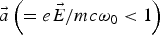 is the normalized electric field, ω p(r) [=4πe 2n(r)/m, n(r) is the plasma density] is the plasma frequency and Coulomb gauge
 has been used. The first term on the right-hand side of Eq. (2) represents the linear source term, while the second term is the nonlinear source term arising due to relativistic effects. Considering a long laser pulse (τ0 > λ p/c, where τ0is the initial pulse duration and λ p is the plasma wavelength), density perturbations have been neglected while deriving the source term in Eq. (2). Substituting Eq. (1) into Eq. (2) leads to the equation governing the evolution of the laser amplitude, as,
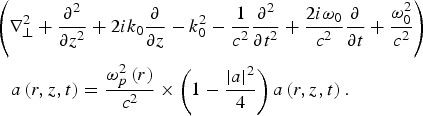
Now transforming variables z,t to η(=z),τ(=t − z/v g, v g is the group velocity) and using the transformed derivatives  and
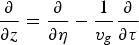 , Eq. (3) takes the form
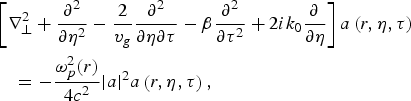
where 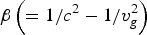 represents the group velocity dispersion parameter. In deriving Eq. (4), the dispersion relation
 has been used. Assuming the radial profile of the plasma to be of the form
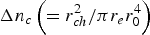
 , where n 0 is the ambient plasma density, r ch is the channel radius, and Δn is the channel depth, the laser beam will propagate several Rayleigh lengths (Z R=
 , where r 0 is the minimum spot-size) with a constant spot-size if the plasma channel depth is equal to the critical value
 where re is the classical electron radius (Esarey et al., Reference Esarey, Sprangle, Krall and Ting1997).
Assuming a slowly varying amplitude, the higher order diffraction term (∂ 2/∂η 2 ~  ) can be neglected in comparison to 2k 0∂/∂η(~4π/λZ R where λ is the wavelength of the pump wave ). The third and the fourth terms on the left side of Eq. (4) scale as
 ~
 and
 ~
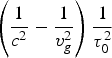 and represent finite pulse length effects. If the laser pulse length is not considered to be long enough, these terms will be about two orders of magnitude less than
 and will therefore perturb the pulse amplitude. Also, the propagation of a broad laser beam can be described with the help of a one-dimensional model (
 , k p is the plasma wavenumber and r 0 is the laser beam waist). Thus, in the one-dimensional limit, Eq. (4) may be written as

where  is the on axis plasma frequency. Considering the Gaussian laser pulse profile to be chirped, the field amplitude may be written as (Agarwal, Reference Agarwal1989)

where b(η,τ) is the pulse amplitude, ∈ is the chirp parameter, and τ0 is the initial pulse duration. Substituting Eq. (6) into Eq. (5) and considering the variation in the pulse amplitude with respect to τ to be a higher order effect, the lowest order evolution equation for the unperturbed pulse amplitude b 0 is given by
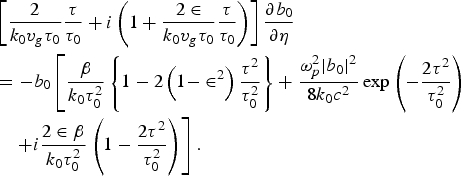
Solving Eq. (7), the lowest order, unperturbed amplitude is given by

where a 00 (laser strength parameter) is the initial (η = 0) amplitude of the laser pulse and A(τ) and Φ(τ) are respectively given by
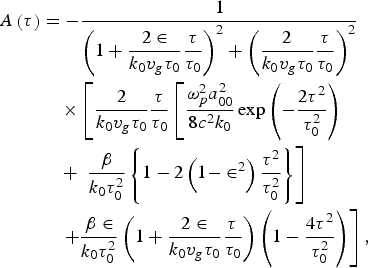
and
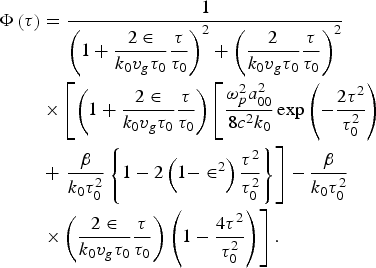
A(τ) leads to amplitude variation in the pulse frame while Φ(τ) is the self-induced phase shift (self phase modulation) experienced by the chirped laser pulse while propagating in plasma. If the chirp parameter ∈ = 0, Eq. (7) reduces to the unchirped case (Jha et al., Reference Jha, Singh and Upadhyay2009). With the help of Eqs. (6) and (8), the lowest order laser pulse intensity is given by

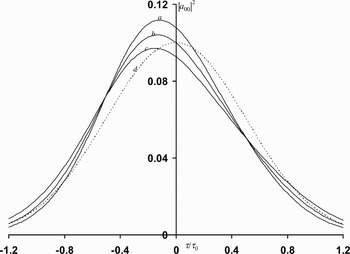
The variation of intensity of a Gaussian laser pulse with normalized pulse time (τ/τ 0) is shown in Figure 1. Figures 1a and 1c, respectively, show the variation of intensity of a Gaussian laser pulse when it is positively and negatively chirped (∈ = ± 0.3), after propagating a distance of 25Z R (where ZR = 0.07cm for a laser beam having r 0 = 15μm, and wavelength λ = 1μm). Figure 1b represents propagation of an unchirped ( ∈ = 0) laser pulse, through the same propagation distance while Figure 1d describes the intensity of the initial (η = 0) pulse profile. The laser and plasma parameters are ω0 = 1.88 × 10¹⁵s −1, a 002 = 0.1, τ0 = 5 × 10⁻¹⁴s, and n 0 = 1.11 × 1019cm −3. It is seen that chirped as well as unchirped laser pulses are distorted as they propagate in plasma. The peak value of intensity of the positively (negatively) chirped pulse increases (decreases) along with a shift in the pulse centroid toward the front of the pulse. It may be noted that the peak intensity of the positively chirped pulse increases by 7.4% and the shift in the centroid is reduced by 7.7% in comparison to the unchirped case, while the pulse intensity of the negatively chirped pulse decreases by 6.7% and shift in centroid increases by 15.4%, as compared to the unchirped case. Thus, higher laser intensity with reduced distortion may be obtained, due to propagation of a positively chirped laser pulse in plasma.
Variation of laser intensity (|a 00|2) of a Gaussian laser pulse with normalized pulse time (τ/τ0) for η = 25ZR (∈ = 0.3 (a), ∈ = 0 (b), ∈ = −0.3 (c), and η = 0 (d) for ω0 = 1.88 × 10¹⁵s −1, a 002 = 0.1, τ0= 5 × 10⁻¹⁴s and n 0= 1.11 × 1019cm −3.

3. MODULATION INSTABILITY
Considering the laser pulse amplitude to be perturbed on account of GVD and finite pulse effects, its modulated amplitude may be written as a superposition of perturbed and unperturbed amplitudes, as
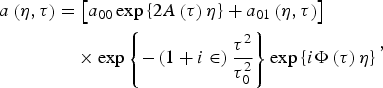
where a 01(η,τ) is the complex perturbed beam amplitude. Substituting Eq. (10) into Eq. (5), considering | a 01 | << | a 00 | and neglecting further variations (∂A/∂τ and ∂Φ/∂τ) in the pulse shape, the evolution equation for the first order perturbed amplitude is given by

where α = (3ωp2a 002/8c 2k 0)exp (2A(τ)η)exp(−2τ2/τ02). Considering the perturbed wave amplitude to be a sinusoidally varying function of η and τ, that is,  (K and Ω are the wave number and frequency of the perturbed wave amplitude, respectively), the dispersion relation for one-dimensional modulation instability is given by
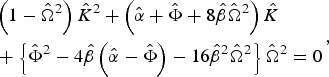
where  ,
 ,
 ,
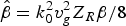 and
 are dimensionless quantities. The solution of Eq. (12) will be complex if
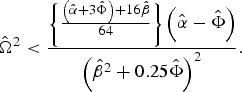
Eq. (13) describes the range of unstable frequencies for which the instability exists. The imaginary part of  (in Eq. (12)) gives the growth rate of modulation instability as
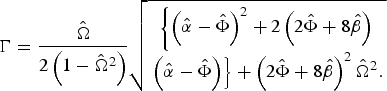
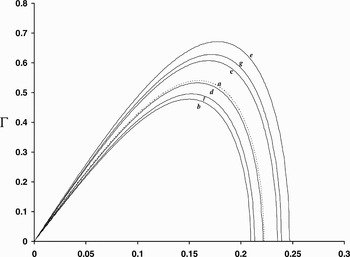
Variation in the growth rate of modulation instability (Γ) with respect to normalized perturbed wave frequency ( ) is shown in Figure 2. The laser plasma parameters used are
 ,
 ,
 , and
 . Figure 2a shows the growth rate of modulation instability for unchirped Gaussian laser pulse at η = 0. Figures 2b and 2c show the variation of the growth rate of modulation instability at the front (
 ) and back (
 ) of an unchirped pulse after it has propagated a distance of 25Z R. Figures 2d and 2e represent growth rates of modulation instability for a positively chirped
 laser pulse at the front and back of the laser pulse, respectively, for a propagation distance of 25Z R while Figures 2f and 2g represent the same for
 . It is seen that for a positively chirped laser pulse, the growth rate of modulation instability increases at the front as well as at the back of the laser pulse, in comparison to that obtained for an unchirped pulse. It is also seen that the peak growth rate of modulation instability is higher for larger chirp parameter at the front as well as at the back of the pulse. On the contrary if the laser pulse is negatively chirped, the growth rate of modulation instability would be suppressed.
Variation in the growth rate of modulation instability with  after the pulse has traversed a distance of 25Z Rfor a symmetric pulse at
 (a), at the back of the asymmetric pulse (
 ) for chirped ( ∈ = 0.3 (d); ∈ = 0.1 (f) and unchirped (b) case, (e, f, c) represent the growth rate of modulation instability at the front (τ/τ 0 = − 0.14) of the asymmetric pulse for chirped ( ∈ = 0.3 & ∈ = 0.1 respectively) and unchirped case respectively. The parameters used are
 ,
 ,
 and
 .

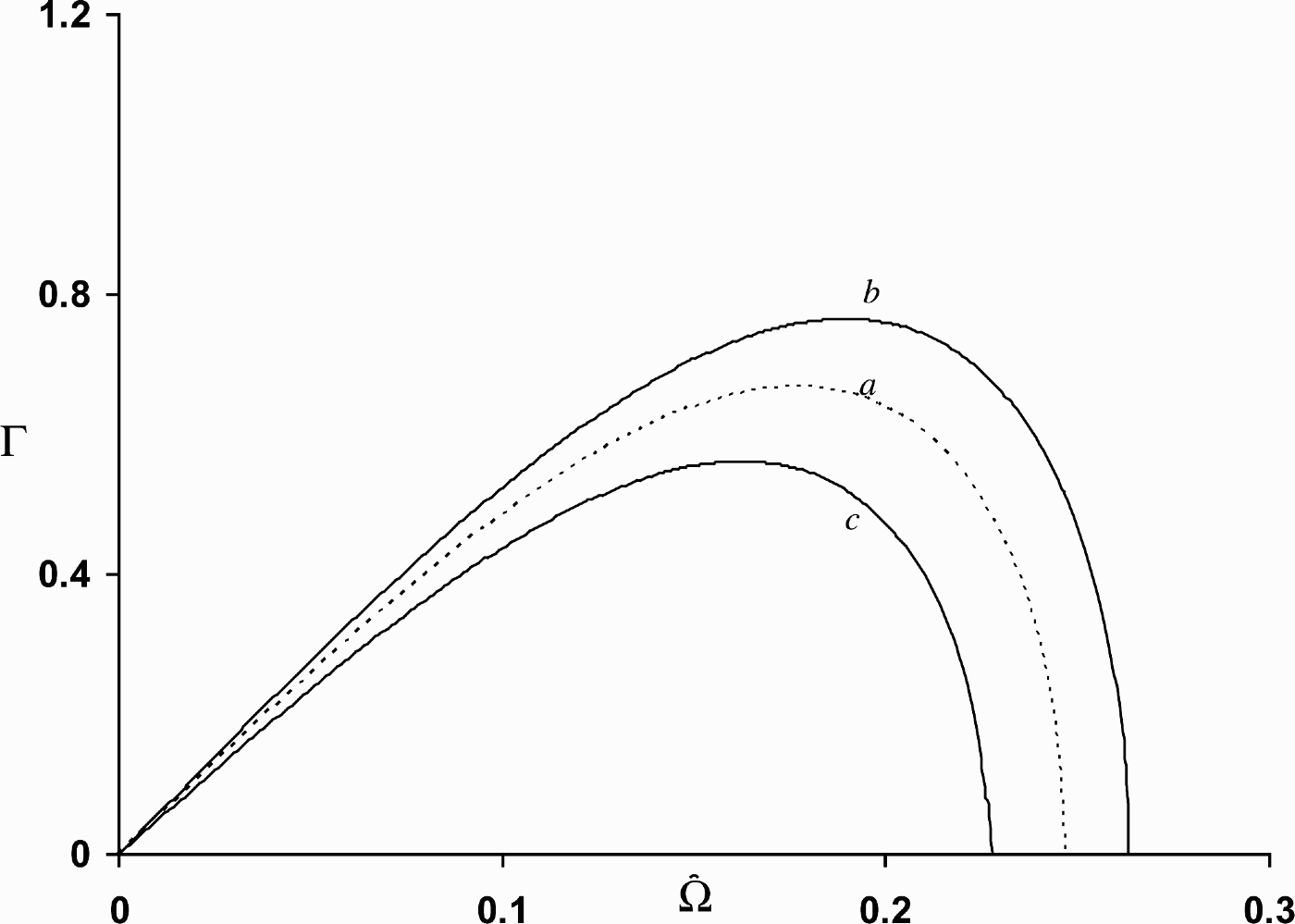
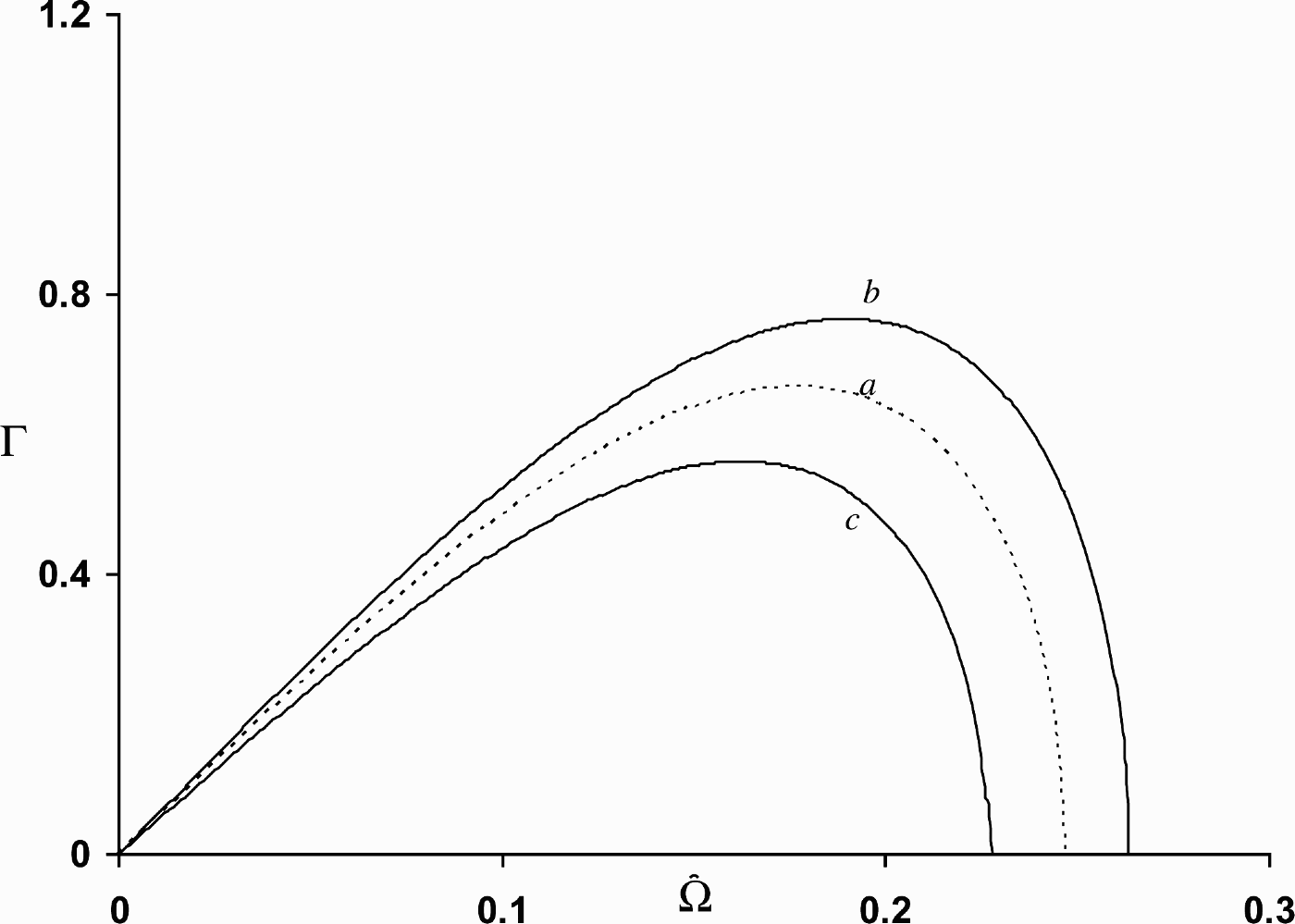
In Figure 3, the growth rate of modulation instability is plotted for the pulse time at which the intensity attains its peak value (see Fig. 1) after it has propagated a distance of  . Figure 3a shows the variation in the growth rate of modulation instability for a positively chirped (
 ) pulse at
 , Figure 3b represents the same for unchirped ( ∈ = 0) pulse at
 while curve c represents the growth rate of modulation instability for the initial pulse (η = 0) at
 . It is seen that for the chirped case the growth rate of modulation instability increases by 14.6% as compared to the unchirped and 36.3% in comparison with the initial pulse.
Variation in the growth rate of modulation instability with  after the pulse has traversed a distance of 25Z R, for the normalized pulse time at which intensity attains its peak value, for chirped (∈ = 0.3) pulse at τ/τ 0 = − 0.12 (a), unchirped (∈ = 0) pulse at
 (b) and initial pulse (η = 0, τ/τ 0 = 0 (c). The parameters used are
 ,
 ,
 and
 .
4. SUMMARY AND CONCLUSIONS
The present paper deals with the study of the effect of chirp on the distortion of a laser pulse as it propagates in a plasma channel. Further, the growth of modulation instability of chirped laser pulses has been analyzed. It is shown that the peak value of intensity for a positively chirped laser pulse increases by 7.4% whereas for a negatively chirped laser pulse it decreases by 6.7% as compared to that obtained for the unchirped case, while the shift in the centroid of the positively (negatively) chirped laser pulse decreases (increases) by 7.7% (15.4%) in comparison to the shift obtained for unchirped case. Thus higher laser intensity may be obtained with reduced distortion due to presence of positive chirp.
The analysis of the growth of modulation instability across the laser pulse shows that the growth rate for front (back) of the asymmetric laser pulse increases (decreases) as compared to the symmetric pulse. It is seen that in presence of positive chirp the growth rate of modulation instability for both, the front and the back of the pulse, increases in comparison to their corresponding values in absence of chirp, but the peak value of growth rate for the front of the pulse is more in comparison to that at the back of the pulse. Also, the growth rate of modulation instability of a positively chirped pulse, at a given normalized pulse time (at which maximum intensity is obtained) increases in comparison to that obtained for an unchirped pulse. The growth rate of modulation instability for a negatively chirped pulse would be suppressed. Hence negatively chirped pulses could be used for the suppression of modulation instability.
ACKNOWLEDGMENT
This work has been done with the financial support of the Science and Engineering Research Council, Department of Science and Technology, Government of India (Project No. SR/S2/HEP-22/2009). The authors thank the organization for funding the research project.