Seeking diversity: rationales for theatre attendance research
When seventeen-year-old Anh was asked by a researcher if she ever attended theatre with her family she laughed and replied, ‘No, they’re Vietnamese’. After a pause she continued, ‘I don't think they even know what theatre means’.Footnote 2 Recent research on arts audience participation through much of the developed world has been motivated by the implications of comments such as Anh’s. Government and private non-profit agencies have been particularly active in commissioning studies, sometimes drawing on large national datasets, to analyse arts attendance through a range of socio-economic and sociocultural factors.Footnote 3 This research has set out to penetrate the silence of non-attendance and to emphasize the responsibilities that publicly funded arts organizations have to the communities they serve. The main emphasis has been on ways to generate cultural demand rather than challenge cultural supply. The research aims are often instrumental and tied to tangible recommendations about educating new audiences,Footnote 4 and sometimes are focused on collecting baseline data to measure the effectiveness of future audience development programmes.Footnote 5
A tension that plays out in the underlying aims of this research can be found in the gap between the emphasis on effective communication strategies and the emphasis on education and induction. For example, in a RAND Corporation report on supply and demand in the arts, communications analyst Laura Zakaras and economist Julia Lowell argue that cultivating demand ‘is not primarily about creating better marketing campaigns and public outreach; but, rather, about providing individuals with the tools they need to have rich experiences with art’.Footnote 6 While research related to education, outreach and marketing is undoubtedly important, we question whether to some extent this has masked the need to address more fundamental questions around practice.
A contentious area that receives less attention is the extent to which mainstream arts providers should challenge their own artistic practices in developing new audiences. Our paper explores this issue by considering the implications of changing demographic patterns as our communities become more diverse. To do this we draw on the findings of a 2008–11 research study, TheatreSpace: Accessing the Cultural Conversation. TheatreSpace investigated young people's cultural choices and the reasons why individuals engage or do not engage with theatre. Although the study included three Australian states, Queensland, New South Wales (NSW) and Victoria, we focus here on the NSW findings, where nearly 40 per cent of the 726 young participants spoke a language other than English at home. Most of these participants attended with English or drama-school excursions and many had never attended theatre with their families.
In two previous major arts participation studies, economist Bruce SeamanFootnote 7 and social scientists Kevin McCarthy, Arthur Brooks, Julia Lowell and Laura ZakarasFootnote 8 identified the different metrics used to measure participation. The data are most frequently derived from samples of audience members and samples of the general population. TheatreSpace, significantly, included the voices of many hundreds of young people who were under eighteen years of age (excluded from most audience-demand research) and who attended based on the choices of others, such as teachers and parents. The majority of NSW participants attended with school excursions and had infrequent or no prior exposure to theatre. In their research into attendance predictors, Alan Andreasen and Russell Belk argue that such marginal attenders have the potential to attend more frequently with the right inducements,Footnote 9 hence the importance of research that can capture their perspectives.
Sociologist Pierre Bourdieu's notions of cultural capital, and distinction and taste, as formulated in the seminal Distinction: A Social Critique of the Judgement of Taste,Footnote 10 offer valuable insights into the reflections of those TheatreSpace respondents who were introduced to Australia's elite arts for the first time. By essentially arguing that taste is used as a means to differentiate classes, Bourdieu dismisses the universalist ideal that ‘great’ art (high culture) is a ‘gift of nature’.Footnote 11 Rather, Bourdieu contends, this myth of transcendence (the ‘objectified’ state of cultural capital) is enacted through learnt behaviour (the embodied state) and through an elite education that gives those who are privileged the tools to decode their cultural artefacts (the institutionalized state). Within the context of audience-development research the emphasis on the education of non-attenders, while undoubtedly inspired by notions of access and equity, does little to question mainstream theatre programming or how it reproduces and confirms the dominant culture. The reflections of our TheatreSpace respondents demonstrated that cultural identification is important and we need to better understand the challenges and confrontations that theatre can present to young, first-generation Australians. We therefore argue that we need to challenge all cultural providers to respond to the growing cultural diversity and to create a policy environment that supports these shifts.
Education, identity and cultural capital
McCarthy et al. regard education as the most significant predictor of attendance, while recognizing that early family exposure is also significant and is more likely from highly educated families, as Bourdieu predicted.Footnote 12 While education and social status are repeatedly regarded as the strongest attendance indicators, the influence of ethnicity has been debated. The Arts Council England with sociologists from Oxford University concluded in a report on arts attendance patterns that people of European descent are more likely to attend than those from ‘mixed’ or ‘other’ ethnic groups regardless of social status and education.Footnote 13 On the other hand, sociologists Paul DiMaggio and Francie Ostrower, in comparing white American and black American cultural attendance patterns, found support for Bourdieu's concept of cultural capital with a positive correlation between education and attendance levels in both groups.Footnote 14 This confirmed the utility of viewing patterns of artistic taste and consumption as ‘quasi-rational responses to incentives for investment in cultural capital and of interpreting cultural capital as symbolic information about social membership required by persons with complex and extended social networks’.Footnote 15
More recently, DiMaggio and Toqir Mukhtar argued that the distinction between high culture and popular culture has become blurred, thus diluting the effect of cultural capital in arts attendance; this distinction was particularly noticeable in younger audiences, with their decline suggesting ‘a failure of these art forms to renew their audiences’.Footnote 16 Despite DiMaggio's earlier findings, ethnicity was not singled out as a factor in declining audiences. Yet the decline might be explained partially by the fact that elite groups associated with attendance at high-culture events are becoming more ethnically and culturally diverse, transforming what constitutes high culture and prestige. As Bourdieu argued, ‘every change in the system of goods induces a change in tastes. But conversely, every change in tastes resulting from a transformation of the conditions of existence and of the corresponding dispositions will tend to induce, directly or indirectly, a transformation of the field of production’.Footnote 17
Familial culture shapes identity with long-lasting influences over taste, which may discount experiences not considered relevant to identity and cultural heritage. Research has often focussed on what cultural-policy analyst Leila Jancovich refers to as the ‘consumer deficit model, which sees the problem to be addressed as people's lack of engagement in art rather than the type of art being offered to engage with’.Footnote 18 This results in recommendations that address ways to maintain the status quo. A report for the Arts Council England, for example, recommended leveraging the connection between cultural attendance and educational achievement to attract more Asian audiences.Footnote 19 Yet outreach strategies aimed at giving people a greater sense of connection with the arts are not necessarily addressing the fundamental issues of inclusion, which lie in practice itself. The TheatreSpace research revealed that cultural background can be significant in shaping taste and left some young people questioning how theatre was relevant to them.
TheatreSpace: accessing whose cultural conversation?
TheatreSpace was a collaborative research project among Sydney, Melbourne and Griffith universities, and thirteen industry partners from Australia's mainstream theatre providers and arts funding bodies. The project's aim was to investigate what attracts, engages and sustains young people who attend theatre in major performance venues and what factors lead to the disengagement or exclusion of others. The intention was to advance theoretical perspectives on young people's engagement with theatre and to explore the implications for future arts policy and theatre programming.
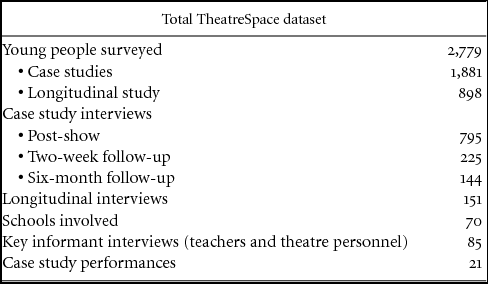
The research used quantitative methods to examine patterns in the demographic and the theatre-attendance history data of participants, and qualitative data, to address the project's aim in greater depth. Case studies developed around a single performance of productions selected jointly by the researchers and the industry partners. Nearly two thousand young attenders were surveyed in the auditorium prior to the performance and 795 were later interviewed on one to three occasions over a six-month period (the data are summarized in Table 1).
National TheatreSpace dataset, including case study and longitudinal data
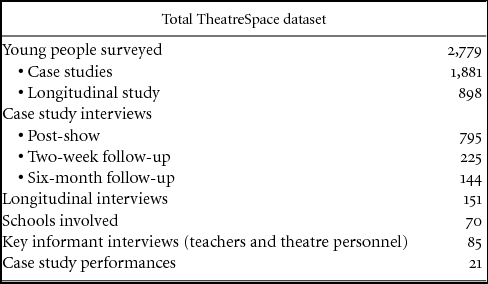
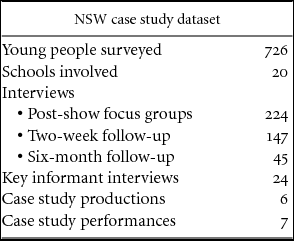
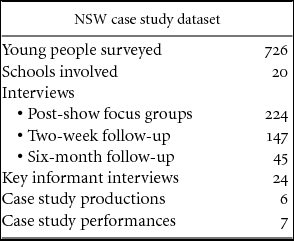
Coded qualitative data precisely defined categories and were analysed using the taxonomy developed by theorist Kathy Charmaz.Footnote 20 The project's methodology and findings are documented in Young Audiences in Theatre: Accessing the Cultural Conversation.Footnote 21 This paper focuses on an emergent finding arising from the NSW research (the data are summarized in Table 2).
NSW dataset for TheatreSpace research case studies
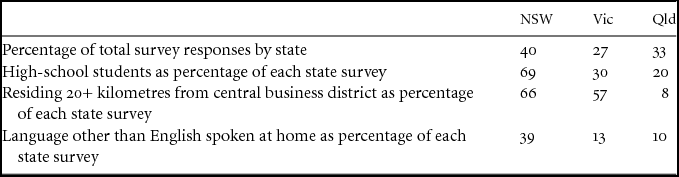
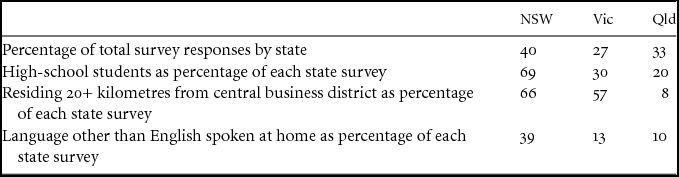
The distinctive features of the NSW data (highlighted in Table 3) are the high percentage of participants who attended high school, resided over twenty kilometres from Sydney's city centre and spoke a language other than English at home – markedly higher than in Victoria and Queensland. These differences are almost certainly due to the higher number of school matinée performances in the NSW case studies. This sample suggests the significant impact that teachers and schools have on bringing a more diverse young audience to the theatre than is found in general-public audiences.
Comparison across the audience samples for the TheatreSpace research
The high proportion of NSW respondents speaking a language other than English at home was notable not only in comparison with the other two states, but also in comparison with other recent cultural-attendance studies in Australia. For example, only 4 per cent of 3,006 participants in the Australia Council for the Arts 2010 arts participation survey spoke a language other than English at home.Footnote 22 The council concluded that Australians born in non-English-speaking countries ‘have significantly lower levels of both creative and receptive participation compared to the total Australian population’.Footnote 23 The most recent Australian Bureau of Statistics (ABS) cultural-attendance survey reported that only 10.6 per cent of immigrants from non-English-speaking countries aged fifteen years and above had attended a theatre performance in the twelve months prior to the survey.Footnote 24 This highlights the fact that our research gave us access to the views of a significantly under-represented group of theatre attenders.
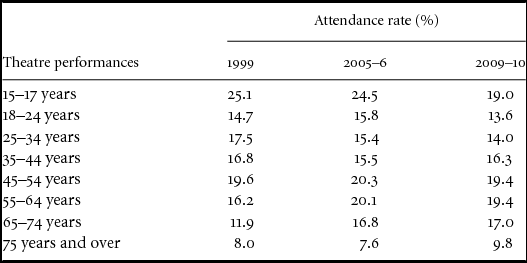
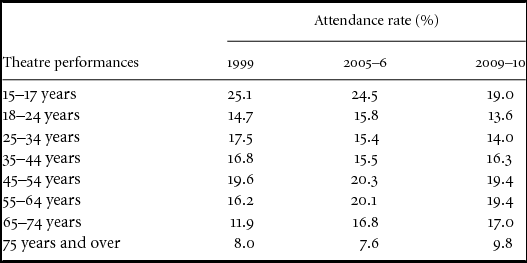
The ABS survey did align with our data in the breakdown of attendance percentages by age range. Those aged fifteen to seventeen years had markedly higher attendance levels than other age groups, as illustrated in Table 4. This suggests that higher attendance levels may be a result of attendance through school excursions and may explain the sudden drop in attendance levels for those over eighteen years. This supports our claim that teachers play a significant role in facilitating access to the theatre for young people from a wide range of cultural backgrounds. Further, it underlines the importance of giving voice to the reflections and insights of these students and teachers.
Theatre attendance by age, based on Australian Bureau of Statistics, Attendance at Selected Cultural Venues and Events (Sydney: ABS, 2010), available at www.ausstats.abs.gov.au/ausstats/subscriber.nsf/0/527DC2F6CB079837CA2577FF0011EC88/$File/41140_2009-10.pdf, accessed 2 March 2013, p. 12
Mainstream theatre productions for mainstream family cultures
The TheatreSpace research in all states affirmed the significant influence that family has on shaping the cultural tastes of young people. The young people who experienced attending theatre as a natural part of their families’ cultural landscape had evolved a language to engage with theatre in nuanced and skilled ways. They often regarded attending as a shared experience and discussions that took place after the performance formed part of their engagement with the work. Group interviews with regular attenders were peppered with excited interjections, confident opinions, engaged listening and camaraderie. Their early memories of attending were most often moments shared with other family members and were redolent with tactile details such as sounds, colour, lighting and the closeness of parents and siblings. These memories were often as much about the closeness of a shared family experience as they were about attending a production. One recollection will serve here as a typical example. A young respondent, Sonya, describes her memory of leaving a production of A Midsummer Night's Dream at the interval:
I was drugged, I loved it so much and dad was like we’ve got to go home, but it was too late and I threw a little kid tantrum and they were all like ‘oh you are tired so you’re throwing a tantrum’ . . . and now he's said that was one of the biggest regrets of his life.Footnote 25
Conversely, respondents with no history of family attendance were often lost for words when asked how they responded to the production they had seen or to theatre in general. Some made explicit connections between their lack of engagement with theatre and the fact that they never attended with their families. Sean explained,
because our parents don't go that much, like they never go to it, so that doesn't influence us to go, so we never really have a theatre experience, so if we never have the experience we can never want to go back again.Footnote 26
A number of participants attributed their families’ lack of participation in theatre to their cultural background. The NSW research team interviewed five respondents, each one on up to three occasions over six months, who came from non-English-speaking backgrounds and who had very little prior exposure to theatre. Many other students from non-English-speaking backgrounds also took part in our school-group interviews. Three brief examples from these interviews will illustrate the comments that made us sensitive to the influence of sociocultural factors on young people's engagement with theatre. Nina attributed her family's non-attendance at theatre to their cultural background in a way that indicated that, as a family, they might lack a sense of inclusion in the cultural traditions of their new home. She explained,
my parents don't speak English, they are from Sierra Leone, they wouldn't ever go to see something like that. I told my mum about it. I was just trying to explain to my mum the difference from my country and this one.Footnote 27
Language barriers also had an impact on Delia and her classmates, who attended a public school on the outskirts of Sydney with a large migrant population. They found the Irish accents in a production of Beauty Queen of Leenane confusing. Delia further explained that she never attended theatre outside school because ‘some people in my family don't even speak English’.Footnote 28 She ‘loved’ the experience of attending and her memories of the production were consistently vivid over three interviews. She wanted to attend again; however, the logistics seemed impossible, let alone getting permission from her parents to travel about fifteen kilometres into the centre of Sydney. She did not know how to access information and was clearly unaware of the large arts complex near the cinema she went to with her friends.
Some young people have an underlying assumption that theatre is not a part of their families’ cultural conversations, as illustrated in Anh's comments at the beginning of this article. Another respondent, Anushka, initially said that the case study production was the first live theatre performance she had attended. She explained that her parents were originally from India and hence they never went to the theatre. Further discussion, however, revealed that Anushka and her family had attended live performances that were connected to the Australian-Indian community, and that she had taken part in at least one performance herself.Footnote 29 Although these performances included acting, Anushka did not classify them as theatre. These responses suggest that some young people may regard theatre as having a set of particular cultural characteristics that do not encompass diverse performance forms such as those that Anushka and her family regularly attended.
Lost in the Chaos of Sounds: the complexity of cultural literacies
The students’ responses and our discussions with teachers reveal the key role that families play in the enculturation of the child. Such replication, of course, aligns with Bourdieu's notion of cultural capital. Yet the cultural influences on the children of migrants in Australia are not consistent because the family and state reinforce different tastes. As one teacher said, for some families the conversation about what their children experience at the theatre ‘becomes a family event rather than a social event’,Footnote 30 whereas for other families the cultural experiences their children have through school excursions are often outside their shared cultural language. This may exacerbate the challenges and confrontations of unfamiliar content and style. In this research the teachers working in schools with significant migrant populations were highly attuned to the cultural sensitivities of their students, although their perspectives varied. Justin taught drama at an outer-suburb public high school. He wanted to expose his students to many different types of theatre. Some of his students found The Beauty Queen of Leenane confronting, especially the scene where the characters partially undressed onstage. Justin's response was somewhat negative, as he stated that many of his students do not understand the concept of storytelling and cannot tell stories from their own cultural traditions. Yet this could be interpreted as his own lack of understanding of the storytelling traditions of his students.
Elizabeth teaches in a public girls’ school with a large Arabic population. She offers an alternative perspective, one that engages with the complexity of cultural literacies:
The speed at which theatre can be delivered at, it's seen as quite daunting to a lot of our ESL [English as a second language] students. Or theatre isn't part of their cultural background in terms of the traditional way that we see it. It's embraced entirely differently in the culture they are from. It's quite interesting because cultural theatre from our girls’ origins, and where they’re from, is very much about culture and very much about revealing who they are themselves, and Australian theatre is so diverse and so broad and it quite often isn't about that at all. And the girls quite often get quite confused by that and they miss the impact of context, they miss the language shifts and it gets quite difficult for them.Footnote 31
Simon, a young enthusiastic theatre attender, offers another perspective on cultural literacy. Simon confidently discussed the multiple layers of meaning in familiar forms of theatre, yet he felt perplexed and was unable to interpret a production of Indian Kathakali that he had recently seen:
I was about to vomit. Like there was drumming behind it, three hours without intermission and there was drumming and there was just like four or five guys just like dancing, but it wasn't just like dancing, they just do like slight movements, like move their cheek and like I didn't get it.Footnote 32
Bourdieu explains that ‘a beholder who lacks the specific code feels lost in a chaos of sounds and rhythms, colors and lines, without rhyme or reason’.Footnote 33 Through Simon we feel a disjuncture of two cultures. This ‘new’ form disturbs the status quo of someone at ease with his own high culture, thus revealing the complexity of cultural literacies and the need for scaffolding a new experience.
Such accounts suggest that cultural providers would do well to reflect on the implications of shifts to the status quo. While Simon had no taste for Kathakali there are many others, particularly from Sydney's large and highly educated Indian community, who do. As Australia's population trends point towards a growing and more educated immigrant population,Footnote 34 there may well be a shift in the tastes of those wanting to participate in their versions of high culture.
The impact of education programmes on theatre attendance patterns
Little attention has been paid in Australia to the impact that theatre-provider education programmes have on bringing people to the theatre who do not typically attend. These programmes’ significant role is in building relationships with schools. For example, they are often linked to access and equity programmes that result in greater diversity in school audiences than would otherwise be the case. Seaman's meta-analysis of audience participation studies distinguished between studies that surveyed existing theatre attenders and those that identified a random sample of the population.Footnote 35 The research reported here was significant in part because it included the views of young people attending theatre through their schools, some for the first time. Many of the participants had never studied theatre and had never attended with their families. These programmes therefore allow theatre providers to reach out to new audiences that more closely represent Australia's culturally diverse population. In achieving this, the education programmes disrupted normative theatre attendance patterns, which draw audiences from a much narrower demographic.
Although many theatre providers would regard these findings as consistent with their own hunches and anecdotal evidence, they have not previously had access to demographic data derived from individual students attending with their schools. The stark demographic differences between school and general-public audiences apparent in the findings clearly demonstrate the effectiveness of provider education programmes in attracting schools and students reflective of the cultural diversity in Australia. However, the research also indicates that providers are not fully leveraging these programmes to build longer-term links with these diverse audiences outside the context of school programmes. As public accountability is increasingly demanded of arts organizations, there may be expectations that theatre providers reflect cultural diversity in all audiences. In relation to this, the findings support the case for strengthening provider education programmes and finding ways for staff to facilitate communication between their organizations and educators, students and parents.
Implications and opportunities
As an industry linkage research project, a major aim of TheatreSpace was to assist theatre providers in their efforts to build stronger relationships with young people. This article questions how broad our concepts of mainstream theatre really are in Australia. Perhaps given our culturally diverse population it is appropriate for our cultural institutions not only to be sensitive to the tastes and needs of those who come from different cultural backgrounds, but also to engage with the opportunities this presents. Here we interpret the implications of our findings and discuss strategies that may assist theatre organizations in their efforts to build new audiences. There are two key areas that warrant further attention: the first relates to how providers can more effectively communicate with young people from diverse cultural backgrounds; the second and more challenging area concerns creative programming and whether more needs to be done to take Australia's growing diversity into account.
The TheatreSpace study demonstrates that provider-education programmes reach a more culturally diverse audience than is the case for general-public programmes. The study also affirmed the strong influence that the family has on the formation of cultural taste in children. Those who attend theatre with their families are more likely to be enthusiastic and articulate in their responses to theatre productions. In contrast, young people who do not identify theatre as being part of their family culture are more likely to feel disengaged and even regard the idea of attending with their families as strange. In considering the significance of family enculturation, the need for providers to effectively establish contacts with the families cannot be overestimated. Therefore this suggests that a significant opportunity exists for providers to reach out to the families of students who attend through education programmes. Yet there is little evidence in this study of providers directly communicating with students and their families. It would make strategic sense for providers to focus on ways to extend their education programmes to include students and parents in ways that complement their work with teachers.
Education programmes and their impacts on audience development have received scarce attention in attendance research, which typically draws on audience data from public programmes, evening audiences or general demographic surveys.Footnote 36 This is surprising given that most of Australia's major arts providers employ at least one staff member, sometimes a whole department, dedicated to education programmes and school liaison. Crucial to the success of these programmes is establishing meaningful links between artistic programme and school curriculum. The large numbers of reattending schools is testament to their success. These links have the potential to be as valued by students and parents as they are by schools. The TheatreSpace research, then, confirms the Arts Council England's ‘Culture on Demand’ report that there is value in emphasizing the educational advantages of theatre attendance to students and parents.Footnote 37 Yet the research also found that many education-programme staff felt constrained, being unable to directly liaise with students and parents as all contact was mediated through the schools. This is understandably a sensitive area. Certainly consideration of strategies for extended contact with parents must be grounded in artistic rather than marketing imperatives. This then brings us to the second key area.
As Jancovich finds in her study on decision-making in arts policy, the ‘consumer deficit’ model used in much audience research regards the education of new audiences as being paramount to increased access.Footnote 38 This model suggests that our cultural values remain somewhat static, and the task for providers is to ensure that their work remains accessible and inclusive despite changing demographics. We argue that the education of new audiences is only part of a solution. Sociocultural shifts in our population will have an impact on our cultural traditions and on the providers of those traditions. Providers therefore also need to educate themselves to adapt to changing times. To do this may require responsive creative programming that can encompass new influences.
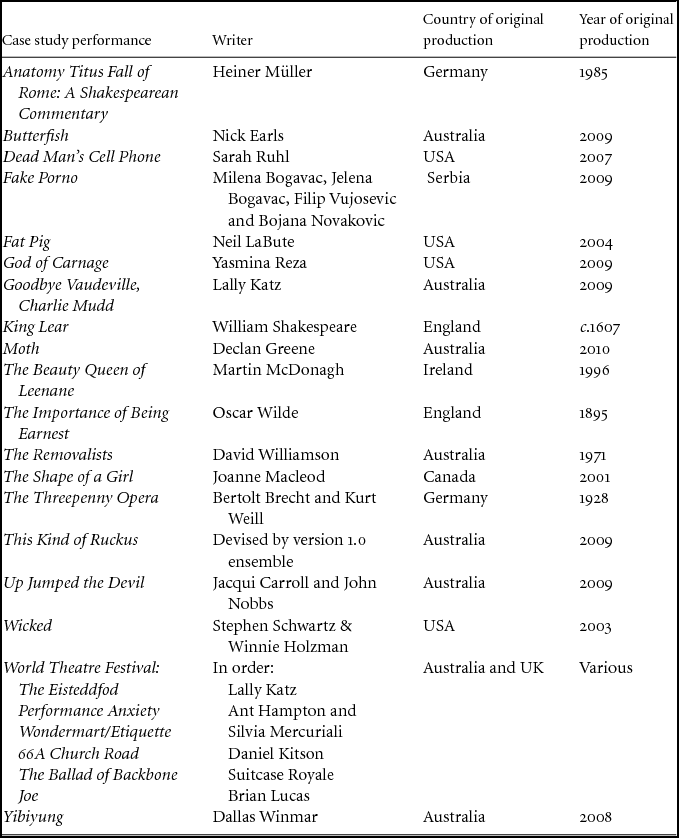
It was somewhat disheartening that the young participants in this research came from such diverse cultural backgrounds and yet by and large regarded theatre as limited to mainstream Western theatre forms. This may have led to a disregard or an under-reporting of cultural performance that was experienced within other cultural communities. Yet this narrow definition is not unsurprising. Our twenty-one case study productions listed in Table 5 were a representative sample of the work of eleven major Australian arts providers. Only one production sourced script, direction and, to some extent, production values from outside a Western theatre tradition. This was the production of Yibiyung, written by Australian Indigenous playwright Dallas Winmar. Another production, Fake Porno, was written by Serbian playwrights Milena Bogavac, Jelena Bogavac, Filip Vujosevic and Bojana Novakovic, and had particular cultural resonance with Queensland's Serbian community. None of the productions reflected Asian or Arabic theatrical traditions or themes, despite the fact that our audience survey found that Chinese, Vietnamese and Arabic were the most common languages spoken at home after English. This finding is consistent with current Australian population trends,Footnote 39 which point towards a growing and more educated immigrant population. This may well result in a shift in the tastes of those wanting to participate in their versions of high culture.
TheatreSpace case study production scripts

Government policy will be critical in shifting the focus of our mainstream cultural institutions. McCarthy et al. highlighted the need for equity policies that support and promote equal access to the arts for minority groups.Footnote 40 While this is necessary, we believe that policy should actively promote and support mainstream-company initiatives to expand their cultural horizons and to programme work that reflects the diverse heritages of our population and develops new forms arising out of this diversity. This is no small task. It will require greater awareness of other traditions, greater understanding of the contemporary work arising out of those traditions and a greater diversity of voices in the creation of work, including artists, playwrights, directors and designers. Rather than commissioning research primarily focused on generating audience demand, government policy must consider how it aligns our mainstream cultural institutions with the demographic shifts in all sectors of our population. As education programmes have successfully introduced to the theatre young people who are not typical attenders, we suggest that funding bodies need to find ways to better access the valuable contribution that these young people could make to changing policy.
In his research into perceptions of ‘liveness’ amongst young theatre audiences, Matthew Reason has written about the significance that a sense of entitlement gives to young people who frequently attend theatre.Footnote 41 Reason argues that young people without a sense of entitlement ‘lack a sense of ownership of both the theatre as a physical entity and of theatre-going as an activity’.Footnote 42 Reason asserts that to encourage the habitus of theatre going, young people have to develop a sense of entitlement. The way to achieve this, he argues, is through ‘presenting work that speaks directly to their world and beyond’.Footnote 43 Unfortunately, much of the audience-development research and resultant policy over the last decade has focused on a limited definition of audience development. This has privileged the perceived economic benefits of educating non-attenders over the potential opportunities for our mainstream cultural institutions to engage in their own education and transformation. Attaching new theatrical initiatives to audience-development strategies that are designed around financial imperatives are often problematic.Footnote 44 The time frames for each are rarely compatible in the context of the dominant culture: new initiatives require a long-term commitment to reconfigure outsiders as insiders, whereas development strategies guided by financial imperatives expect near-term outcomes. The findings of our research demonstrate that school audiences comprise much greater sociocultural diversity than evening audiences and that company education programmes are very effective as an audience-development strategy. However, the research indicates, as do the ABS cultural attendance reports, that the effect is not long-term. In fact one wonders whether the work is not so much speaking to these young audience members as speaking at them.
Towards reimagining practice
This article has identified a clear need for further investigation into the implications of Australia's growing cultural diversity on our mainstream cultural and educational institutions. Few Australian studies directly address audience attendance from the perspective of cultural diversity. Those that do focus primarily on marketing and communications issues with little attention paid to programming.Footnote 45 A number of larger studies, primarily commissioned by governmental arts agencies, have found that those from different cultural backgrounds are under-represented in theatre audiences. However, these studies have not foregrounded this issue or comprehensively addressed its implications in terms of programming. While this article has interpreted a significant and unexpected finding in the TheatreSpace research, this was not the focus of the research and more work needs to be done. In particular, it would be valuable to examine the perspectives of young people and their families who come from different cultural traditions. A significant question is how theatre programmes and arts education curriculums align with issues, values, tastes and aspirations that are important to them. From a positive perspective, our cultural providers have arrived at a point in time with unprecedented opportunities to draw on diverse traditions to expand and renew our mainstream cultural practices.
Over a decade ago in this journal, cultural theorist Joanne Tompkins addressed issues around identity formation in Australian multicultural theatre. She optimistically reasoned that once ‘multicultural drama's preoccupation with multiple configured homescapes’ is inserted into Australia's cultural landscape, ‘a wider-ranging debate about negotiating space, making room, and refiguring ownership over the literal space and the cultural imaginary of Australia’ will ensue.Footnote 46 The research reported here, however, suggests that we have a way to go before our mainstream theatre institutions are able and willing to refigure ownership and reimagine practice.