


Adequate consumption of fruits and vegetables constitutes an important part of recommendations for a healthy diet, is especially important in childhood( 1 ) and contributes to the prevention of some chronic diseases( Reference Hung, Joshipura and Jiang 2 ) and possibly to obesity( Reference Miller, Moore and Kral 3 – Reference Burrows, Janet and Collins 5 ). However, increased consumption of fruits and vegetables could also significantly increase pesticide exposure and may be a health concern( Reference Drouillet-Pinard, Boisset and Periquet 6 ). Children can be exposed to more than one pesticide over one day or even during a single meal as they eat various kinds of fruits and vegetables, and there may be multiple pesticide residues in one food. Some pesticides act by a common mode of action and thus exert a common toxic effect. A single ingested (high) dose of pesticide residues may have adverse effects in children( Reference Hamilton, Ambrus and Dieterle 7 ). There is a need for conducting cumulative risk assessments, because diet has the potential for individuals to be exposed to multiple pesticides which act through a common mechanism of toxicity and synergistic effects may occur at the levels of residues occurring in the diet( Reference Boobis, Ossendorp and Banasiak 8 ).
The methodology to assess cumulative risk assessment has been developing in Europe since 2008 when experts evaluated existing methodologies and new approaches to assess cumulative and synergistic risks from pesticides to human health( Reference Boobis, Ossendorp and Banasiak 8 – 10 ). Recently, a cumulative assessment group for active substances having acute effects on the nervous system in mammals, based on their toxicological profile, has been identified and a group of active substances that inhibit acetylcholinesterase (AChE) has been established( 11 ). According to chemical structure, AChE-inhibiting active substances in pesticides are mostly organophosphorus esters (OP) or N-methylcarbamates (carbamates), widely used as insecticides on various crops. There is a slight difference in the mechanism of action, as OP inhibit AChE irreversibly while carbamates inhibit the enzyme reversibly (minutes to hours)( Reference Colović, Krstić and Lazarević-Pašti 12 , Reference Van Raaij, Ossendorp and Slob 13 ).
There are a number of methods that can be used for cumulative acute risk assessment and in the present study the relative potency factor (RPF) approach was applied. The toxic potencies of compounds within a cumulative assessment group are normalized to an index compound. An index compound should be a compound with an extensive toxicological database and one of the best studied within the group( Reference Wilkinson, Christoph and Julien 14 – Reference Boon and Van Klaveren 17 ). The activity of the mixture is determined by the sum of the potency-normalized doses to yield a total equivalent exposure( 9 , 15 ).
Probabilistic methodology is used to assess the cumulative acute dietary exposure resulting in an exposure distribution. Percentiles of exposure derived from this distribution are compared with a toxicological reference dose (the acute reference dose (ARfD)) of the index compound, to assess if there is a health concern. In the case of cumulative acute dietary exposure, probabilistic modelling is the only tool presently available that can deal with this type of assessment( Reference Boon and Van Klaveren 17 ). With this tool, dietary intake distributions are generated that include the variability in consumption of certain foods within a given population and the variability of the occurrence of substances in the consumed foods. Furthermore, with this tool the effect of uncertainties on the exposure outcome can be quantified. The aim of the present study was to assess the cumulative acute dietary exposure to OP and carbamates among schoolchildren aged 11–12 years as well to estimate the level of health risk that these compounds represent.
Methods
Fruit and vegetable consumption data
Consumption data were based on the Slovene contribution to the PRO GREENS study (www.progreens.org) in 2009/10, which assessed 11–12-year-olds’ consumption of fruits and vegetables in ten European countries (Bulgaria, Finland, Germany, Greece, Iceland, Norway, Portugal, Slovenia, Sweden and the Netherlands) before and after an intervention to promote fruit and vegetable consumption in schools (A Yngve, C Lynch, I Thorsdottir et al., unpublished results). The sample in Slovenia was nationally and regionally representative. The study used cross-sectional data collected at baseline and follow-up data. More detailed methodological issues have been published previously within the PRO CHILDREN project( Reference Klepp, Pérez-Rodrigo and De Bourdeaudhuij 18 , Reference De Bourdeaudhuij, Klepp and Due 19 ). The study was conducted according to the guidelines laid down in the Declaration of Helsinki and all procedures involving human subjects/patients were approved by the National Medical Ethics Committee of the Republic of Slovenia. Written informed consent was obtained from all parents of the children.
In total, 1145 children, 587 boys and 558 girls, and their parents participated in the study on two days, first in May 2009 and second in May 2010. Thus 2290 person-days were available for the consumption data. Consumption of fruits and vegetables in grams was obtained from a validated self-administered 24 h recall questionnaire and individual body weights of children from the parents’ questionnaire (in May 2009). Questions about the consumption of fruits and vegetables and their products (fruit salad, orange juice, cooked vegetables, vegetable salads and vegetable soups) were asked for three different time intervals: (i) before school; (ii) during school time and lunch; and (iii) after school, at supper and after supper. Amounts were designated in terms of the number of slices, portions or pieces eaten. Standard weights were defined for these units for converting them into grams( Reference Haraldsdottir, Thorsdottir and Vaz de Almeida 20 ). Potatoes were not included among vegetables. Food conversion factors and national food-based dietary guidelines for schoolchildren in Slovenia (standard school recipe book) were used to convert dietary survey records of foods as eaten into the corresponding weights of their constituent raw commodities( Reference Hlastan Ribič, Maučec Zakotnik and Koroušić Seljak 21 ).
National monitoring programme for pesticide residue data and relative potency factors
Slovenian authorities regularly perform analyses of pesticides on composite samples of raw commodities destined for human consumption, in order to monitor the occurrence of pesticide residues and to check compliance of raw commodities with the maximum residue limits as set in EU regulation. For the purpose of the current paper, paper national monitoring results for 2009–2011 were filtered for OP and carbamate pesticides and their metabolites that have AChE-inhibiting mechanism of action( 11 ) and levels above the limit of quantification (LOQ) in 2009–2011 in Slovenia (acephate, azinphos-methyl, chlorpyrifos, chlorpyrifos-methyl, dimethoate, ethion, fenamiphos, fenitrothion, methiocarb, methomyl, oxamyl, phosmet, pirimicarb, tolclofos-methyl).
The pesticide residue data available for use in dietary exposure assessment are typically from monitoring programmes and relate to composite samples (e.g. apples are analysed in samples consisting of twelve units each)( 22 , Reference Boon, van Donkersgoed and Christodoulou 23 ). The measured values represent the average of a number of units and may not reflect higher concentrations of pesticides in actually consumed portions of a fruit or vegetable (e.g. one unit). To take into account the full range of variation occurring in individual units, which needs to be considered for acute assessment, we used fixed unit variability factors in our calculations( 24 ).
RPF shown in Table 1 were derived from the literature and considered the benchmark dose at 10 % AChE inhibition (BMD10) in either brain or red blood cells or the no observed adverse effect level (NOAEL)( Reference Boon, Van der Voet and Van Raaij 25 ); RPF of fenamiphos was derived from the lowest observed adverse effect level (LOAEL) for AChE inhibition in red blood cells( 15 ).
Relative potency factors (RPF) applied in the cumulative assessment
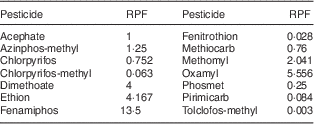
The cumulative acute assessment of selected pesticides was calculated with acephate as index compound. The residue concentration for a pesticide was multiplied by the RPF value for this substance to obtain an equivalent content of the acephate. For concentrations below the LOQ, this limit value was used in the calculations.
Linking food consumption and concentration data for cumulative exposure
The cumulative acute probabilistic exposure assessment was performed using the Monte Carlo Risk Assessment program (MCRA 7·1). MCRA is a web-based program developed by Biometris, Wageningen University and Research Centre for RIVM (National Institute for Public Health and the Environment), the Netherlands. It can be used by registered users by uploading their own input data, such as consumption and concentration data. It quantifies dietary exposure to chemicals as a distribution by combining data on food consumption with data on concentrations of chemicals in foods( Reference De Boer and Van der Voet 26 ).
The cumulative acute dietary exposures to OP and carbamates were calculated both per day and also within a narrower time interval, during school time and at lunch, in order to address a potential overestimation of daily exposure regarding reversibility of AChE inhibition of carbamates in comparison with OP. The variety of fruits and vegetables consumed during school time and at lunch are substantial and the pesticide exposure is the most likely.
Individual consumption patterns for daily consumption and for consumption during school time and at lunch were selected from the food consumption database. Consumption patterns were multiplied with randomly selected equivalent residue levels from the concentration database and expressed per kg body weight. Exposures were performed with 100 000 iterations, adjusted for the individual body weights and specified at percentiles P50, P95, P99, P99·9 and P99·99. The P99·9 was compared with the acute reference dose for the index compound acephate (ARfD, 100 µg/kg body weight per d) and used as a reference point for health risk( 27 ). Uncertainty relative to the limited size of the underlying data sets was addressed with bootstrapping methodology; the assessment was repeated multiple (100) times, each time with resampled data sets (concentration data, consumption data) from the original database( 22 ).
Results
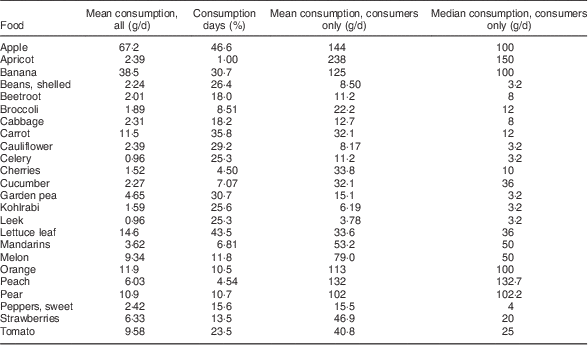
A summary of the fruit and vegetable consumption data from the national survey is presented in Table 2. The highest mean consumption levels were for apples, bananas, oranges and pears among fruits and for lettuce, carrots and tomatoes among vegetables. The highest percentage of consumption days were seen for apples and lettuce. Mean reported body weight of children was 41·5 (sd 9·1) kg.
Fruit and vegetable consumption data for schoolchildren (n 2290) aged 11–12 years, Slovenia, PRO GREENS study, 2009/10
A total of 1620 samples of fruits and vegetables were analysed for pesticides in the period 2009–2011, including OP, carbamates and their metabolites. The organophosphorus pesticide chlorpyrifos was the most frequently detected pesticide residue. At least ten samples were present per product for all selected pesticide residues, least were for kohlrabi (n 10) and beetroot (n 15) and most for apples (n 219) and lettuce (n 236). The distributions of the pesticide residue levels were highly left censored, with the majority of concentration levels being below the LOQ (99 %) and with a few high values in the database. The proportions of quantified positive levels of pesticide residues in samples were 4·0 % for mandarins, 3·5 % for cherries, 2·9 % for apples, 1·7 % for oranges and 1·5 % for pears; others were under 1 %. The highest residue value quantified was 0·54 mg/kg for the carbamate pesticide dimethoate in mandarins.
There were twenty-two samples (0·7 %) with multiple residues (maximum of three, combination of two predominant) of selected OP and carbamates; among them the combinations chlorpyrifos/pirimicarb and chlorpyrifos/phosmet were found the most often. Multiple residues were found in samples of apples, peaches, mandarins, oranges and cabbage. Mean concentrations of selected pesticides in the samples ranged from 7×10⁻⁴ µg/kg in carrots to 2·9 µg/kg in mandarins, expressed as acephate.
Table 3 shows the percentiles of the distribution of dietary exposure to OP and carbamates in the total population of children, including the 95 % confidence interval. The cumulative exposure amounted to 8·3 % of the ARfD (100 µg/kg body weight per d) at P99·9 for daily intake and 4·5 % of the ARfD at P99·9 for intake during school time and at lunch. Fruits and vegetables that contributed most to the total acute exposure distribution of the OP and carbamates during the day and during school time and at lunch are listed in Table 4.
Cumulative acute exposure to organophosphorus and carbamate pesticides with acephate as index compound among schoolchildren (n 2290) aged 11–12 years, Slovenia, PRO GREENS study, 2009/10

Contribution (percentage per product to the total distribution) to the acute exposure to organophosphorus and carbamate pesticides from the top twelve foods consumed during the day and during the school time and at lunch, using acephate as the index compound, by schoolchildren (n 2290) aged 11–12 years, Slovenia, PRO GREENS study, 2009/10

Discussion
Results of our study showed that the highest daily intake reached a maximum of 10·6 µg/kg body weight per d (upper band of the 95 % CI at P99·9), which represents 11 % of the ARfD for acephate as index substance in the assessment. The estimations demonstrated that acute cumulative dietary exposure to selected OP and carbamates is not a health concern for schoolchildren with the assessed dietary patterns of fruit and vegetable consumption. The highest contribution to the total intake was, however, seen for apples and bananas, which are important sources of fruit in schoolchildren’s diet in Slovenia. Among vegetables, lettuce and carrots contributed most, especially during school time and at lunch. The exposure to multiple chemicals occurred mostly due to the fact that children consume different fruits and vegetables per day, although we found a small number of samples with multiple residues of different pesticides in the same fruit or vegetable.
Ideally, risk assessment for chemicals, whether individually or in combination, should consider all sources (plant protection products, veterinary drugs, human medicines), pathways (food, drinking-water, residential, occupational) and routes (ingestion, dermal, inhalation) of exposure that could contribute materially to a person’s total exposure. In the present paper only a group of plant protection products (OP and carbamate pesticides) available via food (fruit and vegetables) through ingestion was estimated. Cumulative risk assessment for carbamates carried out by the US Environmental Protection Agency concluded that exposures through the food pathway predominated( 16 ); however, in the cumulative risk assessment for OP carried out by the Agency, residential exposure was significant( 15 ). Appropriate data on levels of pesticide exposure from other pathways and other sources in Slovenia are not available and further work is required. So far only dietary intake of the substances cadmium, lead and mercury via food for the general population has been assessed in Slovenia( Reference Erzen, Ursic and Bosnjak 28 ).
To address the cumulative exposure to compounds that can be simultaneously present in more than one food and to estimate the exposure for the total population of schoolchildren (consumers and non-consumers of particular fruits and vegetables), we used the probabilistic approach. It introduces more realism by using distributions to represent the range of variation in consumption and residues. In the present paper we used national consumption data from the PRO GREENS project which was not purposely designed to address dietary exposure issues. Data were collected with a methodology (24 h recall) which meets the guidance of the European Food Safety Authority on the use of probabilistic methodology for modelling dietary exposure to pesticide residues( 22 ). It is the only food survey available at national level for schoolchildren in Slovenia. The dietary consumption survey PRO GREENS collected data on foods ‘as eaten’ and not on their component parts (e.g. tomato salad, vegetable soup) and pesticide residue monitoring programmes collect data on raw agricultural commodities (e.g. apples, tomatoes, etc.). Therefore, it was necessary to use national recipes to convert ‘as eaten’ foods to a food commodity basis. Data were collected on two independent days, both in springtime. For this reason, some items were not present in the consumption database, for example spinach or table grapes, which can frequently contain elevated levels of OP and carbamates.
Processes such as washing, peeling, cooking and juicing may decrease or increase the concentrations of pesticides in food( 29 ). Therefore concentrations in the consumed food may be different from concentrations in the food as measured in monitoring programmes (typically raw food). Fruits and vegetables in the diet of our schoolchildren were consumed raw (also in salads) and cooked (salads, vegetable soup). For all these processes processing factors are equal to or lower than 1, so processing factors (defined as the ratios between concentration in processed and unprocessed foods) were not applied in the calculations and that turned out to be justified, since the calculated exposure is low.
It is common that residue data contain a proportion of concentrations that are reported only as being below a given limit, which is referred to as the LOQ in the current paper. The proportion of values below the LOQ can be very high in monitoring data (99 % in our paper). A conservative (pessimistic) way of calculation was applied, thus treating all no detection samples as below the LOQ, although in pesticide/crop combinations for which there is no registered use in their region of production, monitoring results showing no detection could be treated as true zeroes (optimistic model)( 22 ).
For cumulating toxicity of OP and carbamates, acephate was used as index compound. The RPF for a group of compounds with the same mechanism of toxicity should be calculated based on the same toxicological end point and in the case of OP and carbamates this is the ability to inhibit AChE in plasma either in brain or in red blood cells. The output from using different index compounds can be slightly different and thus difficult to compare. Jensen et al.( Reference Jensen, Petersen and Christensen 30 ) reported cumulative acute exposure to OP and carbamates using the two index compounds chlorpyrifos and methamidophos, and calculated 1·8 µg/kg body weight per d and 0·93 µg/kg body weight per d, respectively, at P99·9 for children up to 6 years old. Caldas et al.( Reference Caldas, Boon and Tressou 31 ) used acephate as index compound and reported intake of 84·5 (sd 12·2) µg/kg body weight per d at P99·9 for children of the same age as in the previous study. Boon et al.( Reference Boon, Van der Voet and Van Raaij 25 ) used acephate as index compound for a group of OP only and reported an intake of 57 (95 % CI 35, 143) µg/kg body weight per d at P99·9 for children from 1 to 6 years of age. Calculated cumulative intake of our study was 8·3 (95 % CI 1·6, 3·0) µg/kg body weight for daily exposure and lower, 4·5 (95 % CI 0·75, 1·3) µg/kg body weight, at P99·9 in the time frame during school and at lunch for 11–12 year-old children. Apples contribute most to the total intake of AChE-inhibiting pesticides in both scenarios (29·6 % and 24·8 %), following contributors are bananas (17·2 % and 14·4 %). The highest apple and banana contribution is greatly due to high consumption, since there are no values above the LOQ for banana samples in the concentration database. Lettuce and carrots are the highest contributors among vegetables, again mostly due to a high consumption.
Conclusions
Despite uncertainties and use of a conservative approach, results showed that the cumulative acute exposure via fruits and vegetables is well below the ARfD for acephate as index compound at the 99·9th percentile. In our study we calculated that there is no cumulative acute risk from the majority of AChE-inhibiting pesticides in fruits and vegetables for schoolchildren in Slovenia. Pesticides which we selected in our calculations represent the most frequently used pesticides in production of fruits and vegetables. There might be also other pesticides present, which would have to be assessed, so as to take into account acute and chronic exposure, regarding their outcome to the children’s health. However, given the very low exposures reported here, there is presently no reason to reduce the consumption of fruits and vegetables because of the presence of pesticide residues. Intervention programmes and policies for schoolchildren should therefore not hesitate to emphasize increased consumption of a variety of fruits and vegetables given their known benefits for health. This includes school activities and integrated measures within policies with systemic measures for healthy nutrition.
Acknowledgements
Acknowledgements: The PRO GREENS project was made possible with financial support of the Programme of Community Action in the Field of Public Health 2003–2008 of the European Commission. The authors thank the participating children, their parents, the schools and all the staff who have worked on the PRO GREENS project. Financial support for the Slovenian study group was provided by the Ministry of Health of the Republic of Slovenia and support of the Slovenian Research Agency (P3-0395: Nutrition and Public Health). Financial support: This work was supported by the Programme of Community Action in the Field of Public Health 2003–2008 of the European Commission (A.Y., C.H.R.) and by the Ministry of Health of the Republic of Slovenia (U.B., I.E., C.H.R.). The grants are estimated at €50 000. Conflict of interest: The authors declare that they have no conflicts of interest. Authorship: U.B. contributed to conception and design of the study, acquisition of national concentration and food consumption data, analysis and interpretation of data, drafting the article and final approval of the version to be published; A.Y. contributed to conception and design of the food consumption study, revising the article critically for important intellectual content and final approval of the version to be published; I.E. contributed to revising the article critically for important intellectual content and final approval of the version to be published; C.H.R. contributed to conception and design of the food consumption study, acquisition of national food consumption data, interpretation of data, revising the article critically for important intellectual content and final approval of the version to be published. Ethics of human subject participation: The study was conducted according to the guidelines laid down in the Declaration of Helsinki and all procedures involving human subjects/patients were approved by the National Medical Ethics Committee of the Republic of Slovenia.



