Introduction
Microstrip antennas have become a necessity in today's times, owing to their small size and ease of manufacturing. Many different designs are made to increase the radiator electrical path so that the signal strength of the antenna is good. This widespread usage has demanded the development of suitable antennas to be used in the UWB systems. Various designs have been presented for the ultra-wideband, such as curved slot, printed circular ring, triangular-shaped, circular, rectangular, “U”, and “L” shaped and printed semi-circular slots [Reference Mishra, Verma, Yashwanth and Singh1–Reference Srivastava, Baudha and Yadav6]. The antenna called as a defective ground structure by making slots in the ground plane, resonates with lower oscillations is reported [Reference Chakraborty, Rana, Sarkar and Das7]. Two resonant bands are obtained by trims slots in the structure, rectangular patch, and attaching circles in the backplane [Reference Ghosh, Ghosh, Ghosh and Chattopadhyay8, Reference Baudha and Yadav9]. UWB spectrum is reported by adding a corrugated structure and by adding a half-curved element slot in the radiator [Reference Baudha and Yadav9, Reference Abdelraheem and Abdalla10]. Small-fractal elements are added to the structure, and multiple slots are also introduced to enhance the bandwidth [Reference Fallahi and Atlasbaf11, Reference Awad and Abdelazeez12]. A unique method is used to the truncated backplane with an extended patch for improved performance as reported [Reference Basak, Manocha, Baudha and Yadav13]. Linear polarization pattern has been achieved; by extending the circular patch with PGP (partial ground plane) and cutting a rectangular element [Reference Yadav and Baudha14, Reference Deshmukh, Singh, Zaveri, Gala and Ray15]. UWB spectrum applications have been reported due to; trimming semi-circular shape slots in the ground plane, making a modified patch element with the defected backplane [Reference Hota and Mangaraj16, Reference Baudha and Yadav17]. Planar radiator with a unique shape like “Dumbbell Shaped” planar antenna and a flexible radiator are reported [Reference Garg and Baudha18, Reference Lakshmanan and Sukumaran19]. Increasing the signal path by making a rectangular strip and slot in defective backplane for stable pattern is reported [Reference Mangaraj, Hota and Varun Yadav20]. Balanced radiation pattern has been achieved; by a modified patch with PGP backplane and properly cutting a circular slots on the backplane in planar antenna [Reference Hota and Mangaraj21, Reference Golait, Varun Yadav, Patil, Baudha and Bramhane22]. Higher frequencies were achieved by adding rectangular plates at the edges as reported [Reference Mazinani and Hassani23]. High gain is achieved by designing Slotted circular fractal antenna [Reference Samyuktha, Das, Mishra and Behera24]. Large impedance is reported by cutting wide-slot cone from front-side antenna [Reference Cheng, Hallbjorner and Rydberg25]. The lower band starts resonating by making L-shape strip as reported [Reference Kim and Yun26]. The main objectives of the presented antenna are useful for the ultra-wideband applications, which exhibits a return loss from 2.3 to 11 GHz with an 8.7 GHz central frequency and has 130% impedance bandwidth. The peak gain is achieved at 9.8 GHz with a value of 2.67 dBi and the peak radiation efficiency is observed at 9.2 GHz with a value of 0.851 or efficiency of 85%. Proposed design antenna configuration, four stages of development, and their return loss (magnitude of S 11) of the “flower-shaped” antenna and variation in radiation loss (S 11) of the antenna (A) “a” parameter, (B) “b” parameter, (C) “c” parameter with various simulated and measured results are discussed in other sections.
Design principle and structure
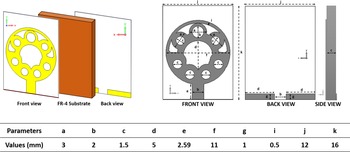
Figure 1 shows the “flower-shaped” structure's configuration with labeled parameters. The optimum size of the designed structure is 12 mm × 16 mm × 1.6 mm. FR4 substrate is used to etch out structure with a (4.3) dielectric constant, and (0.025) loss tangent. The FR4's upper layer is copper (annealed) with a conductivity of 5.8 × 10⁷ S/m. The relative bandwidth [Reference Wu, Wang, Xie and Niu27] of the designed structure is 130%, with a central frequency of 8.7 GHz (2.3 to 11 GHz). The “flower-shaped” structure's length is represented by “j” and width by “k”. “c” is the thickness of the FR4. The design of the patch is a flower-shaped structure developed from a simple circular patch antenna.
The optimum dimension and configuration of the proposed “Flower-shaped” antenna.

To develop a flower shaped structure, firstly, the circular shape of a simple patch antenna is converted to a flower frame by etching out a circular shape from inside. “a” represents the diameter of the circular shape. The properly etched out and reduced ground makes a partial ground-plane (PGP) and is denoted by “dxg”. One rectangular slot of length “b” and width “g” is cut into it. This rectangular slot is properly adjusted on both sides of the rectangular elements of the ground plane, which helps to match the impedance in the desired band. The design is further developed by creating a flower shaped geometry inside the frame. In addition, several circular slots with diameters of “b” and “c” are etched inside the main patch. Then the slots with the shape of a “d” were added in the center of the main patch, these slots helped the structure to resonate at lower frequencies.
This flower shaped structure is fed by 50 Ω microstrip line with a width of “b” and length of “e”. All the other dimensions with their optimum dimensions are shown in Fig. 1.
Development of antenna
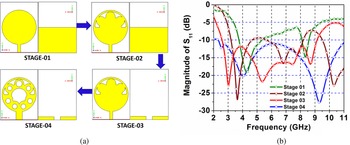
Figure 2(a) shows the 04-stage development of the designed radiator. The “flower-shaped” antenna development was done by using Computer Simulation Technology (CST) software.
(a) Four stages of development, (b) The simulated return loss (magnitude of S 11) of the “flower-shaped” antenna.

Figure 2(b) shows the reflection coefficient (magnitude of S 11) of the suggested antenna. Stage-01 shows a simple circular patch with a fixed ground plane. A circular element with a diameter of 11 mm is being fed through a “2 mm × 2.59 mm” microstrip line. The length of the backplane is 8 × 16 mm2, producing dual-band resonances from 3.7 to 5.4 GHz and 8.2 to 8.6 GHz. Stage 02 shows the revision of the front patch. This is done by turning the circular patch into a flower frame of diameter 3 mm by cutting circular grooves from the inside of the upper circular patch. Due to this, the triple band is resonating from 3.2 to 4.6 GHz, 5.7 to 8.2 GHz and 9.5 to 11 GHz. Stage 03 shows modifications done in the ground plane. A plane is reduced from 8 mm to 1 part. This helped reduce the lower and upper bands of the operating frequency range from 2.6 to mm and a slot is cut out in the partial ground patch, of width 2 mm and length 1 mm, at the lower 9.2 GHz.
Stage 04 is the proposed structure. The development is finalized by making multiple slots in the main patch. Two circular slots “b” and “c” are cut into the plane with diameter of 2 mm and “1.5mm”. There is an additional cut out of 5 mm in the geometry. These slots are in the main patch and help extend the lower and higher limits of the operating range to more than 8.7 GHz (2.3 to 11 GHz).
Parameter study of antenna
We have conducted a parametric study to optimize the parameters that could affect the (S 11) results during the design of the radiator. We have discussed the 03-parameter variations and optimized the design on this basis taking into account their effect on the reflection coefficient (magnitude of S 11) results.
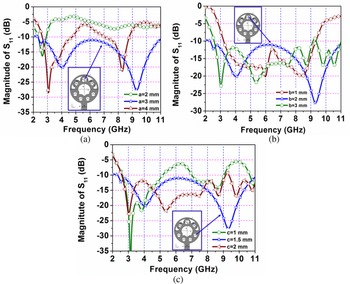
Figure 3(a) shows the variation in the reflection coefficient (S 11) of the designed antenna denoted by “a” parameter, it varied from 2 to 4 mm. “a” is the diameter of the upper circular patch. When “a” is small the radiator is not in optimal performance from 2.9 to 11 GHz. Due to the variation of parameter “a”, there is impedance matching, and the reflection coefficient curves show a large value of the return losses. Based on this observation, we conclude that the optimized result (reflection coefficient) is obtained when the diameter is fixed at 3 mm.
Simulated variation in radiation loss (S 11) of the antenna (a) “a” parameter, (b) “b” parameter, (c) “c” parameter.

Figure 3(b) shows the variation of the reflectance coefficient curves with variation in “b”, varying from 1 to 3 mm. “b” is the diameter of the upper circular slot. When it's at 1 mm, the results are only helpful from 3.2 to 9.2 GHz. If the size is 3 mm, the results are better but still not usable across the range. Thus optimized results are obtained at 2 mm.
Figure 3(c) shows the variation of reflection coefficient curves with “c” parameter. “c” represents the diameter of remaining circular slots. “c” ranges from 1 to 2 mm. By changing the dimensions of the diameter slots cut into it. The size of “c” is kept at 1 mm; the radiator is helpful for dual bandwidth from 2.7 to 5 GHz and from 7 to 9 GHz. The size of “c” is increased, observed bandwidth of 2.7 to 9.2 GHz at 2 mm. mainly, in this case, impedance mismatching is visible at higher frequencies. Thus the optimized results are seen at 1.5 mm.
Results
The presented structure is a low-profile UWB antenna. A modified patch antenna with a PGP plane of optimum length operates in the range from 2.3 to over 11 GHz. A unique “flower” shaped design in patches with multiple slot elements helped to further enhance the upper and lower bound. Multiple circular slots in the main patch along the PGP plane help to match the impedance across the working band.
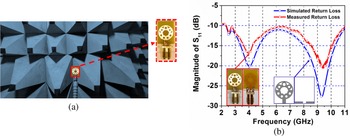
Figure 4(a) shows the “flower-shaped” (stage-04) antenna measurement setup in an anechoic chamber. The “flower-shaped” antenna testing and measurement are conducted with (VNA) and a 50Ω (SubMiniature) A-type connector attached to a microstrip line. Figure 4(b) shows the coefficient of reflection (S 11) curve. Both simulated and measured curves are in good agreement, except for a slight resonance shift at the mid frequencies.
(a) Testing setup in an anechoic chamber, (b) simulated and measured reflection coefficient (S 11).

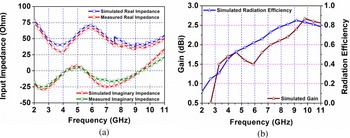
Figure 5(a) shows the simulated and measured real i/p and imaginary i/p impedance of the structure. As one can see from the above figure, the real part of the antenna hovers around 50 ohms in the operating range, i.e., between 2.3 and 11 GHz. The real part of the impedance varies from 35 to 70 ohms, the imaginary part of the impedance varies from −30 to 10 ohms. It shows us that the impedance can behave as a capacitive impedance for some frequencies. The imaginary part is negative and can act as capacitive impedance for other frequencies where the imaginary part is positive. There is also a mismatch of impedance at the frequencies where the antenna doesn't have the required return loss. Both simulated and measured curves are in good agreement.
(a) Simulated and measured input impedance curve, (b) Gain and radiation efficiency of the “Flower-shaped” antenna.

Figure 5(b) shows the variation of the simulated and measured antenna efficiency and gain curve. Peak gain is achieved at 9.8 GHz with a value of 2.67 dBi and the peak radiation efficiency is observed at 9.2 GHz with a value of 0.851 or efficiency of 85%. Both simulated and measured curves are in good agreement. As visible from the graph, the antenna efficiency gradually decreases while the frequency increases as the ohmic loss increase at higher frequencies.
Table 1 shows an outcome comparison between the “flower-shape” structure and previously published printed antennas with respect to various parameters by comparing all parameters. According to the table, our presented antenna is suitable for ultra-wideband. The proposed structure aims to design a compact-sized printed antenna, which is easy to printed and capable of transmitting UWB signals from (2.3–11 GHz).
Comparison between the “flower-shaped” structure and earlier published printed antennas

Bold text in table associated with the proposed one while rest are the previously proposed changes.
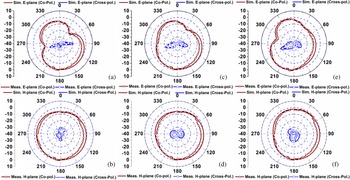
Figure 6 show the Co-pol., and Cross(X)-Pol. Radiation patterns at 03 different frequencies (4, 6 and 9.2 GHz). The radiation pattern is defined as H-plane by Φ = 0, X-Z plane, and E-plane by Φ = 90, Y-Z plane. Stable Omnidirectional H-plane & Bi-directional E-plane radiations patterns are obtained at 03 different frequencies, 4/6/9.2 GHz. At all frequencies, the antenna is very efficient, and therefore the radiation patterns are stable.
Simulated and measured radiation pattern of “Flower-shaped” antenna.

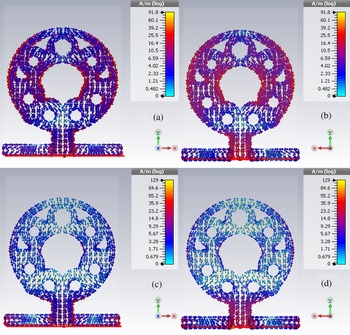
Figure 7 shows the 3D-vector current distribution at two different frequencies (4 and 9.2 GHz). Figures 7(a) and 7(c) shows the front view, and Figs 7(b) and 7(c) shows the backplane of the structure. We can replace the antenna with the equivalent surface currents on its body, and the resulting radiated field will be similar to the one radiated by the antenna. Therefore, the surface current can help us see the radiation without the help of the primary source of current.
Simulated 3-D surface current distribution of “Flower- shaped” antenna.

Conclusion
A compact flower shaped printed antenna for the ultra-wideband spectrum is proposed. The suggested “flower-shaped” structure is measured and investigated. The optimum dimensions of the designed antenna structure are 12 × 16 × 1.6 mm3. The structure shows excellent stable radiation pattern. The 3D-vector surface current distribution shows good signal strength. The 3D-vector surface current distribution shows good signal strength. The peak gain is observed to be 2.67 dB and its antenna efficiency to be 85%. The relative bandwidth of the proposed structure is 130%, with a central frequency of 8.7 GHz (2.3 to 11 GHz). It is compact, low signal distortion, and suitable impedance matching over the UWB frequency. It can also be used for the (Wi-Fi-2.4 GHz), (WiMAX-2.5/3.5/5.5 GHz), (WLAN-2.5/5.2/5.8 GHz) and satellite communication at 4/6 GHz, among other UWB communications.
 Manohar Golait obtained his B.E. degree in electronics engineering from Manoharbhai Patel Institute of Engineering and Technology, Gondia (India) in 2006 and received his M.Tech degree in electronics engineering from Bapurao Deshmukh College of Engineering, Sewagram (India) in 2016. He has been pursuing his Ph.D. degree from the Department of Electronics Engineering, G H Raisoni University, Saikheda (India) since 2020. His field of interest are microstrip antenna, microwave engineering.
 Dr. Mahendra Gaikwad is an professor & head, Department of Information Technology, G H Raisoni College of Engineering, Nagpur and project director of GHRC's Nano-Satellite Program having the primarily objective to develop & launch nano-satellite, he did his BE in electronics engineering. He did his M. Tech in communication engineering from Indian Institute of Technology (IIT), Bombay in 1998. He did his Ph.D. on “Network -on-chip architecture using perfect difference network topology” from VNIT, Nagpur. He has published 112 research papers in various International and National Journals & Conferences. He has delivered more than 75+ expert lectures, keynote address in various International & National Level Conferences. He is also the recipient of prestigious National Award “Rashtriya Vidya Saraswati Purskar” for outstanding achievement in the field of engineering & technology. His research areas of interest are network-on-chip architecture, perfect difference network topology, signal processing, DIP & speech analysis and synthesis.
 Dr. Balasaheb H. Patil obtained his bachelor's degree in electronics & telecommunication engineering from Saitribai Phule Pune University, Pune in year 2001. He obtained M.E. E&TC (microwave communication) in year 2010 from Saitribai Phule Pune University, Pune. He received Ph.D. E&TC in year 2020 from Saitribai Phule Pune University. His Ph.D. thesis is in the area of image inpainting in electronics & telecommunication engineering.
 Manish Varun Yadav is an assistant professor in the Department of Aeronautical and Automobile Engineering, Manipal Institute of Technology, Manipal Academy of Higher Education, Manipal, Karnataka, he obtained his B.E. degree in electronics and communication engineering from Government Engineering College, Ujjain (India) in 2007 and obtained his M.E. degree in digital communication from Rajiv Gandhi Proudyogiki Vishwavidyalaya, Bhopal (India) in 2011. Ph.D. degree from Department of Electrical & Electronics Engineering, Goa Campus, BITS, Pilani, (India) in 2022. His fields of interest are microstrip antenna, planar antenna. He is a life member of India Society of Technical Education (ISTE), and member of institute of electrical and electronics engineers (IEEE).
 Dr. Sudeep Baudha is an assistant professor in the Department of Electrical and Electronics Engineering, BITS Pilani, K K Birla Goa Campus, India. He obtained his M. Tech degree in radio frequency and microwave engineering from Indian Institute of Technology, Kharagpur (India) in 2009 and Ph.D. degree from Indian Institute of Information Technology Design and Manufacturing (IIITDM), Jabalpur (India) in 2016. His fields of interest are microstrip antenna, planar antenna, microwave communication etc. He is also associated with several research journals as a reviewer. He is a member of institute of electrical and electronics engineers (IEEE).
 Dr. Lokesh Kumar Bramhane is an assistant professor in the Department of Electronics and Communication Engineering, National Institute of Technology, Goa, India. He worked as an assistant professor in the electronics and telecommunication engineering department of G H Raisoni College of Engineering, Nagpur, (India). He obtained his B.E. degree in electronics and telecommunication engineering from the Shri Govindram Seksaria Institute of Technology and Science, Indore, (India) 2007. He obtained his M-Tech degree in VLSI & embedded system design from NIT Bhopal in 2012 and Ph.D degree from PDPM Indian Institute of Information Technology Design and Manufacturing (IIITDM), Jabalpur, (India) in 2017. His fields of interests are semiconductor devices, biosensors, IC design, antenna design & fabrication and nanowires.