INTRODUCTION
Ecosystem services are, in the broadest terms, the benefits that humans derive from nature (Daily Reference Daily1997; MA [Millennium Ecosystem Assessment] 2005). Increasing recognition that both biodiversity and the ecosystem services that natural areas of the world provide to people are under threat has led to widespread promotion and implementation of strategies that seek to align conservation and human development (Tallis et al. Reference Tallis, Goldman, Uhl and Brosi2009). Payments for ecosystem services (PES) schemes are intended to have users of environmental benefits compensate those who bear the costs of producing them (Wunder Reference Wunder2007). For example, upstream landowners who conserve forests, thereby maintaining or enhancing water quality for downstream water users, would be compensated by those users for the lost economic opportunities associated with retaining forests. In this way, incentives to conserve environments that provide public benefits are given to landowners whose private economic interests would otherwise dictate conversion of habitat to more profitable land uses.
Namibia's national community-based natural resource management (CBNRM) programme officially began with legislation (Act No. 5, Nature Conservation Amendment Act of Nambia) passed in 1996 that allowed the formation of communal conservancies, areas of customary land tenure in which local communities were granted the rights to benefits derived from natural resources such as wildlife and plant products (Barnes et al. Reference Barnes, MacGregor and Weaver2002). The programme followed on pioneering work in north-west Namibia by individuals and non-governmental organizations (NGOs) who had developed a programme of investing local community game guards with the protection of endangered wildlife such as the black rhino (Diceros bicornis) (Holmes Reference Holmes1992). Since its inception, the CBNRM programme has stressed the devolution of benefits and management responsibilities to local communities, and has operated to support communities in empowering themselves via natural resource management (NACSO [Namibian Association of Community Based Natural Resource Management Support Organizations] 2008).
In this paper, we re-examine Namibia's CBNRM programme, which has always been viewed as a community-based conservation effort, from a PES perspective. A recent and widely-accepted definition of PES suggests that a PES programme comprises a voluntary transaction where an ecosystem service (or land use that produces such a service) is bought from at least one seller by at least one buyer, subject to the verifiable provision of the service in question (Wunder Reference Wunder2007). A review of putative PES schemes found that many did not perfectly conform with the definition above, including even flagship cases such as Costa Rica's and China's Sloping Land Conversion programme (Wunder et al. Reference Wunder, Engel and Pagiola2008). It therefore becomes a judgment call as to whether any particular programme being evaluated according to the criteria above is called a PES programme or, should they fail on some criteria, whether they are simply a ‘PES-like’ programme (Wunder> et al. Reference Wunder, Engel and Pagiola2008). Here we compare and contrast Namibia's CBNRM programme with the five elements of an idealized PES scheme: sellers, buyers, ecosystem services, voluntary nature of the transaction, and conditionality.
In addition to the five elements that define a PES scheme, we address for the Namibia case other important considerations that surround PES programmes. A major concern is additionality, which refers to the net effect of payments on outcomes. In cases where making a payment to ecosystem service providers does little to change the provision of services as compared to what would have happened in the absence of a payment, the programme is said to lack additionality. To measure additionality, it is necessary to quantify the baseline conditions that exist at the time of programme implementation, and to estimate what would have happened to the provision of the ecosystem services in question had the PES programme not occurred (the ‘counterfactual’). Counterfactuals are often difficult to estimate and it may be unclear or difficult to select from competing counterfactuals (Wunder Reference Wunder2007).
Furthermore, start-up costs, the mode of payments to service providers, and the possibility of perverse incentives arising in response to PES programmes have all been identified as key issues affecting the likelihood of programme success. Start-up costs of PES programmes can be extremely high, and the mode of payment to recipients can affect the degree of welfare gains from the programme in question (Wunder Reference Wunder2007; Wunder et al. Reference Wunder, Engel and Pagiola2008). Critics of PES schemes have suggested that paying landholders to conserve ecosystem services can lead to perverse incentives, whereby a person's (or community's) inherent ethical or moral reasons for conservation may be replaced by a money-motivated attitude less disposable towards conservation (Campbell et al. Reference Campbell, Mandondo, Nemarundwe, Sithole, De Jong, Luckert and Matose2001). In addition to these concerns, we also address broader criticisms of both community-based conservation and PES or market-based conservation approaches, as well as suggest how further diversification of Namibia PES programme would be beneficial.
This review was motivated by several factors. The idea of PES has exploded within the conservation community in the last 5–10 years, and PES programmes are widely assumed to be at the forefront of current conservation practice (Redford & Adams Reference Redford and Adams2009). Readers may therefore be interested in knowing how a major national-level conservation programme measures up to the definition of a PES scheme. In re-evaluating Namibia's CBNRM programme through a PES lens, we seek to draw attention to attributes that place it in the same group of national-scale conservation policies exemplified by Costa Rica's Pagos para Servicios Ambientales programme (Wunder et al. Reference Wunder, Engel and Pagiola2008). In Nambia, the first communal conservancies were established in 1998, and data on various elements of the programme have been collected in a systematic way since then. Namibia's CBNRM programme is therefore one of the longest running PES-type programmes, and the potential for it to inform other programmes, and thinking on large-scale market-based conservation schemes is likely to be high once awareness of its existence has been raised.
ELEMENTS TO A PES PROGRAMME
Who are the sellers?
The sellers of ecosystem services in the Namibia context are local communities who have registered their customary landholdings as a ‘conservancy’ (NACSO 2008). In this sense, the Namibia programme is different from most existing PES programmes, and similar to Zimbabwe's ‘PES-like’ CAMPFIRE programme (Frost & Bond Reference Frost and Bond2008), in that sellers are not private landholders but rather community members who collectively hold rights to customary landholdings. The 1996 conservancy legislation devolved (conditional) user rights to wildlife and tourism from the government to local communities. As such, secure resource tenure arrangements now exist that give communal conservancies the ability to sell various ecosystem services that are produced on their lands. Tenure arrangements often limit the coming together of buyers and sellers of ecosystem services, as uncertain user rights over the service in question result in an inability to guarantee that buyers will receive what they have paid for, therefore eroding their confidence in the transaction (Wunder Reference Wunder2007). The Namibian legislation enshrines in law user rights foreseen in the constitution, thereby providing to buyers a high level of legal assurance that sellers will have the continuous ability to manage the service being sold without interference from outside parties. The conservancies’ structure brings a greatly recognized added value to potential buyers who can deal with a governing body with management functions and financial systems in place.
One bureaucratic issue faced by communities is that the user rights to wildlife are governed by a different piece of legislation than that which covers the rights to plant products (Nature Conservation Amendment Act versus Forest Act no. 12 of 2001, respectively). This can create practical problems and sometimes lead to conflicts in communities about who has the right to make certain decisions regarding natural resources. To overcome this problem more and more conservancies are also registering as Community Forests, to secure the resource management rights and benefits such status confers.
Who are the buyers?
Unlike many large-scale, national-level programmes, the ecosystem services in Namibia's CBNRM programme are not being sold to the government, but rather to private sector actors. Private companies, including licensed hunting operators and tourism operators, compete with one another in a tendering process to acquire the rights to ecosystem services (described below) on communal lands. In the case of natural plant products and crafts, buyers and distributors deal directly with conservancy members, with the support of conservancy committees and NGOs. However, these actors are simply the middlemen that facilitate the experience of the end-users of the services, who are often international citizens (whether visitors to Namibia or consumers of exported products in their home country). In the case of plant products the consumers are mostly Namibians, although exports to international clients have been growing. The state, along with numerous NGOs, does provide support to the programme through training and capacity building activities; this is likely to be a permanent feature of the programme, and is similar to other cases where NGOs act as intermediaries between buyers and sellers (Wunder et al. Reference Wunder, Engel and Pagiola2008). Note that wildlife is also used directly by locals for meat and hides, but we do not consider this class of benefits further, as from a PES perspective, the buyer and seller are the same entity in that case.
What is being bought/sold?
The ecosystem services being sold include photographic safaris (key drivers for ecotourism are wildlife and spectacular scenery, sometimes acting in combination, particularly in the rugged north-west of the country), trophy hunting (high value species include elephant, roan, sable, buffalo, lion and leopard, along with an assortment of more common ‘plains game’), and various products derived from plant species. The last include baskets and other crafts, aromatic resins and oils from various plants species that are used in cosmetic products, anti-inflammatory compounds derived from devil's claw (Harpagophytum procumbens and H. zeyheri) and thatching grass (used for construction within Namibia).
Although there are numerous classification schemes for ecosystem services, probably the most widely accepted current classification is that developed by the Millennium Ecosystem Assessment, which considers four classes: provisioning, regulating, cultural and supporting services (MA 2005). Of the services that we consider here, photographic safaris/ecotourism and trophy hunting fall under the ‘cultural’ services category, defined as ‘the non-material benefits people obtain from ecosystems through spiritual enrichment, cognitive development, reflection, recreation, and aesthetic experience’. In contrast, plant products are ‘provisioning’ services, defined as ‘the products obtained from ecosystems’, which include such things as food, fibre, fuel, genetic resources and pharmaceuticals. Note that the last category encompasses what in early definitions (Daily Reference Daily1997) were referred to as ‘ecosystem goods’, i.e. the tangible, material products that result from ecosystem processes. The distinction between ecosystem goods and ecosystem services in subsequent classifications has largely been blurred, a convention which we follow, though we note a recent call to revert to separate classifications of ecosystem goods and services (Brown et al. Reference Brown, Bergstrom and Loomis2007), and also note the wide variety of recent ecosystem service definitions and classification schemes (Boyd & Banzhaf Reference Boyd and Banzhaf2007; Wallace Reference Wallace2007; Fisher et al. Reference Fisher, Turner and Morling2009).
Voluntary transactions
To qualify as a PES scheme, the buying and selling of the ecosystem service or land-use that provides it must be voluntary for both parties. In the case of Namibia's CBNRM programme, neither the sellers (local communities as represented by conservancy committees) nor the buyers (private companies acting as middlemen for final consumers) are obliged to enter into a transaction with one another. The legislation that enabled local communities to begin profiting from the natural resources on their communal lands does not force them to do so. However, it should be noted that to the extent that communities are not homogenous entities, a conservancy's decision to zone lands for ecosystem service-producing activities may not reflect the perceived best interests of every community member. So households within the conservancy are legally required (subject to enforcement by traditional authorities and/or the government) to abide by any land use restrictions on communal lands that such an agreement entailed, even if their private cost-benefit calculus were to show that it would be in their best interests to pursue a different land-use decision. This discrepancy between the scale at which land-use decisions are most pertinent (the household) versus the scale to which natural resource rights are devolved (the conservancy level) has been called ‘centralization at the local level’ (Murombedzi Reference Murombedzi1999).
The power dynamics and distribution of benefits in programmes where decisions to participate are made by communities and their representatives, rather than by individual households, is an important area warranting further investigation (Frost & Bond Reference Frost and Bond2008). In the case of the Namibia CBNRM programme, a few studies have examined the issue of conservancy costs and benefits at the household level. Two studies have examined households in the Kunene and Caprivi regions of Namibia and used impact evaluation methods (control and treatment groups, and quantitative statistical methods). One showed that elite households were not capturing a disproportionate share of the wealth and that households in established conservancies were better off relative to households in newer conservancies (Bandyopadhyay et al. Reference Bandyopadhyay, Humavindu, Shyamsundar and Wang2004). This difference in welfare was found equally across all households in the Kunene region, but was highest in the poorest households for the Caprivi region. The second impact evaluation study, using a different data set, found that participation in conservancy activities (but not simple residence within a conservancy) led to a doubling of per person consumption relative to non-participating conservancies in both the Kunene and Caprivi regions (Bandyopadhyay et al. Reference Bandyopadhyay, Guzman and Lendelvo2010).
Using a different qualitative methodological approach, a review of a number of livelihood studies within Namibia showed a variety of positive effects of the CBNRM programme (increased income from employment, sale of wildlife and plant products, and increasing levels of empowerment) offset by negative effects to some households (reduced access to land, and in particular a variety of damages due to human-wildlife conflict) (Suich Reference Suich2010). Additionally, there is strong anecdotal and some documented evidence around indigenous plant products to suggest that increased income from these resources can stimulate increased cultivation by individuals and households (Botelle Reference Botelle2001; Aitana Reference Aitana2003). Finally, unpublished data on surveys of household attitudes towards wildlife suggests that for two conservancies in the Kunene region, conservancy residents reported having higher levels of prosperity, harmony, self-determination and wildlife appreciation than similar respondents outside of conservancies (D.B. Morais & H. Zinn, unpublished data 2010).
This admittedly thin set of studies suggests that, despite the mismatch in scales mentioned above, the CBNRM programme may have had some success in seeing benefits trickle down from the community level to the household level. Nevertheless, an expanded investigation into this phenomenon is warranted and is indeed currently being pursued by several different groups in the country.
Conditionality
Conditionality refers to the fact that payment by buyers should be conditional on the provision of the service at the agreed level. For example, landowners selling carbon storage credits from their land should only be paid if it can indeed be demonstrated that the agreed-upon carbon levels have been stored during the agreed time period. If sellers fail to provide the agreed service level, buyers should be able to withdraw from the contract. Similarly, sellers should be able to walk away from a contract if buyers are not delivering the agreed payment at the agreed time. Reviews of putative PES programmes show that the conditionality criterion is typically the most difficult to satisfy (Wunder Reference Wunder2007; Wunder et al. Reference Wunder, Engel and Pagiola2008).
The level of conditionality in the Namibia programme varies depending on which ecosystem service is considered. In the case of photographic tourism, some elements of the natural capital that contribute to the overall experience are immutable (topographic features and geography of an area), while others (wildlife populations) can be managed for. Nevertheless, tourism agreements between local communities and private operators do not specify specific levels at which wildlife populations must be maintained or else the contract is nullified.
Conditionality is more apparent when considering rights to trophy hunting because the link between population size and offtake levels of any particular species is more direct than with population size and tourism. Contracts between conservancies and hunting operators, typically three to five years in duration, specify the number of individuals of various species that can be hunted; an estimate is made at the beginning of the contract, but this number may be revised based on annual wildlife censuses. A proportion of these are ‘guaranteed’ in that the operator must pay the community for them regardless of whether they are in fact taken, whereas the remainder are ‘optional’ and payment is made only if they are taken. Any breach of the contract by either party can result in the other cancelling the agreement.
For both tourism and hunting, along with some agreements involving harvesting of indigenous natural plants, communities must abide by zoning and management practices (including anti-poaching efforts) that favour the conservation of wildlife and other natural resources. This is similar to many PES schemes where land management activities proxy for actual ecosystem service levels (Engel et al. Reference Engel, Pagiola and Wunder2008; Wunder et al. Reference Wunder, Engel and Pagiola2008). Some conservancies have also started enrichment plantings of favoured indigenous plants that are considered to be under harvesting pressure in certain areas.
OTHER ELEMENTS OF PES
Additionality
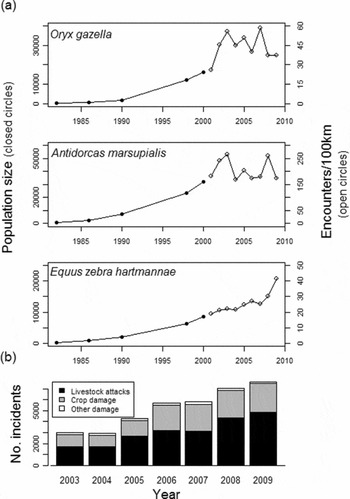
From the outset Namibia's CBNRM programme has had monitoring systems in place and every year, with the aid of profits generated from ecosystem services, community members systematically collect data on wildlife population sizes, as well as incidents of poaching and human-wildlife conflict (for example crop raiding or livestock killed) (Stuart-Hill et al. Reference Stuart-Hill, Diggle, Munali, Tagg and Ward2005). Population sizes of most animals have increased dramatically in the years since the first community game guard efforts came into existence in north-west Namibia in the mid 1980s (Fig. 1a), providing some evidence that the programme (and its predecessor) has been successful at delivering the ecosystem services being sold. Similar increases have been shown in other parts of the country (NACSO 2008). As a corollary to increasing wildlife populations, human-wildlife conflict incidents may be expected to increase, and this is in fact what has been observed in various parts of the country, illustrated again here by data from the north-west (Fig. 1b). Despite these two pieces of evidence, a more rigorous argument for the effectiveness of conservation on conservancies would involve the calculation of a counterfactual for wildlife populations from the years 1998–present; namely what would have been expected to happen to wildlife populations based on ‘business-as-usual’ conditions in the absence of the CBNRM programme. While some factors that would contribute to the counterfactual are relatively straightforward to estimate (such as precipitation levels in the region), others (for example what poaching and development pressure levels would have been in the absence of the CBNRM programme) are less clear.
(a) Trends in wildlife abundances and (b) number of incidents of human-wildlife conflict in north-west Namibia.

Start-up costs and co-benefits
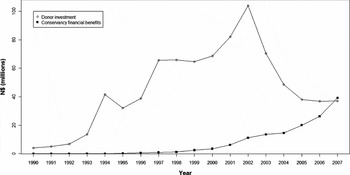
Namibia's CBNRM programme has had the benefit of a long period of sustained donor funding; indeed, the fact that one major donor (United States Agency for International Development [USAID]) was willing to fund the bulk of the programme costs for 15 years is believed to be one of the biggest reasons for its current success (Chemonics International Inc. 2008). The programme has now been running long enough to have seen the fruits of this initial investment, as in 2007 the aggregate financial benefits generated by all conservancies exceeded for the first time the total of all donor funding to the programme, the latter of which has declined over time (Fig. 2). In addition, the programme's contribution to net national income in Namibia is estimated to be almost five times greater than current donor funding (NACSO 2008).
Changes in donor investment (‘costs’) and communal financial benefits over the life of Namibia's CBNRM programme (Namibian dollars, N$ 6.5 = c. US$ 1, August 2011).

Another way to interpret the sustained donor funding, other than as a contribution towards start up and transaction costs, is as a north-south transfer of funds from beneficiaries of African biodiversity to those who supply it. It is well documented that many people hold an ‘existence value’ for elements of the environment such as biodiversity, namely some degree of willingness-to-pay to ensure its persistence even if it is never used or experienced directly (Kramer & Mercer Reference Kramer and Mercer1997). Aid flows from developed to developing countries designed to support biodiversity conservation represent one expression of this value (Pearce Reference Pearce2007). In the case of USAID funding for Namibia's CBNRM programme, reference to conserving or enhancing biodiversity in communal areas is mentioned as a key outcome in a number of discussions surrounding their investment in the programme (Chemonics International Inc. 2008). Seen in this light, we argue that there are two different types of benefits that communal lands in Namibia are actually ‘selling’: direct use benefits such as hunting and photographic safaris, paid for by visitors to conservancies (via private tour operators) and existence value co-benefits that are captured by communities via grant transfers from developed countries whose citizens are concerned with ensuring the persistence of African biodiversity.
Mode of payment
How payments actually reach community members varies depending on the conservancy and service in question. Income derived from services sold by conservancies may be disbursed in a number of ways, and spans the gradient from individual cash payments made to every conservancy member, through boosting conservancy committee capacity by purchasing vehicles and office equipment, to investing in community-level services and infrastructure such as schools and medical clinics (NACSO 2008). As yet there has been little research into how different payment modes affect the accumulation of household or communal wealth, nor on how different payment types might result in varying attitudes towards the CBNRM programme and natural resource conservation in general beyond the studies mentioned in the ‘Voluntary transactions’ section.
At least one mode of payment has been targeted specifically to allow access to income for disadvantaged conservancy members. A revolving plant fund allows individual harvesters of Commiphora wildii resin to receive payment immediately upon delivery of the resin to a central location within the conservancy. Since the middlemen buyers of the resin buy the entire harvest at a later date, this mode of payment allows the harvesters, who are mostly women from the Himba tribe, to access and spend income during the hot dry season, a time of the year when this is most needed.
COMMUNITY-BASED CONSERVATION AND PES
Namibia's CBNRM programme has much in common with Zimbabwe's CAMPFIRE programme, a groundbreaking community-based natural resource management programme that has been widely emulated across southern Africa (Frost & Bond Reference Frost and Bond2008). Like CAMPFIRE, Namibia's CBNRM programme has always been viewed as a community-based conservation programme, and indeed this has largely been the logical framework surrounding its development and implementation. Several commentators have discussed the CAMPFIRE programme and concluded that while it contains PES elements, it cannot be considered a ‘pure’ PES programme. Detracting elements include weak conditionality (Frost & Bond Reference Frost and Bond2008), the involuntary participation of at least some fraction of households (Murombedzi Reference Murombedzi1999; Frost & Bond Reference Frost and Bond2008) and, perhaps most importantly, the lack of an externality or market failure, since wildlife is both provided and ‘used’ on-site (Wunder et al. Reference Wunder, Engel and Pagiola2008).
Nevertheless, for the reasons detailed throughout this paper, we agree with Frost & Bond (Reference Frost and Bond2008) who ‘(We) argue that there is more in common between community conservation and PES than is commonly acknowledged’. Namibia's CBNRM programme meets many of the criteria used to define a PES scheme and, to the extent it does not (conditionality, potentially involuntary participation of some households), it is hardly unique when compared with a number of well-known PES examples (Wunder et al. Reference Wunder, Engel and Pagiola2008). Though not apparent from the definition we use, the Namibia programme may actually be closer in spirit to the market-based philosophies that originally underpinned the idea of PES (Grieg-Gran & Bishop Reference Grieg-Gran, Bishop and Roe2004) than the more prominent national PES programmes of Costa Rica, China and Mexico (Wunder et al. Reference Wunder, Engel and Pagiola2008). In the Costa Rican, Chinese and Mexican cases, there is only one buyer (the government), whereas in the Namibia (and Zimbabwe CAMPFIRE) cases, a relatively large pool of private buyers and sellers (many of them offshore) interact in the ecosystem services market.
On the externality issue, while we agree that benefits are consumed on site, there is also an off-site element to consider. Conservancies are unfenced and the larger (and more valuable) species of wildlife are known to move between communal areas, protected areas and tourism/hunting concessions (for example African buffalo Syncerus caffer in the Caprivi region; R. Naidoo et al. unpublished data 2011). As with other ecosystem services (such as water purification and nutrient regulation), the production of wildlife can therefore occur in one conservancy, but the benefits derived from wildlife can occur on that conservancy, or in another conservancy, or in a national park or other jurisdiction (and vice versa). Indeed, the design of systems that allow joint management on landscapes with different types of land tenures is a major focus of the CBNRM programme going forward, as indicated by incipient conservancy and private land complexes around the Etosha and Waterberg National Parks, as well as by the pending Kavango-Zambezi transfrontier conservation area centred on Namibia's Caprivi Strip. Managing at these larger scales also facilitates connectivity for wide ranging species and is likely to improve their resilience to threats such as changes in land-use and climate (Noss & Daly Reference Noss, Daly, Crooks and Sanjayan2006).
Perverse incentives?
In the case of Namibia, there do not appear to be strong reasons to think that perverse incentives have been a major issue for the CBNRM programme, based on three separate lines of evidence. In the first instance, wildlife management in southern Africa has historically operated within a sustainable use philosophy, with a strong focus on direct-use utilitarian values of wildlife (Child Reference Child and Child2004). Secondly, poaching was rampant in communal areas prior to the advent of the community game guard programme in the late 1980s, which was the forerunner of early CBNRM activities that themselves led to the 1996 conservancy legislation (NACSO 2008). This suggests that ethical reasons (and legal imperatives) for conservation were subservient to pragmatic livelihood concerns, as exhibited by the illegal harvest of wildlife for meat during the 1970s and early 1980s.
Finally, since the advent of CBNRM activities in Namibia, there appears to have been a major attitudinal shift of community members towards natural resources. Whereas previously wildlife had often been perceived as a detriment to livelihoods, today it is increasingly seen as a livelihood asset and conservancies take great pride in their recovering wildlife populations. In some ways, this fact is as important, if not more important, than the financial benefits that the CBNRM programme has generated. Our personal observations, along with published and unpublished studies, suggest that an important reason for the initial success of the community game guards programme in the north-west, and the continuing recovery of wildlife populations throughout the country, is the sense of pride and ownership that communities feel towards their wildlife, along with a desire to ensure their children will also be able to experience living alongside wildlife (Jones & Murphree Reference Jones, Murphree and Child2004; Suich Reference Suich2010; D. B. Morais & H. Zinn, unpublished data 2010). The desire to preserve wildlife populations for future generations may also increase the probability of long-term sustainability in the CBNRM programme, helping it withstand potential periodic drops in market values for various ecosystem services.
CONCERNS AND CRITIQUES
The following wide-ranging criticisms of Namibia's CBNRM programme have been made: the programme is a scheme to conserve large wildlife that is only of value to citizens of the developed world; women are further marginalized in decision-making in conservancies; the burden and costs of conservation are further shifted onto local communities; and conservancies have been imposed on communities that lack any viable alternatives (Sullivan Reference Sullivan and Hodgson2000, Reference Sullivan, Chatty and Colchester2002, Reference Sullivan, Berglund and Anderson2003). A full rebuttal of these critiques is clearly beyond the scope of this paper. However, in brief response, we note the following points. Beyond the services considered here, the consumption (‘own use’) of meat from wildlife is counted among the most beneficial aspects of the CBNRM programme, from both an economic and a food security standpoint, by conservancy members (NACSO 2008; Suich Reference Suich2010). While participation of women in natural resource decision making could certainly be improved, as of 2009, the proportion of women on management committees of 59 conservancies stood at 34.8%, while 53.3% of conservancy treasurers were female (NACSO 2009). In terms of local communities bearing costs, in an ideal world, conservancies will eventually be self-sufficient entities, with the costs of management offset by the benefits that accrue via services. So far, 20 conservancies have hit this target, but it is widely acknowledged that a sub-set of conservancies in less productive areas will never attain a high degree of financial prosperity (NACSO 2009). Finally, land-use alternatives are lowest in the arid inhospitable areas of north-west Namibia, where the conservancy programme and its predecessors originated. Nevertheless, conservancies are now established throughout the country, even in the Kavango and Caprivi regions, where alternative land uses such as cultivation and livestock rearing are of much higher value than in the north-west (Mendelsohn et al. Reference Mendelsohn, Jarvis, Roberts and Robertson2002).
The Namibian experience with CBNRM stands in at least partial contrast with efforts in other countries, both in southern Africa and further afield. Though some authors strike a cautiously optimistic tone (Child & Barnes Reference Child and Barnes2010), the predominant emerging narrative is that, after much initial promise, CBNRM efforts have generally failed to meet the lofty ambitions that had been expected. In some instances, CBNRM schemes have ended up enriching political elites through the incomplete devolution of resource rights or ‘centralization at the local level’ (Murombedzi Reference Murombedzi1999). In complete opposition to their stated goals, other CBNRM programmes have ‘produced devolved approaches that have, by privileging conservation, facilitated community disempowerment and impoverishment’ (Dressler et al. Reference Dressler, Buscher, Schoon, Brockington, Hayes, Kull, McCarthy and Shrestha2010). Clearly, many CBNRM programmes have failed to live up to expectations (Campbell et al. Reference Campbell, Mandondo, Nemarundwe, Sithole, De Jong, Luckert and Matose2001), not only for livelihoods, but also those related to biodiversity protection, which has at times been ignored at the expense of a focus on socioeconomic development (Kellert et al. Reference Kellert, Mehta, Ebbin and Lichtenfeld2000). As noted elsewhere (Nelson & Agrawal Reference Nelson and Agrawal2008), Nambia's CBNRM programme appears to be an exception in this regard, though as we discuss below, there remain many challenges for the programme to address if it is not to meet the same fate as others have.
Finally, there are a number of authors who have broadly questioned the wisdom of increasingly engaging with market forces to conserve biodiversity and/or improve human livelihoods. Their reservations centre around issues such as having little faith that private companies (being primarily concerned with shareholder profits) are likely to invest in broader social goals such as the environment or poverty alleviation; that developing countries with typically weak institutions will have great difficulty in monitoring and verifying the compliance of powerful companies with the country's environmental and social regulations; and, most broadly, that the increasing alignment of conservation and corporate interests subjects the former to the full force of capitalism's inherent antipathy towards environmental preservation (Swatuk Reference Swatuk2002; Brockington & Duffy Reference Brockington and Duffy2010; Igoe et al. Reference Igoe, Neves and Brockington2010a, b). In this context, we have provided some evidence to suggest a programme focused on conservation and development has benefited in both those domains from engaging more robustly with the market, which suggests that not all such engagements must lead to disastrous outcomes. Nevertheless, it would be wise for Namibia's CBNRM programme and others in similar positions to be mindful of all of the cautions and lessons from the literature cited above.
MOVING FORWARD: DIVERSIFICATION OF SERVICES
The generation of cash and employment benefits within the CBNRM programme has historically been heavily reliant on visits by foreigners to Namibia. Benefit flows to local communities have therefore been highly exposed to the vagaries of international tourism and air travel, both of which are beyond the control of actors within Namibia. Diversification of the ecosystem services being provided by communal areas would therefore help to buffer against predicted or unexpected shocks to the flow of international visitors to Namibia.
In recent years, the success of tourism and trophy hunting operations and the improvement of conservancies’ management structures have led to the development of other ecosystem services, such as those from the harvesting, processing and trade of indigenous plants and other natural products, a sub-sector in which Namibia has a strong national programme going back some 15 years. This class of benefits totalled US$ 300 000 in 2008, representing the third largest source of income for the conservancy programme (6.6% of the total). Current projections are that the trade in indigenous plants and other natural products in Namibia could increase to a potential US$ 25 million in ten years (Bennett Reference Bennett2006). In addition, many local communities could stand to further benefit from the commercial use of their genetic resources and associated traditional knowledge, assuming a functional international access and benefit-sharing regime is eventually implemented.
In addition to the increasing benefits being provided by plant products, other services may offer future scope for benefit generation. In the more vegetation-rich areas in the north-east of the country, payments for carbon storage or sequestration services under a future global climate change accord, or on the existing voluntary market, may offer some potential for diversification. Although the arid lands of Namibia will never be competitive with tropical forest countries in terms of the amount of carbon stored or sequestered per unit land area, Namibia has a distinct advantage when it comes to area under management. It has been suggested that conservancies could gear their existing resource monitoring and management activities and capacity more towards verifiable carbon sequestration (through for example improved grazing management, enrichment planting of useful species and localized bio-char applications) and sell the resulting carbon credits, along with their conservation credentials, as an ‘elephant-friendly’ carbon portfolio diversification product and/or directly to tourists visiting Namibia (Du Plessis Reference Du Plessis2007). An additional advantage of such a product would be to help to partially offset growing public concerns about the carbon footprint of long-haul tourism (Davidson Reference Davidson2009). In addition, extensive areas of locally-adapted woody invasive species imply an opportunity for carbon sequestration through such innovative mechanism as bio-char and structural wood or fuel bricks made of invader bush chips.
Watershed services in the Caprivi/Kavango regions are also a possibility for expanding the scope of the programme, but developing payment schemes here would be complicated because users and providers are scattered across three countries (Angola, Botswana and Namibia), requiring international cooperation in a complex situation where each country has differing policies and capacities around enacting such PES schemes. Finally, community-based forestry and freshwater fisheries are currently underused resources that also have potential to generate significant benefit flows for local communities, in particular in the northern and eastern parts of the country (Barnes et al. Reference Barnes, MacGregor, Nhuleipo and Muteyauli2010).
CONCLUSIONS
Payments for ecosystem services programmes are increasingly being used as a means of linking biodiversity conservation with human livelihoods (Goldman et al. Reference Goldman, Tallis, Kareiva and Daily2008; Tallis et al. Reference Tallis, Goldman, Uhl and Brosi2009). We have shown here that Namibia's community-based natural resources programme has led to increasing economic benefits for 230 000 people resident to communal conservancies, and that this increase in revenue generated by sustainable natural resource management has coincided with the improved management and recovery of populations of large wildlife throughout the affected communal areas. Based on a detailed examination of the programme against formal criteria that define PES schemes, we believe that the nature of Namibia's CBNRM programme warrants its consideration as a PES programme alongside the likes of those of Mexico, China and Costa Rica (Wunder et al. Reference Wunder, Engel and Pagiola2008). We also suggest that an examination of its history, mode of operation and achievements to date may provide important lessons to those wishing to fuse large-scale biodiversity conservation with the improvement of local livelihoods in other areas of the world.
ACKNOWLEDGEMENTS
We thank Greg Stuart-Hill, Richard Diggle, Eric Dinerstein, Taylor Ricketts, Brendan Fisher, Daniel Brockington and three anonymous reviewers for comments and discussions which contributed to the manuscript.