INTRODUCTION
When caring for a loved one with a life-limiting illness, caregivers' own suffering can be profound (Rabow et al., Reference Rabow, Hauser and Adams2004; Schulz & Sherwood, Reference Schulz and Sherwood2008; Zarit, Reference Zarit2006). This suffering may be rooted in threats to physical, emotional, or spiritual integrity. Efforts to improve the caregiver experience have tended to focus on skill building and self-efficacy, including patient pain and symptom management, as well as caregiver coping (Funk et al., Reference Funk, Stajduhar and Toye2010; Stajduhar et al., Reference Stajduhar, Funk and Toye2010). However, less is known about effective ways to address other elements of the caregiver experience that might influence well-being and the capacity to care—namely, the meaning caregivers ascribe to their caregiving role (Funk et al., Reference Funk, Stajduhar and Toye2010; Stajduhar et al., Reference Stajduhar, Funk and Toye2010). Research has shown that caregivers with a higher sense of meaning report lower subjective caregiver burden (Funk et al., Reference Funk, Stajduhar and Toye2010; Stajduhar et al., Reference Stajduhar, Funk and Toye2010).
In palliative care, the important tasks of caregiver preparation and completion are tools through which caregivers engage in meaning making, identifying purpose, and connecting with that which is held most important (Burton et al., Reference Burton, Sautter and Tulsky2012; Erikson, Reference Erikson1982; Steinhauser et al., Reference Steinhauser, Christakis and Clipp2001; Reference Steinhauser, Christakis and Clipp2000 a; Reference Steinhauser, Clipp and McNeilly2000 b). The tasks of preparation and completion include reviewing one's life, addressing relationship conflicts, forgiveness, and identifying wisdom gained and future goals (Steinhauser et al., Reference Steinhauser, Christakis and Clipp2001; Reference Steinhauser, Christakis and Clipp2000 a; Reference Steinhauser, Clipp and McNeilly2000 b). Through a series of observational studies, we identified these tasks as dimensions of a caregiver's existential needs and central to patient and family quality of life during advanced life-limiting illness. We subsequently developed Caregiver Outlook, an intervention to foster their expression. Caregiver Outlook is a companion to the previously developed Patient Outlook intervention, whose pilot studies showed feasibility and acceptability among seriously ill patients as well as improved anxiety, depression, functional status, and preparation for the end of life as compared to attentional and true control groups (Steinhauser et al., Reference Steinhauser, Alexander and Byock2008).
Addressing issues of meaning, exploring relational well-being, and supporting a caregiver's own sense of loss and hope is at the heart of chaplaincy care (VandeCreek & Burton, Reference VandeCreek and Burton2001). Professional chaplaincy routinely uses narrative pastoral care to help patients, families, significant others, and staff integrate concerns, values, beliefs, and practices, in the midst of health celebration, changes, crises, and loss. The goal is to enhance caring with integrity and authenticity as well as to conduct ongoing spiritual assessment and clinical pastoral care planning.
However, both how and the extent to which caregiver concerns are addressed vary based on family and patient circumstance, time available, and individual chaplain skill. Most chaplains' approaches to these concerns have not been delivered or evaluated in a manualized format. The chaplaincy evidence base would be strengthened by data that systematically explored the acceptability and feasibility of chaplains leading a standardized intervention that included skills central to their training and experience. Therefore, the purpose of our project was to administer and evaluate a standardized chaplain-led intervention to improve the well-being of caregivers of patients with advanced life-limiting illness. Caregiver Outlook employed a semistructured standardized protocol to foster conversations related to the meaning of the caregiver experience and included specific attention to issues of caregiver preparation and completion.
METHODS
Design
This single-arm pilot trial qualitatively and quantitatively evaluated the feasibility and acceptability of the Caregiver Outlook intervention, the content of which is based on the robust human development and self-disclosure literatures (Butler, Reference Butler1980; Fratorolli, Reference Fratorolli2006; Pennebaker et al., Reference Pennebaker, Barger and Tiebout1989; Pennebaker & O'Heeron, Reference Pennebaker and O'Heeron1984; Pennebaker & Seagal, Reference Pennebaker and Seagal1999). The human development literature gave rise to life-review interventions, shown to be a valuable and reflective meaning-making exercise for older adults (Butler, Reference Butler1980). The literature on emotional self-disclosure demonstrates the health benefits of expressing emotions related to stressful events for a variety of health conditions and life circumstances (Pennebaker et al., Reference Pennebaker, Barger and Tiebout1989; Pennebaker & O'Heeron, Reference Pennebaker and O'Heeron1984; Pennebaker & Seagal, Reference Pennebaker and Seagal1999; Smyth et al., Reference Smyth, Stone and Hurewitz1999).
Participants
We identified caregivers of persons with advanced life-limiting illness (e.g., stage IV cancers, stage III or IV congestive heart failure, and amyotrophic lateral sclerosis [ALS]) who were being treated at the Duke University outpatient palliative care oncology or ALS clinics, and who were not currently enrolled in hospice care. Because the intervention focused on relational issues, we limited enrollment to spouses, partners, parents, adult children, close grandchildren, or longstanding familial-type relationships. Following identification by clinical staff, caregivers were approached, informed about the study, and, if interested, consented and enrolled.
Protocol
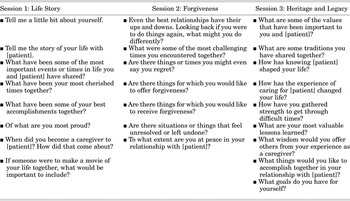
Following baseline assessment, caregivers were contacted to schedule intervention sessions, which consisted of speaking with a board-certified chaplain three times, approximately a week apart, for an hour each time. In session 1, participants discussed their relational life story, cherished times, and proudest accomplishments. In session 2, they spoke about relational concerns left undone, regrets, and issues of forgiveness. Session 3 included conversational prompts for lessons learned and future goals. At the end of each of the three sessions, participants were sent a handout whose content reinforced session topics (see Table 1). Within a week of session 3, participants received an unscripted pastoral check-in, which lasted 15 to 20 minutes, to allow for elaboration of topics raised during the sessions.
Caregiver Outlook intervention questions

As noted, Caregiver Outlook is based on the literature on emotional self-disclosure (Pennebaker et al., Reference Pennebaker, Barger and Tiebout1989; Pennebaker & O'Heeron, Reference Pennebaker and O'Heeron1984; Pennebaker & Seagal, Reference Pennebaker and Seagal1999; Roger, Reference Rogers1961). Accordingly, participants are provided opportunities to express themselves without subsequent interpretation by another. Therefore, the chaplain interventionist followed the Caregiver Outlook question script to elicit caregivers' experiences without responding with a framework—spiritual, religious, or otherwise—not expressed by the caregiver. The chaplain would probe for additional details when vague adjectives or adverbs were used, with the intent of gathering additional details. For example, if a caregiver described a life event as being “important,” the interventionist would ask, “Can you tell me what about that experience made it important?” Caregivers responded to questions within frameworks meaningful to them, sometimes religious or spiritual; and the chaplain supported all participant frames with techniques of active and supportive listening, consistent with chaplaincy training, which relies heavily on Rogerian teachings (Roger, Reference Rogers1961). The content of the intervention was based on foundational work in palliative care and human development. The questions are similar to those a chaplain might ask when using narrative pastoral care to elicit a patient's or caregiver's personal story (Brueggemann, Reference Brueggemann1990).
All sessions were conducted via telephone so as to facilitate caregivers' scheduling convenience, proximity to patient, and geographic breadth (NHPCO, 2010). Sessions were audiotaped and transcribed, and we audited a sample of transcripts to assess content fidelity. Feasibility and acceptability were assessed quantitatively via rates of enrollment, attrition, and completion of measures. We assessed initial trends and response levels for key outcomes variables and conducted qualitative semistructured interviews with participants, who evaluated the benefits and challenges and offered overall feedback on their participation in the intervention. Our study was approved by the Duke University Medical Center institutional review board.
Measures
We administered the following measures at baseline and at 6- and 8-week follow-up: the preparation and completion subscales of the QUAL–E (fam) (Steinhauser et al., Reference Steinhauser, Clipp and Hays2006); the FACIT–Sp, a 12-item measure of meaning, peace, and faith (Peterman et al., Reference Peterman, Fitchett and Brady2002); the 5-item anxiety subscale from the modified Brief Profile of Mood States (POMS) (Cella et al., Reference Cella, Jacobsen and Orav1987; Radloff, Reference Radloff1977); the 10-item Center for Epidemiology Studies Depression Scale (CES–D) (Peterman et al., Reference Peterman, Fitchett and Brady2002); the 12-item Prolonged Grief Scale (PG-12), validated in bereavement and also used in the setting of anticipatory pre-death loss (Prigerson et al., Reference Prigerson, Horowitz and Jacobs2009); the 14-item Brief Religious Coping Activity Scales (RCOPE) to assess both positive and negative religious coping (Pargament et al., Reference Pargament, Feuille and Burdzy2011); and the 24-item Caregiver Reaction Assessment (CRA), which includes subscales on caregiver esteem, family support, impact on finances, impact on schedule, and impact on health (Given et al., Reference Given, Given and Stommel1992). We asked two questions: (1) “How many hours per day, on average, do you spend ‘on duty' caring for the patient?” (response options: <4 hours, 5–8 hours, 9–16 hours, and >16 hours per day); and (2) “About how long ago did you start helping your loved one do things they were no longer able to do alone?”
We tested the RCOPE results in two ways: first, as a continuous measure for both subscales of positive and negative religious coping; second, we dichotomized the negative religious coping scale to assess the presence or absence of spiritual distress, a method used as a screening tool. Item scores of 0 or 1 were coded as 0, and scores of 2 or 3 were coded as 3. Scores greater than or equal to 3 were deemed indicative of distress.
Baseline-only measures included: demographics (gender, ethnicity, age, education, income, religious affiliation, and relationship to patient), the Daily Spiritual Experience Scale, the Duke University Religion Index (DUREL), and single items assessing level of religiosity/spirituality, religious affiliation, and participation.
Qualitative Intervention Evaluation
Following the final quantitative assessment, a subset of participants provided feedback regarding the intervention, including what was or was not helpful, what they did or did not like, the extent to which it assisted coping with emotional and role changes related to caregiving, what was the best timing in the course of caregiving for such an intervention, and their feedback on using a chaplain-led intervention.
Analyses
Intervention feasibility was evaluated using descriptive statistics summarizing rates of eligibility, enrollment, attrition, session completion, and response to outcomes questionnaires. Pre–post intervention changes in outcomes measures was evaluated using linear mixed-effects models (all measures were continuous). The mixed effects model parameters were estimated and tested using SAS PROC MIXED (SAS Institute, Cary, NC). Using the estimated coefficients and standard errors from the models, we plotted the expected trajectories for each of the outcomes, with confidence intervals, and we were able to discern average trends in the outcomes over the course of the study.
Qualitative Data Analyses
In assessing acceptability and feasibility, we present results from the evaluation interviews only. Each transcript was reviewed for common and recurrent themes related to evaluation questions. Analyses followed a descriptive qualitative analytic approach, given the highly structured nature of an evaluation interview and the goal of eliciting feedback on intervention content, style, and usefulness.
RESULTS
Enrollment and Completion Rates
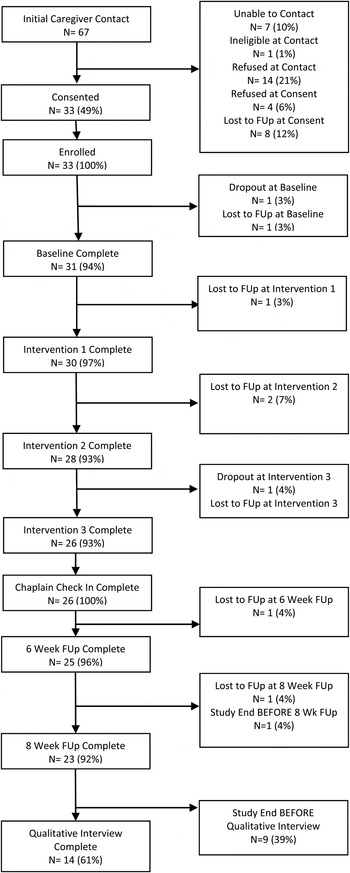
Of the 67 referred participants, 31 completed a baseline assessment: 7 were unable to be contacted, 1 was found ineligible at contact, 18 declined, 9 were lost to follow-up (unable to be contacted after consent), and 1 dropped out at baseline. Thus, 52% of eligible contacted caregivers agreed to participate (see Figure 1).
Study consort statement.

A total of 26 participants completed all the intervention sessions and the unscripted check-in, resulting in an intervention completion rate of 84%. Some 25 (81%) completed the 6-week and 23 (74%) the 8-week follow-up quantitative assessments. We conducted qualitative evaluation interviews with 14 (45%) caregivers. The reasons for dropout included busy schedules and a caregiver's own health issues.
Sample Description
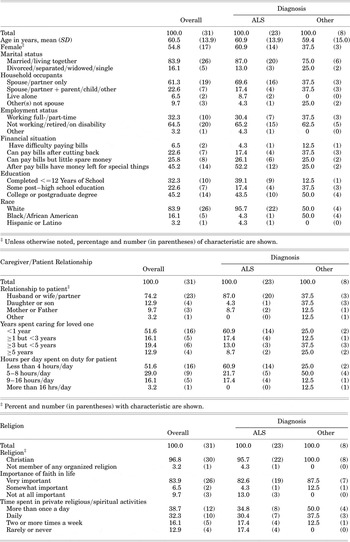
Participants averaged slightly over 60 years of age, and a third of them worked full- or part-time. The sample included a range of socioeconomic status groups. Compared with national averages, participants were disproportionately well educated (45%) and financially stable (45%). Most were caring for a spouse or partner (74%); a quarter of the sample cared for a parent (13%), child (10%) or other close family member (3%). Some 61% of those caring for a loved one with ALS had been doing so for less than a year, as compared to 25% of cancer-related caregivers; 25% of cancer carers had done so for more than 5 years. Half of the caregivers reported spending less than 4 hours, a third 5–8 hours, and 16% 9–16 hours a day (Table 2).
Caregiver Outlook sample characteristics

‡ Percent and number (in parentheses) with characteristic are shown.
Pre–Post Intervention Measurements
All participants completed 100% of the study measures, demonstrating high measure acceptance and low interview attrition. Two were unable to complete the final eight-week assessment due to the study ending or personal health issues.
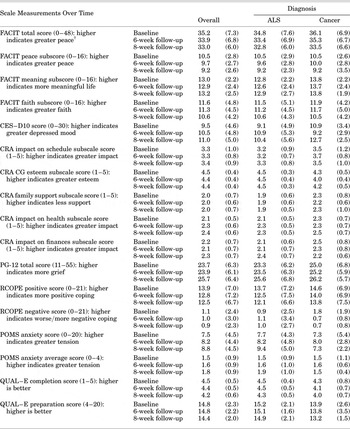
At baseline, participants presented with average levels of anxiety and depression, lower than usual spiritual well-being and religious coping levels, average levels of grief, and lower than average levels of burden. For example, CES–D scores greater than 10 are indicative of need for treatment by the most conservative standards; other studies have used 16 as a treatment threshold. Our sample averaged a score of 9.5 at baseline, with 42% scoring greater than 10. Population averages for POMS anxiety subscale scores range from 8.2 (samples of nondepressed patients) to 14.3 (depressed patients), while the average for our sample was 7.5 (see Baker et al., Reference Baker, Denniston and Zabora2002). Anticipatory grief includes a therapeutic threshold of 32–34 for syndromal grief, and our sample averaged 23.7, with 6% above threshold (Prigerson et al., Reference Prigerson, Horowitz and Jacobs2009; Prigerson & Maciejewski, Reference Prigerson and Maciejewski2014). Threshold values are more elusive on the CRA. However, previous work with palliative caregivers that split the sample into low and high burden suggests that our sample was average, with the exception of self-esteem (Sautter et al., Reference Sautter, Tulsky and Johnson2014). On the subscale assessing self-esteem (which taps questions regarding the meaning of caregiving), our sample respondents had rather high self-esteem, averaging 4.5 (on a 5-point scale). The average FACIT–Sp total score is 35.2, while the average scores on the combined meaning/peace and faith subscales are 22.9 and 11.6, respectively (Canada et al., Reference Canada, Murphy and Fitchett2008; Murphy et al., Reference Murphy, Canada and Fitchett2010); our sample scored lower than average on both of these measures. Finally, while the average score range for positive religious coping is 17–20 and for negative religious coping 8–14, our sample scored 13.9 and 1.1, respectively, indicating particularly low levels of spiritual distress (Pargament et al., Reference Pargament, Feuille and Burdzy2011). Using the dichotomized scoring method (not shown in the tables), 3 of 31 participants exhibited spiritual distress at baseline.
The measures exhibited stability of response for the sample over time. Linear mixed models were employed, but because the results were not significant, we do not present them in tabular form. We did see a small trend toward increases in low mood (depression), anxiety, and grief as assessed by the negative religious coping scales, and there was a trend among cancer caregivers toward less spiritual distress over time (Table 3). None of these changes were statistically significant, and the sample size was small.
Outcomes measures at baseline, 6-week, and 8-week follow-up

Program Evaluation Follow-Up Interviews
Some 14 (45%) caregivers participated in a qualitative evaluation interview. Nonparticipants were unable to be contacted or were no longer available for follow-up. Of these 14, 10 were female, all were white, 4 were caring for loved ones with cancer, and 10 had loved ones with ALS. A total of 13 were spouses/partners, and 1 was the parent of an adult child.
Overall Reactions to the Caregiver Outlook Intervention
Participants overwhelmingly (12 of 14) reported a positive intervention experience. Two described the sessions as enjoyable but were not sure whether the conversations were necessary. Both had strong support networks and psychotherapists.
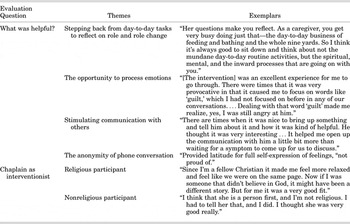
Participants suggested several ways in which Caregiver Outlook was assistive: it allowed one to step back from day-to-day tasks, it gave one the opportunity to process emotions and to reflect on support received, it provoked thoughts and emotions between sessions, it promoted discussion of role changes, it stimulated communication with others, and the process allowed for the anonymity of a phone conversation. Although level of illness severity and length of time from diagnosis varied, participants found the timing of the intervention to be acceptable, suggesting that the content was flexible with respect to stage of illness. Finally, participants who identified as religious or nonreligious were comfortable with a chaplain facilitating the intervention. We illustrate these themes in Table 4.
Evaluation question feedback

DISCUSSION
This pilot study showed that Caregiver Outlook is acceptable and feasible for use among a sample of male and female caregivers ranging in age from the late 40s to the 80s who were spouses/partners, adult children, parents, or close family members, white and African American, and with a range of education levels. Both religious and nonreligious participants found the chaplain-led Caregiver Outlook intervention to be an acceptable format for reflecting on the meaning of caregiving for a loved one with an advanced life-limiting illness. The 53% enrollment rate is excellent compared to many palliative care trials, particularly those involving caregivers. The rates of completion of sessions and measures were high and exceptional given the needs of the patient population (Grande & Todd, Reference Grande and Todd2000; Jordhoy et al., Reference Jordhoy, Kaasa and Fayers1999; Steinhauser et al., Reference Steinhauser, Clipp and Hays2006). At baseline, the sample population did not demonstrate measurable distress, showing average levels of mood, higher self-esteem, and lower spiritual distress and grief. Study participants exhibited slightly lower spiritual well-being, however, and these levels were statistically stable over the period of observation. Given the small sample size, any conclusions about quantitative trends should be met with caution. Only a full-scale trial would permit formal evaluation of the relationship between the intervention and the outcomes of interest.
During recent years, a handful of studies have sought to develop an evidence base for the efficacy of chaplain interventions (Bay et al., Reference Bay, Beckman and Trippi2008; Hausmann, Reference Hausmann2004; Iler et al., Reference Iler, Obenshain and Carmac2001). Unfortunately, the content of chaplain interventions tends to be poorly described (Bay et al., Reference Bay, Beckman and Trippi2008; Iler et al., Reference Iler, Obenshain and Carmac2001). In one study of patients with chronic obstructive pulmonary disease, chaplain visits were shown to increase positive religious coping and decrease negative religious coping (Iler et al., Reference Iler, Obenshain and Carmac2001). Negative religious coping, a measure of spiritual struggle, has been shown to be strongly associated with poor mental health outcomes (Ano & Vasconcelles, Reference Ano and Vasconcelles2005). However, the chaplain visit content was unknown and likely varied from patient to patient. The study did not show changes in patient anxiety, depression, or hope. In a randomized controlled trial of patients receiving a coronary artery bypass graft, the chaplains offered five visits, focusing on patient needs, a family visit, hope, resources, and adjustment to grief, loss, and illness. The cumulative length of chaplain time with patients averaged 44 minutes total for all sessions combined. While moving toward standardization of topic, there was unlikely sufficient time or depth of the intervention to produce sustained positive outcomes. Though modifications to content and design are warranted, Caregiver Outlook contributes to the body of chaplaincy research through demonstrating the acceptability and feasibility of a standardized approach, often thought anathema to chaplaincy care. Our structured approach offered consistent content, revealed information that could provide several foundational elements for a spiritual care plan, and was received well by caregivers.
In addition to evaluating overall acceptability and feasibility, our pilot project indicated suggested refinements to the study design and intervention content. First, study participants did not demonstrate high levels of distress at baseline, making it unlikely that we would observe changes in outcomes. The emotional self-disclosure literature suggests that the greatest effect is available for those in greatest need of expression. For example, males, who may not have had higher access to social support networks, are thought to have increased benefit compared to females (Steinhauser et al., Reference Steinhauser, Alexander and Byock2008). Our inclusion criteria were based on a physical diagnosis of advanced illness, not on the presence of current emotional or spiritual distress. Selecting a population that is experiencing distress would make it more possible to test the efficacy of the intervention in alleviating measurable distress. In a similar manner, trials studying analgesia screen for patients with pain; perhaps interventions addressing spiritual suffering should screen for distress. Our recommendations regarding screening for distress relate to evaluation of a standardized intervention and not more broadly to chaplaincy care. Chaplains routinely support patients and families with a broad array of needs, not only those meeting clinical criteria for spiritual distress.
Second, our results suggest that the interventionist may play a more active role in facilitating reflection. Caregiver Outlook provides standardized prompts to elicit participants' experiences and emotions, yet it does not offer the insights or cognitive reframing techniques more typical of psychotherapeutic approaches. As a result, the chaplain limited responses to probing for additional detail or reflecting expressed views, within the patient's disclosure frame. Participants appeared to vary in their likelihood and perhaps current skill in making statements related to insight and causality, both of which have been linked to the health benefits of disclosure (Pennebaker & Seagal, Reference Pennebaker and Seagal1999). Experience and facility with personal reflection varies among participants; therefore, future interventions could more actively assist participants with reflective strategies, and within a framework consistent with their belief systems. In facilitating discussions, the chaplain gleaned substantial information that could contribute to developing a spiritual care plan. No such plan was enacted for our pilot. A future modification of the chaplaincy setting could include a stronger marriage of intervention question content and more traditional chaplain-based techniques so as to explore and navigate spiritual and emotional concerns. The intervention could also include specific probes to help more fully formulate a spiritual care plan.
Third, our study results suggest modification of the measures selection process. Descriptive statistics showed relatively low hours per day of caregiving, which contrasted with qualitative descriptions of caregivers' daily experience. In the interview sessions and at follow-up, caregivers described extensive hours spent aiding with transportation, meal preparation, planning, and coordination of care, yet they did not necessarily consider these to be “caregiving” tasks. Measures that more precisely describe the nature of caregiving activities would improve our ability to characterize participants' experience, with particular attention to necessary instrumental assistance. Additionally, given that participants were overwhelmingly positive in their responses to the content of Caregiver Outlook, future design modifications might include more positive outcomes, such as resilience or positive emotional states that may be promoted by the intervention. This is consistent with other similar interventions (e.g., dignity therapy and meaning-centered psychotherapy), whose authors have identified the need to examine positive emotional response and non-pathologizing outcomes measures (Chochinov et al., Reference Chochinov, Cann and Cullihall2012; Breitbart et al., Reference Breitbart, Poppito and Rosenfeld2012; Reference Breitbart, Rosenfeld and Pessin2015).
Of note, Caregiver Outlook was developed separately from dignity therapy, a primarily generative-focused intervention, yet it has similar components on reflection and review. Caregiver Outlook is distinct in spending extensive time on issues of forgiveness and in not producing a legacy document that requires editing. Caregiver Outlook participants reported on the value that the intervention afforded them, particularly with respect to phone delivery and the opportunity to share some of the challenges of caregiving. The intervention shares some similarities with meaning-centered psychotherapy (Breitbart et al., Reference Breitbart, Poppito and Rosenfeld2012), but it is briefer and focused more on the individual. All three of these types of interventions are part of a larger literature that explores the intersection of psychosocial and existential needs among those living with or caring for those with serious illness (Breitbart et al., Reference Breitbart, Rosenfeld and Pessin2015; Chochinov et al., Reference Chochinov, Cann and Cullihall2012; Fegg et al., Reference Fegg, Brandstatter and Kramer2010; Henry et al., Reference Henry, Cohen and Lee2010; Lee, Reference Lee2008; Lethborg et al., Reference Lethborg, Aranda and Kissane2008).
Finally, our study included many participants caring for those with ALS. With its rapid disease progression, 50% mortality within 3 years of symptom onset, and frequent devastating functional changes in terms of movement, breathing, eating, speech, and cognitive capacity, research has demonstrated that ALS caregivers experience increased stress, burden, and changes in quality of life (Aoun et al., Reference Aoun, Bentley and Funk2013; Reference Aoun, Connors and Priddis2012). With the caregiver burden and loss of quality of life so well established within this population, expert palliative care interventions are crucial tools. Of note, a recent study of ALS caregivers showed that their existential concerns were more prevalent than psychosocial issues (Aoun et al., Reference Aoun, Connors and Priddis2012). Other studies have demonstrated social isolation and the resulting need for a confidant. In addition, burden has been shown to be moderated by caregiver religiosity and social support. Such a chaplain-led intervention as Caregiver Outlook could certainly serve as a model for care within this population.
LIMITATIONS
Our study was limited by the nature of the single-arm trial, which precluded comparisons. Statements about the causal effects of the intervention are not possible. Though a chaplain led the intervention, its standardized protocol excluded pastoral care techniques other than those described (e.g., prayer or ritual). Further discussion of chaplains' views on leading a standardized intervention and qualitative analysis of the content of the intervention will be discussed in forthcoming work.
CONCLUSION
The results of our study demonstrate the feasibility and acceptability of a standardized chaplain-administered tool for addressing caregivers' preparation and completion needs. Our results provide intervention refinements and preliminary data for future large-scale randomized controlled trials. In general, the content offers an acceptable format for addressing caregivers' existential needs during a loved one's advanced illness.
ACKNOWLEDGMENTS
This study was conducted with funding from a grant from the Healthcare Chaplaincy Network. Dr. Steinhauser is an employee of the Health Services Research and Development Service, Department of Veterans Affairs. The views expressed in this article are those of the authors and do not necessarily represent the views of the Department of Veterans Affairs.