I. INTRODUCTION
The intermetallic compounds based on Ti–Al binary alloys have been widely considered to be a kind of promising light-weight structure material due to their excellent properties, such as low density, high hardness, attractive fracture strength, good oxidation resistance, and high creep resistance at room temperature, and elevated temperatures. Reference Liu, Li, Su, Guo and Fu1–Reference Wu8 Because of these brilliant properties mentioned above, the compounds of TiAl based alloys own good application potentials in the aerospace, automotive, and turbine power generation markets. Reference Shiue, Wu and Chen4 But the poor ductility and flexural toughness have prevented their further practical application in the fields mentioned above. Reference Li, He and Feng5–Reference Yamaguchi, Inui and Ito7
Many works have been performed to investigate the strengthening of TiAl intermetallic compounds. Reference Wu8–Reference Wang, Zhao, Nash, Liu, He, Shi and Li18 And considerable investigations have shown that incorporation of second phase and micro-alloying are doable and resultful to control the microstructure and improve the mechanical properties of TiAl intermetallics. Reference Song, Cao, Wang and Feng10–Reference Wang, Zhao, Nash, Liu, He, Shi and Li18 On one hand, ceramic particles, for instance, Si3N4, Reference Song, Cao, Wang and Feng10 TiB2, TiC, Reference Hu, Chen, Meng and Zhang11 Al2O3 Reference Yeh and Li13 as well as Ti5Si3 Reference Rao and Vyas15 as effective reinforcements have been performed in many researches. Rao et al. Reference Rao and Vyas15 have successfully synthesized TiAl–Ti5Si3 in situ composites by hot isostatic pressing (HIP), which showed that the yield strengths of TiAl based alloys obtained with the technique adopted in the study were significantly high even at an elevated temperature of 800 °C. Zhu et al. Reference Zhu, Yang, Yang and Wang17 have found out the combining aluminothermic reduction of Nb2O5 into the synthesis process to produce in situ formed Al2O3 particles were considered as an appropriate reinforcing method for the TiAl matrix, which was attributed to the outstanding mechanical properties of Al2O3 particles of high hardness, high modulus, and matched thermal expansion coefficient with TiAl phase. Reference Wang, Zhao, Nash, Liu, He, Shi and Li18 On the other hand, some elements such as Nb, Cr, B, V, and Y have been investigated to improve the mechanical properties of TiAl intermetallics. Reference Wu and Hwang16,Reference Zhu, Yang, Yang and Wang17 According to the research from Wu et al., Reference Wu and Hwang16 the alloys with Y addition have higher ultimate tensile strength and oxidation resistance than those of the Y-free alloy. Meanwhile the room-temperature ductility is also improved by the refinement of microstructure and the removal of interstitial oxygen in the α2 and γ phases.
At present, the incorporation of Al2O3 combined with the addition of Mo to meliorate the performances of TiAl based composite have rarely been reported. What is more, the improvement of wettability between metallic phase and ceramic phase by element Mo has been reported in previous researches, Reference Lindahl, Guatafson, Rolander, Stals and Andrén19–Reference Liu, Xu, Li, Chen, Li and Zhang21 which is in favor of the mechanical properties of TiAl based composites composed of TiAl phase and Al2O3 ceramic phases.
Herein, to investigate the modified effect of incorporation of Al2O3 ceramic particles combined with the solid solution of Mo, (Ti,Mo)Al/Al2O3 composites with a range of different Al2O3 contents were synthesized successfully aided by the thermite reaction with the elemental powder mixtures Ti, Al, and MoO3 during the in situ hot pressing process. The microstructure and mechanical properties of the as-synthesized composites were characterized and the reaction mechanism as well as the reinforcing mechanism was also discussed.
II. EXPERIMENTAL
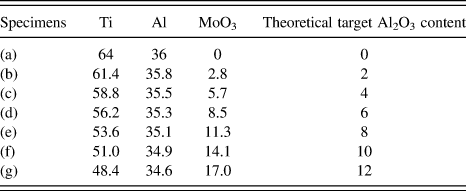
Al (200 mesh, 99.5% purity), Ti (280 mesh, 99.3%), and MoO3 (200 mesh, 99.5% purity) powders were used as the starting materials in this work. The chemical component of mixture powders were listed in Table I, which was according to the stoichiometry of the following equation:
 $${\rm{Ti}} + \left( {7x + 1} \right){\rm{Al}} + 3x{\rm{Mo}}{{\rm{O}}_3} \to {\rm{TiAl}} + 3x{\rm{A}}{{\rm{l}}_2}{{\rm{O}}_3} + x{\rm{AlM}}{{\rm{o}}_3}\quad .$$
The component of the samples (wt%).

The element powders were ball milled in alcohol for 1 h and dried at about 40 °C for several hours. Then the milled powders were compacted uniaxially under 10 MPa in a graphite mold coated with BN inside. Meanwhile the compacted samples were hot press sintered at different temperatures for 2 h in vacuum (∼10−2 Pa) under a pressure of 17 MPa. Finally, the samples were cooled down to room temperature in the furnace. And the surface of the samples was ground to remove the graphite contamination layer prior to characterization. To expose the morphology of grains, the surface of the samples was polished and etched using a solution mixed by HF:HNO3:H2O with a 1: 1: 1 volumetric ratio.
The flexural strength and fracture toughness of the samples were evaluated by three point bending testing. And the single-edge notched beam (SENB) method was used for the preparation of fracture toughness testing samples. All the samples used were 4 × 4.5 × 25 mm3 in size. And the fracture toughness and flexural strength tests were conducted by a universal material testing machine (PT-1036PC, Perfect Instrument Co. Ltd., Taiwan, China) with a span of 18 mm at a testing rate of 0.05 and 0.5 mm/min, respectively. The facture toughness and the flexural strength were calculated according to the following equations:
 $$\sigma = {{3PL} \over {2b{h^2}}}$$
 $${K_{{\rm{IC}}}} = Y \times {{3PL{a^{1/2}}} \over {2b{W^2}}}\quad ,$$
where P is the fracture load, L, b, h, Y, and α denote the span, width, height, form factor, and notch depth of the samples, respectively. The variations between load, deflectometer, and time were automatically recorded by the data acquisition program. The hardness of the samples was conducted on a hardness testing machine (200HR-150, Fangyuan test instrument Co. Ltd., Jinan, China) with a diamond indenter under a 588 N load for 15 s. And the bulk density of the as-prepared composites was measured by the Archimedes method. The phase identification of the obtained samples was performed by x-ray diffraction [XRD; D/max-2200PC X, Rigaku Corporation, Tokyo, Japan, Cu Kα radiation (40 kV and 30 mA)]. Then the microstructure of the samples was observed by using scanning electron microscopy (SEM; JEOL JSM-6700F, JEOL Ltd., Tokyo, Japan) and energy dispersive spectroscopy (EDS). Eventually, each kind of test must be calculated by averaging five individual measurements.
III. RESULTS AND DISCUSSION
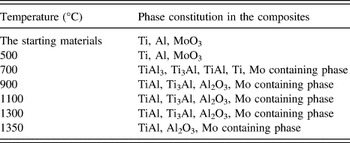
The X-ray diffraction patterns of the hot pressed (Ti,Mo)Al/10 wt% Al2O3 composites at different temperatures for 2 h are shown in Fig. 1. And the phase compositions of the as-synthesized composites in the temperature range of 500–1350 °C for 2 h are exhibited in Table II. There were no significant differences between the content of the as-prepared composite and the starting material at 500 °C, but trace amounts of Ti6O11 originated from Ti being oxidized appeared probably due to the existed of pores in as-synthesized composites. When the temperature increased to 700 °C, the Ti and MoO3 decreased apparently with Al almost entirely disappeared. As a result, the sintered sample mainly consists of Mo containing phase Al8Mo3, TiAl3, Ti3Al, and a small amount of TiAl. This means there are chemical reactions of molten Al with Ti to produce TiAl3 and Ti3Al from which TiAl was originated. Meanwhile, the thermite reaction between molten Al and MoO3 has proceeded with the products of Al2O3 and Mo. Then the generated Mo was wrapped in molten Al (melting point 660.8 °C) forming Mo containing phase subsequently. At the same time, the reaction between Ti and molten Al has started, the reactions mentioned above can be concluded as follows:
 $${\rm{Al}}({\rm{s}}) \to {\rm{Al}}({\rm{l}})$$
 $${\rm{Ti}} + 3{\rm{Al}}({\rm{l}}) \to {\rm{TiA}}{{\rm{l}}_3}$$
 $$3{\rm{Ti}} + {\rm{Al}}({\rm{l}}) \to {\rm{T}}{{\rm{i}}_3}{\rm{Al}}$$
 $${\rm{TiA}}{{\rm{l}}_3} + 2{\rm{Ti}} \to 3{\rm{TiAl}}$$
 $$2{\rm{Al}} + {\rm{Mo}}{{\rm{O}}_3} \to {\rm{A}}{{\rm{l}}_2}{{\rm{O}}_3} + {\rm{Mo}}$$
 $$8{\rm{Al}} + 3{\rm{Mo}} \to {\rm{A}}{{\rm{l}}_8}{\rm{M}}{{\rm{o}}_3}$$
XRD patterns of hot press sintering (Ti,Mo)Al/10 wt% Al2O3 composites at different temperatures: (a) 500 °C; (b) 700 °C; (c) 900 °C; (d) 1100 °C; (e) 1300 °C; (f) 1350 °C.

Summary of phase constitution of the as-synthesized composites in temperature range of 500–1350 °C for 2 h.

When the temperature rose to 900 °C, the peak of TiAl was clearly detected by XRD with Ti and MoO3 vanished practically. This denotes that TiAl3 reacted with the remaining Ti and Ti3Al to produce TiAl equilibrium phase according to Eqs. (7) and (10), respectively. And TiAl became main phase in the as-received composite simultaneously. Besides, the intensities of Bragg peaks corresponding to AlMo3 increase along with the disappearing of peaks belonging to Mo containing phase Al8Mo3, suggesting the occurring of reaction between Ti and Al8Mo3 according to Eq. (11). Equations (10) and (11) can be generalized as:
 $${\rm{TiA}}{{\rm{l}}_3} + {\rm{T}}{{\rm{i}}_3}{\rm{Al}} \to 4{\rm{TiAl}}$$
 $${\rm{A}}{{\rm{l}}_8}{\rm{M}}{{\rm{o}}_3} + 7{\rm{Ti}} \to {\rm{AlM}}{{\rm{o}}_3} + 7{\rm{TiAl}}\quad {\rm{.}}$$
When the temperature rises to 1100 °C, the intensities of TiAl and Ti3Al enhanced continually. This phenomenon signifies that the contents of TiAl and Ti3Al increase cumulatively. With the temperature rising to the point of 1300 °C, AlMo3 phase disappears and the Ti3Al phase reduced with AlMoTi2 emerging simultaneously. And the process mentioned above root in the relative high activity of Mo diffusing from AlMo3 into Ti3Al to produce AlMoTi2. There were only TiAl, Al2O3, and Mo containing phase AlMoTi2 remaining at 1350 °C, which means the target sintered bulk of (Ti,Mo)Al/Al2O3 composites could be synthesized successfully at this point of temperature.
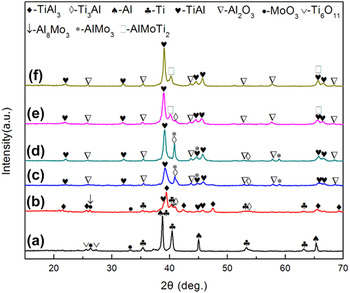
Figure 2 shows the XRD patterns of hot press sintering samples with different Al2O3 contents at 1350 °C. As shown in the XRD patterns, the monolithic TiAl bulk was composed of TiAl and a trace of Ti3Al. As the content of Al2O3 is in a comparatively minor level of 2 wt%, the amount of generated Mo containing phase AlMoTi2 is not clearly detected by the XRD, but only the TiAl matrix is detected. With the Al2O3 content increases to 4 wt%, there are not any Bragg peaks of AlMoTi2 due to its relative less amount. When the content of Al2O3 increased from 6 wt% to 12 wt%, the sintered composite mainly consists of TiAl, Al2O3, and a relative small amount of AlMoTi2 whose quantity increases along with the increasing of Al2O3 simultaneously.
XRD patterns of hot press sintering of composites with different Al2O3 contents at 1350 °C: (a) 0 wt%; (b) 2 wt%; (c) 4 wt%; (d) 6 wt%; (e) 8 wt%; (f) 10 wt%; (g) 12 wt%.

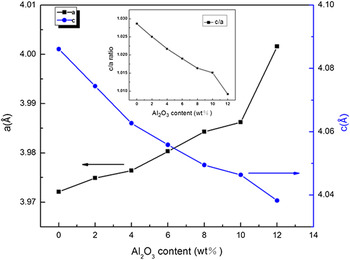
The zoom in drawing of XRD patterns for TiAl phase is plotted in the top left corner of Fig. 2. It can be observed that the diffraction peaks of TiAl shift into large angles that presented more smoothly with the increment of Al2O3 contents, which is due to the variation of lattice parameters. And for precisely depicting the changes of lattice parameters about the Mo solution treatment, Rietveld cell refinement of the diffraction patterns is carried out by MID jade 5 software accompanying with TiAl (JCPDS 65-8565) as a structure model. As detailed plotted in Fig. 3, the lattice constant a increases from 3.9721 Å to 4.0016 Å and c decreases from 4.0861 Å to 4.0383 Å, respectively, as the Al2O3 contents raise. So the increase of lattice constants is credited to the smaller atom radius of Mo (r Ti = 147 pm, r Mo = 139 pm). Reference Clementi, Raimondi and Reinhardt22 Meanwhile, it is noticeable that Ti3Al almost decreases to the extent of vanishment with the appearing of Mo containing phase AlMoTi2. Therefore, this reaction procedure can be explained reasonably that the addition of Mo is over its needed level of solution treatment in TiAl matrix and finally bringing about the disappearance of Ti3Al phase according to Eqs. (12) and (13).
 $${\rm{TiAl}} + {\rm{Mo}} \to ({\rm{Ti,Mo}}){\rm{Al}}$$
 $${\rm{AlM}}{{\rm{o}}_3} + 2{\rm{T}}{{\rm{i}}_3}{\rm{Al}} \to 3{\rm{AlMoT}}{{\rm{i}}_2}\quad .$$
The calculated lattice parameters of TiAl phases in (Ti,Mo)Al/Al2O3 composites with different contents of Al2O3.

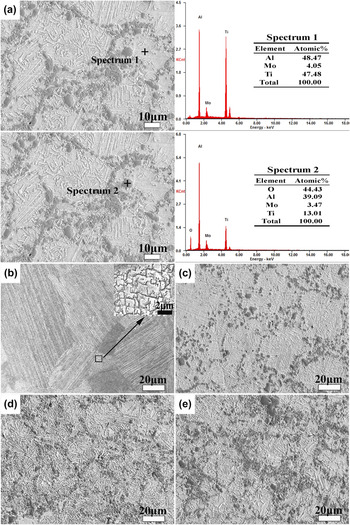
Figure 4 shows the EDS analysis of the as-prepared (Ti,Mo)Al/6 wt% Al2O3 composite and SEM micrographs of etched surfaces of the bulk samples with different Al2O3 contents at 1350 °C. From Fig. 4(a), the composites consist of lamellar matrix phases and particle-like second phases are shown in Fig. 4(a). The individual phases could be identified clearly from the EDS analysis in the right of Fig. 4(a). The plate-like matrix (marked as Spectrum 1) possessed a Ti:Al atomic ratio of 47.48:48.47, which is quite in accordance with TiAl. Then the quantitative atomic ratio of Al and O in the fine particle (marked as Spectrum 2) is 38.48:61.52, which is very close to stoichiometric Al2O3. Combined with the XRD results in Fig. 2, it was confirmed that the (Ti,Mo)Al/Al2O3 composites are composed of the matrix phase and the granular phase.
EDS analysis of (Ti,Mo)Al/6 wt% Al2O3 composite (a); SEM micrographs of polished and etched surfaces following of the bulk samples with different Al2O3 contents at 1350 °C [(b) 0 wt%, (c) 2 wt%, (d) 6 wt%, and (e) 12 wt%].

Figures 4(b)–4(e) show the SEM micrographs of etched surfaces of the bulk samples with different Al2O3 contents at 1350 °C. In Fig. 4(b), stratified TiAl phase with inhomogeneous grains distribution is observed perspicuously and some of the matrix grains is even over 40 μm in size. Besides, the Ti3Al phase appears Reference Niu, Wang, Yang and Wang23,Reference Li, Cui, Wang, Qu, Li, Zhang, Gan, Geng and Meng24 and is depicted in the top right corner of Fig. 4(b), which is consistent with the XRD analysis result of curve (a) in Fig. 2. With the incorporation of Al2O3 particles, microstructure of refined matrix grains is gained apparently from Figs. 4(c)–4(e). Moreover, it could be seen that the Al2O3 particles uniformly distribute at the boundaries of (Ti,Mo)Al/Al2O3 composites matrix with equiaxed morphology in Fig. 4(d) with 6 wt% Al2O3. When the further increment of Al2O3 content is 12 wt% in Fig. 4(e), the composition uniformity is damaged due to the locally distributed and agglomerate of Al2O3 phase, which is detrimental to the mechanical properties of (Ti,Mo)Al/Al2O3 composites.
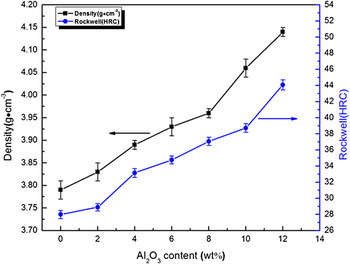
Figure 5 shows that the density and hardness of the in situ TiAl composites with different contents of Al2O3. When the Al2O3 contents increase from 0 to 12 wt%, the densities of the composites increase gradually from 3.79 g/cm3 to 4.14 g/cm3, which is close to the 4.02 g/cm3 reported in Ref. Reference Zhu, Yang, Yang and Wang17. This means the density increase of (Ti,Mo)Al/Al2O3 composites caused by Al2O3 particles is not significant, hence, the lightweight feature of (Ti,Mo)Al/Al2O3 still remains. At the same time, the (Ti,Mo)Al/12 wt% Al2O3 composite owns the maximum Rockwell hardness value of 44.08 HRC, increasing by 57.4% comparing to the monolithic TiAl of 28.00 HRC. The increase of hardness is mainly caused by high hardness of the in situ formed Al2O3 rigid particles. Furthermore, the smaller grains of TiAl matrix in (Ti,Mo)Al/Al2O3 composites refined by the incorporation of Al2O3 phase also contributes to the enhancement of the hardness.
The density and hardness of the (Ti,Mo)Al/Al2O3 composites with different Al2O3 content.

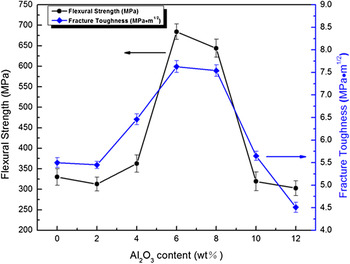
The flexural strength and fracture toughness of the (Ti,Mo)Al/Al2O3 composites with different Al2O3 contents are displayed in Fig. 6. The flexural strength and the fracture toughness reach to the maximum values of 684 MPa and 7.63 MPa m1/2, respectively, when the concentration of Al2O3 is 6 wt%, which are higher than those of 263 MPa and 5.9 MPa m1/2 separately in Ref. Reference Peng, Li, Li, Wang and Gong25. However, when the content of Al2O3 increases continually, the flexural strength and fracture toughness of (Ti,Mo)Al/Al2O3 composites decrease monotonically. The excessive Al2O3 particles resulting in local agglomeration in the TiAl matrix and the inhomogeneous of the matrix grains bring about the reduction of mechanical properties of (Ti,Mo)Al/Al2O3 composites.
The flexural strength and fracture toughness of the (Ti,Mo)Al/Al2O3 composites with different Al2O3 contents.

The SEM micrograph of surface for (Ti,Mo)Al/6 wt% Al2O3 composite demonstrated in Fig. 4(d) shows that the in situ formed Al2O3 particles uniformly disperse at grain boundaries and the grains of TiAl matrix are refined. In the earlier works, Zhu et al. Reference Zhu and Li26 had researched that the percentage of grain boundaries increased as a result of matrix grain refinement. Meanwhile, for polycrystalline materials, the glide of dislocations would be hindered by grain boundaries and the crack propagation is also hindered for the roundabout and zigzag paths along grain boundaries, both of which are beneficial to the improvement of flexural strength and fracture toughness. Reference Zhu and Li26
For another thing, it can be concluded from Figs. 5 and 6 that the higher hardness of in situ formed Al2O3 particles can increase the hardness of the as-synthesized composites. And the increment of flexural strength and fracture toughness of (Ti,Mo)Al/Al2O3 composites is attributed to the second-phase strengthening effect of in situ formed Al2O3 particles. In view of the stiff second phase with high Young’s modulus (386 GPa) and shear modulus (175 GPa), Al2O3 particles can cause reinforced effect to (Ti,Mo)Al/Al2O3 composites as a consequence of residual stress toughening. Because of the higher thermal expansion coefficient of TiAl matrix (αm = 10.8 × 10⁻⁶ K−1) than that of Al2O3 particle (αp = 8.3 × 10⁻⁶ K−1), the residual stress presents as compressive state at the interfaces of matrix and second phase. Choi et al. Reference Choi, Honda, Nishikawa, Awaji, Gnanam, Vishista and Kuroyama27 have investigated the strengthening and toughening mechanisms in ceramic/metal nanocomposites in the early time. During the process of crack propagation, the crack deflection is prone to occur and the stress concentration at crack tips would be reduced through the release of residual compressive stresses and the toughness of composites increases ultimately.
According to the researches from Meng et al. Reference Meng, Zhou and Wang28 and Zhu et al., Reference Zhu and Pan29 Ti2AlC can be strengthened by substituting Ti with M (M = V, Mo) to form (Ti,M)2AlC solid solutions. Since Mo is smaller and has one more valence electron than Ti, the weak Ti–Al bonds are reinforced. In this work, Mo atom with one more valence electron than that of Ti, the weak Ti–Al bonds have been replaced by more stronger Mo–Al bonds which makes the former to be reinforced and then (Ti,Mo)Al solid solutions are formed and the composite is further strengthened.
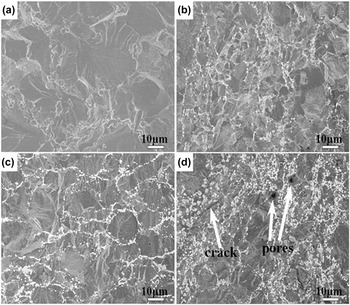
Figure 7 showed the SEM images of the fracture surfaces of the as-received (Ti,Mo)Al/Al2O3 composites with varying Al2O3 contents. Comparing to the single-phase TiAl in Fig. 7(a), the grain sizes of (Ti,Mo)Al/Al2O3 composites decrease significantly for the introduction of in situ formed Al2O3 particles in Figs. 7(b)–7(d). In the previous studies, Lindahl and Liu et al. Reference Lindahl, Guatafson, Rolander, Stals and Andrén19,Reference Liu, Xu, Li, Chen, Li and Zhang21,Reference Wu, Yang, Xue and Sun30 have reported that the formed Mo containing phase could improve the wettability of interfaces between ceramic and metallic matrix phases to introduce a stronger combination of the interfaces. In early years, Humenik et al. Reference Humenik and Parikh31 have researched nickel–titanium carbide systems by smelting vacuum-melted method. As a result, Ni–10Cr–TiC, Ni–10Nb–TiC, and Ni–10Mo–TiC systems exhibited the contact angles of 23°, 22°, and 0°, respectively. Similarly, Liu and Ning Reference Liu and Ning32 had elaborated surface and interfacial energy, work of adhesion and contact angle of metal–ceramic system with Eqs. 14–16.
 $$\cos \,\theta = {{{\sigma _{{\rm{SV}}}} - {\sigma _{{\rm{SL}}}}} \over {{\sigma _{{\rm{LV}}}}}}\quad ,$$
where σSV, σSL, and σLV are the solid–vapor, solid–liquid, and liquid–vapor interfacial tensions respectively.
 $${W_{{\rm{ad}}}} = {\sigma _{{\rm{LV}}}} + {\sigma _{{\rm{SV}}}} - {\sigma _{{\rm{SL}}}}\quad ,$$
where W ad denotes the work of adhesion, defined as the reversible work associated with creating the respective free surfaces from a bonded interface.
SEM images of the fracture surfaces of the (Ti,Mo)Al/Al2O3 composites with different Al2O3 contents: (a) 0 wt%; (b) 2 wt%; (c) 6 wt%; (d) 10 wt%.

Based on Eqs. (14) and (15), the relationship between the work of adhesion and the contact angle can be obtained as:
 $${W_{{\rm{ad}}}} = {\sigma _{{\rm{LV}}}}(1 + \cos \,\theta )\quad .$$
Equation (16) reveals that larger W ad corresponds to smaller contact angle for better wettability. Combining with the study of Humenik et al., Reference Humenik and Parikh31 the Ni–10Mo–TiC system exhibited the minimum contact angle (0°), meaning that the addition of Mo led to better wettability and superior to the other two systems. Hence, the wettability between Al2O3 and TiAl should be improved by the addition of MoO3, which is very helpful to improve the mechanical properties, especially for fracture toughness. Accordingly, the consequences have an advantage in comprehensive properties of composites. Besides, the shape of matrix grains of (Ti,Mo)Al/Al2O3 composites change in the scope of elongated and equiaxial morphology as the Al2O3 contents increase from 0 wt% to 10 wt%. And the shape of matrix grains of (Ti,Mo)Al/6 wt% Al2O3 owns mainly equiaxial morphology. The combination of equiaxed grains and uniform distribution of Al2O3 have a positive effect on the mechanical properties. Reference Sun, Li, Feng and Fang33 This explanation is consistent with the conclusions of SEM microstructure in Fig. 6.
What’s more, there is no pores existed in Fig. 7(c) of composite with 6 wt% Al2O3 content, which is conducive to mechanical properties based on fully dense composites. However, when the content of Al2O3 further increased to 10 wt% [Fig. 7(d)], surface pores and even cracks occur for the local agglomeration of Al2O3 phase at the grain boundaries. The defects are detrimental to the densification of the (Ti,Mo)Al/Al2O3 composites and the mechanical properties of the (Ti,Mo)Al/Al2O3 composites will be deteriorated.
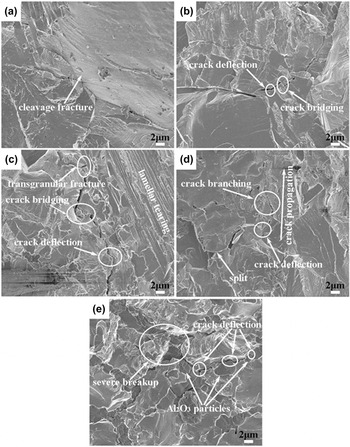
Figure 8 presents the typical crack propagation patterns of as-received TiAl composites with varying Al2O3 contents. It is obviously that there is only cleavage fracture of big grains occurring on fracture texture in Fig. 8(a). At the same time, it can be seen that the cracks show their traits of elongation and straight morphology, on account of the existence of coarse grains and lack of dissipation mechanism of energy. From Figs. 8(b) and 8(c), combined damage modes including crack deflection, crack bridging, transgranular fracture, lamellar tearing, crack branching, and crack propagation are viewed along with the incorporation of in situ generated Al2O3 particles. These multiple damage modes are incorporated as energy dissipation mechanism to make clear the enhanced mechanical behavior. In the meantime, the extended paths of cracks caused by the intergranular fracture bring about more energy consumption due to the dispersed Al2O3 particles at grain boundaries, as depicted in Fig. 8(e). However, split and severe breakup are observed in Figs. 8(d) and 8(e), due to excessive two-phase interfaces and residual thermal stresses are caused by excessive Al2O3 particles and the overall performance of composites is deteriorated.
Typical crack propagation patterns of TiAl composites with different Al2O3 contents: (a) 0 wt%; (b) 6 wt%; (c) 6 wt%; (d) 10 wt%; (e) 10 wt%.

IV. CONCLUSIONS
(Ti,Mo)Al/Al2O3 in situ composites were manufactured successfully at 1350 °C by in situ hot-pressing method based on the Ti–Al–MoO3 system. The synthesized process contains the formation of transient phases TiAl3 and Ti3Al and solid solution (Ti,Mo)Al. The lattice constants a increases and c decreases, respectively, due to the replacement of Ti by Mo atom with smaller size. In situ formed fine Al2O3 particles disperse at the matrix grain boundaries of (Ti,Mo)Al/Al2O3 composites and the grains of TiAl matrix have been refined. As a result, the flexural strength and fracture toughness of (Ti,Mo)Al/Al2O3 composites with the optimum addition of MoO3 8.5 wt% increase as high as 684 MPa and 7.63 MPa m1/2, respectively.
ACKNOWLEDGMENTS
This work was supported by the National Foundation of Natural Science, China (51272145, 51171096), the Shaanxi Provincial Foundation of Natural Science, China (2010JM6014), and the Graduate Innovation of Shaanxi University of Science and Technology. And Mr. Xiaojiang Hou is the person from whom we have got help with the grammar and sentence structure fluent in written technical English.