Introduction
Reflecting on Black voters’ dilemma in the 1916 presidential election, W.E.B. Du Bois wrote, “We found ourselves politically helpless. We had no choice. We could vote for Wilson who had segregated us or for Hughes who, despite all our requests, remained doggedly dumb on our problems.” At its heart, this was the fundamental problem for Black voters in 1916—both viable options were unappealing. There was the Democratic incumbent, Woodrow Wilson, who appointed avowed segregationists and had grievously failed to satisfy his previous promises to Black people. His rival was Charles Evans Hughes, a former New York governor and Supreme Court justice, who promised very little improvement to Black people.Footnote 1
Faced with these options, Black voters could not help but express disappointment. They had been loyal to the Republican Party since the Civil War, yet for years the GOP had seemed loath to outline any program for the improvement of their condition. In 1912, angered by President William Howard Taft’s “alleged discrimination against the colored race in the matter of presidential appointments” and by former President Theodore Roosevelt’s courting of Southern white supremacists as the nominee of the Progressive Party, many Black voters supported the Democratic nominee, Governor Woodrow Wilson of New Jersey. Though Democrats, dominated by a fiercely racist Southern bloc, had long been inhospitable to Blacks and largely unwilling to support civil rights, Wilson seemed to be a new type of Democrat. He promised Bishop Alexander Walters of the African Methodist Episcopal Zion Church “justice … and not mere grudging justice” for Blacks under a Wilson presidency. Wilson’s overtures to the Black community helped earn him the reluctant endorsement of The Crisis, the young magazine of the National Association for the Advancement of Colored People (NAACP).Footnote 2
Yet Wilson’s presidency was a bitter disappointment for Blacks who had supported him. He allowed his Cabinet officers to institute segregation in the federal workforce, dismissed Black civil servants and appointed white Democrats to replace them, and appointed only two Blacks to federal office, even giving positions traditionally held by Blacks—most famously, the post of Ambassador to Haiti, held near-continuously by Blacks since 1869—to white Democrats. Feeling they’d been tricked, many politically involved Blacks grew determined to defeat Wilson in 1916.Footnote 3
Their enthusiasm about the project of unseating Wilson was not rewarded by a convenient Republican nominee. The Republicans chose Hughes, then serving on the Supreme Court, who promptly resigned from the bench to run; buoyed by the dissolution of the Progressives after Roosevelt’s refusal of renomination, Hughes seemed to have a strong shot at the presidency. And yet the Republicans failed to effectively court Black voters and did little to dispel the fear that the GOP promised nothing to Black voters.
As a result of Black voters’ unenviable position, 1916 was an important moment in a longer transition lasting through the 1910s and 1920s in which Black voters’ once-inflexible loyalty to the Republican Party was replaced by a more flexible partisanship that ultimately evolved, in the late 1920s and early 1930s, into support for the Democratic Party. The year 1916 saw the consolidation of a newfound yearning for political independence among Black voters, expressed most obviously in the unenthusiastic response to the Hughes campaign; the creation of local outfits like the Twentieth Century Voters Club of Raleigh, North Carolina; and the first stirrings of a Black independent politics in the thinking of Du Bois and Hubert Harrison.
This essay seeks to buttress the existing literature on Black voting patterns during the Progressive Era and add to the growing subtlety and complexity of the scholarly understanding of Black politics during the era. It does not seek to present 1916 as an inflection point, but rather as an election that caused Black leaders to give more serious thought to strains of Black thought that stressed political independence. By no means was this school of Black thought, which featured a pronounced political realism and an embrace of tactical voting, an innovation. As Millington Bergeson-Lockwood has shown, Black voters had a long tradition of “flexible partisanship” at the local and state levels. “Rather than backing parties in particular … [they supported] any candidate who looked out for their interests, regardless of political affiliation,” as in 1883 when Black voters largely supported Democrat Benjamin Butler’s 1883 gubernatorial bid, or in the 1890s when many North Carolina Blacks supported the Populist Party.Footnote 4
But at the national level, Black voters remained reflexively loyal to Republicans. The election of 1912 had seen an important breaking of some Black voters’ Republican loyalty, though largely for reasons unique to that year: the appeal of Wilson, the distaste for Taft, the divided state of the Republicans. But 1916 saw the underlying factors—the decreasing power of Black voters in the Republican Party and a thirst among Black leaders, especially younger ones, for alternatives—that drove some not to vote for Taft harden and become permanent. The dismay that accompanied the political events of 1916 was a solvent to the old bonds of party loyalty, and Black intellectuals and unhappy Black voters, in turning to alternatives like the Negro Party or simple flexible partisanship, effectively nationalized the local traditions Bergeson-Lockwood described. Ultimately, this change would help catalyze the shift of Black voters into Franklin Roosevelt’s Democratic Party—suggesting a pattern of party migration not from Republican to Democrat, but Republican to “flexible partisan” to Democrat.
Blacks and the Republican National Convention
The first major disappointment of 1916 for Blacks came with the process of nominating delegates to the Republican National Convention in Chicago. Always controversial, the process had assumed an added racial significance since the late nineteenth century, when the Southern “lily whites” began to purge state Republican parties of Black members. Since most Black delegates to Republican conventions had come from the South, “Blacks-and-Tans,” the Southern Republican faction supportive of civil rights and composed largely of Blacks, saw the Southern state conventions that chose national delegates as vitally important for the continuation of Black influence over Republican policy-makers.Footnote 5
The lily-white insurgency in the GOP had been preceded by a wave of Black disenfranchisement across the South that robbed Southern Republicans of their largest constituency. In Louisiana, for example, new legislation and practices caused the number of Blacks registered to vote to drop by nearly 99 percent between 1896 and 1904, to only 1,342. With so many Black citizens newly unable to vote, leading Southern Republicans—who believed that the issue of civil rights had blocked them from electoral competitiveness in the South—decided that Black support had become deleterious to Republican success in the region. The lily-white faction of the GOP, who sought to act on this conviction, first emerged in the 1880s in Texas and took power in the Republican Party there in 1896. Other states followed swiftly. Senator Jeter C. Pritchard of North Carolina pushed the state’s GOP to hold its first all-white convention in 1902. Alabama Republicans followed shortly thereafter, and lily whites took control of the Louisiana Republican Party during Theodore Roosevelt’s first term. State conventions—often held in segregated facilities, a favorite tactic of the lily whites—became heated battlegrounds for the futures of state parties. Oftentimes, when one faction won out at a state convention, the opposing faction would organize a rump convention and fight for legitimacy before the Credentials Committee at the National Convention, which in 1916 was to be held in Chicago.Footnote 6
Because of a change in delegate allotment, the war over control of the state parties promised to be particularly pitched in 1916. National Republican leaders, having been locked out of the South electorally for decades and seeing little reason to maintain a foothold there, proposed a motion that tied delegate allotment at the National Convention to party strength—empowering parties in the North and West and weakening those in the South. The proposal, which gave each state one delegate per congressional district and additional delegates for each 10,000 votes cast for the Republican nominee in the last election, was ratified in 1913 and came into effect in 1916. This reform sharply cut Southern political power at the Convention: Georgia’s delegation, for example, fell in size by nearly a third. Because Blacks had often constituted large shares of the delegates to the Convention, there was “much protest against” the reform measure “by those Negroes who have always attended Republican National Conventions,” the Negro Year Book noted. With fewer spots to go around, competition for those few spots that did remain would prove to be particularly vicious.Footnote 7
The first battle between Blacks-and-Tans and lily whites in 1916 came in North Carolina, where lily whites had near-total control over the state party. On March 2, the state party nominated a slate of white candidates; Black Republicans responded by organizing their own convention, as they had in 1912. The “Negro Republican State Convention,” organized by high school principal Charles N. Hunter, met in Raleigh on April 24. It nominated a rival delegation, composed of both Black and white Republicans, and, according to one newspaper, condemned the state party for “shutting them out of the councils of the state.” Wrote the Raleigh News and Observer: “The G.O.P is placed in a new role. Its disowned child is about to hit back.”Footnote 8
On March 23, the Louisiana GOP met in a whites-only New Orleans hotel. The Louisiana lily whites named a slew of white delegates to the National Convention. As in North Carolina, Black Republicans responded with their own convention on April 27. Assembled by Walter L. Cohen, a confidante of Booker T. Washington, the group styled itself the “Old Republican Party of Louisiana” and nominated a convention equally split between Black and white delegates. The Times-Picayune, a Democratic paper eager to exploit vulnerabilities in the Republican coalition, commented acerbically that “a fight between the opposing delegates from Louisiana is a regular event, sure to come as an exciting prelude to every regular convention….”Footnote 9
On April 26, the Arkansas Republican Party held its convention. There, too, lily whites were in command. The convention voted not to recognize Black-and-tan delegates from Pulaski and Hempstead counties, and nominated an entirely white delegation to Chicago. This refusal to nominate any Blacks was a break with precedent for the Arkansas party—just eight years earlier, a fifth of the delegation had been Black—and caused outrage among the Blacks-and-Tans. The move sparked a revolt from Black Republicans, led by Elias C. Morris. After “the treatment meted out to members of my race in Pulaski and Hempstead counties … I had rather go down with them than go up with those who sought to prevent their affiliation with the party,” Morris wrote to the state party chairman. The Arkansas Gazette described Morris’s rebellion as a plan to “boycott the Republican party.”Footnote 10
On May 20, the Alabama Republican Party held an all-white convention in Birmingham. It also named a largely white delegation, leading J.O. Diffay and Ulysses G. Mason, two prominent Black leaders, to host a Black-and-tan convention that sent a mixed group to Chicago to plead its case before the Credentials Committee. Meanwhile, the Texas Republican Convention at Fort Worth saw high drama due to factional battles. The Fort Worth convention was also dominated by the lily whites. Charles J. Hostrasser, a Black-and-tan from the town of Hearne, introduced resolutions condemning party leaders for their association with the lily whites; when Hostrasser’s resolution failed, he left the convention along with sixty others—most of whom, the Arkansas Gazette noted, “were Negroes”—to form a rump convention. Hostrasser’s gathering nominated a delegation equally divided between Blacks and whites, but it never appeared in Chicago.Footnote 11
At the National Convention, the various battles over credentials that the various rival conventions had promised were each decided in favor of the lily whites. Only one Black delegate, W.L. Saunders of Alabama, was recognized by the committee over the objections of the state party. Because of lily whites’ triumphs and the Republican allotment reform, there were likely fewer Black delegates at the Republican convention than there had been in years, and perhaps decades. There had been 120 known Black delegates from the former Confederacy in 1900, and then 107 in 1912. By 1916, the count had plunged to 69.Footnote 12
Republican Outreach to Black Voters
With a diminished Black presence at the Republican National Convention, it is perhaps not surprising that the GOP gave Blacks a smaller prominence in their platform than it had in years past. In 1908, the Republicans had included in their platform a plank entitled “Rights of the Negro,” reading, in part: “We demand equal justice for all men, without regard to race or color; we declare … for the enforcement in letter and spirit of the Thirteenth, Fourteenth and Fifteenth amendments….” Likewise, in 1912, the Republican platform read, “We call upon the people to … condemn and punish lynchings and other forms of lawlessness….” Yet in 1916, there was no mention or allusion to Blacks, lynching, or “equal justice.”Footnote 13
Nor was the Republican nominee, Hughes, notably friendly to Blacks. Ralph Waldo Tyler, a newspaperman and Republican politician from Ohio, noted that, “while Governor of New York [Hughes] did not make one solitary colored appointment, big or little.” According to Tyler, the candidate had justified this by suggesting “that he would not appoint any man because he was colored, Irish, German, or what not.” While many white Republicans of the time would consider this admirable, a strike against race prejudice, Tyler counted it as a mark against Hughes: “Usually that high idealistic stand results in the utter ignoring of Ham.”Footnote 14
Hughes—an aloof intellectual widely regarded as icy in personal matters—was not, however, an enemy to Blacks’ interests. While serving on the Supreme Court, Hughes had been sympathetic to civil rights pleas. In 1915’s Guinn v. U.S., he had found that Oklahoma’s grandfather clause restriction on voting violated the Fifteenth Amendment—a ruling that affected a number of Southern states, though they soon found other ways to disenfranchise Blacks. In 1914’s McCabe v. Atchison, Topeka & Santa Fe Railway Co., Hughes had delivered the opinion of the court on a case concerning Oklahoma’s “separate but equal” law on railroad facilities. The case had been filed by five Blacks who had wanted the judiciary to restrain railroads from implementing the law before it went into effect. Though Hughes refused to nullify the law on the grounds that the complainants could not show that the claimants had standing (having not been harmed by the law, as it was not yet in effect), he did write, in response to the railroads’ argument that the law was a reasonable response to Blacks’ low demand for luxury coaches, that “whether or not particular facilities shall be provided may … be conditioned upon there being a reasonable demand therefor, but … substantial equality of treatment of persons traveling under like conditions cannot be refused.” It was a bold stand that seemed to contradict the Plessy v. Ferguson case of eighteen years earlier. The Crisis, after the election, praised Hughes’s opinions as “several of the best decisions in favor of the Negro that the reluctant Supreme Court has ever handed down.”Footnote 15
Apart from his court record, Hughes’s speeches did suggest some small measure of interest in Black advancement. What few words that Hughes devoted to civil rights before he entered the presidential campaign came in two speeches, one to Bethel A.M.E. Church in New York City in 1906 and the other to the Tuskegee Institute in 1908. During the Bethel speech, he indulged in the meager denunciation of Southern horrors that many Northern politicians favored (in lieu of appointing Black civil servants or curbing discrimination), declaring: “We don’t want any lynch law, or the spirit that manifests itself in lynch law, anywhere.… I stand ever against unjust discrimination on account of … race or on account of anything.” His Tuskegee speech was longer and more detailed. During it, he dwelled on Black self-help in the vein of Booker T. Washington:
The black man is entitled to his chance. He is entitled to the advantages of training and education. He is entitled, under the stimulus of free institutions, to an opportunity to prove by his works what is in him, and he is entitled to the rewards which his character and industry may deserve.… In this provision that is made for special preparation, for needed particular training, the Negro must have a generous share. He must have a share that is delimited in recognition of the disadvantages under which he has labored and the serious handicaps of the past.
Hughes thus possessed a lukewarm record on civil rights as he entered 1916. Though likely largely free from prejudice himself—he had, before entering public life, earned derision from fellow Baptists by inviting Washington to be a guest at a dinner of the New York Baptist Social Union—he expressed no great interest in Black uplift and clearly had no intention of making it a focus of his presidency were he elected. In the same paragraph in which it had praised his court record, The Crisis called him “curiously dumb” in regard to “specific Negro problems.”Footnote 16
With its candidate wielding a relatively deficient record on Black issues, most Republican outreach to Black voters came through intermediaries or independent supporters of Hughes. John E. Milholland, the first treasurer of the NAACP, assured the group that “Hughes’ attitude is right on every question” of civil rights. Likewise, Elizabeth Freeman, a white English-born suffragist and Progressive who had investigated the lynching of Jesse Washington for the NAACP before joining the “Hughesettes,” a group of prominent women campaigning for the Republican ticket across the West, pitched Hughes as the best candidate for Black voters. During her speeches in the West, Freeman gave special attention to Blacks, going to Black churches and attacking Wilson on his appointments record, lynchings, and civil rights. As with prior years, most Republican outreach to Black voters came at the local level—if voters were motivated to turn out to support friendly local authorities, they would likely cast a ballot for the presidential candidate of the same party while at the polls. Former Ohio governor Myron Herrick, who was running for a Senate seat in Ohio, excelled in outreach to Blacks. The Cleveland Advocate praised him for a speech extolling Blacks’ progress “in Education, Character and Thrift.” Herrick also maintained an active, if exceedingly formal, correspondence with leading Black barber and politician George Myers.Footnote 17
The major factor aiding Hughes in securing Black votes was the default preference many Black leaders had for the Republican Party. Ida B. Wells-Barnett, for example, gave at least one speech for Hughes in Kansas City, seemingly without any involvement from the national campaign. Wells-Barnett seems to have been an effective orator for the GOP. A correspondent of Mary Church Terrell, writing from Fort Wayne, Indiana, said in late October that “they [presumably the Republicans, possibly a lecture circuit group] sent in Mrs. Ida Wells, Barnett [sic]. She spoke very nicely and pleased them. At night Ms. B. made a political speech. She was very good at that.” Hughes was also boosted by supportive Black leaders at a “national race conference” in Indianapolis, Indiana. Held at the Mount Carmel Baptist Church and composed largely of representatives from the North and the West, the convention quickly declared for Hughes after an unsuccessful pro-Wilson speech from H. Martin Williams, the reading clerk of the House of Representatives. The conference sent a delegation to New York City to hear from the Republican nominee on civil rights. Though Hughes gave a relatively uninspired speech upon receiving the delegation—“I am and always have been friendly in my feelings to the colored people … [and] am mindful of your problems”—his words were received positively and reprinted in several Black publications, including The Crisis. Footnote 18
The Black outreach that did come out of the Hughes campaign on its own initiative was limited. He received a visit from the African American activist William Monroe Trotter around the same time as his meeting with the race conference delegation, though Trotter did not publicly announce an endorsement.Footnote 19 Apart from his statement to the race conference delegation, the candidate commented on civil rights only once during the campaign. On September 4, in Nashville, Tennessee, speaking before a Black audience, Hughes said, “I stand … for equal and exact justice to all. I stand for the maintenance of the rights of all American citizens, regardless of race or color.”Footnote 20
Far more active in making the case for voting Republican to Black voters was the Republican National Committee’s Colored Advisory Committee (CAC), which was formed in October. Headquartered in New York, the committee was composed largely of Republican stalwarts who composed the upper crust of the Black elite, “regulars” more involved in GOP activities than Du Bois or Harrison: Fred R. Moore, editor and publisher of the New York Age; Charles A. Cottrill, former collector of internal revenue for Hawaii; William H. Lewis, whom Taft had appointed to be the first Black assistant attorney general; Harry S. Cummings, the first Black Baltimore councilman; R.R. Church, Jr., the powerful leader of Black Republicans in Tennessee; Charles W. Anderson, an associate of Washington and collector of internal revenue for the Second District of New York; Andrew F. Stevens, a member of the Pennsylvania Republican Committee; and Henry Lincoln Johnson, the former recorder of the deeds for the District of Columbia.
The committee conducted myriad activities to support the Republican ticket. It sent Black surrogates to speak to Black communities in states Hughes needed to win, such as Maryland and Ohio. It sponsored a pro-Hughes advertisement in the November Crisis, reprinting Hughes’s Bethel speech and declaring that “EVERY COLORED MAN Should Endorse these Lofty Sentiments by VOTING FOR CHARLES EVANS HUGHES and the Entire Republican Ticket.”Footnote 21
Perhaps the major gauge of Black opinion in 1916 can be found in the Black press. Undoubtedly, many Black newspapers responded highly favorably to the Hughes candidacy. Those that did—mainly mainstream Black outlets already loyal to the Republicans—painted him as a champion of civil rights. The New York Age, edited by James Weldon Johnson, was jubilant upon his nomination:
The nomination of Charles Evans Hughes means victory for the Republican party.… In Mr. Hughes, the Republican party has a candidate of the highest order.… [Some] feel that what the race needs in a president is not only mere absence of prejudice, but sympathetic interest. And they have been wondering if Charles E. Hughes has won will develop this sort of interest. In our opinion fears upon this point are needless….
As proof of his “sympathetic interest” in Blacks, the article cited Hughes’d Supreme Court record. The Age also made much of the nominee’s speech in Nashville. On October 19, it ran a front-page cartoon showing Hughes standing on ground labeled “Republicanism” and holding a paper saying, “You May Have Implicit Confidence in Me, for I Believe in Equal Opportunity for All.”Footnote 22
With all indicators suggesting a close race, Black newspapers supporting Hughes shifted to focusing on Wilson’s segregationist ties as the election neared. James Weldon Johnson, for example, shifted from advocating Hughes’s civil rights bona fides to equating Wilson to the most notorious of Southern demagogues:
And again we say to the colored voters throughout all the civilized sates [sic] that the coming election means more to us as a people than any in the past thirty years. It is not a question of the Democratic party going into power with a Grover Cleveland in office; it is a question of the Democratic party going into power with a man in office who does not stand with liberal Democrats of the North, nor even with the broader minded Democrats of the South, but who is one in sentiment and practice with the Hoke Smiths, the [James] Vardamans, the [Benjamin] Tillmans and the Cole Bleases, the men who openly declare that the Negro should have no part or participation in the Government.
Smith, Vardaman, Tillman, and Blease were notorious as the most retrograde and violent Southern demagogues. The tactic of tying Wilson to these Southrons was not an uncommon one in the Black press in 1916; nor was the charge wholly inaccurate, given Wilson’s record. In a style similar to the Age, the Cleveland Advocate suggested that reelecting Wilson would be tantamount to “another four years of anti-Negro legislation, segregation in government offices, and the continued reign of Tillman, Vardaman, Hoke Smith and the rest.” The Denver Star even ran an article, “Two Views on Education,” comparing a speech from Hughes to a speech not from Wilson, but from Tillman. Given the heavy use of old quotations in these attacks, the remarkable consistency of the comparison across many newspapers, and the repetition of certain articles, it is certain that the tactic was manufactured by the CAC.Footnote 23
Making Tillman the Democratic candidate was not the Republican Black press’s only strategy. Other papers sought to stir their readers to vote by simply invoking the Republican Party as the party of safety for Black people. The Kansas City Sun, in its pre-election issue, paraphrased Frederick Douglass: “The Republican party is the ship of state. The Democratic party is the sea. Democrats would destroy your rights. Republicans made you free.” The St. Louis Argus declared, “Safety First. Vote The Straight Republican Ticket.” This tactic, too, seems to have mirrored a tactic of the Republican campaign. Leading a rally with Freeman and Cottrill, W.T. Vernon, a former registrar of the Treasury, declared that a Hughes presidency “will mean race safety.” With no real promises to which to point, a mere promise of maintaining the bare minimum—“race safety”—sufficed as justification for voting Republican.Footnote 24
Another element of the Black press’s shadow campaign against Wilson was advancing the argument that the booming wartime economy of 1916 that many Blacks were enjoying was doomed to crash. The Indianapolis Recorder, in a list of reasons to vote for Hughes, declared that “he will protect this country against being flooded with the cheap manufactures of Europe after the war.” Earlier, the paper had blared: “Remember Dark Days Under Democratic Tariff Law Before European War Began?” The Cleveland Advocate chimed in with a cartoon that warned Black voters of a return to “Normal Democratic Times,” with the implication that the war boom was an abnormality that allowed the Democrats to appear good stewards of the economy. This was largely the extent of campaign-related war commentary in the Black press in 1916; whereas white papers devoted extensive attention to the events in Europe and the possibility of American involvement, Black papers focused mainly on domestic concerns in 1916. The possibility of Americans, and thus Blacks, serving in the European war was hardly brought up in Black weeklies in relation to the campaign; it was often incurred, instead, as a possible cause of an improvement in Black wages and living standards. Many Black voters, it seemed, were more preoccupied with domestic issues than with the prospect of war.Footnote 25
An Unsuitable Alternative
In contrast to his activities in 1912, Wilson barely bothered with Black outreach in 1916. He did not devote a considerable amount of time or effort to talking with Black leaders; nor did he try to spin his presidency as a success for Blacks. Perhaps his infamous meeting with Trotter in 1914—when the activist told Wilson that in 1916 segregation would alienate Black voters, who had seen him as a new Lincoln, causing the president to snap that it was “a matter of entire indifference to him how the Negroes of the country voted, provided he was convinced in his own mind that what he was doing was the right thing to do”—had deflated any illusions about winning the Black vote. When The Crisis reached out to him to ask about promises he would like to make to Black voters, his secretary, Joe Tumulty, responded: “He stands by his original assurances. He can say with a clear conscience that he has tried to live up to them, though in some cases his endeavors have been defeated.” The decision to leave such a task to an aide, and to make neither apologies nor new promises after a first term that had dismayed Black Americans, suggests that Wilson had given up on matching or exceeding his showing among Black voters in 1912.Footnote 26
In spite of Wilson’s apparent disinterest in cultivating Black voters, a few prominent Black leaders attached themselves to his cause. Walters, to whom Wilson had made the promise of “justice … and not mere grudging justice” in 1912 and whom Wilson had offered the post of ambassador to Liberia in 1915, praised the president for his efforts to appoint Black civil servants. Rufus L. Perry, Jr., president of the Hannibal Democratic Club of New York, wrote a pro-Wilson article that was circulated to Black publications around the country. As head of the Hannibal Club (sometimes called the Hannibal National Negro Democratic League), Perry distributed a report of a “long and satisfactory” interview with Wilson—of which no record exists in Tumulty’s records, or anyone else’s—that met with ridicule from the Baltimore Afro American, which said that the “members of this heroic body” presented Wilson with only a “long address of praise.” Groups like the Afro-American Council of San Francisco also favored Wilson’s reelection. P.C. Thomas, the editor of the Kansas Baptist Herald, was particularly vociferous in supporting the president. He claimed that Wilson had a strong record of appointing Blacks and falsely alleged that Hughes had turned out Black officeholders—the very charge of which Wilson was guilty.Footnote 27
As was the case with the Republicans, the Democratic Party compensated for their candidate’s lack of appeal to Blacks with the creation of a campaign bureau. Chair of the Democratic National Committee Vance McCormick, who was directing Wilson’s reelection campaign, ordered Robert S. Hudspeth, a longtime Democratic worker and chair of the campaign’s Labor Bureau, to form “a bureau … to have charge of negro [sic] voters,” according to Hudspeth. A white man, Hudspeth was supportive of Black interests, having lobbied for Black appointments early in the Wilson presidency, and he viewed his task as defending a relatively positive record of achievement. Hudspeth promised to “go ahead and create the Bureau so that the negroes would see that the democrats [sic] have not ignored them.” The bureau is only known to have produced a single pamphlet, Cornelius A. Hughes Discusses Wilson and Why Colored Men Should Favor His Re-Election, written by a prominent Black Tammany Hall official.Footnote 28
In addition to Hudspeth’s bureau, Black Democrats formed independent groups like the Colored Democratic League of New York State, led by James A. Ross, the editor of Buffalo’s Globe & Freeman, and Perry, Jr., who was also a renowned Brooklyn lawyer. The National Colored Democratic League—led by A.E. Patterson, whom Wilson had unsuccessfully nominated for register of the Treasury, and by Thomas Wallace Swann, a civil servant in Illinois—also established headquarters at Chicago and New York. It seems the only event held by Black supporters of Wilson was in September 1916 in Buffalo, New York; the Afro American mocked it harshly, publishing a poem satirizing the Black Democrats’ subservience:
We are with you, Father Woodrow
Because we love you so
We forget that you against us did sin
And are going to let you do it ag’in.Footnote 29
The Wisconsin Weekly Blade note that of the “more than 300 colored newspapers in the United States,” “only three are supporting the Democratic party.” It is not entirely clear to which three the Blade was referring. Certainly, one was the Tulsa Weekly Star of Oklahoma. Though most of its pre-election issues have been lost, its September issue includes critiques of the Republican Party as an institution that had failed Blacks: “WHAT HAS THE REPUBLICAN city administration does for the East End? Answer: Nothing! … WHAT ABOUT the assistant city attorneyship promised the leader of the Colored forces of the G.O.P. last spring?” The paper also praised Wilson for his actions on behalf of farmers and suffragists, while upbraiding Hughes for his evasive answers on railroad regulations.Footnote 30
Despite these examples of Black support for Wilson, one would be remiss to think that Wilson was seriously interested in securing the Black vote. This is illustrated by his encouragement of the “colonization” conspiracy theory, a response to the massive migration of Black Southerners to the North that was in its infancy in 1916. Black migration and a close race between Wilson and Hughes in East St. Louis, Illinois, led to charges from local Democrats (with support from the Democratic National Committee) that Republicans were importing Blacks to vote. The conspiracy theory spread, with encouragement from Wilson—who warned of voter fraud being executed by “sinister forces”—and Attorney General Thomas W. Gregory, who announced a federal investigation into the allegations. In East St. Louis, dozens of Black voters were removed from the voting rolls, while Gregory’s investigators questioned (and undoubtedly intimidated) Black voters in Illinois, Indiana, and Ohio. William Willcox, the chairman of the Republican National Committee, called Gregory’s investigation “a bald attempt to disenfranchise Negro voters.”Footnote 31
The Power of Black Disenchantment
The pervasiveness and force of the Black press’s campaign against Wilson indicates not only Wilson’s weakness with Black voters but also that Hughes suffered a dearth of appeal. The case for Hughes could not be made on his own merits; he could only be shown as an honorable, upstanding man who was better than the alternative. In fact, with Hughes as the nominee, Republicans suffered nearly as bad a problem of Black enthusiasm as they had in 1912.
Part of the reason for the lack of Black enthusiasm for Hughes was the campaign’s failure to cultivate Black voters. The stolid, reticent candidate provided relatively few words that could be used as evidence of his sympathy for Black citizens. In fact, the candidate’s privacy was so thoroughgoing that he kept stories that could have helped his cause, such as that of the Baptist Social Union dinner, to himself. He was a careful, prevaricating, sometimes vague speaker, a problem that hounded him throughout the campaign and that earned him the mocking nickname “Charles ‘E-vasion’ Hughes.”Footnote 32
But the broader reason that a Hughes presidency did not elicit enthusiasm among Black voters was the growing recognition that even a Republican victory would mean little in the way of progress. Nothing from Hughes’s campaign statements showed any determination to appoint more Blacks, push for civil rights, or curb lynching. The platform did not mention civil rights, but even if it had it stands to reason that many Blacks would see these as hollow words that would not be honored. A representative opinion belonged to Tyler, who wrote to Myers, “We cannot fare any worse under [Hughes] than we did, or have under that bourbon—Wilson. We, at least, under Hughes, will get justice so far as the letter of the law goes….” The Black nationalist and longtime Republican John Edward Bruce wrote that Hughes was “neither a Lincoln a McKinley or a Roosevelt in his attitude toward the Negro” and was “hardly a man to enthuse over.” Echoing warnings about Blacks’ declining influence in Republican politics, Bruce suggested that the Republican convention was “the beginning of the end” of civil rights as a campaign issue. And the Afro American lamented that “Republican leaders in Maryland are working like trojans to get white men to support Hughes” while “very little is being done to arouse the interest of the big army of colored voters.”Footnote 33
The extent of unease over the lack of compelling options in 1916 can be seen most clearly in the pages of The Crisis, which agonized publicly over the election. In October, it declared:
The Negro voter enters the present campaign with no enthusiasm.… They are forced … to vote for the Republican candidate, Mr. Hughes, and they find there little that is attractive.
Mr. Hughes is a northern man of sterling honesty, but he knows nothing about Negroes and he has neither time nor inclination to learn. His final conclusions concerning them were made twenty or thirty years ago.… Under ordinary circumstances the Negro must expect from him, as chief executive, the neglect, indifference and misunderstanding that he has had from recent Republican presidents. Nevertheless, he is practically the only candidate for whom Negroes can vote. We say nothing concerning the Socialist candidate. They are excellent leaders of an excellent party; God send them success! But the effective voter has a chance between two parties, the vote for the third party is at least temporarily thrown away.
With no political party exclusively devoted to Blacks yet existent, The Crisis focused on wringing concessions and promises out of Hughes. On September 28, its editors sent him a pleading missive:
As Negroes and as their friends; as Americans; as persons whose fathers have striven for the good of this land and who ourselves have tried unselfishly to make America the land of just ideals, we write to ask if you do not think it possible to make to the colored and white people of America some statement of your attitude toward this grievous problem such as will allow us at least to vote with intelligence.
It seems to us that we have a right to know your attitude toward lynching, disenfranchisement, caste and race hatred, and that without this knowledge it will be impossible for us to cast a discriminating vote. We are especially anxious to know how far the possession of a dark face or a drop of Negro blood will in your administration act as a bar to appointment to office and how far the inherited prejudice of many Americans shall veto the rights and civil privileges of others.
The letter was signed by Du Bois; Joel Springarn, the chairman of the NAACP’s board of director; Oswald Garrison Villard, then its treasurer, and Archibald Grimké, the leader of its Washington, D.C., branch. Despite a notice from Hughes’s secretary that the letter would be brought to his attention—and despite the Republican Party’s ostensible interest in serving a long-standing constituency and reliable source of votes—the missive went unanswered.Footnote 34
Angered by Republican neglect, The Crisis wrote a scathing editorial in its November issue. “We want to say a last word to the leaders of the Republican party,” it said. “If anyone thinks that the Republicans have 500,000 Negro votes in their pockets they have some more thinking to do.” The editorial drew attention to how critical Black voters were to the Republican coalition:
No intelligent Negro can vote for Woodrow Wilson, but he can vote Allan L. Benson [the Socialist nominee] or he can stay home on election day, unless Mr. Hughes satisfies him by some statement more specific than the Nashville speech and more recent than the speech of ten years ago [to Bethel A.M.E. Church].
The Crisis editorial, in its tone of clear exasperation and anger at a party to which the majority of Black voters had been loyal for decades, is a clear statement of the extent of Black intellectuals’ dismay. They were, indeed, demanding more of the politicians they supported: not mere “sympathetic interest,” but action.Footnote 35
The quasi-endorsement of Benson, too, illustrates the difficult position of Black leaders in 1916. Du Bois and other liberals were forced to walk a difficult line between pragmatism and idealism. Du Bois had, as is well known, a long history of supporting the Socialist Party for what he dubbed its “manly stand for human rights irrespective of color.” Yet a large Black vote for the Socialists carried with it distinct risks. If Blacks were to totally abandon the major parties, they might find their causes abandoned by both parties, not just the Democrats. Moreover, the Socialist Party, while more progressive on race than both major parties, was neither immune to racism nor particularly attentive to Black interests.Footnote 36
The disenchantment of Blacks can be seen in the decisions of several past Black surrogates for the GOP. Mary Church Terrell, a charter member of the NAACP, did not volunteer on behalf of the Republicans as she had in 1912, though she appears to have remained sympathetic to the party. The same could not be said of one of her correspondents: S. Willie Layton, secretary of the Philadelphia Association for the Protection of Colored Women and the president of the Black Baptist Woman’s Convention was disillusioned with the available options and threw her support behind the National Woman’s Party (not, in fact, a political party, but rather a militant interest group headed by Alice Paul), suggesting that it “affords our people one of the best chances since emancipation.”Footnote 37
The Prospect of Independent Black Politics
In some regards, 1916 was a nadir for Black political aspirations. Neither major party mentioned Black issues in their platforms; both candidates studiously avoided civil rights talk; and few held the illusion that the election of Hughes in November would mean an end to lynchings, discrimination, and other scourges. And yet from this low point was born a reevaluation by leading Black thinkers of the utility of independent Black politics. This idea had many shades: some preferred tactical partisanship; others wanted total nonpartisanship; others yet favored the most radical proposition, an all-black “Negro Party.” These calls for Black political independence can be seen as a parallel to the forthright legal activism illustrated by the anti-disenfranchisement cases, such as Williams v. Mississippi, brought by Blacks around the turn of the twentieth century—a vision of politics that emphasized Black people fighting for their own interests without overdependence on the benefaction of sympathetic whites.Footnote 38
Suggestions of what form Black independent politics would take two basic flavors, which might be called Fortunism and Harrisonism. Fortunism (which might also be called “Negrowumpism,” the name Fortune gave it), named for T. Thomas Fortune, emphasized race pride, and, somewhat paradoxically, the shared interests of voters of all races; in the political sphere, it was contemptuous of irrational party allegiance and tended toward tactical partisanship. Harrisonism, named for Fortune’s sometime colleague Hubert H. Harrison, was more race-conscious and favored specifically Black political institutions, including the concept of a Negro Party.
Fortunism owed its roots to Fortune’s self-identification as a “race man, promoting race pride and race unity and solidarity.” He lobbied for the demonym “Afro-American” as opposed to “negro”; he advocated building a statue of Nat Turner instead of John Brown. (“It is quite remarkable,” he wrote, “that whenever colored men move that somebody’s memory be perpetuated, that somebody’s memory is always a white man’s.”) And yet Fortune also believed fervidly in assimilation, arguing that “race absorption” through miscegenation would eventually solve racial problems. Black people, Fortune thought, ought to view themselves chiefly as Americans, with ever-weakening ties to the “African fatherland”; any element of the country that was incapable of eventual absorption “has no place whatever in American life, and will always be regarded as a national menace.” Fortune saw race pride as part of the process of Black people maturing and becoming normal citizens: “To preach the independence of the colored man is to preach his Americanization.”Footnote 39
Fortune did not see Black people as unique in their political interests. Influenced by Marxist thought, he suggested that “the interests of the white and the interests of the colored people are one and the same.” This meant that the Black man should “rise to a full conception of his citizenship” and thus normalize his approach to politics and end unquestioned support of the Republican Party. What was needed were “Negrowumps,” people who voted “race first; then party.” This did not mean a Black electoral monolith or exclusively Black political parties. The “Negrowumps” would inevitably not be united in their votes. “When the colored voters differ among themselves and are found to be on both sides of local political contests, they will begin to find themselves of some political importance, and their votes will be sought, cast, and counted,” he suggested. Instead, Fortunism was more atomistic, with each Black person making the decision themselves based on an unsentimental, coldly rational analysis of whatever party would help them the most. Douglass-style aphorisms meant “a million votes sacrificed annually upon the altar of gratitude” to the Republicans; there were “more advantageous affiliations” than the GOP, but the choice of party affiliation was up to each individual and ought to be made based on facts.Footnote 40
Not all Negrowumps, even those who inspired directly by Fortune, clung to all of his doctrines. Trotter, a committed Negrowump, differed from Fortune on his attitude toward Booker T. Washington (Fortune an ally, Trotter a harsh critic) and on several political questions, such as the role of women in the movement. But Trotter correctly perceived the essence of being a Negrowump as building communal solidarity and promoting nonpartisanship: in 1912 he held rallies imploring Black voters to “vote policy, not party.”Footnote 41
Harrisonism, meanwhile, was more militant and far friendlier to the concept of an all-Black partisan outfit. It was more internationalist in character, with Harrison finding inspiration from the Irish independence movement in 1916. Harrison expounded these views for years and gave them conclusive voice years later, with his influential editorial on “A Negro for President.” Harrison wrote that
the Negro people of America would never amount to anything much politically until they should see fit to imitate the Irish of Britain and to organize themselves into a political party of their own whose leaders, on the basis of this large collective vote, could “hold up” Republicans, Democrats, Socialists or any other political group of American whites.
The proper policy, Harrison felt, was not only Fortunist tactical partisanship but indeed a Negro Party. It was a mistake to support either political party in the present situation, and throughout 1916 Harrison was a harsh critic of both parties. Wilson was “a sayer of great things whose deeds bore no consistent relation to his words.” Harrison pilloried “Negro radicals like [A. Philip] Randolph and [Chandler] Owen and liberals like DuBois [sic]” whom he claimed were Wilson supporters. (None of them were actually supporting Wilson.) This did not mean, however, that supporting Hughes as a lesser evil was right.Footnote 42
On the surface, both Fortunism and Harrisonism favored serious alternatives to the Republican monopoly on the Black vote. Both favored race pride and some sense of autonomous Black political identity. But their conclusions were starkly different. Harrison refused to support either Wilson or Hughes. Fortune, meanwhile, made the tactical decision to support the Republicans in 1916. He compiled a campaign booklet titled “The Republican Party and the Negro,” in which he argued that “as a matter of principle the Negro is a Republican, born and nurtured in the Republican Faith, and is against the Democratic party because it is and always has been against him.” Some of this hyperbole, which would seem to contradict his opposition to language like “the Republican Faith,” is owed to the peculiar exigencies of campaigning; but Fortune is clear that the reason Blacks ought to support Hughes was not Douglass’s bromide on “the ship and the sea,” but rather a logical assessment of the two parties’ stances.Footnote 43
Regardless of whether they had encountered Fortune’s writings, the ideas underlying Fortunism, which suggested less radical action than Harrisonism, had significant cachet among certain Black political bosses and activists. The year 1916 saw two prominent attempts to create Negrowump institutions.
In Tennessee, R.R. Church, Jr., the maven of Black politics in that state and the so-called “dictator of the Lincoln belt,” sought to build political muscle outside the direct control of white Republican bosses. Thus he founded the Lincoln League, which was determined to “regain the lost rights of a growing race.” This was not an attempt to coerce concessions out of Republicans but rather one to concentrate more political power in the Black community; as one newspaper said of the League, its goal was making “a wise use of this [electoral] power in defending itself and advancing the interests of all the people.” The Lincoln League succeeded in registering about ten thousand voters, making Blacks almost a third of the total electorate in Shelby County.Footnote 44
Church, Jr.,’s group differed from Fortune’s vision in a few important ways. Fortune harshly criticized unquestioned loyalty to the GOP; though Church, Jr., built political power in the community, there was never a question that the Lincoln League (its formal name the Lincoln Republican League) would be solidly Republican. The organization required those it registered to support the GOP at the ballot box, and its registration drive was credited with delivering Shelby County to Hughes in an otherwise bad year for Republicans in Tennessee. Economically, too, the group was significantly different from Fortune’s vision. Fortune was a quasi-Marxist who focused on the “struggle … between capital and labor, landlord and tenant”; Church, Jr., was a bank president and the son of the wealthiest Black man in the country. Fortune stressed diversity in voting choices; Church, Jr., emphasized unity: a unified front “would result in the election on local and national scenes [of] candidates for various offices who would be compelled to adhere to the demands of the voters who elected them,” he declared.Footnote 45
A more faithful example of Fortunism in action was the Twentieth Century Voters Club of Raleigh, North Carolina. Formed by leaders like Charles N. Hunter, the group was less tied to the Republicans. As Glenda Elizabeth Gilmore notes, the name “Twentieth Century Voters Club” was “a conspicuously non-partisan appellation.” It declared that unless Black voters united and demonstrated their power, they would be “reduced to a condition of vassalage.” Unlike the Lincoln League, they did not evince a strong sense of loyalty to the Republican Party, and indeed they struck fear into the Republican establishment. The Raleigh Times wrote: “‘The Twentieth Century Voters Club’ may or may not bring some negroes to the polls; but it will certainly cost the Republicans some ballots—a circumstance about which … [its leaders] are worrying about as they would about a possum up a tree!”Footnote 46
Despite the progress made by Church, Jr., and Hunter, the Fortunist political organization did not inspire a great sense of confidence. As the examples of Tennessee and North Carolina show, they were typically top-down efforts. They did not have the sense of radical possibility of Harrison and his acolytes; though they flirted with independence from the Republican Party, even the comparatively bolder Twentieth Century Voters Club did not recommend alternatives to the Republicans in 1916. (It would do so in 1919.)Footnote 47 Nevertheless, many prominent Black intellectuals followed Fortune’s path: they swallowed their unhappiness and decided to tactically support the Republicans. For example, Bruce, who had lamented Hughes’s failure to match his Republican forebears, decided that the GOP remained the best option and opted to “render some service” to the nominee.Footnote 48
The Harrisonist mode of Black political independence, meanwhile, saw a boom in 1916. Unlike Fortunism, it gained a constituency mainly among intellectuals. An increasing number of thinkers who would normally have disagreed strenuously with Harrison’s radicalism, such as those behind the NAACP, came to agree that “a political party of their own” was the best solution to the Black political struggle. The idea of a Negro Party was reborn at Troutbeck, Joel Springarn’s home in Amenia, New York, in August 1916. Technically, it was an “independent” retreat for national civil rights leaders, though for all intents and purposes it was an NAACP event. It came at a propitious time. The time, as Du Bois would later reflect, was “ripe.” Booker T. Washington having recently died, the NAACP viewed the conference as an opportunity “to unify civil rights leaders and to fortify its own role in the struggle for freedom for African Americans.” About two hundred invitations were sent out; Wilson, Hughes, Roosevelt, and Taft declined, each sending “messages of good will.” Among those who did attend were John Hope, Charles Chesnutt, Fred Moore, William H. Lewis, James Weldon Johnson, Mary Church Terrell, and Alexander Walters.Footnote 49
Du Bois would later write that he doubted “if ever before so small a conference of American Negroes had so many colored men of distinction who represented at the same time so complete a picture of all phases of Negro thought.” Ironically, it was a relatively obscure white woman, Inez Milholland, who became the exponent of the Negro Party idea. Milholland was a suffragist and the daughter of NAACP treasurer John E. Milholland. No transcript of the speech survives, but its potency is evidenced by its enthusiastic reception. “Miss Inez Milholland, in a recent address, outlined with singular clearness and force a Negro Party on the lines of the recently formed Woman’s Party,” he wrote in the October Crisis. In the same article, he declared:
There is for the future one and only one effective political move for colored voters.… It is a move of segregation, it “hyphenates” us, it separates us from our fellow Americans; but self-defense knows no nice hesitations. The American Negro must either vote as a unit or continue to be politically emasculated as at present.… Negroes can have choice in the naming of these candidates and they can vote for or against them. Their only effective method in the future is to organize in every congressional district as a Negro Party to endorse those candidates.… If no candidate fills this bill they should nominate a candidate of their own and give that candidate their solid vote. This policy effectively and consistently carried out throughout the United States, North and South, by colored voters who refuse the bribe of petty office and money, would make the Negro vote one of the most powerful and effective of the group votes in the United States. This is the program which we must follow.Footnote 50
With the Harrisonist proposal of a Negro Party boosted by Du Bois, it soon received a warm reception in the Black press. The St. Luke’s Herald of Richmond, Virginia, declared, “It almost seems that the Negro will be forced to do this, willing or unwilling.” The Baltimore Afro American enthused over the possibilities, suggesting that “with the two and one-half millions of colored people actually wielding the ballot in a single party, their popular vote would be just six times the voting strength of the Socialists’ and fourteen times the strength of the Prohibitionists’ in the presidential election of 1912.” Moorfield Storey, the white civil rights activist and associate of the NAACP, endorsed the proposal as “exactly right.… An extremely good number.” Also apparently inspired by Millholland, two prominent Black educators, R.R. Wright and William Pickens, both of whom had been present at the Amenia Conference, urged the “black masses” to create their own party.Footnote 51
The November Crisis seemed to suggest that Arkansas Blacks were already thinking about acting on the idea. A short bulletin ran in that issue suggesting that “Negro voters in Arkansas are considering a Negro Party ticket.” This was an exaggeration. Morris, after the Credentials Committee rejected his plea for recognition, had formed a group called the Arkansas Voters’ League. Morris flirted with abandoning the Republicans, only to rename the group the Hughes and Fairbanks Republican League and settle on distributing sample ballots to Black voters that instructed them to vote against the lily whites.Footnote 52
Roots of the Black Exodus from the Republican Party
The 1916 race was the closest in decades, closer even than the McKinley-Bryan contest of 1896. Wilson swept the South and the West, while Hughes took the North and most of the Midwest; Wilson eked out a victory despite close races in Ohio and California.
No pre-election or exit polls were conducted of the Black vote in 1916, and there is very little data to show how Black people specifically cast their ballots. Of course, it seems likely, if a bit strong, to say with the preeminent Wilson historian Arthur S. Link wrote that “the Negro vote went almost solidly to Hughes.” Republicans certainly won the Black vote, but this is almost trivial. The real story of the Black vote in 1916 was diminishing enthusiasm—which can be seen in a look at the votes of counties with significant Black populations.Footnote 53
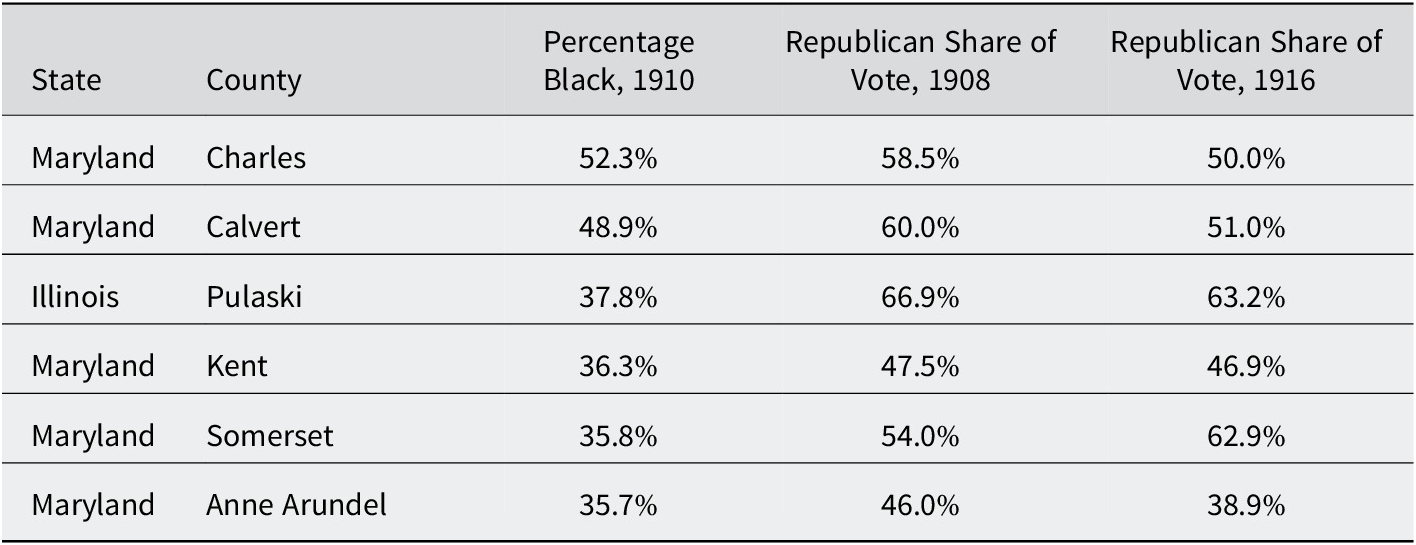
The closest approximation can be found by the vote of counties containing large numbers of black citizens. Table 1 lists all counties in non-Southern states (including Maryland) in which Blacks constituted at least 35 percent of the population in 1910, and gives the percentage they gave to Hughes in 1916 compared with the percentage they gave to William Howard Taft in 1908 (table 1).Footnote 54
Race and Voting in Presidential Contests, 1908 & 1916

With the exception of Somerset County in Maryland, each county in the nation with a 35 percent Black population or more showed less support for the GOP nominee in 1916 than it had in 1908. Four hypotheses seem possible to explain the decreased support of these counties for Republicans:
-
1) Substantial changes in the Black population.
-
2) Especially strong white support for Democrats.
-
3) Migration of Black voters to other parties.
-
4) Decreased Black turnout.
Hypothesis 1 is possible, though a substantial outmigration from any of these counties over an eight-year period seems unlikely. If anything, there would be more substantial Black migration to these counties, though the Great Migration was then only in its infancy. Hypothesis 2 is also possible: an especially strong Democratic performance among whites might explain the drop in Republican support. There likely was an improvement in Democratic performance among whites from 1908 to 1916, but if true it would only explain part of the shift of these counties away from Republicans.Footnote 55
Hypothesis 3 seems slightly too strong. It is unlikely that a significant number of Black voters would shift to the Democrats, and none of the counties show an unusually large number of votes cast for the Socialist nominee. If there was some shift to support the Democrats among Black voters, it was for economic reasons: some may have set aside the issue of race and voted based on other considerations, such as the strong economy. Du Bois, in his memoirs, supports this view: “The Negroes … were disappointed in President Wilson and bitter at the Democrats.… On the other hand, a new demand for labor had come … and a wave of war-born economic prosperity was sweeping … over black folk.”Footnote 56 But, with the Democrats running a campaign of unalloyed racism, it seems unlikely that there was a large surge in Blacks who voted for the president.
Hypothesis 4 seems distinctly likely. With the prospect of either four more years of Wilson or a government with meager interest in Black issues like lynching and segregation, many Blacks likely opted not to vote. In a sense, they were practicing Fortunism—they weren’t supporting a party that had failed to fight for their interests, even as they were refusing to ally with avowed white supremacists like Wilson and his coterie. In 1916, this could have meant staying home as a result of discontent. This seems the likeliest effect of a presidential candidate’s failure to energize the disenfranchised: they were less eager to bear the real and opportunity costs of voting. In fact, many analyzing the returns of the election in 1916 in the immediate aftermath believed that Blacks did not vote for Hughes in the numbers they had for the GOP in years prior. Some suggested that, in the words of one observer, “Wilson’s election … was due largely to the fact that Negroes did not vote solidly for the Republican candidate.”Footnote 57
The Wilson-Hughes contest’s importance in the history of Black voting lies in the two dynamics it illustrates. The first dynamic relates to white-dominated power structures. Because of a systematic effort by white elites in the former Confederacy to weaken Blacks politically, leading Southern Republicans sought to drive Blacks from power within the party, which they accomplished through a variety of tactics. These efforts achieved a previously unknown level of success in 1916. Relatedly, leading Northern Republicans lost interest in Black voters, partly as a result of their declining influence within the party. Specific promises to Black voters were replaced with vows of “sympathetic interest” in their situation, in the words of The Crisis. The second dynamic is less studied, but equally important: with a GOP less hospitable to their interests, Black voters lost enthusiasm for Republican candidates and embraced Fortunist or Harrisonist modes of political independence. Some became tactical partisans; others sought to overthrow the two-party system entirely and focus on all-Black political vehicles. The year 1916 saw the culmination of the first dynamic and the beginning of the second.
Despite the efforts by figures like Hunter, 1916 did not see a triumph of Fortunist or Harrisonist political organization. This is partly due to a lack of political will on the part of local Black elites like Church, Jr., for whom bucking the Republican Party seemed futile and self-destructive. Those who commanded the loyalties, influence, and financial resources necessary to construct these institutions were almost always already deeply invested in GOP power structures and had little incentive to challenge the Republicans as long as the patronage on which they relied upon was secure. Intellectual leaders like Harrison may have made strong cases for abandoning the GOP; but those with more influence with ordinary Black people, figures like Henry Lincoln Johnson, saw no reason to do so. Those who controlled independent bases of power in Black communities were distinct from those who found an incentive to leave the Republican Party.
But 1916 did see a crystallization of opinion in favor of a truly independent Black politics, free from dependence on any white power structure. It was not only militants and radicals like Fortune and Harrison who backed the idea; it was now mainstream Black liberals like Du Bois and newspaper editors across the country. It is not that Hughes was a particularly offensive figure. Rather, it was the grievous failure on the part of Republicans to craft a positive, compelling reason Black voters should support them.
Indeed, the sense of urgency that accompanied the crafting of independent Black political institutions can be seen in the prominence of language associating that independent stance with masculinity. This had long been a feature of Fortune’s writing—he had lamented in 1886 that Black leaders had “swallowed without a grimace every insult to their manhood.” He demanded “one black leader, one colored leader, who has had the manhood … to characterize in fitting terms” the betrayal of Black voters by the GOP It was a brilliant appeal that connected communal weakness to personal weakness, and it became a common feature of polemics for independent-leaning politics in 1916. The October Crisis, in its plea for a Negro Party, called Blacks “politically emasculated,” while the Weekly Star trumpeted that Tulsa’s Black voters had “votd [sic] as MEN for MEN and not as slaves for any party.”Footnote 58
Even though most Blacks continued to vote Republican into the 1920s and early 1930s, they had begun doing so not out of party loyalty or gratitude but rather because they took the Fortunist approach and decided that voting Republican was, for then, the rational choice in the absence of better alternatives. Further neglect from the GOP once it assumed the presidency in 1921 confirmed for more African Americans that the Republicans had no interest in helping them. Ambassador to Liberia Solomon Porter Hood warned President Calvin Coolidge in 1923 that “many strong, well thinking, well educated Negroes are breaking away from the Party.” William H. Lewis, the attorney who had campaigned for Hughes and was a friend to Coolidge, warned of Black dissatisfaction with the GOP before becoming an example himself and endorsing the Democratic candidate, John W. Davis, in the 1924 race. Senator Ovington Weller of Maryland, a Republican, wrote to Coolidge’s private secretary that “the political situation in reference to the colored people of Maryland” was “far from satisfactory,” with many having “openly voted the Democratic ticket.” Black wards generally went for the Republicans in 1924, but at historically low rates.Footnote 59
The later 1920s saw this trend accelerate: Democrats under Al Smith took a more welcoming approach to Northern Blacks, while Republicans, attempting to “crack” the South, cooperated with lily-white Republicans. Hoover sided with lily whites in convention credentials disputes and oversaw the scuttling of resolutions calling for enforcement of the Fourteenth and Fifteenth Amendments; the experience was so “insulting and humiliating,” the Chicago Defender declared, that prominent Black Republicans established the National Negro Voters League to “ascertain where the Negro stands in the Republican party.” More Black leaders became disenchanted with the “clutches of Republican treachery,” though a strong undercurrent of distrust of the Democrats remained. “Those Negroes who can find anything to get enthusiastic about” in the speeches of Hoover and Smith “are welcome to their enthusiasm,” Du Bois commented wryly. Smith performed better in Black wards than any Democratic presidential candidate in recent memory, but was still soundly defeated by Hoover, whose friendliness to the lily whites as president would lead to the disillusionment even of staunch Republicans like Church, Jr., who in late 1929 told the president that the Republican “conspiracy” against Black people would “leave the … party a wreck upon the shores of the political ocean.”Footnote 60
The dynamic of Black voters and intellectuals’ political behavior in 1916 poses challenges to the narrative that the exodus of Blacks from the Republican Party in the 1930s was “as dramatic and sudden a change in political behavior as has ever occurred in American politics.” Contrary to those who focus on disaffection post-1928, Black identification with the GOP was seriously weakening by the mid-1910s, not in the form of a growing affinity for Democrats but rather in a newfound independence that mirrored Fortune’s Negrowump doctrine—a shift not of Republican-to-Democrat but Republican-to-independent-to-Democrat. This growing disenchantment with the Party of Lincoln over the insufficiency of its “sympathetic interest” played as significant a role in Blacks’ shift to the Democrats as the appeal of the New Deal and Franklin Roosevelt’s more progressive stance on race in the 1930s. In essence, it was the triumph of Fortune’s brand of “race first; then party,” the solidification of the delinking of being Black and being a Republican. It marked a major re-examination of what Black politics meant, a reassessment that—as the connections made by Fortune and the Weekly Star between independence and masculinity suggest—also suggests notions of Black identity changing in ways that transcended simple political preference. It is no accident that Harrison’s proposal for all-Black political institutions was linked to his broader project of crafting a race-conscious “New Negro.”Footnote 61
Douglass called the Republican Party “the ship” and any other option “the sea.” What could have transpired to convince another generation of Black citizens otherwise? The factors that pushed them away from the ship—the rise of the lily whites, the Republican National Convention’s delegate allocation reforms, the aloof attitude of Hughes—are obvious. But equally important are the factors that pulled them toward the sea: the allure of self-sufficiency and independence, a declaration of freedom, dignity, and “manhood” that previous generations had not mustered. The “politically helpless” nadir Du Bois described in 1916 solidified the appeal of this sea, and the crucibles of the 1920s only further confirmed it. For a growing number of Black leaders and ordinary voters, “race first; then party” it would be. The Tulsa Weekly Star best captured this new mood. “No colored man whether democrat or republican,” it declared, “can well afford to put the interest of any political party above that of his race. We should remember we were negroes before we wre [sic] republicans or democrats.”Footnote 62
Acknowledgement
The author would like to thank Bettina Weil, Matthew Browne, Robert Fish, Will Fitzhugh, Stephen Tuck, Henry Williams, Daniel Bring, Eli Emery, Hannah Bashkow, Nick Moore, Layne Donovan, and the audience of his panel at the 103rd Conference of the Association for the Study of African American Life and History for helpful feedback during the preparation of this article.