Introduction
A very limited number of alloys of platinum-group elements (PGE) and Pb are known as approved mineral species and these are all Pd–Pb alloys, such as zvyagintsevite, Pd3Pb; plumbopalladinite, Pd3Pb2; and norilskite, (Pd,Ag)7Pb2. These minerals are normally described in Cu–Ni–PGE deposits and allocated to the latest mineralisation stages of low-T evolved sulfide liquids (Tolstykh et al., Reference Tolstykh, Krivolutskaya, Safonova, Shapovalova, Zhitova and Abersteiner2020) or post-magmatic fluids (Spiridonov et al., Reference Spiridonov, Kulagov, Serova, Kulikova, Korotaeva, Sereda, Tushentsova, Belyakov and Zhukov2015; Ames et al., Reference Ames, Kjarsgaard, McDonald and Good2017). Platinum and Pb have been reported previously constituting the sulfide and selenide phases (e.g. inaglyite, Cu3Pb(Ir,Pt)8S16 and crerarite, Pt2–x(Bi,Pb)11(S,Se)11), but Pt–Pb alloys remained unknown.
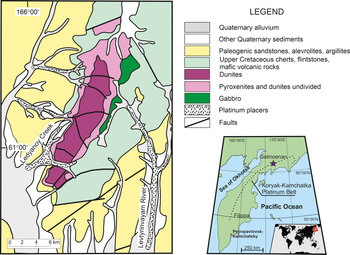
This paper describes the first Pt–Pb intermetallic phase – the new mineral kufahrite, PtPb, which has a synthetic analogue but has never been described previously in Nature. The new mineral was found during panning at the Ledyanoy Creek placer (61°00'N, 166°05'E) related to the Galmoenan Ural–Alaskan type ultramafic complex at the Koryak Highlands, Far East Russia (Fig. 1). Kufahrite (Cyrillic: куфарит) is named in honour of Fahrid Shakirovitch Kutyev (1943‒1993), a geologist from the Institute of Volcanology of USSR Academy of Sciences, who played a key role in the discovery of the Koryak–Kamchatka platinum belt, including the Ledyanoy placer platinum deposit where the new mineral has been discovered. The holotype material (polished section) is deposited in the Fersman Mineralogical Museum, Moscow, Russia, catalogue No. 5576/1.
The position and structure of the Galmoenan complex and Ledyanoy Creek placer. Modified from Astrakhantsev et al. (Reference Astrakhantsev, Batanova and Perfil'ev1991).

The mineral and its name have been approved by the International Mineralogical Association Commission on New Minerals, Nomenclature and Classification (IMA2020-045, Sidorov et al., Reference Sidorov, Kutyrev, Zhitova, Agakhanov, Sandimirova, Vymazalova and Chubarov2020).
Occurrence
Kufahrite was found in the heavy-mineral concentrate from Ledyanoy Creek placer, related to the Galmoenan Ural–Alaskan type ultramafic complex, located in the Koryak Highlands, Far East Russia (Fig. 1). Ledyanoy Creek placer together with Levtyrinvayam Creek placer produced more than 60 metric tons of platinum during 1994–2012 (Nazimova et al., Reference Nazimova, Zaytsev and Petrov2011; Sidorov et al., Reference Sidorov, Kozlov and Tolstykh2012), which makes them one of the largest platinum-group mineral (PGM) placers worldwide. The Galmoenan complex comprises a dunite core surrounded by a rim grading outwards of wehrlite, clinopyroxenite and gabbro units, which is typical of the Ural–Alaskan type (Fig. 1, Astrakhantsev et al., Reference Astrakhantsev, Batanova and Perfil'ev1991; Batanova et al., Reference Batanova and Astrakhantsev1994, Reference Batanova, Pertsev, Kamenetsky, Ariskin, Mochalov and Sobolev2005). The majority of the platinum is concentrated in chromitites, located at the dunite unit of the complex (Mochalov and Bortnikov, Reference Mochalov and Bortnikov2008; Nazimova et al., Reference Nazimova, Zaytsev and Petrov2011; Sidorov et al., Reference Sidorov, Kozlov and Tolstykh2012). The prevailing PGM is isoferroplatinum Pt3Fe, associated with native osmium, native iridium, tetraferroplatinum PtFe, tulameenite Pt2FeCu, laurite RuS2, irarsite IrAsS, and numerous less abundant minerals (Tolstykh et al., Reference Tolstykh, Sidorov and Kozlov2004; Sidorov et al., Reference Sidorov, Kozlov and Tolstykh2012). Ledyanoy Creek placer is located at the south-western margin of the Galmoenan complex, in close proximity of the dunite outcrops (Fig. 1). The placer assemblage is nearly identical to those of the lode chromitites, giving evidence of the latter being the primary source of the PGM (Tolstykh et al., Reference Tolstykh, Sidorov and Kozlov2004).
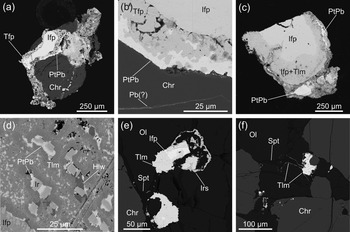
Kufahrite occurs as a constituent of tetraferroplatinum and tulameenite rims after isoferroplatinum (Fig. 2a–d). In one case, it together with hollingworthite overgrowths native iridium crystals enclosed in the tulameenite rim over isoferroplatinum (Fig. 2d). The width of kufahrite rims or size of its grains normally does not exceed 10 μm (Fig. 2a,b,d), and only one grain 150 ×100 μm was observed (Fig. 2c). Along with the minerals listed above, kufahrite is associated with Cr-rich spinel, native iridium and hollingworthite (Fig. 2a–d). A similar mineral assemblage is present in the partly serpentinised chromitites of the Galmoenan complex (Fig. 2e,f).
Kufahrite (PtPb) and associated minerals from Ledyanoy Creek placer. (a) Thin rim of kufahrite and tetraferroplatinum (Tfp) over isoferroplatinum (Ifp) at the contact with chromite (Chr); (b) close-up of Fig. 1a; (c) relatively large kufahrite grain associated with isoferroplatinum and tulameenite (Tlm), holotype material sample No 5576/1 stored in the Fersman Mineralogical Museum; (d) intergrowths of kufahrite and hollingworthite (Hlw) with native iridium (Ir) as inclusions in metasomatic tulameenite rim over isoferroplatinum; (e, f) polished samples from the Galmoenan complex which represent the textural position of minerals analogous to those coexisting with kufahrite, note that tulameenite and irarsite (Irs) fringe the walls of serpentine veinlets, indicating late origin of these PGM. Polished section, back-scattered electron images.

Physical and optical properties
Kufahrite is opaque and has a metallic lustre. Its colour is white; streak was not observed because of the tiny size of the grains and paucity of material. Micro-indentation measurements yielded a mean value of 295 kg/mm2 (VHN range: 262–320, n = 5), which corresponds to a Mohs hardness of 4. The mineral is malleable, and other physical properties, such as cleavage, parting and fracture, were not observed. Its density could not be measured due to the small grain size and their occurrence in intergrowths with isoferroplatinum, tulameenite and other minerals (Fig. 2). The mineral density, calculated using the unit-cell dimensions, is 14.80 g/cm–3.
The optical properties of kufahrite in reflected light are as follows: white colour, strong bireflectance, ΔR = 5.03% (589 nm); pleochroism is weak, from white to greyish-white; anisotropy is moderate, rotation tints vary from light brown to grey, and internal reflections are not observed. Reflectance values, measured in air with SiC reference material, are listed in Table 1 and plotted in Fig. 3.
Reflectance data for kufahrite in air. Blue line – R max and orange line – R min.


Chemical composition
Electron microprobe analyses (n = 23) were obtained in EDS mode (15 kV accelerating voltage and 0.7 nA beam current with beam diameter 0.2 nm) using a Tescan Vega-3 electron microscope equipped with an Oxford X-Max 80 detector and gave contents of Pt, Pb, Sb and Rh (Tables 2, 3). The contents of other elements with an atomic number higher than carbon are below detection limits. The contents of Sb and Rh are below the limits of detection in some grains, but may reach 3.69 and 12.84 wt.% respectively in the others. The empirical formula calculated on the basis of 2 atoms per formula unit is: (Pt0.94Rh0.04)Σ0.98(Pb0.83Sb0.19)Σ1.02. The simplified formula is Pt(Pb,Sb). The ideal composition is PtPb, which requires Pt 48.49, Pb 51.51, total 100 wt.%. There is a linear negative correlation between Pb and Sb content in kufahrite (Fig. 4) indicating that these elements occur at one crystallographic site.
Element correlation for kufahrite. Note the excellent (R 2 = 0.99) Pb vs. Sb and good (R 2 = 0.84) Pt vs. Rh negative correlations that point to Pb and Sb occurring at one crystallographic site, while Pt and Ru occupy the other site.

Chemical data (in wt.%) (n = 23) for kufahrite

S.D. – standard deviation; b.d.l. – below detection limit
Powder X-ray diffraction data for kufahrite and its synthetic analogue.

* JCPDS-ICDD database, card # 01-077-3195. The strongest lines are given in bold. Note: synthetic PtPb was prepared by smelting of lead and platinum (99.9 wt.%) in a resistance oven (Zhuravlev et al., Reference Zhuravlev, Zhdanov and Smirnova1962).
** The difference of intensities between measured and calculated powder patterns for 110 and 312 reflections can be caused by the fact that a solid grain has been used coupled with the geometry of the diffractometer which imply rotation around the ω axis. These two factors can cause a textured effect on the sample and changes in measured reflection intensities.
Crystal structure
The structure refinement based on single-crystal X-ray diffraction data could not be carried out because of the absence of a crystal of suitable quality and general paucity of available material. The data were collected from one available grain (~70 μm) extracted from the polished block (Fig. 2c) that has been previously analysed by electron-microprobe analyses. The grain has been examined for full data collection in the air at room temperature using a Bruker SMART APEX single-crystal diffractometer operated at 50 kV, 40 mA and equipped with a CCD area detector and graphite-monochromated MoKα radiation (MoKα, λ = 0.71073 Å). Later the same crystal was subjected to full data collection by a more powerful machine – Bruker Apex II Duo diractometer (MoKα radiation) operated at 50 kV, 40 mA and equipped with a CCD area detector. The intensity data were reduced and corrected for Lorentz, polarisation and background effects using Bruker software Apex2 (Bruker AXS, 2014). The data analyses showed that only ~15% of reflections can be indexed within the following unit cell (showing the best match): symmetry hexagonal, a = 4.209(3) Å, c = 5.476(13) Å, V = 84.0(2) Å3 because the studied grain represents a multicomponent twin. In both cases the data allowed only an estimation of the unit-cell parameters without any further satisfactory data procession. Poor data quality is also partly due to high absorbency of Pb. The reciprocal space slices (obtained by processing the data using CrysAlis PRO, Agilent Technologies, 2014) reconstructed for data processed using the aforementioned unit cell are shown in Fig. 5 from which it is evident that reflections that do not suit the unit cell occur randomly excluding their appearance due to a superstructure.
Slices of reciprocal space of kufahrite.

Powder X-ray diffraction (XRD) data were collected with a Rigaku R-axis Rapid II diffractometer (Debye–Scherrer geometry, d = 127.4 mm) equipped with a rotating anode X-ray source (CoKα, λ = 1.79021 Å) and a curved image plate detector. The data were collected for 600 seconds from the same small grain (~70 μm) extracted from the polished block (Fig. 2c) that was analysed previously by electron-microprobe analyses. The same grain as used for single-crystal X-ray diffraction was studied with no additional treatment. The data were recorded from the grain rotating around the ω axis. The data were integrated using the software package Osc2Tab/SQRay (Britvin et al., Reference Britvin, Dolivo-Dobrovolsky and Krzhizhanovskaya2017). The obtained powder XRD pattern (Fig. 6) of kufahrite is very close to that reported in the JCPDS-ICDD database, # 01-077-3195 (powder diffraction files from the International Centre for Diffraction Data, https://www.icdd.com/), which corresponds to the synthetic phase PtPb (Zhuravlev et al., Reference Zhuravlev, Zhdanov and Smirnova1962). Table 3 represents a comparison of the powder X-ray diffraction pattern of a grain of kufahrite and synthetic PtPb. As it is evident from the table, both powder patterns show a satisfactory agreement in reflection positions and intensities. Nevertheless, due to the paucity of available material, the kufahrite diffraction pattern is characterised by considerable low intensities.
Experimentally obtained powder XRD pattern with indexed reflections that belong to kufahrite.

The crystal structure of kufahrite was impossible to refine using (1) single-crystal or (2) powder X-ray diffraction data due to (1) absence of single crystals and (2) paucity of available material, low reflection intensities and the fact that atoms are located in the special positions (see below). The crystal structure of the PtPb synthetic compound was described by Zhuravlev et al. (Reference Zhuravlev, Zhdanov and Smirnova1962), and has the NiAs structure type (Fig. 7a). In the NiAs structure type both atoms occupy special positions: Ni (0, 0, 0) (denoted here as the A site) and As (⅓, ⅔, ¼) (denoted here as the B site). The A site is octahedrally coordinated, whereas the B site is located within trigonal prism (Fig. 7b,c). In our case, the experimentally obtained powder pattern has been indexed in the P63/mmc space group using the structure data for the synthetic PtPb compound (Fig. 6, Table 3) and showed good agreement in reflection positions and intensities. It is worth noting that the NiAs structure type is widespread for minerals of the nickeline group to which kufahrite belongs. Experimental data do not allow distinguishing whether Pt and Pb are ordered or disordered in the A and B sites of the crystal structure. This is because the crystal chemical formulas of ordered (Pt0.95Rh0.05)(Pb0.80Sb0.20) (A site = 76 electrons per formula unit and B site = 76 epfu) and disordered, e.g. (Pt0.6Pb0.3Sb0.1)(Pb0.5Pt0.4Sb0.1) (A site = 76 epfu and B site = 77 epfu) modifications are nearly identical in the number of electrons, though the low intensity of reflections does not allow the scattering power to be determined with high accuracy. A rough comparison of observed and calculated powder diffraction data taken from a model with different occupation on the A and B sites shows agreement with the experimental chemical formula. At the same time, the chemical data allow clear discrimination of the phase under study from the approved mineral species. The modelling of theoretical powder diffraction patterns using the Vesta program (Momma and Izumi, Reference Momma and Izumi2011) showed that different variants in the site occupancies (calculated for modifications with different distribution of Pb, Sb, Pt and Rh using aforementioned occupancies) do not lead to significant changes in the intensity of reflections (Supplementary Table S1, see below).
The NiAs structure type (a); the octahedral coordination of the A site (b); and site B located in a trigonal prism (c).

The chemical data show a negative linear correlation between Pb and Sb content (Fig. 4), such a correlation is absent for Pt and Sb (Fig. 4b), whereas Pt shows some correlation with Rh (Fig. 4c). It is worth noting that the experimental work of Zhuravlev and co-authors (Reference Zhuravlev, Zhdanov and Smirnova1962) has shown the existence of a solid-solution series for PtBi–PtSb and PtBi–PtPb, which indicates the potential substitution of Pb by Sb. Considering all of the above, we can assume that Pb and Sb occur at one crystallographic site, while Pt and Rh occupy another crystallographic site. Moreover, Pb has been reported as an admixture in stumpflite PtSb (Melcher and Lodziak, Reference Melcher and Lodziak2007) which also indirectly confirms the presence of solid solutions series PtPb–PtSb. By analogy with other nickeline-group minerals, we can suggest that for kufahrite Pt (and possibly Rh admixture) occurs at the A site, whereas the Pb and Sb admixture occupies the B site (Fig. 7). This is evident by the fact that for other nickeline-group minerals with the NiAs structure type (1) Pt is found in the A site for stumpflite and (2) Sb occurs in the B site for stumpflite, sudburyite and breithauptite. The comparison of the strongest lines in the powder XRD pattern for kufahrite, its synthetic analogue, stumpflite and sudburyite are shown in Table 4.
Comparative data of kufahrite, its synthetic analogue, and closely related nickeline-group minerals: stumpflite and sudburyite.

*JCPDS-ICDD database, card # 01-077-3195; **JCPDS-ICDD database, card # 00-025-1482; ***JCPDS-ICDD database, card # 00-026-0888.
Relation to other species
Kufahrite fits the 2.CC group according to the Nickel and Strunz classification and the nickeline group of Dana Classification (02.08.11). The new mineral is the natural analogue of synthetic PtPb (Zhuravlev et al., Reference Zhuravlev, Zhdanov and Smirnova1962). Kufahrite is also chemically related and isotypic to such nickeline-group minerals as stumpflite, PtSb, (Johan and Picot, Reference Johan and Picot1972) and sudburyite, PdSb, (Cabri and Laflamme, Reference Cabri and Laflamme1974). The comparison of kufahrite, synthetic PtPb, stumpflite and sudburyite is given in Table 4. No mineral close to kufahrite is present in the lists of both valid and invalid unnamed species.
Genetic implications
Kufahrite has been found as a part of tetraferroplatinum and tulameenite rims after isoferroplatinum (Fig. 2). The origin of tetraferroplatinum and tulameenite rims has been assigned previously to relatively low-temperature alteration processes, which occurred under relatively low  $f_{{\rm S}_ 2}$ (Nixon et al., Reference Nixon, Cabri and Laflamme1990; Cabri and Genkin, Reference Cabri and Genkin1991; Tolstykh et al., Reference Tolstykh, Sidorov and Kozlov2004, Reference Tolstykh, Telegin and Kozlov2011, Reference Tolstykh, Kozlov and Telegin2015; O'Driscoll and González-Jiménez Reference O'Driscoll, González-Jiménez, Harvey and Day2016). The main evidence for this conclusion are: (1) the occurrence of both tetraferroplatinum and tulameenite as rims over isoferroplatinum grains (Fig. 2; Nixon et al., Reference Nixon, Cabri and Laflamme1990; Tolstykh et al., Reference Tolstykh, Sidorov and Kozlov2004, Reference Tolstykh, Kozlov and Telegin2015; Stepanov et al., Reference Stepanov, Palamarchuk, Kozlov, Khanin, Varlamov and Kiseleva2019, Reference Stepanov, Palamarchuk, Antonov, Kozlov, Valrlamov, Khanin and Zolotarev2020); and (2) the presence of these minerals as separate phases in serpentine veinlets (Fig. 2e,f); and (3) experimental studies which proved the possibility of formation of Pt–Fe alloys under hydrothermal conditions (Evstigneeva and Tarkian, Reference Evstigneeva and Tarkian1996). Usually, such reduced hydrothermal conditions are assigned to be a result of a serpentinisation process. Therefore, the possible temperature of kufahrite formation estimated as the temperature of dunite serpentinisation should be below 450°C (Fruh-Green et al., Reference Früh-Green, Connolly, Plas, Kelley and Grobéty2004; Klein and Bach, Reference Klein and Bach2009; Evans et al., Reference Evans, Hattori and Baronnet2013), or even less than 350°C according to other estimations (Popov et al., Reference Popov, Bazylev and Shcherbakov2006).
As stumpflite PtSb and numerous Pd–Pb alloys are related to kufahrite in terms of either crystal structure or composition, it would be fruitful to compare the conditions of their formation with those proposed for kufahrite. Stumpflite was been described in the dunite pipe Driekop, one of the several zoned dunite pipes crosscutting the layered sequence of the Bushveld complex (Johan and Picot, Reference Johan and Picot1972). Subsequent studies revealed that this mineral, together with the whole assemblage of Pt–Pd–Sb–Bi–Te–Sn minerals, belong to the latter low-temperature hydrothermal stage (Rudashevsky et al., Reference Rudashevsky, Avdontsev and Dneprovskaya1992; Melcher and Lodziak, Reference Melcher and Lodziak2007). In Ural–Alaskan type complexes, stumpflite is an exceptionally rare mineral. The only available description is of those from the Filippa complex, Kamchatka, where it occurs as a part of metasomatic sperrylite rim after isoferroplatinum (Sidorov et al., Reference Sidorov, Tolstykh, Podlipsky and Pakhomov2004). Therefore, stumpflite of both layered intrusions and Ural–Alaskan type complexes may be assigned to the post-magmatic overprint in the same way that was proposed for kufahrite.
Palladium–lead alloys are also the minerals with an affinity to layered intrusions (e.g. Cabri, Reference Cabri and Cabri2002). The most common of them, zvyagentsevite Pd3Pb and plumbopalladinite Pd3Pb2, were first reported in the deposits of the Norilsk group, where their origin has been assigned to post-magmatic processes (e.g. Spiridonov et al., Reference Spiridonov, Kulagov, Serova, Kulikova, Korotaeva, Sereda, Tushentsova, Belyakov and Zhukov2015). The only description of Pd–Pb minerals in Ural–Alaskan type complexes is those of zvyagentsevite in the altered parts of isoferroplatinum grains of the Veresovoborsky Complex, Urals (Stepanov et al., Reference Stepanov, Palamarchuk, Antonov, Kozlov, Valrlamov, Khanin and Zolotarev2020). Here its textural position and assemblage irrefutably points towards post-magmatic origin.
Summarising the above, kufahrite, its Sb counterpart stumpflite and Pd–Pb alloys all are the result of post-magmatic processes probably formed from hydrous fluids. Kufahrite extends the wide group of PGE minerals for which hydrothermal origin have been proven.
Acknowledgements
We are thankful to Anatoly Kasatkin for his recommendations and fruitful discussion. Members of the CNMNC are greatly acknowledged for their advice and critical remarks during the preparation of the new mineral submission form. This work was largely supported by RFBR grant #20-05-00290. The XRD data were collected using the XRD Resource Center of St. Petersburg State University. Finally, we thank Louis J. Cabri, František Laufek and three anonymous reviewers for their suggestions and Associate Editor Oleg Siidra and Principal Editor Stuart Mills for the manuscript handling.
Supplementary material
To view supplementary material for this article, please visit https://doi.org/10.1180/mgm.2021.18