INTRODUCTION
Phenotypic plasticity occurs when a single genotype gives rise to different phenotypes depending on the environmental condition, and in some cases, the reaction of a genotype to the environment may be adaptive (Schlichting and Pigliucci, Reference Schlichting and Pigliucci1998; Pigliucci, Reference Pigliucci2001). This phenomenon is not unique to free-living organisms; parasites can also exhibit phenotypic plasticity in various parasite traits (Thomas et al. Reference Thomas, Brown, Sukhdeo and Renaud2002; Reece et al. Reference Reece, Ramiro and Nussey2009; Wolinska and King, Reference Wolinska and King2009; Mideo and Reece, Reference Mideo and Reece2012). Vizoso and Ebert (Reference Vizoso and Ebert2005) found that certain parasites life history traits responded plastically to the mode of transmission (vertical vs horizontal). Similarly, Poulin (Reference Poulin2003) experimentally demonstrated that a trematode parasite of fish, which uses a crustacean intermediate host for transmission, exhibited plasticity in development and transmission strategies in response to variability in crustacean mortality rates and fish availability. Other studies have shown that environmental variation can influence various parasite traits, including parasite transmission strategy (Buckling et al. Reference Buckling, Taylor, Carlton and Read1997; Kaltz and Koella, Reference Kaltz and Koella2003; Restif and Kaltz, Reference Restif and Kaltz2006) and virulence (Bedhomme et al. Reference Bedhomme, Agnew, Sidobre and Michalakis2004; Tseng, Reference Tseng2006; Brown et al. Reference Brown, Cornforth and Mideo2012). Intraspecific variation in parasitic life history traits could be linked to a parasite's ability to perceive environmental variables and respond accordingly to maximize their fitness (Taylor et al. Reference Taylor, Day, Nagy, Wild, Andre and Gardner2006; Poulin, Reference Poulin2007; Reece et al. Reference Reece, Ramiro and Nussey2009). Yet disease models often classify species simply as parasitic or non-parasitic, even as levels of host exploitation can vary continuously in nature. Phenotypic plasticity may provide a mechanism by which the relationship between interacting species can be dynamic, shifting along a continuum from free-living to parasitic (Agrawal, Reference Agrawal2001; Fordyce, Reference Fordyce2006).
Phenotypic plasticity may also arise from differences in the internal state of an organism (Houston and McNamara, Reference Houston and McNamara1992, Reference Houston and McNamara1999). These conditions may include age, physiological state, nutritional status, reproductive status, etc. One explanation for individual variation in plasticity is that individuals differ intrinsically in the benefits they derive from state-dependent plasticity. For example, individuals may differ in their energetic and metabolic state, which in turn affects the net benefit of a particular foraging strategy (Mathot and Dall, Reference Mathot and Dall2013; Sih et al. Reference Sih, Mathot, Moiron, Montiglio, Wolf and Dingemanse2015). State-dependent behaviour could also be applied to parasites, such that individual differences in state can influence its infection strategy. Host-finding behaviour can be viewed as analogous to the foraging behaviour of free-living consumers. In some parasitic taxa such as nematodes, trematodes and arthropods, free-living infective stages are able to actively seek out a host. The host-finding behaviour is likely adaptive as it impacts the probability of successful infection and hence parasite fitness. Fenton and Rands (Reference Fenton and Rands2004) proposed a state-dependent model in which a parasite's infection behaviour could be predicted by the parasite's energy reserve.
The host is without a doubt also part of the parasite's environment, and host state (e.g. age, body size, immune status, endocrine state, general vigour, infection history, etc.) is therefore likely to influence a parasite's latency to infect or decision to infect at all (Thomas et al. Reference Thomas, Brown, Sukhdeo and Renaud2002; Reece et al. Reference Reece, Ramiro and Nussey2009; Cornet et al. Reference Cornet, Bichet, Larcombe, Faivre and Sorci2014). For instance, some parasites have been shown to preferentially infect larger hosts, presumably because larger hosts provide more resources and space for establishment, growth and reproduction (Valera et al. Reference Valera, Hoi, Darolova and Kristofik2004; Harrison et al. Reference Harrison, Scatlebury and Montgomery2010; Campbell and Luong, Reference Campbell and Luong2016). The presence of other parasites in or on the host may have negative (e.g. increased competition) or positive (e.g. facilitate cooperation, increase mating opportunities) consequences for the parasite (Thomas et al. Reference Thomas, Brown, Sukhdeo and Renaud2002). The presence of conspecifics may be adaptive if it increases the chance of finding and successfully establishing in a susceptible host, but the outcome may be outweighed by costs associated with increased within-host competition.
Facultative parasites serve as ideal model systems for investigating phenotypic plasticity, specifically in the form of state-dependent infectivity because individuals can exhibit two life history strategies (free-living or parasitic) depending on the environmental conditions (Tseng, Reference Tseng2006; Reece et al. Reference Reece, Ramiro and Nussey2009; Wolinska and King, Reference Wolinska and King2009; Mideo and Reece, Reference Mideo and Reece2012; Stasiuk et al. Reference Stasiuk, Scott and Grant2012). The facultative, ectoparasitic mite Macrocheles subbadius Berlese (Acari: Macrochelidae) has an aggregated distribution within natural populations of Drosophila nigrospiracula Patterson and Wheeler (Diptera: Drosophilidae) (Polak and Markow, Reference Polak and Markow1995). Adult female mites opportunistically infect adult fruit flies, relying on the host to move between patchy resources (i.e. phoresy) while feeding on the haemolymph (Polak and Markow, Reference Polak and Markow1995; Polak, Reference Polak1996). Since the mites live in ephemeral habitats, the decision to disperse is not one of if but when, which will in turn depend on the relative costs and benefits of remaining on a transient resource. We hypothesize that the decision to remain free-living or to parasitize a host, will depend importantly on the mite's internal state and the condition of available hosts.
Here, we experimentally investigate the role of mite starvation and mating status on the propensity to parasitize a host. Mites under nutritional stress may be more motivated to infect a host that provides nutrients and transport to a potentially better habitat. Mites may also benefit from delaying parasitism if the transient habitat is presently rich in resources, especially if dispersal is costly (Bonte et al. Reference Bonte, Van Dyck, Bullock, Coulon, Delgado, Gibbs, Lehouck, Matthysen, Mustin, Saastamoinen, Schtickzelle, Stevens, Vandewoestijne, Baguette, Barton, Benton, Chaput-Bardy, Clobert, Dytham, Hovestadt, Meier, Palmer, Turlure and Travis2012). Among macrochelid mites, it is thought that mated, non-reproductive females serve as the phoretic stage (Farish and Axtell, Reference Farish and Axtell1971; Walter and Proctor, Reference Walter and Proctor2013), so we would expect mite mating status to also influence rate of host attachment (i.e. infectivity). We also tested for preference of hosts based on the presence and/or number of mites already on a host. Finally, we examined whether mites preferred experimentally injured flies relative to uninjured flies. An injured fly may be easier to attack and successfully infect in the same way that predators specifically target weakened or injured animals (Stankowich, Reference Stankowich2003; Genovart et al. Reference Genovart, Negre, Tavecchia, Bistuer, Parpal and Oro2010). Alternatively, mites may avoid injured flies if injury compromises the host's ability to disperse.
MATERIALS AND METHODS
Study system
The ectoparasitic mite, M. subbadius (Acari: Macrochelidae) is a naturally occurring facultative ectoparasite of the fly species D. nigrospiracula (Diptera: Drosophilidae) and is found at necrotic cacti in the Sonoran Desert. Mites (n = 200–300 adult females) were collected in the field from infected flies at necrotic saguaro cacti in the Sonoran Desert (Phoenix, Arizona, USA). Natural levels of infection vary with the age of necrosis in the cactus, ranging from 0·05 to 1·28 mites per fly, and intensities as high as 7·8 mites per fly (Polak and Markow, Reference Polak and Markow1995). These mites were used to establish a laboratory culture in 2015 by removing the mites from infected flies and mass culturing the mites at standard laboratory light and temperature (12 h light, 25 °C: 12 h dark, 24 °C, 70% RH). Mite cultures were maintained in the laboratory for ~48 generations before commencing experiments, in 4 L tubs containing artificial media that consists of wheat bran and wood shavings, as well as nematodes as a food source. A nematode-only media was also maintained in a similar wheat bran–wood shaving mixture. The D. nigrospiracula that had mites removed were combined with uninfected flies to create a laboratory population. These flies (n ~ 120 adults per sex per generation) were cultured in media consisting of potato spuds (Idahoan Foods®, Idaho Falls, Idaho, USA), active yeast (Fleischmann's®, Memphis, Tennessee, USA), drosophila instant (Formula 4–24 Instant Drosophila Medium, Carolina Biological Supply Company, Burlington, North Carolina, USA), and a small amount of autoclaved necrotic cactus. Flies were maintained in a separate incubator from the mites under similar conditions (12 h light, 25 °C: 12 h dark, 24 °C, 70% RH) for 14–16 generations before starting the experiments.
Parasite state-dependent infection
Starvation: Putative female mites at the deutonymph stage (n ~ 20) were collected from the mass culture and transferred to a container (90 mL cup with a ventilated lid) containing 1·5 g of the nematode media. After 24 h, mature mites could be verified for sex; unmated female mites were transferred to individual containers containing media and maintained for an additional 3 days. Individual mites were then transferred to separate containers lined with moist paper towels, but no media (no food). Preliminary trials revealed that mites starved for up to 7 or 8 days suffered high mortality rates. For the experiment, we subjected mites to 0, 1, 3 and 5 days of starvation before being assayed for infection. Mites were individually transferred into infection chambers constructed from modified 200 µL pipette tips (truncated and stoppered with cotton) to produce a restricted environment for the mite to infect the fly. Host susceptibility is based primarily on variation in behavioural resistance, which consists of bursts of flight and reflex movements to avoid contact by mites, followed by tarsal flicking and vigorous grooming to prevent mites from successfully attaching (Luong et al. Reference Luong, Heath and Polak2007). By restraining the flies, we ensure that any variation in infection is not due to difference in behavioural resistance. A single adult female fly was anaesthetized with carbon dioxide (CO2) and placed inside the infection chamber. After 2 h, the flies and mites were scored for attachment (i.e. infection). This experiment was completed over time in 11 replicate blocks, with each starvation level represented in each block (n = 11 per level).
Mating status: Female deutonymphs were collected from the mass culture and randomly assigned to either the ‘virgin’ or ‘mated’ group. Virgin, unmated females (n = 34) were established by placing a single female deutonymph mite in a pipette tip alone. Note: unmated females in this study are comparable with the females (subject to 0 days of starvation) in the starvation study as they were also unmated. Mated mites (n = 34) were generated by placing a single female deutonymph in a pipette tip with two adult male mites. The ends of the pipette tips were stoppered with moistened cotton and left undisturbed for 24 h in the incubator. To check that female mites actually mated with the males, we maintained a subgroup of females and examined their progeny. Macrocheles subbadius mites are arrhenotokous, and thus only produce female offspring if the eggs are fertilized (Filipponi, Reference Filipponi and Evans1964). Mites were then transferred to individual plastic 90 mL containers with 1·5 g of nematode media. After an additional 48 h, mites were assayed to determine infectivity. Mites were individually transferred into infection chambers (pipette tips described above). A single adult female fly was lightly anaesthetized with CO2 and placed inside the infection chamber. After 2 h, the flies and mites were scored for attachment (i.e. infection).
Preference for infected flies
Female mites at the deutonymph stage (n = 20) and adult male mites (n = 20) were collected from the main culture containers and transferred into a small sample container with ~15 cc of media containing only bacteriophagic nematodes. Mites were allowed to mature and mate for 40–48 h before commencing the experiment. On the day of the trial, surviving female mites were removed from the containers and transferred to an infection chamber (modified pipette tip) containing a single adult female fly to generate the ‘infected’ group. We controlled for preferential attachment based on host sex and size by size matching female flies within 0·05 mg (Campbell and Luong, Reference Campbell and Luong2016). Flies were anaesthetized using CO2 and weighed (Mettler Toledo™ XP105). These flies were then immobilized by gluing (Elmer's Rubber Cement) a small piece of cotton to the very distal (and slightly dorsal) portion of the abdomen. Flies were allowed 1 h to recover from the anaesthesia before transferring to an infection chamber containing five mites; attached cotton served as the stopper. The infection chambers were monitored up to until (maximum 60 min) the appropriate number of mites had attached: 1, 2 or 3 mites per fly. Concurrently, uninfected flies were also glued to cotton stoppers and placed in similar infection chambers without mites. Since the number of infecting mites and the rate of infection varied in each trial, this procedure was replicated until we achieved a total of 40 replicate choice tests per treatment group.
Infected flies carrying either 1, 2 or 3 mites (which reflect natural levels of infection) were paired with an uninfected fly and transferred to a Y-maze. Since flies were still attached to the cotton, the flies were inserted into the terminal end of the Y-maze, with the cotton acting as the stopper (Y-connector for 6 mm ID tubing, Cole-Parmer, Canada). Within each pairwise choice test, placement of the infected and uninfected flies alternated between the left and right arms of the Y-maze, which was rinsed with 70% ethanol and air dried in between each use. A single mature female mite was then transferred to the bottom arm of the Y-maze, which was also stoppered with cotton. The Y-mazes were then set aside, loosely covered and left undisturbed for 60 min. At this time, the flies were removed and inspected for attached mites under a stereomicroscope.
An additional choice test was performed to control for the possibility that intrinsically attractive flies simply accumulate more mites at the onset of the trial, irrespective of the number of mites attached. If mites prefer hosts simply because of some intrinsic factor, then the removal of mites from previously preferred hosts should not alter the outcome of the choice test. Mature female mites (established in the same manner as above) were given the choice between a naïve (unexposed, uninfected) fly and a previously infected fly that had mites removed prior to the choice test. Size-matched flies were anaesthetized, glued to cotton and placed in infection chambers using the same protocol as above. Naïve flies were not exposed to mites while ‘infected’ flies were each exposed to five mites for up to 60 min. Once all five mites had attached to a fly, the mites were immediately removed from the fly. To ensure that the fly was not damaged during the mite removal process, mites were squeezed with a fine-tipped forceps until they detached on their own. Naïve and previously infected flies were then transferred to a Y-maze chamber, alternating between the left and right arms of the chamber. A single mite was then placed in the open end of the Y-chamber, stoppered with cotton, and set aside for 60 min before being scored for mite attachment. A total of 24 pairwise choice tests were conducted.
Preference for injured flies
We tested whether mites preferred experimentally injured flies relative to uninjured flies. Mites use their mouthparts and chelicera to attach to and pierce the cuticle of flies, resulting in damage to host tissue (Polak, Reference Polak1996; Beresford and Sutcliffe, Reference Beresford and Sutcliffe2009). Adult female flies were randomly assigned either a control or injured category. Flies were weighed and size matched (as above) to the nearest 0·05 mg to ensure that size would not be a confounding factor. Flies in the treatment group were mechanically injured under light CO2 anaesthesia by gently scraping (4–5 mm) the cuticle on the most distal abdominal sternite with a sterilized insect pin (size 0). Flies in the control group were handled in similar manner except that they were not injured. We immobilized the flies by applying a small dab of rubber cement to the head and affixing it to a small piece of cotton. Flies were allowed 60 min to recover from the anaesthesia before commencing the paired choice tests (n = 30). A control and an injured fly were introduced to each of the arms of the Y-maze (order was random) followed by an adult female mite randomly chosen from the base laboratory culture. Mites were allowed 60 min to attach to a fly.
Data analysis
All data were analysed using the R statistical program (R Development Core Team, 2015). We analysed the starvation experiment using a generalized linear model with a binomial error; days of starvation and replicate block were the explanatory variables. Significance levels were based on drop in deviance following the removal of a factor, retaining a variable with P < 0·05 based on χ 2 statistic. The effect of mating status on infection was analysed with a two-sample test for equality of proportions with continuity correction (R, prop.test). All pairwise choice tests were analysed with an exact binomial test (R, binom.test).
RESULTS
State-dependent infection
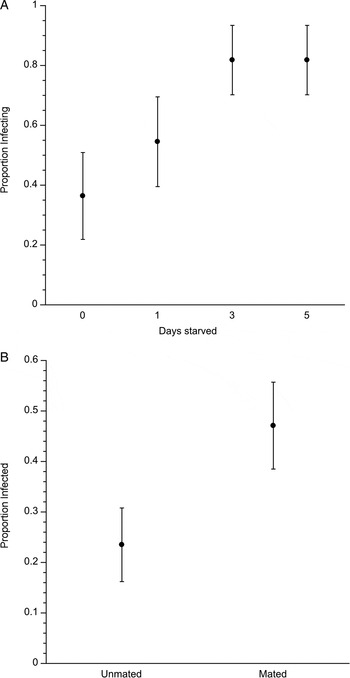
Starvation had a significant effect on whether a mite infected a host (deviance = −6·61, P = 0·01); replicate block was not significant (deviance = −1·39, P = 0·24). The proportion of mites infecting flies increased with days of starvation, eventually levelling off at 82·8% infection rate on days 3 and 5 (Fig. 1A). This represented a 2-fold increase in infection rate compared with control, unstarved mites.
(A) Proportion of Macrocheles subbadius mites infecting flies following 0, 1, 3 or 5 days of starvation; (B) effect of mating status on probability of infection. Bars represent ±1 s.e.

Mite mating status also had a significant impact on infection status (one-tailed prop.test, χ 2 = 3·16, P = 0·038). Mated female mites were twice as likely to infect flies than unmated female mites (Fig. 1B). Among the 34 mated female mites, 16 (47·1%) attached to a fly, whereas only 8 of the 34 virgin mites (23·5%) attached to a fly.
Preference for infected flies
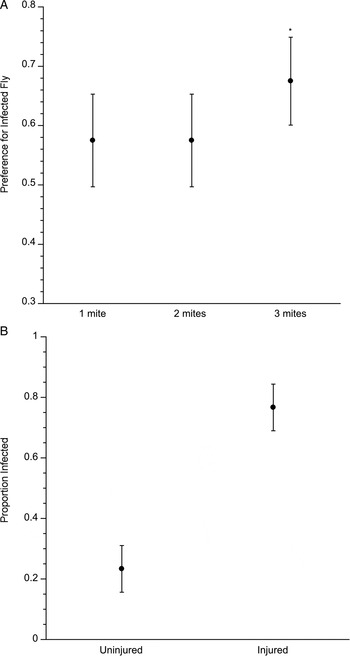
Overall, mites preferred infected hosts to uninfected hosts in 73 of the 120 trials (60·8%, binomial test, P = 0·022). The strongest indication of host preference was observed when uninfected flies were paired with flies infected with three mites. Infected host was chosen in 67·5% of the trials, which was significantly different than a 50 : 50 probability (Fig. 2A, binomial test, P = 0·038). At lower mite loads, the preference for infected hosts was 57·5% in both the one-mite and two-mite groups. However, neither of these proportions differed significantly from 50 : 50 (binomial test, P = 0·429 for both).
(A) Results of pairwise choice tests with an infected and uninfected fly. The infected fly had 1, 2 or 3 mites already attached. Response values above 0·5 indicate a preference by mites for infected flies over control flies; asterisk indicates significant (P < 0·05) deviance from a 50 : 50 probability of infection. (B) Proportion of flies infected based on injury status. Bars represent ±1 s.e.

In the control choice test, mites were presented with a choice between an uninfected, naïve fly and a fly previously infected with mites. A choice was made in 21 of the 24 trials: 11 (52·4%) mites selected the uninfected fly and 10 (47·6%) chose a previously infected fly. This lack of preference (binomial test, P = 1·0) suggests that differential attractiveness and/or behavioural resistance was not contributing to host preference by the mites.
Preference for injured flies
In injury experiment, an individual mite was presented with an uninjured fly and an injured fly in a paired choice test. Out of the 30 trials, 23 mites (76·7%) were found attached to the injured fly and 7 (23·3%) attached to the control fly (Fig. 2B). That is, the majority of the mites preferentially infected the injured fly over the uninjured fly (binomial test, P = 0·005).
DISCUSSION
In this study, we experimentally tested the hypothesis that phenotypic plasticity and more specifically state-dependent plasticity underlies the expression of infectivity in a facultative ectoparasite. Our results show that among individual differences in host-attachment behaviour were attributed to variation in the internal state of the parasite and the condition of the host. Mites subject to increasing levels of starvation exhibited a higher propensity to infect fly hosts. Indeed, theoretical state-dependent models predict that under certain circumstances, a parasite's infection strategy should depend on the parasite's energy reserve (Fenton and Rands, Reference Fenton and Rands2004). Infective stages with high-energy reserves are expected to adopt a more active host-finding strategy (‘cruising’) as opposed to a passive strategy (‘sit-and-wait’); the later would be favoured if energy reserves fall below some critical threshold (Fenton and Rands, Reference Fenton and Rands2004). Stasiuk et al. (Reference Stasiuk, Scott and Grant2012) also found that food availability influenced the life history strategy of a facultative parasite, Parastrongyloides trichosuri. They showed that as the concentration of food decreased, a larger proportion of larvae developed into infective L3 (parasitic) stages, i.e. switching from a free-living to parasitic strategy. Our study contributes to the growing body of literature (see reviews by Reece et al. Reference Reece, Ramiro and Nussey2009; Wolinska and King, Reference Wolinska and King2009; Brown et al. Reference Brown, Cornforth and Mideo2012; Mideo and Reece, Reference Mideo and Reece2012) on phenotypic plasticity in parasites by highlighting the importance of state-dependent plasticity for host-attachment behaviour, a key component of the parasite infection strategy.
Our results indicate that mating status also influenced infection decisions by the mite. Even though mated female mites were more likely to infect, nearly a quarter of the virgin mites assayed attached to a host. Indeed, mated or gravid female mites are usually considered the dispersal stage among Mesostigmata mites (Farish and Axtell, Reference Farish and Axtell1971). Our experimental design was imperfect in that at least two variables differed between treatments: perceived scarcity of males and mating status. However, increased perceived scarcity of males would be expected to motivate females to disperse, so this cannot account for the observation of higher infection rates among mated females. Alternatively, the presence of two males may be perceived as an increase in relative density, which may in turn increase the propensity to attach to flies. However, given that these mites normally live in high density, the presence of two additional conspecifics is unlikely to influence the decision to infect flies. Nevertheless, female mating status, mate availability and mite density are likely to interact in a complex manner in nature where each factor can vary over space and time. For example, natal dispersal whereby individuals leave their natal site before reproducing has been documented in other arthropod taxa (Powers and Aviles, Reference Powers and Aviles2003; Ruf et al. Reference Ruf, Dorn and Mazzi2011). It is possible that the propensity to infect increases with the age of the mite, which we controlled for in the mating status experiment but not in the starvation experiment. However, senescence is typically associated with a loss in vigour and that is more apt to decrease attachment success with age. Still, future studies should explicitly consider the potential role of mite age on infection behaviour.
The infection status of the host also played an important role in the tendency to infect; mites preferentially attached to flies that were already harbouring mites. The effect was weak at low mite loads (1–2 mites), but when the parasite density reached three mites per fly, mites were more likely to select the parasitized fly. These results are interesting because they suggest that the number of mites provides additional information, not just infected vs not infected. The more mites already attached, the stronger the passive cue, or the more valuable the social information about the quality of the fly. The control choice tests further confirmed that host choice was not driven by some intrinsic host trait alone. Once heavily infected flies were removed of mites, there was no detectable host preference. Mite attachment and the subsequent removal of mites in this experiment may have resulted in scaring or injury to the fly, which could in turn attract more mites. However, given that mites were attached ⩽60 min, there would not have been sufficient time to induce significant tissue damage and/or scaring. These results contrast those of the injury experiment in which mites showed a clear preference for flies that were mechanically injured. Future research should increase the duration of mite attachment to assess the role of mite-induced tissue damage on host preference. In general, injured hosts may be easier to attack and successfully infect in the same way that predators specifically target weakened or injured animals (Stankowich, Reference Stankowich2003; Genovart et al. Reference Genovart, Negre, Tavecchia, Bistuer, Parpal and Oro2010). Our results suggest that the decision to parasitize infected hosts is based in part on the presence of other mites. Moreover, density-dependent attachment rates could create an information cascade: the more mites attach, the more strongly subsequent mites are attracted.
Zhang (Reference Zhang1991) found that when larval velvet mites were given the choice between parasitized and unparasitized aphids, mites preferentially infected the parasitized aphid, resulting in higher infection intensities. Since the aphid hosts were not restrained during the choice tests, the authors could not distinguish if parasitized hosts were more vulnerable to attack or that mites and/or hosts were producing chemicals that could attract other conspecifics mites. The role of parasite selection for infected hosts could not be disentangled from host-generated variation in infection. In contrast, the hosts in our study were restrained, minimizing the role of differential behavioural resistance. The preference for infected hosts is most likely due to the presence of previously established mites. We do not yet understand the mechanism associated with host selection. Mites may be emitting an aggregation-attachment pheromone, presumably because aggregation has fitness benefits. Pheromones released from established ticks attract more conspecifics to already infected hosts (Hess and Decastro, Reference Hess and Decastro1986; Norval et al. Reference Norval, Andrew and Yunker1989). The authors suggest that the pheromones permit ticks to discriminate between suitable hosts on which parasites have fed successfully and potentially unsuitable hosts. Volatile compounds released from hosts as a result of damage to the cuticle (as in the case of the injury experiment) may also serve as attractants for other mites. In this case, the mites are simply using the volatile compounds as cues for host finding, and may not be showing preference for infected hosts per se.
Preferentially infecting a parasitized host can be an adaptive strategy, e.g. to avoid the Allee effect, overcome host resistance or facilitate feeding (see review by Wertheim et al. Reference Wertheim, van Baalen, Dicke and Vet2005). Individual ticks in the genus Ixodes exhibit enhanced feeding performance when feeding in aggregation on a host (Wang et al. Reference Wang, Hails, Cui and Nuttall2001; Van Oosten et al. Reference Van Oosten, Matthysen and Heylen2016). Small-bodied ectotherms such as M. subbadius have a relative high surface-area-to-volume ratio and are highly susceptible to desiccation (Harrison et al. Reference Harrison, Woods and Roberts2012; Dhooria, Reference Dhooria2016), aggregating on a host during dispersal could help reduce water loss. For instance, dust mites Dermatophagoides farinae reduce their risk of desiccation by forming groups (Glass et al. Reference Glass, Yoder and Needham1998). The mites in our study rely on fruit flies for dispersal between ephemeral habitats, so could potentially benefit from attaching to flies already carrying conspecifics because it ensures mate location upon arriving at a new habitat. Once female mites arrive in a new habitat, group living can facilitate mate finding and/or dilute the risk of predation for the founders as well as subsequent generations. These benefits of aggregation are particularly important in the early stages of colonization when a new population is establishing and mite density is relatively low. Mites are expected to preferentially parasitize infected hosts as long as the benefits outweigh the costs of sharing a host with many other conspecifics. Costs may arise as a result of density-dependent competition among mites (e.g. loss in nutrient acquisition) or parasite-mediated reduction in host dispersal resulting from tissue damage or other physiological costs (Luong et al. Reference Luong, Penoni, Horn and Polak2015). Further studies are needed to determine whether a trade-off exists, whereby the benefits of aggregation are outweighed by the costs.
State-dependent plasticity in host-attachment behaviour is likely adaptive for the mites given that they live on ephemeral habitats and rely principally on fly hosts for dispersal. Indeed, the central issue is not simply about the propensity to infect, but more importantly the timing. For many organisms that utilize ephemeral habitats (e.g. rotting cactus, compost, manure), the resources are abundant and density is relatively low at the time of colonization; but as population density builds and resources become strained over time, dispersal becomes increasingly critical. Still, dispersal can incur costs including increased mortality risks during transport or settling in an unsuitable habitat, while at the same time giving up the opportunity to reproduce in the natal habitat (Bonte et al. Reference Bonte, Van Dyck, Bullock, Coulon, Delgado, Gibbs, Lehouck, Matthysen, Mustin, Saastamoinen, Schtickzelle, Stevens, Vandewoestijne, Baguette, Barton, Benton, Chaput-Bardy, Clobert, Dytham, Hovestadt, Meier, Palmer, Turlure and Travis2012). When switching to a parasitic strategy, facultative parasites must weigh the cost of giving up a free-living lifestyle prematurely (while resources are still available) against the risks of delaying infection. The nature of these trade-offs will depend on the internal state (e.g. physiological state, nutritional status, reproductive status) of the facultative parasite. The decision to parasitize currently available hosts vs delaying infection will ultimately depend on a combination of factors, including the parasite's internal state, host condition and the external environment. Understanding when and why organisms become parasitic can have significant implications for predicting emerging diseases and potentially enable manipulation of the plastic responses with the goal of controlling infection and virulence. Phenotypic plasticity may also play an important role in facilitating evolutionary divergence and speciation (West-Eberhard, Reference West-Eberhard1989; Ghalambor et al. Reference Ghalambor, McKay, Carroll and Reznick2007), and perhaps the evolution of parasitism.
ACKNOWLEDGEMENTS
Thank you to Kimberley Mathot for providing helpful feedback on the manuscript. We also thank the two anonymous reviewers for their constructive comments and suggestions. Many thanks to C. Horn for collecting data for the injury experiment. We also thank the undergraduate students in our laboratory for maintaining the fly and mite cultures.
FINANCIAL SUPPORT
The project was funded by a Natural Sciences and Engineering Research Council of Canada, Discovery Grant (L.T.L., grant number 435245). S.J.C. was funded by the NSERC Undergraduate Student Research Award.